

Sample Category Title
EUR/AUD Daily Outlook
Daily Pivots: (S1) 1.5736; (P) 1.5786; (R1) 1.5842; More...
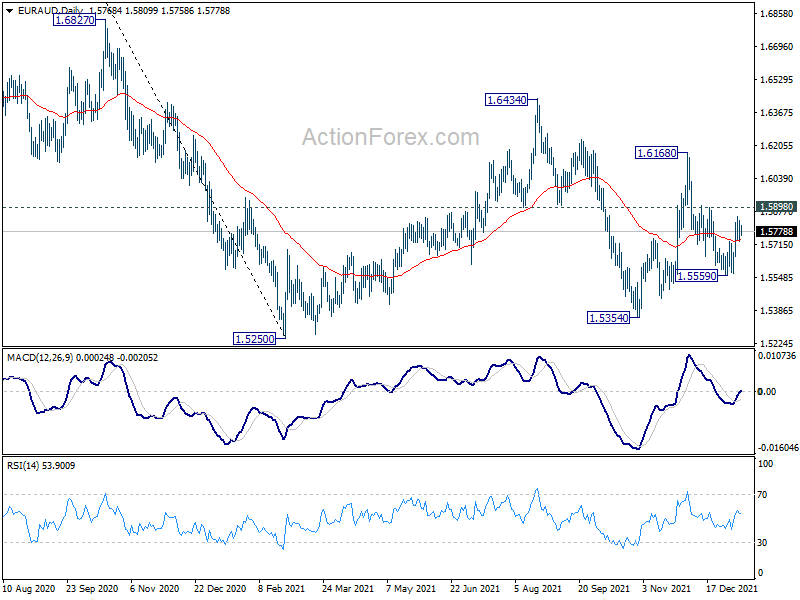
Intraday bias in EUR/AUD remains neutral and outlook is unchanged. On the downside, break of 1.5559 will resume the fall from 1.6168 to retest 1.5250/5354 support zone. On the upside, however, break of 1.5898 will argue that pull back form 1.6168 has completed. Intraday bias will be back to the upside for 1.6168 resistance.
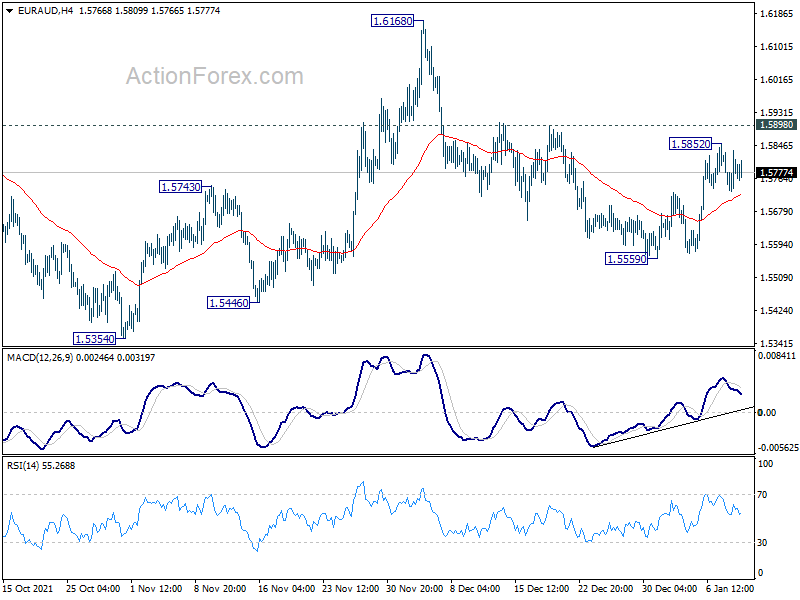
In the bigger picture, rise from 1.5354 is seen as the third leg of the corrective pattern from 1.5250 low. Further rise cannot be ruled out, but even in that case, strong resistance should be seen at 38.2% retracement of 1.9799 to 1.5250 at 1.6988. Larger down trend from 1.9799 is in favor to extend through 1.5250 at a later stage.
EUR/CHF Daily Outlook
Daily Pivots: (S1) 1.0451; (P) 1.0478; (R1) 1.0531; More....
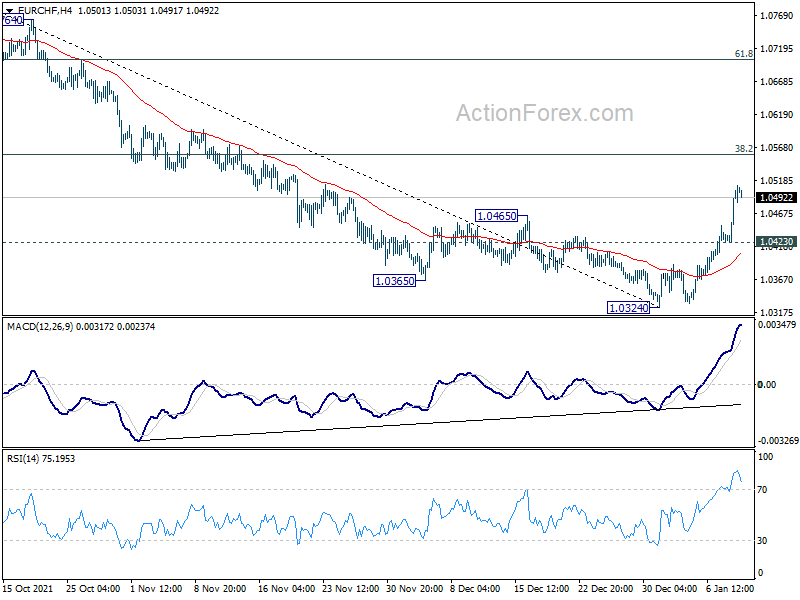
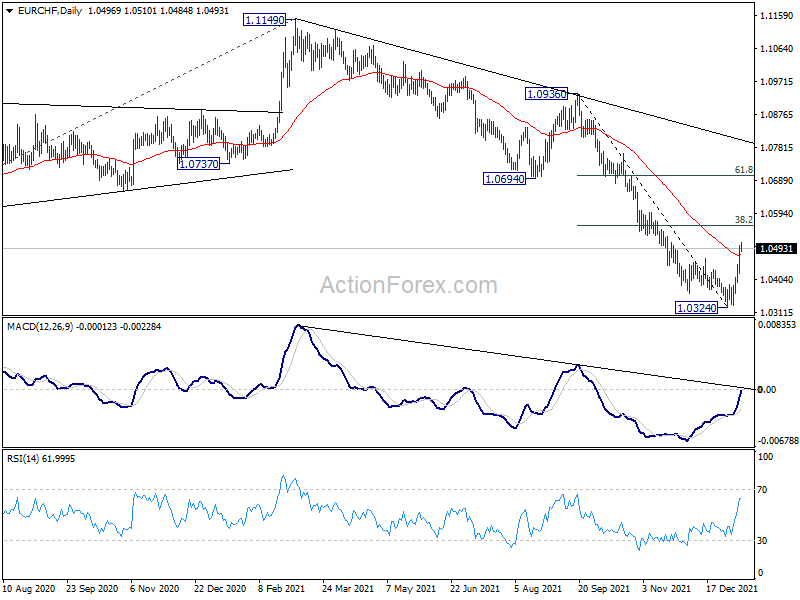
Intraday bias in EUR/CHF stays on the upside as rebound from 1.0324 short term bottom is extending. Next target is 38.2% retracement of 1.0936 to 1.0324 at 1.0558. We'd expect strong resistance from there to limit upside to finish the rebound. On the downside, below 1.0423 minor support will turn bias back to the downside for retesting 1.0324 low.
In the bigger picture, long term down trend from 1.2004 (2018 high) is now extending. Next target is 61.8% projection of 1.2004 to 1.0505 to 1.1149 at 1.0223. On the upside, break of 1.0505 support turned resistance is needed to be the first sign of medium term bottoming. Otherwise, outlook will remain bearish even in case of rebound.
EUR/USD Daily Outlook
Daily Pivots: (S1) 1.1290; (P) 1.1325; (R1) 1.1366; More...
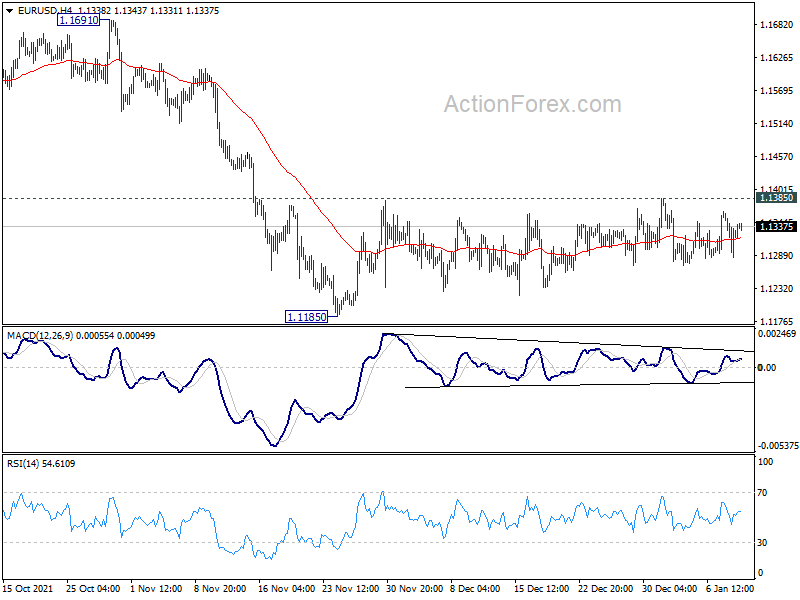
Intraday bias in EUR/USD remains neutral and more sideway trading could be seen. On the upside, sustained trading above 55 day EMA (now at 1.1385) will bring stronger rise back to 1.1663 support turned resistance. On the downside, break of 1.1185 will resume larger decline from 1.2348. Next target is 161.8% projection of 1.2265 to 1.1663 from 1.1908 at 1.0934.
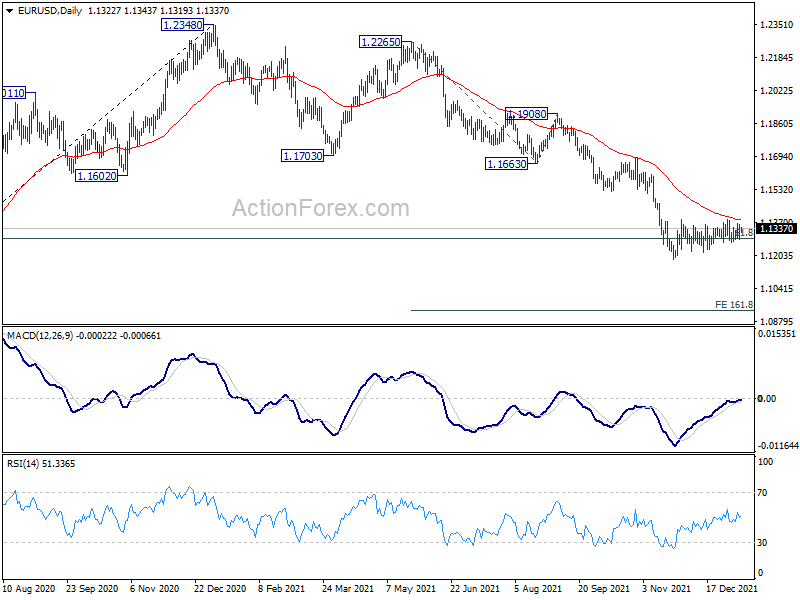
In the bigger picture, there are various ways of interpreting the fall from 1.2348 (2021 high). It could be a correction to rise from 1.0635 (2020 low), the fourth leg of a sideway pattern from 1.0339 (2017 low), or resuming long term down trend. In any case, outlook will now stay bearish as long as 1.1703 support turned resistance holds. Sustained break of 61.8% retracement of 1.0635 to 1.2348 at 1.1289 would pave the way back to 1.0635.
GBP/USD Daily Outlook
Daily Pivots: (S1) 1.3541; (P) 1.3572; (R1) 1.3612; More...
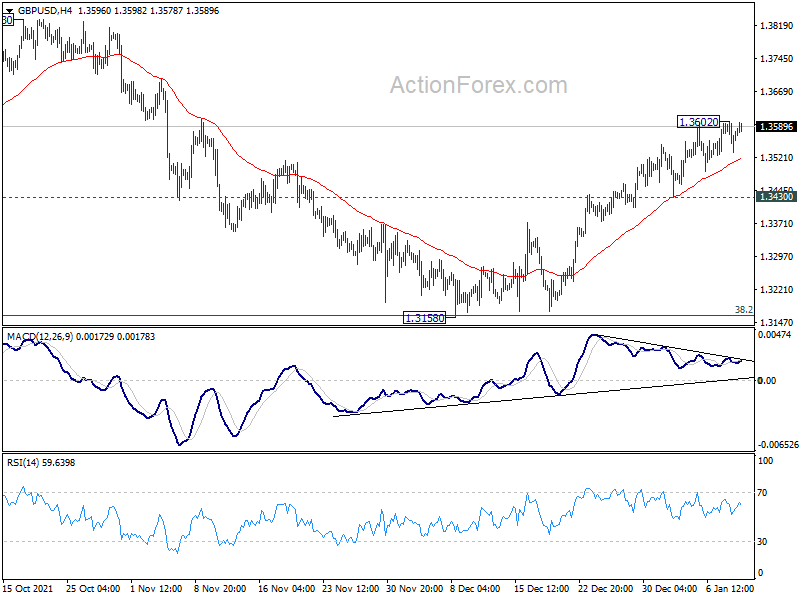
Intraday bias in GBP/USD is neutral as consolidation from 1.3602 temporary top is extending. Further rise is still expected as long as 1.3430 minor support holds. Corrective fall from 1.4248 could have completed with three waves down to 1.3158, after hitting 1.3164 medium term fibonacci level. Sustained trading above 1.3570 will pave the way to 1.3833 resistance next. On the downside, however, break of 1.3430 will dampen this bullish case and turn bias back to the downside for 1.3158 low.
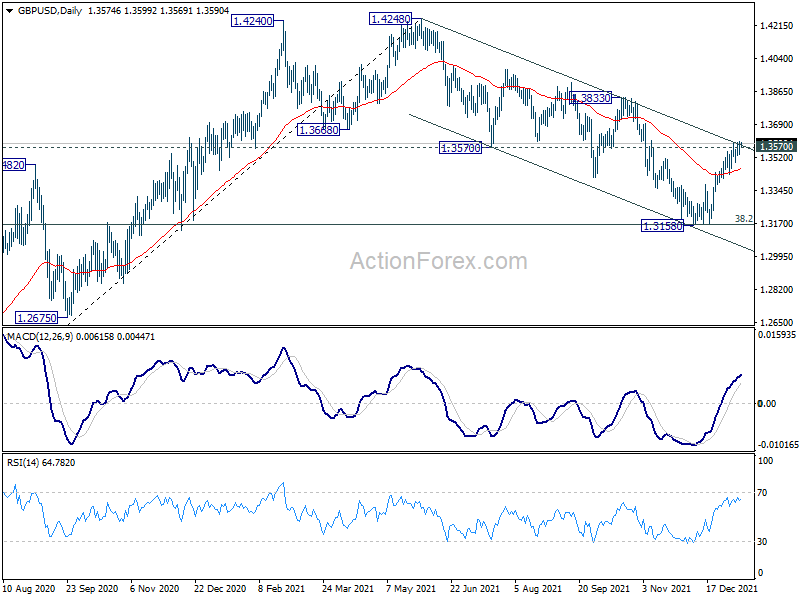
In the bigger picture, strong support was seen from 38.2% retracement of 1.1409 to 1.4248 at 1.3164. The development suggests that up trend from 1.1409 (2020 low) is still in progress. On resumption, next target will be 38.2% retracement of 2.1161 to 1.1409 at 1.5134. Nevertheless sustained break of 1.3164 will argue that whole rise from 1.1409 has completed and bring deeper fall to 61.8% retracement at 1.2493.
USD/JPY Daily Outlook
Daily Pivots: (S1) 114.89; (P) 115.37; (R1) 115.69; More...
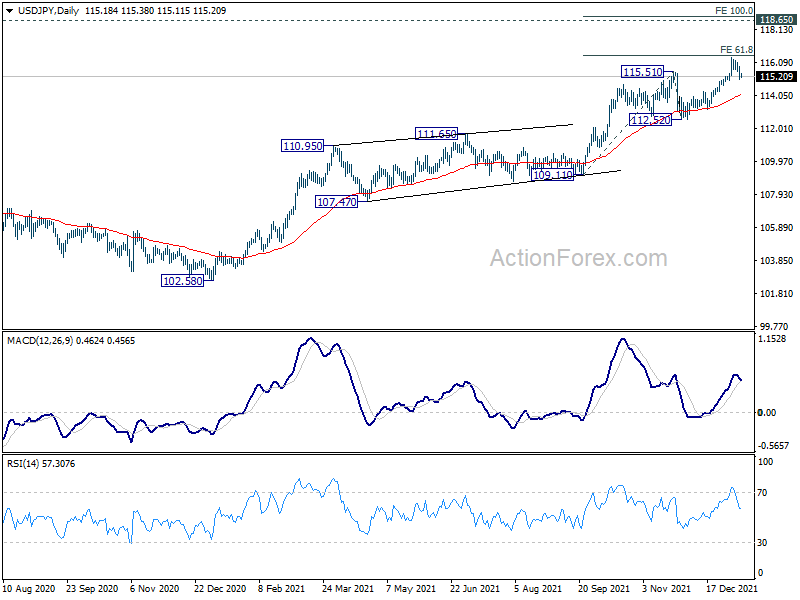
Intraday bias in USD/JPY remains neutral and outlook is unchanged. Downside of the retreat from 116.34 should be contained well well above 114.26 resistance turned support to bring rally resumption. On the upside, firm break of 61.8% projection of 109.11 to 115.51 from 112.52 at 116.47 will pave the way to 100% projection at 118.90, which is close to 118.65 long term resistance.
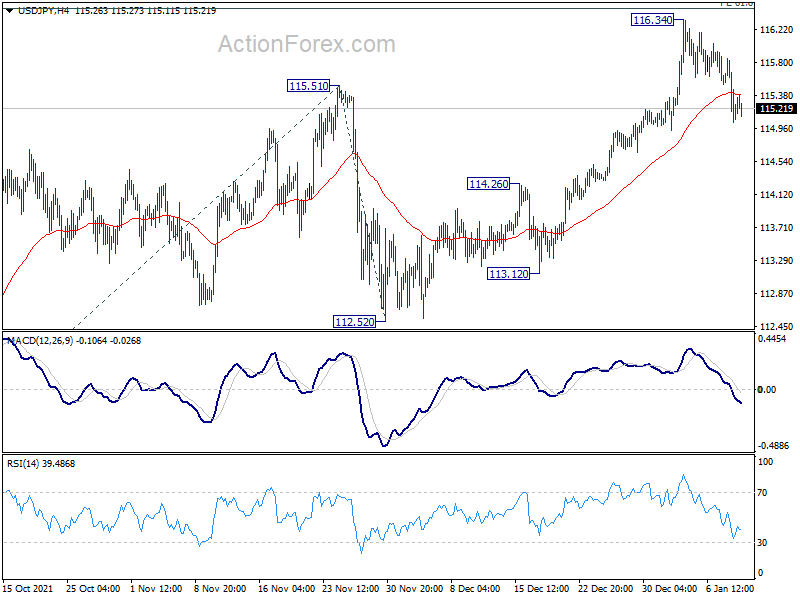
In the bigger picture, no change in the view that rise from 102.58 is the third leg of the up trend from 101.18 (2020 low). Such rally should target a test on 118.65 (2016 high). Sustained break there will pave the way to 120.85 (2015 high) and raise the chance of long term up trend resumption. For now, this will remain the favored case as long as 112.52 support holds, in case of deep pull back.
Equities Down and Up on Hawkish Fed and Soft Retailer Data
Yesterday was quite a stressful session for stock traders as we saw an aggressive selloff at the beginning of the session, which, then softened, brought back the ‘dip-buyers’.
Warnings that the Q4 sales may have not been as strong as expected from some retailers like Lululemon dampened the mood, which was already well fragilized by the hawkish Fed expectations after the US jobs figures supported the idea that the Federal Reserve (Fed) could and should move fast to rectify its relaxed behaviour against inflation last year. Lululemon Athletica which was one of the first retailers to reveal the holiday season performance said its fourth-quarter sales and earnings would be toward the low end of its expectations- Holiday season apparently kicked off on a strong footage for Lululemon, but then staffing shortages and shorter operating hours seemingly hit the holiday season performance.
And the staffing shortages has become a real issue for businesses. It is said that 2-3% of the US labour force is calling in sick due to omicron related issues nowadays. Europe is dealing with similar absences and the situation is alarming, the economic activity is slowing, but the tighter central bank expectations remain in place due to a rising inflation. It’s a bad cocktail.
Nasdaq dived more than 2.5% yesterday, but bounced higher to close the session 0.05% up. Yesterday’s rebound was bigger than any rebound we observed since the bottom of the pandemic bear market. Yet, the index tipped a toe below its long-term bullish channel base and the major catalyzer of the move, the hawkish Fed expectations, hasn’t changed. This means that the downside risks prevail in stock markets, and growth stocks remain on the chopping block, as they are the most sensitive to interest rate changes.
Meanwhile the prospects of higher interest rates are strengthening, many call for four Fed rate hikes in 2022 instead of three, and the US 2-year yield continues pushing higher; it’s probably just a matter of time before we step above the 1% mark.
The question is, does the Fed have any interest in wreaking havoc in the financial markets just to fight back inflation? The answer is no. This is why the whole thing is data-dependent and given how hawkish the market shifted recently, there is a chance we see a certain softening in hawks’ positioning, which could lead to a certain positive correction to the latest equity selloff.
And the actual index levels start looking interesting for dip buyers, as Nasdaq slipped below its bullish trend base and approached the important 15’000 psychological support, while the S&P500 came very close to its up-trending channel base and the 100-dma, near 4560/4580 band. And if there is a rebound, the actual levels look good for, at least, a minor positive correction.
But - and there is always a but - the appetite is of course dependent on tomorrow’s inflation read in the US. The US inflation may print a figure at or above the 7% mark tomorrow. A softer figure will likely give hope that the positive pressure may be coming to an end and give a sigh of relief to investors, but in all cases the actual levels remain very high for a country like the US which targets a 2% average inflation. And it also shows that insisting on the fact that inflation is transitory was a mistake.
The latter is true for Europe as well. The German 10-year bund yield is now preparing to step above zero for the first time in three years, as investors are increasingly betting that the European Central Bank (ECB) should also declare war against inflation. In this respect, the EURUSD could soon clear the 50-dma offers.
Rate Hike Frenzy Continues
It was another choppy session overnight in equity and currency markets, followed today, by another cautious Asian session on equity markets, with forex markets marching on the spot. In other words, business as usual for the past few days.
Federal Reserve rate hike nerves continue to grow tauter after Friday’s fall in unemployment and rise in employment cost indexes. From three hikes, I am now hearing for hikes could be possible this year. I would have been laughed out of the room for saying as much a month ago. Actually, I was, it's funny how quickly sentiment shifts.
Given how cautious the FOMC has been over the past two years, to the point of appearing snail-like, I am struggling to see them hitting the panic button right now. As such I am struggling to pencil in a March hike just as the Fed taper finishes, although I don’t disagree with three hikes across all of 2022. I am definitely disagreeing with four hikes. As such, I do believe we may be approaching “peak Fed-fear” for now. That could see a sharp jump for equities, a retreat by US yields and the US Dollar. The first move the market throws the kitchen sink at is usually the wrong one, always fade January.
Wall Street spent much of the evening on the back foot, especially the interest rate sensitive Nasdaq. It's sudden rally into positive territory towards the end of the session. The sudden reversal was put down to “bottom-fishing” and I’ll not disagree with that. But I believe the volatility is being spurred by the US monetary policy outlook. Until just how hawkish, or not, the FOMC will be, becomes clearer, we can expect more days with a lot of intra-day noise, but not change by the close, to be ahead.
Data wise, Asia’s calendar today is fairly quiet. Indonesia and Australian Retail Sales for November outperformed, reflecting the recovery in consumer sentiment in both post-delta. The arrival of omicron, particularly in Australia, will likely mean a new year’s hit to consumer demand once again. Apart from that, markets will be awaiting China CPI tomorrow morning and US CPI tomorrow evening as the week’s highlights.
Readers should watch the situation in China as well. Evergrande dodged another bullet yesterday by engineering a domestic bond extension with creditors. But Evergrande, Shimao and other private property developers remain in deep trouble and a slow-moving credit trainwreck. It has the potential to further cut into China’s growth prospects this year. Likewise, the omicron variant keeps popping up in small numbers across China, even as it and Hong Kong tighten restrictions. The only way for Covid-zero policy countries in 2022 is down, whether by wider outbreaks or social restrictions.
Another mixed day for Asian equities
Wall Street had a schizophrenic session overnight, falling hard for most of the day as markets continued winding themselves up that the Federal Reserve could tighten by as early as March, amid escalating inflation concerns. It is very much a short-term phenomenon though, as US inflation break evens all the way from 1 to 10 years are still pricing in a return to a 2.0% inflation nirvana. Markets rallied sharply for no apparent reason near the end of the session hinting that fast-money flows are dominating at the moment. The S&P 500 finished 0.14% lower even as the Nasdaq unwound over 2.0% intraday losses to finish 0.05% higher. The Dow Jones suffered a late value to growth rotations, falling 0.46%.
In Asia, it is another mixed day once again with the value-centric ASEAN markets outperforming. With Japan returning from holiday today, the Nikkei 225 has played catchup as it falls 0.93%. South Korea’s Kospi by contrast, has eased just 0.15%, with both Japan and South Korean markets ignoring yet another North Korean missile test this morning.
In China, upward momentum quickly faded and reversed as Covid-19 restrictions were tightened once again in some Chinese cities, notably Zhengzhou today. With China showing no signs of opening the stimulus floodgates, swirling virus nerves and property sector concerns, local markets are struggling to maintain any sort of upward momentum. The Shanghai Composite is 0.45% lower, while the CSI 300 is down 0.75%. Hong Kong has gained a temporary respite from the latest Evergrande debt rollover, but the Hang Seng is still only 0.15% higher.
Singapore is 0.45% higher today as it continues to be a defensive play versus Northern Asia with investors still wanting Asia exposure. Taipei, Jakarta and Kuala Lumpur are 0.25% higher, with Manila down 0.15% while Bangkok has climbed 0.45% higher. A weak and nervous New York session, and spiralling omicron cases Australian markets sharply lower today. The All Ordinaries and ASX 200 have tumbled by 0.80%.
Europe should open neutral this morning and I believe markets there will remain more focused on movements in German Bund yields, than noise from Wall Street.
Currency markets nervously range-trade
The US Dollar rallied sharply overnight as US equities headed south, only to give back most of those gains towards the end of the New York session as the Nasdaq recovered. US Bond markets provided no direction with yields almost unchanged. It all paints a picture of nervous tail-chasing as the dollar index finished 0.22% higher at 95.95, before edging lower to 94.85 in Asia today. In the bigger picture, the dollar index is range trading. I am waiting for 95.50 or 96.50 to break to signal the US Dollar’s next directional move.
EUR/USD and GBP/USD both feel intra-session before steadying at the New York close. GBP/USD continues to erode resistance at 1.3600, signalling a further rally to 1.3800 if broken. EUR/USD’s is marooned at 1.1340 and only a close above 1.1400 will lessen the bearish outlook. Risks are still skewed towards a retest of 1.1200, especially if German Bund yields stop rising. USD/JPY has eased to 115.25 but remains a bid on dips into 115.00 as long as US yields remain at these levels, targeting 118.00 initially.
AUD/USD and NZD/USD are unmoved at 0.7190 and 0.6190 today. Both continue to be bounced around on RORO (risk-on, risk-off) sentiment swings, but ultimately, are range-trading right now. Key levels for AUD/USD are 0.7150 and 0.7300, and 0.6700 and 0.6850 for NZD/USD. USD/CAD is trading sideways at 1.2650 and has support at 1.2600, and resistance at 1.2700.
USD/Asia has run into offers overnight and I suspect some regional central banks may be looking to cap the US Dollar’s rally for now. USD/KRW has fallen to 1195.00, USD/PHP to 51.15, while USD/MYR has eased to 4.1940, and USD/THB to 33.520. USD/CNY and USD/CNH remain just below 6.3800 which is becoming a key pivot point now. The key directional driver this week will be the US CPI data, especially if a high CPI print lifts Fed hiking expectations, pressuring Asian FX.
Oil consolidates
Oil prices eased slightly overnight in corrective price action consistent with a consolidation of oil’s recent impressive price gains. Brent crude fell by 1.0% to $81.00, rising to $81.30 a barrel in Asia. WTI fell by 0.55% to $78.40, rising slightly to $78.75 in Asian trading.
Despite prices easing again overnight, oil continues to hold onto almost all its gains since the start of December. Omicron has yet to wreak the havoc of the delta variant and may never do so, keeping the global recovery on track, and OPEC+ compliance means that spare production capacity is limited. Both factors will continue supporting oil’s bullish outlook.
In the nearer term, Brent crude has support at $79.60 and the 100-day moving average (DMA) at $78.55 a barrel. A rally through $83.00 signals more gains to $86.00 a barrel. WTI has support at $78.00 and $77.50 a barrel, with resistance at $80.50 and 82.00 a barrel.
Gold rallies in Asia
Gold continued range-trading overnight. With US yields moving sideways buyers cautiously push gold higher by 0.30% to $1801.75 an ounce overnight. In Asia, the buying momentum has continued, perhaps after North Korea’s latest missile test today. Gold has risen 0.45% to $1809.50 an ounce.
Gold has resistance here at $1810.00 and $1830.00 an ounce. Support lies at $1785.00, followed by $1780.00 and $1760.00 an ounce. Gold continues to drag in hapless bulls to false rallies, and as such, I believe gold will trade in a $1775.00 to $1815.00 range this week.
US and Russia Agree to Extend Talks
Market movers today
Today's calendar is rather thin.
In the US, the NFIB small business survey is quite interesting, not least the sub-components, which provide information about the labour market and underlying inflation pressure. We expect the survey will reveal that the labour market remains tight, with many businesses struggling to find qualified workers and expecting higher wage growth. Simultaneously, businesses are likely to report that a majority expects consumer price increases.
The US Senate Banking Committee holds a hearing on Fed Chair Powell's renomination. We expect Powell to be approved without too many problems, as he enjoys overall support from most Democrats and Republicans, despite some criticism from both left-wing Democrats and right-wing Republicans.
Also still focus on rising geopolitical tensions between Russia and US/Europe/NATO.
The 60 second overview
US-Russia talks ended on Monday on a cautiously optimistic tone, sending RUB higher. As expected, no agreement was reached, but both sides agreed to continue talks. The US representative, Deputy Secretary of State Wendy Sherman, said that any major breakthrough would take several weeks if not longer. She also said the US was open to discuss the size and scope of future military exercises as well as the positioning of intermediate-range missile systems in Europe. The US had earlier communicated that Russian demands not to expand NATO further to the east are a non-starter. Russia, however, repeated its demands in this regard while also insisting that NATO should never let Ukraine or other ex-Soviet states join the alliance. Stakes remain high with Russia having deployed more than 100,000 troops at the Ukraine border and the possibility of large-scale economic sanctions against Russia being raised in a response to a potential attack. The focus now turns to Brussels, where Russia is due to meet NATO representatives on Wednesday and to Vienna for consultations under the OSCE framework on Thursday.
Euro Macro: The number of unemployed people in the euro area fell by 220,000 in November, lowering the jobless rate to 7.2%, within a whisker of its record low in March 2020 when the pandemic hit. Although the labour market recovery remains a bright spot, the triple headwinds of new COVID-19 restrictions, ongoing supply bottlenecks and real household income erosion are increasingly weighing on the euro area macro momentum, as we discuss in Euro Area Macro Monitor - Triple headwinds, 10 January.
FI: Modest movements in yields and spreads yesterday after the sell-off that began in mid-December. Since mid-December 10Y US Treasuries and 10Y Bunds have risen approx. 35bp. The German and US curves have steepened between 2Y and 10Y, while 10-30Y flattened in the US and the German curve was more or less unchanged from mid-December. The long trend is still for flatter curves as central banks tighten monetary policy.
FX: USD, JPY and GBP rose yesterday vis-à-vis Scandies and CHF. There were big moves on Monday with EUR/USD taking a brief dip below 1.13 as one of the main highlights.
Credit: Spreads in the secondary markets continued their widening trend yesterday. We see this as being the result of the continuation of rising rates, but also being due to an aggressive start to the primary printing season. Yesterday the market saw a flurry of new deal announcements, including hybrid bonds from TotalEnergies (i.e. 5.25 years to first call which fixed at 2%). This focus on the primary market drew liquidity away from the secondary market causing iTraxx Main to widen 1.2bp to 51.6bp and Xover to widen 4.5bp to 254.4bp. In cash, the move was more muted with IG widening 0.5bp and HY widening 1.9bp.
Nordic macro
The Swedish Debt Office (SNDO) will present their monthly report on the net outcome of the central government's revenues and payments (the net borrowing requirement) for the month of December. The forecast is for positive borrowing requirement (budget deficit) of SEK 91.5bn. However, the two months since the latest forecast (October) have yielded an aggregate surplus (compared to said forecast) of approximately SEK 40bn, and for the whole year the figure is even greater, so we would not be surprised to see today's figure follow that trend.
USD/CHF Daily Outlook
Daily Pivots: (S1) 0.9214; (P) 0.9244; (R1) 0.9303; More....
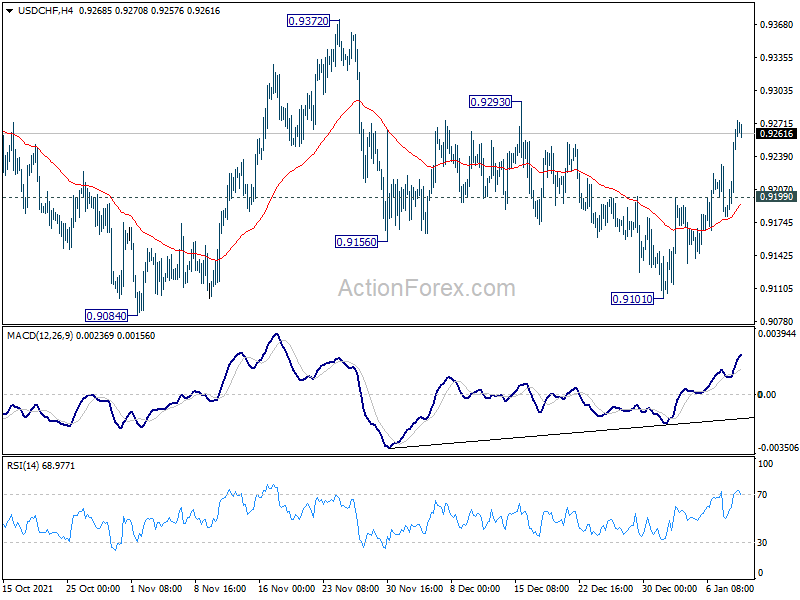
Intraday bias in USD/CHF remains on the upside for 0.9293 resistance first. As noted before, with 0.9084 support intact, choppy rise from 0.8925 could still extend higher. Break of 0.9293 should target 0.9372 resistance and above. On the downside, break of 0.9199 minor support will turn intraday bias neutral first.
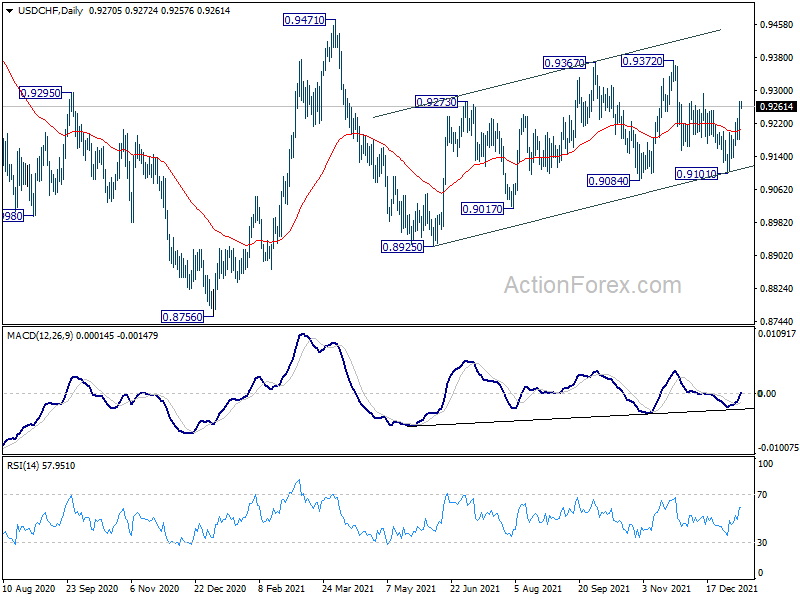
In the bigger picture, the corrective structure of the rebound from 0.8925 argues that fall from 0.9471 is not complete yet. It could either be the second leg of pattern from 0.8756 (2021 low), or resuming larger down trend from 1.0237 (2018 high). We'd pay attention to the downside momentum and assess the odds later. But for now, medium term outlook will be neutral at best as long as 0.9471 resistance holds.
Swiss Franc Down Broadly, Focus Turns to Fed Powell
Overall market sentiment is rather mixed for the moment. Despite the initial steep selloff overnight, major US indexes staged an impressive come back towards the end of the session. NASDAQ even eked out a slight gain. Gold is back above 1800 handle while Bitcoin appears to be supports by 40k for now. Investors are probably still holding their bets before Fed Chair Jerome Powell's testimony today, and US CPI tomorrow. In the currency markets, Yen is staying in near term recovery for now. Selling focus has apparently turned to Swiss Franc. Commodity currencies are recovery while Sterling appears to be ready to extend recent rally.
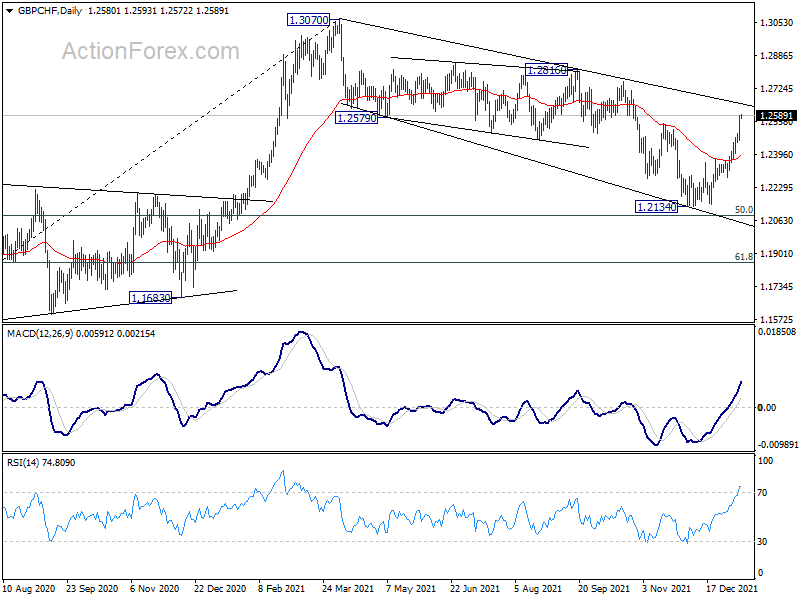
Technically, GBP/CHF's strong rally yesterday, and break of 1.2549 resistance argues that the corrective fall from 1.3070 might have completed at 1.2134 already. Immediate focus is now on trend line resistance at 1.2652. Sustained break there will add to this bullish case and send GBP/CHF through 1.2816 resistance back to 1.3070 high. We'll monitor USD/CHF's reaction to 0.9293 resistance and at the same time.
In Asia, at the time of writing, Nikkei is down -0.90%. Hong Kong HSI is up 0.20%. China Shanghai SSE is down -0.46%. Singapore Strait Times is up 0.44%. Japan 10-year JGB yield is up 0.0161 at 0.151. Overnight, DOW dropped -0.45%. S&P 500 dropped -0.14%. NASDAQ rose 0.05%. 10-year yield rose 0.009 to 1.780, after hitting 1.808.
NASDAQ staged strong rebound after initial dive
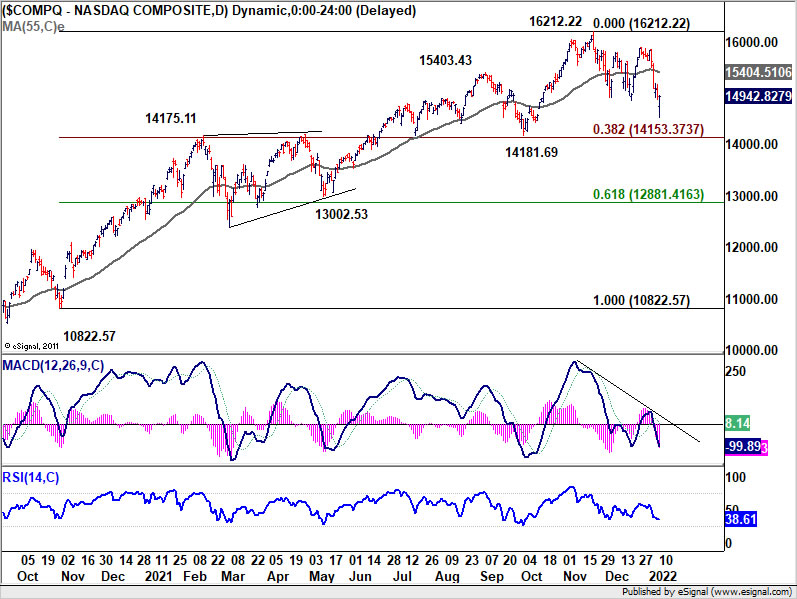
NASDAQ initially dived sharply to as low as 14530.22 overnight, but staged a strong rebound to close up 0.05% at 14942.82. Technically, we're seeing NASDAQ as in correction to the move from 10822.57 to 16212.22. It's envisaged as a range pattern that could last for a while.
Nevertheless, 14100/14200 zone should provide enough support to floor any decline attempt. We're talking about a cluster of support levels there, including 14175.11 resistance turned support, 14181.69 support, and 38.2% retracement of 10822.57 to 16212.22 at 14153.37.
However, it should be noted that a firm break of 14181.69 structural level, which is unlikely, would indicate that NASDAQ could be in a larger scale correction.
Australia retail sales rose 7.3% mom in Nov as restrictions eased
Australia retail sales rose 7.3% mom in November, well above expectation of 4.0% mom. That's also the fourth strongest monthly rise on record. Total turnover at current prices hit a record AUD 33.4B.
"Further easing of COVID-19 restrictions in the South-Eastern states and territories has seen the retail industry recover all lost momentum caused by the Delta outbreak," Ben James, Director of Quarterly Economy Wide Statistics, said. "Victoria recorded the largest state rise, up 20.0 per cent, reaching its highest level of the series. This follows the state's lockdown ending in late October."
"Continued easing of COVID-19 restrictions, including less strict density and capacity limits, in New South Wales (5.1 per cent) and the Australian Capital Territory (19.2 per cent) led to rises in turnover to record levels."
Australia exports rose 2% in Nov, imports rose 6%
Australia goods and services exports rose 2.% mom or AUD 691m to AUD 43.86B in November. Goods and services imports rose 6% mom or AUD 2049m to AUD 34.44B. Trade surplus came in at 9.42B, below expectation of AUD 10.75B.
Fed Powell committed to prevent higher inflation from becoming entrenched
In the prepared remarks for the nomination hearing before Senate Banking Committee, Fed Chair Jerome Powell said, "today the economy is expanding at its fastest pace in many years, and the labor market is strong."
After the initial shutdown and the subsequent reopening, "the economy has rapidly gained strength despite the ongoing pandemic, giving rise to persistent supply and demand imbalances and bottlenecks, and thus to elevated inflation."
"We are strongly committed to achieving our statutory goals of maximum employment and price stability," Powell said. "We will use our tools to support the economy and a strong labor market and to prevent higher inflation from becoming entrenched."
Looking ahead
Fed Chair Jerome Powell's testimony is the main focus for today. Italy will release retail sales while US will release NFIB business optimism index.
USD/CHF Daily Outlook
Daily Pivots: (S1) 0.9214; (P) 0.9244; (R1) 0.9303; More....
Intraday bias in USD/CHF remains on the upside for 0.9293 resistance first. As noted before, with 0.9084 support intact, choppy rise from 0.8925 could still extend higher. Break of 0.9293 should target 0.9372 resistance and above. On the downside, break of 0.9199 minor support will turn intraday bias neutral first.
In the bigger picture, the corrective structure of the rebound from 0.8925 argues that fall from 0.9471 is not complete yet. It could either be the second leg of pattern from 0.8756 (2021 low), or resuming larger down trend from 1.0237 (2018 high). We'd pay attention to the downside momentum and assess the odds later. But for now, medium term outlook will be neutral at best as long as 0.9471 resistance holds.
Economic Indicators Update
| GMT | Ccy | Events | Actual | Forecast | Previous | Revised |
|---|---|---|---|---|---|---|
| 00:01 | GBP | BRC Like-For-Like Retail Sales Y/Y Dec | 0.60% | 1.80% | ||
| 00:30 | AUD | Retail Sales M/M Nov | 7.30% | 4.00% | 4.90% | |
| 00:30 | AUD | Trade Balance (AUD) Nov | 9.42B | 10.75B | 11.22B | 10.78B |
| 05:00 | JPY | Leading Economic Index Nov P | 102.90% | 101.50% | ||
| 09:00 | EUR | Italy Retail Sales M/M Nov | 0.60% | 0.10% | ||
| 11:00 | USD | NFIB Business Optimism Index Dec | 98.6 | 98.4 |