Sample Category Title
Dollar Holds Firm after Mixed NFP Report
Dollar unsurprised by NFP miss
Despite the dollar's initial pullback after the NFP report came short of expectations, delivering 199k job additions versus the 400k projection, the dollar quickly pared its losses as the US unemployment figure fell to 3.9% against the 4.1% expectation. This employment report seems solid enough for the Fed to proceed with its plan to both lift interest rates and reduce the size of its balance sheet at the same time.
Commodity-linked currencies such as the kiwi and loonie are trading higher today, supported by the soaring oil prices, while the aussie is slightly down on the day. In addition, the stronger-than-expected Canadian employment report seems to be adding more fuel to the loonie's rally.
On the other hand, the persistent rally in global yields continues to undermine the safe haven currencies, with the franc and yen losing ground in the current session.
The euro is also gaining traction today since both retail sales and inflation reports for the Eurozone positively surprised the markets. The latter report pointed out that annual inflation reached 5%, while core inflation was higher than 2% in December, reaffirming that price pressures are not abating yet and that the ECB might be forced to accelerate its rate hike timeline to counter inflationary pressures.
US stocks lose ground after the NFP report
Wall Street seems to be resuming yesterday's downfall as the NFP report reinforced the Fed's ultra-hawkish stance and significantly increased expectations for a rate hike in March 2022. E-mini futures for the major US indices are taking a hit in premarket trade as spiking yields seem to be unfavorable for stocks.
In individual stock news, Gamestop announced yesterday that it is launching a division to develop a marketplace for NFTs and establish cryptocurrency partnerships. Hence, with investors pricing in that news on today's session, the stock is up 18% in pre-market trade.
Oil surges; gold stabilizes
Oil prices have climbed to a seven-week high as extremely harsh weather conditions in Canada and the northern US have been disrupting oil flows, boosting prices just as American stockpiles decrease. Moreover, riots in Kazakhstan and outages in Libya raised further concerns over the supply side.
Although geopolitical flare-ups have intensified globally, gold cannot manage to capitalize on them as soaring real yields negatively weigh on the precious metal.
Bitcoin and the broader cryptocurrency market continue to be a sea of red today after the ultra-hawkish FOMC meeting minutes cast a shadow over risky assets.
Canada: Employment Continues to Move On Up in December
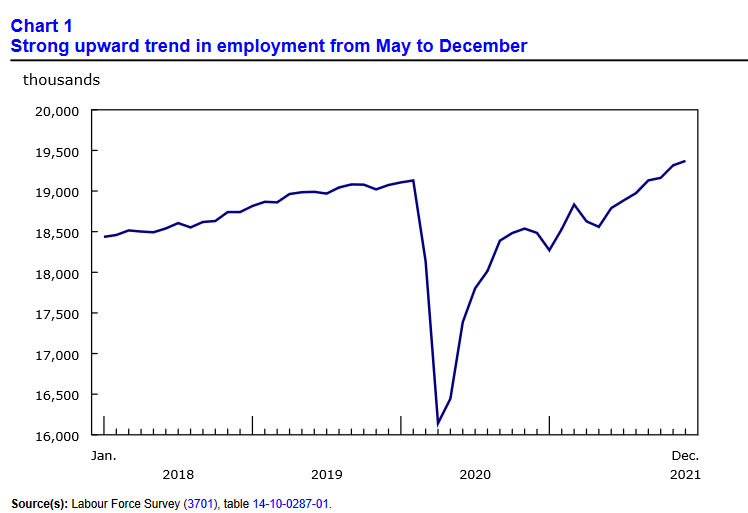
The Canadian labour market added 55k positions in December, and was well above the consensus call for a gain of 25k position. Full-time (+123k) employment drove the increase in December, while part-time (-68k) employment fell on the month.
Canada's labour force (+23k) also expanded in December. Given the larger increase in employment, the unemployment rate edged down by 0.1 percentage points to 5.9% in December, and was within touching distance of the 5.7% recorded in February 2020.
By industry, employment growth was strong in the goods-producing sector (+44k) with the construction industry (+27k) doing the heavy lifting for the month. Meanwhile, services-producing employment was little changed (+11k), although, there was a sizeable increase in educational services employment (+17k) in December.
By province, employment was up in Ontario (+47k) and Saskatchewan (+6k), while all other provinces did not see much change last month. Notably, employment in B.C. was steady even as flooding impacted the southwest region of the province. Statistics Canada noted that by December, the province was already in reconstruction.
Lastly, total hours worked rose 0.3% month-on-month, continuing the string of advances seen since July 2021.
Key Implications
Despite the severe flooding in B.C., the Canadian labour market continued to see gains in December. The construction industry recorded its first employment increase since August, and this trend is likely to continue due to rebuilding efforts in southwestern B.C. Interestingly, the accommodation and food services industry saw a 4k decline in employment even with job vacancies at an elevated level, reflecting hiring difficulties in the sector.
It's important to note that today's release did not fully include the impact of Omicron-related public health restrictions as the labour force survey was taken during the week of December 5 to 11, and more stringent measures were imposed later on in the month. With daily caseloads rising at an incredible pace and provinces tightening the screws on mobility, January labour market figures are likely to be more downbeat. Hopefully, the impact of Omicron will be short-lived, allowing the labour market to recover quickly in coming months.
US: Unemployment Rate Drops to 3.9% at the End of 2021
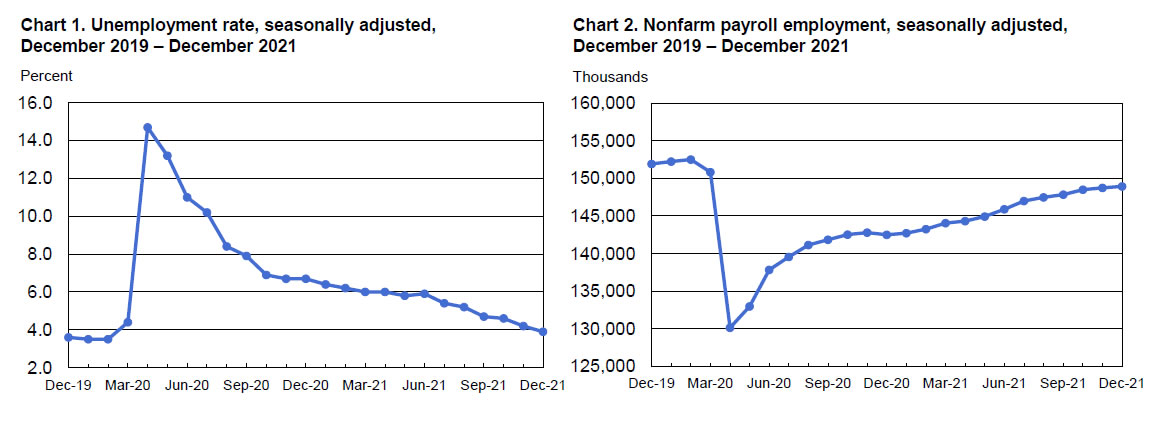
The U.S. economy added 199k new jobs in December, disappointing market expectations for a 400k+ tally. However, the prior two months was revised up by 141k positions, continuing a trend. Even with an average 537k new jobs per month in 2021, payrolls remained 2.3% below their February 2020 level, or 3.6 million fewer jobs.
The unemployment rate dropped to 3.9% in December, narrowing in on its 3.5% pre-pandemic low, as household survey employment rose 651k. Household survey employment has been stronger than payrolls for a couple of months now, and is 1.8% below its pre-pandemic level, a smaller gap than indicated by the payroll measure. The labor force participation rate was unchanged from November at 61.9%. However, November's part rate was revised up as part of the usual annual revisions to the seasonal factors.
Looking at shifts by industry, employment continued to trend up in leisure and hospitality (+53k), professional and business services (+43k), manufacturing (+26k), transportation and warehousing (+19k) and construction (+22k).
Average hourly earnings were up 4.7% from a year ago in December, as a healthy demand for workers is driving wages higher across sectors.
Key Implications
The jobs numbers are typically the most highly anticipated release on the calendar but December's data was captured prior to the surge in Omicron infections, so it feels a bit more stale than usual. We will have to wait until January to see what, if any, impact Omicron has on employment. Consumer caution is likely to dampen activity in some sectors, but given a tight labor market, employers are likely going to hang on to staff. Disruptions from large swaths of infected workers are likely to disrupt activity more than employment.
Despite the disappointment with the headline hiring tally, December's data are consistent with a labor market that is looking pretty tight. Markets may need to recalibrate monthly hiring expectations going forward. Given limited labor market slack, the pace of hiring may look more like pre-pandemic trends going forward. The pace of job gains through November and December is in fact quite similar to the pace of hiring immediately before the pandemic. With the unemployment rate getting quite close to its pre-pandemic low and inflation higher than the Fed would like, rate hikes are likely not too far away, as outlined in our recent forecast. Omicron may prove disruptive in the short run, but as with past waves, we expect activity to bounce back quickly.
EUR/USD Mid-Day Outlook
Daily Pivots: (S1) 1.1279; (P) 1.1305; (R1) 1.1326; More...
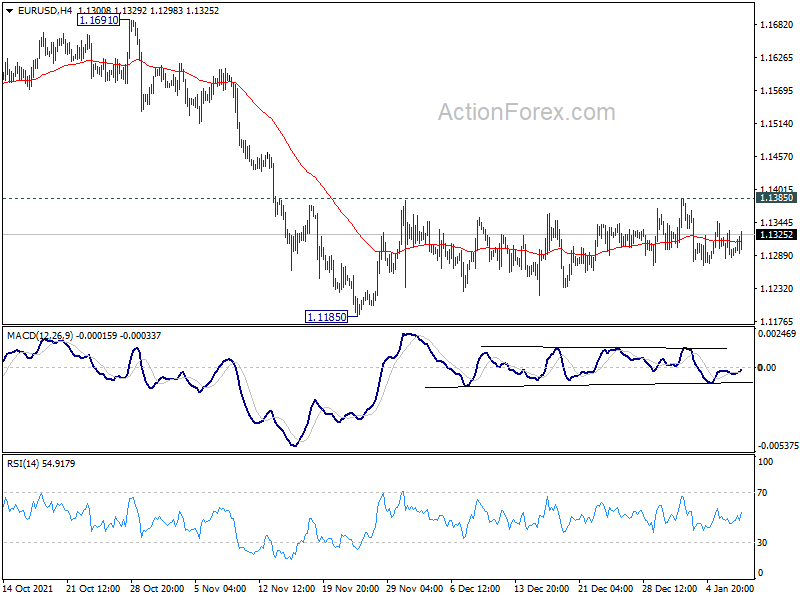
Range trading continues in EUR/USD and intraday bias remains neutral. On the downside, break of 1.1185 will resume larger decline from 1.2348. Next target is 161.8% projection of 1.2265 to 1.1663 from 1.1908 at 1.0934. On the upside, firm break of 1.1385 resistance will resume the rebound from 1.1186. Sustained trading above 55 day EMA (now at 1.1382) will bring stronger rise back to 1.1663 support turned resistance.
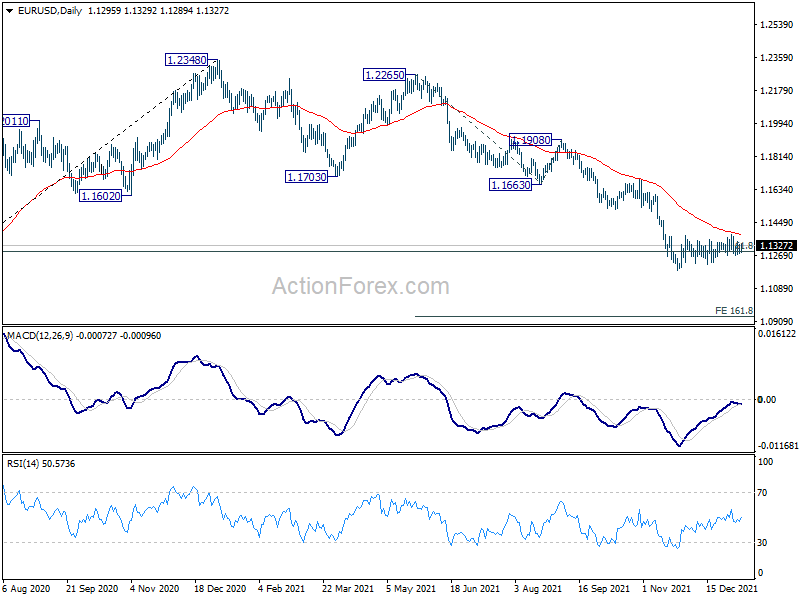
In the bigger picture, there are various ways of interpreting the fall from 1.2348 (2021 high). It could be a correction to rise from 1.0635 (2020 low), the fourth leg of a sideway pattern from 1.0339 (2017 low), or resuming long term down trend. In any case, outlook will now stay bearish as long as 1.1703 support turned resistance holds. Sustained break of 61.8% retracement of 1.0635 to 1.2348 at 1.1289 would pave the way back to 1.0635.
GBP/USD Mid-Day Outlook
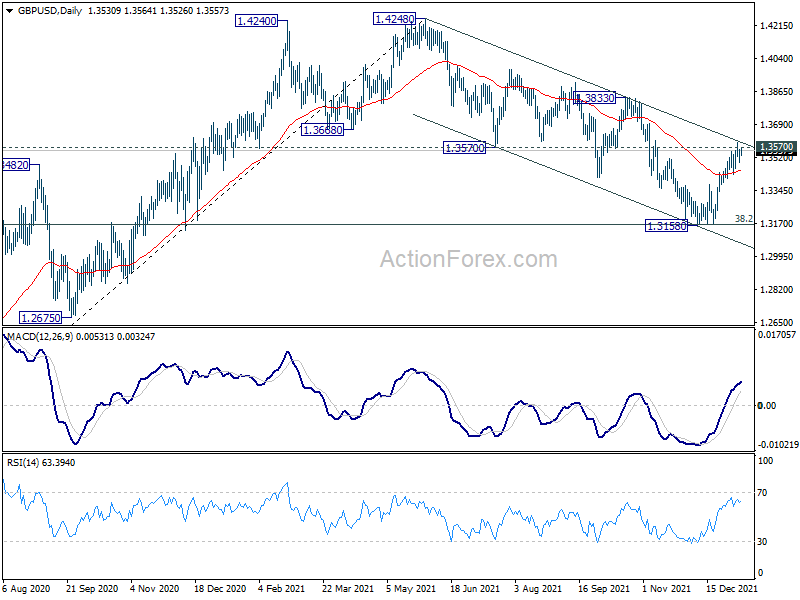
Daily Pivots: (S1) 1.3498; (P) 1.3528; (R1) 1.3567; More...
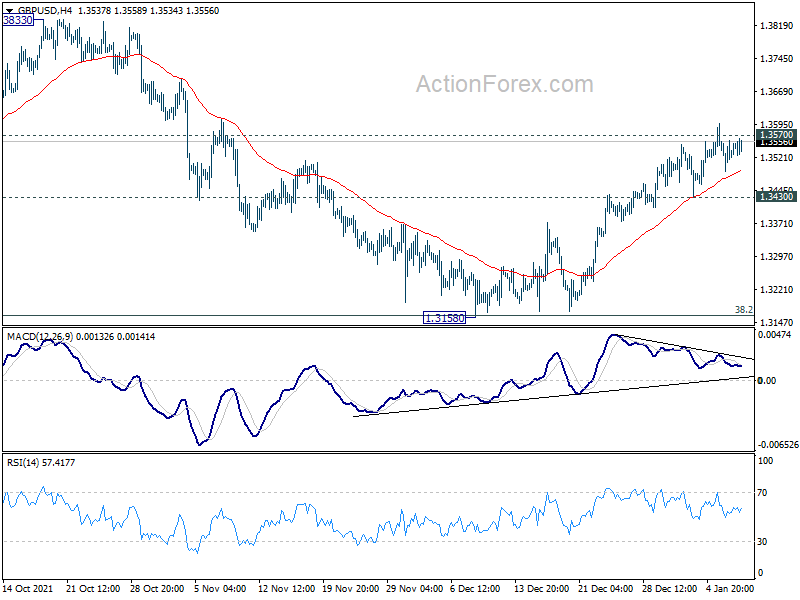
GBP/USD is staying in consolidation and intraday bias remains neutral. Further rally is still expected as long as 1.3430 support holds. We're seeing corrective fall from 1.4248 as complete with three waves down to 1.3158, after hitting 1.3164 medium term fibonacci level. . Sustained break of 1.3570 resistance will further affirm this bullish case and target 1.3833 resistance next. However, break of 1.3375 will turn bias back to the downside for 1.3158 low again.
In the bigger picture, focus remains on 38.2% retracement of 1.1409 to 1.4248 at 1.3164. Sustained break there will argue that whole rise from 1.1409 has completed at 1.4248, after rejection by 1.4376 long term resistance. That will revive some medium term bearishness and and target 61.8% retracement at 1.2493. However, strong rebound from current level will revive argue that up trend from 1.1409 is still in progress, and probably ready to resume.
USD/JPY Mid-Day Outlook
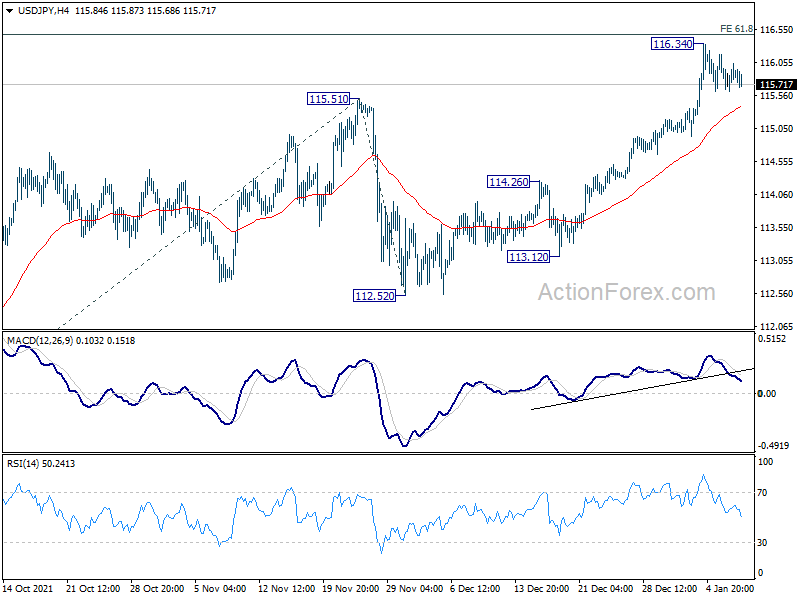
Daily Pivots: (S1) 115.60; (P) 115.89; (R1) 116.16; More...
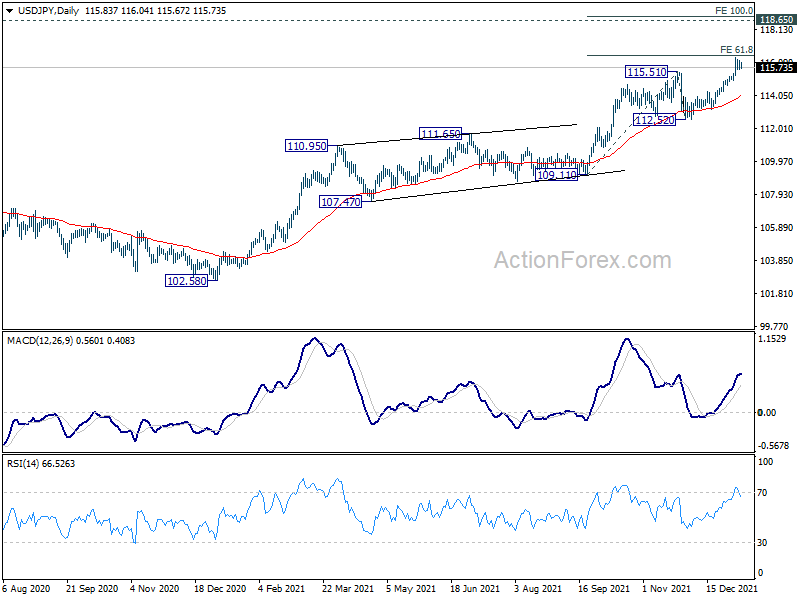
USD/JPY is staying in consolidation below 116.34 temporary top and intraday bias remains neutral. Downside of retreat should be contained well above 114.26 support turned resistance to bring another rally. On the upside, sustained break of 61.8% projection of 109.11 to 115.51 from 112.52 at 116.47 will pave the way to 100% projection at 118.90, which is close to 118.65 long term resistance.
In the bigger picture, no change in the view that rise from 102.58 is the third leg of the up trend from 101.18 (2020 low). Such rally should target a test on 118.65 (2016 high). Sustained break there will pave the way to 120.85 (2015 high) and raise the chance of long term up trend resumption. For now, this will remain the favored case as long as 112.52 support holds, in case of deep pull back.
USD/CHF Mid-Day Outlook
Daily Pivots: (S1) 0.9179; (P) 0.9202; (R1) 0.9235; More....
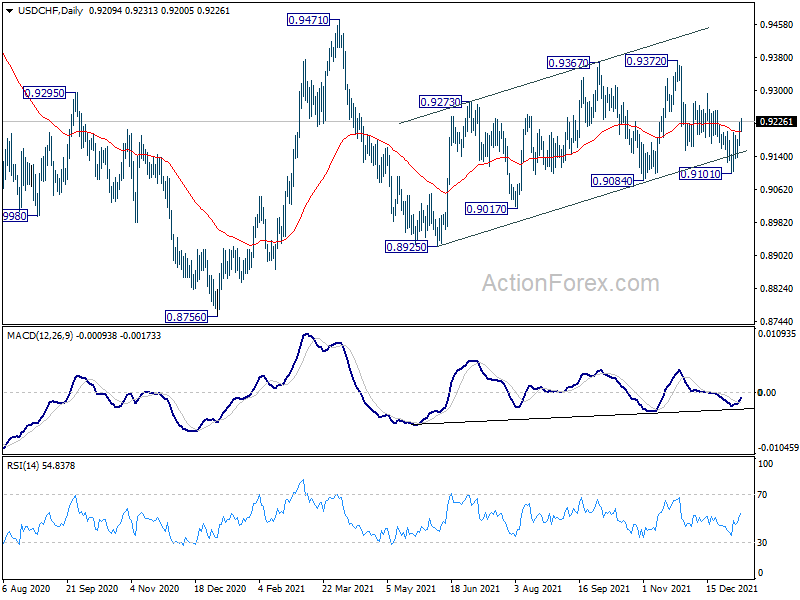
Intraday bias in USD/CHF remains mildly on the upside at this point. Fall from 0.9372 should have completed with three waves down to 0.9101. Further rally would be seen to 0.9293 resistance first. Break will likely resume the choppy rise from 0.8925 through 0.9372 resistance. On the downside, break of 0.9101 will resume the fall from 0.9372 instead.
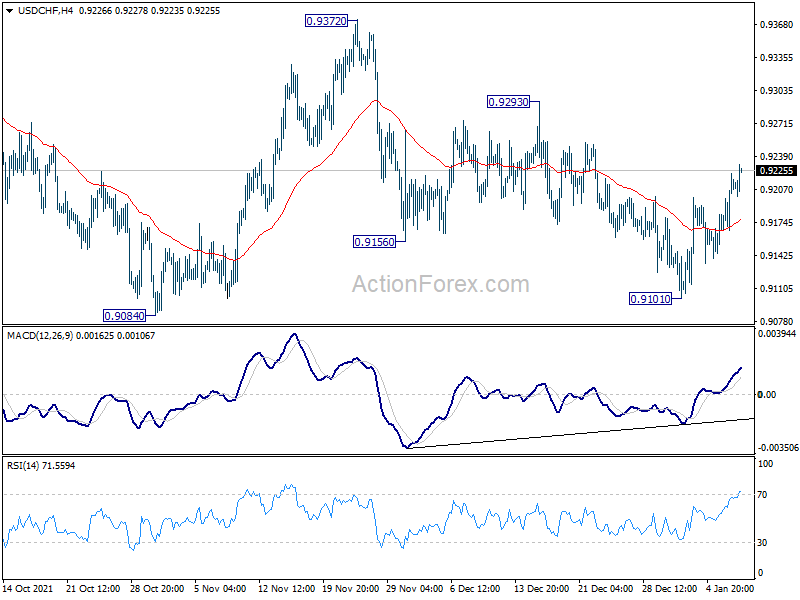
In the bigger picture, the corrective structure of the rebound from 0.8925 argues that fall from 0.9471 is not complete yet. It could either be the second leg of pattern from 0.8756 (2021 low), or resuming larger down trend from 1.0237 (2018 high). We'd pay attention to the downside momentum and assess the odds later. But for now, medium term outlook will be neutral at best as long as 0.9471 resistance holds.
No Decisive Reaction to Mixed NFP, Dollar Staying Firm
At the time of writing, markets are still figuring out how to react to the mixed US non-farm payroll data. While the headline job grow was very disappointing, unemployment rate improved. More importantly, wages reported another month of strong growth. Canadian Dollar is trading mildly higher after strong job data, but there is no clear follow through buying yet. For, Sterling and Dollar are still the strongest ones for the week while Aussie and Kiwi are the weakest.
In Europe, at the time of writing, FTSE is down -0.05%. DAX is down -0.85%. CAC is down -0.65%. Germany 10-year yield up sharply by 0.052 at -0.047. Earlier in Asia, Nikkei dropped -0.03%. Hong Kong HSI rose 1.82%. China Shanghai SSE dropped -0.18%. Singapore Strait Times rose 0.66%. Japan 10-year JGB yield rose 0.0160 to 0.135.
US non-payroll missed expectation, but unemployment rate and wage growth beat
US non-farm payroll employment rose only 199k in December, much worse than expectation of 400k. Overall job growth averaged 537k per month in 2021. Non-farm employment remained -3.6m, or -2.3%, from its pre-pandemic level in February 2020.
Unemployment rate dropped to 3.9%, down from 4.2%, better than expectation of 4.1%. Number of unemployed persons dropped -483k to 6.3m. Labor force participation rate was unchanged at 61.9%, remain -1.5% below pre-pandemic level.
Average hourly earnings rose strongly by 0.6% mom, above expectation of 0.4%.
Canada employment grew 54.7k in Dec, way above expectation
Canada employment grew 54.7k in December, much better than expectation of 24.5k. Full-time employment rose 123k while part-time employment dropped -68k. Total hours worked dropped -0.3%, first decline since June.
Unemployment rate dropped from 6.0% to 5.9%, better than expectation of 6.0%. Labor force participation rate held steady at 65.3%.
Eurozone CPI accelerated to 5.0% yoy in Dec, another record
Eurozone inflation accelerated from 4.9% to 5.0% in December, above expectation of 4.7% yoy. That's another record print since record began in 1991. CPI core was unchanged at 2.6% yoy, above expectation of 2.3% yoy.
Energy is expected to have the highest annual rate in December (26.0%, compared with 27.5% in November), followed by food, alcohol & tobacco (3.2%, compared with 2.2% in November), non-energy industrial goods (2.9%, compared with 2.4% in November) and services (2.4%, compared with 2.7% in November).
Eurozone retail sales rose 1.0% mom in Nov, EU up 0.9% mom
Eurozone retail sales rose 1.0% mom in November, much better than expectation of -0.5%. Volume of retail trade increased by 1.6% for non-food products and by 0.6% for food, drinks and tobacco, while it fell by -1.5% for automotive fuels.
EU retail sales rose 0.9% mom. Among Member States for which data are available, the highest monthly increases in the total retail trade volume were registered in Spain (+4.9%), Luxembourg (+4.0%) and Portugal (+2.8%). The largest decreases were observed in Austria (-4.1%), Latvia (-3.6%) and Croatia (-3.1%).
Eurozone economic sentiment dropped to 115.3 in Dec, EU down to 114.5
Eurozone Economic Sentiment Indicator dropped -2.3 pts to 115.3 in December. Employment Expectations Indicator dropped -1.6 pts to 114.0. Industry confidence rose from 14.3 to 14.9. Services confidence dropped sharply from 18.3 to 11.2. Consumer confidence dropped from -6.8 to -8.3. Retail trade confidence dropped from 3.7 to 1.1. Construction confidence rose from 9.0 to 10.2.
EU ESI dropped -2.1 pts to 114.5. EEI dropped -1.4 pts to 114.2. Amongst the largest EU economies, the ESI rose only in Poland (+0.6). By contrast, confidence worsened in the Netherlands (-4.1), Germany (-2.8), France (-2.1), Italy (-1.6) and Spain (-0.8).
Also released, Germany industrial production dropped -0.2% mom in November, versus expectation of 1.0% mom. Trade surplus narrowed to EUR 10.9B, versus expectation of EUR 12.7B.
France consumer spending rose 0.8% mom in November, versus expectation of 0.5% mom. Industrial output dropped -0.4% mom, versus expectation of 0.5% mom. Trade deficit widened to EUR -9.7B, versus expectation of of EUR -7.2B.
Swiss retail sales rose strongly by 5.8% yoy in November, versus expectation of 0.8% yoy. Unemployment ticked down to 2.4%, versus expectation of being unchanged at 2.5%.
UK PMI construction dropped to 54.3, worst phase of supplier delays passed
UK PMI Construction dropped from 55.5 to 54.3 in December, above expectation of 53.9. Markit said weakness centered on commercial and civil engineering segments. House building regained its place as fastest-growing category. Suppliers delay were the least widespread since November 2020.
Tim Moore, Director at IHS Markit: "UK construction companies ended last year on a slightly weaker footing... The worst phase of supplier delays seems to have passed... Input cost inflation moved down another notch.... The latest rise in purchasing prices was far slower than the 24-year peak seen last June."
USD/CHF Mid-Day Outlook
Daily Pivots: (S1) 0.9179; (P) 0.9202; (R1) 0.9235; More....
Intraday bias in USD/CHF remains mildly on the upside at this point. Fall from 0.9372 should have completed with three waves down to 0.9101. Further rally would be seen to 0.9293 resistance first. Break will likely resume the choppy rise from 0.8925 through 0.9372 resistance. On the downside, break of 0.9101 will resume the fall from 0.9372 instead.
In the bigger picture, the corrective structure of the rebound from 0.8925 argues that fall from 0.9471 is not complete yet. It could either be the second leg of pattern from 0.8756 (2021 low), or resuming larger down trend from 1.0237 (2018 high). We'd pay attention to the downside momentum and assess the odds later. But for now, medium term outlook will be neutral at best as long as 0.9471 resistance holds.
Economic Indicators Update
| GMT | Ccy | Events | Actual | Forecast | Previous | Revised |
|---|---|---|---|---|---|---|
| 23:30 | JPY | Tokyo CPI Core Y/Y Dec | 0.50% | 0.40% | 0.30% | |
| 23:30 | JPY | Labor Cash Earnings Y/Y Nov | 0.00% | 0.50% | 0.20% | |
| 23:30 | JPY | Household Spending Y/Y Nov | -1.30% | 1.60% | -0.60% | |
| 06:45 | CHF | Unemployment Rate Dec | 2.40% | 2.50% | 2.50% | |
| 07:00 | EUR | Germany Industrial Production M/M Nov | -0.20% | 1.00% | 2.80% | |
| 07:00 | EUR | Germany Trade Balance (EUR) Nov | 10.9B | 12.7B | 12.5B | |
| 07:30 | CHF | Real Retail Sales Y/Y Nov | 5.80% | 0.80% | 1.20% | |
| 07:45 | EUR | France Trade Balance (EUR) Nov | -9.7B | -7.2B | -7.5B | -7.7B |
| 07:45 | EUR | France Consumer Spending M/M Nov | 0.80% | 0.50% | -0.40% | -0.60% |
| 07:45 | EUR | France Industrial Output M/M Nov | -0.40% | 0.50% | 0.90% | |
| 09:30 | GBP | Construction PMI Dec | 54.3 | 53.9 | 55.5 | |
| 10:00 | EUR | Eurozone CPI Y/Y Dec P | 5.00% | 4.70% | 4.90% | |
| 10:00 | EUR | Eurozone CPI Core Y/Y Dec P | 2.60% | 2.30% | 2.60% | |
| 10:00 | EUR | Eurozone Economic Sentiment Indicator Dec | 115.3 | 116 | 117.5 | 117.6 |
| 10:00 | EUR | Eurozone Services Sentiment Dec | 11.2 | 16.1 | 18.4 | 18.3 |
| 10:00 | EUR | Eurozone Industrial Confidence Dec | 14.9 | 14 | 14.1 | 14.3 |
| 10:00 | EUR | Eurozone Consumer Confidence Dec F | -8.3 | -8.3 | -8.3 | |
| 10:00 | EUR | Eurozone Retail Sales M/M Nov | 1.00% | -0.50% | 0.20% | |
| 13:30 | USD | Nonfarm Payrolls Dec | 199K | 400K | 210K | 249K |
| 13:30 | USD | Unemployment Rate Dec | 3.90% | 4.10% | 4.20% | |
| 13:30 | USD | Average Hourly Earnings M/M Dec | 0.60% | 0.40% | 0.30% | |
| 13:30 | CAD | Net Change in Employment Dec | 54.7K | 24.5K | 153.7K | |
| 13:30 | CAD | Unemployment Rate Dec | 5.90% | 6.00% | 6.00% | |
| 15:00 | CAD | Ivey Purchasing Managers Index Dec | 64.3 | 61.2 |
Canada employment grew 54.7k in Dec, way above expectation
Canada employment grew 54.7k in December, much better than expectation of 24.5k. Full-time employment rose 123k while part-time employment dropped -68k. Total hours worked dropped -0.3%, first decline since June.
Unemployment rate dropped from 6.0% to 5.9%, better than expectation of 6.0%. Labor force participation rate held steady at 65.3%.
US non-payroll missed expectation, but unemployment rate and wage growth beat
US non-farm payroll employment rose only 199k in December, much worse than expectation of 400k. Overall job growth averaged 537k per month in 2021. Non-farm employment remained -3.6m, or -2.3%, from its pre-pandemic level in February 2020.
Unemployment rate dropped to 3.9%, down from 4.2%, better than expectation of 4.1%. Number of unemployed persons dropped -483k to 6.3m. Labor force participation rate was unchanged at 61.9%, remain -1.5% below pre-pandemic level.
Average hourly earnings rose strongly by 0.6% mom, above expectation of 0.4%.