Sample Category Title
Pound Steady as Markets Eye NFP
UK Construction PMI cools off
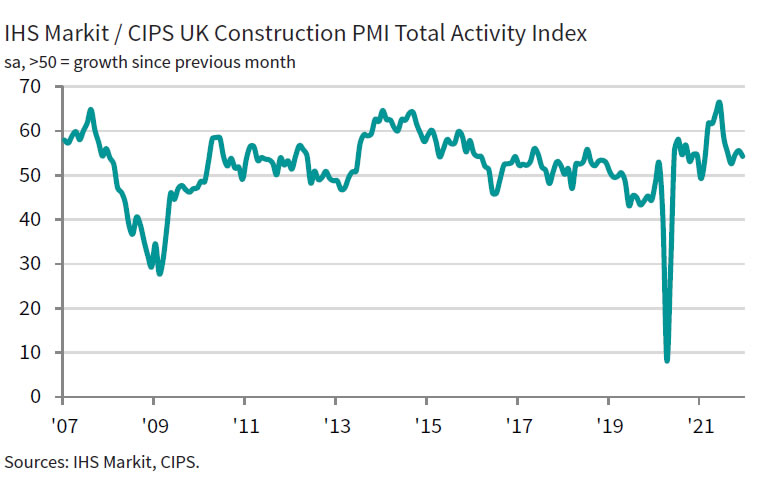
The UK Construction PMI for December indicated that growth at cooled off and fallen to a 3-month low. The PMI slowed to 54.3, down from 55.5 in November. Although the construction sector continues to expand, the pace of expansion is considerably weaker than the summer months, when we were seeing readings in the mid-60s. This follows a disappointing Services PMI on Thursday, which fell from 58.5 to 53.6, its lowest level since February 2021.
The reason for the weak PMIs is the spread of the Omicron Covid variant, which has taken a toll on hospitality and travel as well as construction activity. Although Omicron appears to be milder than other Covid variants, the numbers of infections has skyrocketed, and this could result in negative growth for the UK in December and January. This could cause the Bank of England to delay its next rate hike, which had been expected as early as February.
There is plenty of anticipation ahead of the US nonfarm payroll release, especially after the huge ADP release earlier this week. The ADP gain of 807 thousand was double the consensus of 400 thousand, but historically, ADP has not been a reliable gauge of nonfarm payrolls.
The forecast for NFP is around 425 thousand, and a release below 250 thousand or above 550 thousand could shake up the US dollar. Investors are starting to get nervous now that a Fed rate hike may be only a few months away, and the timeline for the first rate hike of the year could be impacted by the strength of the nonfarm payroll release. A strong gain would strengthen the likelihood of a March hike, while a soft NFP could delay a rate hike and result in a rotation out of US dollars.
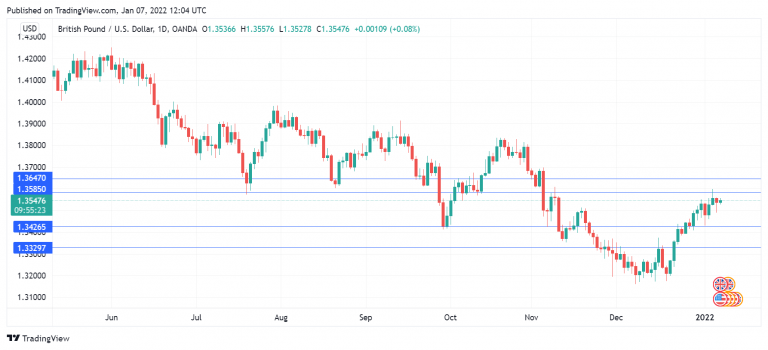
GBP/USD Technical Analysis
- GBP/USD has support at 1.3426 and 1.3329
- There is resistance at 1.3585. Above, there is resistance at 1.3647
Canadian Dollar Calm ahead of Job Reports
The Canadian dollar is on a holding pattern ahead of key Canadian and US employment reports later today. Currently, USD/CAD is trading just above the 1.27 line.
Nonfarm payrolls could shake up US dollar
It could be an active North American session for the Canadian dollar, with the release of Canada’s job creation numbers and the US nonfarm payrolls. Expectations are low for the Canadian data, with a forecast of just 27 thousand new jobs in December, after a robust gain of 153 thousand in November. There is plenty of anticipation around the nonfarm payroll release, however, especially after the monster ADP release earlier this week. The ADP gain of 807 thousand was double the consensus of 400 thousand, but historically, ADP has not been a reliable gauge of nonfarm payrolls.
The forecast for NFP is around 425 thousand, and a release below 250 thousand or above 550 thousand could shake up the US dollar. Investors are starting to get nervous now that a Fed rate hike could only a few months away, and the timeline for the first rate hike could be impacted by the strength of the nonfarm payroll release. A strong gain would strengthen the likelihood of a March hike, while a soft NFP could delay lift-off of a hike, which could lead to a rotation out of US dollars.
In determining when to start hiking, policymakers will be looking not only at the strength of the recovery but also at inflationary pressures. The Fed has abandoned its view that inflation is ‘transitory’ and this week’s FOMC minutes indicated that policymakers viewed inflation risks to the upside and are also concerned about the very tight job market. The minutes also stated that the Fed is considering scaling back its balance sheet as another brake on the economy. The markets took note, with 10-year bonds rising above 1.70% and CME FedWatch pegging the likelihood of a March hike above 70%.
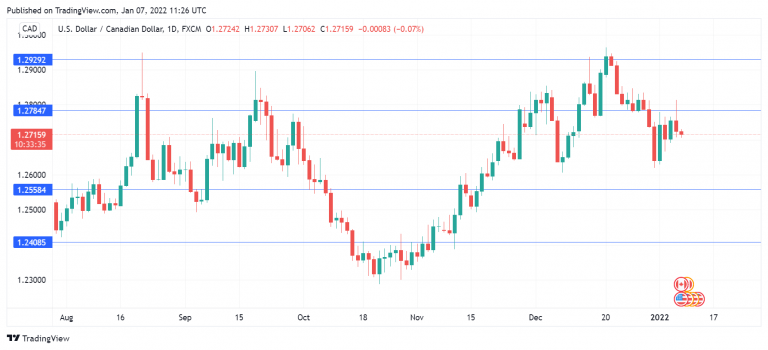
USD/CAD Technical
- USD/CAD is testing resistance at 1.2784. Above, there is resistance at 1.2929
- There are support levels at 1.2558 and 1.2477
Eurozone economic sentiment dropped to 115.3 in Dec, EU down to 114.5
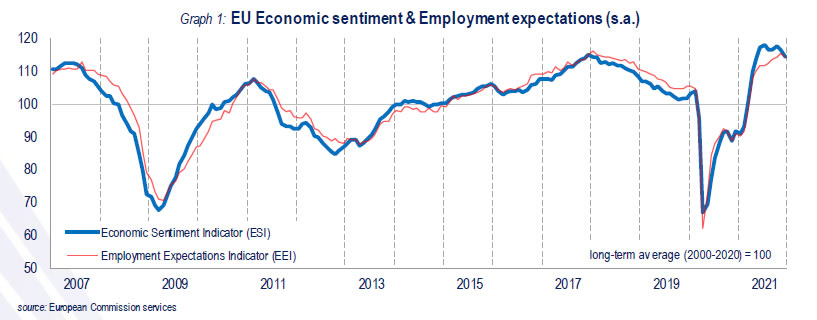
Eurozone Economic Sentiment Indicator dropped -2.3 pts to 115.3 in December. Employment Expectations Indicator dropped -1.6 pts to 114.0. Industry confidence rose from 14.3 to 14.9. Services confidence dropped sharply from 18.3 to 11.2. Consumer confidence dropped from -6.8 to -8.3. Retail trade confidence dropped from 3.7 to 1.1. Construction confidence rose from 9.0 to 10.2.
EU ESI dropped -2.1 pts to 114.5. EEI dropped -1.4 pts to 114.2. Amongst the largest EU economies, the ESI rose only in Poland (+0.6). By contrast, confidence worsened in the Netherlands (-4.1), Germany (-2.8), France (-2.1), Italy (-1.6) and Spain (-0.8).
Eurozone retail sales rose 1.0% mom in Nov, EU up 0.9% mom
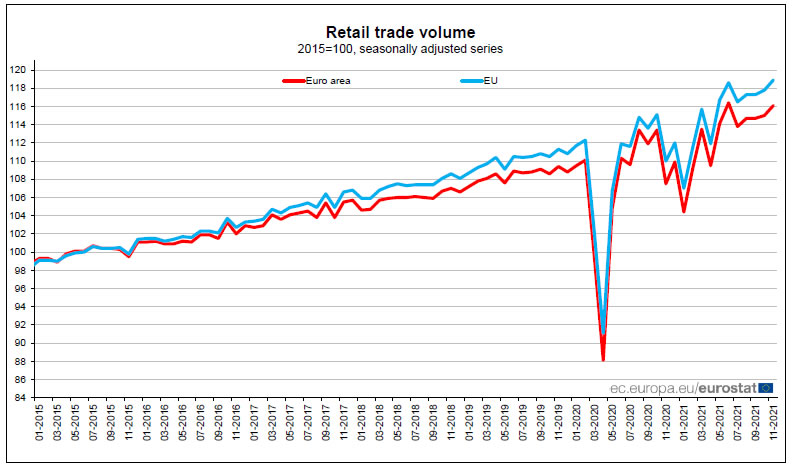
Eurozone retail sales rose 1.0% mom in November, much better than expectation of -0.5%. Volume of retail trade increased by 1.6% for non-food products and by 0.6% for food, drinks and tobacco, while it fell by -1.5% for automotive fuels.
EU retail sales rose 0.9% mom. Among Member States for which data are available, the highest monthly increases in the total retail trade volume were registered in Spain (+4.9%), Luxembourg (+4.0%) and Portugal (+2.8%). The largest decreases were observed in Austria (-4.1%), Latvia (-3.6%) and Croatia (-3.1%).
Eurozone CPI accelerated to 5.0% yoy in Dec, another record
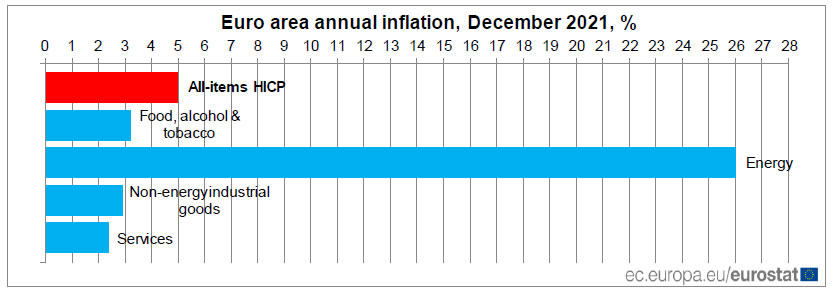
Eurozone inflation accelerated from 4.9% to 5.0% in December, above expectation of 4.7% yoy. That's another record print since record began in 1991. CPI core was unchanged at 2.6% yoy, above expectation of 2.3% yoy.
Energy is expected to have the highest annual rate in December (26.0%, compared with 27.5% in November), followed by food, alcohol & tobacco (3.2%, compared with 2.2% in November), non-energy industrial goods (2.9%, compared with 2.4% in November) and services (2.4%, compared with 2.7% in November).
UK PMI construction dropped to 54.3, worst phase of supplier delays passed
UK PMI Construction dropped from 55.5 to 54.3 in December, above expectation of 53.9. Markit said weakness centered on commercial and civil engineering segments. House building regained its place as fastest-growing category. Suppliers delay were the least widespread since November 2020.
Tim Moore, Director at IHS Markit: "UK construction companies ended last year on a slightly weaker footing... The worst phase of supplier delays seems to have passed... Input cost inflation moved down another notch.... The latest rise in purchasing prices was far slower than the 24-year peak seen last June."
Yen Hovers Just Below 116
All eyes are on US nonfarm payrolls, perhaps the monthly highlight on the economic calendar. An interesting prelude to nonfarm payrolls was the ADP employment report on Wednesday. ADP is not a reliable indicator for the NFP, but it always garners a fair degree of attention, coming just before the nonfarm payrolls release.
The December ADP delivered a massive overperformance, to the tune of 807 thousand new jobs, crushing the forecast of 400 thousand. Such a miss to the upside could not be ignored, prompting Goldman Sachs to revise upwards its estimate for NFP from 450 thousand to 500 thousand. Still, the consensus is around 425 thousand, so unless it falls below 250 thousand or rises above 550 thousand, I don’t expect the markets to react and shake up the US dollar. A weak reading could delay a Fed rate hike and would drive a risk-on mood. Conversely, a strong release would support an earlier Fed hike and would be bullish for the US dollar.
Japan’s consumers hold tight to purse strings
In Japan, consumers cut back on spending in November. Household Spending declined by -1.3% y/y, the first drop in three months. With the economy showing signs of improvement, analysts had projected a 1.2% gain. The negative reading is particularly worrying as consumption fell before the rapid spread of Omicron in December. If consumer spending also fell in December, it will throw a wrench in the government’s plans to kickstart economic growth. The government is pushing companies to raise wages but businesses will be reluctant to do so if consumers hold tight to the purse strings.
The Japanese yen finds itself at 5-year lows against the greenback, courtesy of rising US Treasury yields. The 10-year yield, which finished 2021 above the 1.50% level, hasn’t missed a beat in the first week of 2022 and has risen to 1.73%. The widening US/Japan rate differential has been weighing on the yen, which is extremely sensitive to the rate differential. If US yields remain high, we could see USD/JPY break past the 118 mark over the coming weeks.
USD/JPY Technical
- USD/JPY continues to put pressure on resistance at 115.78. Above, there is resistance at 116.34
- There is support at 114.54 and 113.98

GBPJPY Bulls Hang in there Despite Minor Pullback to 157
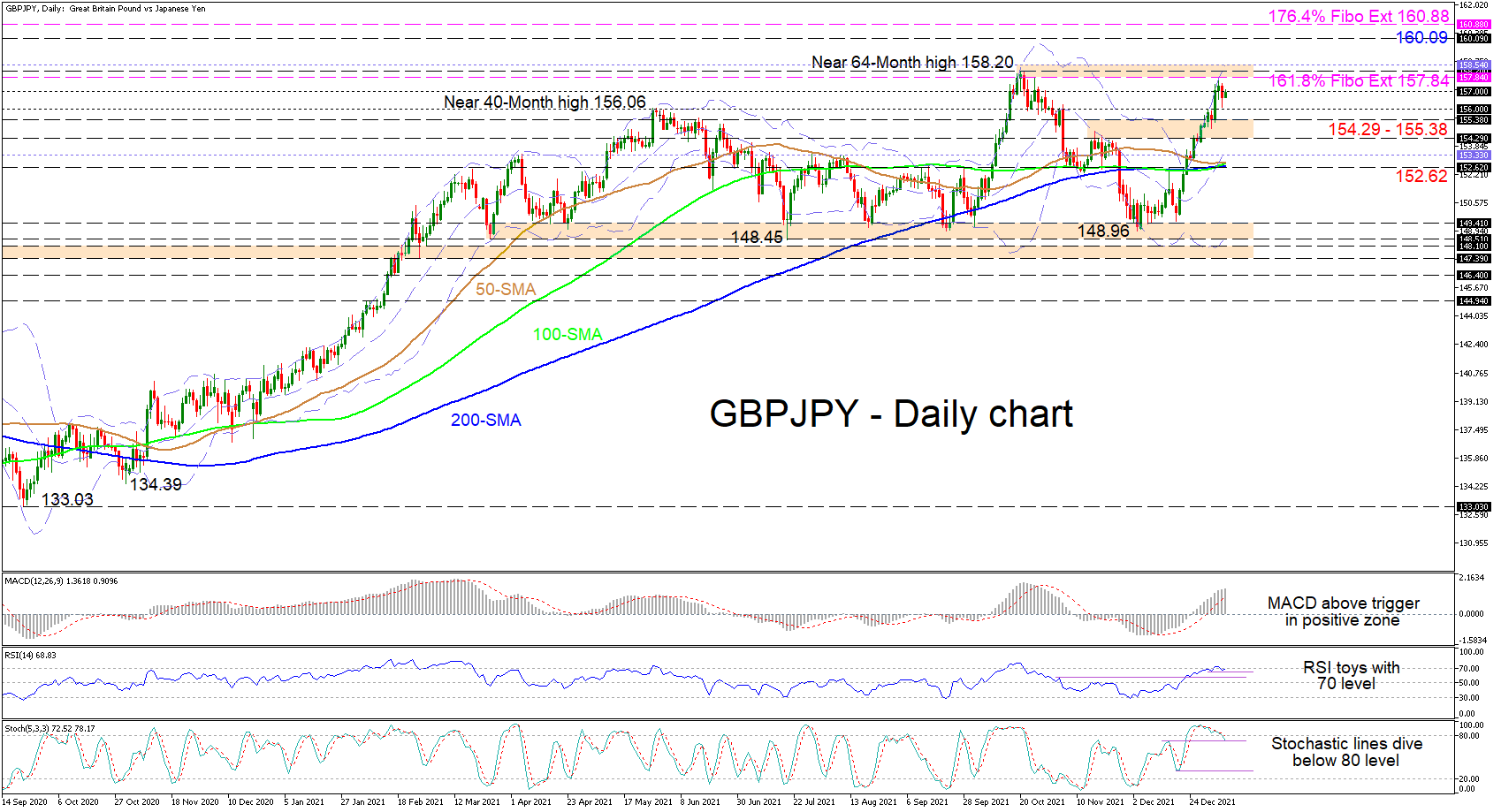
GBPJPY’s strong two-week rally, which began from 149.50 has lost steam just shy of the 157.84 level and the more than 5-year high of 158.20, the former being the 161.8% Fibonacci extension of the down leg from 144.94 until 124.00. The simple moving averages (SMAs) have flatlined, implying a more neutral bearing in the pair in the short-term timeframe.
The short-term oscillators are transmitting conflicting messages in directional momentum. The MACD, in the positive region, continues to strengthen above its red trigger line, while the RSI is flirting with the 70 overbought level. On the other hand, the stochastic oscillators’ bearish charge seems to be growing, which is promoting the pair’s recent negative impetus.
If sellers stay in control, downside friction could commence around the 156.00 handle ahead of the 154.29-155.38 support section. If the bears manage to drive the price beneath this key barrier, a deeper retracement could unfold with the price aiming for the fortified zone of support between the mid-Bollinger band at 153.33 and the 152.62 inside swing high.
Then again, if buying interest picks up, initial tough resistance could emanate from the 161.8% Fibo extension of 157.84 until the upper Bollinger band at 158.54, an area that also encompasses the more than 5-year high of 158.20. Successfully conquering this, the pair could propel for the critical 160.09 June peak of 2016, where the pair had previously collapsed, ahead of the 176.4% Fibo extension of 160.88.
Summarizing, GBPJPY’s neutral-to-bullish tone remains intact above the SMAs and the 148.96 trough. A jump above 158.20 could bolster bullish action, while a dip beneath the 154.29-155.38 support border could start to strengthen downside pressures.
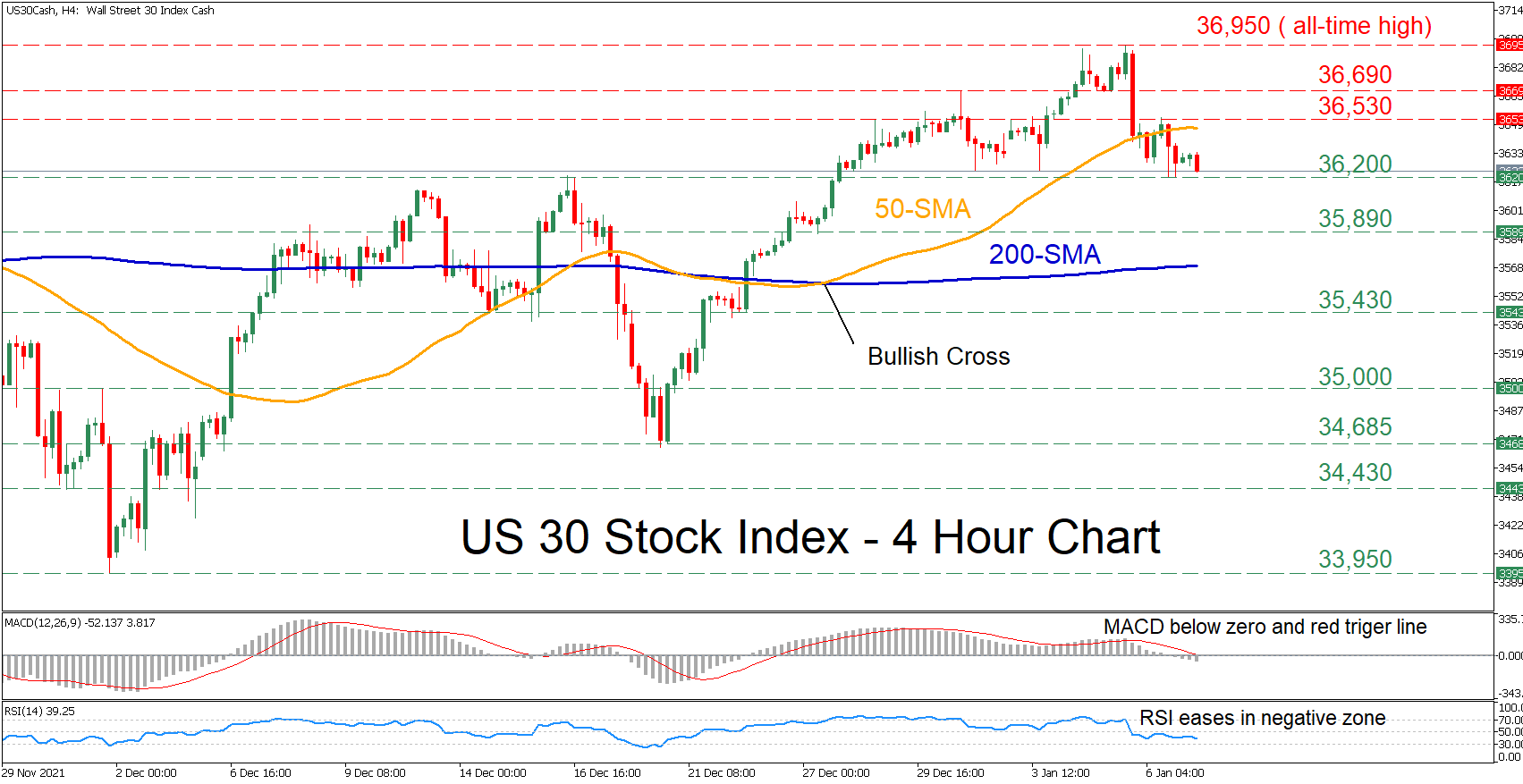
US 30 Retreats from All-Time High as Bearish Forces Reign
The US 30 stock index (cash) has been experiencing a minor pullback in the last few four-hour sessions since its long-term rally peaked at the all-time high of 36,950. Moreover, the price crossed below its 50-period simple moving average (SMA), reinforcing the index’s imminent bearish bias.
The recent retreat is likely to continue as the short-term oscillators confirm that sellers have gained the upper hand. The MACD is found below its red signal line in the negative region, while the RSI has flatlined well beneath its 50-neutral mark.
Should the selling pressure intensify further, immediate resistance could be encountered at the most recent low of 36,200. Piercing through this barrier, the price might dip towards 35,890 or lower to challenge the 35,430 hurdle. If the bears overcome these obstacles, the spotlight would turn to the 35,000 psychological mark.
Alternatively, if the bulls retake control, the 36,530 region could act as an initial resistance point for the price. Overcoming this barricade, the 36,690 obstacle could appear on the radar. Higher up, the price ascent might halt at the record high of 36,950, before it moves towards uncharted waters.
Overall, the US 30 stock index appears to have run out of steam after posting a new all-time high. However, a clear dive below 35,430 is needed to turn the medium-term outlook to negative.
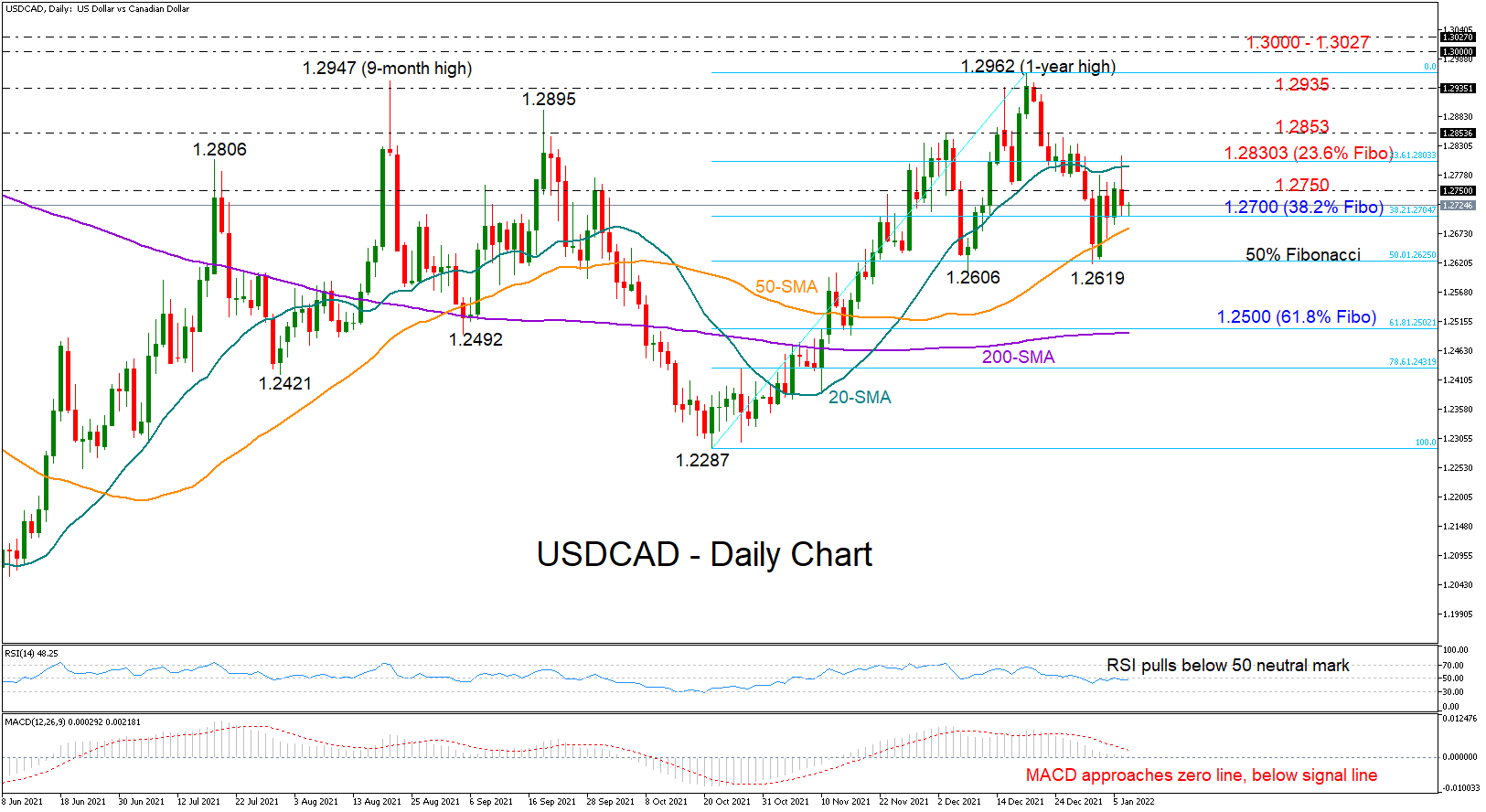
USDCAD Finds Support at 1.2700 but Mood Still Gloomy
USDCAD is facing difficulties in extending Monday’s swift bullish correction, which helped the pair survive a trend deterioration below the previous low of 1.2606 in the short-term window.
Despite the flash pickup to 1.2812 yesterday, the price flipped back to maintain its weekly neutral trajectory within the 1.2700 – 1.2750 region, with the former representing the 38.2% Fibonacci retracement of the 1.2287 – 1.2962 upleg.
The technical signals are currently illustrating a gloomy mood among traders as the MACD has further distanced itself below its red signal line in the positive area and the RSI is looking powerless to cross above its 50 neutral mark.
Support at 1.2700 and the 50-day simple moving average (SMA) currently at 1.2685 are keeping some buying interest in play at the moment. If they fail to hold, all attention will shift back to the 1.2600 – 1.2619 floor, where any violation is expected to activate a sharp decline towards the 61.8% Fibonacci of 1.2500 and the 200-day SMA.
On the upside, a close above 1.2750 could bring the area around the 23.6% Fibonacci of 1.2800 back under examination. Climbing higher, the 1.2853 barrier could challenge the bulls ahead of the 1.2935 – 1.2962 resistance zone. Then, not far above, the 1.3000 – 1.3027 bar from August – November 2020 could be another tough obstacle.
In brief, although the short-term uptrend in USDCAD remains valid, negative risks continue to linger in the background. A clear move below 1.2700 – 1.2685 is expected to confirm a bearish bias.