Sample Category Title
AUD/USD Daily Report
Daily Pivots: (S1) 0.6504; (P) 0.6522; (R1) 0.6555; More...
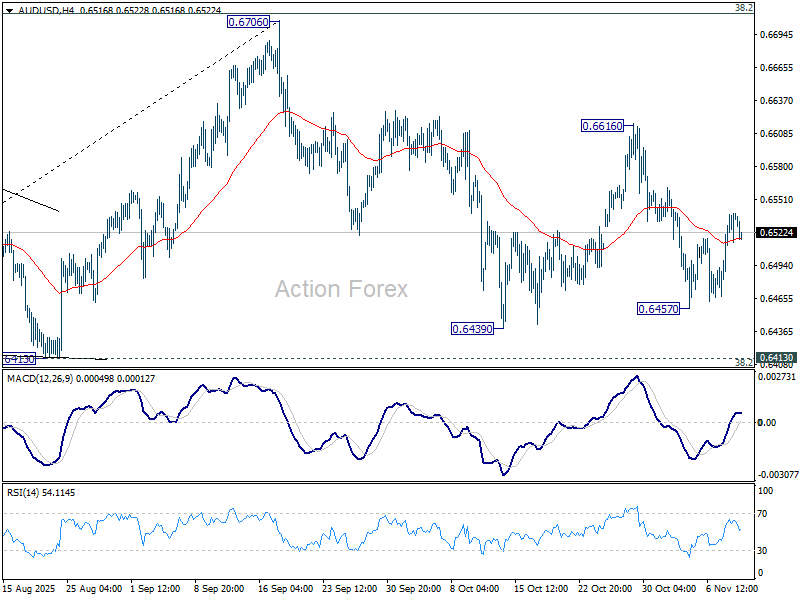
Intraday bias in AUD/USD stays neutral as sideway trading continues. On the downside, break of 0.6457 will target 0.6413 cluster (38.2% retracement of 0.5913 to 0.6706 at 0.6403). Decisive break there will carry larger bearish implications. On the upside, break of 0.6616 will bring retest of 0.6706 high instead.
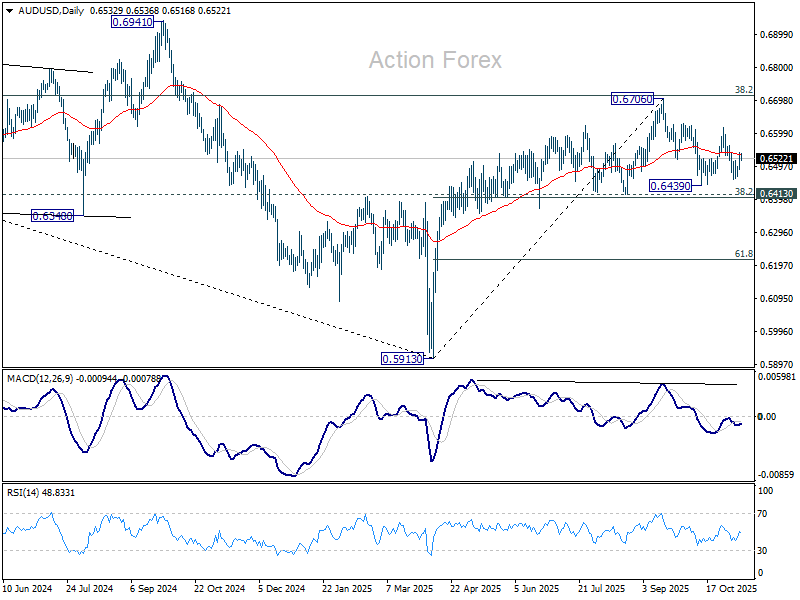
In the bigger picture, there is no clear sign that down trend from 0.8006 (2021 high) has completed. Rebound from 0.5913 is seen as a corrective move. Outlook will remain bearish as long as 38.2% retracement of 0.8006 to 0.5913 at 0.6713 holds. Break of 0.6413 support will suggest rejection by 0.6713 and solidify this bearish case. Nevertheless, considering bullish convergence condition in W MACD, sustained break of 0.6713 will be a strong sign of bullish trend reversal, and pave the way to 0.6941 structural resistance for confirmation.
EUR/USD Daily Outlook
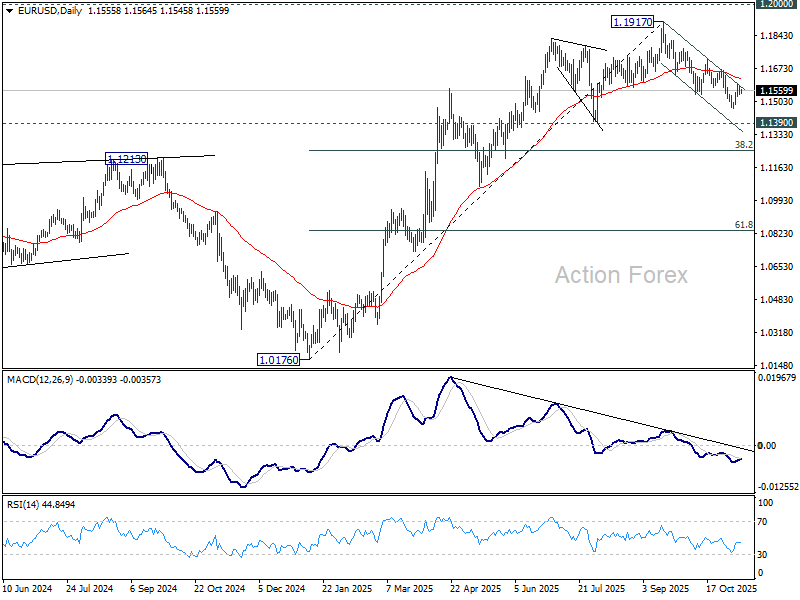
Daily Pivots: (S1) 1.1538; (P) 1.1560; (R1) 1.1580; More…
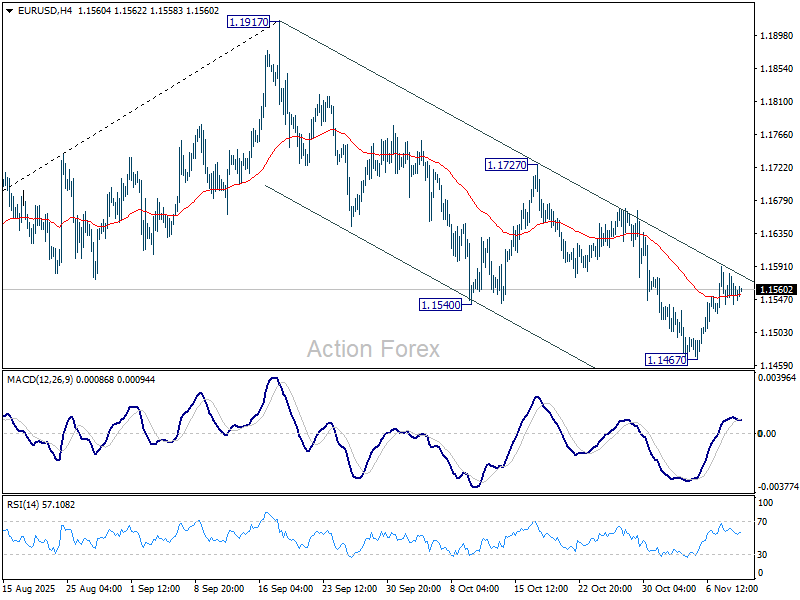
Intraday bias in EUR/USD stays neutral and outlook is unchanged. Further fall would remain in favor as long as 55 D EMA (now at 1.1623) holds. Below 1.1467 will resumed the decline from 1.1917 to 1.1390 support next. However, sustained trading above 55 D EMA will argue that fall from 1.1971 has completed as a correction only, and bring further rise to 1.1727 resistance next.
In the bigger picture, considering bearish divergence condition in D MACD, a medium term top is likely in place at 1.1917, just ahead of 1.2 key psychological level. As long as 55 W EMA (now at 1.1306) holds, the up trend from 0.9534 (2022 low) is still expected to continue. Decisive break of 1.2000 will carry larger bullish implications. However, sustained trading below 55 W EMA will argue that rise from 0.9534 has completed as a three wave corrective bounce, and keep long term outlook outlook bearish.
GBP/USD Daily Outlook
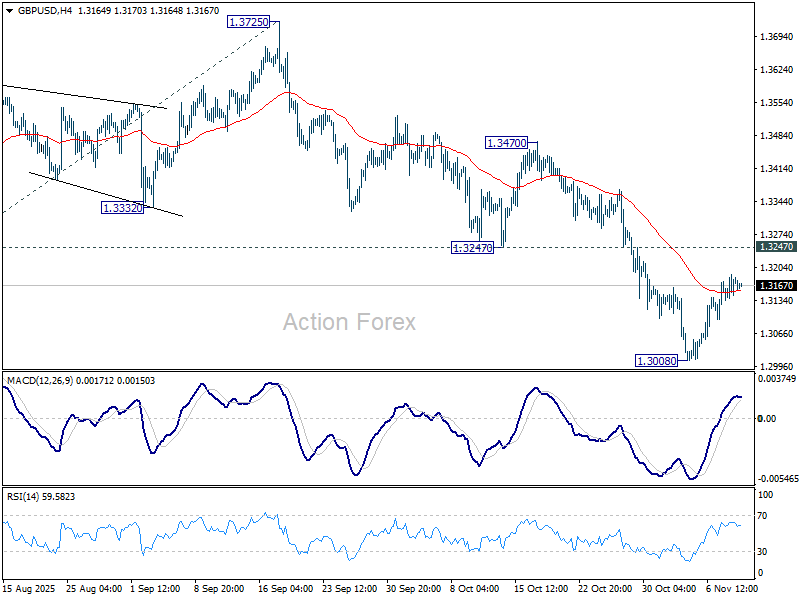
Daily Pivots: (S1) 1.3144; (P) 1.3168; (R1) 1.3198; More...
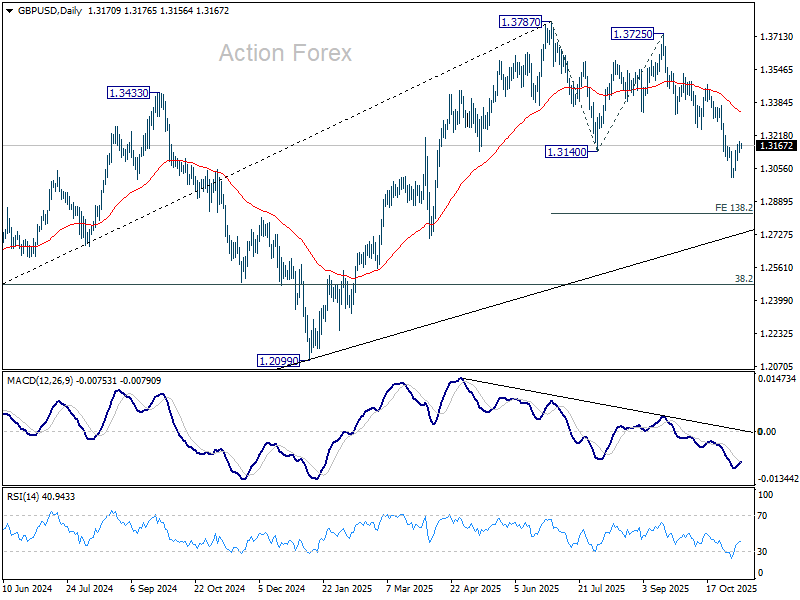
Intraday bias in GBP/USD remains neutral and more consolidations would be seen above 1.3008. Further decline is expected as long as 1.3247 support turned resistance holds. Break of 1.3008 will target 138.2% projection of 1.3787 to 1.3140 from 1.3725 at 1.2831. Nevertheless, firm break of 1.3247 will suggest that fall from 1.3787 has completed as a corrective move already.
In the bigger picture, the break of 55 W EMA (now at 1.3185) is taken as the first sign that corrective rise from 1.0351 (2022 low) has completed. Decisive break of trend line support (now at 1.2780) will solidify this case and target 38.2% retracement of 1.0351 to 1.3787 at 1.2474 next. Meanwhile, in case of another rise, strong resistance should emerge below 1.4248 (2021 high) to cap upside to preserve the long term down trend.
USD/CHF Daily Outlook
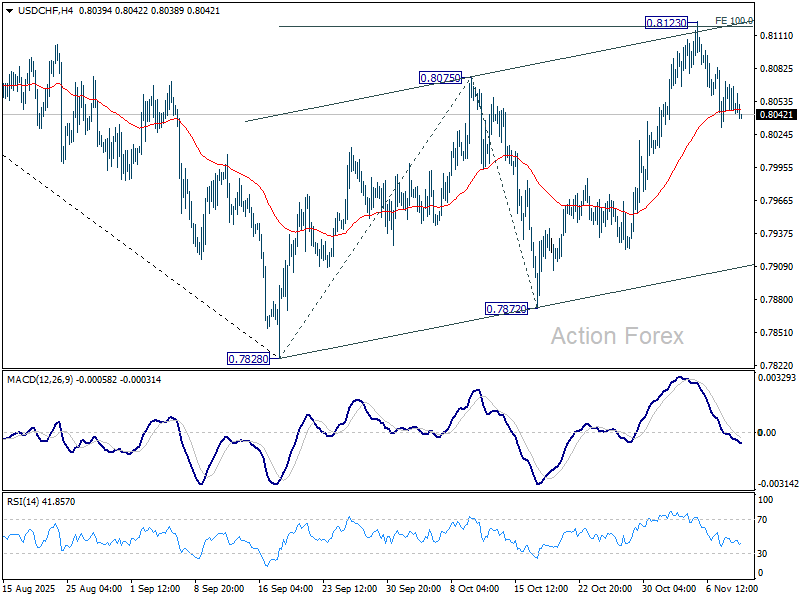
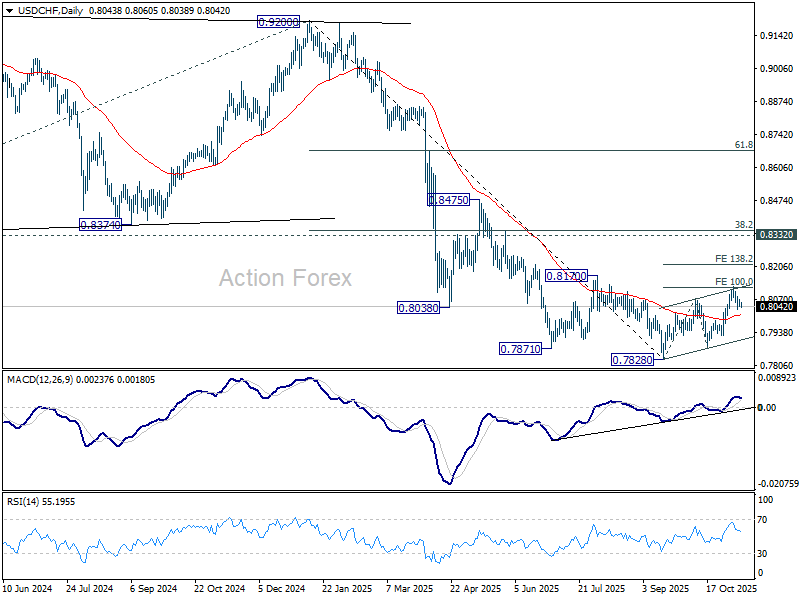
Daily Pivots: (S1) 0.8038; (P) 0.8056; (R1) 0.8067; More…
Intraday bias in USD/CHF remains neutral and outlook is unchanged. On the downside, decisive break of 55 D EMA (now at 0.8008) will argue that the corrective bounce from 0.7828 has completed and bring retest of this low. On the upside, above 0.8123 will resume the rebound to 138.2% projection of 0.7828 to 0.8075 from 0.7872 at 0.8213.
In the bigger picture, long term down trend from 1.0342 (2017 high) is still in progress. Next target is 100% projection of 1.0146 (2022 high) to 0.8332 from 0.9200 at 0.7382. In any case, outlook will stay bearish as long as 0.8332 support turned resistance holds (2023 low).
USD/JPY Daily Outlook
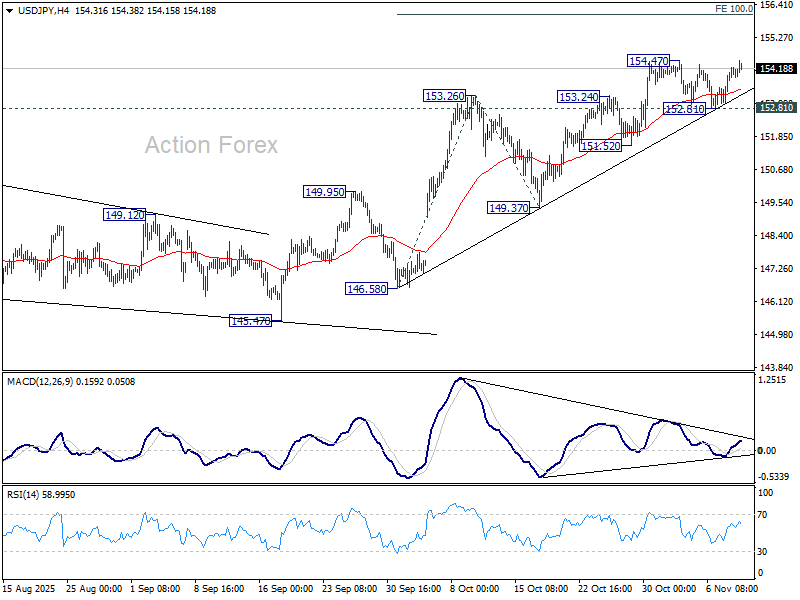
Daily Pivots: (S1) 153.64; (P) 153.95; (R1) 154.43; More...
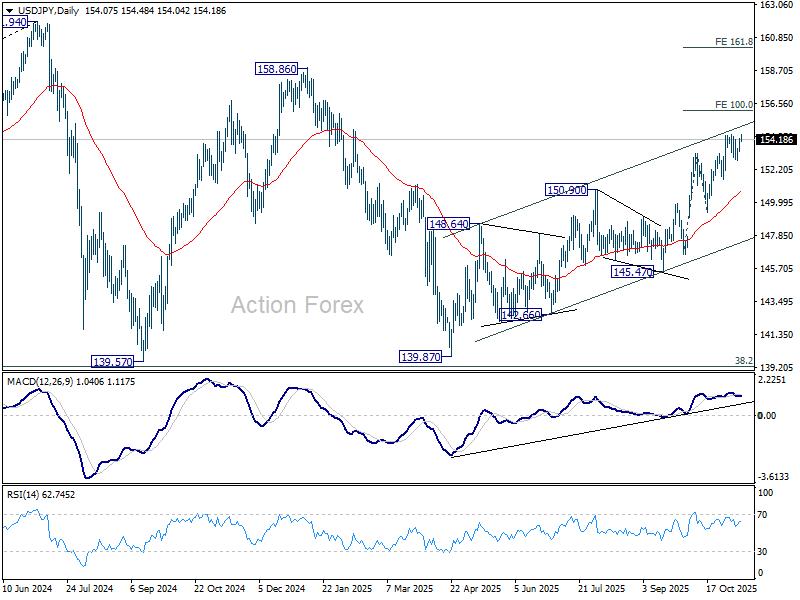
Immediate focus is now on 154.47 resistance in USD/JPY. Decisive break there will confirm resumption of whole up trend from 139.87. Next target is 100% projection of 146.58 to 153.26 from 149.37 at 156.05. Break there will pave the way to 158.85 key structural resistance. However, break of 152.81 support will turn bias back to the downside for 149.37 support for deeper correction.
In the bigger picture, current development suggests that corrective pattern from 161.94 (2024 high) has completed with three waves at 139.87. Larger up trend from 102.58 (2021 low) could be ready to resume through 161.94 high. On the downside, break of 149.37 support will dampen this bullish view and extend the corrective pattern with another falling leg.
Wall Street Rallies But Asia Cools After Early Lift, Yen Stays Weak
U.S. markets surged overnight after lawmakers in Washington moved closer to ending the country’s record-breaking government shutdown, boosting risk sentiment across equities and commodities. The Senate’s approval of a bipartisan deal eased fiscal uncertainty and restored momentum to Wall Street, where Nvidia, Palantir, and Broadcom led a powerful rebound in technology and AI-linked stocks.
The rebound also marked a sharp reversal from last week’s caution when concerns over stretched AI valuations triggered broad profit-taking. Those fears have quickly taken a back seat, replaced by renewed risk appetite as investors welcomed the prospect of a fiscal resolution and an extended runway for the U.S. economy. Greed, it seems, has once again overtaken fear.
The U.S. Senate on Monday approved a bipartisan compromise to end the country’s longest-ever shutdown, passing the measure by 60 votes to 40 with support from nearly all Republicans and eight Democrats. The agreement would restore funding for government agencies that have been shuttered since October 1 and halt President Donald Trump’s drive to downsize the federal workforce, preventing further layoffs until January 30.
The legislation now moves to the Republican-controlled House of Representatives, where Speaker Mike Johnson has pledged swift action, aiming to pass the bill as soon as Wednesday and send it to the President for signature. The resolution would end a damaging impasse that has frozen public-sector activity and delayed key economic data, paving the way for normalization ahead of the Fed’s December meeting.
Wall Street welcomed the news with conviction. DOW rose 0.81%, S&P 500 climbed 1.54%, and NASDAQ Composite surged 2.27%, powered by strong gains in chipmakers and AI-linked names. Treasury yields inched higher, with 10-year yield up 1.7bps to 4.11. Asian markets, however, offered a more tempered response. Initial gains faded through the session, leaving the region mixed. At the time of writing, Nikkei is down -0.17%, Hong Kong’s HSI -0.35%, and Shanghai’s SSE -0.44%, while Singapore’s Straits Times outperforms with a 1.11% advance.
In currency markets, optimism was more restrained. Aussie led gains for the week so far on improving risk tone, followed by Kiwi and Swiss Franc. Yen remained the weakest performer, pressured by Tokyo’s commitment to maintaining easy monetary conditions, while Euro and Dollar both softened modestly within tight ranges. Sterling and the Canadian Dollar traded mid-pack. Most pairs are still confined within last week’s ranges.
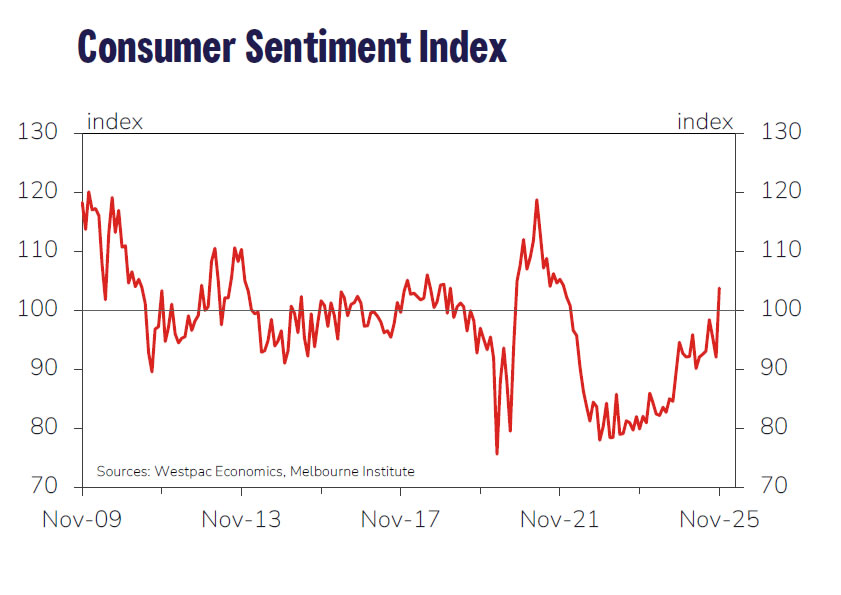
Australia Westpac consumer confidence surges to 103.8, marking end of prolonged pessimism
Australian consumer confidence jumped sharply in November, marking a clear break from years of pessimism. The Westpac Consumer Sentiment Index rose 12.8% mom to 103.8, its first positive reading since early 2022 and the highest in seven years, excluding the brief COVID-era spike. The surge was underpinned by a sharp improvement in views on the economy, with the 12-month and five-year outlook sub-indexes rising 16.6% and 15.3%, respectively—both now well above long-run averages.
Westpac said the result “draws a clearer line” under the prolonged period of consumer strain caused by high inflation, elevated interest rates, and rising tax burdens. The rebound likely reflects stronger domestic momentum, particularly in housing and consumer demand, as well as a more stable external backdrop. The recent de-escalation in U.S.–China trade tensions and a new Australia–U.S. deal on critical minerals have also buoyed sentiment.
The real surprise, according to Westpac, is how decisively these positive forces outweighed lingering worries about inflation and future rate settings. The data suggest households are regaining confidence in Australia’s recovery prospects even as monetary policy remains tight—offering a fresh signal that consumer resilience could help underpin growth heading into 2026.
RBNZ survey points to one more cut, then extended hold through 2026
New Zealand’s inflation expectations remain well anchored, while rate projections signal the RBNZ’s easing cycle is nearing its end.
The latest RBNZ Survey of Expectations showed the mean one-year-ahead inflation expectation edging up slightly to 2.39% from 2.37%. Two-year expectation stayed unchanged at 2.28%. Longer-term views were broadly steady, with the five-year expectation easing to 2.22% and the ten-year measure rising modestly to 2.18%—all consistent with the Bank’s 1–3% target midpoint.
Respondents now see the Official Cash Rate, currently at 2.50% following October’s 50bps cut, at 2.25% by year-end, implying just one more 25bps reduction before policy stabilizes. The one-year-ahead OCR expectation fell sharply to 2.31% from 2.86%, indicating that market participants expect the RBNZ to remain on hold through much of 2026 as inflation trends near target and growth moderates.
Growth over currency defense: Japan’s low-rate bias to fuel CHF/JPY rally
Yen weakness persisted as comments from Japan’s officials reinforced the view of supporting growth through lower interest rates outweighs concerns about further Yen depreciation.
Economic Revitalization Minister Minoru Kiuchi acknowledged today that a weaker Yen can push up prices prices. However, he also emphasized that “import prices in Yen terms have been falling for eight consecutive months.” The latest BoJ Corporate Goods Price Index showed that annual import price inflation has been negative throughout 2025, except in January. This underlines Kiuchi’s message that the government remains broadly comfortable with current exchange rate trends.
Taken together with recent comments from other officials, Tokyo’s stance appears tolerant of moderate Yen weakness. As long as the moves are not disorderly, authorities seem focused on broader economic stability rather than exchange-rate management.
The stance reflects clear priorities under new Prime Minister Sanae Takaichi, whose administration has emphasized growth and fiscal stimulus over premature monetary tightening. Her economic package leaves little ambiguity as she called it “extremely important” for monetary policy to focus on achieving strong economic growth
Takaichi also explicitly urged the BoJ to reach 2% inflation sustainably through wage gains, not cost-push effects. Her stance effectively discourages early tightening, highlighting that policy coordination now leans toward growth-first rather than currency defense.
This political backdrop makes it increasingly unlikely that Governor Kazuo Ueda will push for a rate hike at the December meeting. While BoJ board members have indicated readiness to tighten if inflation stays resilient, the growing government influence implies that any move may be delayed until early 2026—and that the pace of normalization will remain slow thereafter.
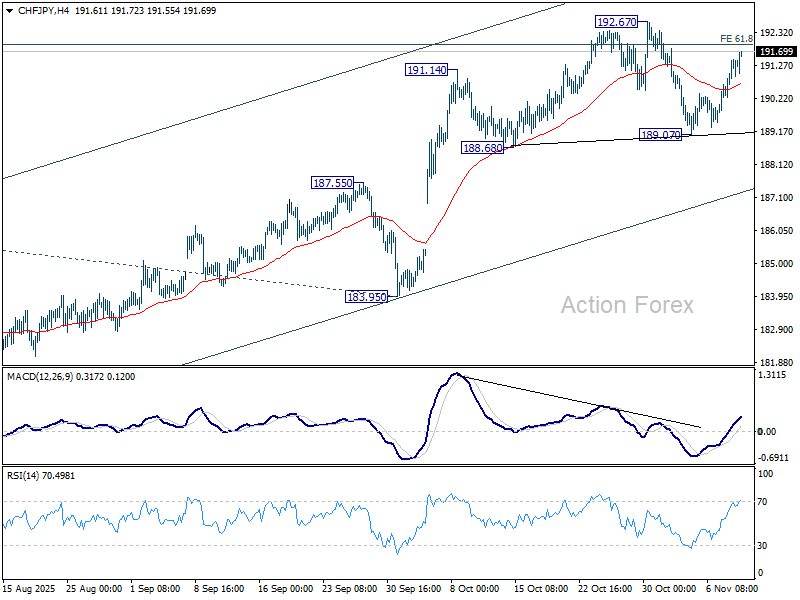
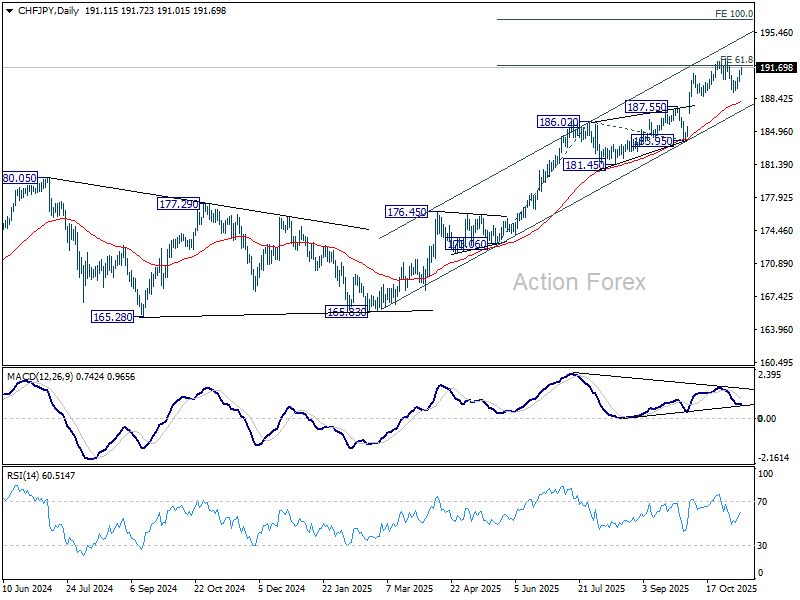
Technically, CHF/JPY’s rebound suggests that the pullback from 192.67 has completed at 189.07. Decisive break above 192.67 would resume the long term uptrend, targeting 100% projection of 173.06 to 186.02 from 183.95 at 196.91.
On the downside, however, firm break of 189.07 support would risk completing a head-and-shoulders top, signaling the end of the five-wave rally from 165.83.
USD/JPY Daily Outlook
Daily Pivots: (S1) 153.64; (P) 153.95; (R1) 154.43; More...
Immediate focus is now on 154.47 resistance in USD/JPY. Decisive break there will confirm resumption of whole up trend from 139.87. Next target is 100% projection of 146.58 to 153.26 from 149.37 at 156.05. Break there will pave the way to 158.85 key structural resistance. However, break of 152.81 support will turn bias back to the downside for 149.37 support for deeper correction.
In the bigger picture, current development suggests that corrective pattern from 161.94 (2024 high) has completed with three waves at 139.87. Larger up trend from 102.58 (2021 low) could be ready to resume through 161.94 high. On the downside, break of 149.37 support will dampen this bullish view and extend the corrective pattern with another falling leg.
Bitcoin’s Relief Rally Faces Resistance — Could the Bounce Be Short-Lived?
Key Highlights
- Bitcoin started a recovery wave above $103,500 and $105,000.
- BTC/USD cleared a key bearish trend line with resistance at $104,000 on the 4-hour chart.
- Ethereum also started a decent increase above $3,400.
- XRP price climbed above $2.50 to move into a positive zone.
Bitcoin Price Technical Analysis
Bitcoin price found support near $98,500 and started a recovery wave against the US Dollar. BTC climbed above $102,000 and $103,500 to enter a short-term positive zone.
Looking at the 4-hour chart, the price surpassed the 50% Fib retracement level of the downward move from the $126,279 swing high to the $103,447 low. During the increase, the price broke a key contracting triangle with resistance at $112,900.

BTC settled above $113,000, the 100 simple moving average (red, 4-hour), and the 200 simple moving average (green, 4-hour). If the price extends gains, it could face resistance at $116,500.
The main hurdle is now forming near $117,550 and the 61.8% Fib retracement level of the downward move from the $126,279 swing high to the $103,447 low. A successful close above $117,550 might start another steady increase. In the stated case, the price may perhaps rise toward the $118,800 level. Any more gains might call for a test of $120,000.
Immediate support sits at $112,200. A downside break below $112,200 might start another decline. The next major support is $111,500. Any more losses might call for an extended decline toward the $108,800 support zone.
Looking at Ethereum, the price was able to follow Bitcoin and climbed above the $4,000 resistance region.
Today’s Key Economic Releases
- UK Claimant Count Change for Oct 2025 – Forecast 20.3K, versus 25.8K previous.
- UK ILO Unemployment Rate for Sep 2025 (3M) – Forecast 4.9%, versus 4.8% previous.
- US NFIB Business Optimism Index for Oct 2025 – Forecast 98.3, versus 98.8 previous.
RBNZ survey points to one more cut, then extended hold through 2026
New Zealand’s inflation expectations remain well anchored, while rate projections signal the RBNZ’s easing cycle is nearing its end.
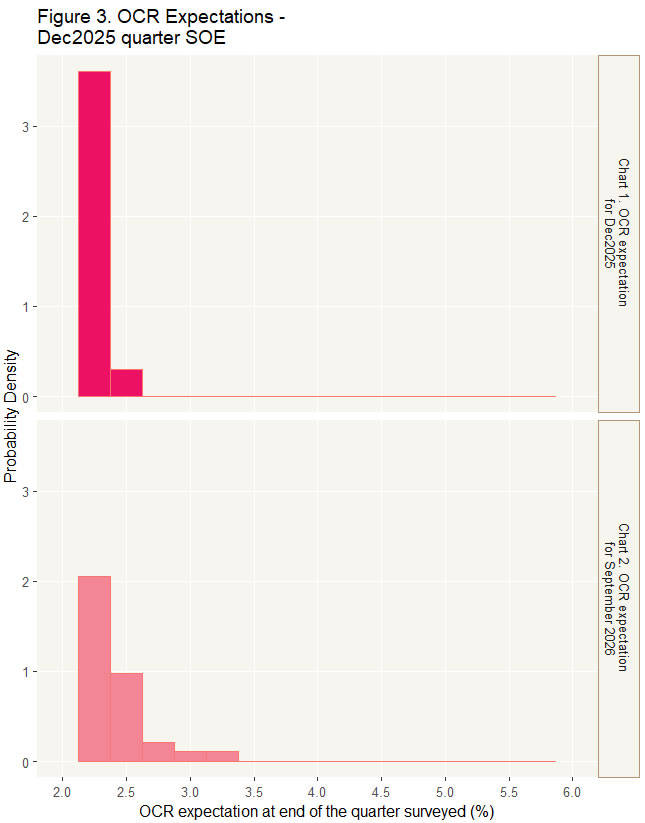
The latest RBNZ Survey of Expectations showed the mean one-year-ahead inflation expectation edging up slightly to 2.39% from 2.37%. Two-year expectation stayed unchanged at 2.28%. Longer-term views were broadly steady, with the five-year expectation easing to 2.22% and the ten-year measure rising modestly to 2.18%—all consistent with the Bank’s 1–3% target midpoint.
Respondents now see the Official Cash Rate, currently at 2.50% following October’s 50bps cut, at 2.25% by year-end, implying just one more 25bps reduction before policy stabilizes. The one-year-ahead OCR expectation fell sharply to 2.31% from 2.86%, indicating that market participants expect the RBNZ to remain on hold through much of 2026 as inflation trends near target and growth moderates.
Growth over currency defense: Japan’s low-rate bias to fuel CHF/JPY rally
Yen weakness persisted as comments from Japan’s officials reinforced the view of supporting growth through lower interest rates outweighs concerns about further Yen depreciation.
Economic Revitalization Minister Minoru Kiuchi acknowledged today that a weaker Yen can push up prices prices. However, he also emphasized that “import prices in Yen terms have been falling for eight consecutive months.” The latest BoJ Corporate Goods Price Index showed that annual import price inflation has been negative throughout 2025, except in January. This underlines Kiuchi’s message that the government remains broadly comfortable with current exchange rate trends.
Taken together with recent comments from other officials, Tokyo’s stance appears tolerant of moderate Yen weakness. As long as the moves are not disorderly, authorities seem focused on broader economic stability rather than exchange-rate management.
The stance reflects clear priorities under new Prime Minister Sanae Takaichi, whose administration has emphasized growth and fiscal stimulus over premature monetary tightening. Her economic package leaves little ambiguity as she called it “extremely important” for monetary policy to focus on achieving strong economic growth
Takaichi also explicitly urged the BoJ to reach 2% inflation sustainably through wage gains, not cost-push effects. Her stance effectively discourages early tightening, highlighting that policy coordination now leans toward growth-first rather than currency defense.
This political backdrop makes it increasingly unlikely that Governor Kazuo Ueda will push for a rate hike at the December meeting. While BoJ board members have indicated readiness to tighten if inflation stays resilient, the growing government influence implies that any move may be delayed until early 2026—and that the pace of normalization will remain slow thereafter.
Technically, CHF/JPY’s rebound suggests that the pullback from 192.67 has completed at 189.07. Decisive break above 192.67 would resume the long term uptrend, targeting 100% projection of 173.06 to 186.02 from 183.95 at 196.91.
On the downside, however, firm break of 189.07 support would risk completing a head-and-shoulders top, signaling the end of the five-wave rally from 165.83.
Australia Westpac consumer confidence surges to 103.8, marking end of prolonged pessimism
Australian consumer confidence jumped sharply in November, marking a clear break from years of pessimism. The Westpac Consumer Sentiment Index rose 12.8% mom to 103.8, its first positive reading since early 2022 and the highest in seven years, excluding the brief COVID-era spike. The surge was underpinned by a sharp improvement in views on the economy, with the 12-month and five-year outlook sub-indexes rising 16.6% and 15.3%, respectively—both now well above long-run averages.
Westpac said the result “draws a clearer line” under the prolonged period of consumer strain caused by high inflation, elevated interest rates, and rising tax burdens. The rebound likely reflects stronger domestic momentum, particularly in housing and consumer demand, as well as a more stable external backdrop. The recent de-escalation in U.S.–China trade tensions and a new Australia–U.S. deal on critical minerals have also buoyed sentiment.
The real surprise, according to Westpac, is how decisively these positive forces outweighed lingering worries about inflation and future rate settings. The data suggest households are regaining confidence in Australia’s recovery prospects even as monetary policy remains tight—offering a fresh signal that consumer resilience could help underpin growth heading into 2026.