

Sample Category Title
Once Fed Engages to Additional Rate Cuts, They Should/Could Opt for a Bigger Start
Markets
An interview with US Treasury Secretary Bessent got full coverage thanks to an otherwise empty economic agenda. He suggested that the Fed should cut rates by 50 bps in September given lack of evidence of significant tariff-related inflation and following significant downward revisions to June and May payrolls data. Bessent thinks that the Fed probably already pulled the trigger if data would have been more accurate. He sees scope for the Fed funds target range to fall by 150-175 bps. While we don’t side with the total magnitude of policy easing, we do side with the argument that once the Fed engages to additional rate cuts, they should/could opt for a bigger start. The Powell Fed has a history of waiting until they are absolutely convinced about something and then opting to move quickly. In this respect, it’s telling that US money markets in the wake of the Bessent interview for the first time discounted more than a 25 bps rate cut in September. It even triggered hawkish comments by Chicago Fed Goolsbee (voter) who warned against being lurched into action especially given persisting services inflation. We’d err on the side of the dovish positioning to be extended though if today’s (producer price inflation, weekly jobless claims) or tomorrow’s (retail sales, empire manufacturing survey, University of Michigan consumer confidence) data shows signs of weakness. US Treasuries rallied yesterday with the curve moving lower in a parallel shift (5-6 bps across). We continue to prefer steepening going forward. EUR/USD closed above 1.17 for the first time since end July with the YtD top at 1.1829 being the reference. The approaching Alaska summit between US president Trump and Russian president Putin is a wildcard for trading.
News & Views
Australian labour market data for the month of July came out near consensus this morning. Employment rose by 24.5k (from +2k in June and vs +25k consensus). The full-time/part-time breakdown was opposite to last month. More pronounced gains in full-time occupations (+60.5k) were partly offset by a 35.9k decline in part-time jobs. The unemployment rate ticked lower (4.3% to 4.2%) but the participation rate (67.1% to 67%) did the same thing. The female employment-to-population ratio and participation rate reached 60.9% and 63.5% respectively, both new historical highs. In a separate release, the Australian Bureau of Statistics indicated that average weekly ordinary time earnings for full-time adults has been greater than A$2000 for the first time ever in May (A$2010). Annual wage growth remained high at 4.5%. The solid labour market report strengthens the view that the Reserve Bank of Australia can take a gradual normalization approach going forward after lowering its policy rate by 25 bps to 3.6% earlier this week. Money markets favour a skip at the next, September, meeting followed by a 25 bps rate cut in November. They see room for one more additional move after that early next year. The Aussie dollar briefly profited from the labour numbers, but couldn’t hold on to gains. AUD/USD (0.6550) is locked in a trading range between roughly 0.64 and 0.66.
The UK Royal Institution of Chartered Surveyors (RICS) released its July Residential Market Survey. Sales market conditions remain challenging with previous signs of recovery faltering somewhat. Measures of demand (new buyer enquiries – 6 from +4) and agreed sales (-16 from -4) slipping back into negative territory. Meanwhile, forward-looking sentiment now points to a largely flat picture for activity in the near-term (1 from 7). At the 12-month time horizon, sentiment is a little more positive, with a net balance of +8% of contributors anticipating a pick-up in sales activity. Supply indicators point at marginal growth when it comes to new listings on the market and a flatter pipeline for new instructions moving forward. House price indicators signalled a small downward adjustment in average house prices across the country. Over the coming three months, respondents expect prices to remain under a small degree of downward pressure. The 12-month outlook however thus suggest and increase in prices.
US PPI Could Douse Overheated Fed Cut Bets
Investors spent Wednesday betting that the Federal Reserve (Fed) would not only cut rates by 25bp in September but could even deliver a jumbo rate cut, after CPI data released the day before came in softer than analysts expected. Fed doves now see a huge opportunity for the central bank to focus on the slowing jobs market rather than tariff-led inflation risks that have yet to materialise. Fed funds futures currently price around a 95% probability of a 25bp cut and 5% for a 50bp cut. Bets that the Fed would hold off due to inflation risks are now largely off the table. According to Bessent, US rates should be 150–175bp lower.
Diving deeper: Scott Bessent also said that the unique model Trump put in place — forcing a 15% cut from Nvidia and AMD’s Chinese businesses — could serve as a blueprint for other industries. While the approach may make the US government look like a mafia organisation, it would have a major impact in controlling the exploding US debt. In theory, that could mean lower sovereign bond issuance and, over time, reduced long-term borrowing costs. That would be good for companies and valuations — though it would come with a price tag. Bonds reacted positively with the downside pressure on yields coming primarily from dovish Fed expectations. The US 2-year yield is now testing its August lows; the 10-year is steady around 4.23% — well below the 4.50–5.00% range that some have framed as the new normal amid structurally higher long-term inflation bets. The US dollar index has fallen for a third straight session, while Bitcoin hit a fresh record.
Today’s US PPI figures could cool overheated dovish Fed bets, as both headline and core readings are expected to tick higher on tariff costs. If that’s the case, some of the more aggressive bets — especially the 50bp camp — could be reversed by week’s end. Delivering a jumbo cut amid inflation uncertainty could risk a repeat of last September’s market backlash. A 25bp move would likely deliver a steadier, more predictable reaction. Also, Bessent believes the Bank of Japan (BoJ) is ‘behind the curve’ in addressing inflation and should hike. The USDJPY dropped to test its 50-day moving average and the Nikkei fell 1%.
In US equities, rising rate-cut expectations pushed the S&P 500 and Nasdaq to fresh all-time highs yesterday. The equal-weight S&P 500 narrowed its gap with the original, tech-heavy version. Nvidia slipped after CoreWeave — a ‘neo-cloud’ provider backed by Nvidia and with Microsoft and OpenAI among its biggest customers — posted a larger-than-expected Q2 loss. But the loss was mainly due to higher spending and acquisitions to expand capacity quickly enough to meet demand. Revenue beat expectations by a wide margin at $1.20 billion versus $1.08 billion forecast. While volatile, CoreWeave’s drop may look attractive to investors betting that today’s losses are investments for tomorrow’s bigger gains.
The rally in small- and mid-cap stocks, which began after the August jobs report, is gaining momentum on dovish Fed expectations. Lower borrowing costs are especially important for smaller firms struggling with higher tariff-driven costs. That could pull money out of tech — which acted as a safe haven amid tariff and rate uncertainty — and into more rate-sensitive corners of the market.
The million-dollar question: could a premature, outsized cut reignite inflation and backfire? I have no answer. The new BLS chief will no doubt find ways to make the data look ‘not too bad.’
If the US tech rally fades, diversification may be prudent. The Stoxx 600 could catch up after its summer stall caused by tariff issues, though upside is likely capped given limited further potential in defence stocks that drove H1 gains.
Japanese equities — especially the tech-heavy Topix — remain a hot pick. Despite Bessent’s critics, the BoJ will likely support the economy against US disruptions. Meanwhile, Chinese equities remain strong on a stable flow of trade headlines. Mainland-listed firms are on track for 5% profit growth in Q2, rising to 13% for overseas-listed peers. Tencent beat expectations last quarter thanks to AI-driven segments, while Alibaba’s Cloud Intelligence Group posted triple-digit growth in AI-related product revenue, delivering 18% year-on-year growth. The Nasdaq Golden Dragon China index jumped 2% yesterday and is up nearly 30% since its April low, with room for further gains on supportive policy and growing AI demand.
EA Labour Market Resilience in Focus
In focus today
In the euro area, we receive the second estimate of GDP growth for Q2 2025 and the first estimate of employment in Q2. The key focus of the release is the employment data, expected to reflect a slight rise, which would be a continued sign of a resilient labour market. The first estimate of GDP showed a growth rate of 0.1% q/q, exceeding the consensus expectation of 0.0%. The low growth rate follows a very strong first quarter of the year where the economy grew 0.6% q/q. Evaluating the first half of the year, growth has been higher than expected.
In the US, focus will be on the July PPI. The CPI, released on Tuesday, suggested that tariff-driven inflation has so far remained more muted than expected, but PPI could offer further insight into the cost pressures that companies are facing currently.
In Norway, we expect Norges Bank to keep the policy rate unchanged at 4.25%. This is an interim meeting without new forecasts, only a press release and a press conference. Since the June meeting, growth and inflation have been very much in line with expectations, so we expect the MPC to signal that the policy rate most likely will be cut in September. This is well in line with consensus and current market pricing, so we expect the market reaction to be muted.
Economic and market news
What happened overnight
In Australia, the unemployment rate dipped to 4.2% in July (cons: 4.2%, prior: 4.3%), easing from a 3-1/2 year high and reflecting resilience in the labour market.
What happened yesterday
In China, credit and money data were released. Credit figures were slightly weaker than expected at 23,990bn CNY ytd (cons: 24,456 bn CNY ytd). However, money growth exceeded expectations, with M2 at 8.8% y/y (cons: 8.3%, prior: 8.3%) and M1 growth at 5.6% y/y (cons: 5.2%, prior: 4.6%). Overall, a fairly neutral release, with credit slightly softer but money growth stronger than expected.
In Japan, pressure is building within the Bank of Japan to shift its monetary policy communication towards a more hawkish tone, as inflation surpasses the 2% target. Some board members are calling for a focus on headline inflation, reflecting concerns over persistent price pressures and the risk of being "behind the curve" on rate hikes.
In geopolitics, US President Trump has threatened 'severe consequences' if Russia's President Putin does not agree to peace in Ukraine during Friday's Alaska summit. Trump emphasised that any territorial decisions must involve Ukraine, offering reassurance amidst concerns of an unfavourable deal. European leaders and President Zelenskiy laid out red lines during a virtual call, stressing that Ukraine's borders cannot be changed by force. Meanwhile, escalating Russian advances in eastern Ukraine heighten tensions ahead of the talks.
Equities: Equities notch fresh highs, volatility grinds lower. Global equities extended gains yesterday, with several major indices - including MSCI World - printing new highs. Implied equity volatility continued to decline, with the VIX settling at 14.5, the lowest year-to-date. Interestingly, sector performance did not resemble a classic "risk-on" session. Defensive sectors outperformed on both sides of the Atlantic, led by a notable recovery and renewed appetite for healthcare. Small caps also posted another strong day, trading at a historically wide discount to large caps - a dynamic mirrored in healthcare, which has shifted from a nearly 20% valuation premium two-and-a-half years ago to a ~20% discount today. The drivers remain twofold: a robust macro backdrop typically compressing healthcare's relative valuation, and persistent uncertainty around pharma tariffs.
In the US yesterday, Dow +1.0%, S&P 500 +0.3%, Nasdaq +0.1% and Russell 2000 +2.0%.
Asian equity markets show modest weakness this morning, led lower by Japan, while European and US equity futures trade marginally in the red.
FI and FX: Global yields moved lower across the curve yesterday, as markets increasingly price in a resumption of Fed rate cuts in September. The low-volatility, risk-on environment remains intact, with Treasury yields declining, equities advancing, and the USD weakening. In FX, the USD continues to trade on the back foot following the benign US July CPI print. EUR/USD has stabilised around 1.17, while the JPY and GBP were standout performers, broadly appreciating across G10 in yesterday's session. The JPY strengthened after US Treasury Secretary Scott Bessent said he expected the BoJ to hike to tame inflation.
UK GDP beats forecasts with 0.3% growth in Q2, as June data delivers strong finish
UK GDP expanded 0.3% qoq in Q2, beating expectations of a 0.1% gain, though slowing sharply from Q1’s robust 0.7% pace. In output terms, growth was supported by a 0.4% qoq rise in services and a solid 1.2% qoq gain in construction, while the production sector contracted by -0.3% qoq. Real GDP per head grew 0.2% qoq over the quarter, underlining modest but broad-based expansion despite headwinds.
Some of the Q2 slowdown was likely due to front-loading in Q1, with activity pulled forward into February and March ahead of April’s stamp duty changes and US tariffs.
June posted a strong 0.4% mom rebound—double consensus, back-to-back declines in April and May. Within the monthly data, services output climbed 0.3% mom, production rose 0.7% mom, and construction gained 0.3% mom.


USD/JPY Daily Outlook
Daily Pivots: (S1) 146.92; (P) 147.55; (R1) 148.00; More...
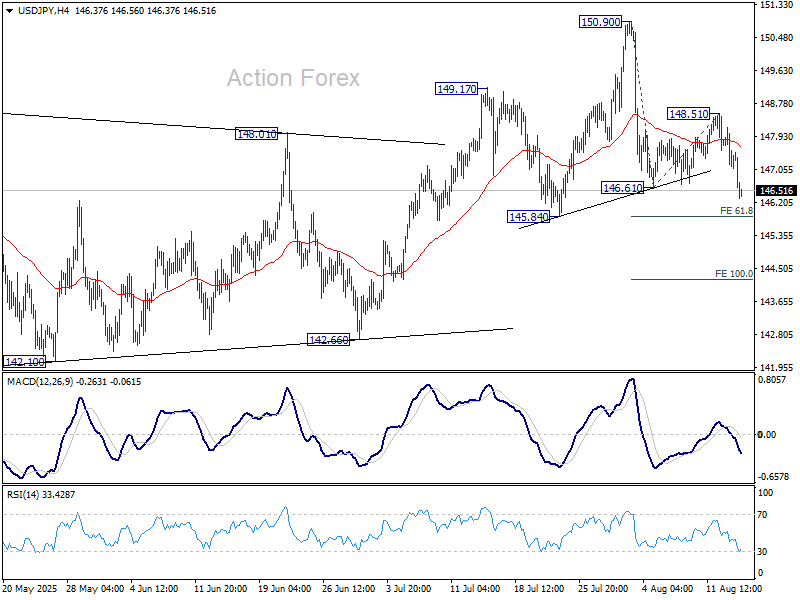
USD/JPY's fall from 150.90 resumed by breaking 146.61 support, and head and should top pattern is in place (ls: 149.17, h: 150.90, rs: 148.15). Intraday bias is back on the downside for 145.84 support next. Decisive break there will suggest that whole rebound from 139.87 has completed at 150.90, and turn outlook bearish. Next target is 100% projection of 150.90 to 146.41 from 148.51 at 144.22. On the downside, above 148.51 will bring retest of 150.90 instead.
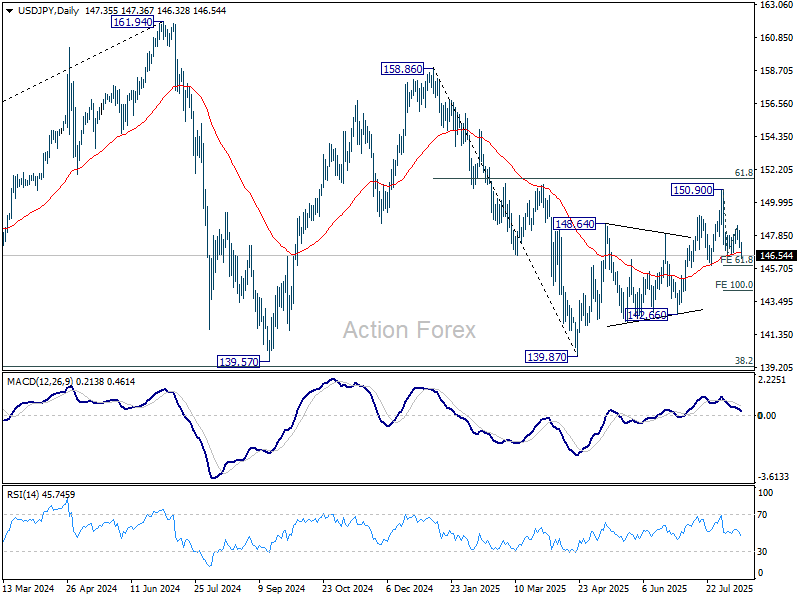
In the bigger picture, price actions from 161.94 (2024 high) are seen as a corrective pattern to rise from 102.58 (2021 low). Decisive break of 61.8% retracement of 158.86 to 139.87 at 151.22 will argue that it has already completed with three waves at 139.87. Larger up trend might then be ready to resume through 161.94 high. In case the corrective pattern extends with another fall, strong support is expected from 38.2% retracement of 102.58 to 161.94 at 139.26 to bring rebound.
Profit-Taking Hits Nikkei, Yen Jumps; Aussie Jobs Data Supports Gradual RBA Path
Market headlines are thin today, with Japan stealing the spotlight as the Nikkei saw a steep pullback following yesterday’s record-setting close. The drop appears driven by traders cashing in on an extended rally rather than any shift in economic outlook. Fundamentally, Japanese equities remain supported, with the economic fallout from US tariffs proving milder than many had feared.
With major trade risks out of the way, Japan’s economy looks increasingly well-positioned to escape its decades-long battle with deflation for good. That structural optimism, however, did not stop short-term traders from locking in gains, leading to a pullback that has triggered a notable rebound in Yen. The Japanese currency is currently the day’s best performer, fueled by a combination of risk position adjustments and the Nikkei retreat.
Aussie is the second strongest performer, supported by solid employment figures released earlier in the day. While the job gain came in just below expectations, the composition of the data—highlighted by a strong rise in full-time employment—points to a labor market that is softening gradually rather than facing a sharp downturn.
One key takeaway from the numbers is that the unemployment rate remains slightly below RBA’s estimated full employment level of 4.3%. This reinforces the view that the central bank is in no rush to accelerate its easing cycle. Instead, policymakers are likely to stick to a measured and gradual approach to further rate cuts.
On the weaker side of the currency spectrum, Sterling is the day’s worst performer, though the move largely reflects a modest pullback after recent strong gains. Traders will look to upcoming UK GDP figures for fresh direction. Euro is the second weakest, followed by D, which will face its next test with today’s PPI data and jobless claims releases. The Swiss Franc and Loonie are trading mixed.
In Asia, at the time of writing, Nikkei is down -1.40%. Hong Kong HSI is down -0.26%. China Shanghai SSE is down -0.10%. Singapore Strait Times is down -0.42%. Japan 10-year JGB yield is up 0.03 at 1.551.
Overnight, DOW rose 1.01%. S&P 500 rose 0.32%. NASDAQ rose 0.14%. 10-year yield fell -0.055 to 4.238.
Australia jobs rebound with 24.5k growth in July, unemployment ticks lower
Australia’s labor market showed renewed strength in July, with employment rising by 24.5k, just shy of expectations for a 25.3k gain and a marked improvement from June’s tepid 1k increase. The headline was boosted by a sharp 60.5k jump in full-time positions, which more than offset a -35.9k drop in part-time jobs.
The unemployment rate eased from 4.3% to 4.2%, in line with forecasts, while the participation rate held steady at 67.0%. Signs of underlying resilience were also reflected in a 0.3% mom increase in total hours worked.
The strong full-time hiring points to ongoing momentum in higher-quality job creation, which could temper any immediate RBA shift toward further easing as policymakers weigh domestic strength against global uncertainties.
Fed's Goolsbee says fall FOMC meetings will be “live”
Chicago Fed President Austan Goolsbee said overnight that the next few months will bring “live” policy meetings, as the Fed faces one of the hardest tasks in central banking—getting the "timing" right during "moments of transition".
Goolsbee expressed caution over assuming the inflationary impact of tariffs will fade quickly, preferring to wait for upcoming wholesale and consumer price data before deciding on the need for a rate cut.
On jobs, Goolsbee downplayed the signal from recent payroll slowing, suggesting it may reflect reduced immigration rather than a broad cooling. With unemployment at 4.2%, "I think the state of the labor market is pretty strong, pretty solid," he said.
Fed's Bostic urges patience, says tariffs may redefine inflation path
Atlanta Fed President Raphael Bostic signaled that the strength of the US labor market gives policymakers breathing room before deciding on rate moves. With unemployment near full employment, he said the Fed can avoid rushing into policy changes. “My predisposition is to try not to do that,” he said, emphasizing the need for more clarity before acting.
Bostic stressed that while inflation remains the primary mandate risk, the job market is in solid shape, and the coming weeks should be spent assessing its underlying health. That evaluation will be key in setting the tone for the Fed’s September meeting, he said.
Turning to tariffs, Bostic noted that Trump’s trade measures differ from past experiences in scope, scale, and intent. Rather than simply raising prices temporarily, he said they could fundamentally alter global supply chains, meaning post-tariff inflation could follow an entirely different trajectory. “It is actually a different economy,” he added.
USD/JPY Daily Outlook
Daily Pivots: (S1) 146.92; (P) 147.55; (R1) 148.00; More...
USD/JPY's fall from 150.90 resumed by breaking 146.61 support, and head and should top pattern is in place (ls: 149.17, h: 150.90, rs: 148.15). Intraday bias is back on the downside for 145.84 support next. Decisive break there will suggest that whole rebound from 139.87 has completed at 150.90, and turn outlook bearish. Next target is 100% projection of 150.90 to 146.41 from 148.51 at 144.22. On the downside, above 148.51 will bring retest of 150.90 instead.
In the bigger picture, price actions from 161.94 (2024 high) are seen as a corrective pattern to rise from 102.58 (2021 low). Decisive break of 61.8% retracement of 158.86 to 139.87 at 151.22 will argue that it has already completed with three waves at 139.87. Larger up trend might then be ready to resume through 161.94 high. In case the corrective pattern extends with another fall, strong support is expected from 38.2% retracement of 102.58 to 161.94 at 139.26 to bring rebound.
WTI Crude Oil Under Fire—Could Another Wave of Selling Hit Soon?
Key Highlights
- WTI Crude Oil prices started a fresh decline below the $65.00 zone.
- A connecting bearish trend line is forming with resistance at $65.00 on the 4-hour chart.
- Gold could attempt a fresh increase if it clears the $3,385 resistance.
- Ethereum price rallies further above the $4,650 and $4,700 levels.
WTI Crude Oil Price Technical Analysis
WTI Crude Oil price struggled above $66.50 against the US Dollar. There was a decline below the $65.50 and $65.00 support levels.
Looking at the 4-hour chart of XTI/USD, the price settled below the $65.00 level, the 100 simple moving average (red, 4-hour), and the 200 simple moving average (green, 4-hour). The bears even pushed the price below $63.20.
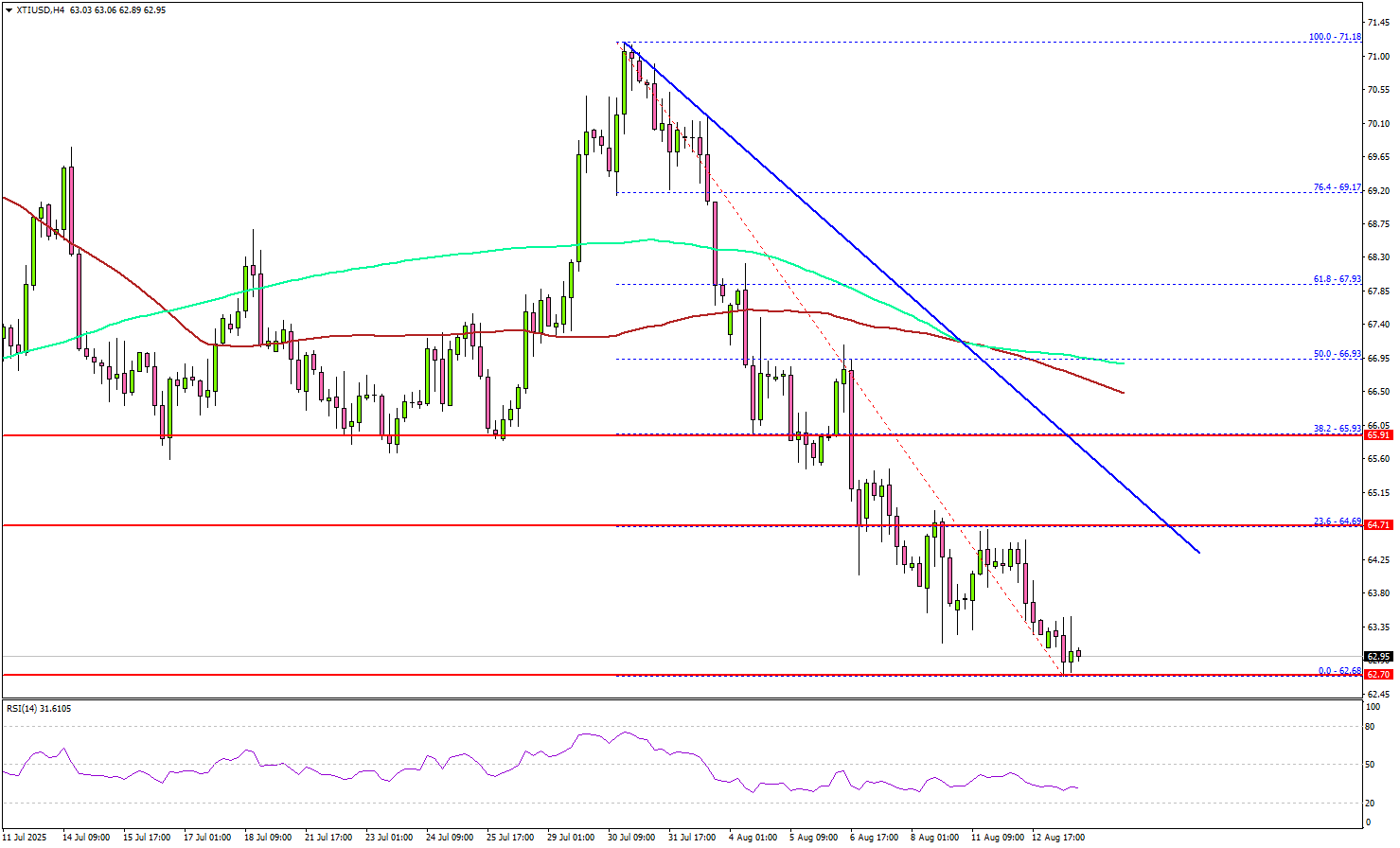
Finally, the price tested the $62.65 zone and recently started a consolidation phase. On the upside, immediate resistance is near the $64.50 level or the 23.6% Fib retracement level of the downward move from the $71.18 swing high to the $62.68 low.
The first key resistance sits near the $65.00 level. There is also a connecting bearish trend line forming with resistance at $65.00. The main hurdle is now near the $65.90 zone, above which the price may perhaps accelerate higher.
In the stated case, it could even visit the 100 simple moving average (red, 4-hour) at $66.50. Any more gains might call for a test of $68.00 in the near term.
On the downside, the first major support sits near the $62.65 zone. The next support could be $61.50. A daily close below $61.50 could open the doors for a larger decline. The next major support is $60.00. Any more losses might send oil prices toward $58.00 in the coming days.
Looking at Gold, the bulls are slowly regaining strength and might soon aim for a move above the $3,385 resistance zone.
Economic Releases to Watch Today
- US Initial Jobless Claims - Forecast 224K, versus 217K previous.
- US Producer Price Index for July 2025 (MoM) – Forecast +0.2%, versus 0% previous.
- US Producer Price Index for July 2025 (YoY) – Forecast +2.5%, versus +2.3% previous.
Australia jobs rebound with 24.5k growth in July, unemployment ticks lower
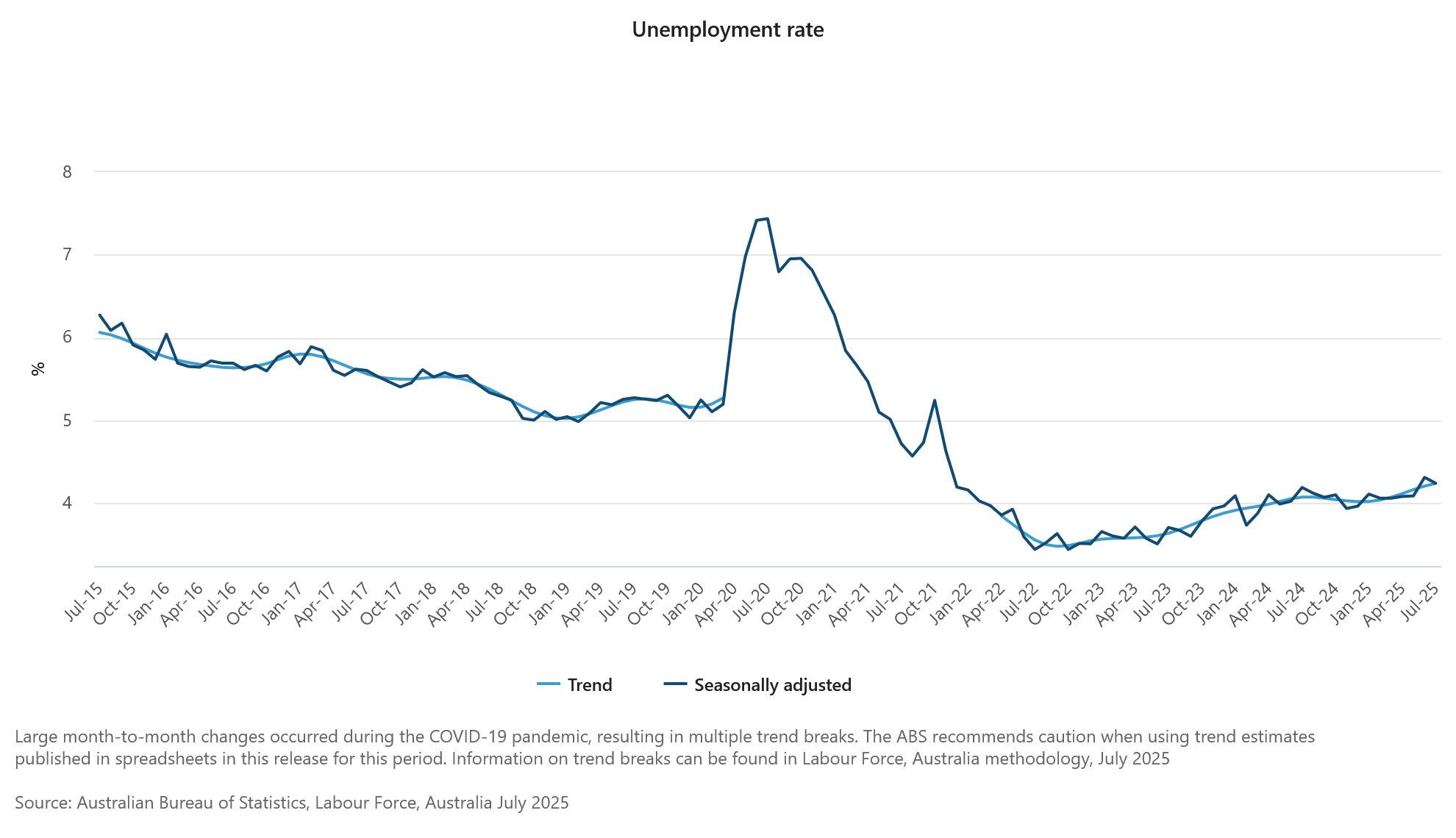
Australia’s labor market showed renewed strength in July, with employment rising by 24.5k, just shy of expectations for a 25.3k gain and a marked improvement from June’s tepid 1k increase. The headline was boosted by a sharp 60.5k jump in full-time positions, which more than offset a -35.9k drop in part-time jobs.
The unemployment rate eased from 4.3% to 4.2%, in line with forecasts, while the participation rate held steady at 67.0%. Signs of underlying resilience were also reflected in a 0.3% mom increase in total hours worked.
The strong full-time hiring points to ongoing momentum in higher-quality job creation, which could temper any immediate RBA shift toward further easing as policymakers weigh domestic strength against global uncertainties.
Fed’s Bostic urges patience, says tariffs may redefine inflation path
Atlanta Fed President Raphael Bostic signaled that the strength of the US labor market gives policymakers breathing room before deciding on rate moves. With unemployment near full employment, he said the Fed can avoid rushing into policy changes. “My predisposition is to try not to do that,” he said, emphasizing the need for more clarity before acting.
Bostic stressed that while inflation remains the primary mandate risk, the job market is in solid shape, and the coming weeks should be spent assessing its underlying health. That evaluation will be key in setting the tone for the Fed’s September meeting, he said.
Turning to tariffs, Bostic noted that Trump’s trade measures differ from past experiences in scope, scale, and intent. Rather than simply raising prices temporarily, he said they could fundamentally alter global supply chains, meaning post-tariff inflation could follow an entirely different trajectory. “It is actually a different economy,” he added.
Fed’s Goolsbee says fall FOMC meetings will be “live”
Chicago Fed President Austan Goolsbee said overnight that the next few months will bring “live” policy meetings, as the Fed faces one of the hardest tasks in central banking—getting the "timing" right during "moments of transition".
Goolsbee expressed caution over assuming the inflationary impact of tariffs will fade quickly, preferring to wait for upcoming wholesale and consumer price data before deciding on the need for a rate cut.
On jobs, Goolsbee downplayed the signal from recent payroll slowing, suggesting it may reflect reduced immigration rather than a broad cooling. With unemployment at 4.2%, "I think the state of the labor market is pretty strong, pretty solid," he said.