Sample Category Title
Dow Jones (DJIA): Dow Steady at $44,417 Ahead of Key Inflation Data
The Dow Jones (US30USD) has rallied ~0.29% higher today, having found support at the bottom of the current daily range, trading at around $44,471.
Dow 30 (DJIA): Key takeaways from today’s session
- Having ended last week’s trading on a sour note, the Dow Jones has found support in today’s session and continues to trade in a period of consolidation
- Markets now turn their gaze toward tomorrow’s CPI release, with the effect of previous tariffs on otherwise cooling inflation yet to be fully understood
Dow 30 (DJIA): Trade tariffs remain a significant macroeconomic headwind for US equities
In a return to regularly scheduled programming, trade tariffs and the associated renewal of commitments to negotiation deadlines remain one of, if not the largest, determining factors in US equity performance.
Recently offered a period of comparative respite, the Dow Jones has proven particularly vulnerable to trade-related news in recent memory, especially compared to tech-led US indices like the Nasdaq-100.
For now, the $1,000,000 question remains whether Trump will remain firm with his new deadline. Naturally, much of the success of Trump’s current strong-arm tactics on trade will be determined by whether other nations believe this will be their last chance to strike a deal, or whether ongoing negotiations will allow for an extension in the deadline, not for the first time.
At the time of writing, the EU and Mexico are the latest to be caught in Trump’s crosshairs. On Saturday, Trump announced that a 30% tariff would be imposed if an agreement isn’t reached before August 1st.
With the so-called ‘Liberation Day’ sell-off still fresh in the collective mind, Trump will need to carefully navigate the next twenty days or risk inviting downside to otherwise buoyant stock market.
The markets remain primarily concerned about how tariffs could affect inflation and, therefore, the Federal Reserve’s monetary policy decisions, alongside how changes in trade relations will affect economic performance.
If put in one word, any increase in market uncertainty will harm risk appetite, which will likely bode poorly for US equities and other risk-on markets.
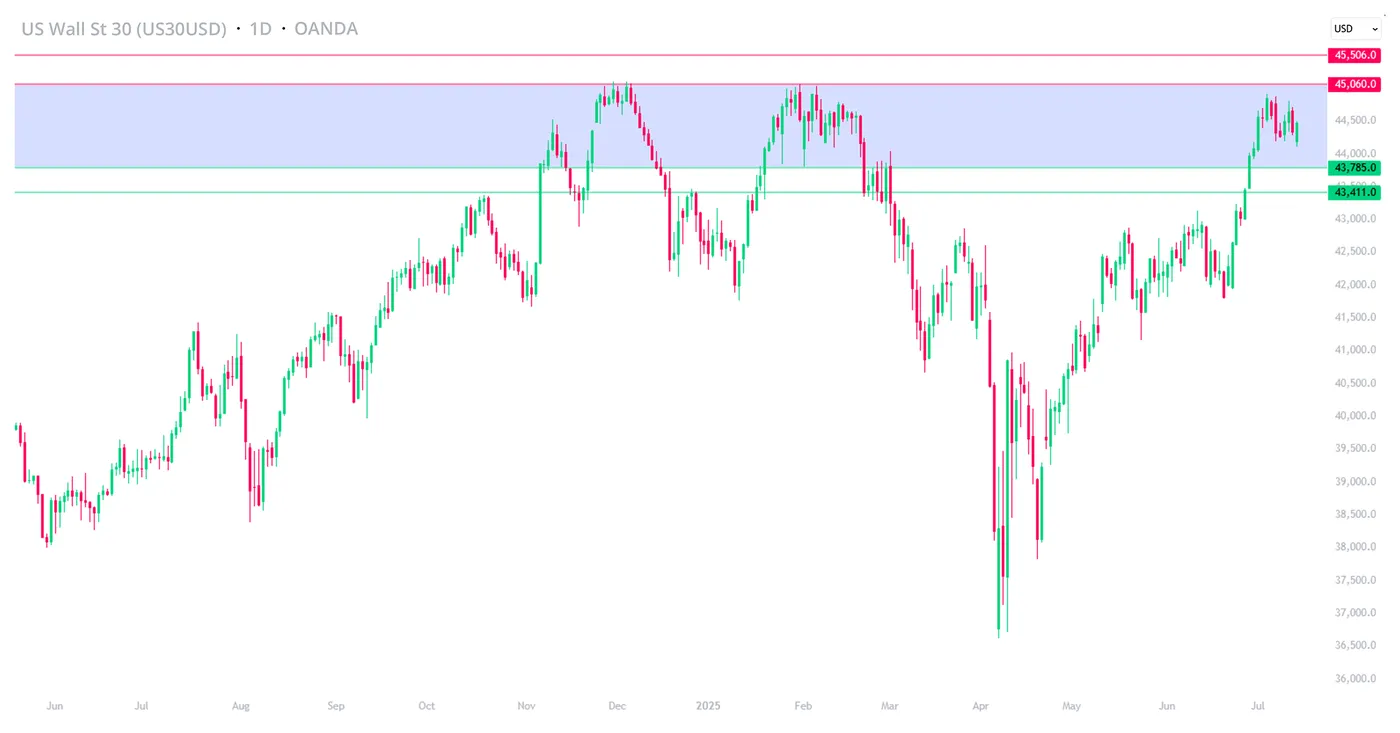
DJIA (US30USD), OANDA, TradingView, 14/07/2025
Dow 30 (DJIA): Tuesday’s CPI report remains key focus ahead of Fed rate decision
While at least ‘a couple’ of policymakers were shown to be at least considering rate cuts courtesy of last week’s FOMC minutes, a July rate cut remains overwhelmingly unlikely.
That said, markets keenly await tomorrow’s CPI release to confirm whether inflation is continuing to cool and whether previous Trump tariffs will have any adverse consequences on the data.
If inflation continues to cool, pressure will continue to mount on the Fed, which, by all accounts, will have a harder time justifying higher rates in the short term.
The above goes double as this month’s PCE report falls on July 31st, meaning that tomorrow’s report will be the last to offer any data on inflation before the Federal Reserve’s July 30th decision.
Naturally, any inclination that a potential rate cut may come sooner than expected, July or otherwise, will likely offer some buying support for US equities, the Dow Jones included.
As can be expected, US equity markets are relatively flat today ahead of tomorrow’s report.
Upcoming US Events (Tuesday 15th 2025):
- 08:30 EDT US Consumer Price Index June (MoM)
- 08:30 EDT US Consumer Price Index June (YoY)
- 08:30 EDT US Consumer Price Index Core s.a. June
- 08:30 EDT US Consumer Price Index n.s.a. June (MoM)
- 08:30 EDT US Consumer Price Index ex. Food & Energy June (MoM)
- 08:30 EDT US Consumer Price Index ex. Food & Energy June (YoY)
- 08:30 EDT US NY Empire State Manufacturing Index (Jul)
- 08:55 EDT Redbook Index (YoY)
- 09:15 EDT Fed’s Bowman speech
- 12:15 EDT Fed’s Barr speech
- 14:45 EDT Fed’s Collins speech
- 16:30 EDT API Weekly Crude Oil Stock
- 19:45 EDT Fed’s Logan speech
Silver Wave Analysis
Silver: ⬇️ Sell
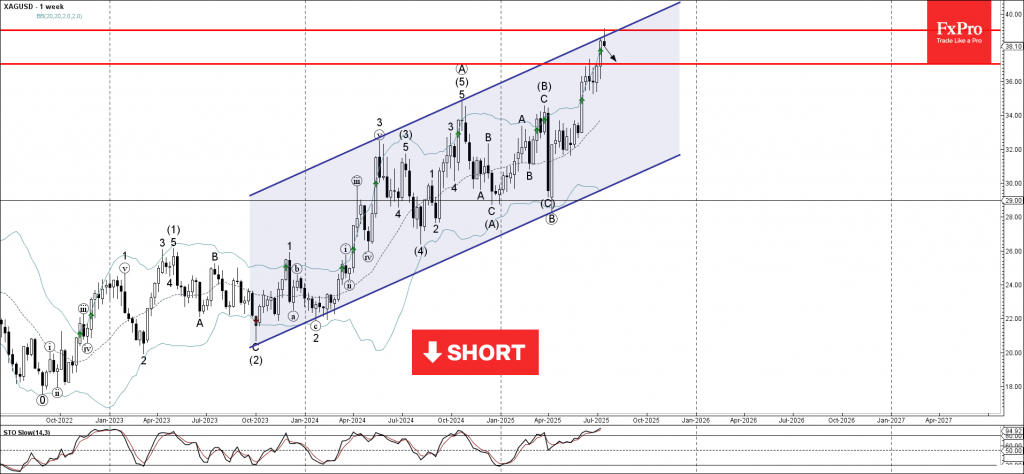
- Silver reversed from resistance zone
- Likely to fall to support level 37.00
Silver recently reversed down from the resistance zone lying at the intersection of the resistance level 39.00, upper weekly Bollinger Band and the resistance trendline of the weekly up channel from 2023.
The downward reversal from resistance zone created the daily Japanese candlesticks reversal pattern Shooting Star.
Given the strength of the nearby resistance zone and the overbought weekly Stochastic, Silver can be expected to fall to the next support level 37.00.
British Pound Testing Support, Risking Breaking It
The British pound fell below $1.35, confirming the downward trend since the beginning of the month. However, in recent days, this profit-taking after growth has been accompanied by the possibility of a deeper dive.
The upward trend in GBPUSD since the beginning of the year has formed a trend of higher local lows and higher highs. In April, May and June, touching the 50-day moving average spurred buyers, stopping the local retreat.
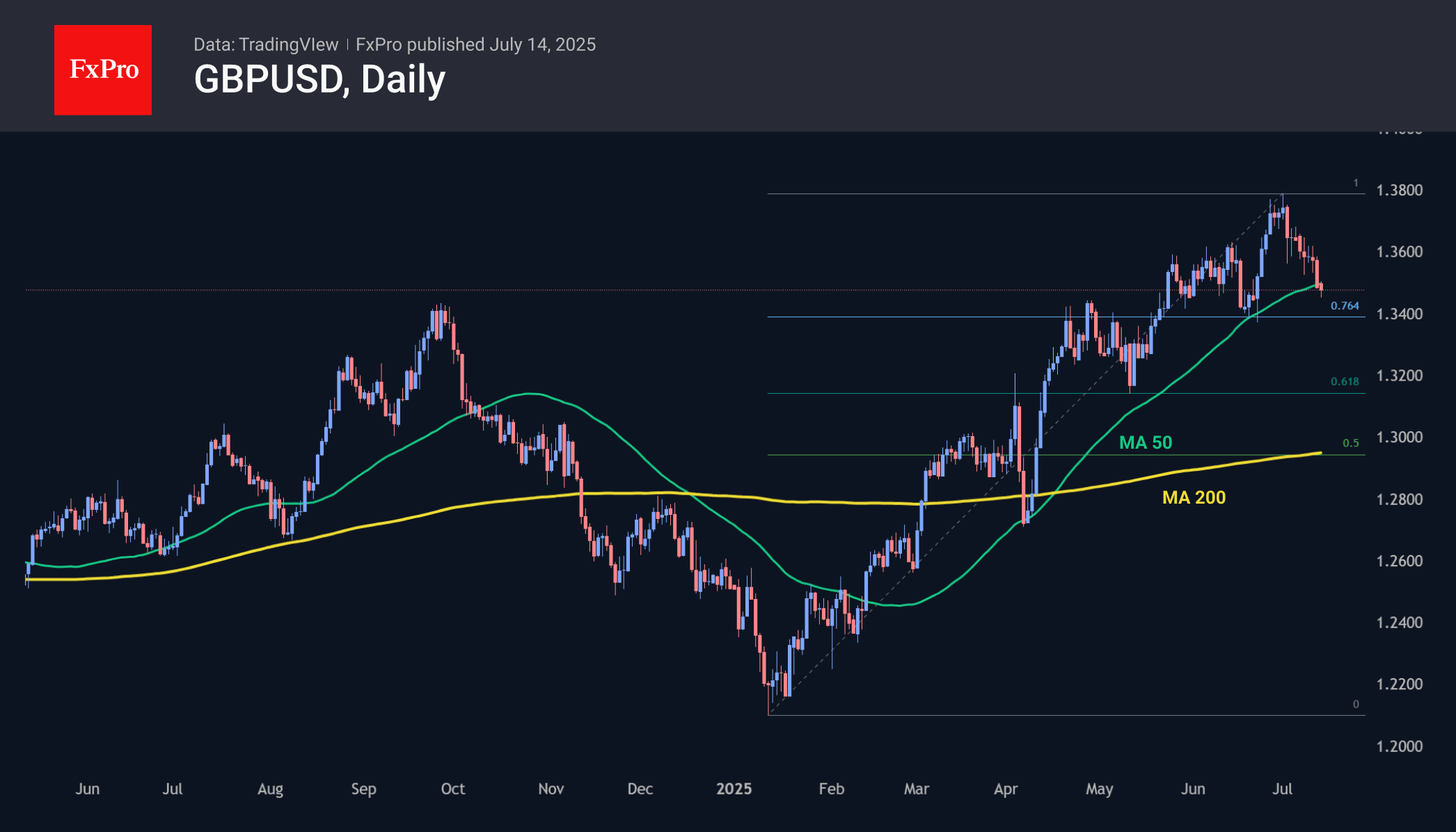
However, the new week begins with a dip below the 50-day moving average and below the round level of 1.35. Moreover, at current levels, the price is only 100 points above the previous local low, threatening to break the upward trend.
The fundamental background has also been working against the British currency recently, with the chances of the Bank of England moving further towards a more dovish position increasing. This implies lower interest rates than previously assumed by the markets. The main factor behind this revision is tariffs, which are weighing on business activity in the UK. In contrast, tariffs create inflationary risks, intensifying speculative pressure on the currency market.
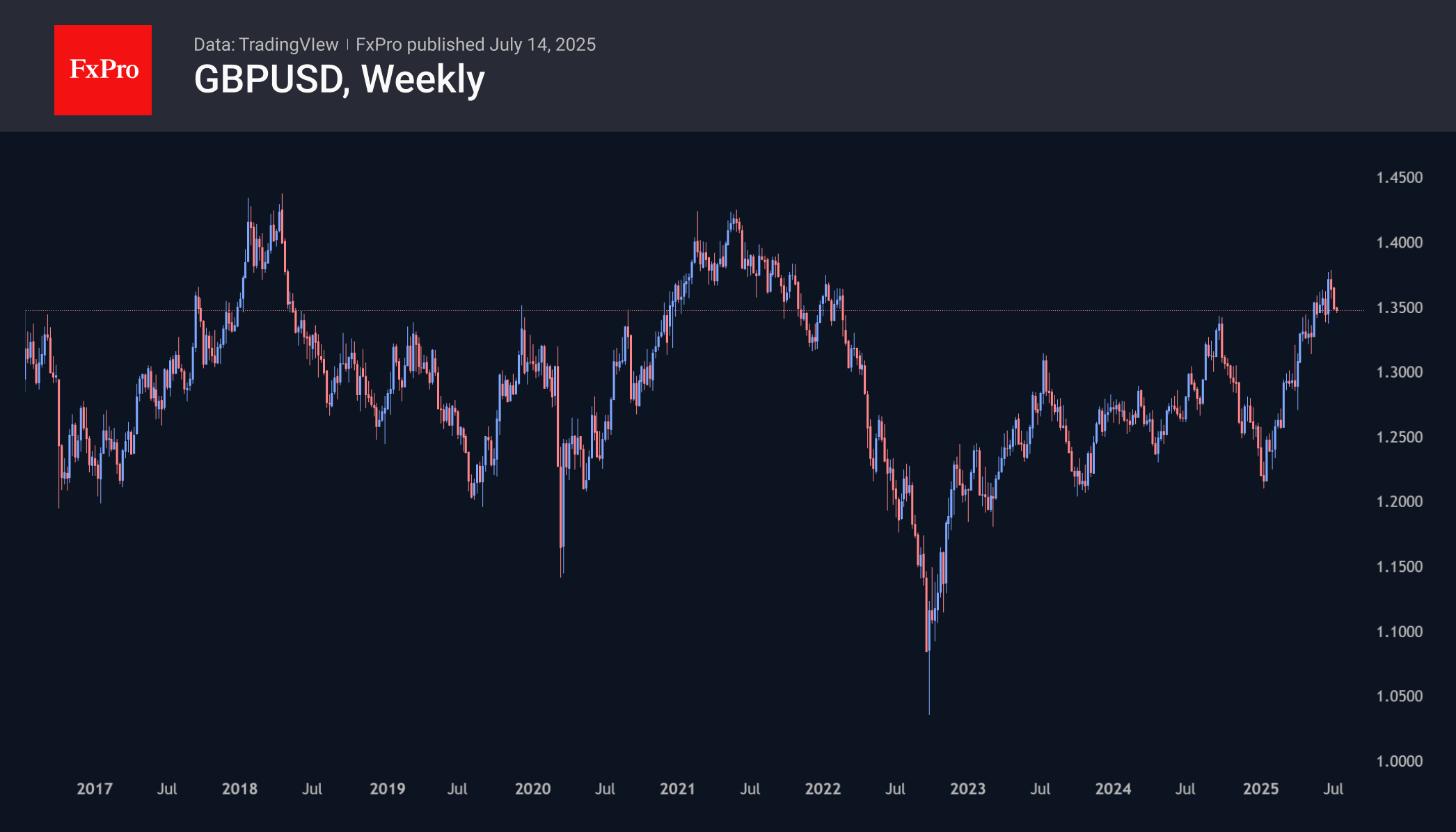
The tariff wars of 2018 proved to be a bullish factor for the dollar despite its initial weakening. Even with the frightening sell-off of the dollar in the first half of the year, we may well see a repeat of this trend in the long term.
We see the levels of 1.3380, the area of previous local lows, and 1.3150, where support is at 61.8% of the growth amplitude from the January lows to the peak in early July, as potential targets for the beginning of the pullback.
USDJPY Tests the Extremes of Its Range in a Calm Forex Session
Good morning for the North-American readers and nice start to the week to everyone.
The ongoing Forex session is a very calm one, as most traders brace for the upcoming US CPI data release tomorrow, with the most moving currency in the day being the AUD and NZD seeing some selling.
France is also celebrating their National Day! (Bonne fête aux compatriotes !)
Other markets have however seen some movements:
- the Singapore STI has been making records highs on its 6th consecutive session
- Bitcoin hit highs of $123,000
- Orange Juice Futures are squeezing again (up above 18% on the session, +50% since July)
Let's prepare for tomorrow's huge number by taking a look at where we stand in the current range in USDJPY as the pair has also been rising strongly in the past two weeks.
USDJPY Analysis from the Daily to 1H Charts
USDJPY Daily Chart
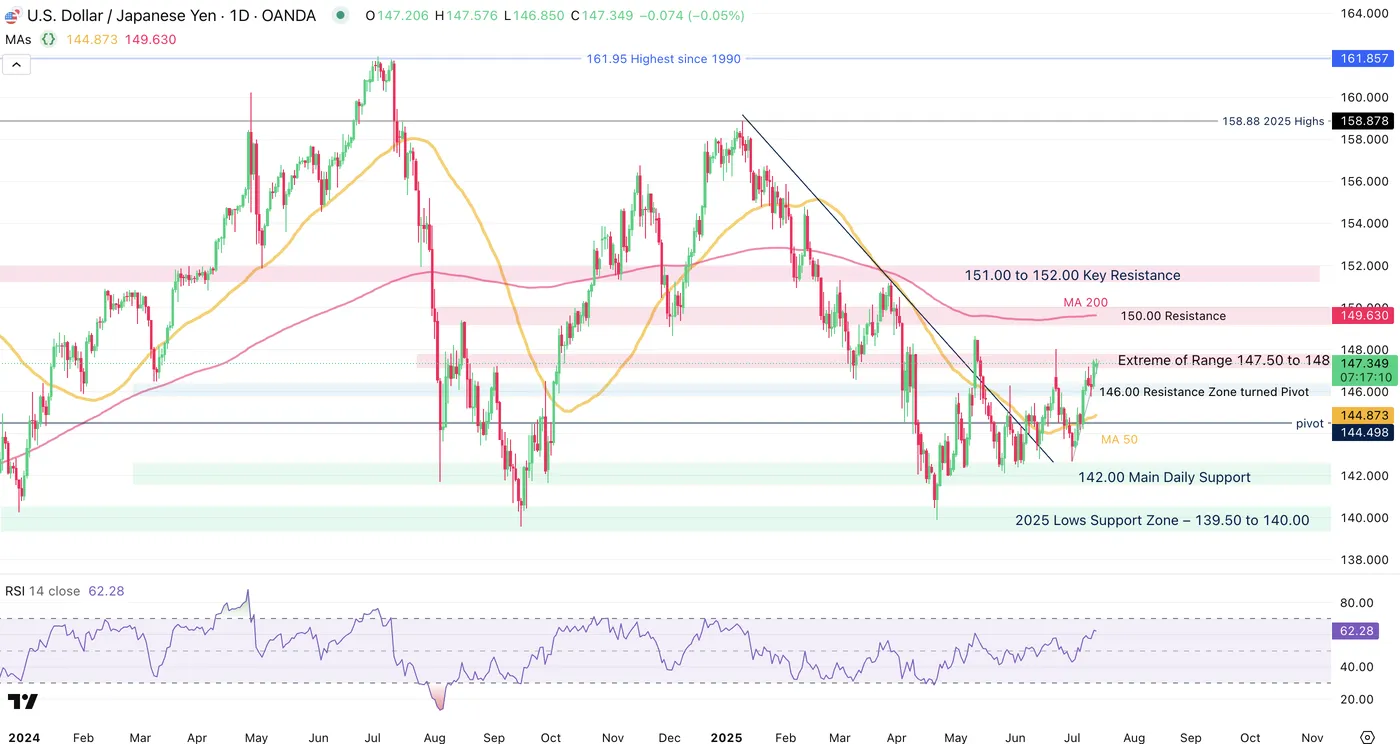
USDJPY Daily Chart, July 14, 2025 – Source: TradingView
A lack of bullish catalysts for the Yen has created a massive outflow in the currency.
The CHF is once again taking the throne for the most favored Safe-Haven major currency amid Dollar Restructuring.
The still dovish (though much less than previous years) policies from the Bank of Japan, and lack of solid hawkish communications while American rates are still at 4.50% keep giving USDJPY Buyers a fundamental edge, particularly as Dollar selling has been abating since the beginning of July.
USDJPY 4H Chart
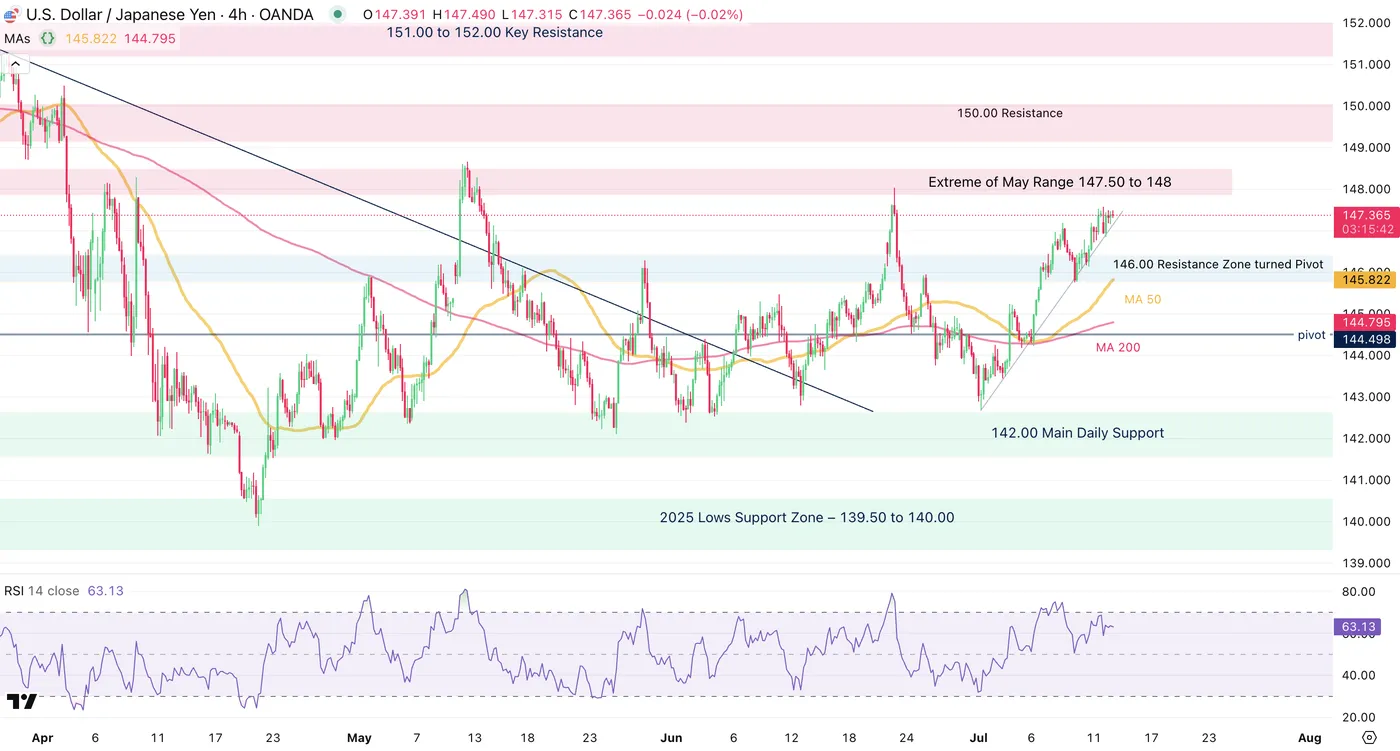
USDJPY 4H Chart, July 14, 2025 – Source: TradingView
The rebound from the 142.50 July 1st lows has been remarkable, seeing more details from the Daily chart – The 4H 50-period moving average is starting to tilt upwards, potentially giving even more underlying strength to the ongoing move.
The 4H RSI is approaching overbought but isn't there yet, with today's lack of movement helping momentum to pause which will surely be a good reason for prices to catapult upwards or downwards tomorrow – The direction is difficult to predict, but volatility is sure to be elevated.
In case of any breakout to the upside, the upcoming Resistance will be between 149.50 to 150.00.
USDJPY 1H Chart
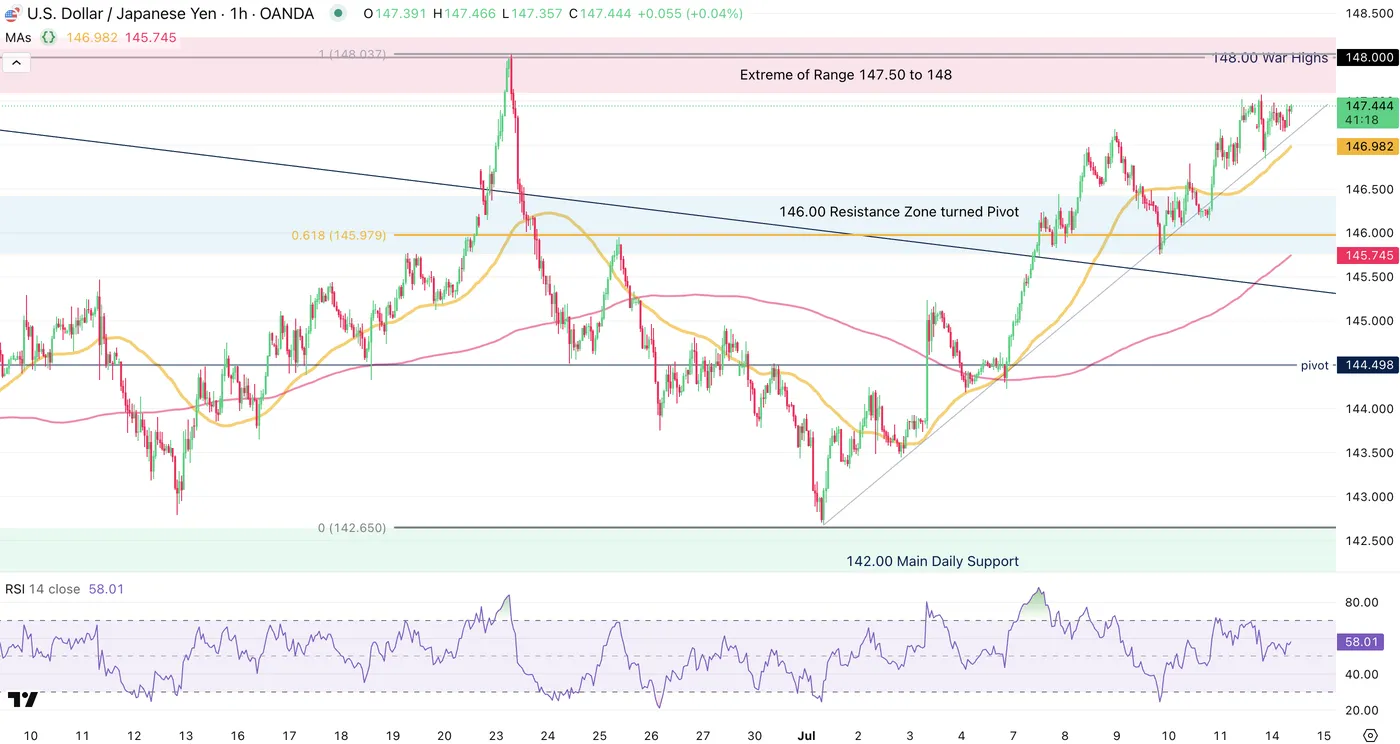
USDJPY 1H Chart, July 14, 2025 – Source: TradingView
Compared to the two other times were prices visited the extremes of the range between 147.50 to 148.00, this ongoing uptrend is more progressive and stable – In Markets, more erratic, steep trends can end more abruptly therefore keep an eye on how consistent this move has been.
It could be a sign of more progressive demand for the USD and may lead to a breakout
In any way, players will be waiting for tomorrow's data release to get a better idea of US Dollar demand which will be difficult to predict.
Any fail to break the highs of the range will confirm its solidity, leading to a higher probability of retesting at least the 146.00 Resistance turned Pivot.
A spike upwards tomorrow will surely be met with some continuation amid a potential breakout to test at least 150.00.
A consolidation around these levels also may up the probabilities of a more progressive breakout.
In the meantime, before seeing the contrary, the range is to hold, but behold tomorrow's CPI 8:30 AM release which may break any resistance or support!
Safe Trades!
Fed’s Hammack sees no urgency to cut rates, focuses on inflation
In a Fox Business interview, Cleveland Fed President Beth Hammack signaled that she sees little urgency for rate cuts given the current strength of the US economy. Hammack said Fed is “pretty close to where the neutral rate is,” and noted that unless there’s “material weakening on the labor side,” she doesn’t see a compelling case for policy easing.
While leaving the door open to shifts based on incoming data, Hammack emphasized that Fed is meeting its employment mandate, but still falling short on inflation. “We’re not there yet on the inflation side of the mandate,” she said, adding that a restrictive stance should be maintained until clear progress is made.
Sunset Market Commentary
Markets
The start of the new week was a copy-paste of last week’s. A surge in long-term Japanese bond yields weighed on other core bonds too. Japan’s 30-yr yield shot up another 11 bps to be just 3 bps away from the tenor’s record 3.2% of May this year. The driving force, just as last week, is investor concern about fiscal stimulus in the run-up and aftermath of this Sunday’s Upper House elections. Spillovers affect US Treasuries with the long end of the curve adding up to 4 bps at some point. The 30-year (4.98%) is closing in on the symbolically and technically important 5% barrier. President Trump’s renewed tariff threat vs Europe (and others, including Mexico) towards the end of last week could be lingering as well in the form of increasing inflation expectations. That’s what dragged the long end of the curve on Friday anyway. Short-term yields in the US add between 1.2-1.7 bps. The bear steepening also shows up on European soil. Swap rates in the region rise up to 2.7 bps, pushing the 30-yr maturity to a new 1.5 year high (2.88%). Gilts slightly outperform today, lead by the front end. This came after Bailey highlighted the potential for bigger rate cuts in an interview with The Times yesterday. The Bank of England governor stuck with the official guidance of going “gradual and careful” due to inflation still being above target. But he also said that “if we saw the slack opening up much more quickly, that would lead us to a different conclusion.” Bailey referred to an economy growing below potential and businesses adjusting employment and offering lower pay rises, amongst others due to this year’s increase of the businesses national insurance contribution. UK yields lose around 2.9-4 bps in the 2-5 year bucket. UK money markets are upping bets for more than two (quarterly) remaining rate cuts this year.
The aforementioned weighs on the pound sterling for a second day straight after Friday’s surprisingly weak monthly GDP and industrial production prints. EUR/GBP rallies to 0.867, the highest level since mid-April. The 0.874 level hit intraday back then serves as a first resistance. Major currencies such as the euro and the dollar trade more or less in balance, adding to evidence that markets are not taking Trump and his tariff threats too seriously. EUR/USD at around 1.1686 tries to keep the upward sloping trend line since early March in tact. The 8-day bottoming out in DXY (mostly a JPY story) is running into resistance near the 98 barrier, which coincides with the upper bound of a short-term downward sloping trend channel.
News & Views
The German Bundesbank published a study looking into the sustained decline in German export market shares. They haven been contracting since 2017 and increasingly falling behind those of other advanced economies since 2021. More than three-quarters of the export market share losses between 2021 and 2023 were due to the deterioration in German exporters’ competitiveness. This points to fundamental structural problems. To this end, incentives to work should be strengthened, barriers to the immigration of skilled workers and unnecessary red tape should be cut back, tax incentives for private investment increased, and conditions for start-ups and research and development improved, to name a few examples. In addition, weak global demand for motor vehicles, in particular, dampened the development of German export market shares through product-specific demand effects. Energy price increases and supply chain disruptions also played a significant role. In separate comments, German Chancellor Merz today said that the proposed 30% reciprocal tariffs from the US on EU goods would hit the export industry to the core. Merz is really committed to finding a trade deal by the August 1 deadline.
People familiar with the matter indicate that the Bank of Japan will likely consider raising its core CPI forecast for fiscal year 2025 from the current 2.2% after food inflation proved more sticky than expected in the previous quarterly update. Higher oil prices are another reason for increasing inflation forecasts. The next update will be released on July 31st. The BoJ can likely retain its view that Japan’s price trend will be consistent with its sustainable inflation goal in the second half of the three-year outlook period, bolstering the case for eventual further rate hikes. The central bank’s quarterly household opinion survey showed households expecting prices to rise by an average 12.8% a year from now, highest since September 2006 and by an average of 9.9% over the next five years, the highest on record.
Australian Dollar Eyes China GDP
The Australian dollar has edged lower on Monday. In the North American session, AUD/USD is trading at 0.6555, down 0.32% on the day. The Aussie took advantage of US dollar weakness last week as it touched a high of 0.6593, its highest level since November 2024.
China's GDP expected to ease to 5.1%
China's economy is expected to have grown by 5.1% in the second quarter, after back-to-back quarters of gains of 5.4%. The government's annual growth target is around 5.0%, and policymakers won't complain if this target is exceeded for a third consecutive quarter.
Exports were up 5.8% y/y in June, above the consensus of 5.0% and well above the May gain of 4.8%. The jump in exports was driven by a trade truce with the US that lowered tariffs on Chinese goods from 145% to 55%. Still, the economic picture is uncertain as the tariff truce ends in August.
China will also release industrial production and retail sales for June, with the markets forecasting weaker numbers. Industrial production, which has been decelerating in recent months, is expected to ease to 5.6% from 5.8%, while retail sales are expected to fall to 5.6%, down from 6 .4% in May, which was the strongest level since December 2023.
Australia releases Westpac Consumer Sentiment on Tuesday, with a forecast of a 0.4% gain for July . This follows a 0.4% gain in June. Consumers remain cautious, despite the Reserve Bank of Australia's rate cut in May and lower inflation.
The RBA shocked the markets last week when it maintained the cash rate at 3.85%, as all signs appeared to point to a quarter-point cut. The RBA meets next on August 12.
AUDUSD Technical
- AUD/USD is testing support at 0.6562. Below, there is support at 0.6550
- There is resistance at 0.6570 and 0.6582
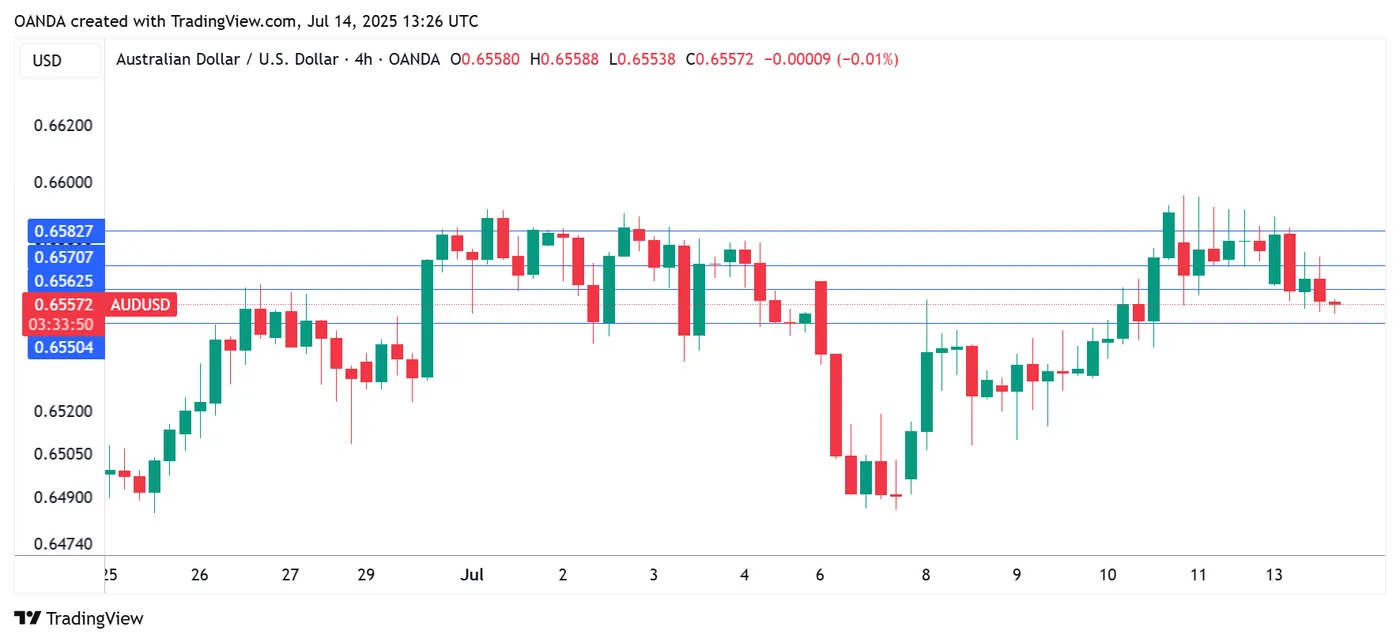
AUD/USD 4-Hour Chart, July 14, 2025
WTI Oil Advances as 200-day MA Serves as Support, Chinese Imports Soar
Oil prices advanced this morning following a bullish close on Friday. It appears that the fears market participants had in regards to a recession may be waning and this has helped Oil prices.
Economists now predict better growth, more jobs, a lower chance of a recession, and slower inflation compared to three months ago, according to The Wall Street Journal's quarterly survey. On average, economists see a 33% chance of a recession in the next year, down from 45% in April but higher than 22% in January.
OPEC + Projects Strong Q3 Demand
Another reason oil prices could be on the up this morning comes from OPEC +. Russia's RIA news agency quoted Haitham Al Ghais on Monday as telling journalists on the sidelines of last week's OPEC seminar in Vienna that the organization expects oil demand to grow by 1.3 million barrels per day in 2025, driven by a strong global economy.
Al Ghais said there is strong demand growth, especially in the third quarter, and good demand growth in the fourth quarter, with tight supply-demand balances. This is why the group of eight countries is increasing oil production, according to the report.
OPEC and its allies are increasing oil production and expect strong demand in the third quarter, with a tight balance between supply and demand in the coming months. According to five sources who spoke to Reuters, OPEC+ plans to approve another large increase in oil production for September, as reported by Reuters.
Chinese Crude Imports Soar
China's crude oil imports bounced back in June, hitting their highest daily rate since August 2023. This happened as refineries increased production and imports from Saudi Arabia and Iran grew, according to consultancies.
China, the world's largest oil buyer, imported 49.89 million metric tons of oil in June, equal to 12.14 million barrels per day, based on data from the General Administration of Customs. This was a 7.1% increase from May's 46.6 million tons and 7.4% higher than the same time last year.
Kpler reported that imports from Saudi Arabia rose by 845,000 barrels per day to 1.78 million barrels per day, as lower prices encouraged Chinese refiners to buy more oil.
China's crude oil stocks also grew by 82 million barrels in the second quarter of 2025, according to the International Energy Agency (IEA).
New policies in China are making oil companies long-term storage partners for the government, keeping these stocks out of the global market, the IEA said. The agency also noted that Chinese companies are expected to keep building up oil inventories, which will play a key role in balancing the market in the coming months.
The fact that China will continue building its oil inventories bodes well for Oil prices and could keep prices supported.
Looking Ahead - Potential Sanctions on Russia to Aid Oil Prices?
US President Donald Trump announced on Sunday that he will send Patriot air defense missiles to Ukraine. He is also set to make a "major statement" about Russia on Monday, expressing frustration with President Vladimir Putin over the lack of progress in ending the war in Ukraine.
To push Russia into serious peace talks with Ukraine, a bipartisan US bill proposing new sanctions on Russia gained support in Congress last week.
Meanwhile, European Union envoys are close to finalizing their 18th round of sanctions against Russia. This package is expected to include a lower price cap on Russian oil, according to four EU sources after a Sunday meeting.
Sanctions have thus far failed to dent Russian oil exports, will this package prove any different? It will be interesting to hear from President Trump and gauge if market participants react to any statement made.
Any sign that Russian exports may be affected could see a spike in Oil prices, however given the flip-flopping we have seen from the Trump administration, markets may ignore the announcement.
Technical Analysis - WTI
From a technical analysis standpoint, Oil prices bounced off the ascending trendline on Friday.
The daily candle closed as a bullish engulfing and has broken above the 200-day MA. We saw a retest of the 200-day MA this morning before oil prices moved higher once more.
For now bulls remain firmly in control with a daily candle close below the swing low at 66.81.
Immediate resistance rests at 71.38 with a break above facing resistance at 73.20 and the psychological 75.00 handle.
Support may be found at the 200-day MA which rests at 68.47 before the all-important swing low at 66.81.
WTI Oil Daily Chart, July 14, 2025
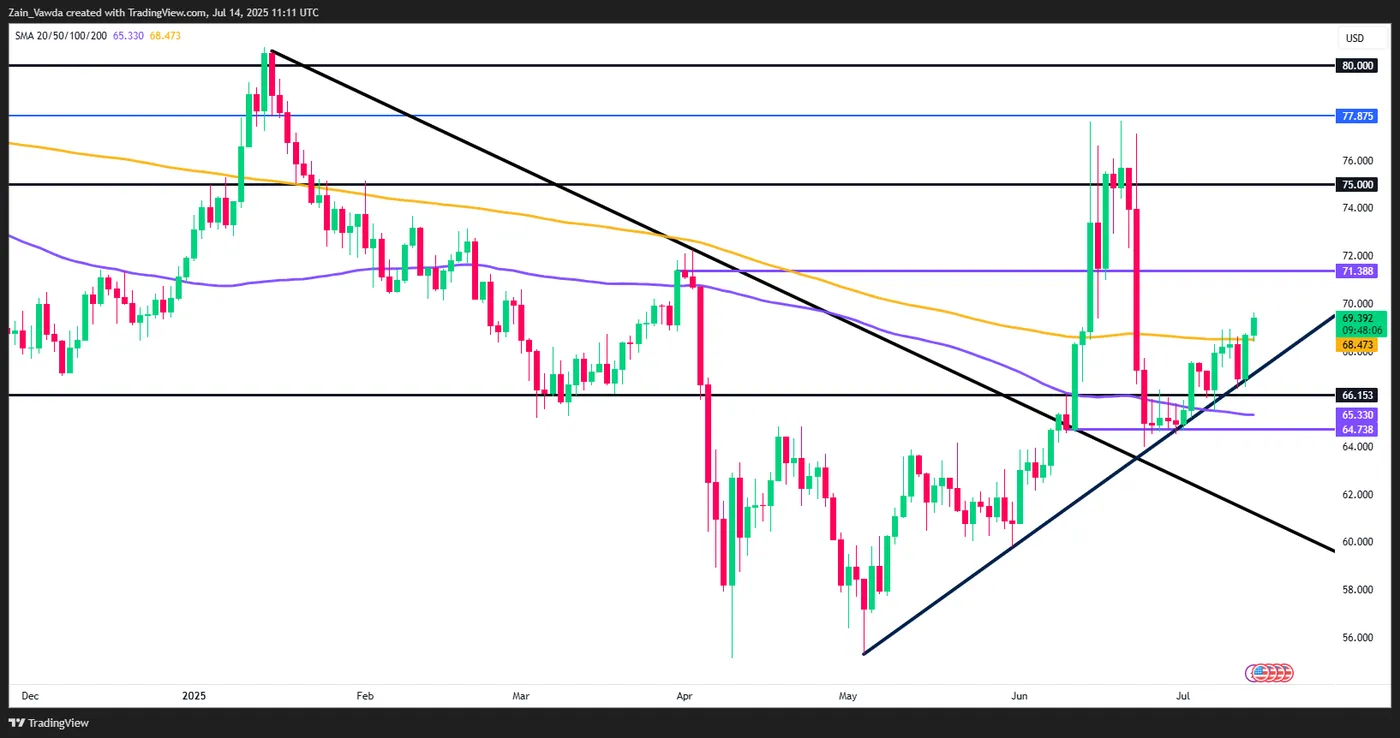
Source: TradingView (click to enlarge)
Client Sentiment Data
Looking at OANDA client sentiment data and market participants are long on WTI with 73% of traders net-long. I prefer to take a contrarian view toward crowd sentiment and thus the fact that so many traders are long means WTI prices could decline in the near-term.
XAG/USD: Silver Hits New Multi-Year High
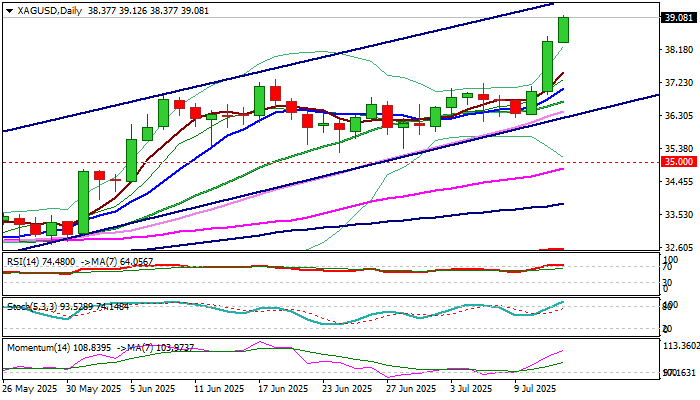
Silver hit the highest in nearly 14 years on Monday, testing levels above $39 as strong bullish acceleration extends into third consecutive day.
Growing uncertainty over US tariffs and weak economic outlook continue to fuel demand and underpin the price.
Fresh rally broke above recent $35.30/$37.30 consolidation range, signaling continuation of broader uptrend and unmasking psychological $40 barrier.
Technical picture on daily chart is firmly bullish but overbought that threatens of increased headwinds on approach to $40 target.
This may put bulls on hold for consolidation which should ideally hold above $37 zone (former breakpoint, reverted to support) to keep bulls intact for fresh push higher.
Sustained break above $40 to generate fresh bullish signal and expose targets at $40.68 (Fibo 76.4% of $49.78/$11.23, 2011/2020 downtrend) and $41.00 (round-figure).
Caution on loss of $37 handle that would weaken near-term structure and risk attack at lower pivots at $35.00 zone (former range floor / broken Fibo 61.8% of $49.78/$11.23 downtrend).
Res: 39.50; 40.00; 40.68; 41.00.
Sup: 38.25; 37.31; 36.15; 35.00.