Sample Category Title
Daily Markets Broadcast
Stocks retreat as Trump reintroduces tariff threat
US indices fell back from record highs yesterday as US president Trump restated that he still has the option of higher tariffs on Chinese goods, despite the truce agreed on last month. Fedspeakers maintained their dovish bias while oil prices eased as Iran reportedly showed a willingness to talk.
US30USD Daily Chart
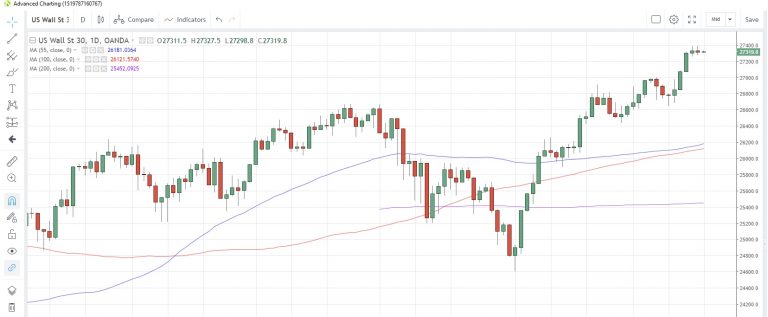
The US30 index halted a four-day rising streak yesterday following Trump’s tariff comment and some lackluster earnings reports
The 100-day moving average at 26,121 and the 55-day average at 26,181 continue to converge at a slow pace
US housing starts are expected to rebound in June, increasing 1.9% after a 0.9% decline in May. Retail sales for June beat estimates and more strong data points could prevent the Fed from easing further after this month’s meeting.
DE30EUR Daily Chart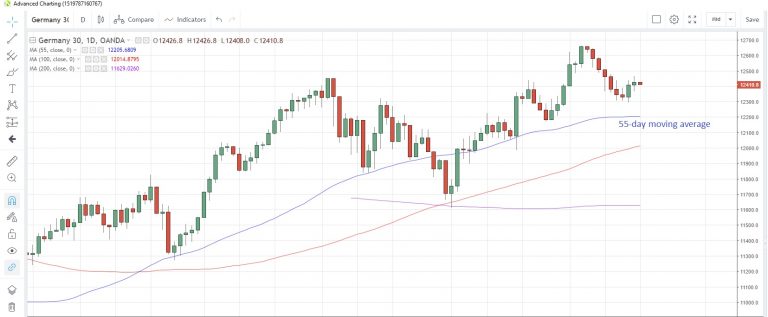
The Germany30 index advanced for a second day yesterday despite the ZEW surveys missing estimates
The index is edging away from the 55-day moving average support, which is at 12,205 today
ZEW surveys for July missed forecasts with the economic sentiment index dropping to -24.5 versus -22.3 expected. The current situation index turned negative for the first time since 2010.
JP225USD Daily Chart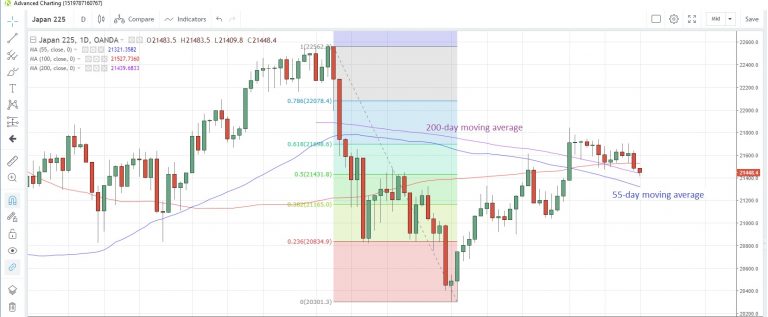
The JP225 index looks set for a second daily loss, echoing the weak sentiment on Wall Street
The index risks closing below the 200-day moving average, which is at 21,439 today, for the first time since June 28
Japan’s trade data for June are expected tomorrow morning, with imports seen falling 0.4% y/y, the second monthly contraction in a row, while exports are expected to drop a more significant 5.6%, which would be the seventh consecutive monthly decline.
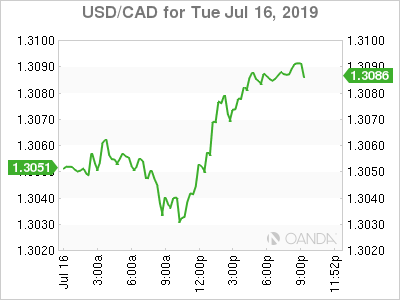
USD/CAD Canadian Dollar Lower After US Retail Sales Puts Multiple Fed Rate Cuts In Question
The Canadian dollar was trading lower against the greenback on Tuesday after a surprise jump in retail sales data could give some breathing room to the Fed. The US central bank has been telegraphing an interest rate cut at the end of the month but improving fundamental indicators could make the overall move a tactical one, and not a deep as the market once believed.
Oil prices tumbled as Middle East tensions eased as the US and Iran appear to be ready to negotiate, although uncertainty remains on how willing both parties are to a compromise. Weather disruptions took a back seat as platforms affected by a tropical storm are on their way to getting back online offering no support for crude. US inventories on Wednesday will be a crucial data point for energy traders with the API printing another drawdown, but a lower one last week.
The US dollar was higher across the board against major pairs. The Canadian dollar was the best performer against the dollar and finished with a loss of 0.18 percent, while the pound registered a 0.88 percent drop as the Conservative leadership race is putting a no-deal exit back on the table.
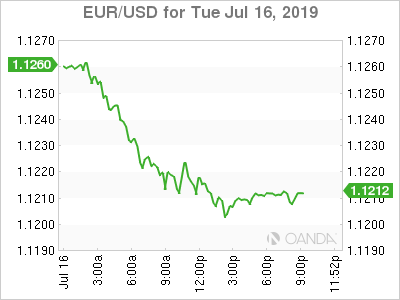
The surprise retail sales indicator in the United States is putting a big question mark on the number of interest rate cuts the Fed can get away with. A July rate cut of 25 basis points is fully priced in but improving fundamentals could give some breathing room to the Fed, despite the wishes of the White House.
Fed members have been actively telegraphing the Fed’s intentions, but while they have agreed for a need for easing the size of the cut is still up for debate, although once again a stronger US economy makes a case for a more tactical rate cut.
OIL – Iran’s Mixed Signals and Stronger Dollar Pressure Crude
Oil prices tumbled on Tuesday as Middle East tensions eased after comments from US Secretary of State Mike Pompeo about Iran’s willingness to negotiate. Previously Iran had a more aggressive stance, but after President Hassan Rouhani said on Sunday that Iran is ready to hold talks if sanctions were lifted, a diplomatic avenue thought to be exhausted came back into play although it did so at the same time of the threat of higher uranium enrichment. Tensions could still flare up as Iran denies it is ready to negotiate on its missile program.
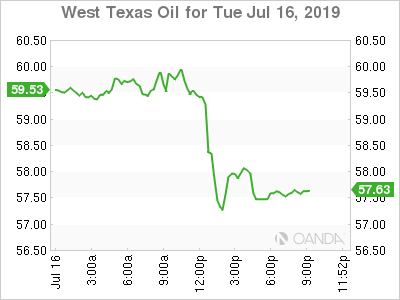
Weather related supply disruptions in the Gulf of Mexico affected around 70 percent of production in the area, but it will slowly get back online, but could lead to lower stock data this week.
Easing of tensions between the US and Iran, mixed Chinese growth data and storm hit operations getting back online are all pressuring oil prices downward.
US weekly stocks are forecasted to show a drawdown of 2.7 million barrels, only another big surprise to the downside could get oil prices out of the current range as a strong dollar and less uncertainty are keeping crude under pressure.
GOLD – Stronger Dollar After Retail Sales Surprise Subdues Gold
Gold lost 0.59 percent on Tuesday after the US retail sales defied expectations and gained 0.4 percent on a 0.1 percent forecast. The strong retail data point puts into question the number of rate cuts by the Fed this year.
The July FOMC meeting is likely to end with a rate cut announcement, but the size of the cut and the future path of the central bank appears to be up in the air, and positive US data decreases the chanced the Fed will do much beyond two rate cuts this year.
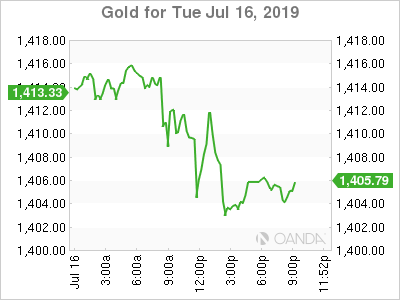
US President Trump’s comments on a deal with China as being far off, did keep gold trading above $1,400, but is US economic indicators continue to improve it could put further pressure on the metal.
STOCKS – Equities Hit Trade and Retail Sales Wall
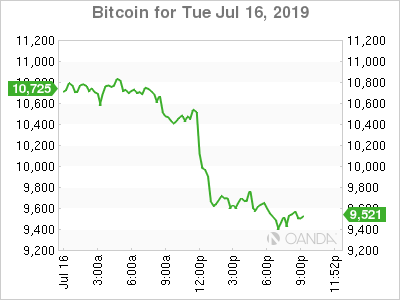
The stock rally faced a perfect storm on Tuesday, as the dollar rose after a stronger retail sales data point that puts in question the number of interest rate cuts by the Fed, President Trump saying a trade deal with China is not close and mixed earning reports from financial institutions.
BITCOIN – Libra Under Fire from Senate Drives Bitcoin Lower
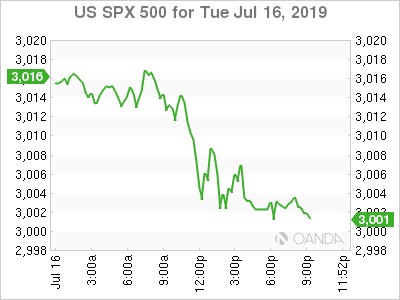
Bitcoin dropped below $10,000 after the US Senate banking committee put Facebook’s Libra project under the microscope.
Libra could be the quickest way to quicken a broad adoption of cryptocurrencies, but Facebook has been under fire for invasion of privacy concerns and the Senate inquires could go from positive to negative for Bitcoin.
Eco Data 7/17/19
[php_everywhere instance="1"]
Japanese Trade and CPI Data Eyed ahead of Upper House Elections
Trade and inflation numbers will be watched out of Japan this week ahead of the weekend elections for Japan’s upper chamber. The June trade data is due on Wednesday at 23:50 GMT, while the inflation figures for the same month will be published on Thursday at 23:30 GMT. Both releases are projected to point to a softening in Japan’s economic picture in a potential warning sign for the Bank of Japan. But with Prime Minister Shinzo Abe’s coalition expected to hold onto its two thirds majority in Parliament’s upper house, additional fiscal stimulus could also be an option for policymakers.
Downtrend in exports to continue
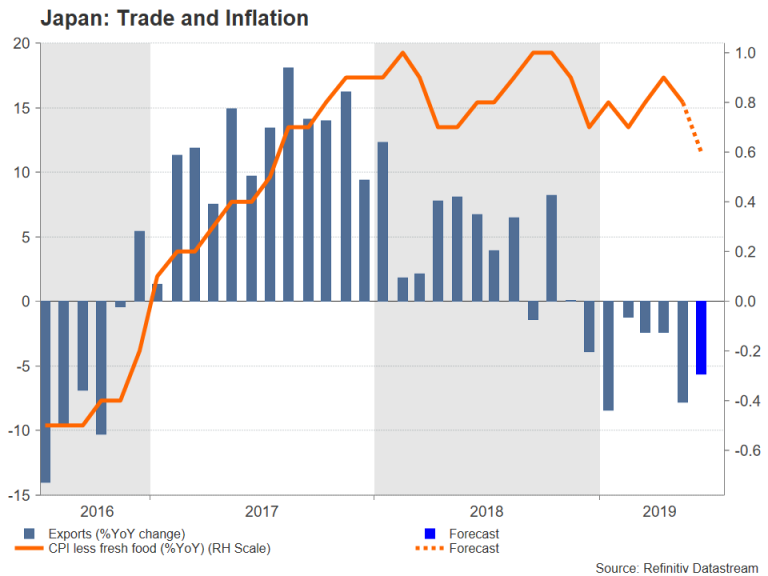
Japanese exports have been on the decline since December as the fallout from the US-China trade war starts to disrupt trade and investment flows globally. After some easing in the rate of decline in recent months, exports plunged by an annual rate of 7.8% in May and are forecast to have dived by a further 5.6% in June. Imports have been performing somewhat better, indicating domestic demand hasn’t been too badly affected from the worsening overseas outlook. However, that could be about to change as imports are forecast to have dropped for the second straight month, by 0.4% year-on-year in June.
Core CPI could hit 2-year low
The inflation numbers are not expected to bring too many smiles either as the core rate that’s monitored by the Bank of Japan is anticipated to moderate again. Core CPI, which excludes fresh food prices, is forecast to slip to a near two-year low of 0.6% y/y from 0.8%. While some of the decline is likely to be down to transitory factors, it would nevertheless take the BoJ’s targeted inflation measure uncomfortably far from the 2% target, adding pressure on the Bank to ramp up stimulus soon.
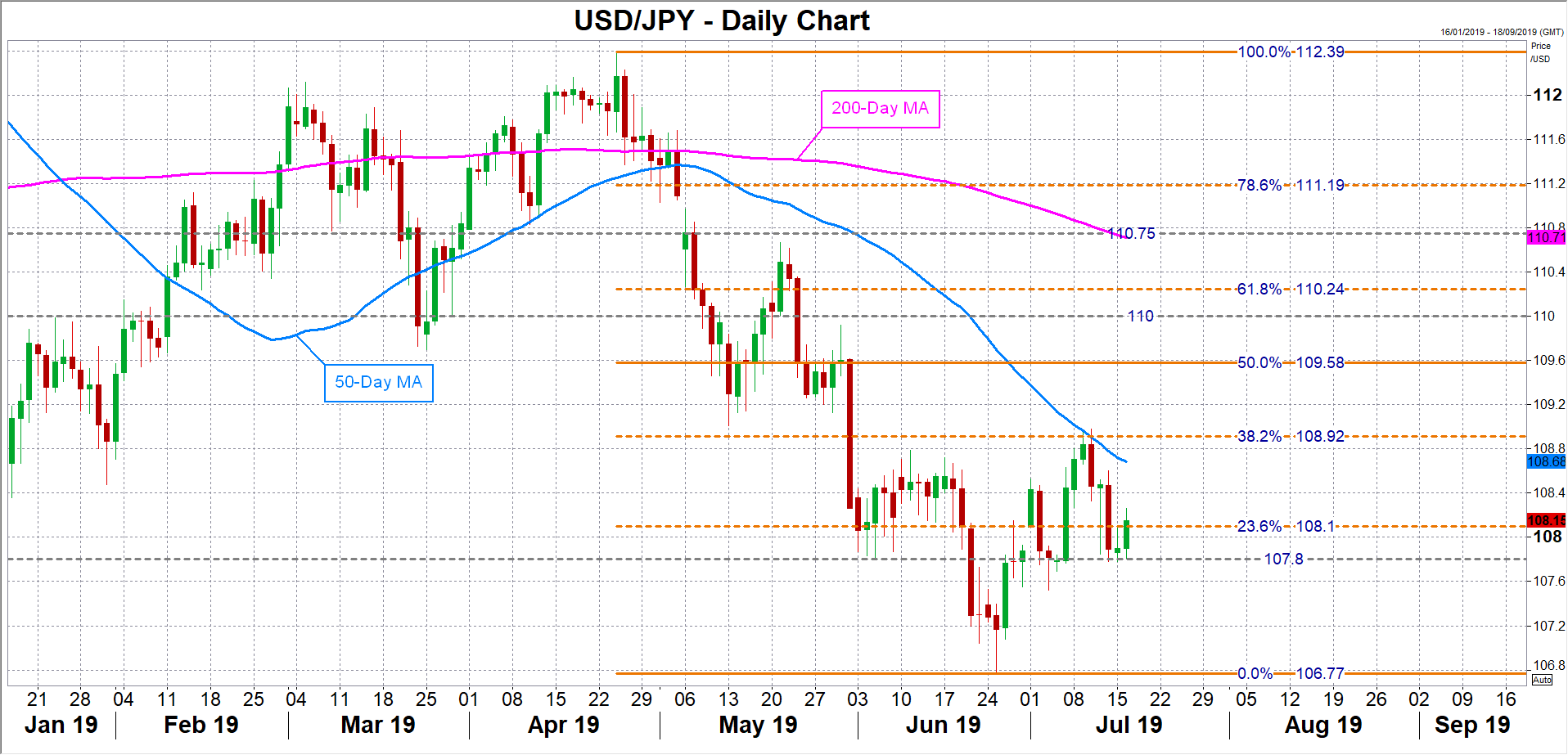
The yen could face some downside pressure if the incoming data begins to firmly point to more monetary easing. Increased expectations of looser policy from this week’s figures could shore up the sliding US dollar against the yen, helping the pair aim for the 50% Fibonacci retracement of the April-June downleg at 109.58. On the other hand, if the data fails to provide clear policy direction, the dollar is likely to remain on the backfoot and could soon re-challenge the recent support at 107.80 yen.
BoJ stimulus may have to wait until Autumn
The Bank of Japan next meets on July 29-30 and although investors see only a very small chance of a change in policy this month, expectations are high for a year-end cut in the main policy rate to -0.20%. The BoJ could also expand the size of its bond holdings as well as possibly diversify the type of assets it purchases. Policymakers are likely to struggle to reach a decision, however, on the need for further policy easing before the planned sales tax hike comes into force in October.
But even if the BoJ was to decide to pump more stimulus in the coming months, many think it would only be effective if it’s accompanied by fiscal stimulus given that monetary policy is increasingly seen as losing its potency. The government has already indicated it stands ready to prepare a fresh fiscal package to overcome any downturn.
Ruling coalition expected to maintain upper house majority
Despite voters’ doubts about the success of Abenomics, the ruling coalition is expected to hold on to its two thirds majority in Parliament’s upper house at this Sunday’s elections. The projected win should give the government the go-ahead to proceed with its long-held desire of changing Japan’s pacifist constitution as well as encourage it to carry out further economic reforms. Any unexpected developments at the polls, however, against Abe’s party could generate some safe-haven flows for the yen.
WTI Price Extends Consolidation after Bulls Stalled at Key Fibo Barrier
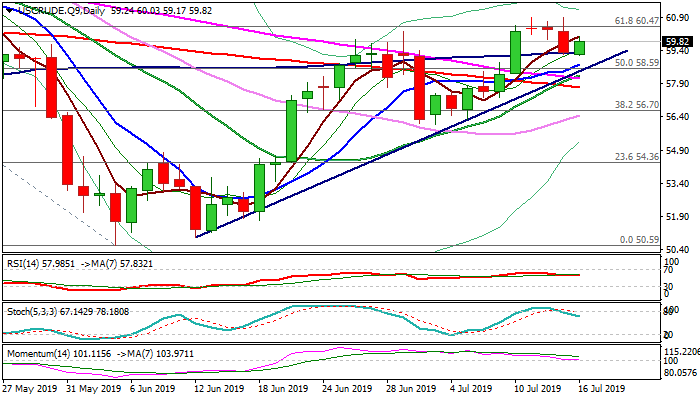
WTI oil price managed to regain traction and edge higher on Tuesday after Monday’s fall was contained by 100DMA ($59.31).
Larger uptrend from $50.59 low showed initial signs of stall at important Fibo barrier at $60.47 (61.8% of $66.58/$50.59), where double-Doji has formed before Monday’s easing.
Bulls came under pressure after hurricane in the gulf of Mexico caused less than expected damage that resulted in restarting production on a number of oil platforms in the gulf.
Fears of fresh pressure on oil price on rising US shale production that is on track to reach record highs in August could put the price lower, with initial negative signal expected on violation of 100DMA and further evidence of deeper pullback expected on break below trendline support ($58.65) and 200DMA ($57.74).
Extended consolidation can be expected while the price stays between 100DMA and Fibo barrier ($60.47), while strong bullish signal could be expected on firm break above $60.47 pivot.
Daily techs are in mixed setup and lack clearer direction signal for now, as markets are awaiting release of weekly US crude inventories report (API due later today and EIA on Wednesday).
Res: 60.00; 60.47; 60.88; 61.38
Sup: 59.31; 58.65; 58.15; 57.74
MARKET WRAP: Facebook Defended Libra, Stocks Moved Higher
Facebook faced its first test for its cryptocurrency today at Capital Hill *Sterling dropped off the cliff.
Stocks
- The S&P 500 failed to move much despite some strong retail US data. The index remained at 3,013 at 15:38 London time.
- The UK 100 index jumped on the back of the Burberry earnings, it gained 0.49%.
- The Stoxx 600 index soared 0.30% and it is up nearly 15.18%.
Currencies
- The Dollar Spot Index increased by 0.37% ahead of the Fed chairman’s speech.
- The Euro continued to move lower and dropped 0.39% to $1.1215.
- The British pound dropped off the cliff and the support of 1.24 came under a major threat. It sank 0.71% to $1.2422.
- The Japanese yen declined 0.32% to 108.24 per dollar.
Bonds
- The yield on 10-year Treasuries increased three basis points to 2.12%.
- Germany’s 10-year yield climbed one basis point to -0.24%.
- Britain’s 10-year yield increased by two basis points to 0.80
- increased one basis point to 0.812%.
Commodities
- West Texas Intermediate crude moved higher 0.45% to $59.65 a barrel.
- Gold dropped 0.07% to $1,411 an ounce.
EU Malmstrom: WTO in deep crisis, appellate body would probably collapse
EU Trade Commissioner Cecilia Malmstrom warned in a conference in France that WTO is in "deep crisis" and "we have to recognize this". In particular, she said "if the appellate body collapses, which probably it will in December - at least temporarily - we will have no enforcement. And if you have no rules everybody can do whatever they want."
At the same conference, WTO Director General Alan Wolff said "you get into a possible scenario where a country that lost (a case) says we appeal but there is no appeal which means the panel is not final. Then, "you could go to retaliation and counter-retaliation, which is what has happened between the U.S and China, which is certainly not good for the world."
EUR/JPY Mid-Day Outlook
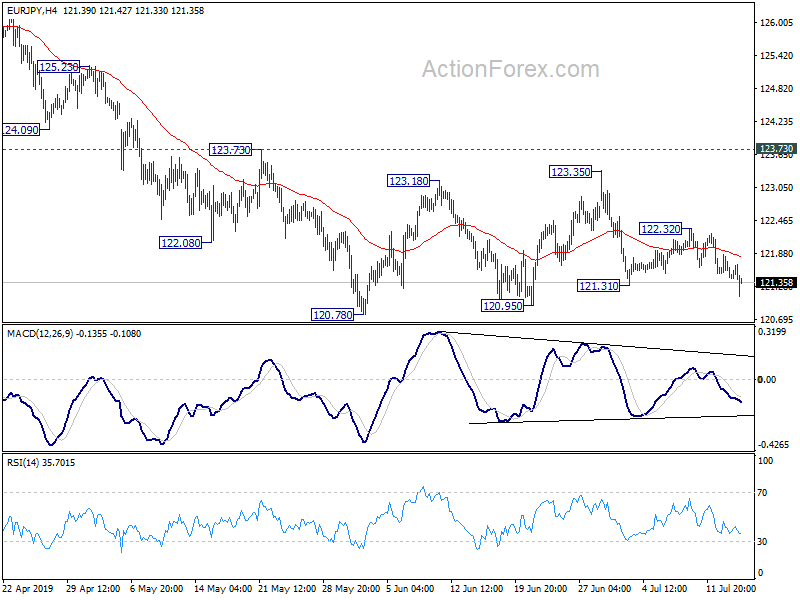
Daily Pivots: (S1) 121.32; (P) 121.58; (R1) 121.75; More....
Intraday bias in EUR/JPY is back on the downside with break of 121.31 minor support. We're still favoring the case that consolidation from 120.78 has completed with three waves to 123.35. Break of 120.78 low will resume fall from 127.50 to 118.62 low. In case of another rise as consolidation from 120.78 extends, upside should be limited by 123.73 resistance to bring fall resumption eventually.
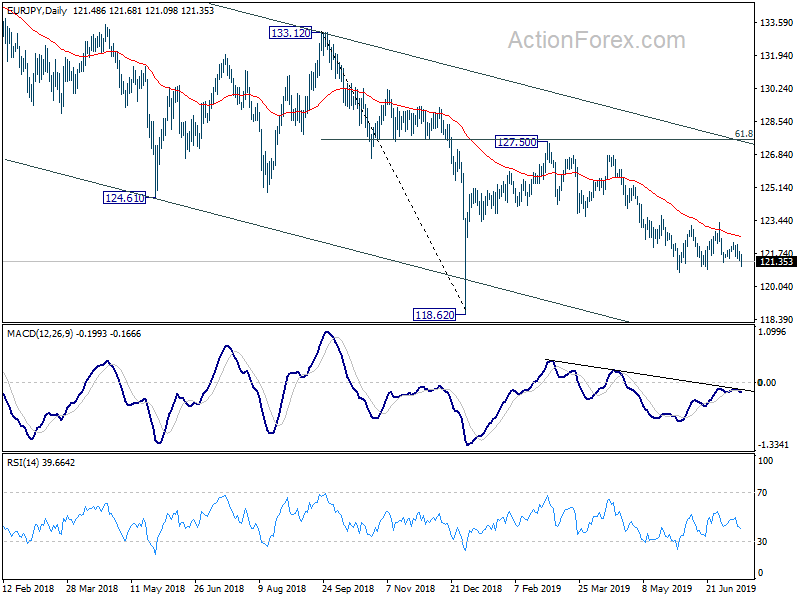
In the bigger picture, down trend from 137.49 is still in progress with the cross staying inside long term falling channel. Break of 118.62 will extend the fall to 109.48 (2016 low). On the upside, break of 127.50 resistance is needed to be the first sign of medium term reversal. Otherwise, outlook will remain bearish in case of strong rebound.
GBP/JPY Mid-Day Outlook
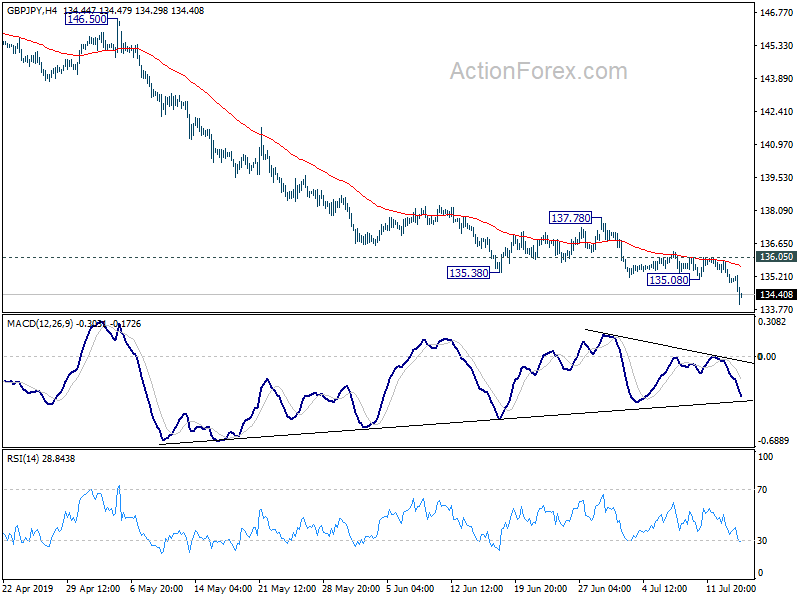
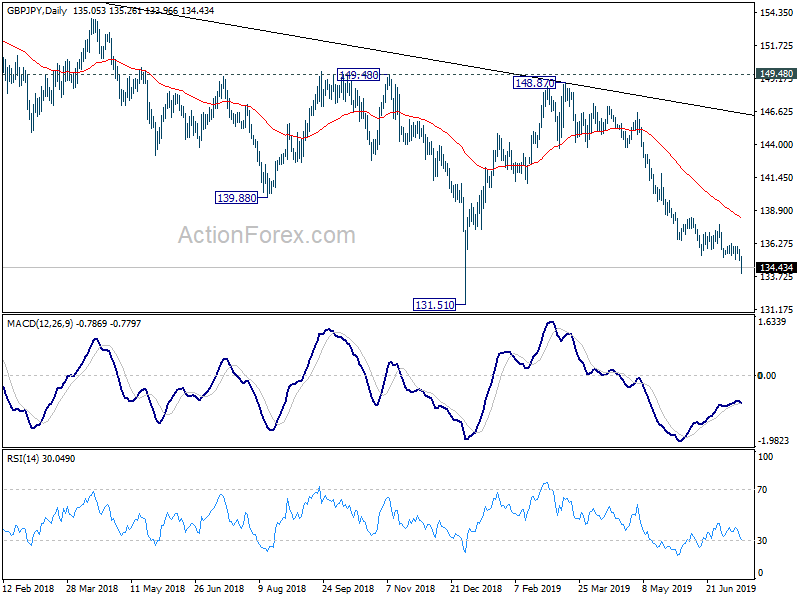
Daily Pivots: (S1) 134.73; (P) 135.29; (R1) 135.63; More...
GBP/JPY's decline resumes by breaking 135.08 temporary low and reaches as low as 133.96 so far. Intraday bias is back on the downside. Current fall from 148.87 should target 131.51 low next. On the upside, break of 136.50 resistance is needed to indicate short term bottoming. Otherwise, outlook will remain bearish in case of recovery.
In the bigger picture, medium term fall from 156.59 (2018 high) is still in progress. Break of 131.51 will target 122.36 (2016 low). Structure of such decline is corrective looking so far, arguing that it's just the second leg of consolidation from 122.36. Thus, we'd expect strong support from 122.36 to contain downside to bring reversal.
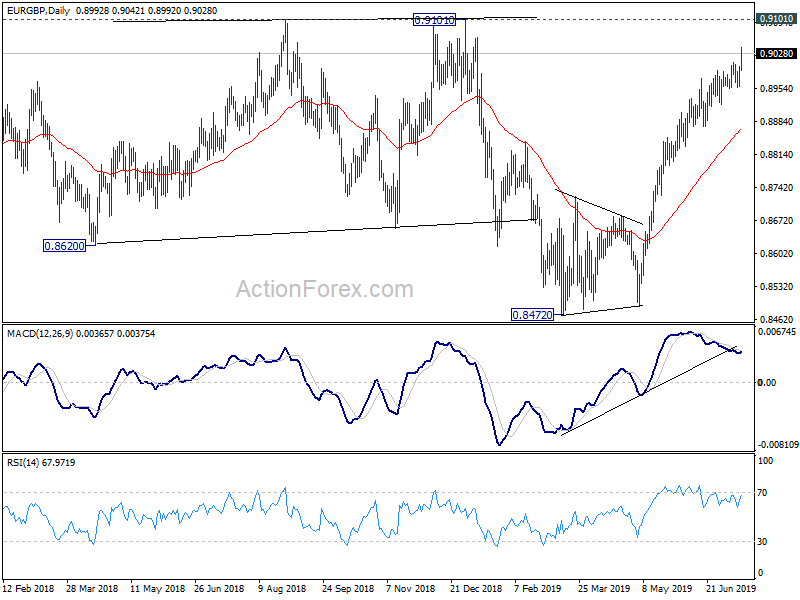
EUR/GBP Mid-Day Outlook
Daily Pivots: (S1) 0.8969; (P) 0.8985; (R1) 0.9011; More...
EUR/GBP's break of 0.9010 indicates resumption of larger rise from 0.8472. Intraday bias is back on the upside for 0.9101 resistance. 4 hour MACD is showing sign of pick up in momentum. But daily MACD remains weak. Thus, we'd be cautious on topping below 0.9101. On the downside, break of 0.8954 support will indicate short term topping. In this case, deeper pull back could be seen to 55 day EMA (now at 0.8869) first.
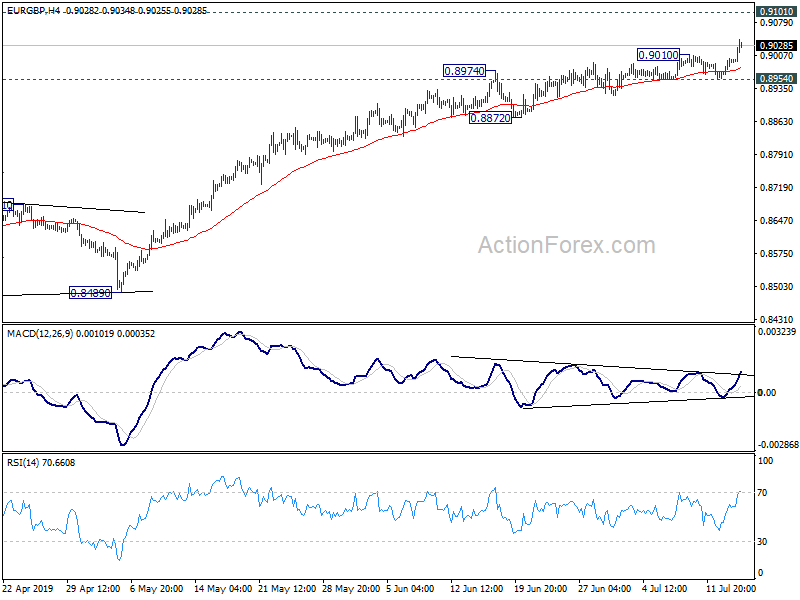
In the bigger picture, medium term decline from 0.9305 (2017 high) is seen as a corrective move. No change in this view. Current development argues that it might have completed with three waves down to 0.8472, just ahead of 38.2% retracement of 0.6935 (2015 low) to 0.9306 at 0.8400, after hitting 55 month EMA (now at 0.8545). Decisive break of 0.9101 resistance will confirm this bullish case. Nevertheless, as EUR/GBP is still staying inside long term falling channel, correction from 0.9305 could still extend to 0.8400 fibonacci level before completion, if upside is rejected by 0.9101.