

Sample Category Title
Sunset Markets Commentary
Markets
Core bonds trade mixed today with US Treasuries significantly underperforming stable Bunds. Disappointing German ZEW investor sentiment pushed the Bund to an intraday high, but the move lacked follow-up action. The main downleg in the US Note future followed after stellar US retail sales. US Treasuries gently pulled Bunds lower as well. Atlanta Fed Bostic repeated his hawkish critique on current market pricing about Fed expectations. He said that inflation has been in the range of its 2% target for a long time with unemployment at record low levels. Yet, he adds, there is a lot of confusion over the Fed outlook. Whatever the non-voting FOMC member thinks, it didn’t alter the fact that a 25 bps rate cut is still fully discounted for the July 31 Fed meeting. US yields add 3.5 bps (30-yr) to 4.7 bps (5-yr) at the time of writing. Changes on the German yield curve are limited to +0.5 bps across the curve. Peripheral yield spreads vs Germany narrow by 3 to 6 bps with Greece (-8 bps) outperforming. The Greek debt agency successfully launched a new 7-yr bond via syndication. The 1.875% Jul2026 GGB was priced to yield 1.9%, tighter than IPT in the 2.1% area and official guidance in the 2% area. The order book was in excess of €13bn even if the country is still rated “junk” at the three big rating agencies. The Hellenic Republic eventually printed €2.5bn, profiting from the hunt for yield and spread compression caused by the ECB’s dovish forward guidance early June.
Yesterday’s failed EUR/USD attempt to clear the 1.1285 resistance caused a modest setback of EUR/USD yesterday and this morning. The move was mainly technical in nature. Investors awaiting the vote an on the new EC president and a disappointing ZEW German investor confidence were additional reasons for investors to take a cautious stance on the single currency. Early in US dealings, the dollar got a shot in the arm as US retail sales accelerated in June, suggesting that Q2 US growth might be better/less worse than expected. The dollar touched new intraday lows, but any follow-through gains remain modest as markets still expect a pre-emptive Fed interest rate cut at the end of this month. EUR/USD dropped to the 1.1210 area, but the EUR/USD 1.1181 key support is left intact. USD/JPY regained the 108 handle and is trading in the 108.25 area.
Sterling continued fighting an uphill battle today. The UK labour data were mixed, but showed resilience given recent slowdown in broader economic slowdown. Job growth slowed slightly more than expected to 28K in the 3 months through May but wage growth (3.6% Y/Y) printed at the highest level in more than 10 yrs. Sterling lost of few more ticks after the labour data, but the UK currency was already under pressure for the start of trading in Europe. Investors understood that a reopening of the Brexit talks between the EU and the UK after the nomination of a new UK PM might be very tumultuous. Both candidates to become UK PM indicated they want to remove the ‘Irish backstop clause’ from the Brexit deal, but this is unacceptable to the EU, raising the risks for a no-deal Brexit. EUR/GBP surpassed the 0.90 handle. Cable is at risk of breaking the key 1.2440 support area. A break below could trigger additional stop-loss repositioning away from sterling.
News Headlines
ECB’s Villeroy said the central bank should not only be independent from political pressures but should also avoid ceding to market pressures, referring to the drop in market based inflation expectations. He added the ECB is data dependent and will “act accordingly if and when needed”.
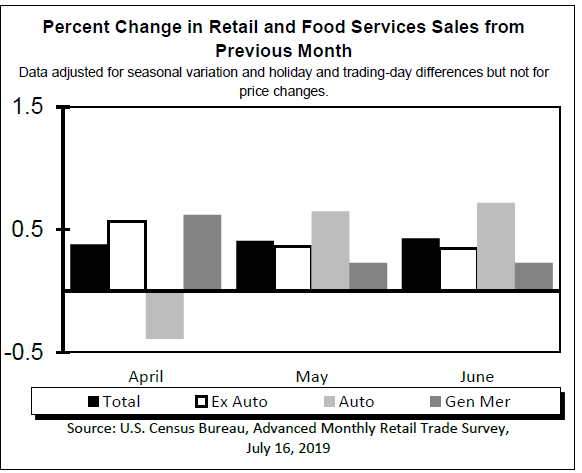
US June retail sales surprised on the upside with the 0.4% MoM headline figure beating 0.2% market expectations. The core control group printed at 0.7% MoM vs. 0.3% expected. The rise was broad-based with 11 of 13 categories showing increased sales with non-store retailers (incl. online) leading. A sharp drop in oil prices at least partially resulted to a decline in gasoline stations sales.
US: Retail Sales Post Another Month of Strong Gains
- Following a strong print in May, retail sales advanced handsomely in June, rising by 0.4%. The headline exceeded the median survey estimate for 0.2% gain. May's print was revised a touch lower from +0.5% in the advance reading to still-healthy 0.4%.
- The retail sales "control group" which excludes the most volatile components (gas, autos, building materials, and food services) posted an even more impressive gain of 0.7%, well ahead of expectations for 0.3%. To top it off, May's "control group" print was revised up from a +0.5% advanced reading to +0.6%.
- Most sub-categories gained in the month, with non-store retailers (+1.7%) again leading the way. Other big gainers were motor vehicles and parts dealers (+0.7%) and eating and drinking places (+0.9%) . Sales also rose at food & beverage, clothing and health & personal care stores (all three up by 0.5%). Ditto for sales of building materials and furniture (both up 0.5%). For the second quarter as a whole, furniture sales were up 8.2% (annualized), rebounding after three consecutive quarters of declines.
- Pulling back in the month were sales at department stores (-1.1%), gasoline stations (-2.8%), and electronics stores (-0.3%).
Key Implications
- Please fasten your seat belts. Another month, another strong retail report. After a soft first quarter, consumers flocked en masse to both brick-and-mortar stores as well as online in the second quarter. Retail sales rose smartly in each of the past four months, and were up 7.5% (annualized) for Q2 as a whole – the strongest quarterly result since Q4 2017. This bodes well for real consumer spending in the quarter, which we expect to come in around 4.0% (annualized) in the second quarter.
- With other GDP components, like business investment and trade, downshifting on the back trade uncertainty, the onus falls on American consumers to drive economic growth. It seems that they are up to this task. With household wealth rebounding, interest rates trending lower and job and wage growth continuing unabated, fundamentals are in place for consumer spending to remain healthy.
USD/JPY Mid-Day Outlook
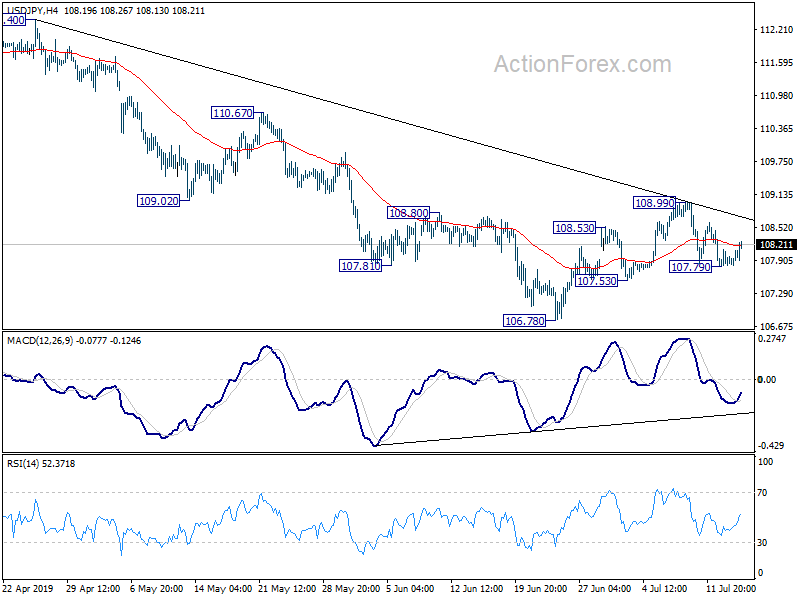
Daily Pivots: (S1) 107.77; (P) 107.94; (R1) 108.08; More...
Intraday bias in USD/JPY is turned neutral with today's recovery. On the downside, below 107.79 will resume the fall from 108.99 to retest 106.78 low first. Break will resume larger decline from 112.40. on the upside, break of 108.99 will resume the rebound from 106.78 to 110.67 resistance next.
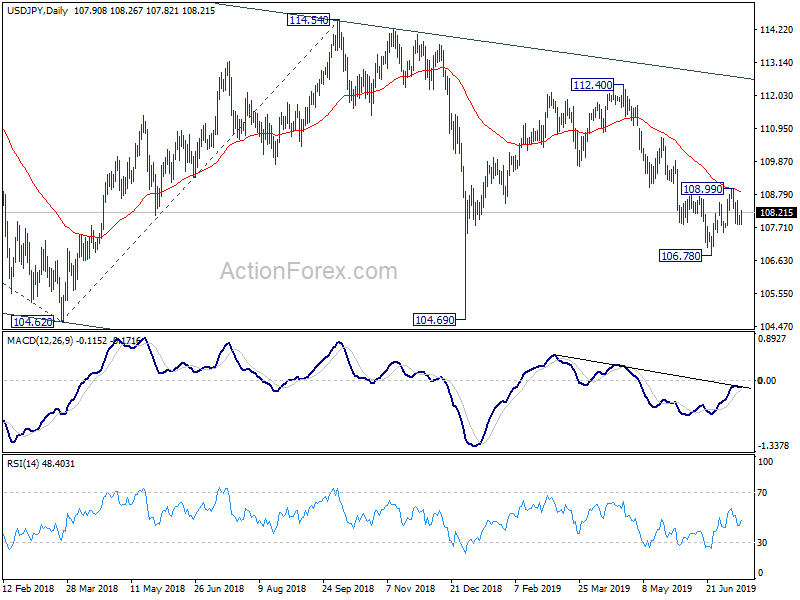
In the bigger picture, decline from 118.65 (Dec 2016) is still in progress, with the pair staying inside long term falling channel. Break of 104.62 will target 100% projection of 118.65 to 104.62 from 114.54 at 100.51. For now, we'd expect strong support above 98.97 (2016 low) to contain downside to bring rebound. In any case, break of 112.40 is needed to the first serious sign of medium term bullishness. Otherwise, further decline will remain in favor in case of rebound.
USD/CHF Mid-Day Outlook
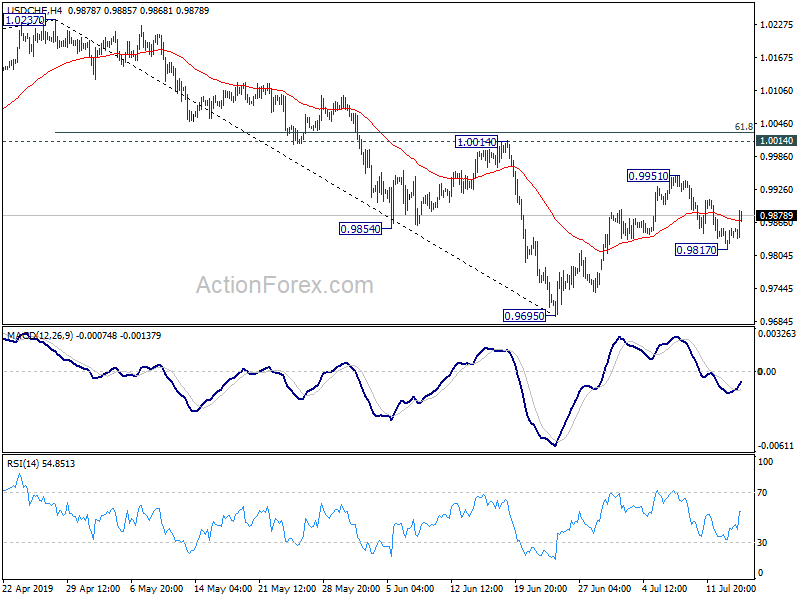
Daily Pivots: (S1) 0.9824; (P) 0.9839; (R1) 0.9861; More...
Intraday bias in USD/CHF is turned neutral with today's recovery. On the downside, below 0.9817 will resume the decline from 0.9951 to retest 0.9695 low first. On the upside, above 0.9951 will extend the rebound from 0.9695. In that case, upside should be limited by 61.8% retracement of 1.0237 to 0.9695 at 1.0030.
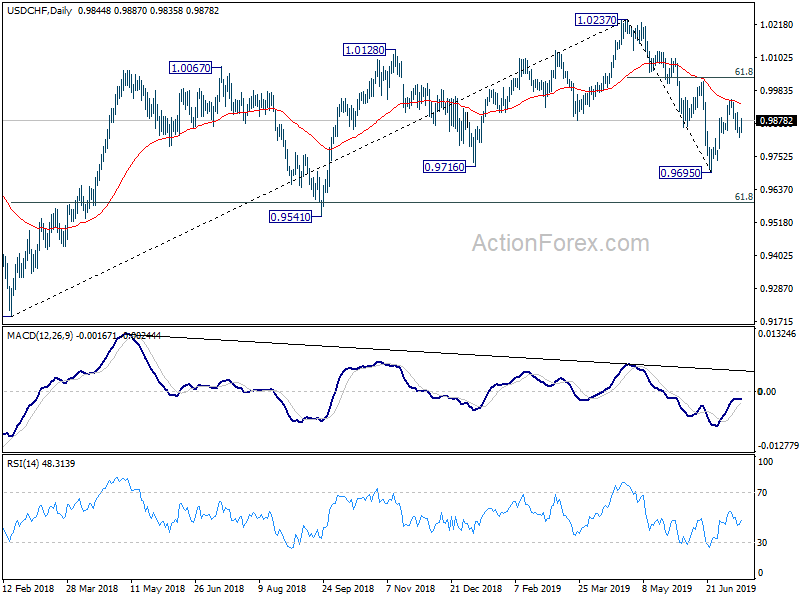
In the bigger picture, up trend from 0.9186 (2018 low) should have completed at 1.0237 already. Deeper decline would be seen to 61.8% retracement of 0.9186 to 1.0237 at 0.9587 and below. For now, USD/CHF is seen as in long term range pattern between 0.9186 and 1.0342. Hence, we'd pay attention to bottoming signal below 0.9587. However, sustained break of 1.0014 will revive medium term bullishness and turn focus back to 1.0237 high.
EUR/USD Mid-Day Outlook
Daily Pivots: (S1) 1.1246; (P) 1.1265; (R1) 1.1277; More...
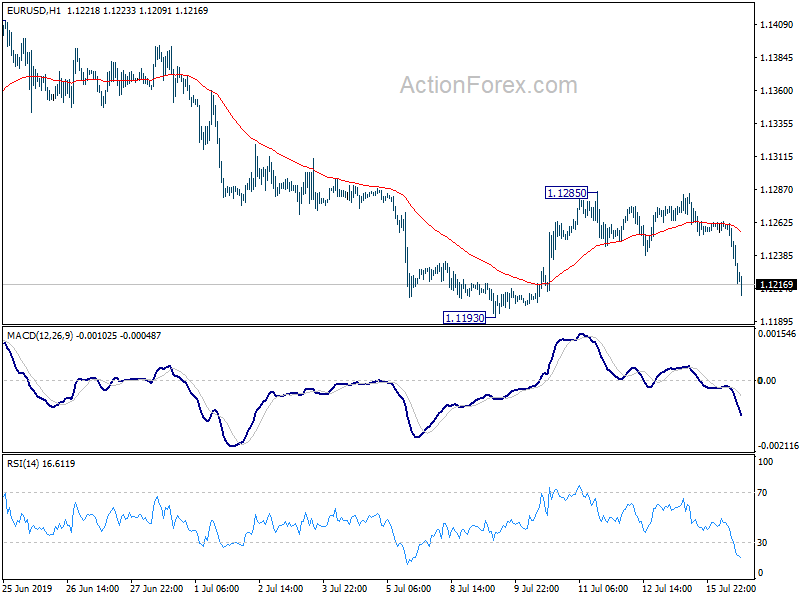
EUR/USD drops notably today and failure to sustain above 55 day EMA dampens original bullish view. Intraday bias stays neutral but focus is back on 1.1193 minor support. Break will resume the fall from 1.1412 to retest 1.1107 low. On the upside, above 1.1285 resistance will turn bias back to the upside for 1.1412 resistance.
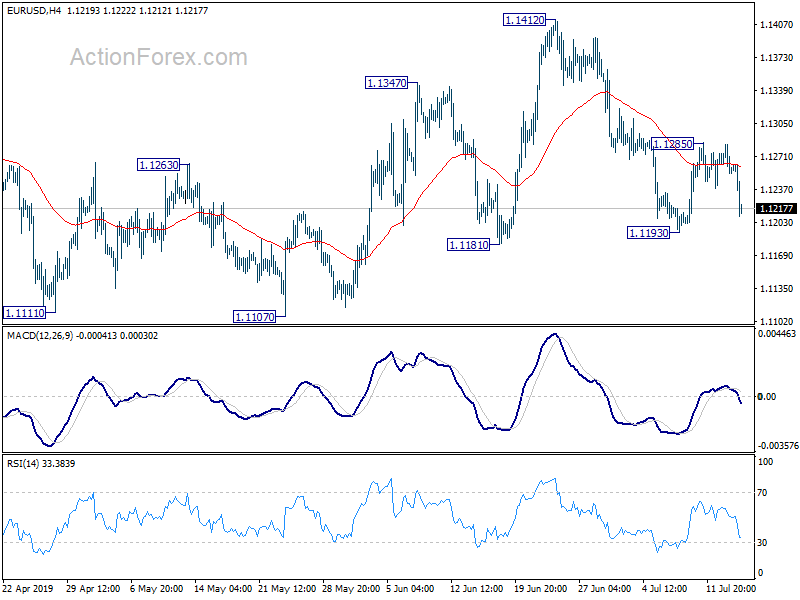
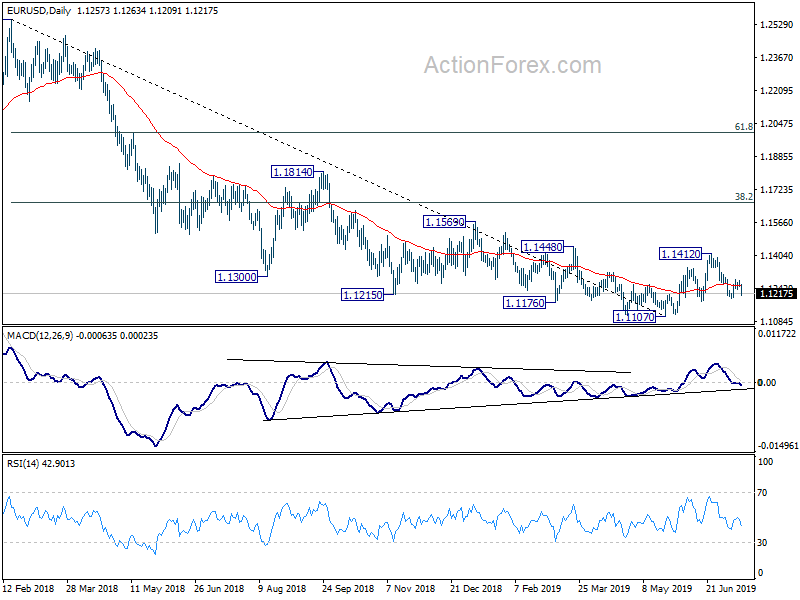
In the bigger picture, bullish convergence condition in daily and weekly MACD suggests that 1.1107 is a medium term bottom. However, rejection by 55 EMA retains medium term bearish. Outlook will be neutral for now. On the downside, break of 1.1107 will resume the down trend from 1.2555 (2018 high) to 78.6% retracement of 1.0339 to 1.2555 at 1.0813. Meanwhile, break of 1.1412 will resume the rebound to 38.2% retracement of 1.2555 to 1.1107 at 1.1660.
GBP/USD Mid-Day Outlook
Daily Pivots: (S1) 1.2491; (P) 1.2535; (R1) 1.2559; More....
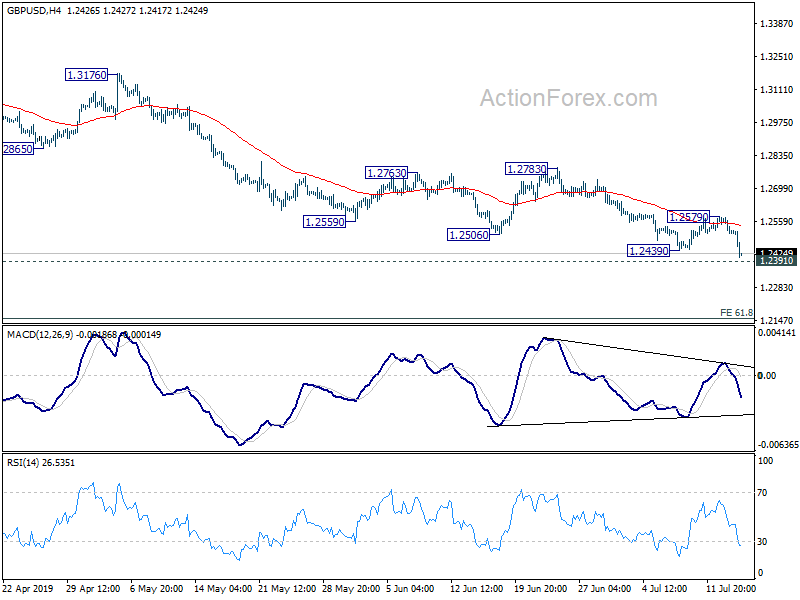
GBP/USD drops to as low as 1.2408 so far today as fall from 1.3381 resumes. Intraday is back on the downside for retesting 1.2391 low. Firm break will resume larger down trend for 61.8% projection of 1.4376 to 1.2391 from 1.3381 at 1.2154 next. On the upside, break of 1.2579 resistance is needed to indicate short term bottoming. Otherwise, outlook remains bearish in case of recovery.
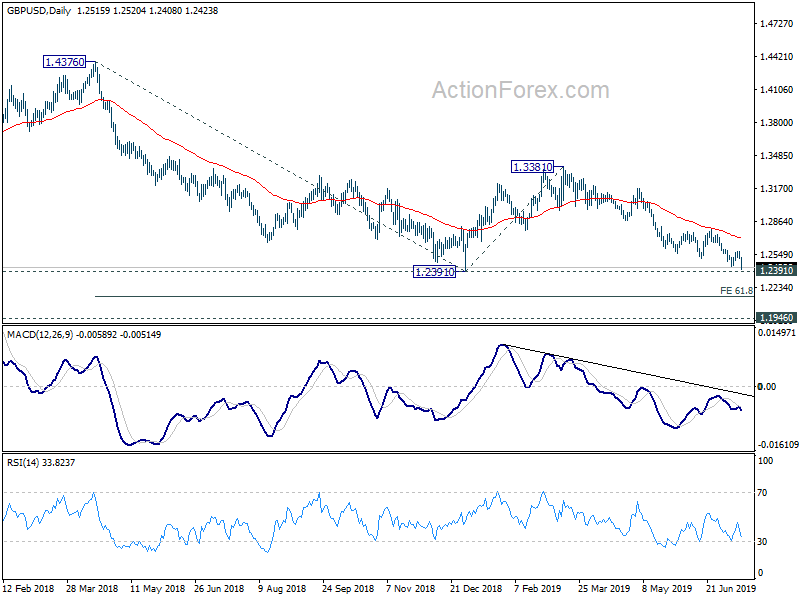
In the bigger picture, down trend from 1.4376 (2018 high) is still in progress. Break of 1.2391 would target a test on 1.1946 long term bottom (2016 low). For now, we don't expect a firm break there yet. Hence, focus will be on bottoming signal as it approaches 1.1946. In any case, medium term outlook will stay bearish as long as 1.3381 resistance holds, in case of strong rebound.
Dollar Rebounds on Retail Sales, Sterling Shrugs Solid Job Data
Dollar rebound strongly in early US session, with support from strong retail sales data. Though, upside is somewhat capped by industrial production miss. Canadian Dollar is, instead, the strongest one. On the other hand, Sterling is the weakest one for today despite solid employment data. UK unemployment rate stayed at 45-year low while wage growth accelerated. But that's overshadowed by renewing no-deal Brexit fear. Both runners Boris Johnson and Jeremy Hunt rejected Irish backstop in any part of Brexit deal. Such position will make Brexit negotiations very tough ahead. Euro is the second weakest as German ZEW Economic Sentiment deteriorated further in July.
Technically, GBP/USD's break of 1.2439 temporary low suggests fall resumption for 1.2391 low. Break there will resume medium term decline. GBP/JPY also resumes recent decline from 148.87 for 131.51 low. EUR/GBP takes out 0.9010 resistance earlier today and should be heading to 0.9101 key resistance next. EUR/JPY break s121.31 minor support and is heading to 120.78 low for resuming larger decline from 127.50. A focus is now on 1.1193 support in EUR/USD and break will revive near term bearishness for 1.1107 low.
In other markets, major US indices open mildly lower while 10-year yield is up 0.0349 at 2.127. In Europe, currently, FTSE is up 0.45%. DAX is up 0.25%. CAC is up 0.53%. German 10-year yield is up 0.003 at -0.248. Earlier in Asia, Nikkei dropped -0.69%. Hong Kong HSI rose 0.23%. China Shanghai SSE dropped -0.16%. Singapore Strait Times rose 0.36%. Japan 10-year JGB yield dropped -0.0071 to -0.121.
US retail sales rose 0.4%, ex-auto sales rose 0.4%, far above expectations
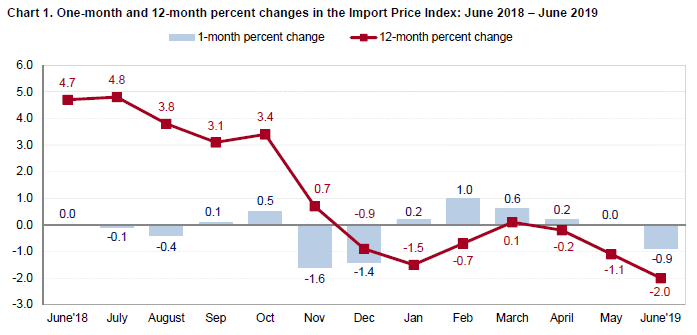
US retail sales rose 0.4% mom in June, above expectation of 0.1%. Ex-auto sales also rose 0.4%, above expectation of 0.1%. Also from US, import price index dropped -0.9% mom in June, worse than expectation of -0.7% mom. Industrial production rose 0.0% mom in June, below expectation of 0.1% mom. Capacity utilization dropped to 77.9%, down from 78.1%.
ECB Villeroy: Should not rely too exclusively on market based inflation expectation measures
ECB Governing Council member Francois Villeroy de Galhau reiterated his stance that ECB rate decision should be "data dependent". In the upcoming meeting, policymakers will "assess actual economic data and we will act accordingly if and when needed."
He acknowledged that policymakers would "take account of market indications" but emphasized "must not be market dependent". That is ECB should not rely "too exclusively for inflation expectations on market-based measures".
Additionally, Villeroy also noted monetary policy is limited as it cannot repair the damage from protectionism, or replace structural reforms or more selective fiscal policies. And, "monetary policies cannot do everything and cannot perform miracles."
German ZEW dropped to -24.5, a lasting containment of factors are causing uncertainty
German ZEW Economic Sentiment dropped to -24.5 in July, down from -21.1 and missed expectation of -22. Current Situation Index dropped to -1.1, down from 7.8 and missed expectation of 5. Eurozone ZEW economic sentiment dropped slightly to -20.3, down from -20.3 and beat expectation of -20.9. Eurozone Current Situation index dropped -6.9 to -10.6.
ZEW President Achim Wambach said: "Continued negative trend in incoming orders in the German industry is likely to have reinforced the financial market experts' pessimistic sentiment. A lasting containment of the factors that are causing uncertainty in the export-oriented sectors of the German economy is currently not in sight. The Iran conflict seems to be intensifying and the ongoing trade dispute between the USA and China is a burden not only to Chinese economic development. Furthermore, no discernible progress has been made in the negotiations as to what Brexit will look like."
Also released, Eurozone trade surplus widened to EUR 20.2B in May, above expectation of EUR 16.4B.
UK unemployment rate stayed at 45-yr low, wage growth picked up
UK unemployment rate was unchanged at 3.8% in the three months to May, matched expectations. It was the lowest level since December 1974. Average weekly earnings including bonus grew 3.4% 3moy, much higher than expectation of 3.1% 3moy. Average weekly earnings excluding bonus also grew 3.6% 3moy, above expectation of 3.5% 3moy. In June, jobless claims rose 38.0k, above expectation of 18.9k.Claimant count rate rose 0.1% to 3.2%.
New Zealand CPI rose 0.6% qoq, more RBNZ easing still needed
New Zealand CPI rose 0.6% qoq 1.7% yoy in Q2, matched expectations. The annual rate accelerated from 1.5% yoy in Q1. However, the rise in headline inflation was largely due to the 5.8% quarter increase in petrol price, which contributed 0.25% to the 0.6% qoq figure. That suggests the pick-up could be temporary only, not to mention that annual CPI remains firmly below 2% mid-point of RBNZ's 1-3% target range.
Stronger monetary stimulus and economic growth is required to lift inflation sustainably back to the 2% target. Yet, domestic and global headwinds remain. Thus, more OCR cuts are still expected for RBNZ. August could be the month to deliver even though it's not totally certain yet.
RBA minutes indicate easing bias, but wait-and-see first
In the minutes of July 2 RBA rate meetings, it's noted that "the Board would continue to monitor developments in the labour market closely and adjust monetary policy if needed to support sustainable growth in the economy and the achievement of the inflation target over time." The conclusion indicates that RBA is still adopting an easing bias after cutting interest rate in both June and July meeting. However, the next move will come "if needed", as the central will first "monitor developments" to see how the economy reacts to the prior rate cuts.
Suggested readings on RBA:
- RBA's July Minutes – Cutting Rate to Weaken Aussie and Lower Unemployment Rate
- RBA Board Minutes Signal a Pause in the Easing Cycle
GBP/USD Mid-Day Outlook
Daily Pivots: (S1) 1.2491; (P) 1.2535; (R1) 1.2559; More....
GBP/USD drops to as low as 1.2408 so far today as fall from 1.3381 resumes. Intraday is back on the downside for retesting 1.2391 low. Firm break will resume larger down trend for 61.8% projection of 1.4376 to 1.2391 from 1.3381 at 1.2154 next. On the upside, break of 1.2579 resistance is needed to indicate short term bottoming. Otherwise, outlook remains bearish in case of recovery.
In the bigger picture, down trend from 1.4376 (2018 high) is still in progress. Break of 1.2391 would target a test on 1.1946 long term bottom (2016 low). For now, we don't expect a firm break there yet. Hence, focus will be on bottoming signal as it approaches 1.1946. In any case, medium term outlook will stay bearish as long as 1.3381 resistance holds, in case of strong rebound.
Economic Indicators Update
| GMT | Ccy | Events | Actual | Forecast | Previous | Revised |
|---|---|---|---|---|---|---|
| 22:45 | NZD | CPI Q/Q Q2 | 0.60% | 0.60% | 0.10% | |
| 22:45 | NZD | CPI Y/Y Q2 | 1.70% | 1.70% | 1.50% | |
| 01:30 | AUD | RBA Minutes Jul | ||||
| 08:30 | GBP | Claimant Count Rate Jun | 3.20% | 3.10% | ||
| 08:30 | GBP | Jobless Claims Change Jun | 38.0K | 18.9K | 23.2k | 24.5K |
| 08:30 | GBP | Average Weekly Earnings 3M/Y May | 3.40% | 3.10% | 3.10% | 3.20% |
| 08:30 | GBP | Weekly Earnings ex Bonus 3M/Y May | 3.60% | 3.50% | 3.40% | |
| 08:30 | GBP | ILO Unemployment Rate 3Mths May | 3.80% | 3.80% | 3.80% | |
| 09:00 | EUR | Eurozone Trade Balance (EUR) May | 20.2B | 16.4B | 15.3B | |
| 09:00 | EUR | German ZEW Economic Sentiment Jul | -24.5 | -22 | -21.1 | |
| 09:00 | EUR | German ZEW Current Situation Jul | -1.1 | 5 | 7.8 | |
| 09:00 | EUR | Eurozone ZEW Economic Sentiment Jul | -20.3 | -20.9 | -20.2 | |
| 12:30 | CAD | International Securities Transactions (CAD) May | 10.20B | 5.02B | -12.80B | |
| 12:30 | USD | Import Price Index M/M Jun | -0.90% | -0.70% | -0.30% | |
| 12:30 | USD | Retail Sales Advance M/M Jun | 0.40% | 0.10% | 0.50% | 0.40% |
| 12:30 | USD | Retail Sales Ex Auto M/M Jun | 0.40% | 0.10% | 0.50% | 0.40% |
| 13:15 | USD | Industrial Production M/M Jun | 0.00% | 0.10% | 0.40% | |
| 13:15 | USD | Capacity Utilization Jun | 77.90% | 78.10% | 78.10% | |
| 14:00 | USD | NAHB Housing Market Index Jul | 64 | 64 | ||
| 14:00 | USD | Business Inventories May | 0.40% | 0.50% |
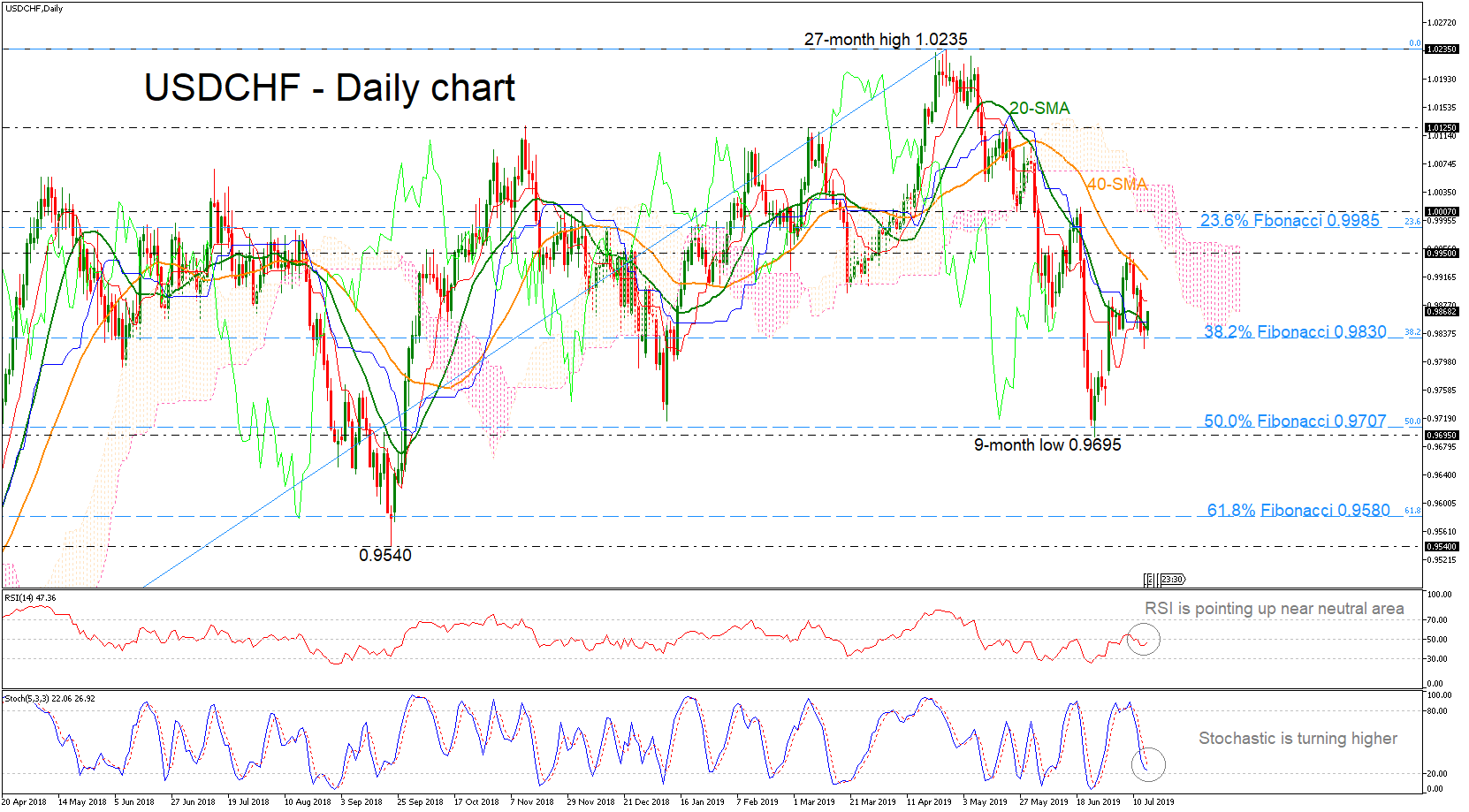
USDCHF Reverses Higher But Remains Bearish in Medium Term
USDCHF rebounded on the 38.2% Fibonacci retracement level of the upleg from 0.9185 to 1.0235 near 0.9830 during yesterday’s trading session, touching the 20-day simple moving average (SMA).
In the short-term, the market could turn positive if the RSI keeps moving around the 50 level, however the red Tenkan-sen line, as well as the blue Kijun-sen line, hold flat. The stochastic oscillator seems ready to turn higher again as the %K line touches the oversold zone and is sloping up.
An extension to the upside could find immediate resistance at the 40-day SMA currently at 0.9910. Further up, resistance could run towards the 0.9950 barrier, taken from the latest highs and the 23.6% Fibonacci region of 0.9985.
On the other hand, if the pair weakens again and declines below the 38.2% Fibonacci region of 0.9830, the 50.0% Fibo of 0.9707 and the 0.9695 support could provide immediate levels for traders.
In the medium-term picture, USDCHF has been trading bearish in the past three months after the close below the 27-month high of 1.0235. Still, if the pair manages to cross above 1.0000, the bearish outlook could switch to a bullish one.
US retail sales rose 0.4%, ex-auto sales rose 0.4%, far above expectations
US retail sales rose 0.4% mom in June, above expectation of 0.1%. Ex-auto sales also rose 0.4%, above expectation of 0.1%. Also from US, import price index dropped -0.9% mom in June, worse than expectation of -0.7% mom. From Canada, international securities transactions rose CAD 10.2B in May, above expectation of USD 5.0B.
Dollar rises notably after the release. EUR/USD is possibly now heading back to 1.1193 temporary low.
Bitcoin – Mnuchin Comments Offer Short Reprieve
Bitcoin initially buoyed by Mnuchin’s comments
Steve Mnuchin added his voice to the President’s in expressing concerns about cryptocurrencies, with Libra and bitcoin naturally at the top of the list of those being spoken about.
Mnuchin was naturally more reserved with his criticisms but highlighted a number of the same issues around illicit uses and money laundering but came across more wary than opposed to them altogether which was certainly the message we had from Trump.
Bitcoin rose back towards $11,000 following Mnuchin’s comments but trades back in the red again this morning. Traders don’t seem to know how to take the news of increased levels of scrutiny for cryptos but at the end of the day, if they want mass adoption, this can only be a good thing. It just is likely to take time, although the way these markets move, they don’t suggest traders have much patience for that.
The area around $9,500-10,000 is looking like increasingly important support for bitcoin having been protected on a couple of occasions but failing to generate any real upside momentum after. A break below here could see it find early support around $9,000 but at that point the damage may be done.
Below here $8,500 and $7,500 look interesting levels but as ever, it can be quite the wild ride in the cryptocurrency space which brings with it a strong element of unpredictability.
How are the rest of the markets trading?
Markets are trading very flat on Tuesday, a theme we may become accustomed to this week as we head into what could be a very interesting summer.
With central banks turning far more dovish in a bid to support the economy and equity markets, attention is shifting to companies who will report second quarter earnings over the coming weeks. This week the focus will primarily be on the banks and in particular, Goldman Sachs and JP Morgan on Tuesday.
The US is widely expected to have entered into an earnings recession in the second quarter which makes the outlooks for these firms all the more important. Citigroup got us off to an okay start but highlighted a few challenges that will likely be repeated by its peers over the coming days, most notably related to trading revenues and lower interest rates.
Sterling tumbles despite strong wage growth
Sterling has taken a tumble this morning to trade back at its recent lows. The declines started early in European trade and have continued throughout the morning. The decline accelerated when the pound broke below 1.25 against the dollar and is now pushing 1.2450. Various Brexit reports may have contributed to the decline, but its interesting that the UK jobs report failed to slow the decline.
While unemployment was unchanged and the claimant count rose, wages were strong which if sustained and no deal can be avoided would surely strengthen the case for no rate cuts and maybe even rate hikes. Unfortunately, traders are finding it hard to look past no-deal risks or at the very least a delay and hard Brexit, which continues to weigh on the currency.