Sample Category Title
USD/CAD Mid-Day Outlook
Daily Pivots: (S1) 1.3038; (P) 1.3079; (R1) 1.3100; More...
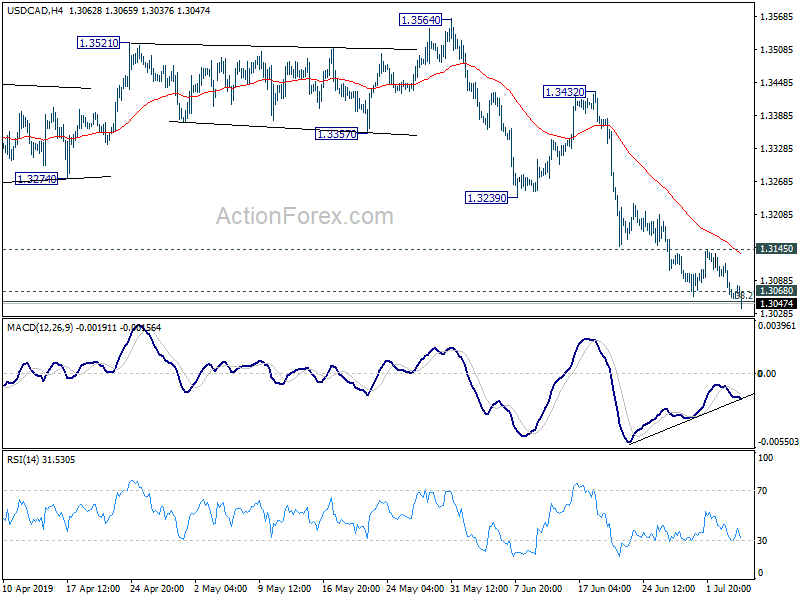
USD/CAD drops to as low as 1.3037 so far today. Sustained trading below 1.3052/68 cluster support zone will carry larger bearish implications. Deeper fall should be seen to 1.2673 fibonacci level next. Nevertheless, rebound from current level, with break of 1.3145 minor resistance, will indicate short term bottoming and bring rebound back to 1.3239 support turned resistance.
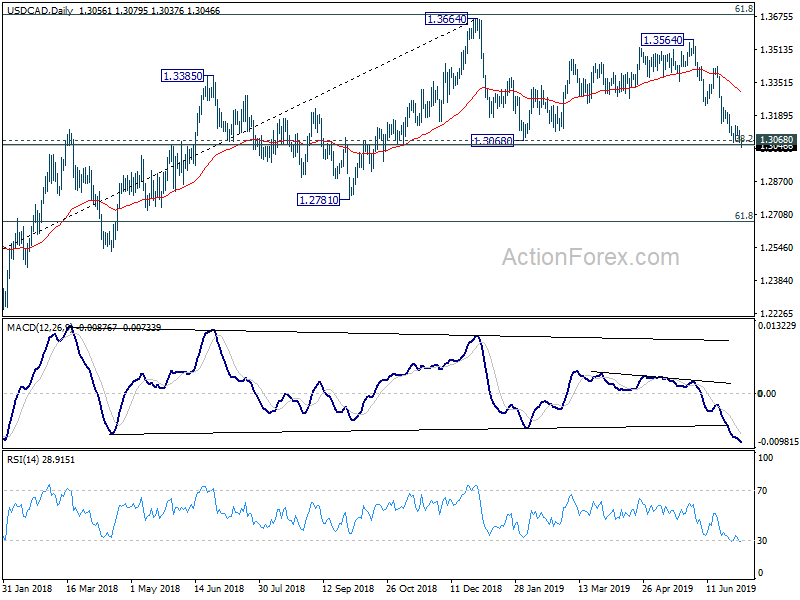
In the bigger picture, medium term outlook stays neutral for now even though the case of bearish reversal is building up. Decisive break of 1.3068 cluster support (38.2% retracement of 1.2061 to 1.3664 at 1.3052) will confirm completion of up trend from 1.2061 (2017 low). Further fall should be seen to 61.8% retracement at 1.2673 next. On the upside, sustained break of 61.8% retracement of 1.4689 (2016 high) to 1.2061 at 1.3685, is needed to confirm resumption of up trend from 1.2061 (2017 low). Otherwise, risk will stay on the downside.
German 10-Yr Yield Hits Record Low on ECB Easing Expectations
Trading in the currency markets are relatively subdued today as US is on holiday. Major volatility is seen in the bond markets, as German 10-year yield hits another record low. Expectations on ECB easing continues to intensify, with an official explicitly calling for action now. Swiss Franc is currently the strongest one, followed by Yen and then Canadian Dollar. On the other hand, New Zealand Dollar and Australian Dollar are the weakest. But the picture at weekly close could be changed drastically with non-farm payroll report tomorrow.
Technically, USD/CAD will be a major focus as it seems to be finally breaking 1.3052/68 cluster support zone. Sustained break will carry medium term bearish implications. EUR/CAD has taken out 2018 low of 1.4759 support earlier this week. It would now be targeting 1.4253 projection level in medium term.
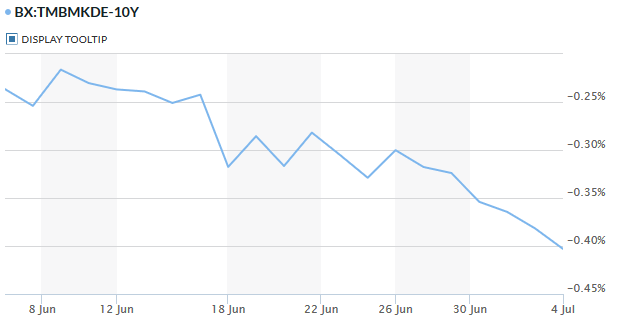
In Europe, currently, FTSE is up 0.02%. DAX is up 0.13%. CAC is up 0.06%. German 10-year yield is down -0.0139 at -0.396. Earlier in Asia, Nikkei rose 0.30%. Hong Kong HSI dropped -0.21%. China Shanghai SSE dropped -0.33%. Singapore Strait Times rose 0.13%. Japan 10-year JGB yield rose 0.0023 to -0.155.
German 10-yr yield breaks ECB's -0.4% deposit rate, Rehn calls for easing now
German 10-year bund yield drops to another record low of -0.407 so far today. More importantly, it's now below ECB's -0.40% deposit rate for the first time ever. The steep decline is interpreted as a clear sign that markets are expecting further rate cut by the central bank.
Firstly, ECB President Mario Draghi has already set the easing course last month, even though he's on the way out later this year. Secondly, the nomination of current IMF Managing Director Christine Lagarde is seen as a node to further easing.
Such expectation is further affirmed by explicitly dovish comments from Governing Council member Olli Rehn. He told German newspaper Boersen Zeitung that "if we really want to live up to our mandate, further monetary stimulus is now needed until there is improvement in economic and inflation prospects".
"We should no longer see the recent slowdown in growth as a brief temporary dip in the economy, as a 'soft patch', Rehn added. "We are experiencing a longer phase of weaker growth." Also, what is also of great concern to us now are inflation expectations," Rehn said. "Market-based inflation expectations have fallen sharply and remain far too low."
Eurozone retail sales dropped -0.3% mom, well below expectation
Eurozone retail sales dropped -0.3% mom in May, below expectation of 0.4% mom rise. Volume of retail trade decreased by -1.3% for automotive fuel, by -0.5% for food, drinks and tobacco, and by -0.1% for non-food products
EU28 retail sales dropped -0.4% mom. Trade volume decreased by -1.6% for automotive fuel, by -0.5% for food, drinks and tobacco, and by -0.3% for non-food products.
Among Member States for which data are available, the largest decreases in the total retail trade volume were registered in Croatia (-4.4%), Lithuania (-3.0%) and Sweden (-2.8%). The highest increases were observed in Portugal (1.5%), Spain (1.1%) and Belgium (1.0%).
China: US must lift all punitive tariffs for a trade deal to be reached
Gao Feng, spokesperson of China's Ministry of Commerce, said US must remove all punitive tariffs for a trade deal to be reached between the two countries. He noted in a regular press briefing that tariffs hurt both sides and ultimately harm the interests of American corporations and consumers. Tariffs also create uncertainty for the global economy. Gao also confirmed that teams from both sides are in contact on trade negotiations.
Elsewhere, Australia retail sales rose 0.1% mom in May, below expectation of 0.2% mom. Swiss CPI was unchanged at 0.6% yoy in June, above expectation of 0.5% yoy.
USD/CAD Mid-Day Outlook
Daily Pivots: (S1) 1.3038; (P) 1.3079; (R1) 1.3100; More...
USD/CAD drops to as low as 1.3037 so far today. Sustained trading below 1.3052/68 cluster support zone will carry larger bearish implications. Deeper fall should be seen to 1.2673 fibonacci level next. Nevertheless, rebound from current level, with break of 1.3145 minor resistance, will indicate short term bottoming and bring rebound back to 1.3239 support turned resistance.
In the bigger picture, medium term outlook stays neutral for now even though the case of bearish reversal is building up. Decisive break of 1.3068 cluster support (38.2% retracement of 1.2061 to 1.3664 at 1.3052) will confirm completion of up trend from 1.2061 (2017 low). Further fall should be seen to 61.8% retracement at 1.2673 next. On the upside, sustained break of 61.8% retracement of 1.4689 (2016 high) to 1.2061 at 1.3685, is needed to confirm resumption of up trend from 1.2061 (2017 low). Otherwise, risk will stay on the downside.
Economic Indicators Update
| GMT | Ccy | Events | Actual | Forecast | Previous | Revised |
|---|---|---|---|---|---|---|
| 1:30 | AUD | Retail Sales M/M May | 0.10% | 0.20% | -0.10% | |
| 6:30 | CHF | CPI M/M Jun | 0.00% | -0.10% | 0.30% | |
| 6:30 | CHF | CPI Y/Y Jun | 0.60% | 0.50% | 0.60% | |
| 9:00 | EUR | Eurozone Retail Sales M/M May | -0.30% | 0.40% | -0.40% | -0.10% |
Sunset Market Commentary
Markets
With US financial markets closed for Independence Day, all trading was concentrated in Europe today. Special focus went to the German Bund, which hovered near the ECB’s -0.40% deposit rate recently. The Bund started off near its latest high and soon resumed an upward trend again amid a cautious risk sentiment. A German construction PMI (June) at the verge of pointing to economic contraction (50.0) and weak EMU retail sales in May, both under ‘normal’ trading circumstances considered irrelevant/outdated, gave the Bund additional support along its march north. It was probably also the final nudge in the back needed for the German 10y yield to slip below the symbolic -0.40% level before recovering marginally. However, ECB’s Rehn hinting at flexibility with respect to the self-imposed limits on quantitative easing a bit later eventually send the German 10y to about -0.41% (-2.3 bps) at the time of writing. Other German yields lose about 1.5 bp (5-yr) to 2 bps (30-yr). The recent steep decline in rates caused France to sell 10-yr and 15-yr bonds at record low yields as did Spain with a 6-yr, 10-yr and 30-yr auction. Peripheral spreads take a breather after narrowing aggressively this week. Portugal adds 6 bps to the spread. Italy (+10 bps) underperforms but still has a -0.36 bps narrowing on the counter this week.
Trading in EUR/USD and USD/JPY developed in extremely tight ranges as activity lacked guidance from the US. EMU May retail sales printed again very weak. The figure is a bit outdated. Still the release reinforced the decline in core European yields but there was little fall-out on the euro. In the wake of yesterday’s tweet of president Trump accusing Europe and China of currency, there were several articles on financial newswires, debating a potential chance in the US FX policy. Some analysts even don’t exclude a scenario of the US using FX interventions to adjust the value of their currency. Any change in the USD policy will be very important for global FX trading. However, it remains uncertain whether such a move will take place and how profound it might be. Whatever the outcome of the debate, it wasn’t the right time for FX investors to trade this theme when US markets are closed. Both EUR/USD (1.1275 area) and USD/JPY (107.80 area) are little changed. Tomorrow’s US payrolls is the next event with potential to move the dollar (and other parts of global markets).
The absence of US traders also paralyzed sterling trading today. The campaign of the two contenders to become UK conservative party leaders (and the UK PM) continues. Of late, both candidates kept the door open for a no deal Brexit. That weighed on sterling. However, there were no new elements in the debate today. UK eco data were also second tier. As was the case for the dollar, sterling trading was also order-driven and confined to tight ranges. EUR/GBP held in the 0.8970 area. The 0.90 barrier remains within striking distance. Cable hovers in the high 1.25 area.
News Headlines
Euro zone retail sales disappointed in May, printing at -0.3% MoM (vs. 0.3% expected) and 1.3% YoY (vs. 1.6% expected). Previous month figures were revised upwardly though. A sharp increase in online shopping failed to compensate a decline in car fuel purchases.
Former UK chancellor of the exchequer George Osborn is seeking to fill the IMF chair vacancy after current head Lagarde is expected to move to the ECB in October. Current governor of the Bank of England, Mark Carney, is also tipped to be considering the role. The BoE declined to comment.
USDZAR Reverses Lower as Bears Retake the Reins
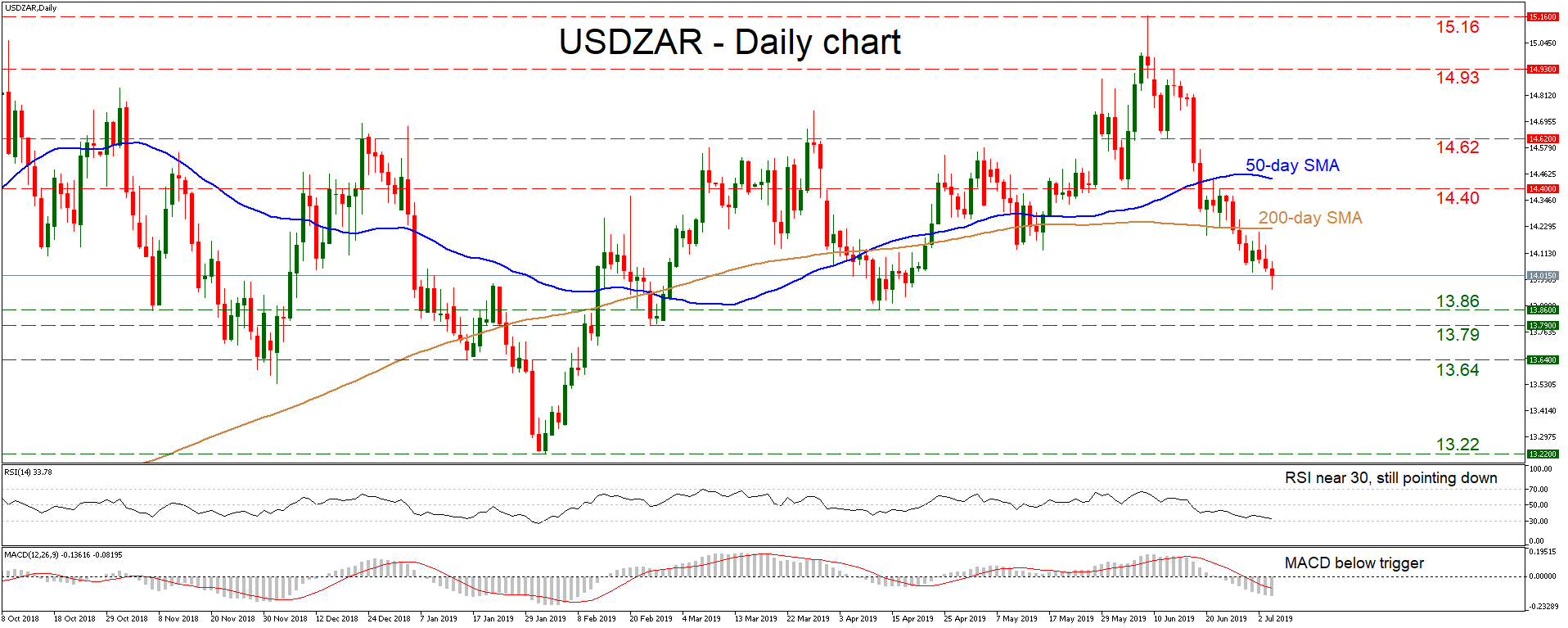
USDZAR has recorded significant losses in recent weeks, moving back below its 50- and 200-day simple moving averages (SMAs) to record a lower low on the daily chart. The picture therefore seems to be shifting to negative, though a clear break below the 13.86 – 13.79 zone is needed to confirm that.
Looking at momentum oscillators, the RSI endorses the negative picture as it is just above 30 and pointing down, while the MACD is also below its red trigger line.
Further declines could stall around the 13.86 – 13.79 zone, which halted the losses both in February and in April. If sellers pierce below it, that would solidify the bearish picture and open the door for 13.64 – the January 16 low.
On the other hand, a recovery in the pair may meet resistance around 14.22, where the 200-day SMA is located. An upside break could turn the attention to the 14.40 zone, marked by the inside swing low on June 4.
Summarizing, a decisive move below 13.79 would mark another lower low, confirming that a short-term downtrend is in progress.
German 10-yr yield breaks ECB’s -0.4% deposit rate, Rehn calls for easing now
German 10-year bund yield drops to another record low of -0.407 so far today. More importantly, it's now below ECB's -0.40% deposit rate for the first time ever. The steep decline is interpreted as a clear sign that markets are expecting further rate cut by the central bank.
Firstly, ECB President Mario Draghi has already set the easing course last month, even though he's on the way out later this year. Secondly, the nomination of current IMF Managing Director Christine Lagarde is seen as a node to further easing.
Such expectation is further affirmed by explicitly dovish comments from Governing Council member Olli Rehn. He told German newspaper Boersen Zeitung that "if we really want to live up to our mandate, further monetary stimulus is now needed until there is improvement in economic and inflation prospects".
"We should no longer see the recent slowdown in growth as a brief temporary dip in the economy, as a 'soft patch', Rehn added. "We are experiencing a longer phase of weaker growth." Also, what is also of great concern to us now are inflation expectations," Rehn said. "Market-based inflation expectations have fallen sharply and remain far too low."
NZDUSD Trades Within Sideways Channel; SMAs Post Bearish Cross
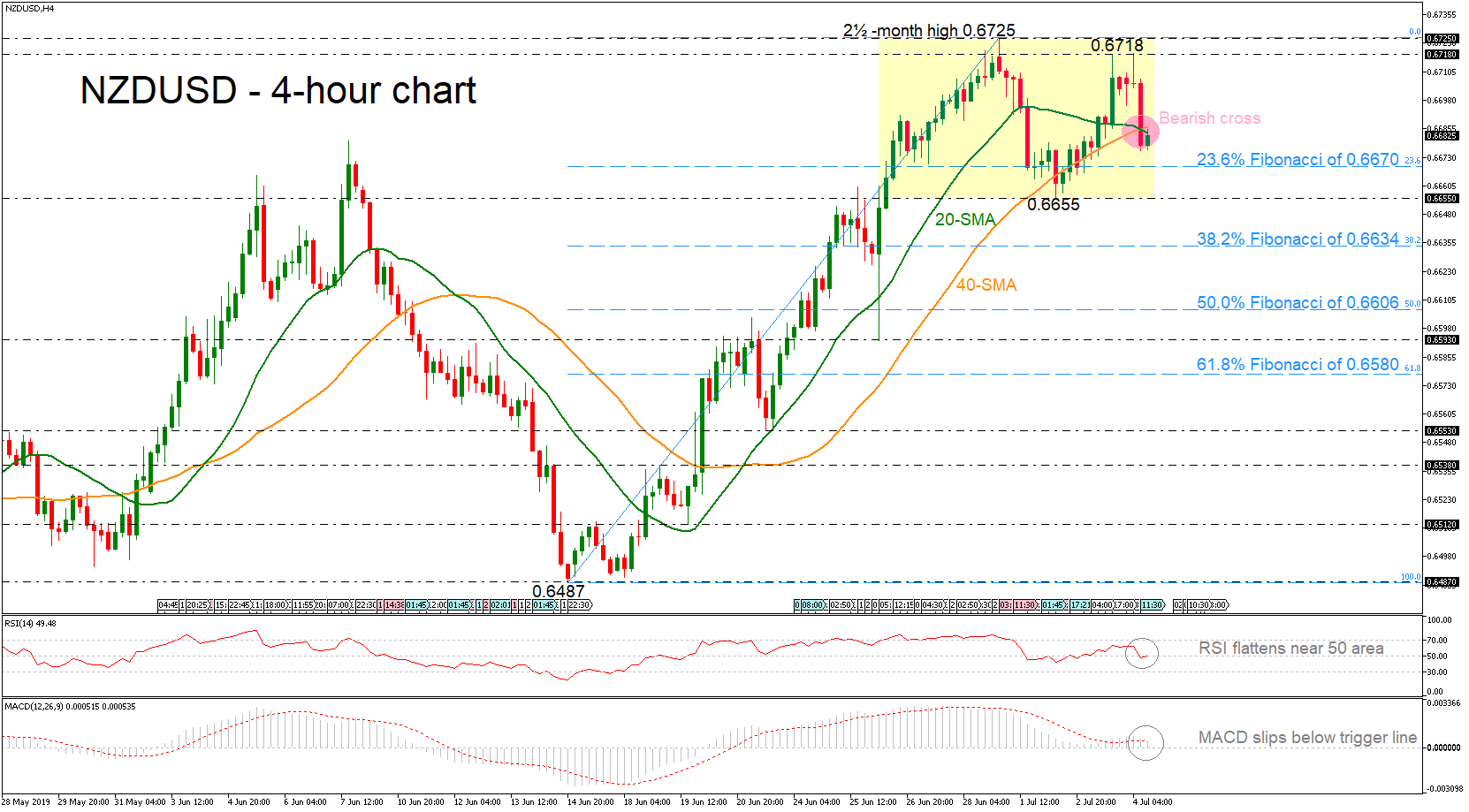
NZDUSD has been consolidating since June 26 within a narrow range of 0.6655 – 0.6718 and is currently hovering beneath the bearish crossover within the 20- and 40-simple moving averages (SMAs) in the 4-hour chart.
The near-term bias is looking neutral-to-bearish as the RSI is flatlining near the 50-neutral level, while the MACD is moving slightly lower below the trigger line in the positive zone, suggesting more downside pressure in the 4-hour chart.
Should the pair pare some of the previous sessions’ losses, it’s likely to meet resistance at the upper band of the sideways channel near 0.6718 and at the two-and-a-half-month peak of 0.6725.
If the current bullish movement fails to hold and prices turn lower again, the 23.6% Fibonacci retracement level of the upward movement of 0.6487 to 0.6725 near 0.6670 could be the immediate support to look for. A potentially more crucial barrier is coming from the 0.6655 area (lower band of the range).
In the near-term picture, NZDUSD would need to make a sustained climb above the two-and-a-half-month high in order for the outlook to become convincingly bullish.
AUDJPY Continues to Consolidate in a Narrow Range
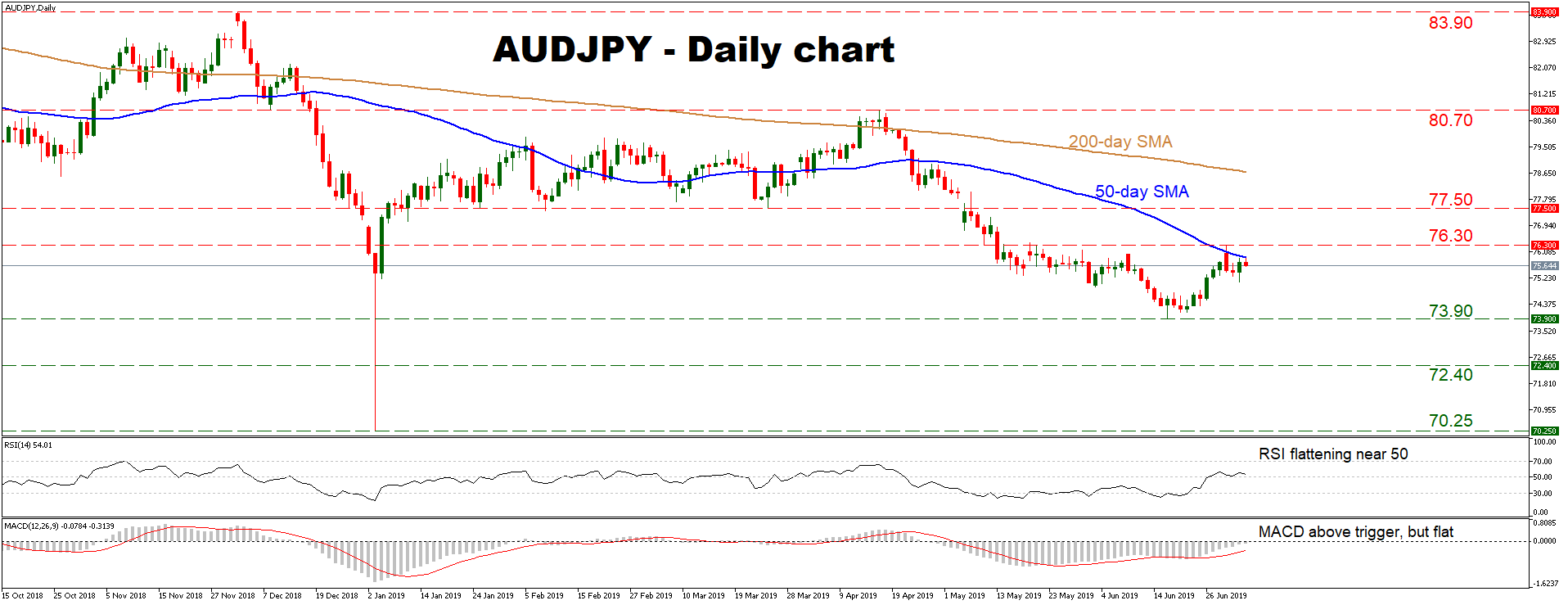
AUDJPY remains confined in a relatively narrow sideways range, between 73.90 and 76.30, since early May. The near-term outlook is therefore neutral, with a break on either side needed to provide the directional bias.
Momentum oscillators also paint a flat picture, with the RSI flattening near its neutral 50 line, and the MACD being close to zero.
If the buyers take control and manage to push above 76.30, that would turn the near-term outlook to cautiously positive, opening the way for a test of the support-turned-resistance area of 77.50 – marked by the March low.
On the downside, a successful violation of the 73.90 zone could signal that the broader downtrend is back in effect. In that case, the bears would eye the 72.40 territory, which halted the selloff back in 2016.
Overall, as long as the price remains between 73.90 and 76.30, the short-term picture is flat.
China: US must lift all punitive tariffs for a trade deal to be reached
Gao Feng, spokesperson of China's Ministry of Commerce, said US must remove all punitive tariffs for a trade deal to be reached between the two countries.
He noted in a regular press briefing that tariffs hurt both sides and ultimately harm the interests of American corporations and consumers. Tariffs also create uncertainty for the global economy.
Gao also confirmed that teams from both sides are in contact on trade negotiations.
BTCUSD Cools After Rally, Cautiously Negative In Very Short Term
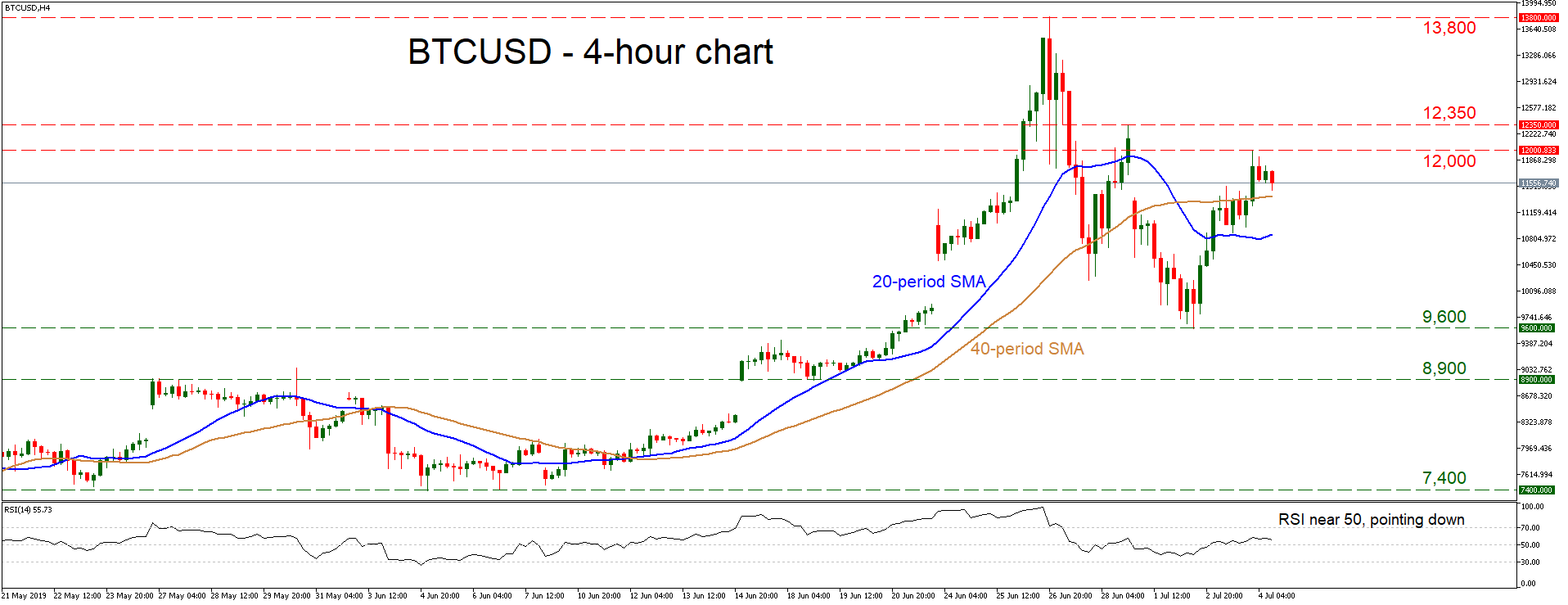
BTCUSD has come off its recent highs, with prices diving to test the 9,600 area, before finding fresh buy orders and rebounding. Yet, the price structure on the 4-hour chart now consists of lower peaks and lower troughs, while the 20-period simple moving average (SMA) has also crossed below the 40-period one, so the outlook seems to have turned cautiously negative in the immediate term.
Short-term momentum oscillators agree, with the RSI still hovering slightly above 50, but pointing lower.
Another wave of declines could meet initial support near the 40-period SMA at 11,375, with a downside break turning the focus to the 20-period one, near 10,850. Even lower, the attention would turn to 9,600.
On the other hand, a recovery in the market may stall around the 12,000 handle, where a bullish violation could open the way for the June 28 peak of 12,350. If buyers overcome that zone too, the next obstacle may be the June 26 top of 13,800.
In short, the picture is somewhat negative in the very short run, but unless prices make a new low below 9,600, the broader outlook still seems positive.
USDJPY Awaiting US Jobs Data
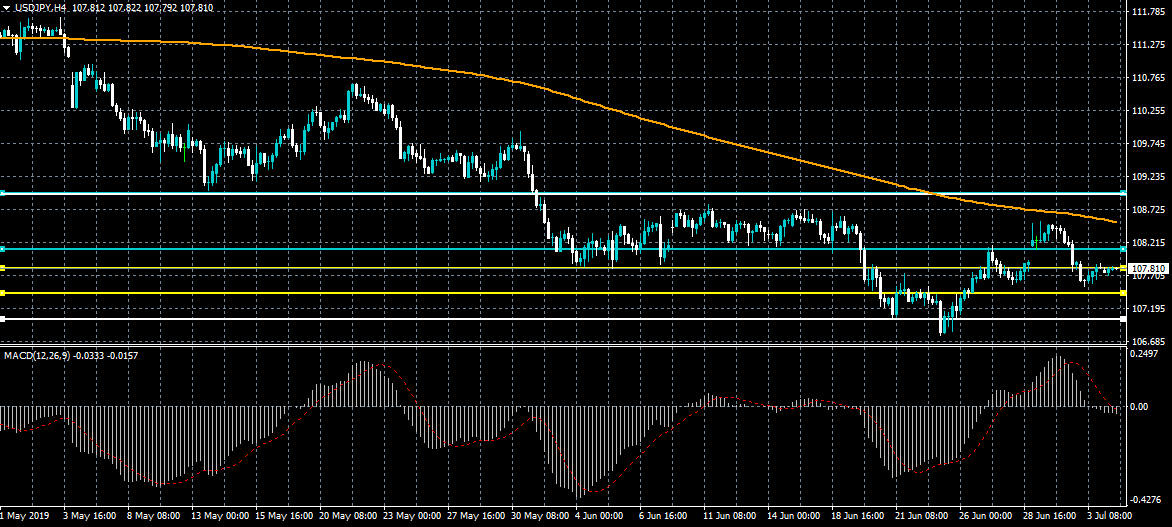
The US dollar is having a quiet session against the Japanese yen as July 4th Independence Day slows down the trading action on Thursday. The US Non-farm payrolls job report is likely to be the next big directional catalyst for the USDJPY pair on Friday. The 107.40 to 108.45 range now needs to be broken in order to encourage to the next major test of important support of resistance.
The USDJPY pair is only bearish while trading below the 107.80 level, key support is found at the 107.40 and 106.40 levels.
If the USDJPY pair trades above the 107.80 level, key technical resistance is found at the 108.45 and 109.00 levels.