Sample Category Title
Lagarde And The ECB, Swiss Inflation
Lagarde's 'Whatever it takes' ECB
Unorthodox monetary policy since the post-financial crisis has always generated controversy. To ensure economic and financial stability during the financial crisis central banks expanded their tools to deal with extreme risks. Since these tools are generally outside the scope of traditional modern economic theory, tactics such as negative interest rates and quantitative easing are accused of distorting asset markets.
The ECB manages three key interest rates main refinancing operations (MRO), the rate on the deposit facility and marginal lending facility rate. In times of calm, it's the deposit facility at -0.40% which captures the market attention although the main refinancing operation is used most often to provide liquidly into the banking system.
With monetary policy stuck at extremely loose levels, the direction of policy action is less clear. Historically, with all things being equal, the direction of inflation was the primary input for deciding policy mix. Higher inflation expectations would trigger higher policy rates (and vise-versa). With ECB policy still at extraordinary positioning, would suggest that policy setting moving forward have a higher discretionary aspect. Hence, ECB chief succession is of critical importance.
The ECB has moved towards a more dovish bias as the regional economic outlook has deteriorated and inflation expectations are fading. Draghi's recent comments suggest significant probably of monetary policy action in July. After that point, the Governing Council will not meet again until September. One can argue the ECB efforts to achieve their price stability mandate have been exhausted and the next policy direction will be based on the personal philosophy of the primary decision maker.
To take over the ECB helm, early bets were skewed towards Jens Weidmann the Bundesbank president. Given his hawkish stance and German economic lean, we would anticipate a shift in ECB predisposition (ie less extreme measures benefiting low growth EU nations). However, Christine Lagarde is now in the pole position to head the ECB. Lagarde with her strong personality and solid global republicans will likely continue Draghi policy, which supports weaker peripheral European nations. Her appointment, which still needs to be approved by the European Parliament, would likely bring a new prescription of accommodative monetary policy. A policy package mix of negative Interest rates, new TLTROs, and asset purchases is coming with Lagarde at the head of the ECB.
Global yields have fallen expectation of weak economic outlook and anticipating additional ultra-loose monetary policy. Yet yesterday saw European yields drop sharply as Lagarde's historical preference for stimulus made an impression on bond markets. Across the continent, short-end yields are now below zero. German 10 yr yields fell to a new all-time low at -0.397 (just a sliver above ECB own deposit rate) while Frances 10 yr yields reached -0.10. While bondholders are being crushed, we should see further rotation into SMI and global equity markets. The mad search for yields has been reignited.
Swiss inflation stable, industry PMI in decline
Despite the punitive decision taken by the EU not to grant equivalence of Swiss stock market, countermeasures undertaken by Swiss authorities to safeguard Swiss equities have paid off. Since the change of regime, trading on Swiss stocks has gone smoothly, with both SMI and SPI indices gaining 1.60%, in line with European peers. CPI remained stable in June while the drop in industry PMI to 47.7 in June, its lowest range since October 2012, is becoming more of an issue.
Swiss inflation came in line with expectations at 0.60% as consumer prices underlying components have been evolving in opposing directions. The EU harmonized and core gauges came both at 0.70%, suggesting a slight acceleration and close to Swiss National Bank inflation June forecast of 0.60% for 2019. The situation on the front of the Swiss industry is yet more worrying, as the industry PMI points for the third consecutive time in contraction territory while production declines for the fourth time in a row at 48.2. Similar trends are shown by Raiffeisen's SME PMI which fell to 52 (prior: 54.2) due to lower production, an increase in inventory and a drop in backlogs (from 56.8 to 50.7), its sharpest drop since March 2018, the inception date of the sentiment indicator.
EUR/CHF is maintained within the 1.11 range, bouncing back from 1.10795 (24/06/2019 low) and expected to trade sideways along 1.11300. June publication of the SNB's foreign exchange reserves on Friday could signal an intervention in the foreign exchange market if significant changes occur.
AUD/JPY 4H Chart: Could Still Edge Higher
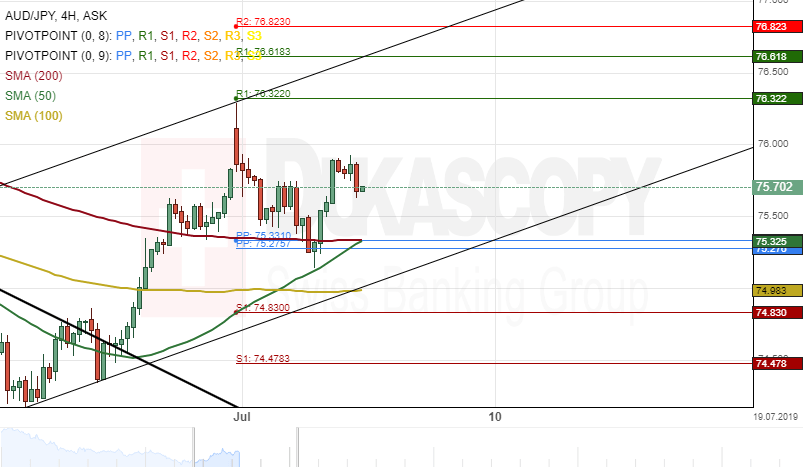
Since June 27, the AUD/JPY currency pair has appreciated about 1.49% in value. The Aussie tested a resistance level formed by the weekly R1 at 76.32 on June 1.
The exchange rate bounced off a support cluster formed by the weekly and the monthly PPs and the combination of the 50– and 200-hour SMAs at the 75.28 regions during yesterday's trading sessions.
As a result, a surge towards a psychological resistance level at the 77.00 marks could occur before the end of this week's sessions.
However, the weekly R1 at 76.32 might still provide resistance for the currency exchange rate.
GBP/JPY 4H Chart: Bounces Off Support
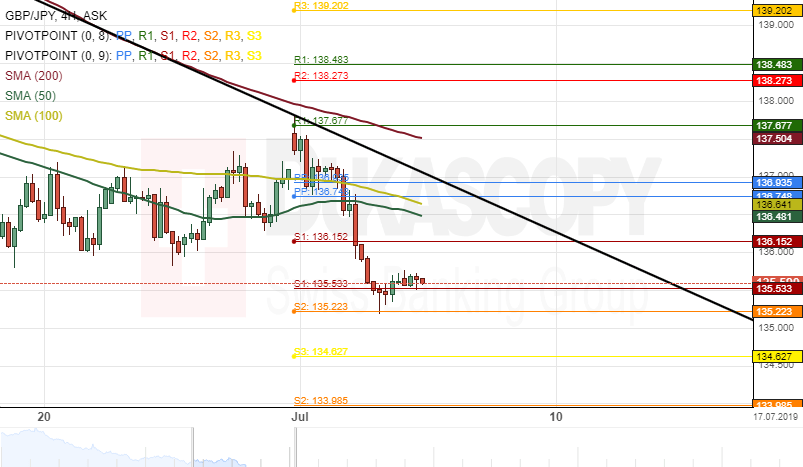
The Pound Sterling has depreciated about 230 base points against the Japanese Yen on June 27. The currency pair was pressured south by the 200-hour simple moving average.
The exchange rate bounced off a support level formed by the weekly S2 at 135.22 on July 3. Most likely, the GBP/JPY currency pair could aim for a resistance level formed by the 50– and 100-hour SMAs at 136.69 before the end of this week's trading sessions.
If the resistance line holds, the currency exchange rate will continue its downward movement during next week's sessions.
EUR/JPY Analysis: Breaches Descending Channel
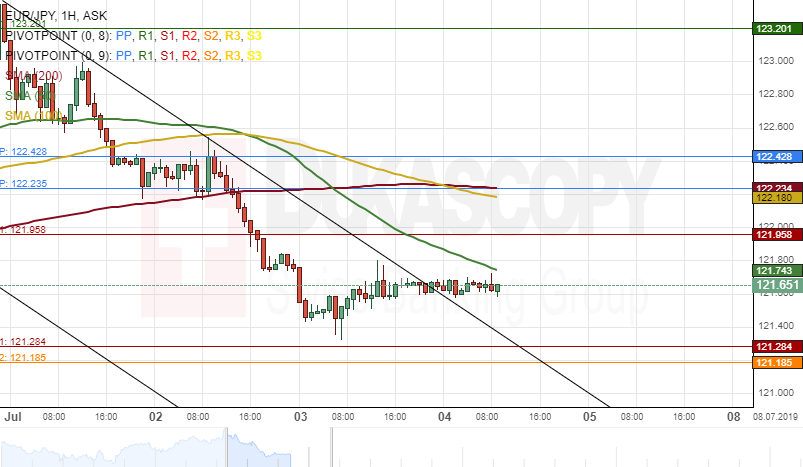
During the previous trading session, the EUR/JPY exchange rate traded sideways around the 50-hour simple moving average at 121.77. The pair breached the descending channel pattern at 121.64.
The common European currency versus the Japanese Yen might aim for a resistance cluster formed by the combination of the 100– and 200-hour SMAs and the weekly pivot point at 122.23 within this session.
However, Note, that the currency exchange rate could continue to trade sideways today, because of the US bank holiday.
 r
r
AUD/USD Analysis: Retracement Down Is Likely
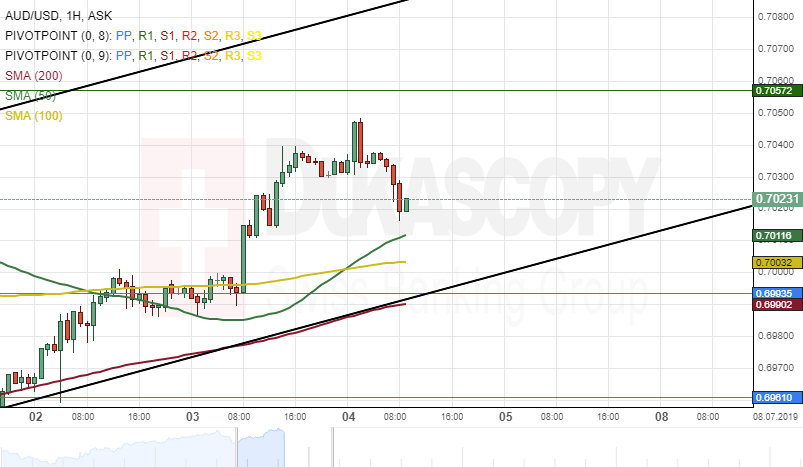
The AUD/USD currency pair reached the previously set target at 0.7040 at the end of yesterday's trading session.
As for the near future, the exchange rate is expected to make a retracement towards the 50– hour simple moving average at 0.7012. In addition, the pair could find support near the 50– and 100-hour SMAs.
If the support level holds, the currency exchange rate could continue its upside movement during the following trading session.
However, if the pair passes the support line, a decline towards the bottom border of an ascending channel pattern could be expected.
USD/CAD Analysis: Could Aim For 50– And 100-Hour SMAs
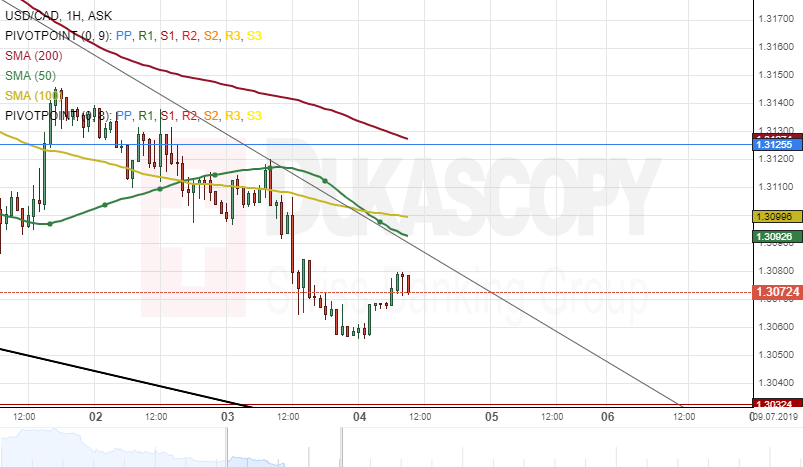
The USD/CAD currency pair continued to decline on Wednesday. During the Asian session on Thursday, the exchange rate reversed from a swing low at 1.3060.
From a theoretical point of view, it is expected, that the USD/CAD pair aim for a resistance level formed by the 50– and 100-hour SMAs at 1.3094 during the following trading session. Although, it is unlikely, that the pair could surpass the resistance cluster today.
However, if the currency exchange rate passes the resistance cluster as mentioned earlier, the pair might end this week's trading sessions on bullish momentum.
NZD/USD Analysis: Should Go Downside
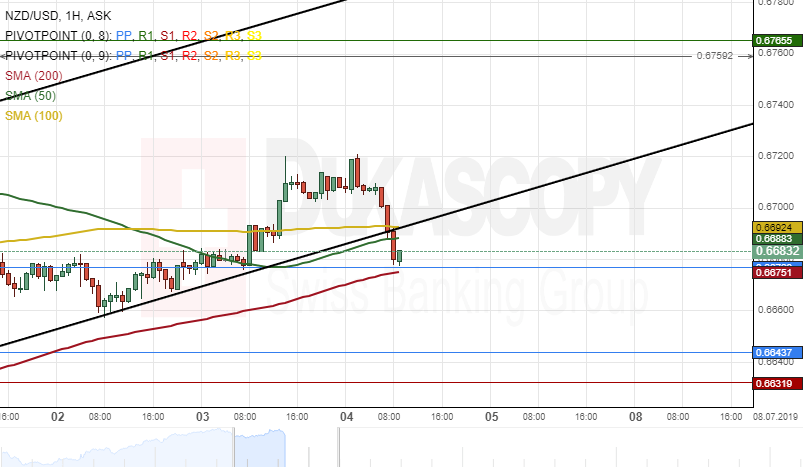
The New Zealand Dollar versus the US Dollar ended yesterday's trading session with a 44-pips gain. However, the currency pair began Thursday's trading session with a decline.
By the middle of Thursday's session, the exchange rate was testing a support cluster formed by the weekly pivot point and the 200-hour simple moving average at 0.6674.
Most likely, the NZD/USD exchange rate might continue its downward movement today. In addition, the currency exchange rate could surpass the support cluster as mentioned earlier.
Eurozone retail sales dropped -0.3% mom, well below expectation
Eurozone retail sales dropped -0.3% mom in May, below expectation of 0.4% mom rise. Volume of retail trade decreased by -1.3% for automotive fuel, by -0.5% for food, drinks and tobacco, and by -0.1% for non-food products
EU28 retail sales dropped -0.4% mom. Trade volume decreased by -1.6% for automotive fuel, by -0.5% for food, drinks and tobacco, and by -0.3% for non-food products.
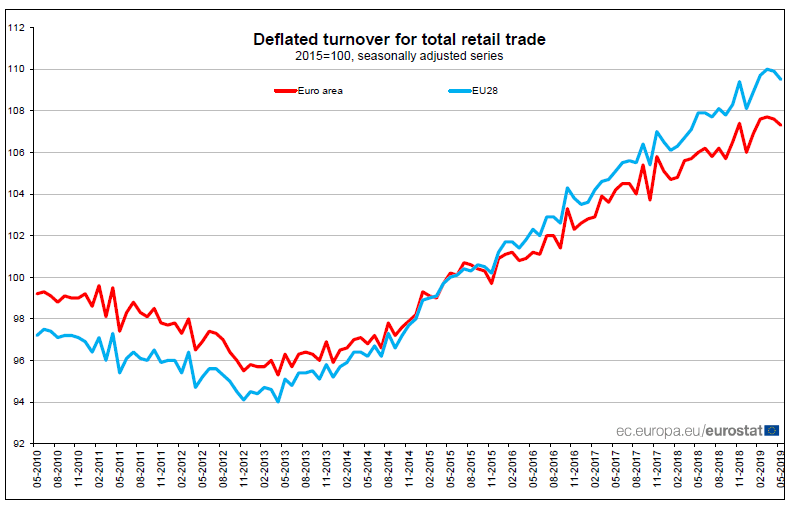
Among Member States for which data are available, the largest decreases in the total retail trade volume were registered in Croatia (-4.4%), Lithuania (-3.0%) and Sweden (-2.8%). The highest increases were observed in Portugal (1.5%), Spain (1.1%) and Belgium (1.0%).
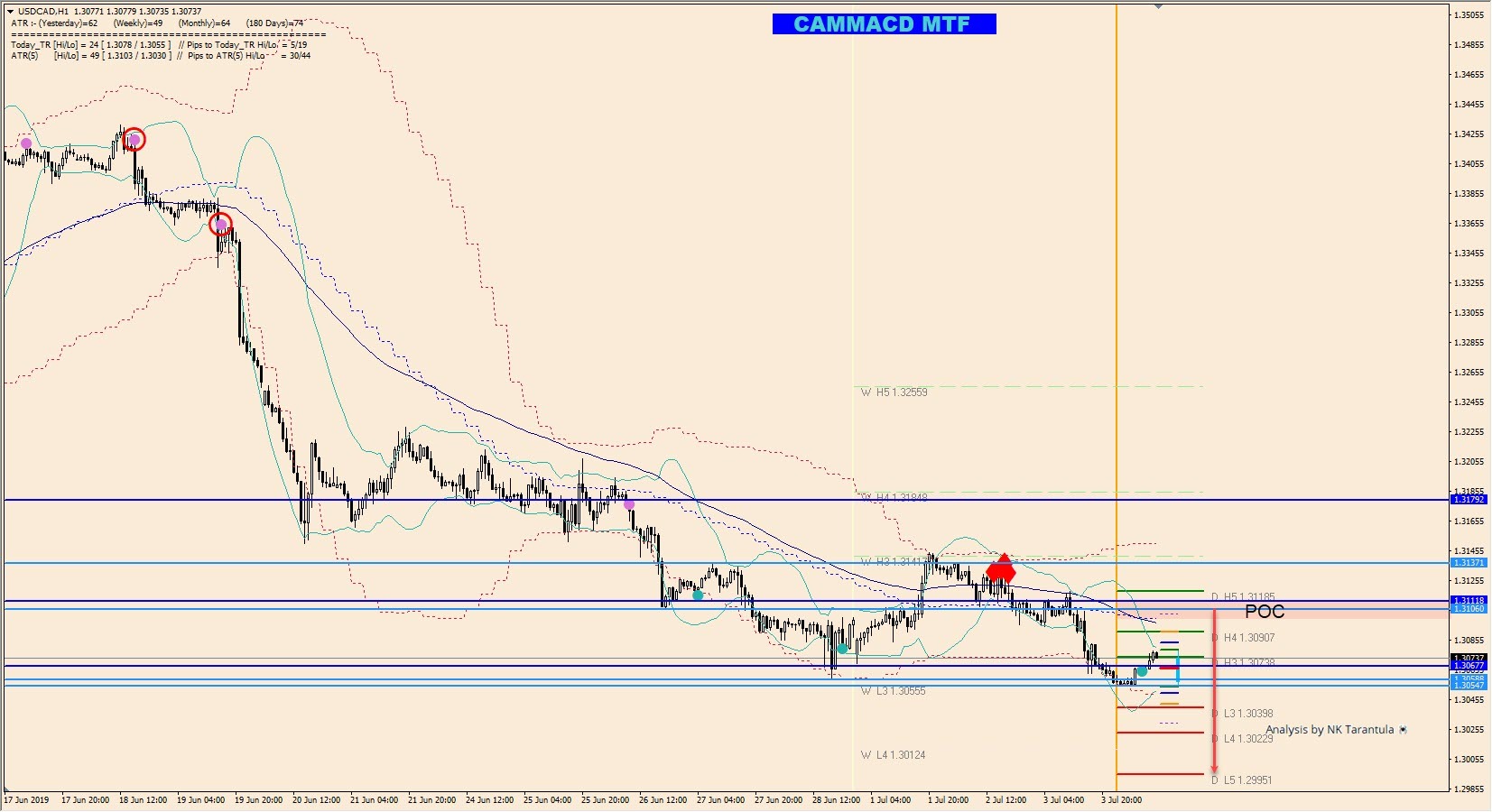
USD/CAD Is Bearish Below W H3 Camarilla Pivot
The USD/CAD has been consolidating within the zonal support straight at W L3 camarilla pivot. Watch for POC rejection.
If the price rejects from 1.3106-1.3120 zone it should do with a nice bearish reversal candlestick or pattern. Then we should see a continuation of bearish trend towards 1.3055. Break of 1.3055 aims for 1.3030 and eventually 1.2955 on a stronger bearish momentum. Have in mind that for this scenario to be valid, the pair needs to stay ideally below 1.3140. A close above might make a deeper retracement towards 1.3180.
EUR/USD Outlook: Extended Sideways Mode Eyes US Jobs Data For Fresh Direction Signals
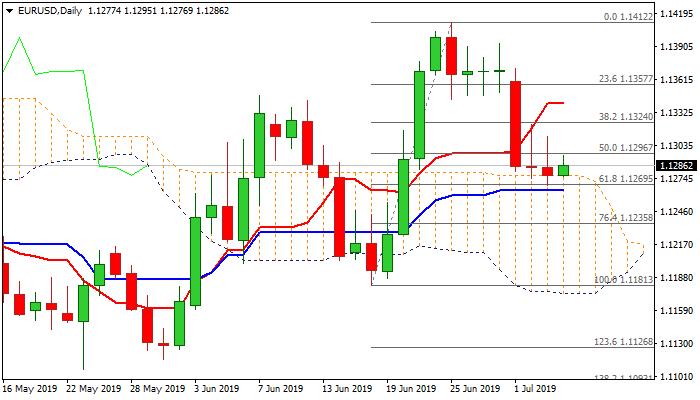
The Euro is holding just above daily cloud top which contains downside attempts for the third consecutive day, but upside remains limited. Repeated Dojis with long upper shadows in past two days signal indecision but also strong recovery rejections, as upside attempts repeatedly failed to close above 20SMA (currently at 1.1302). On the other side, thick daily cloud continues to obstruct bears, but will start thinning and eventually twist next week that could attract fresh weakness. Daily studies show mixed signals as bullish momentum continues to rise, stochastic is turning north in deep oversold zone, but MA's are in mixed setup and RSI is flat in neutral zone. Lower volumes due to US holiday are expected to keep the pair within familiar levels, as all eyes turn towards US NFP data on Friday. US economy is expected to add 160K new jobs in Jun compared to last month's surprise drop to 75K, with earnings expected to rise (0.3% f/c vs 0.2% prev) that could boost dollar if release comes at / above expectations. On the other side, US ADP private sector jobs report, released on Tuesday and often used as an indication for more significant NFP report, fell below expectations (June 102K vs 140K f/c), warning of NFP report downside surprise that would push Euro higher. Daily cloud top (1.1277) and Fibo level (1.1269), reinforced by rising 30DMA, mark key supports, break of which would generate strong bearish signal for extension of pullback from 1.1412 high. Conversely, lift above 20SMA would ease downside risk, but recovery would need clear break above 200DMA (1.1335) to neutralize bears.
Res: 1.1302, 1.1324, 1.1335, 1.1357
Sup: 1.1277, 1.1269, 1.1260, 1.1235