Sample Category Title
US Crude Oil Inventory Continued To Drop
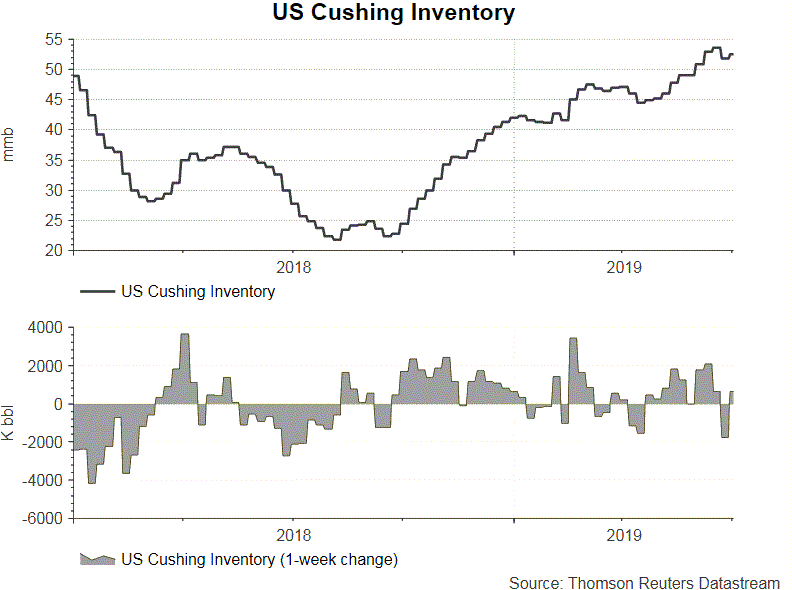
The report from the US Energy Information Administration (EIA) shows that total crude oil and petroleum products (ex. SPR) stocks increased +2.47 mmb to 1307.35 mmb in the week ended June 27. Crude oil inventory fell -1.09 mmb to 468.49 mmb (consensus: -2.96 mmb). Inventories rose in 4 out of 5 PADDs. Stockpile in PADD5 (West Coast) alone dropped -2.1 mmb during the week. Cushing stock added +0.65 mmb to 52.49 mmb. Utilization rate steadied at 94.2% while crude production added +0.1M bpd to 12.2M bpd for the week. Crude oil imports gained +0.93M bpd to 7.59M bpd in the week.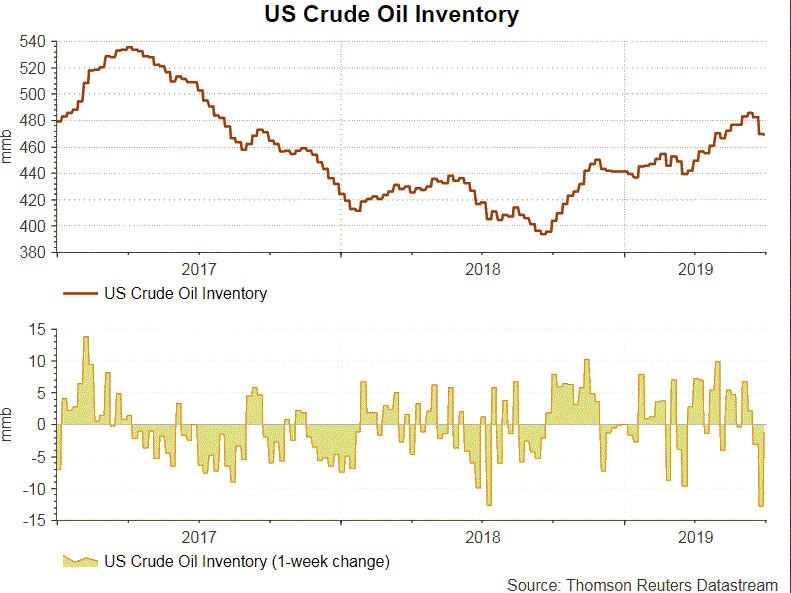
 Concerning refined oil product inventories, gasoline inventory declined -1.58 mmb to 230.64 mmb as demand gained +0.27% to 9.49M bpd. The market had anticipated a -2.17 mmb decrease in stockpile. Production dropped -2.61% to 10.14 bpd while imports plunged -34.31% to 0.54M bpd during the week. Distillate inventory added +1.41 mmb to 126.79 mmb. Demand dropped -3.53% to 3.83M bpd. The market had anticipated a -1 mmb declined in inventory. Production added +0.58% to 5.34M bpd while imports soared +196.97% to 0.1M bpd during the week.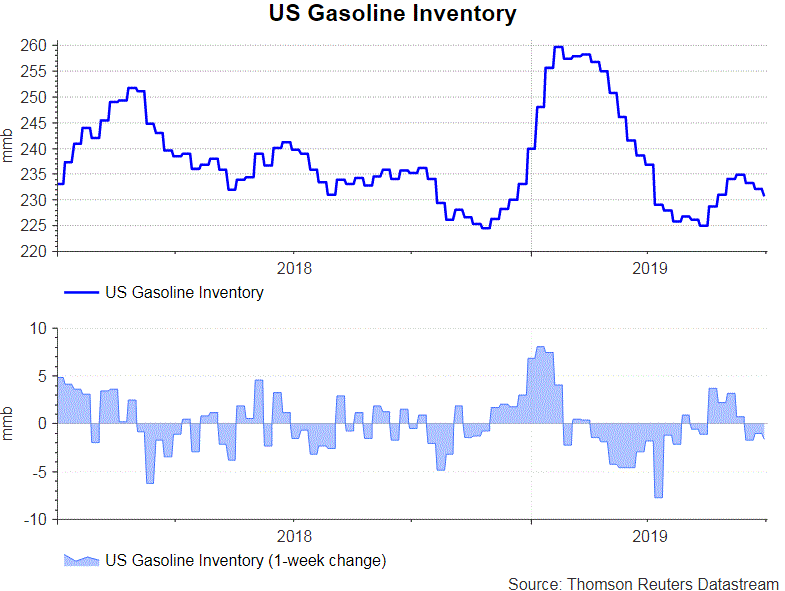
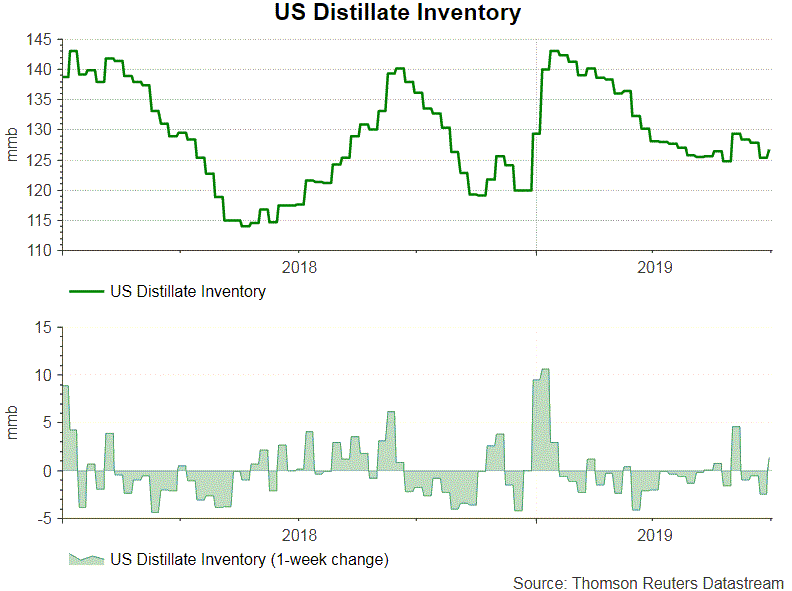 Released after market close on Thursday, the industry- sponsored API estimated that crude oil inventory slumped -5 mmb during the week. For refined oil products, gasoline stockpile fell -0.39 mmb while distillate dropped -1.7 mmb.
Eco Data 7/4/19
[php_everywhere instance="1"]
US Jobs Expected to Bounce Back but Fed Still Likely to Cut
The latest jobs report out of the United States is expected to hit the headlines on Friday at 1230 GMT. Following last month’s disappointing report, which fuelled expectations that the Federal Reserve will begin cutting rates soon, an anticipated bounce back in the number of jobs added in June could relieve some of the pressure on policymakers to ease policy aggressively. But as investors remain undecided about the degree by which the Fed will lower rates, the US dollar is susceptible to any big surprises in the data.
Nonfarm payrolls forecast to rebound
Nonfarm payrolls rose by just 75k in May, well below forecasts, sparking fears that the US economy is headed for a major slowdown. For June, the consensus forecasts are for a rebound of 160k jobs. However, after averaging 223k in 2018, the pace of jobs growth has slowed to 164k a month so far in 2019. The February figure was also weak (56k) and while risks of a recession remain low, a cooling labour market will not help the Fed reach its 2% inflation target, especially as wage growth has also been moderating in recent months.
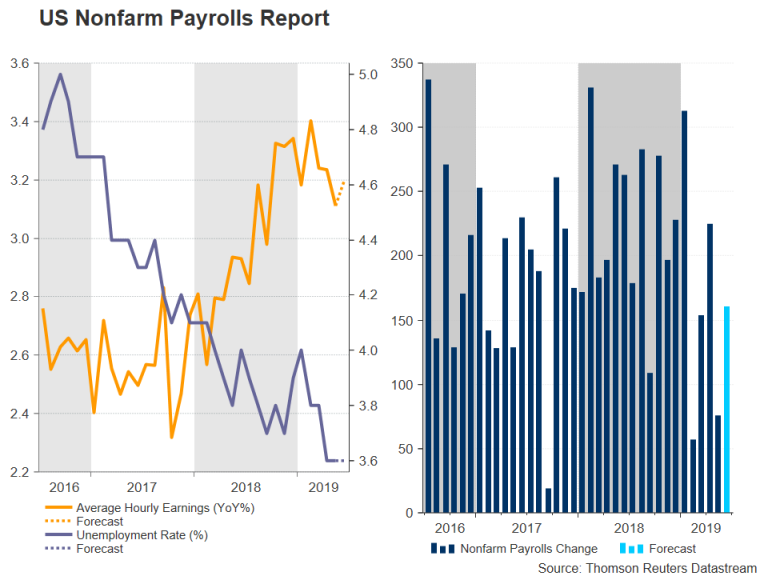
Average earnings growth eased to 3.1% year-on-year in May – the lowest since September 2018. It is expected to have picked up slightly to 3.2% in June. But with the Fed’s preferred price gauge – the core PCE price index – falling uncomfortably below the 2% goal, the modest wage increases are unlikely to be considered substantial enough by policymakers to boost inflation. As for the unemployment rate, it is projected to have stayed unchanged at 3.6% in June.
Dollar to struggle for direction from a neutral report
If the jobs data come in as expected, they’re unlikely to provide much direction to the dollar, which has been hovering between 107-109 yen since early June. The ADP employment report – a survey of private-sector employment that’s seen as a precursor to Friday’s official figures – missed expectations, pointing to gains of 102k jobs versus forecasts of 140k. This suggests there’s a greater risk that the headline NFP number will disappoint than it will beat the estimates.
The 107 handle is a key support to the downside for dollar/yen that could be broken should the June jobs report be another poor one. Breaching below this level would bring the pair in close range of the 78.6% Fibonacci retracement of the January-April upleg at 106.55. If the data is bad enough to strengthen expectations of a 50-basis points reduction at the July meeting, the 105 level would not be inconceivable for the bears.
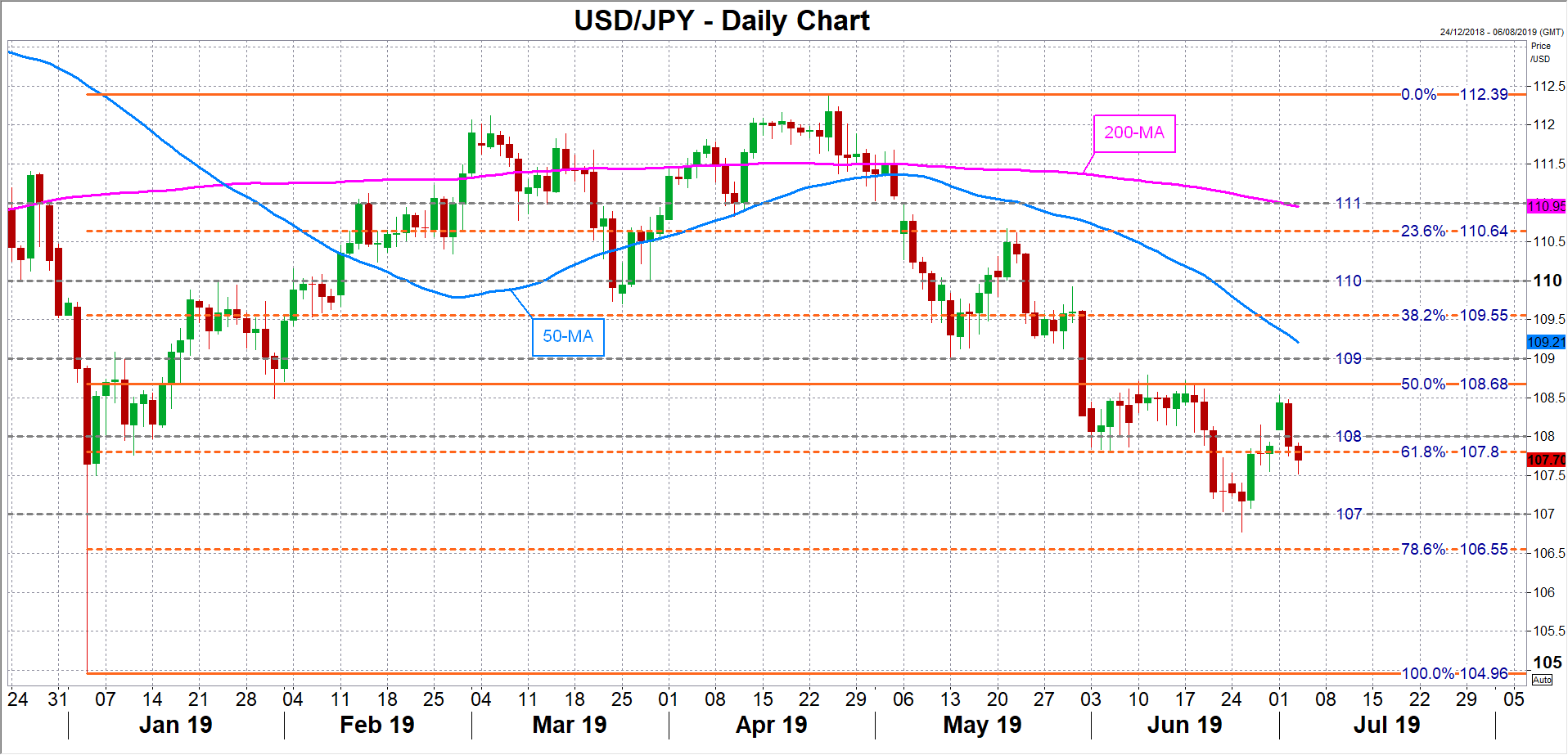
However, an unexpectedly strong jobs report could help the greenback resume the rebound it started when the US and Chinese leaders agreed to restart trade talks at last weekend’s G20 summit. Dollar/yen could reclaim the 108 handle before targeting the 50% Fibonacci at 108.68, which acted as a strong resistance level during June.
Low trading volumes could spark volatility
With many US traders likely to be away from their desks on Friday due to the 4th of July holiday on Thursday, global traders should be wary of lower than usual liquidity on NFP day that could result in some excess volatility.
But the big takeaway from the June report will be whether it will sway the Fed to lower rates on July 31, and if so, by how much. Although the Fed has so far not attempted to correct the market thinking in anticipating some policy easing, neither has it clearly flagged a rate cut as early as this month. In fact, Fed Chairman Jerome Powell recently hinted that a rate cut isn’t a done deal, saying the Fed is “grappling” with the question whether the current uncertainties justify additional policy accommodation.
Canadian Jobs Data Eyed as Loonie Flirts with Year Highs
The Canadian employment data for June will hit the markets on Friday at 12:30 GMT. Forecasts point to a relatively soft report, which if confirmed, could take some shine off the loonie. In the big picture though, the outlook for the currency remains bright, as the Bank of Canada (BoC) may be the only major central bank that won’t cut rates soon.
The Canadian economy has been an oasis of strength lately, even as the data pulse in most other major economies has weakened. Inflation is above the midpoint of the BoC’s target range, the labor market is tight, and most indicators suggest that growth picked up in Q2 after a soft start to the year. Accordingly, the BoC’s latest business survey painted a more positive picture, with firms expecting stronger sales growth, while home prices also stabilized in May following a streak of declines.
This strength is all the more impressive when one considers that the threat of protectionism still hangs in the background, likely holding back investment by firms and therefore constraining economic growth. The bottom line is that if the economy remains solid, the BoC may soon find itself as the only major central bank that isn’t easing policy, which would make the loonie much more attractive from a relative interest rates viewpoint.
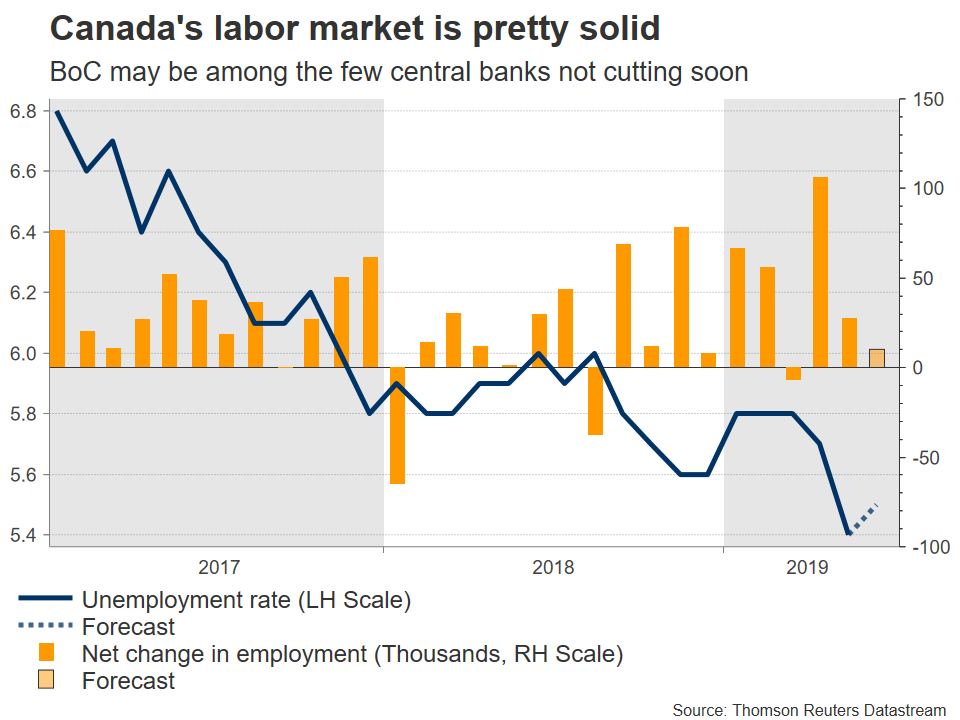
Hence, the upcoming employment data could be crucial in shaping this narrative. In June, the unemployment rate is forecast to have ticked up to 5.5%, from a four-decade low of 5.4%. Meanwhile, the net change in employment is expected at 10.0k, less than the 27.7k in May, but still a positive number.
As for the market reaction, if the actual prints are even weaker than anticipated, that could ignite some expectations for BoC rate cuts and therefore hurt the loonie a little on the news. Taking a technical look at dollar/loonie, advances may stall initially near 1.3145, the June 20 low, with an upside break opening the way for a test of 1.3225.
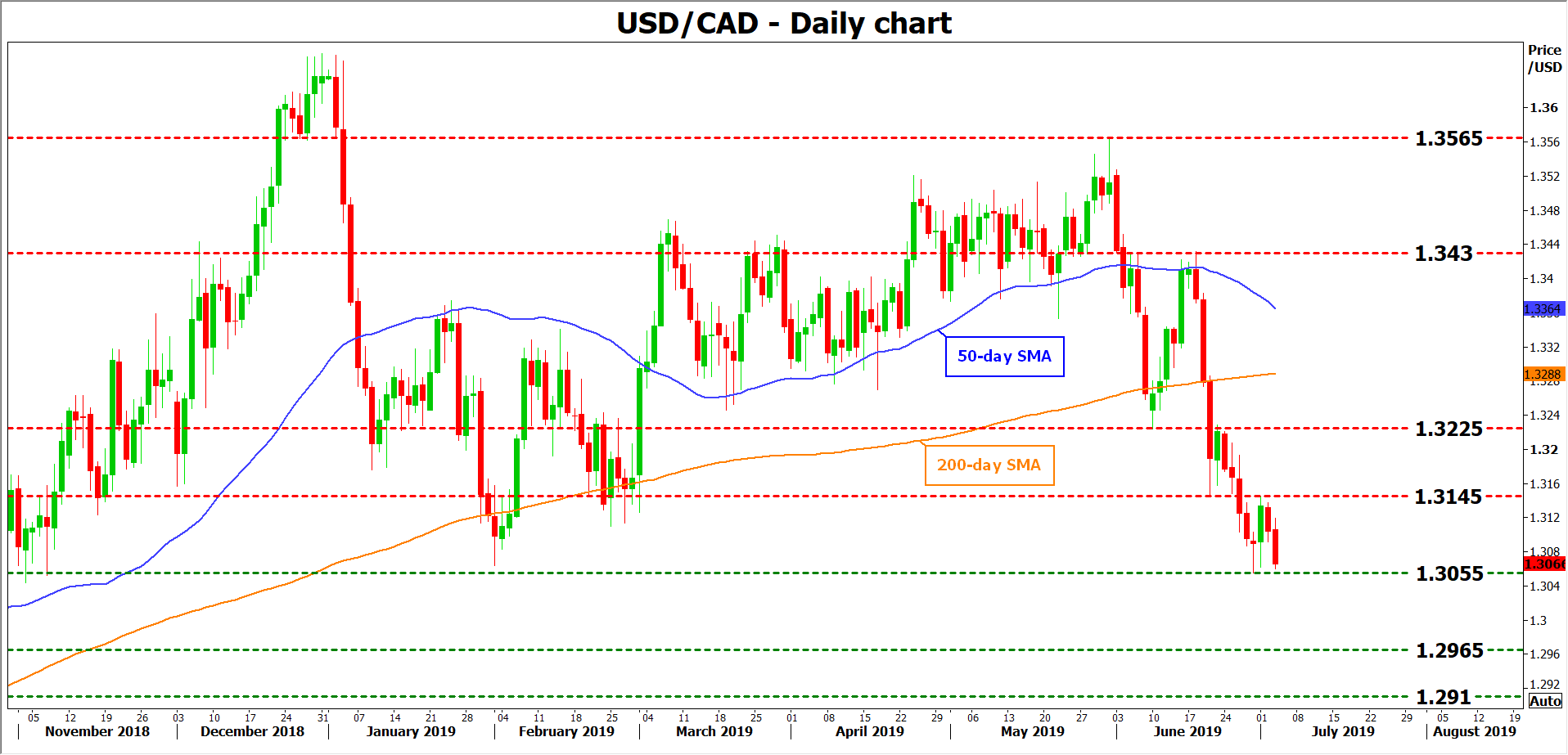
On the other hand, a stronger-than-expected data set may add credence to the narrative that the BoC will be an ‘island of neutrality’, pushing the loonie higher. A potential break below 1.3055 would mark a fresh low for this year, turning the focus to 1.2965, the trough of October 24, 2018.
Note that the US employment data for the same month will be released at the same time, so the reaction in the pair will probably depend on those too.
Overall, the risks increasingly seem tilted towards a stronger loonie. Even in case dollar/loonie rebounds this week, perhaps if the American data are strong enough to dispel some expectations for aggressive Fed easing in July for example, that could be only a temporary reprieve before the next wave lower. The bigger story is still that of monetary policy divergence between the Fed and BoC, and until that changes, there may not be much that can stand in the loonie’s way.
Crude oil inventories dropped -1.1m barrels, WTI soft after prior rejection by 60
US commercial crude oil inventories dropped -1.1m barrels in the week ending June 28, higher than expectation of -2.8m barrels. At 468.5m barrels, crude oil inventories are about 5% above the five year average for this time of year.
WTI crude oil stays soft after the release. It tumbled earlier this week as market is concerned that the output cut announced by OPEC+ would not be sufficient to correct the imbalance driven by the global economic slowdown. (More in this report)
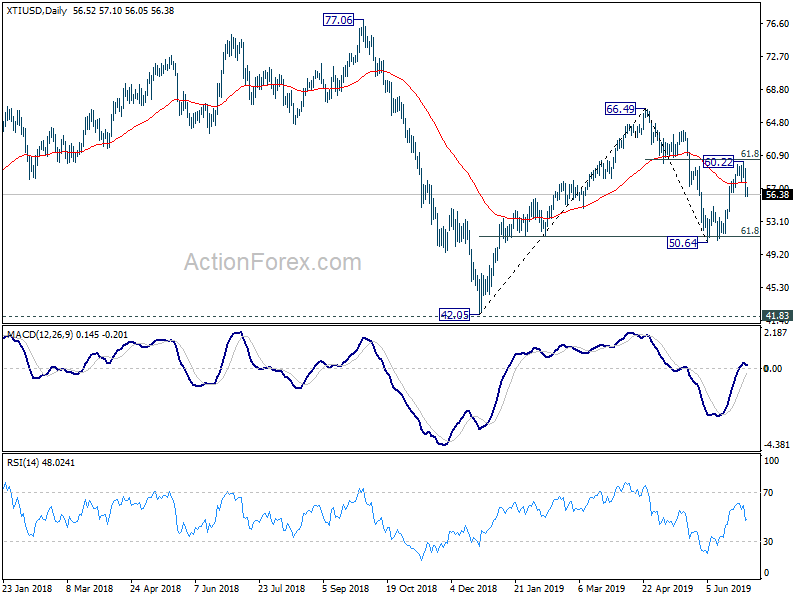
Technically, a short term top should be formed at 60.22 after rejection by resistance zone between 60.03 and 61.8% retracement of 66.49 to 50.64 at 60.34. WTI is also back below both 55 day and 4 hour 55 EMA. Deeper fall is now mildly in favor to 54.86 resistance turned support.
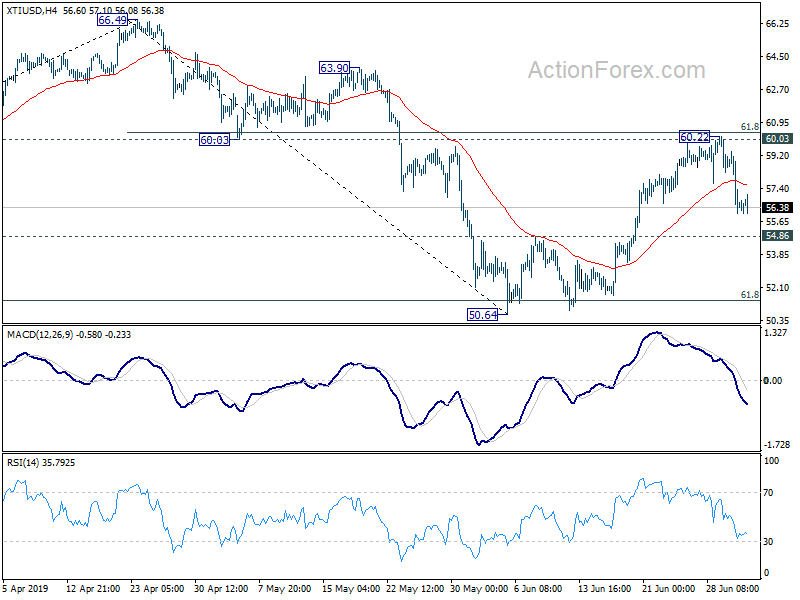
For now, we're slightly favoring the case the decline from 66.39 has completed at 50.64. Thus, we'd look for strong support below 54.86 to contain downside to bring rebound. Near term outlook will, for now, stays neutral until a break of 50.64 or 60.22.
EU won’t open excessive deficit orocedure for Italy
European Commission decided today not to go ahead to open the so called Excessive Deficit Procedure (EDP) for Italy's lack of compliance with the debt criterion.
In the statement, Valdis Dombrovskis, Vice-President for the Euro and Social Dialogue, also in charge of Financial Stability, Financial Services and Capital Markets Union, said: "I welcome the actions taken by the Italian government to ensure a better budget outcome in 2019. Ensuring sound public finances is a bedrock for confidence and growth. Respecting the commitment to prepare a 2020 budget in line with the EU fiscal rules and thus avoiding further uncertainty will be important in this context."
Pierre Moscovici, Commissioner for Economic and Financial Affairs, Taxation and Customs, said: "The aim of the Stability and Growth Pact is not to punish or discipline anyone; it is to ensure that governments pursue sound public finances and correct problems swiftly when they occur. I am pleased to note this is the case today. The Italian government has responded to the Commission's signal one month ago that an Excessive Deficit Procedure was warranted by adopting a sound package of measures that ensure broad compliance with the Pact. We will carefully monitor the implementation of these measures in the second half of the year. Moreover, we stand ready to ensure that the 2020 draft budget to be presented this autumn will be compliant with the Pact. I have no doubt that we will work seamlessly in this context with the next Commission."
EUR/USD Mid-Day Outlook
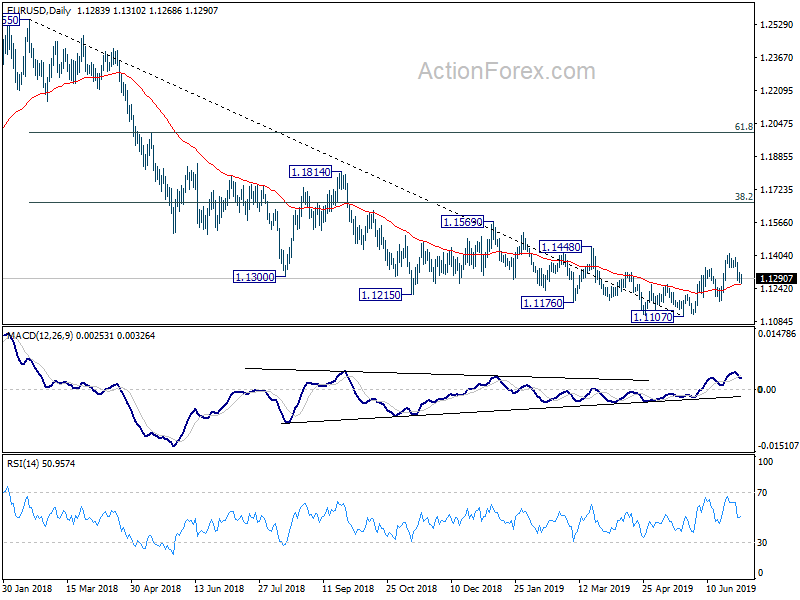
Daily Pivots: (S1) 1.1267; (P) 1.1294; (R1) 1.1313; More...
With 1.1344 minor resistance intact, further fall is mildly in favor to 1.1181 support. Recovery from 1.1107 might have completed earlier than expected at 1.1412. Break of 1.1181 support will confirm and bring retest of 1.1107 low. Though, above 1.1344 minor resistance will turn bias back to the upside to resume the rebound from 1.1107 through 1.1412 instead.
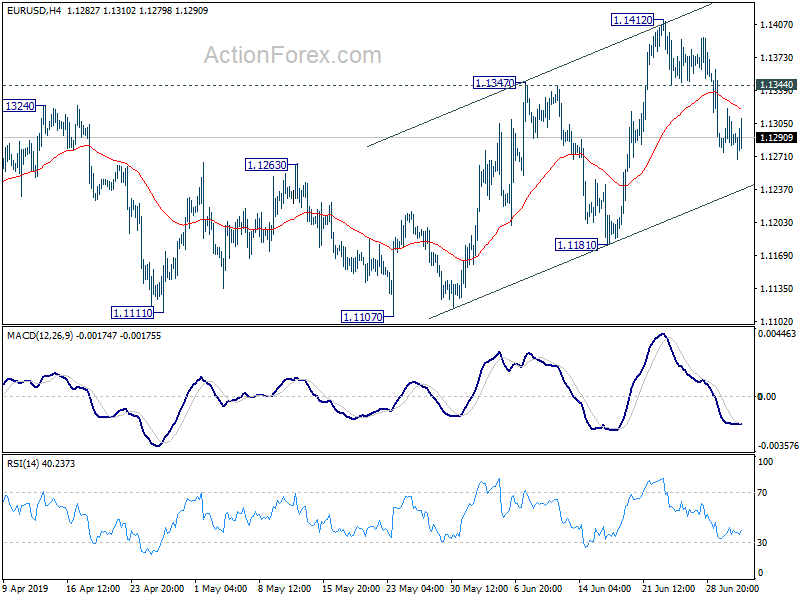
In the bigger picture, considering bullish convergence condition in daily and weekly MACD, a medium term bottom should be in place at 1.1107 after hitting 61.8% retracement of 1.0339 (2016 low) to 1.2555 (2018 high) at 1.1186. Further rise should be seen to 38.2% retracement of 1.2555 to 1.1107 at 1.1660. Reactions from there could indicate whether rebound from 1.1107 is a corrective rise or reversing medium term trend. In any case, risk will stay mildly on the upside as long as 1.1107 low remains intact.
GBP/USD Mid-Day Outlook
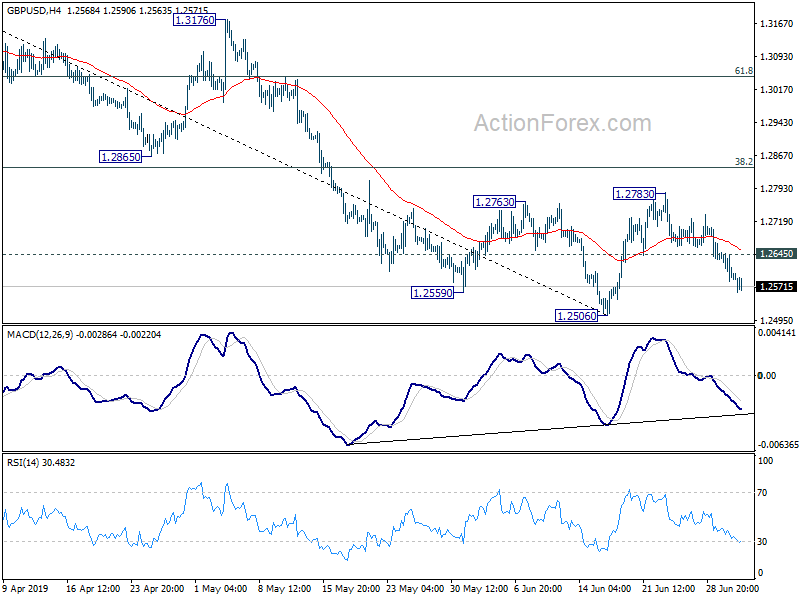
Daily Pivots: (S1) 1.2569; (P) 1.2609; (R1) 1.2635; More....
Intraday bias in GBP/USD remains mildly on the downside. Corrective recovery from 1.2506 should have completed at 1.2783. Firm break of 1.2506 will resume larger fall from 1.3381 to 1.2391 low. On the upside, above 1.2645 minor resistance will extend the consolidation from 1.2506 with another rise. But upside should be limited by 38.2% retracement of 1.3381 to 1.2506 at 1.2840 to bring fall resumption eventually.
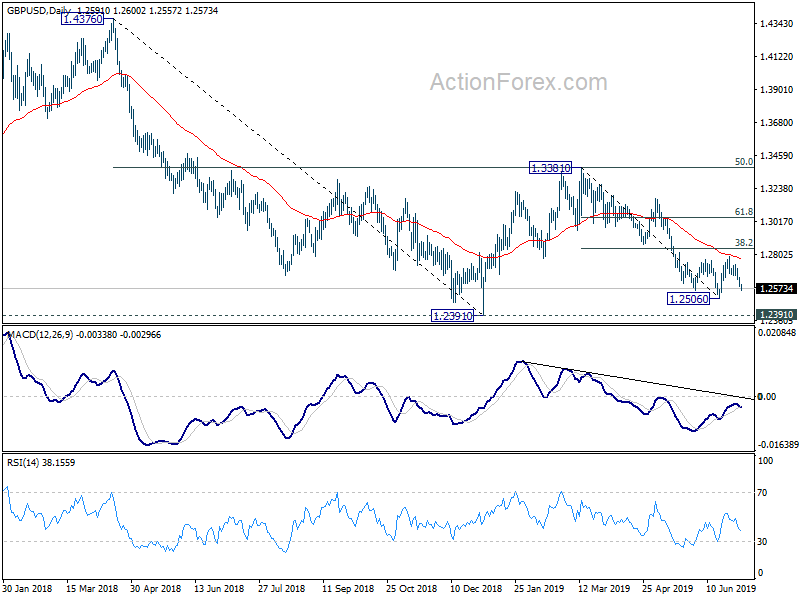
In the bigger picture, down trend from 1.4376 (2018 high) is still in progress. Break of 1.2391 would target a test on 1.1946 long term bottom (2016 low). For now, we don't expect a firm break there yet. Hence, focus will be on bottoming signal as it approaches 1.1946. In any case, medium term outlook will stay bearish as long as 1.3381 resistance holds, in case of strong rebound.
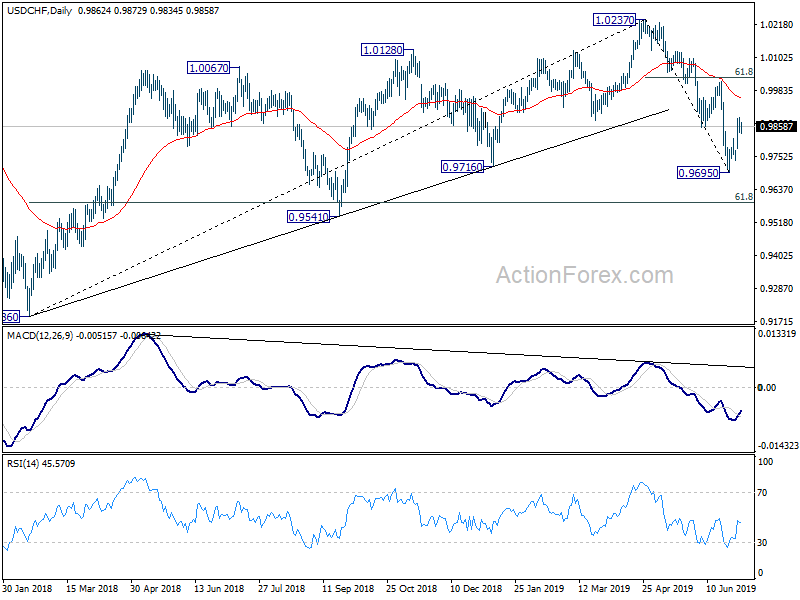
USD/CHF Mid-Day Outlook
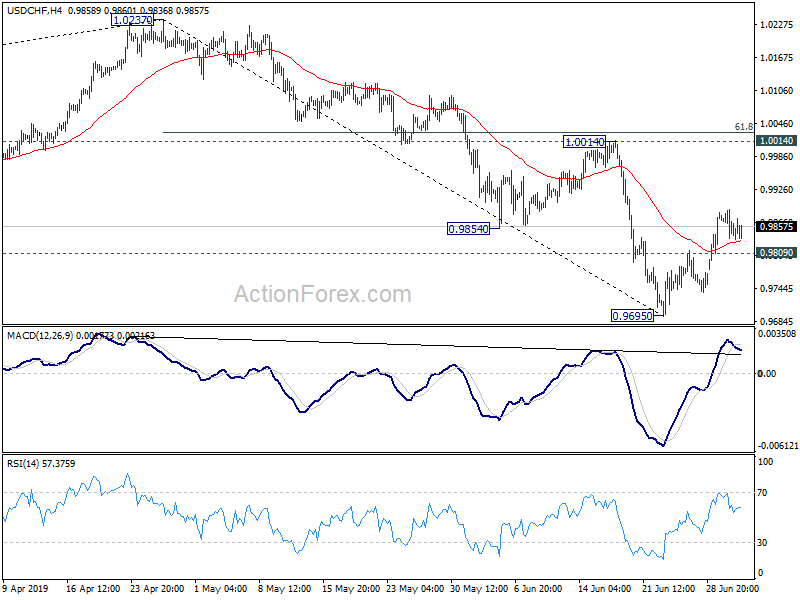
Daily Pivots: (S1) 0.9836; (P) 0.9863; (R1) 0.9889; More...
Further rise remains mildly in favor with 0.9809 minor support intact. Rebound from 0.9695 could target 1.0014 resistance. But upside could be limited by 61.8% retracement of 1.0237 to 0.9695 at 1.0030. On the downside, below 0.9809 minor support will turn bias back to the downside for retesting 0.9695 low.
In the bigger picture, current development suggests that up trend from 0.9186 (2018 low) has completed at 1.0237 already. Deeper decline would be seen to 61.8% retracement of 0.9186 to 1.0237 at 0.9587 and below. For now, USD/CHF is seen as in long term range pattern between 0.9186 and 1.0342. Hence, we'd pay attention to bottoming signal below 0.9587. However, sustained break of 1.0014 will revive medium term bullishness and turn focus back to 1.0237 high.
USD/JPY Mid-Day Outlook
Daily Pivots: (S1) 107.63; (P) 108.06; (R1) 108.34; More...
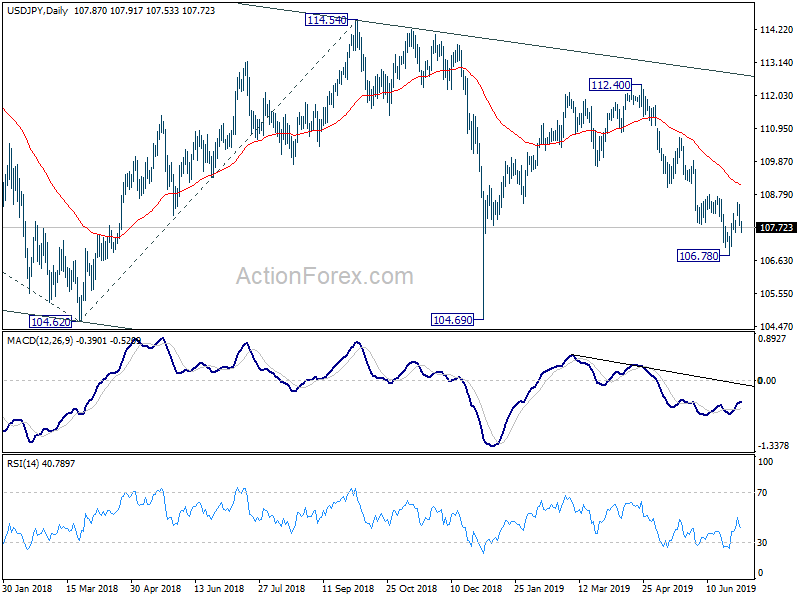
USD/JPY is still holding above 107.56 minor support and intraday bias remains neutral at this point. Also, with 108.80 resistance intact, outlook remains bearish. On the downside, firm break of 107.56 minor support will bring retest of 106.78 low. Break there will extend recent fall from 112.40 to 104.69 low. Nevertheless, sustained break of 108.80 will confirm short term bottoming at 106.78. In this case, stronger rise should be seen back to 110.67 resistance.
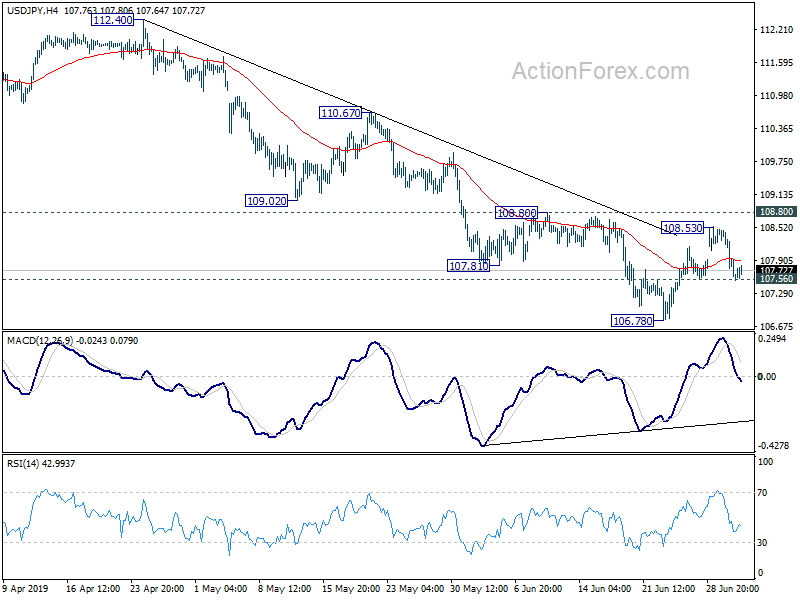
In the bigger picture, decline from 118.65 (Dec 2016) is still in progress, with the pair staying inside long term falling channel. Break of 104.62 will target 100% projection of 118.65 to 104.62 from 114.54 at 100.51. For now, we'd expect strong support above 98.97 (2016 low) to contain downside to bring rebound. In any case, break of 112.40 is needed to the first serious sign of medium term bullishness. Otherwise, further decline will remain in favor in case of rebound.