

Sample Category Title
Australian Dollar Flat Despite Strong Business Confidence Report
AUD/USD is showing little movement in the Tuesday session. In North American trade, AUD/USD is trading at 0.6955, down 0.07% on the day. On the release front, Australian NAB Business Confidence jumped to 7, after two straight readings at zero. It was the indicator’s strongest showing in 10 months. Later in the day, Australia releases Westpac Consumer Sentiment. In the U.S., producer price index reports matched their estimates. PPI dipped 0.1%, down from 0.2% a month earlier. Core PPI edged up 0.2%, up from 0.1% in the previous release. Wednesday will be a busy day. The U.S. releases consumer inflation and Australia releases MI inflation expectations and employment change.
The Australian business sector appears in a buoyant move, according to the latest NAB business confidence survey. The indicator climbed to 7 in May. The business sector was pleased with the unexpected victory of the conservative coalition in the general election last month, as the conservatives are considered more pro-business. Will the Westpac consumer confidence survey follow suit? If so, the Aussie could gain ground.
There were fears that President Trump would slap Mexico with new tariffs, opening up another trade war front. The tariffs were set to take effect on Monday, but the U.S. suspended the tariffs, after high level talks helped defuse the latest crisis. As well, G-20 finance ministers agreed on a joint communique to reduce trade tensions. With President Trump and President Xi of China meeting at the G-20 summit in Japan in late June, we could see progress in the bitter trade dispute between the world’s two largest economies.
USD/JPY Mid-Day Outlook
Daily Pivots: (S1) 108.28; (P) 108.50; (R1) 108.67; More...
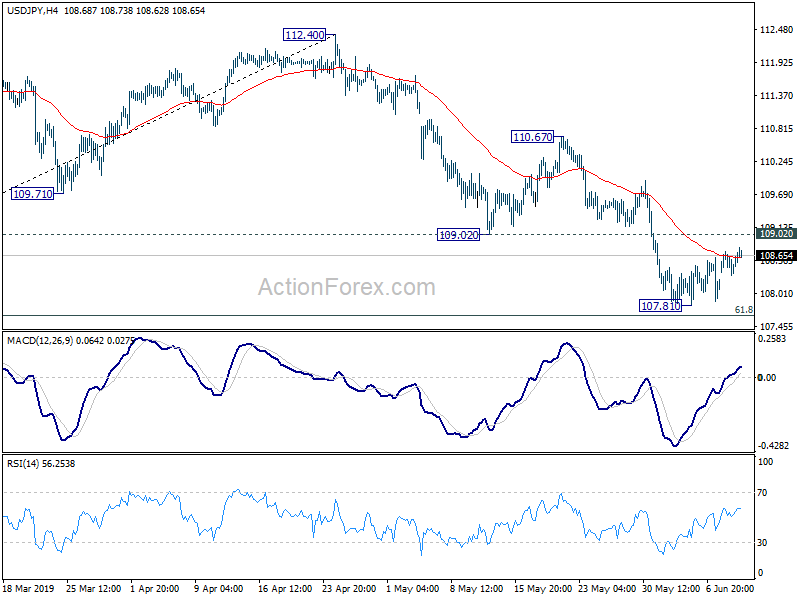
USD/JPY is staying in consolidation from 107.81 and intraday bias remains neutral. Upside of recovery should be limited by 109.02 support turned resistance to bring fall resumption. On the downside, sustained break of 61.8% retracement of 104.69 to 112.40 at 107.63 will pave the way back to 104.62/9 key support zone. Though, break of 109.02 support turned resistance will indicate short term bottoming and bring lengthier consolidations first.
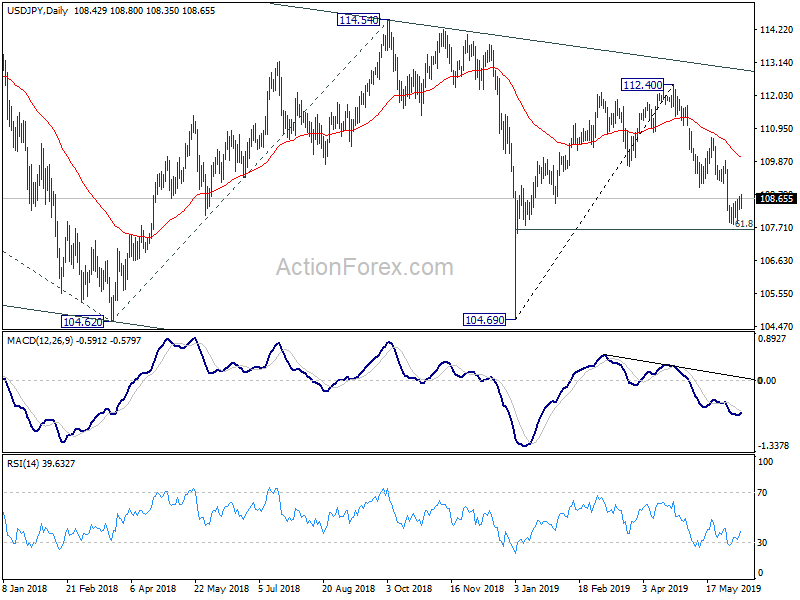
In the bigger picture, decline from 118.65 (Dec 2016) is still in progress, with the pair staying indicate long term falling channel. Break of 104.62 will target 100% projection of 118.65 to 104.62 from 114.54 at 100.51. For now, we'd expect strong support above 98.97 (2016 low) to contain downside to bring rebound.
USD/CHF Mid-Day Outlook
Daily Pivots: (S1) 0.9883; (P) 0.9902; (R1) 0.9919; More...
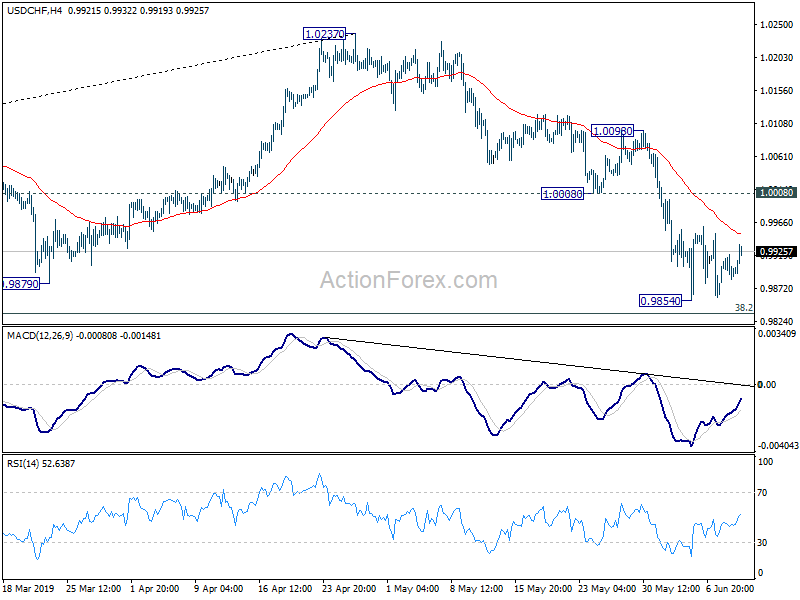
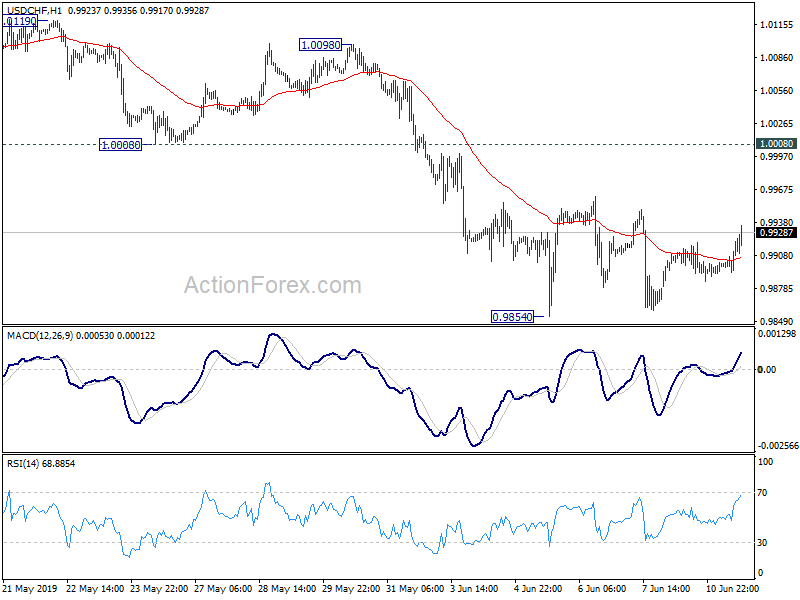
USD/CHF is staying in consolidation from 0.9854 and intraday bias remains neutral. Another recovery could be seen but upside should be limited by 1.0008 support turned resistance and bring fall resumption. On the downside, break of 0.9854 will extend the decline from 1.0237 to 0.9716 cluster support (50% retracement of 0.9186 to 1.0237 at 0.9712).
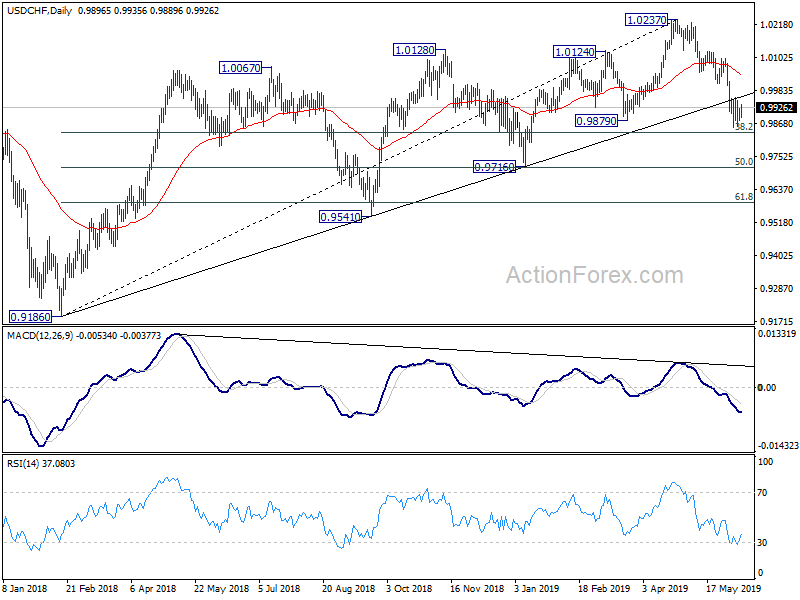
In the bigger picture, USD/CHF's break of long term trend line support is the first indication of medium term reversal. Focus is now back on 0.9879 support. Sustained break should confirm that medium term up trend from 0.9186 has completed at 1.0237 already. Further fall should be seen to 0.9716 cluster support (50% retracement of 0.9186 to 1.0237 at 0.9712) next. Break will target 61.8% retracement at 0.9587.
EUR/USD Mid-Day Outlook
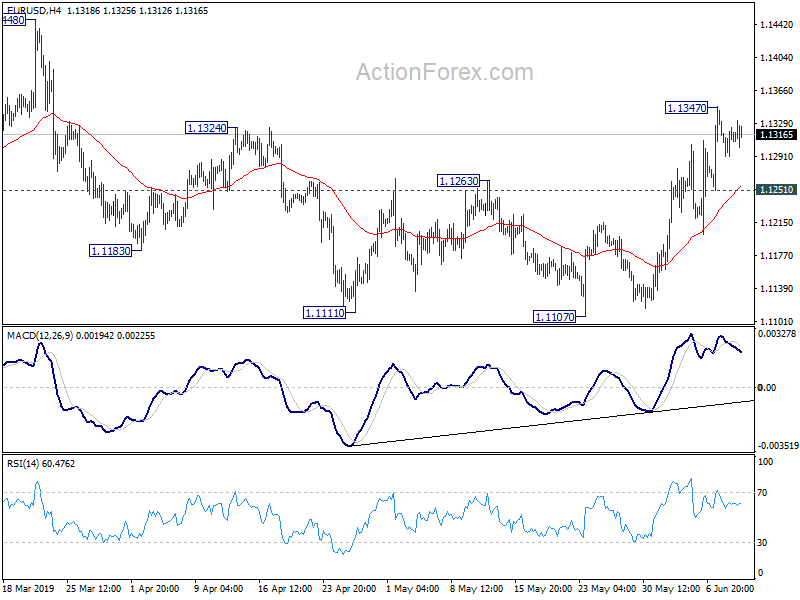
Daily Pivots: (S1) 1.1291; (P) 1.1311; (R1) 1.1332; More.....
Intraday bias in EUR/USD remains neutral and with 1.1251 minor support intact further rise remains mildly in favor. On the upside, above 1.1347 will target 1.1448 key resistance next. Decisive break there will carry larger bullish implications. On the downside, break of 1.1251 minor support will suggest that recovery from 1.1107 has completed. Intraday bias will be turned back to the downside for retesting 1.1107 low.
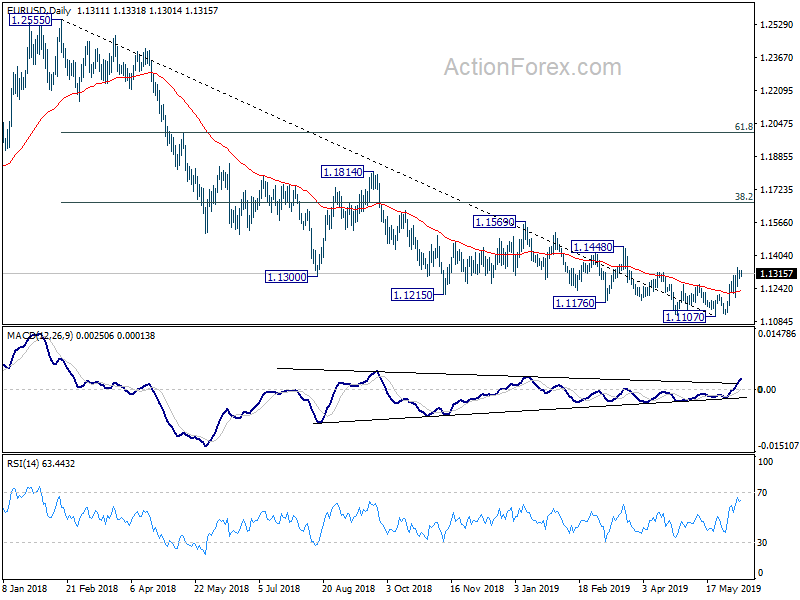
In the bigger picture, current development argues that a medium term bottom could be in place at 1.1107, on bullish convergence condition in daily MACD. Decisive break of 1.1448 resistance would confirm this case. And stronger rebound would be seen to 38.2% retracement of 1.2555 to 1.1107 at 1.1660. At this point, it's early to judge whether rise from 1.1107 is a corrective move or the start of an medium term up trend. We'd look at the structure of the rebound to decide later. But in any case, for now, risk will remain on the upside as long as 1.1107 low holds.
Sunset Market Commentary
Markets
Core bonds are mixed today with US Treasuries underperforming German Bunds. Risk sentiment remains positive with European indices taking over the Asian, Chinese stimulus-driven, vibe. It proved the perfect theoretic breathing ground for some profit taking on the core bond rally. That turned out to be the case for US Treasuries, but not so for German Bunds which remain resilient. Tonight’s start of the mid-month US refinancing operation is probably at play as well. The upleg of the Bund occurred early this morning, before Sentix data for June suggested that the German economy might be slipping into recession. Good US eco data left no traces on markets. US president Trump stepped up his pressure on the Fed to cut rates again and even referred to the (too) strong dollar. The US yield curve bear flattens with yields gaining 2.4 bps (2-yr) to 0.9 bps (30-yr). Changes on the German yield curve range between +0.2 bps (5-yr) and -1.3 bps (30-yr). 10-yr yield spread changes vs Germany narrowed by 2 to 4 bps. Italian PM Conte said that his deputy PM’s agree to avoid an infringement procedure on debt.
The post-payrolls’ USD decline slowed yesterday. The US currency found a better bid as US yields bottomed. The US not raising tariffs on Mexican imports also supported US yields and the dollar. The USD consolidation continued today. EUR/USD tried a shy upside test this morning, but the move was blocked by a gradual further rise in US yields. The NFIB small business confidence printed strong. The direct impact on the dollar was limited, but the USD currency stayed well bid going into the start of US dealings. EUR/USD slipped to the low 1.13 area. President Trump in a tweet indicated that the euro and other currencies are devaluated against the dollar and that Fed policy is (much) too tight. The headlines caused some gyrations but no clear USD trend. EUR/USD hovers in the 1.1315/+20 area. USD/JPY is trading near 10870.
UK eco data often were of second tier importance for sterling trading of late as sterling traders were focused on the gyrations in the Brexit process and the political battle to succeed Theresa May. This political focus for sure will return to the forefront in over the coming weeks. However, today UK labour data finally also triggered an intraday move of significance. April employment growth (32K on 3M3M) and weekly earnings growth (3.4% Y/Y core) were stronger than expected. The report followed recent comments from BoE’s Haldane and Saunders that the BoE might have to raise interest rates in the near future. Markets still see a low chance of the BoE raising interests rates while at the same time the Fed is expected to ease policy. Even so, the market couldn’t completely ignore the combination of BoE guidance and strong data anymore. EUR/GBP dropped temporarily from the 0.8930 area to the 0.89 big figure. Later the session, comments from BoE’s Broadbent were more balanced. Even so, a BoE rate cut looks not evident short-term. Markets pondering this scenario might help to prevent/slow a further decline of sterling short-term. EUR/GBP is trading near 0.89. Cable hovers in the low 1.27 area.
News Headlines
Czech inflation accelerated from 2.8% YoY in April to 2.9% in May, beating market’s 2.7% estimates. Inflation has been around 3% since March, above the central bank’s (CNB) 2% target. Yet markets do not expect the CNB to hike rates substantially going forward given current economic conditions. The Czech koruna barely gains (EUR/CZK 25.63).
May inflation slowed to 2.5% YoY (down from 2.9%) in Norway. Core measures also retreated (2.3% vs. 2.6% in April). Markets expected both figures to stabilize. A knee-jerk reaction in EUR/NOK to 9.83 as doubts on a June rate hike rise was soon offset by a Norges Bank regional survey of business that showed the most optimistic outlook in seven years. The couple is now trading at around 9.76.
GBP/USD Mid-Day Outlook
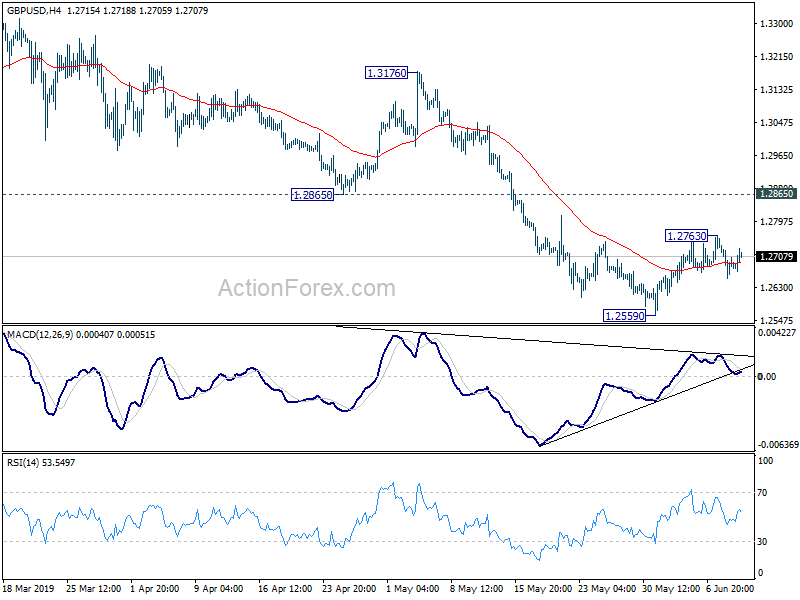
Daily Pivots: (S1) 1.2639; (P) 1.2699; (R1) 1.2746; More....
Intraday bias in GBP/USD is turned neutral again with today's recovery. Break of 1.2763 will extend the corrective rise fro 1.2559. But in that case, upside should be limited by by 1.2865 support turned resistance to bring fall resumption eventually. On the downside, break of 1.2559 low will extend the decline from 1.3381 for 1.2391 low first.
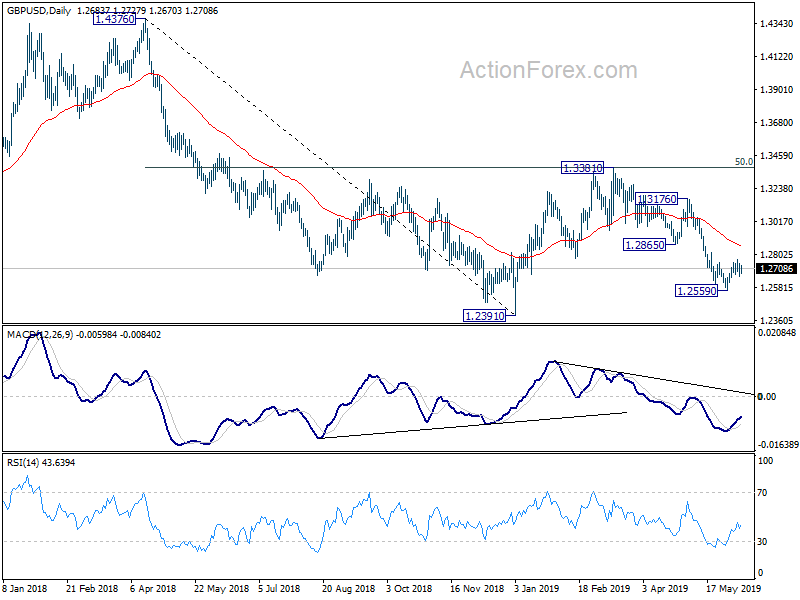
In the bigger picture, medium term decline from 1.4376 (2018 high) is possibly ready to resume. Decisive break of 1.2391 would target a test on 1.1946 long term bottom (2016 low). For now, we don't expect a firm break there yet. Hence focus will be on bottoming signal as it approaches 1.1946. In any case, medium term outlook will stay bearish as long as 1.3381 resistance holds, in case of strong rebound.
Sterling Recovers on Wage Growth, Euro Shrugs Poor Investor Confidence
Sterling recovers broadly today as lifted by stronger than expected wage growth. A key BoE official also noted that interest rate might have to rise more quickly than market expected. Though, upside of the Pound is capped so far, by Brexit uncertainty and worries over slowdown if such uncertainty is not resolved soon. Euro is also firm as second strongest, shrugging off poor Sentix Investor confidence which indicates Eurozone is on the verge of recession. On the other hand, New Zealand Dollar is the weakest one for today. Yen and Swiss Franc are pressured by return of risk appetite.
In other markets, DOW open higher again and is currently up 0.48%. 10-year yield is up 0.012 at 2.155. In Europe, FTSE is up 0.55%. DAX is up 1.43%. CAC is up 0.86%. German 10-year yield is down -0.0159 at -0.232. Earlier in Asia, Nikkei rose 0.33%. Hong Kong HSI rose 0.76%. China Shanghai SSE rose 2.58%. Singapore Strait Times rose 0.67%. Japan 10-year JGB yield rose 0.0109 to -0.11.
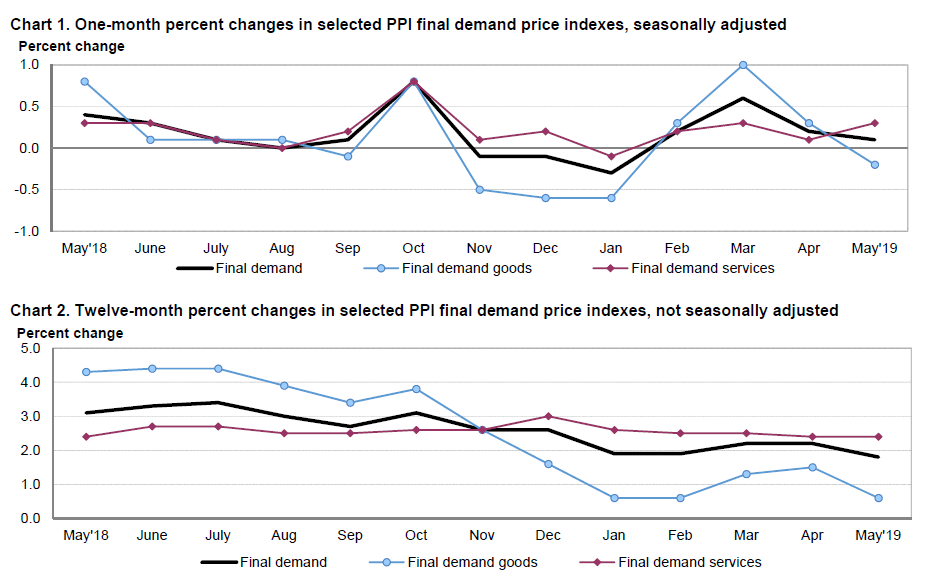
Released in US, PPI rose 0.1% mom 1.8% yoy in May, versus expectation of 0.1% mom, 1.9% yoy. PPI core rose 0.2% mom, 2.3% yoy versus expectation of 0.2% mom, 2.3% yoy.
UK unemployment rate stayed at 44-year low, wage growth accelerates
UK unemployment rate remained unchanged at 3.8% in the three months to April. It's the lowest reading since December 1974. Average weekly earnings, including bonus, rose 3.1% yoy, slowed from 3.3% yoy but beat expectation of 3.0% yoy. Average weekly earnings, excluding bonus, rose 3.4% yoy, accelerated from 3.3% yoy and beat expectation of 3.1% yoy.
BoE Broadbent: Interest rates could have to rise a little more than markets expect
BoE Deputy Governor Ben Broadbent reiterated that Brexit is the major risk to growth in inflation outlook in a Treasury Select Committee hearing. He noted: "The outlook for both growth and inflation will depend significantly on the nature and timing of EU withdrawal, in particular: the new trading arrangements between the EU and the UK; whether the transition to them is abrupt or smooth; how households, businesses and financial markets respond; and the balance of these effects on demand, supply and the exchange rate."
Broadbent also pointed out the May Inflation Report was conditioned to market path of Bank Rate rising only 25bps over the three-year forecast horizon. But "were the economy to develop in line with our projection, and taking as given other asset prices in the forecast, interest rates would probably have to rise by a little more than what was in the curve at the time of the forecast."
Policymaker Michael Saunders warned "no-deal Brexit would probably have a significant adverse effect on the UK's long term growth prospects, because of reduced openness to international trade in both goods and services, and the resultant deterioration in the attractiveness of the UK as a global business location."
Saunders also noted "The major external risk is that the ongoing trade tensions could escalate further, with successive rounds of retaliation, hence undermining business confidence and growth on a wide scale. The UK, as a highly globalized economy, would suffer through various channels including effects on exports, investment and asset prices."
EU reiterates no Brexit renegotiation even with new UK PM
European Commission reiterates its stance that there will be renegotiation of the Brexit deal even with a new UK Prime Minister. The Commission's spokesman said today, "Everybody knows what is on the table. What is on the table has been approved by all member states and the election of a new prime minister will not change the parameters."
The stance is echoed by both Germany and France. France's state secretary for European affairs Amélie de Montchalin said "We consider it is up to Britain to decide how it wants to proceed. The exit agreement was not negotiated against the British; negotiators on both sides tried, painstakingly, to find the best solution for all concerned." Also, without a "new political line" in the UK or a second referendum, Britain must expect to leave the bloc on 31 October.
Germany's Europe Minister Michael Roth said "I see no willingness to restart negotiations from the beginning. The candidates would do well to bear that in mind in the course of their internal party campaigns."
Sentix: Eurozone on threshold of recession, Trump shoots himself in the knee
Eurozone Sentix Investor Confidence dropped to -3.3 in June, down from 5.3 and missed expectation of 2.5. Current Situation Index dropped from 11.0 to 6.0. Expectations index dropped from -0.3 to -12.3.
Sentix noted that "renewed escalation in the US-China trade dispute is also having a considerable impact on the Euro zone economy". Also, it warned "the Euroland economy is once again on the threshold of recession". Sentix also complained that "more than ever, the economic forecast becomes a short-winded Twitter analysis."
The Overall Investor Confidence Index for Germany tumbled from 7.9 to -0.7, lowest since March 2010. Current situation Index dropped from 18.3 to 13.5. Expectations Index dropped from -2.0 to -14.0. Germany's key industry, the automotive industry, is still "in a crisis of its own making". And the "current government coalition's inability to act does not contribute to stabilization."
For US, Overall Investor Confidence Index dropped from 17.7 to 6.5, lowest since February 2016. Current Situation Index dropped from 43.3 to 31.8, lowest since October 2016. Expectations Index dropped from -5.3 to -16.0. Sentix warned that Trump could "underestimate how much he is currently threatening to shoot himself in the knee with his trade rhetoric". The US economy is "currently experiencing a real emergency stop."
ECB Rehn: Should developments require ECB would use forward guidance, cut rates or even relaunch QE
ECB Governing Council member Olli Rehn said "in case of a further weakening of economic activity and a materialization of adverse contingencies, the Governing Council is determined to act and stands ready to adjust all of its instruments, as appropriate".
To be more specific, "the Governing Council may, should economic developments so require, strengthen its forward guidance and its linkage to the achievement of the price stability objective, lower the monetary policy rates and introduce possible mitigating measures, and/or relaunch net purchases under the securities purchase program.
Australia business condition dropped as private sectors continue to lose momentum
Australian NAB Business Condition dropped again in May to 1, down from 3. Private sector continues to lose momentum. Goods distribution industries remain particularly weak, and manufacturing is not far behind. Business Confidence jumped from 0 to 7, in a post-election spike, as well as on RBA rate cut expectations. However, forward looking indicators suggest more weakness lies ahead.
Alan Oster, NAB Group Chief Economist noted "business confidence saw a sharp increase in the month following the Federal election and a confirmation from the RBA that rates would be cut in June. We think this will be a short-term spike given other forward-looking indicators saw further deterioration in the month. Forward orders declined further and in addition to being well below average are negative. Capacity utilisation has also pulled back in 2019 to date and is now a touch below average".
"While confidence, at least at face value was a positive outcome, business conditions deteriorated further. Trading conditions and profits are particularly weak. The employment index which we are watching closely, partially reversed some of its decline last month, but is only around average".
China refuses to confirm Trump-Xi summit at G20
China's Foreign Ministry spokesman Geng Shuang refused to confirm if there will be a Trump-Xi meeting at G20 in Osaka later this month. Instead, he just reiterated that stance that "China does not want to fight a trade war, but we are not afraid of fighting a trade war". Also, "if the United States only wants to escalate trade frictions, we will resolutely respond and fight to the end."
Yesterday, Trump said he and Chinese President Xi are "scheduled to have a meeting" at the G20 summit in Osaka. He then threatened, "We're expected to meet and if we do that's fine, and if we don't — look, from our standpoint the best deal we can have is 25% on $600 billion."
GBP/USD Mid-Day Outlook
Daily Pivots: (S1) 1.2639; (P) 1.2699; (R1) 1.2746; More....
Intraday bias in GBP/USD is turned neutral again with today's recovery. Break of 1.2763 will extend the corrective rise fro 1.2559. But in that case, upside should be limited by by 1.2865 support turned resistance to bring fall resumption eventually. On the downside, break of 1.2559 low will extend the decline from 1.3381 for 1.2391 low first.
In the bigger picture, medium term decline from 1.4376 (2018 high) is possibly ready to resume. Decisive break of 1.2391 would target a test on 1.1946 long term bottom (2016 low). For now, we don't expect a firm break there yet. Hence focus will be on bottoming signal as it approaches 1.1946. In any case, medium term outlook will stay bearish as long as 1.3381 resistance holds, in case of strong rebound.
Economic Indicators Update
| GMT | Ccy | Events | Actual | Forecast | Previous | Revised |
|---|---|---|---|---|---|---|
| 01:30 | AUD | NAB Business Conditions May | 1 | 3 | ||
| 01:30 | AUD | NAB Business Confidence May | 7 | 0 | ||
| 06:00 | JPY | Machine Tool Orders Y/Y May P | -27.30% | -33.40% | ||
| 08:30 | GBP | Jobless Claims Change May | 23.2K | 12.3K | 24.7K | 19.1K |
| 08:30 | GBP | Claimant Count Rate May | 3.10% | 3.00% | ||
| 08:30 | GBP | Average Weekly Earnings 3M Y/Y Apr | 3.10% | 3.00% | 3.20% | 3.30% |
| 08:30 | GBP | Weekly Earnings ex Bonus 3M Y/Y Apr | 3.40% | 3.10% | 3.30% | |
| 08:30 | GBP | ILO Unemployment Rate 3Mths Apr | 3.80% | 3.80% | 3.80% | |
| 08:30 | EUR | Eurozone Sentix Investor Confidence Jun | -3.3 | 2.5 | 5.3 | |
| 10:00 | USD | NFIB Small Business Optimism May | 105 | 101.9 | 103.5 | |
| 12:30 | USD | PPI M/M May | 0.10% | 0.10% | 0.20% | |
| 12:30 | USD | PPI Y/Y May | 1.80% | 1.90% | 2.20% | |
| 12:30 | USD | PPI Core M/M May | 0.20% | 0.20% | 0.10% | |
| 12:30 | USD | PPI Core Y/Y May | 2.30% | 2.30% | 2.40% |
US PPI at 1.9%, core PPI at 2.3%. USD/CHF mildly higher
In May, US PPI rose 0.1% mom 1.8% yoy versus expectation of 0.1% mom, 1.9% yoy. PPI core rose 0.2% mom, 2.3% yoy versus expectation of 0.2% mom, 2.3% yoy. Full release here.
 USD/CHF rises mildly after the release. But there is no indication of bullish reversal yet.
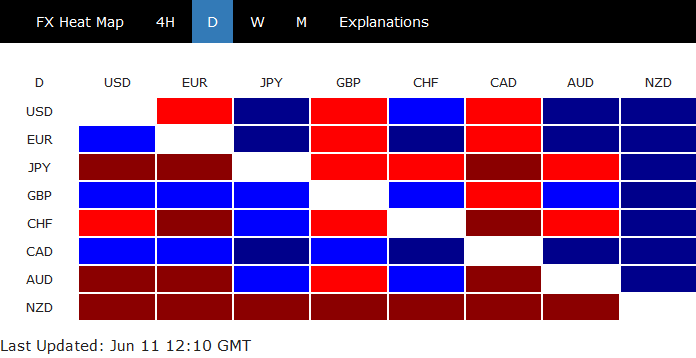
Into US session: Sterling recovers on wage growth, but Canadian stronger
Risk appetite remains generally firm in the global markets today. Asian markets closed broadly higher and strength continues in European session. Mixed economic data from Europe is generally ignored by stock investors. Sentix warned that Eurozone is on threshold of recession as Investor Confidence deteriorated in to -3.3 in June. On the other hand, UK unemployment rate stayed at 44-year low but wage growth accelerated in April.
In the currency markets, Sterling is lifted by wage growth data but Canadian Dollar is even stronger. After all, sluggishness in UK growth could eventually drags down wage growth if Brexit uncertainty is no resolved swiftly. Dollar is following as the third strongest, awaiting PPI. Yen and Swiss Franc are soft on risk appetite, but New Zealand and Australian Dollar are also weak.
In other markets, currently:
- DOW future is up 126 pts or 0.48%.
- Gold is down -0.38% as Dollar rises.
- WTI crude oil is up 1.09%.
In Europe:
- FTSE is up 0.48%.
- DAX is up 1.33%.
- CAC is up 0.80%.
- German 10-year yield is down -0.0018 to -0.218.
Earlier in Asia:
- Nikkei rose 0.33%.
- Hong Kong HSI rose 0.76%.
- China Shanghai SSE rose 2.58%.
- Singapore Strait Times rose 0.67%.
- Japan 10-year JGB yield rose 0.0109 to -0.11.
BoE Broadbent: Interest rates could have to rise a little more than markets expect
BoE Deputy Governor Ben Broadbent reiterated that Brexit is the major risk to growth in inflation outlook in a Treasury Select Committee hearing. He noted: "The outlook for both growth and inflation will depend significantly on the nature and timing of EU withdrawal, in particular: the new trading arrangements between the EU and the UK; whether the transition to them is abrupt or smooth; how households, businesses and financial markets respond; and the balance of these effects on demand, supply and the exchange rate."
Broadbent also pointed out the May Inflation Report was conditioned to market path of Bank Rate rising only 25bps over the three-year forecast horizon. But "were the economy to develop in line with our projection, and taking as given other asset prices in the forecast, interest rates would probably have to rise by a little more than what was in the curve at the time of the forecast."
Policymaker Michael Saunders warned "no-deal Brexit would probably have a significant adverse effect on the UK's long term growth prospects, because of reduced openness to international trade in both goods and services, and the resultant deterioration in the attractiveness of the UK as a global business location."
Saunders also noted "The major external risk is that the ongoing trade tensions could escalate further, with successive rounds of retaliation, hence undermining business confidence and growth on a wide scale. The UK, as a highly globalized economy, would suffer through various channels including effects on exports, investment and asset prices."