Sample Category Title
DAX Storms Higher After Holiday Break
The DAX has climbed sharply on Tuesday, after German stock markets were closed for a holiday on Monday. Currently, the index is at 12,203, up 1.31% on the day. In economic news, there are no German events. In the eurozone, Sentix Investor Confidence declined by 3.3 points, missing the estimate of 2.3 points. This marked the sixth decline in seven months. On Wednesday, Mario Draghi speaks at an ECB event in Frankfurt. The U.S. will post consumer inflation numbers.
There were fears that President Trump would slap Mexico with new tariffs, opening up another trade war front. The tariffs were set to take effect on Monday, but the U.S. suspended the tariffs, after high level talks helped defuse the latest crisis. As well, G-20 finance ministers agreed on a joint communique to reduce trade tensions. With President Trump and President Xi of China meeting at the G-20 summit in Japan in late June, we could see progress in the bitter trade dispute between the world’s two largest economies. On the DAX, bank and automaker listings are sharply higher on Tuesday. Deutsche Bank is up 2.67%. BMW has gained 2.67%, Daimler is up 1.87% and Volkswagen has climbed 1.92%.
The U.S dollar suffered broad losses last week, and equity markets responded with strong gains. The DAX jumped 2.7%, its strongest weekly gain since early April. There were a combination of factors which hurt the greenback. First, comments from Federal Reserve president Jerome Powell have set the stage for a rate cut in the coming months. Since raising rates in December, the Fed has been neutral with regard to the direction of the next rate move, but rising trade tensions have raised fears of a slowdown in the U.S. economy. This has prompted the Fed to reconsider a rate cut later this year. The CME Group has projected a 64% likelihood of a 0.25% rate cut, up sharply from a month ago, when the odds of a cut were just 16%.
Secondly, there was dismal news on the employment front. Nonfarm payrolls posted its second dismal reading in four months. In May, the economy created only 75 thousand jobs, down from 263 thousand a month earlier. Wage growth was unchanged at 0.2%, shy of the estimate of 0.3%. Despite these soft job numbers, the U.S. labor market is in strong shape, and the greenback could quickly bounce back.
EU reiterates no Brexit renegotiation even with new UK PM
European Commission reiterates its stance that there will be renegotiation of the Brexit deal even with a new UK Prime Minister. The Commission's spokesman said today, "Everybody knows what is on the table. What is on the table has been approved by all member states and the election of a new prime minister will not change the parameters."
The stance is echoed by both Germany and France. Germany's Europe Minister Michael Roth said "I see no willingness to restart negotiations from the beginning. The candidates would do well to bear that in mind in the course of their internal party campaigns." France's state secretary for European affairs Amélie de Montchalin said "We consider it is up to Britain to decide how it wants to proceed. The exit agreement was not negotiated against the British; negotiators on both sides tried, painstakingly, to find the best solution for all concerned." Also, without a "new political line" in the UK or a second referendum, Britain must expect to leave the bloc on 31 October.
EUR/USD – Euro Drifting, Euro Confidence Sags
EUR/USD is showing limited movement in the Tuesday session. Currently, the pair is trading at 1.1316, up 0.04% on the day. On the release front, eurozone Sentix Investor Confidence declined by 3.3 points, missing the estimate of 2.3 points. This marked the sixth decline in seven months. The markets are braced for weak U.S. inflation reports. PPI is expected to come in at 0.1%, while core PPI is projected to post a gain of 0.2%. On Wednesday, Mario Draghi speaks at an ECB event in Frankfurt. The U.S. will post consumer inflation numbers.
The U.S. dollar has settled down, after a rough week. EUR/USD jumped 1.5% last week, on a combination of factors. First, comments from Federal Reserve president Jerome Powell have set the stage for a rate cut in the coming months. Since raising rates in December, the Fed has been neutral with regard to the direction of the next rate move, but rising trade tensions have raised fears of a slowdown in the U.S. economy. This has prompted the Fed to reconsider a rate cut later this year. The CME Group has projected a 64% likelihood of a 0.25% rate cut, up sharply from a month ago, when the odds of a cut were just 16%.
Secondly, there was dismal news on the employment front. Nonfarm payrolls posted its second dismal reading in four months. In May, the economy created only 75 thousand jobs, down from 263 thousand a month earlier. Wage growth was unchanged at 0.2%, shy of the estimate of 0.3%. Despite these soft job numbers, the U.S. labor market is in strong shape, and the greenback could quickly bounce back.
European Update – Fed High Heads Into Day Seven
Fed high continues into seventh day
The stock market run looks set to continue on Tuesday, with Europe trading comfortably in positive territory and US futures signalling a similar session on Wall Street.
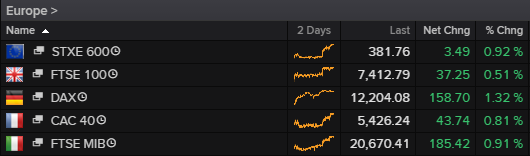
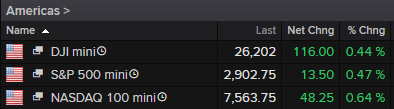
Safe to say, the changing expectations for interest rates is the primary reason for such a strong rebound in the markets that didn’t look particularly likely at the start of last week. Once again, it’s central banks that are left to fill the economic void, easing investor fears over trade wars and a global slowdown.
Of course, should the G20 meeting between Trump and Xi at the end of the month reach a successful conclusion, that balance may shift while also likely being favourable for stock markets. It may not entirely remove concerns about the outlook for the global economy but this is widely regarded as being the greatest risk.
There may well be some hangover from a large number of months of disruption and uncertainty which acts as a continued drag on the outlook. Not to mention the fact that Trump is unlikely to end the tariff offensive with China, with the EU and Japan being next in the firing line. We also have other issues to contend with including Brexit and a slowdown in Europe.
Australian Dollar: Recent Stability to Give Way, AUD to Fall to 66¢ in 2020
We look for AUD/USD to fall to USD0.68 in late-2019, then to USD0.66 in early-2020.
Since our last Market Outlook, the Australian dollar has again traded a tight range. From USD0.6999 a month ago, the currency fell to a low of USD0.6868 briefly before quickly rallying back above USD0.69, now 0.6960. US/Australian interest rate differentials and commodity prices remain key for valuation.
Beginning with the RBA, the past month has seen the RBA cut the cash rate to 1.25% and expectations of further easing build. As detailed on page 6, on 24 May Westpac Economics added a third cut to our RBA call, to take the cash rate down to 0.75% in November. The market has also now priced in three cuts in this cycle, though not until mid-2020 – the expected cash rate at June 2020 falling from 1.00% a month ago to 0.73% currently.
A shift in expectations like this would typically weigh heavily on a nation’s currency. Why not on this occasion? In part because of commodity price strength (more below), but also as US interest rate expectations have moved further than our own.
For the FOMC, a month ago two cuts (to a fed funds rate of 1.875%) were priced in by the September 2020 meeting. Now, almost four cuts (89bps) are expected by November 2020. Moreover, spreads at the long end of the yield curve have also narrowed, from –73bps to –68bps for the 10-year yield. The cause of this abrupt shift in US policy expectations is detailed on page 18. In short, whereas the world previously believed President Trump’s trade disputes would be resolved in short order, after repeated escalations, they now see no end in sight. Consequently, there is cause to be concerned over US growth, foremostly business investment but, if not offset by policy, also household spending.
Looking ahead, while we now expect the FOMC to cut the federal funds rate twice in 2019 (in September and December), the current market expectation of essentially another two cuts in 2020 is, to us, unwarranted. Therefore, with the market having priced too many cuts in for the US and still yet to bring the timeline of the remaining two cuts for this RBA cycle into line with ours, we expect the Australian dollar to depreciate in coming months.
From USD0.6960 currently, we look for our currency to fall to around USD0.68 in the second half of 2019, then to USD0.66 in the first half of 2020. The pall over Australia’s economic outlook is thicker and slower moving than the US, and so only a very modest lift in the second half of 2020 can be expected – to USD0.67.
Obviously, for exchange rates, interest rates are not the only explanatory variable. For Australia in particular, commodities are also key. On this front, price movements continue to be dictated by the supply side. This is particularly the case for iron ore, owing to the tragic developments in Brazil earlier this year. Having risen above USD$100/t in mid May, 62%fe iron ore in early June was around US$99/t.
Though global supply is expected to increase in coming months, it will be slow in coming to market. Along with an expectation that run-down inventories will be partially rebuilt, and as Chinese authorities continue to stimulate a lift in infrastructure and construction activity, the slow response of supply should see the price of high-quality iron ore only slowly retreat – to US$95/t December 2019; US$80 June 2020; then $US65 December 2020. Also held up by supply-side issues, coal prices are set to remain at elevated levels over the forecast horizon.
If it were not for the above sustained strength in commodity prices, all else equal, the Australian dollar would be much lower and set to remain that way over the forecast horizon – particularly given the benefit elevated commodity prices are currently offering our governments’ budgets, and in turn public investment and GDP.
A final point then on capital flows after the release of the latest Balance of Payments. In recent years, Australia has not only experienced robust demand from diversified foreign investors, but also from entities looking to make a concentrated ‘direct’ investment which gives them partial or complete control over a whole asset (both companies and buildings).
However, in the three months to March 2019, the direct investment flow looks to have come to a halt. Versus the $79bn inflow of 2018, the most-recent quarter saw a annualised net direct inflow of just $3.2bn. In part, this was because Australian firms invested more offshore in the quarter. But, given growth fundamentals and the outsized gains of recent years, it seems appropriate to assume that future direct inflows will be materially smaller than the past seven years. This points to the end of an extraordinary support for the Australian dollar and, as a result, our currency becoming more susceptible to downside shocks.
Dollar On Standby For US Inflation And Retail Sales Data After Poor Jobs Report
With rate cut expectations running high following Friday's disappointing NFP report, the focus for the US dollar this week is firmly on the latest inflation and retail sales figures. The inflation data is released first on Wednesday at 12:30 GMT, followed by the retail sales report on Friday, at the same time. As concerns grow about a sharp slowdown in the US economy, investors will be watching this week's indicators for more clues about the timing of a rate cut by the Federal Reserve.
Inflation remains elusive
A much-anticipated pick-up in inflation is yet to materialize in a post-financial crisis world, to the bewilderment of economists and policymakers alike, and was a key factor in prompting the Fed to pause its rate hikes at the start of the year. Just a few months later, the Fed has to contend with a deteriorating growth outlook as well and markets are already pricing a 100% probability that rates will be cut twice by 25 basis point each by October.
The first real sign of trouble that the US economy may be fast running out steam came from Friday's jobs report that showed a big drop in payrolls in May. Hence, any unanticipated weaknesses in the upcoming inflation and retail sales numbers are bound to intensify expectations of a Fed rate cut.
CPI to moderate, retail sales to rebound in May
The US consumer price index is forecast to have increased by 1.9% year-on-year in May, easing marginally from the prior 2.0%. The month-on-month rate is expected at 0.1%, down from 0.3% in April, while core CPI is forecast to remain unchanged at 2.1% y/y. Although the Fed does not monitor CPI inflation as closely as it does the core PCE price index, a fall in the CPI rate would point to cooling inflationary pressures in the economy.
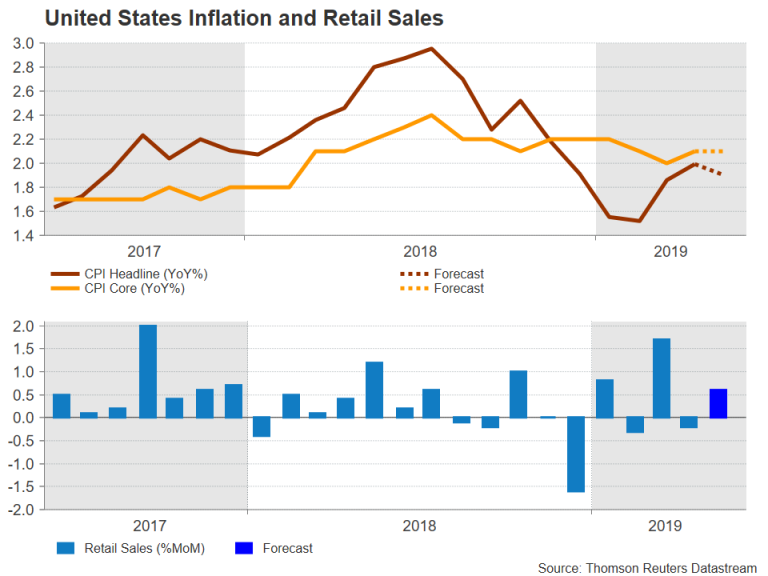
The retail sales figures will be just as, if not more important. Consumption accounts for just under 70% of the US economy so any slowdown in retail spending would point to weaker growth. Retail sales were down by 0.2% m/m in April but are forecast to have rebounded by 0.6% in May. Core retail sales that exclude auto and gasoline sales are predicted to have accelerated from 0.1% to 0.4% m/m. Crucially, the ‘retail control group' measure, which is used in GDP calculations and excludes autos, gasoline, building materials and food services, is also seen to have bounced back in May by 0.4% m/m.
Dollar may wait for Fed meeting for direction
With the dollar being on the backfoot since the latest eruption in trade tensions, the US currency is looking slightly oversold and could be prone to an upside correction if the data come in at or above estimates. Dollar/yen could overcome resistance at the 50% Fibonacci retracement of the upleg from 104.96 to 112.39, at 108.68, opening the way for the 38.2% Fibonacci at 109.55.
However, the US currency is just as vulnerable to a steep sell-off if this week's releases add to worries about the economic outlook. Dollar/yen faces an important support at the 61.8% Fibonacci at 107.80. If broken, the bears could pull the pair to as low as 106.55 – the 78.6% Fibonacci level.

A note of caution is likely, though, as the forthcoming data may not provide a clear enough direction for traders, and with the next Fed policy meeting a week away on June 18-19, some investors may choose to sit on the sidelines until then. The Fed will update its economic forecasts as well as its famous dot-plot chart at its June meeting, with the big question being on whether or not policymakers will foresee a rate cut in their projections.
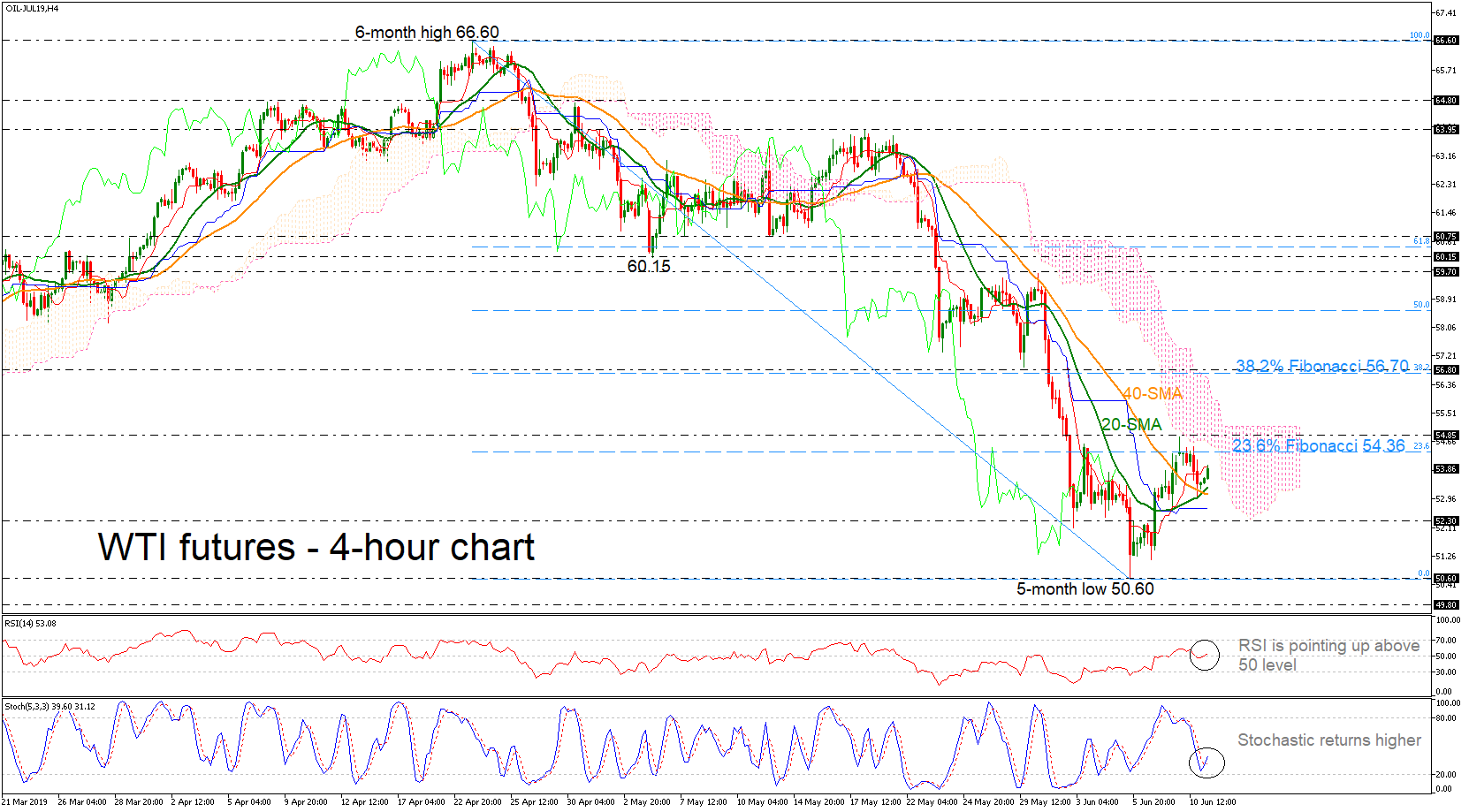
WTI Futures Lack Clear Direction In Short-Term, Medium-Term Downtrend Intact
WTI crude oil futures are rising above the bullish cross within the 20- and 40-simple moving averages (SMAs) but are still hovering below the Ichimoku cloud in the 4-hour chart. The downside momentum appears to have run out of steam as the stochastic oscillator is returning higher while the RSI is trying to gain ground above the neutral threshold of 50.
Should oil prices manage to strengthen the slightly bullish retracement the next resistance could come around the 23.6% Fibonacci mark of the dowleg from 66.60 to 50.60 near 54.36. A break above this region would open the way towards the 54.85 region and above this level the 38.2% Fibonacci of 56.70 could attract traders’ attention.
On the other hand, if prices tumble below the bullish cross of the moving averages, they could find immediate support at the 52.30 hurdle. A potential downside violation could increase negative pressure until the five-month low of 50.60.
In the near-term, the bias turned marginally positive since prices hold above all the moving average lines. However, traders should be waiting for a jump above 54.85 for positive orders, or a drop below 50.60 for more downside movement.
Escalation Of The Trade Conflict Continues. The US Dollar Is Still Under Pressure
During yesterday's trading session, the US dollar strengthened slightly against a basket of major currencies. The American currency was supported by the decision of US President Donald Trump not to impose duties on Mexican goods. However, the US dollar is still under pressure due to rising expectations of lowering the interest rates by the Fed at upcoming meetings. The trade conflict between Washington and Beijing is in the spotlight. Yesterday, US President announced that he would increase tariffs on $300 billion worth of Chinese goods if his talks with President of the People's Republic of China Xi Jinping did not take place in the upcoming G20 summit in Japan. The US dollar index closed yesterday in the positive zone (+0.23%).
The British pound has been declining after the publication of weak economic releases from the UK. GDP (m/m) fell by 0.4%, although experts expected a decline by only 0.1%. The manufacturing output (m/m) fell by 3.9% in April instead of the forecasted decline by 1.1%. Today we expect important statistics from the US and the UK.
The "black gold" prices have been growing after the fall the day before. Currently, futures for the WTI crude oil are testing $53.60 per barrel.
Market Indicators
- Yesterday, bullish sentiment was observed in the US stock market: #SPY (+0.46%), #DIA (+0.28%), #QQQ (+1.17%).
- The 10-year US government bonds yield rose slightly. Currently, the indicator is at the level of 2.15-2.16%.
The news feed on 2019.06.11:
- Data on the UK labor market at 11:30 (GMT+3:00);
- Producer price index in the US at 15:30 (GMT+3:00).
UK Wage Data Beats Expectations
Notes/Observations
- Markets watching for further developments in the U.S.-China trade war after President Trump threatened to raise tariffs
- UK wage data beats expectations
Asia:
- China PBOC to sell bills in Hong Kong later in June in order to improve yuan bond yield curve in Hong Kong, no amount given
- China said to have issued notice related to local government special bonds issuance and project financing; to encourage financial firms and individuals to invest in local gov't bonds. To allow local governments to use the proceeds from special bonds as capital for qualified major projects.
Europe/Mideast:
- BOE's Saunders stated that interest rates might need to rise faster than curve implied; BOE did not need to wait for Brexit resolution to act. BOE would likely need to return to neutral policy stance sooner than markets expected
- Italy PM Conte and the heads of the ruling parties (Salvini and Di Maio) reiterated stance to seek to avert a disciplinary action from the EU against Italy
- Italy Dep PM Salvini (League): stated that meeting with PM went 'well' . Reiterated stance that coalition govt wanted to avert EU disciplinary action and reiterated stance of ruling out deficit cutting measures and tax increases.
SPEAKERS/FIXED INCOME/FX/COMMODITIES/ERRATUM
Equities
- Indices [Stoxx600 +0.70% at 380.90, FTSE % at #, DAX +1.13% at 12,181.74, CAC-40 +0.50% at 5,409.63, IBEX-35 +0.11% at 9,303.86, FTSE MIB +0.63% at 20,613.50, SMI +0.82% at 9,829.50, S&P 500 Futures +0.32%]
- Market Focal Points/Key Themes: European Indices trade higher once again continuing the recent positive momentum on trade optimism, with export names, particularly in Germany outperforming as it plays catch up following closure for Whit Monday. Asian Indices continued the recent positive tone, while US Index futures also are higher this morning. On the corporate front, shares of Systemair trades sharply higher on a strong rise in profits, with NCC Group, Oxford Instruments, Halma and Crest Nicholson among other names rising on earnings and updates. Meanwhile Ted Baker declines over 25% after a profit warning after an extremely difficult start to the year, with Quiz, Carclo and Trifast among other names declining on earnings. In other news Evotec gains following a partnership with the Bill & Melinda Gates foundation; Saga rises sharply after announces a partnership with Marcus by GS, while AMG Advanced Metallurgical gains as the company explore the IPO of its technology segment. Looking ahead notable earners include H&R block, Chico Fas and HD Supply holding.
Equities
- Consumer discretionary: Ted Baker [TED.UK] -25% (profit warning), QUIZ [QUIZ.UK] -30% (earnings)
- Financials: Commerzbank [CBK.DE] +2% (ING reportedly drops its interest), Crest Nicholson [CRST.UK] +1.5% (earnings)
- Healthcare: Evotec [EVT.DE] +3.5% (partnership)
- Industrials: Halma [HLMA.UK] +2% (earnings), Systemair [SYSR.SE] +10% (earnings)
- Technology: Taptica [TAP.UK] -20% (legal filing), Saga PLC [SAGA.UK] +7.5% (partnership), NCC Group [NCC.UK] +8% (trading update), Atari [ATA.FR] +10% (partnerships)
- Materials: AMG Advanced Metallurgical [AMG.NL] +4.5% (exploring unit IPO)
Speakers
- ECB's Rehn (Finland) stated that low inflation expectations to hamper achievement of price stability. Reiterated Council stance that ECB was ready to act in case of further weakening of economic activity. ECB could strengthen its forward guidance, cut rates or introduce mitigating measures from negative rates and relaunch QE if necessary. Lastly he added that US-China trade war would unlikely to subside anytime soon
- BOE's Saunders reiterated MPC view that could see more rate hikes if Brexit was smooth. Reiterated view that markets might be underestimating the pace of rate hikes
- BOE's Vlieghe stated that wage growth pick had been very slow. Would have expected economic improvement already if it was not for trade and Brexit uncertainties
- Czech Central Bank Gov Rusnok stated that he saw no change of trend with May CPI acceleration, higher reading attributed to volatile factors
- Japan Govt issued its Mid-year policy guidelines which expected BOJ to promote monetary easing to achieve 2% price target asap. To implement flexible macroeconomic policy if risks to economy materialized. To raise sales tax to 10% in October (as planned) to support social security for all generations
- Japan Econ Min Motegi reiterated domestic recovery was continuing as fundamentals were solid. Confirmed that US-Japan trade talks would be conducted this week as he would meet with USTR's Lighthizer on Thursday, Jun 13th in Washington
- China Foreign Ministry spokesperson Geng Shuang reiterated if US insisted on escalating trade tension than China would respond with firm resolve. Reiterates stance that China did not want a trade war with U.S. but was not afraid of one. Stressed that dialogue was welcomed to move forward.
Currencies/Fixed Income
- GBP/USD was firmer in the session after UK wage data beat expectations. The data reinforced some BOE members view that markets might be underestimating the pace of rate hikes if the Brexit process was smooth. GBP/USD higher by 0.3 at 1.2720 just ahead of the NY morning.
- EUR/USD was steady at 1.1315 and currently capped by some ECB speak that ECB seemed determined to act in case of a further weakening of economic activity and lingering concerns about low inflation expectations in the region.
Economic Data
- (NO) Norway May CPI M/M: -0.3% v +0.1%e; Y/Y: 2.5% v 2.9%e
- (NO) Norway May CPI Underlying M/M: -0.2% v +0.1%e; Y/Y: 2.3% v 2.6%e
- (NO) Norway May PPI (including Oil) M/M: -1.0% v +0.7% prior; Y/Y: 0.4% v 2.6% prior
- (DK) Denmark May CPI M/M: -0.1% v +0.2%e; Y/Y: 0.7% v 1.0%e
- (DK) Denmark May CPI EU Harmonized M/M: 0.0% v 0.3% prior; Y/Y: 0.7% v 0.9% prior
- (JP) Japan May Preliminary Machine Tool Orders Y/Y: -27.3% v -33.4% prior
- (FR) Bank of France May Industrial (Business) Sentiment: 99 v 100e
- (CZ) Czech May CPI M/M: 0.7% v 0.4%e; Y/Y: 2.9% v 2.7%e
- (CZ) Czech Apr Export Price Index Y/Y: 3.1% v 2.6% prior; Import Price Index Y/Y: 3.4% v 2.8% prior
- (MA) Malaysia end-May Foreign Reserves: $102.3B v $102.8B prior
- (NO) Norway May Region Output Survey past 3-months): 1.51 v 1.40e; Output Survey (next 6-months): 1.57 v 1.42e
- (CH) Swiss Weekly Total Sight Deposits (CHF): 578.1B v 578.2B prior; Domestic Sight Deposits: 469.1B v 474.3B prior
- (UK) May Jobless Claims Change: +22.2K v +19.1K prior; Claimant Count Rate: 3.1% v 3.0% prior
- (UK) Apr Average Weekly Earnings 3M/Y: 3.1% v 3.0%e; Weekly Earnings (ex Bonus) 3M/Y: 3.4% v 3.2%e
- 04:30 (UK) Apr ILO Unemployment Rate: 3.8% v 3.8%e; Employment Change 3M/3M: +32K v+4Ke
- (EU) Euro Zone Jun Sentix Investor Confidence: -3.3 v +2.5e
- (US) May NFIB Small Business Optimism Index: 105.0 v 102.0e
Fixed Income Issuance
- (ID) Indonesia to sell EUR-denominated 7-year note; guidance seen +175bps to mid-swaps
- (ES) Spain Debt Agency (Tesoro) sold €5.035B vs. €4.5-5.5B indicated range in 6-month and 12-month Bills
Looking Ahead
- 05:30 (UK) Weekly John Lewis LFL Sales data
- 05:30 (EU) ECB allotment in 7-Day Main Refinancing Tender (MRO)
- 05:30 (HU) Hungary Debt Agency (AKK) to sell in 3-month Bills
- 05:30 (BE) Belgium Debt Agency (BDA) to sell €1.4-1.8B in 3-month and 12-month bills
- 06:00 (TR) Turkey to sell Bonds
- 06:45 (US) Daily Libor Fixing
- 07:00 (ZA) South Africa Apr Manufacturing Production M/M: 0.4%e v 0.8% prior; Y/Y: 1.3%e v 1.2% prior
- 07:00 (BR) Brazil Jun IGP-M Inflation (1st Preview): No est v 0.6% prior
- 07:00 (CZ) Czech Central Bank to comment on CPI data
- 07:45 (US) Weekly Chain Stores Sales data
- 08:00 (UK) Daily Baltic Dry Bulk Index
- 08:00 (RU) Russia announces upcoming OFZ Bond issuance
- 08:30 (US) May PPI Final Demand M/M: 0.1%e v 0.2% prior; Y/Y: 2.0%e v 2.2% prior
- 08:30 (US) May PPI Ex Food and Energy M/M: 0.2%e v 0.1% prior; Y/Y: 2.3%e v 2.4% prior
- 08:30 (US) May PPI Ex Food, Energy, Trade M/M: 0.2%e v 0.4% prior; Y/Y: No est v 2.2% prior
- 08:30 (CL) Chile Central Bank Economists Survey
- 08:55 (US) Weekly Redbook LFL Sales data
- 09:00 (RU) Russia Apr Trade Balance: $15.8Be v $15.5B prior; Exports: $37.0Be v $36.5B prior; ; Imports: $21.6Be v $21.0B prior
- 09:00 (MX) Mexico Apr Industrial Production M/M: +0.5%e v -1.3% prior; Y/Y: -2.4%e v -0.1% prior; Manufacturing Production Y/Y: 0.4%e v 2.8% prior
- 10:00 (MX) Mexico Weekly International Reserve data
- 10:30 (CA) Canada to sell 3-month, 6-month and 12-month Bills
- 13:00 (US) Treasury to sell 3-Year Notes
- 16:30 (US0 Weekly API Oil Inventories
AUD/USD Outlook: Aussie Consolidates After Strong Fall, Monday’s Bearish Engulfing Weighs
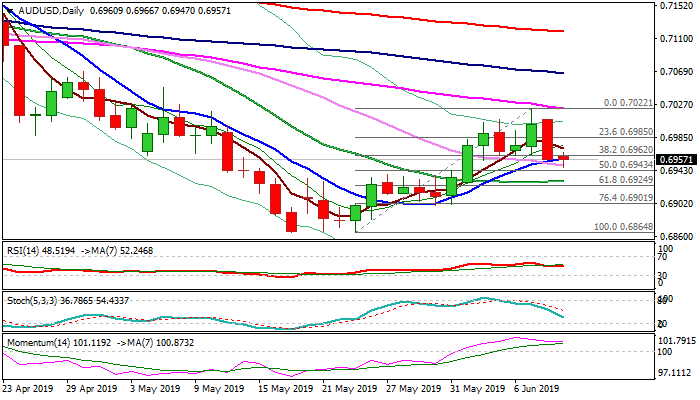
The Australian dollar probes through 30SMA support (0.6949) on Tuesday, in extension of 0.71% fall previous day and pressure 0.6943 (50% retracement of 0.6864/0.7022).
Monday's bearish outside day and close below pivotal Fibo support at 0.6962 (38.2% of 0.6764/0.7022) was negative signal, helped by weaker momentum and falling stochastic on daily chart.
Mixed Australian data overnight had no impact on the price, driven lower by stronger dollar and weaker techs.
Sustained break below 0.6949/43 supports would open way for test of pivotal points at 0.6930 (20SMA) and 0.6924 (Fibo 61.8%) break of which is needed to confirm reversal and lower top at 0.7022 (7 June high).
Fresh bears may stay on hold if the price returns and closes above 10SMA (0.6958) but there will be long way towards upper pivot at 0.7022 (falling 55SMA) as Monday's long bearish daily candle weighs.
Res: 0.6966, 0.6985, 0.7000, 0.7022
Sup: 0.6943, 0.6930, 0.6924, 0.6900