Sample Category Title
USDCAD Bulls Face Big Challenge Around 4-Month High
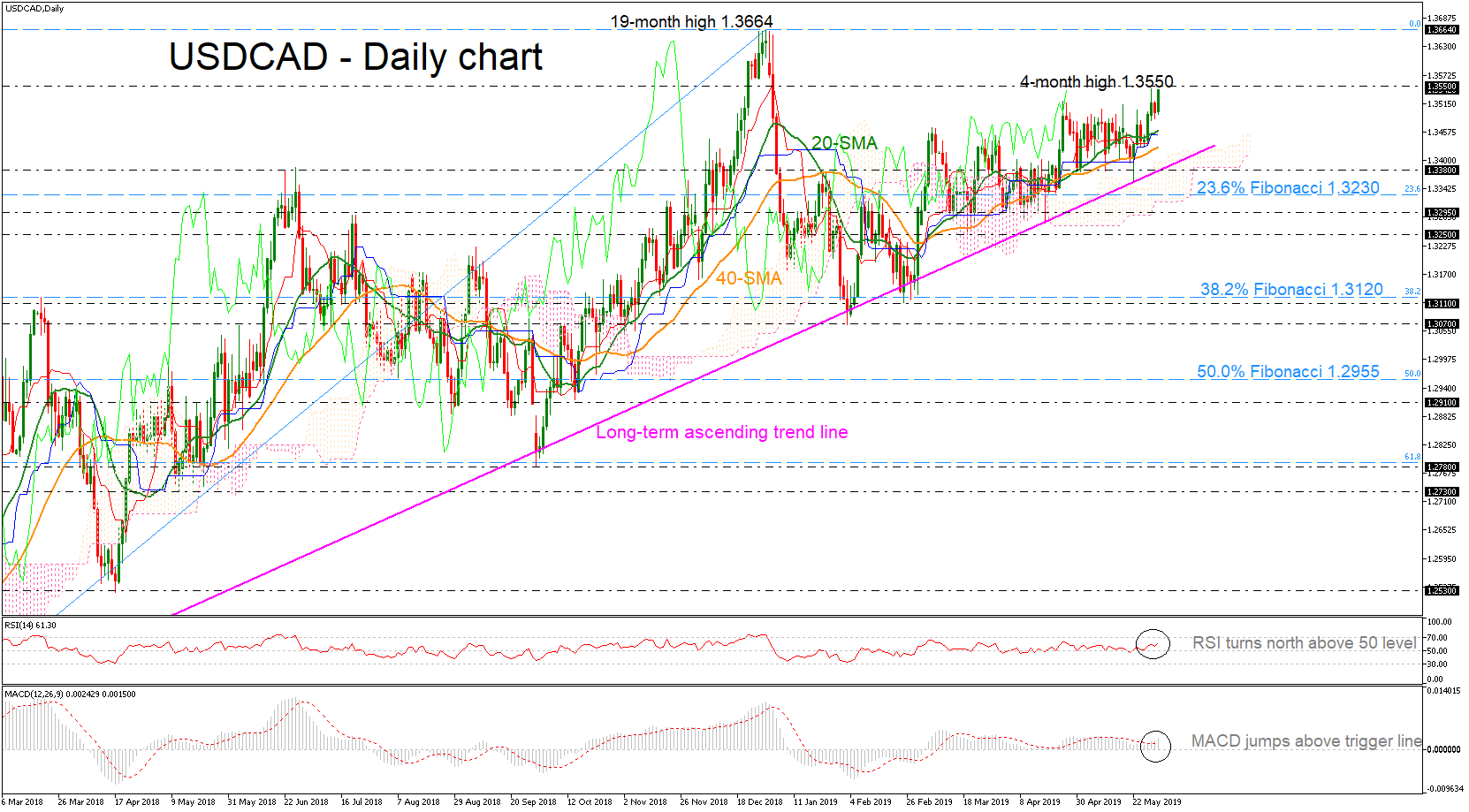
USDCAD is trading not too far from Wednesday’s new four-month high of 1.3550, following the rebound on the long-term ascending trend line in the daily timeframe.
The momentum indicators suggest that there is still some advance for the pair. The RSI indicator is sloping upwards in the positive territory, while the MACD surpassed the trigger line and is rising above the zero line. Price action at the moment is above the Ichimoku cloud so the risks are to the upside.
Should the pair make another rally higher and jumps above the four-month high, it would open the way for the 19-month high of 1.3664 registered on December 31. Steeper increases could drive the bulls towards the 1.3790 resistance, taken from the peaks on April 2017.
If the upward momentum fails to hold and prices return lower, the 20-day simple moving average (SMA) currently at 1.3460 is the nearest support for the bears. A leg below this hurdle could send the pair to a more important support of the 40-SMA and upper surface of the Ichimoku cloud near 1.3430. If breached, the focus would shift to the 1.3380 support and the uptrend line.
In all timeframes, USDCAD maintains a bullish profile and traders could turn their attention towards the 19-month high (1.3664) if there is daily close above the four-month high (1.3550).
EUR/USD Daily Outlook
Daily Pivots: (S1) 1.1116; (P) 1.1131; (R1) 1.1145; More.....
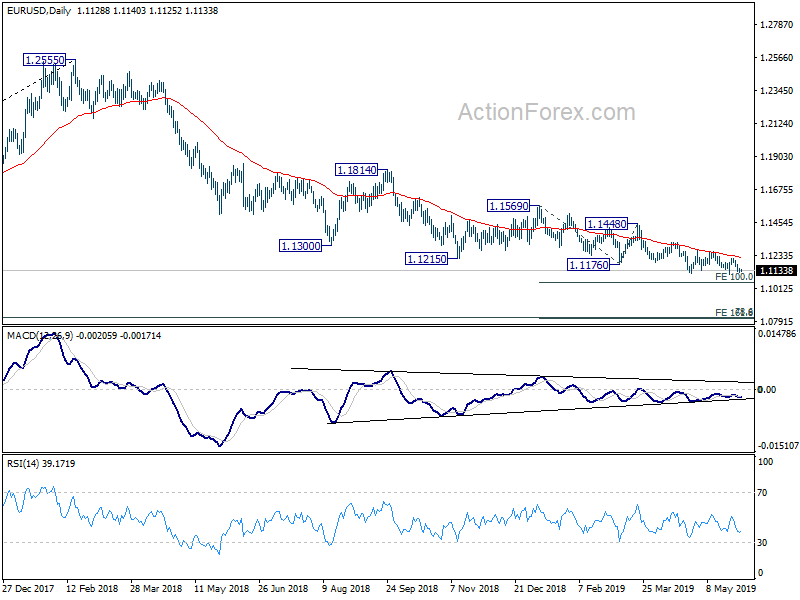
Intraday bias in EUR/USD remains neutral as it's staying in range above 1.1107/1111 support zone. Consolidation from 1.1111 could extend further. In case of another rise, upside should be limited by 1.1263 resistance to bring down trend resumption. On the downside, firm break of 1.1107 will target 100% projection of 1.1448 to 1.1183 from 1.1324 at 1.1059. However, sustained break of 1.1263 resistance will now be an early sign of trend reversal and turn bias to the upside for 1.1448 key resistance.
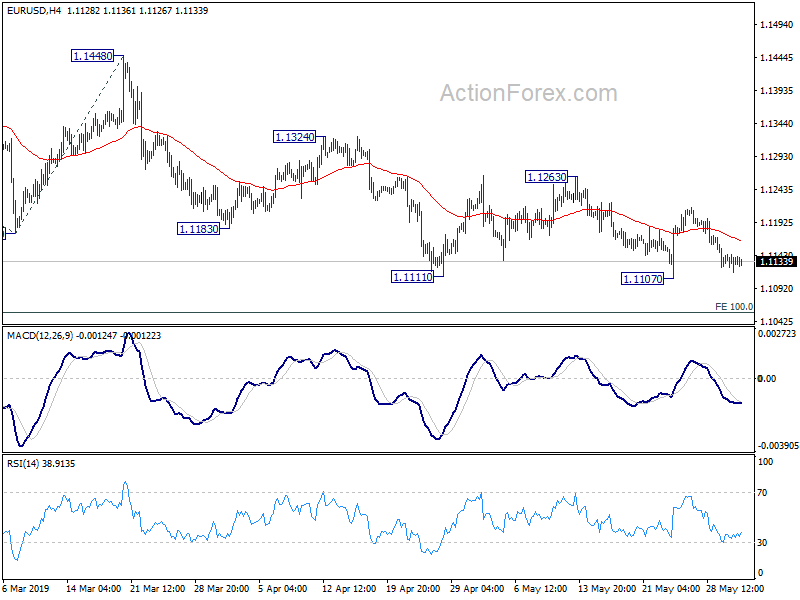
In the bigger picture, down trend from 1.2555 (2018 high) is still in progress. Such decline would target 78.6% retracement of 1.0339 (2016 low) to 1.2555 (2018 high) at 1.0813 next. Sustained break there will pave the way to retest 1.0339. On the upside, break of 1.1448 resistance is needed to be the first sign of medium term bottoming. Otherwise, outlook will stay bearish in case of rebound.
GBP/USD Daily Outlook
Daily Pivots: (S1) 1.2580; (P) 1.2610; (R1) 1.2640; More....
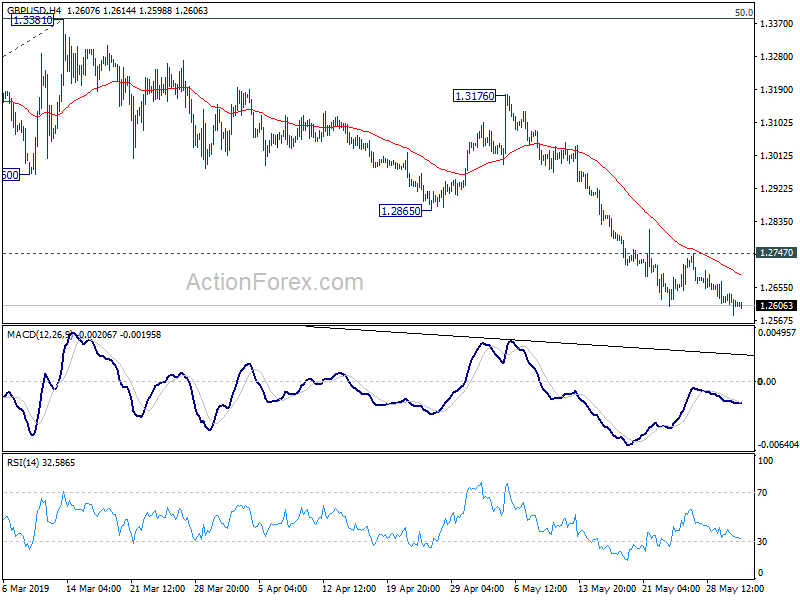
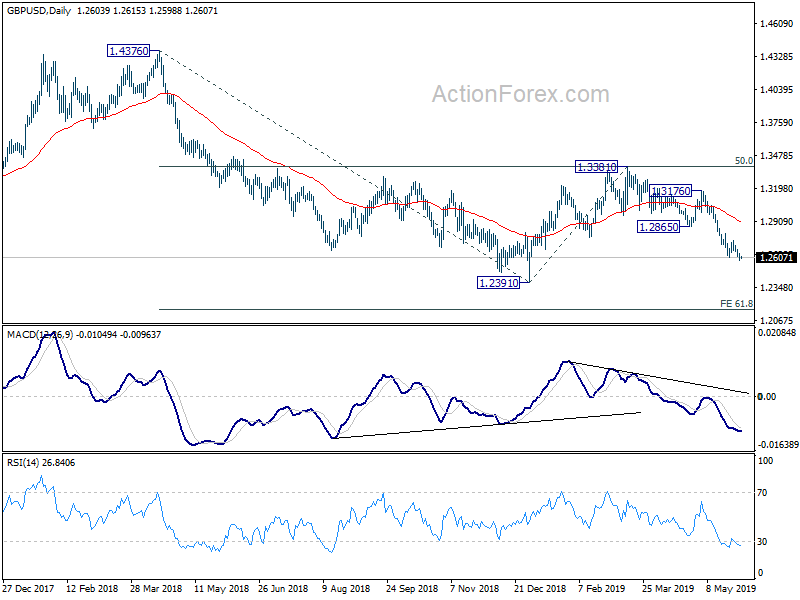
Intraday bias in GBP/USD remains mildly on the downside at this point. Current fall from 1.3381 should target 1.2391 low first. Firm break there will resume larger down trend to 61.8% projection of 1.4376 to 1.2391 from 1.3381 at 1.2154 next. On the upside, break of 1.2747 resistance is needed to indicate short term bottoming. Otherwise, outlook will remain bearish in case of recovery.
In the bigger picture, current development suggests that medium term decline from 1.4376 (2018 high) is not completed, and is possibly ready to resume. Decisive break of 1.2391 would target a test on 1.1946 long term bottom (2016 low). For now, we don't expect a firm break there yet. Hence focus will be on bottoming signal as it approaches 1.1946. In any case, medium term outlook will stay bearish as long as 1.3381 resistance holds, in case of strong rebound.
USD/CHF Daily Outlook
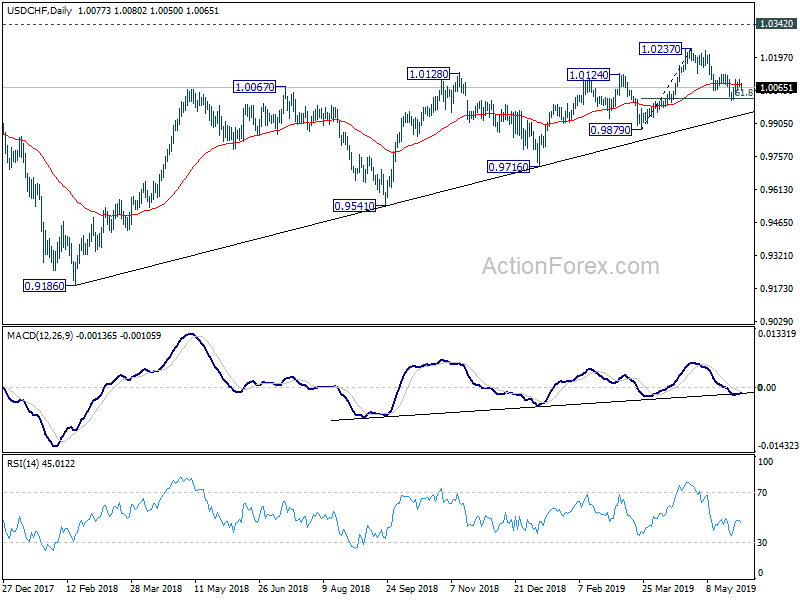
Daily Pivots: (S1) 1.0066; (P) 1.0082; (R1) 1.0096; More...
No change in USD/CHF's outlook as it's bounded in range of 1.0008/0119. Intraday bias remains neutral first. On the upside, decisive break of 1.0119 resistance will suggest that decline from 1.0237 is merely a correction and has completed. Intraday bias will be turned back to the upside for retesting 1.0237. That will also retain medium term bullishness in the pair. On the downside, however, firm break of 1.0008 should pave the way to retest 0.9879 key support next.
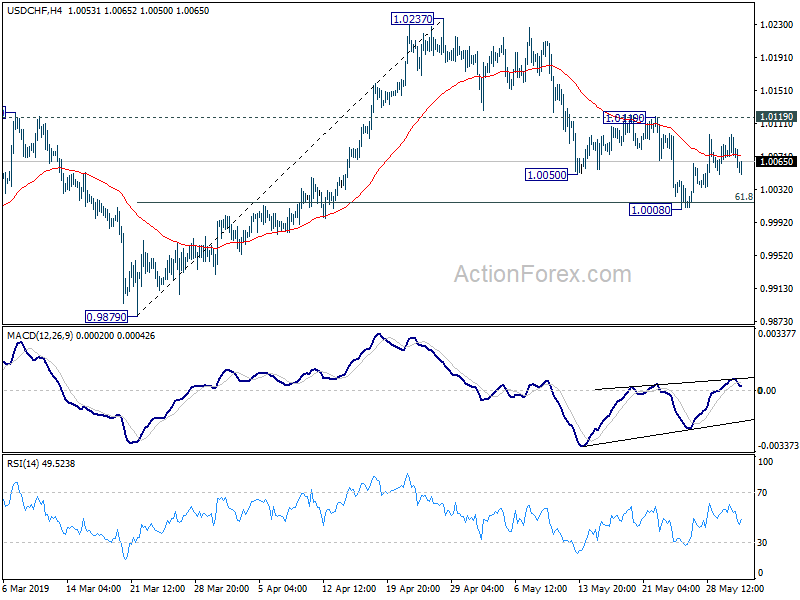
In the bigger picture, USD/CHF is losing upside momentum ahead of 1.0342 key resistance (2016 high). There is no clear sign of reversal yet. But even in case of another rise, we'd be cautious on strong resistance from 1.0342 to limit upside. On the downside, break of 0.9879 support will suggest that larger rise from 0.9186 (2018 low) has completed. Deeper fall will be seen to 0.9716 support for confirmation.
USD/JPY Daily Outlook
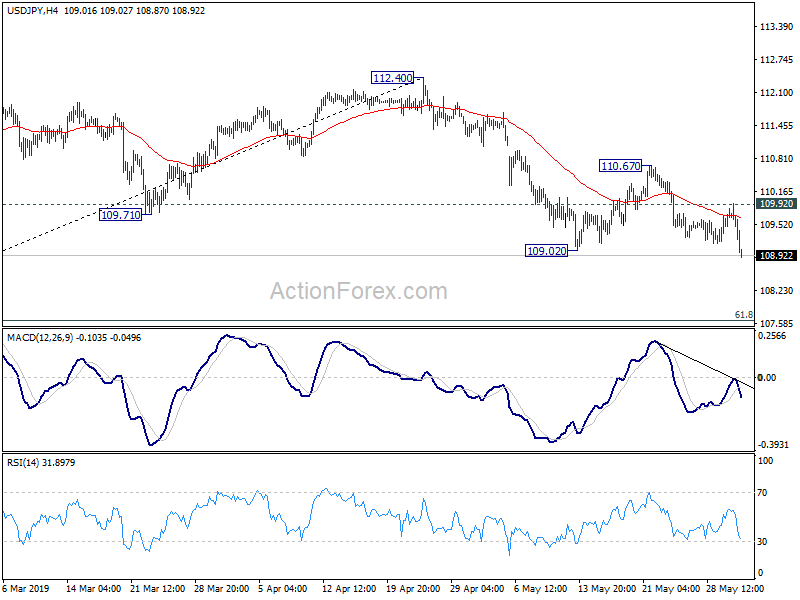
Daily Pivots: (S1) 109.42; (P) 109.68; (R1) 109.88; More...
USD/JPY drops to as low as 108.87 so far today. Break of 109.02 support indicates resumption of fall from 112.40. Intraday bias is back on the downside for 61.8% retracement of 104.69 to 112.40 at 107.63 next. Sustained trading below 107.63 will pave the way to retest 104.69 low. On the upside, break of 109.92 resistance is needed to indicate short term bottoming. Otherwise, outlook will remain bearish in case of recovery.
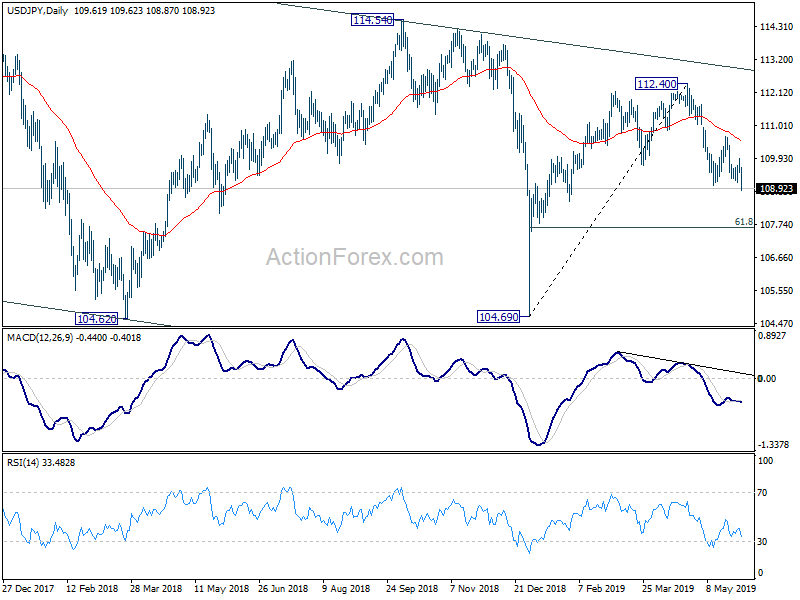
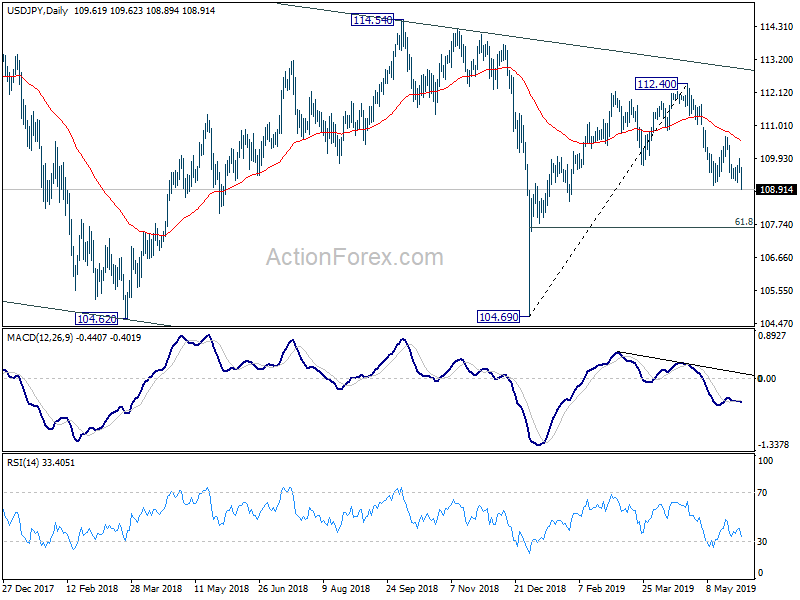
In the bigger picture, USD/JPY is staying inside falling channel from 118.65. Current development suggests that rebound from 104.69 is only a corrective move. And fall from 118.65 is not completed yet. Decisive break of 104.69 will extend the down trend towards 98.97 support (2016 low). For now, we'd expect strong support above there to bring rebound.
Yen Jumps as Trump Uses His Only Trick of Tariffs on Mexico
Risk aversion intensifies again today as Trump uses his one old tricky in tariffs again, but turned to Mexico. 5% tariffs will be imposed on all Mexican imports on June 10, and "gradually" move up to 25% in less than 4 months time if Mexico doesn't help on border security "crisis" of the US. The announce came as German Chancellor Angela Merkel urged Harvard graduates to "tear down walls of ignorance and narrow-mindedness, for nothing has to stay as it is." in a speech. And she called for "truthfulness in our attitude toward others" which "requires us not to describe lies as truth and truth as lies".
Yen surges broadly today, together with Swiss Franc, and that in turn reinforced the selloff in Nikkei. Canadian Dollar is the weakest one for today, partly dragged down by renewed selloff in WTI crude oil. Though, Australian and New Zealand Dollar has been rather firm this week despite trade war threats. Dollar is the second weakest for today so far. There are increasing talks of so called "insurance cut" by Fed. But such speculation will have to pass the test of today's PCE inflation data first.
Technically, USD/JPY has finally broken 109.02 support and fall from 112.40 is resuming for 107.63 fibonacci level. EUR/JPY and GBP/JPY are extending near term decline too, targeting 118.62 and 131.51 respectively. After some brief retreat, USD/CAD's rally resumes today and is on track to 1.3664 resistance. EUR/USD, USD/CHF and AUD/USD are stuck in range as breakout awaited.
In Asia, Nikkei closed down -341.34 pts or -1.63%. Hong Kong HSI is down -0.42%. China Shanghai SSE is down -0.20%. Singapore Strait Times is down -0.78%. Japan 10-year yield is down -0.016 at -0.097. Overnight, DOW closed up 0.17%. S&P 500 rose 0.21%. NASDAQ rose 0.27%. 10-year yield dropped -0.009 to 2.227. DOW future is currently down -200pts and we'd probably see DOW loses 25000 handle before month end.
Trump uses tariffs to stop illegal migrants through Mexico
The highly anticipated "big league statement" of Trump regarding border security turned out to be announcement of the same old "one-trick". In a rather shocked, he announced, by his tweets, to impose 5% tariff on all Mexican imports, "until such time as illegal migrants coming through Mexico, and into our Country, STOP." And the tariff will "gradually increase until the Illegal Immigration problem is remedied".
In the more detailed announcement by the White House, Trump said he was "invoking the authorities granted to me by the International Emergency Economic Powers Act.". Starting June 10, 5% tariff will be imposed on all goods imported from Mexico. If the "crisis persist", tariffs will be raised to 10% on July 1, then 15% on August 1, 20% on September 1, and 25% on October 1.
He further warned: "If Mexico fails to act, Tariffs will remain at the high level, and companies located in Mexico may start moving back to the United States to make their products and goods. Companies that relocate to the United States will not pay the Tariffs or be affected in any way."
Fed Clarida: Interest rate consistent with Talyor-type rule results
Fed Vice Chair Richard Clarida reiterated the view that US economy is in a "very good place". Also current interest rate lies in the range of neutral and remain appropriate. Softness in recent inflation is seen as "transitory". Though, he also outlined the conditions for a rate cut, in persistent inflation miss or deterioration in global economic financial developments.
In a speech delivered yesterday, he said "the U.S. economy is in a very good place, with the unemployment rate near a 50-year low, inflationary pressures muted, expected inflation stable, and GDP growth solid and projected to remain so."
Also, the federal funds rate is now in the range of estimates of its longer-run neutral level, and the unemployment rate is not far below many estimates of u*. And, "plugging these inputs into a 1993 Taylor-type rule produces a federal funds rate between 2.25 and 2.5 percent, which is the range for the policy rate that the FOMC has reaffirmed".
Fed's decision to leave interest rate unchanged in May "reflects our view that some of the softness in recent inflation data will prove to be transitory."
Nevertheless, Clarida also noted "if the incoming data were to show a persistent shortfall in inflation below our 2 percent objective or were it to indicate that global economic and financial developments present a material downside risk to our baseline outlook, then these are developments that the Committee would take into account in assessing the appropriate stance for monetary policy."
BoC Wilkins: Trade war is a wild card and our major preoccupation
BoC Senior Deputy Governor Carolyn Wilkins reiterated in a speech the central bank's view that " the slowdown in late 2018 and early 2019 was temporary." However, "global trade risks have increased". Thus, the current accommodation provided by BoC remains "appropriate". And upcoming rate decisions will remain data dependent, with attention to "household spending, oil markets and the global trade environment."
She described trade war as the "wild card" on global and domestic outlook. "How costly are trade wars for the global economy? In April, we said tariffs over the past two years and trade policy uncertainty would chop 0.4 per cent from global GDP by the end of 2021—that's about US$350 billion. While this can only be a rough estimate, we know it matters more for trade-dependent economies like Canada's."
Wilkins noted the positive development that US has dropped steel and aluminum tariffs recently, increasing chance of ratification of USMCA. But "other developments are discouraging", with US and China escalated their dispute and Canada "caught in the crossfire". She also noted the "potential for more friction between the United States and European Union."
She warned "if the disputes were to worsen and become long lasting, the outlook would be quite different. Not only would we see weaker economic demand, but the supply side of the economy would also take a hit as companies deal with disruptions to their supply chains. Obviously, this remains a major preoccupation for us."
Japan unemployment rate dropped, so was consumer confidence
The batch of economic data released from Japan today is mixed. Unemployment rate dropped to 2.4% in April, down from 2.5%, matched expectations. However, better employment was not reflected in retail sales nor consumer sentiment. Retail sales rose 0.5% yoy, missed expectation of 1.0% yoy. Consumer confidence dropped to 39.4, below expectation of 40.6.
Meanwhile, industrial production rose 0.6% mom in April, above expectation of 0.2% mom. However, the road ahead could be bumpy with trade war escalation in May. Housing starts dropped -5.7% yoy in April, below expectation of -0.8% yoy. Tokyo CPI core slowed to 1.1% yoy in May, down from 1.3% yoy and missed expectation of 1.2% yoy.
China PMI manufacturing dropped to 49.4, widening decline, increasing downward pressure
The official China PMI manufacturing dropped to 49.4 in May, down from 50.1 and missed expectation of 49.9. It further confirmed that March's recovery was a false dawn and the slowdown trajectory in China is ongoing. More importantly, deterioration could quick further with the current round of US-China trade war escalation. Non-manufacturing PMI was unchanged at 54.3.
Analyst Zhang Liqun noted that "the decline was widening, indicating that the downward pressure on the economy has increased." And, "foundation for economic stabilization has not yet been established." In particular, new orders index, the export order index decreased significantly, "reflecting the lack of market demand is more prominent, especially the downward pressure on exports".
Looking at some details: Production dropped -0.4 to 51.7; New order dropped -1.6 to 49.8; New Export order dropped -2.7 to 46.5; Import dropped -2.6 to 47.1; Employment dropped -0.2 to 47.0.
Elsewhere
UK Gfk consumer sentiment improved to -10 in May, up from -13 and beat expectation of -12. Australia private sector credit rose 0.2% mom in April, missed expectation of 0.3% mom. Germany retail sales dropped -2.0% mom in April, below expectation of 0.4% mom.
Looking ahead. UK will release mortgage approvals and M4. Germany will release May CPI flash. Main focus will be US personal income and spending, with PCE inflation. US will release Chicago PMI. Canada GDP will be another major focus, while IPPI and RMPI will also be featured.
USD/JPY Daily Outlook
Daily Pivots: (S1) 109.42; (P) 109.68; (R1) 109.88; More...
USD/JPY drops to as low as 108.87 so far today. Break of 109.02 support indicates resumption of fall from 112.40. Intraday bias is back on the downside for 61.8% retracement of 104.69 to 112.40 at 107.63 next. Sustained trading below 107.63 will pave the way to retest 104.69 low. On the upside, break of 109.92 resistance is needed to indicate short term bottoming. Otherwise, outlook will remain bearish in case of recovery.
In the bigger picture, USD/JPY is staying inside falling channel from 118.65. Current development suggests that rebound from 104.69 is only a corrective move. And fall from 118.65 is not completed yet. Decisive break of 104.69 will extend the down trend towards 98.97 support (2016 low). For now, we'd expect strong support above there to bring rebound.
Economic Indicators Update
| GMT | Ccy | Events | Actual | Forecast | Previous | Revised |
|---|---|---|---|---|---|---|
| 23:01 | GBP | GfK Consumer Confidence May | -10 | -12 | -13 | |
| 23:30 | JPY | Unemployment Rate Apr | 2.40% | 2.40% | 2.50% | |
| 23:30 | JPY | Tokyo CPI Core Y/Y May | 1.10% | 1.20% | 1.30% | |
| 23:50 | JPY | Industrial Production M/M Apr P | 0.60% | 0.20% | -0.60% | |
| 23:50 | JPY | Retail Trade Y/Y Apr | 0.50% | 1.00% | 1.00% | |
| 1:00 | CNY | Manufacturing PMI May | 49.4 | 49.9 | 50.1 | |
| 1:00 | CNY | Non-manufacturing PMI May | 54.3 | 54.3 | 54.3 | |
| 1:30 | AUD | Private Sector Credit M/M Apr | 0.20% | 0.30% | 0.30% | |
| 5:00 | JPY | Consumer Confidence Index May | 39.4 | 40.6 | 40.4 | |
| 5:00 | JPY | Housing Starts Y/Y Apr | -5.70% | -0.80% | 10.00% | |
| 6:00 | EUR | German Retail Sales M/M Apr | -2.00% | 0.40% | -0.20% | |
| 6:30 | CHF | Retail Sales Real Y/Y Apr | -0.80% | -0.70% | ||
| 8:30 | GBP | Mortgage Approvals Apr | 64K | 62K | ||
| 8:30 | GBP | Money Supply M4 M/M Apr | 0.40% | -0.50% | ||
| 12:00 | EUR | German CPI M/M May P | 0.30% | 1.00% | ||
| 12:00 | EUR | German CPI Y/Y May P | 1.60% | 2.00% | ||
| 12:30 | CAD | GDP M/M Mar | 0.30% | -0.10% | ||
| 12:30 | CAD | GDP Y/Y Mar | 1.20% | 1.10% | ||
| 12:30 | CAD | Industrial Product Price M/M Apr | 1.30% | |||
| 12:30 | CAD | Raw Materials Price Index M/M Apr | 2.80% | |||
| 12:30 | USD | Personal Income Apr | 0.30% | 0.10% | ||
| 12:30 | USD | Personal Spending Apr | 0.20% | 0.90% | ||
| 12:30 | USD | PCE Deflator M/M Apr | 0.30% | 0.20% | ||
| 12:30 | USD | PCE Deflator Y/Y Apr | 1.60% | 1.50% | ||
| 12:30 | USD | PCE Core M/M Apr | 0.20% | 0.00% | ||
| 12:30 | USD | PCE Core Y/Y Apr | 1.60% | 1.60% | ||
| 13:45 | USD | Chicago PMI May | 54 | 52.6 | ||
| 14:00 | USD | U. of Mich. Sentiment May F | 101 | 102.4 |
Asian Equities Trade Mixed Amid Trump Threat To Mexico
General Trend:
- Trump says to impose tariffs on all goods from Mexico from June 10th , said tariffs could gradually rise to 25% if Mexico does not address illegal immigration issue
- Mexican Peso (MXN) declines over 2% on comments by Trump
- Trump comments on Mexico weigh on automakers in South Korea and Japan
- Aussie credit growth slows ahead of next week’s RBA decision (June 4th)
- Australian Q1 government bond market turnover rises 44% q/q
- South Korea Fin Ministry said April current account deficit is possible, notes impact of stock dividend payments
- Bank of Korea (BOK) Chief reiterates not time for rate cut, one BoK member voted for rate cut
- BoJ may announce its June bond purchase schedule later today
Headlines/Economic Data
Australia/New Zealand
- ASX 200 opened -0.1%
- (AU) Australia Apr Private Sector Credit M/M 0.2% v 0.3%e; Y/Y: 3.7% v 3.8%e (5.5 year low)
- (AU) AOFM: March Australia government bond market turnover A$156.6B (highest level since July 2016). +35% m/m
- (NZ) New Zealand May Consumer Confidence: 119.3 v 123.2 prior
China/Hong Kong
- Shanghai Composite opened -0.1%, Hang Seng -0.4%
- (CN) CHINA MAY MANUFACTURING PMI (OFFICIAL): 49.4 V 49.9E (moves back below 50 into contractionary territory; lowest reading since Feb); Non-manufacturing PMI: 54.3 v 54.3e
- Huawei: Said to have repatriated US workers from base in China - FT
- (CN) China govt said to have put US soy purchases on hold - financial press
- (US) President Trump: Reiterates view that he believes China would "love" to make a trade deal; China wants to make a deal because companies are leaving the country to avoid the tariffs
- (CN) Follow Up: China has plan ready to cub rare earth sales to US if needed
- (CN) China Former PBoC Chief Dai Xianglong: Expects no major breakthrough between US and Chinese leaders at G20 meeting; China able to keep stock market above 3,000 points in the future
- (CN) China PBoC sets yuan reference rate: 6.8992 v 6.8990 prior
- (CN) China PBoC Open Market Operation (OMO): Skips OMO v CNY30B injected in 7-day reverse repos prior; Net: CNY0B v CNY30B injection prior
Japan
- Nikkei 225 opened -0.8%
- (JP) Japan Fin Min Aso: Won’t comment on Trump remark on tariffs related to imports from Mexico; no plan to talk with US Treasury Sec Mnuchin about currencies in Fukuoka
- (JP) Japan Apr Preliminary Industrial Production M/M: 0.6% v 0.2%e; Y/Y: -1.1% v -1.5%e
- (JP) Japan Apr Retail Sales M/M: 0.0% v 0.6%e; Y/Y: +0.5% v 0.9%e
- (JP) Japan May Tokyo CPI Y/Y: 1.1% v 1.20%e; CPI Ex-Fresh Food Y/Y: 1.1% v 1.20%e
- (JP) JAPAN APR JOBLESS RATE 2.4% V 2.4%E
- (JP) Japan May Consumer Confidence: 39.4 v 40.7e (lowest reading since early 2015)
Korea
- Kospi opened -0.5%
- (KR) BANK OF KOREA (BOK) LEAVES 7-DAY REPO RATE UNCHANGED AT 1.75%; AS EXPECTED
- (KR) South Korea Finance Ministry statement after gov't meeting: May post April current account deficit on stock dividend payments; expects exports to decline in May on global slowdown and chip shipments
- (KR) South Korea Apr Industrial Production M/M: 1.6% v 1.00%e ; Y/Y: -0.1% v -2.20%e
Other
- (PH) Philippines Central Bank (BSP) Chief Diokno: Has more room to ease monetary policy, sees more cuts in RRR
North America
- (US) US President Trump: US to impose 5% tariff on all goods from Mexico. Tariffs will gradually increase to 25% "until illegal immigration problem is remedied"
Levels as of 1:20 ET
- Nikkei 225, -1.4%, ASX 200 -0.1%, Hang Seng -0.3%; Shanghai Composite +0.2%%; Kospi +0.3%
- Equity Futures: S&P500 -0.8%; Nasdaq100 -0.8%, Dax -0.9%; FTSE100 -0.4%
- EUR 1.1142-1.1127 ; JPY 109.62-109.12 ; AUD 0.6919-0.6901 ;NZD 0.6517-0.6501
- Gold +0.3% at $1,290/oz; Crude Oil -0.9% at $56.06/brl; Copper +0.2% at $2.655/lb
Japan unemployment rate dropped, so was consumer confidence
The batch of economic data released from Japan today is mixed. Unemployment rate dropped to 2.4% in April, down from 2.5%, matched expectations. However, better employment was not reflected in retail sales nor consumer sentiment. Retail sales rose 0.5% yoy, missed expectation of 1.0% yoy. Consumer confidence dropped to 39.4, below expectation of 40.6.
Meanwhile, industrial production rose 0.6% mom in April, above expectation of 0.2% mom. However, the road ahead could be bumpy with trade war escalation in May. Housing starts dropped -5.7% yoy in April, below expectation of -0.8% yoy. Tokyo CPI core slowed to 1.1% yoy in May, down from 1.3% yoy and missed expectation of 1.2% yoy.
Yen is the strongest one for today so far, mainly thanks to Trump's announcement to use tariff to curb illegal immigration through Mexico. USD/JPY drops through 109.02 support finally. Fall from 112.40 is resuming for 61.8% retracement of 104.69 to 112.40 at 107.63 next.
China PMI manufacturing dropped to 49.4, widening decline, increasing downward pressure
The official China PMI manufacturing dropped to 49.4 in May, down from 50.1 and missed expectation of 49.9. It further confirmed that March's recovery was a false dawn and the slowdown trajectory in China is ongoing. More importantly, deterioration could quick further with the current round of US-China trade war escalation. Non-manufacturing PMI was unchanged at 54.3.
Analyst Zhang Liqun noted that "the decline was widening, indicating that the downward pressure on the economy has increased." And, "foundation for economic stabilization has not yet been established." In particular, new orders index, the export order index decreased significantly, "reflecting the lack of market demand is more prominent, especially the downward pressure on exports".
Looking at some details:
- Production dropped -0.4 to 51.7;
- New order dropped -1.6 to 49.8;
- New Export order dropped -2.7 to 46.5;
- Import dropped -2.6 to 47.1;
- Employment dropped -0.2 to 47.0.
Fed: Dovish Policy Signal To Pave The Way For An Upcoming Insurance Cut
Fed at an inflection point
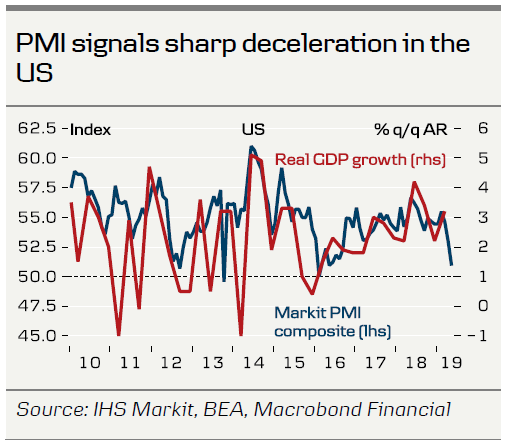
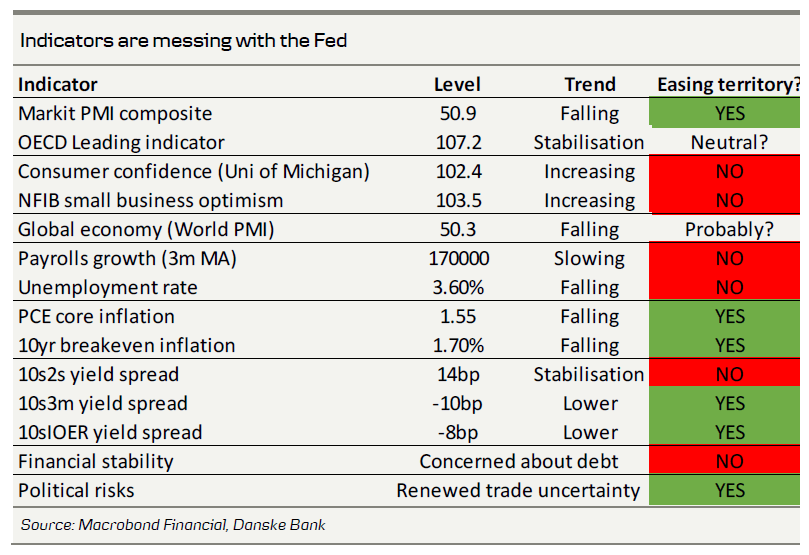
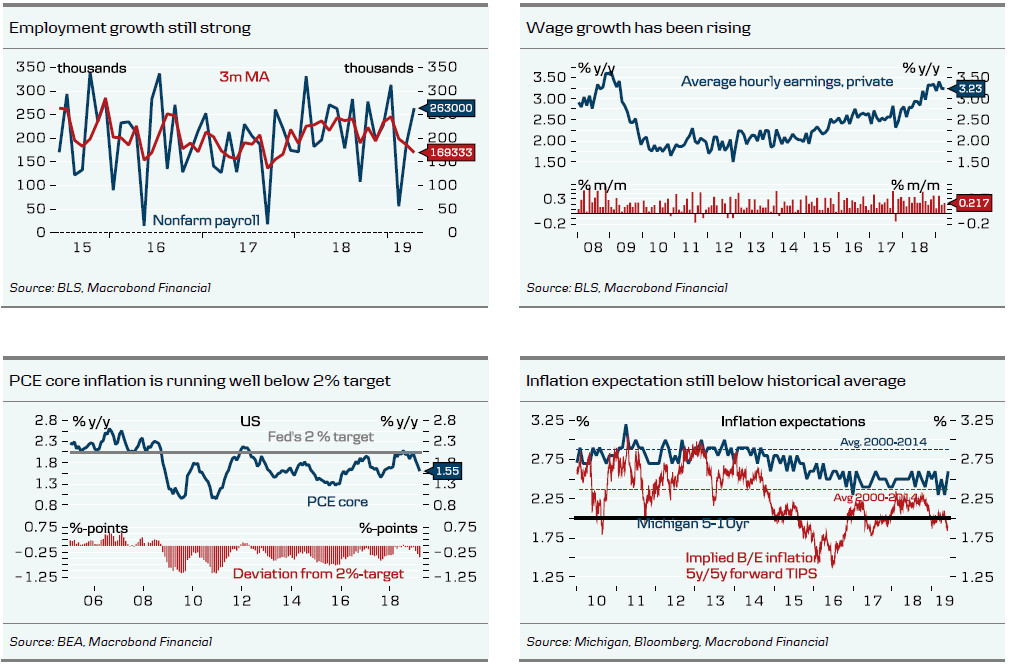
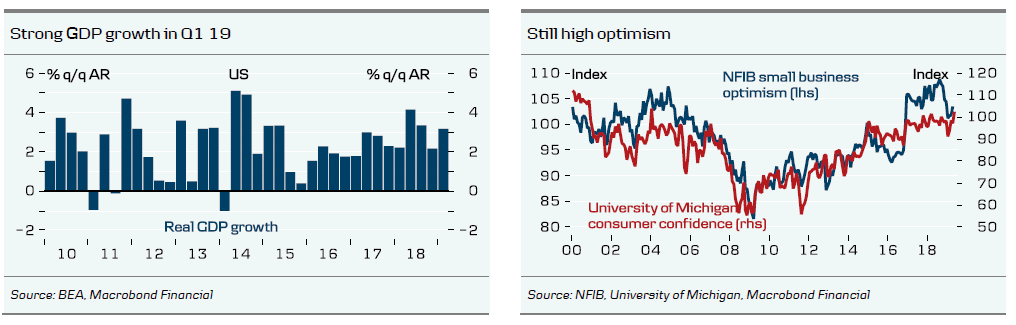
The US Markit PMIs released last week were weaker than expected. It is not a big surprise that the manufacturing sector is being hit by the manufacturing downturn globally, but we were caught by surprise by the sharp decline in the PMI service index as well . According to the PMIs, US GDP growth is currently just around 1% annualised, which is below trend, see chart to the right. Some of it may be due to transportation, which is dependent on manufacturing activity, but otherwise we are left a bit puzzled, as other indicators such as consumer confidence continue to show strength (see table page two).
Our base case for the Fed remaining on hold was that the real economy was in good shape but uncertainty has risen on the back of the weak PMIs . While the drop in Markit PMI service may just be a blip, it is one of the fastest released indicators and it will take time before we can get confirmation from other indicators.
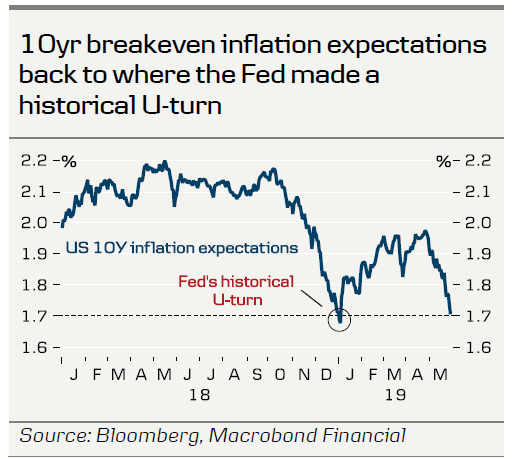
The Fed has also changed reaction function by emphasising inflation expectations more . US 10Y breakeven inflation rates have declined during the risk-off and are not far away from the levels at which the Fed u-turned in early Q1 by ending the hiking cycle. It does not seem the Fed has to worry about inflation spinning out of control if it decides to ease monetary policy at this stage, despite the expansion being the longest on record. From a risk management perspective, the case for easing strengthens by the day.
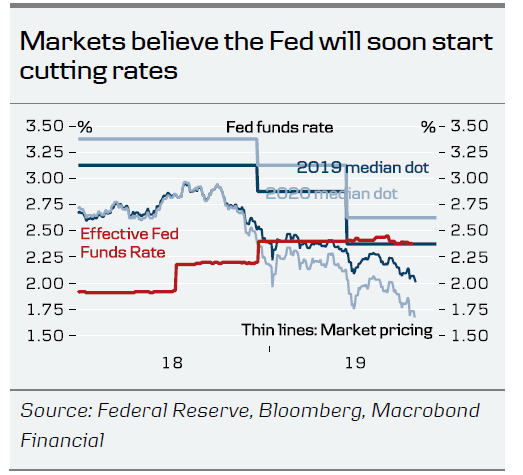
The Fed is unlikely to cut rates in June but we expect the Fed to change its current neutral signal ('no strong case for moving in either direction') to a more dovish stance highlighting risks. Fed chair Powell could make this move during the press conference and in the FOMC statement at the next meeting on 18-19 June, but yesterday Fed vice chair Clarida opened the door for a rate cut if the outlook deteriorates. Clarida also mentioned that inflation expectations are "at the low end of a range" consistent with the 2% target. If we are right about the Fed making a dovish shift in rhetoric, we believe the Fed will make a 25bp insurance cut in July or September. While it is probably too early for the Fed to make more than an insurance cut at this point, the history from previous recessions is that the Fed can quickly make a more forceful response by cutting rates to 0% again.
As we wrote in FX Strategy: Policy inaction keeping a lid on EUR/USD , 21 May, an important prerequisite for a move in EUR/USD towards our 6M and 12M forecasts of 1.15 and 1.17 is a break with recent policy inaction . That could come from the Fed if it starts to turn more dovish. Rate cuts are not necessarily required. Hints about what it would take for the dovish market pricing of three cuts before end 2020 would be sufficient in our view for the market to start reversing its short position in EUR/USD. Until that happens the market is likely to continue to pick up the carry in short EUR/USD though.
Even though the market is already pricing a rate cut, a change in the policy stance should make US treasuries rally further depending on the reaction in risk markets. Some of the latest flattening of the 2s10s curve should be reversed.