Sample Category Title
Asia Learns Its Alphabet
Asia learns its Alphabet
Data from Taiwan, Singapore and Vietnam showed a slight improvement yesterday as the region’s equity markets enjoyed a mildly positive session. Wall Street continued its march higher with the Nasdaq and S&P tiptoeing to record closes again. Even Turkey’s economic confidence indicator rebounded more than expected, showing you can’t keep a good man down. European business confidence data, of course, disappointed, signalling yet another nail in the economic coffin for the single-currency region. If I were to look for a positive, it would be at least performance in the European Union (EU) has been consistent, for all the wrong reasons.
US consumer spending rebounded, but core PCE inflation remained stubbornly anchored, printing up 1.7% versus an expected 1.8%. Still, the Federal Reserve can take some comfort in the fact that at least the US has some inflation, which remains an elusive and rare commodity in so many developed markets. The FOMC begins its two-day meeting today, and while the PCE print was a slight miss, it’s unlikely to make the Federal Reserve waiver from its wait-and-see stance.
The PCE inflation data did bring the dollar’s upward trajectory to a gentle halt against the major currencies overnight, however, this respite will likely be temporary. The markets have likely been spooked by the Alphabet – Google’s parent company – earnings report. Revenues increased, but the pace of growth fell to a mere 17%, which is less than the street expected. The rising US dollar also impacted earnings, and this may be a story we see more of later in the year. Alphabet’s shares collapsed 7% in after-market trading. Apple releases its Q1 earnings after the close tonight, and the results will take on a greater sense of urgency with straw that broke the camel’s back coming to mind.
South Korea’s business confidence and industrial production data rebounded this morning, month on month. Combined with yesterday’s regional data prints, this suggests a nascent recovery by Asia that is coat-tailing on China’s climb back off the canvas, as well as hopes of an imminent US-China trade deal. China releases Manufacturing and Non-Manufacturing PMIs at 9am Singapore, which will undoubtedly set the tone for the Asian session. Of the two, the manufacturing data will carry more weight, with the street looking for a 50.5 print. A print below 50 would set alarm bells ringing across Asia.
Japan is on holiday for the rest of the week and will be joined by China from tomorrow, along with much of the region.
FX
The US dollar weakened across the board with the euro (EUR) rising 0.3% to end just shy of 1.1200 yesterday. The sell-off against the rest of the majors was tepid at best and should be taken with a grain of salt as sentiment will likely flip-flop daily with such a heavy week of economic releases.
Assuming no surprises from China though, regional currencies could outperform today as inflation stays benign in the US and data implies that a nascent recovery is underway in Asia, ex China.
Equities
Alphabet’s missed revenue and subsequent after-hours sell-off will undo most of Wall Street’s good work overnight. China shares surged initially yesterday but then fell, closing just slightly higher at session’s end. China’s main indices seem hesitant to follow Wall Street’s lead at the moment, implying a lot of good news is built into prices at these levels.
With Alphabet weighing on regional markets, the China PMI data will we the key event today. A poor print could see a mass exodus by investors ahead of a holiday-shortened week in Asia. Conversely, a decent print could result in a very loud collective sigh of relief by regional stock markets and focus attention back onto the Federal Reserve and Apple’s results tonight.
Oil
Oil stayed out of the limelight overnight following the Trump-induced sell-off on Friday. Both major contracts have made a decent correction lower, and oil seems content to consolidate and adopt a wait-and-see attitude for now. Brent Crude closed almost unchanged at USD72.00 a barrel while WTI edged out a minor 0.60% gain, rising to USD63.70 a barrel.
Barring a surprise from China – and with so many holidays rapidly approaching in Asia – regional oil trading is expected to be quiet today.
Gold
Gold continues to trade aimlessly on daily sentiment. Improved US data overnight offset a weaker dollar and saw the yellow metal fall USD5 to USD1,280.00 an ounce. Gold continues to bounce around on the nuances of other markets although, and with the Labour Day holidays in Asia upon us, it should find support on dips this morning as traders hedge risk over the next week.
Eco Data 4/30/19
[php_everywhere instance="1"]
Gold’s recovery capped at 1288, fall from 1346 still in progress
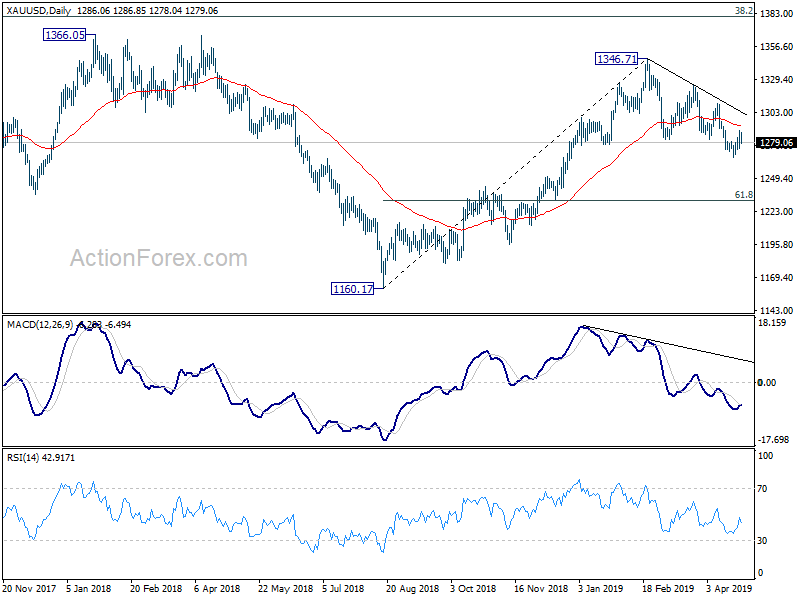
Gold recovered after hitting 1266.30 but such recovery lost steam after hitting 1288.67. The corrective structure of the recovery firstly affirm near term bearishness. That is fall from 1346.71 is still in progress. We'd expect it to resume sooner or later and break of 1266.30 will target 100% projection of 1346.71 to 1280.85 from 1324.49 at 1258.63.
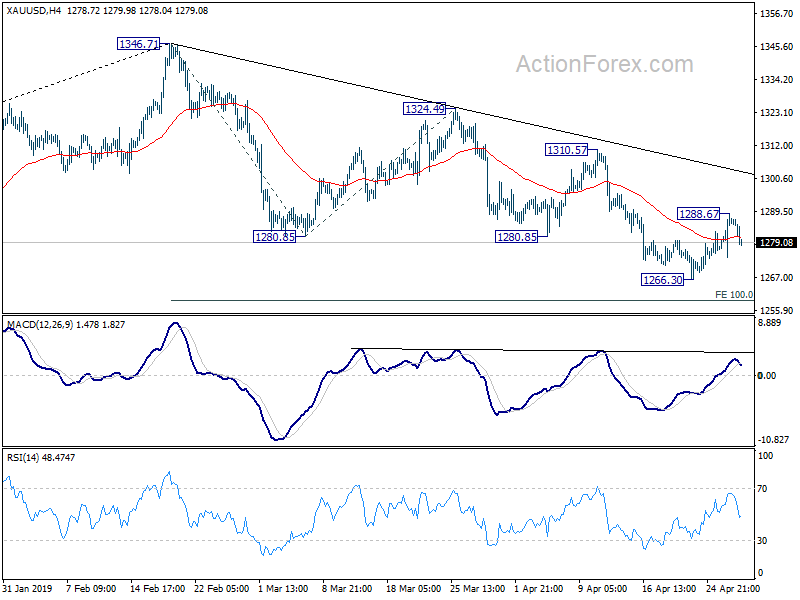
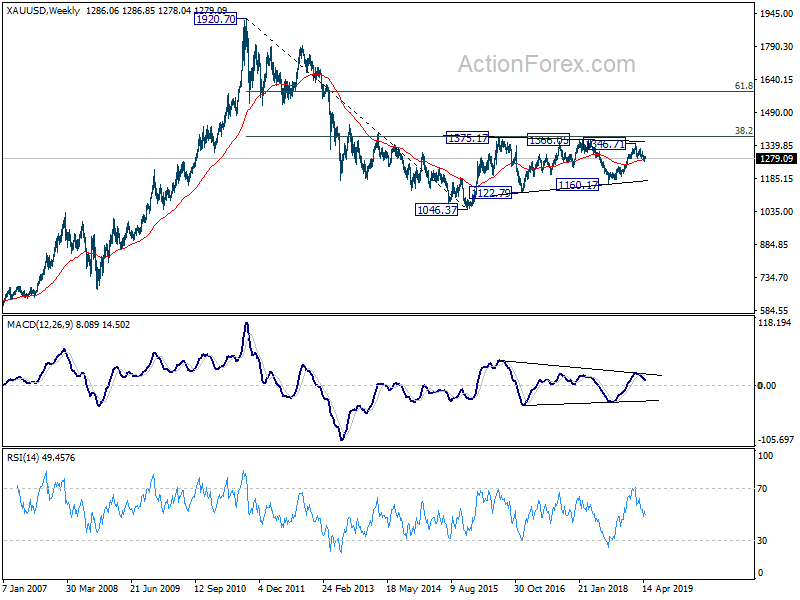
Decisive break of 1258.63 will indicate downside acceleration and solidify the case of medium term reversal. That is, rise from 1160.17 has completed at 1346.71 has completed after being rejected below key fibonacci level of 38.2% retracement of 1920.70 to 1046.37 at 1380.36 again. Further fall should be seen to 61.8% retracement of 1160.17 to 1346.17 at 1234.42 and below.
FTSE Edges Higher as US-China Trade Talks Enter Critical Phase
The FTSE index has started the week in positive territory. In the North American trade, the FTSE is trading at 7,452 up 0.32% on the day. On the release front, the U.K. releases GfK Consumer Confidence, which has been mired in negative territory. The indicator is projected to tick upwards to -12 points.
Is a U.S-China trade deal around the corner? Negotiations will continue on April 30, in Beijing, and U.S. Treasury Secretary Mnuchin waxed positive on Sunday, saying that the talks were in their “final laps”. However, Mnuchin cautioned that the talks could still end without an agreement. The nasty trade war between the two largest economies in the world has rocked the global economy and curbed growth. If the sides continue to make progress, there could be a summit between President Trump and President Xi of China. A new trade agreement between the U.S. and China would likely see investor risk appetite soar and boost equity markets.
The FTSE continues to gain ground, despite the chaos surrounding Brexit and weak construction and services PMIs. The blue-chip index soared 8.0% in the first quarter and hasn’t missed a beat in April, gaining 2.1%. Despite the turmoil surrounding Brexit and the lingering uncertainty over Britain’s imminent departure from the EU, investor confidence remains high. The British economy has generally performed well, although there are constant concerns that a no-deal Brexit could send the British economy reeling.
AUDUSD Faces Recovery Threats Though Vulnerable
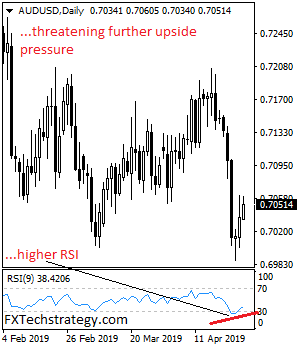
AUDUSD faces recovery threats though vulnerable medium term. On the upside, resistance lies at the 1.7100 level. A cut through here will turn attention to the 0.7150 level and then the 0.7200 level where a violation will set the stage for a retarget of the 0.7250 level. Support resides at the 0.7000 level where a breach will aim at the 0.6950 level. Below here will set the stage for a run at the 0.6900 level with a cut through here targeting further downside pressure towards the 0.6850 level. On the whole, AUDUSD faces recovery threats though vulnerable medium term.
BOE Preview: Looking Through Strong First Quarter, with Focus on Softer Inflation and Prolonged Brexit Uncertainty
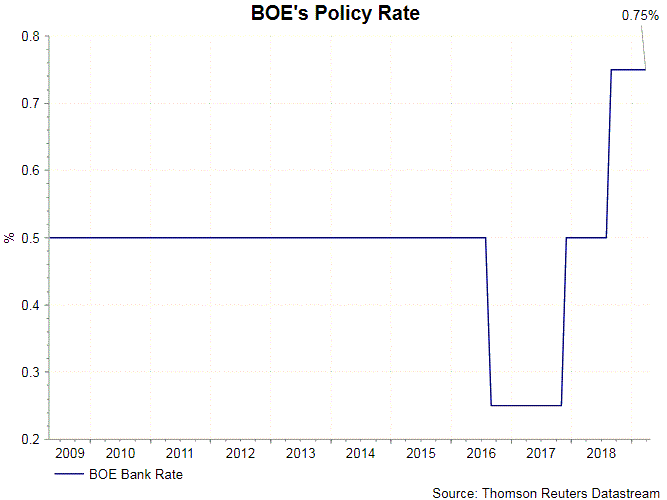
Some positive notes are seen in the first quarter, both domestically and globally. Yet, these are neither sufficient not strong enough to alter BOE’s stance in May, the first monetary policy meeting since Brexit was offered an extension until October 31. The central bank is certain to leave its Bank rate at 0.75% and the asset purchase program at 435B pound. We expect the decision would be unanimous.
Strong GDP Growth Distorted by Front-Loaded Activities
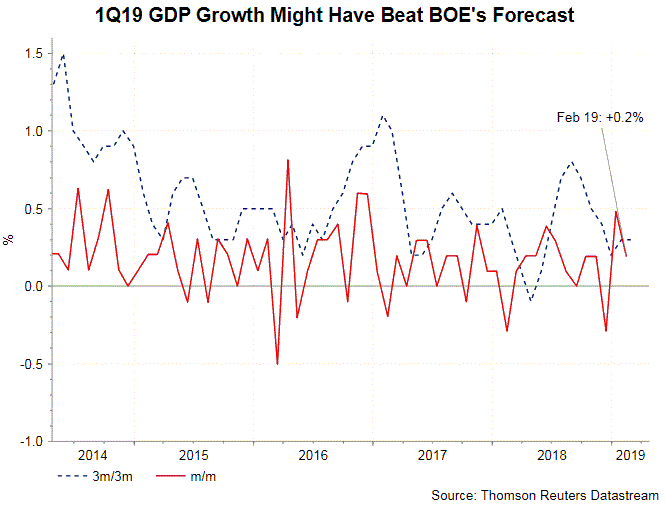
GDP growth for 1Q19 surprised to the upside. GDP rose +0.2% m/m in February, down from January’s +0.5% but beat expectation of 0.1%. Index of services rose +0.1% m/m, while index of production rose +0.6% m/m. Rolling three-month growth rate (Dec to Feb) was unchanged at +0.3%. Stronger-than-expected February data has raised the likelihood that first quarter growth could have surpassed BOE's projection of +0.3%. Note, however, that the figure should have been boosted by manufacturers "changing the timing of their activities", i.e.: stockpiling, ahead of Brexit. As such, the strength in the first quarter might be offset by second and third quarters.
Inflation Stays within Target
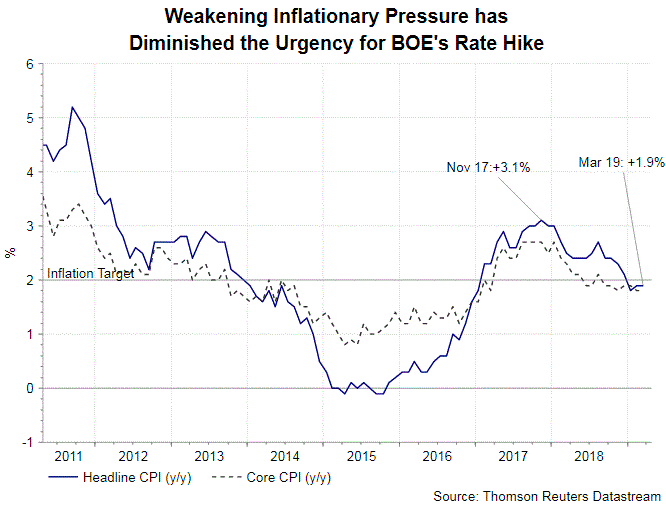
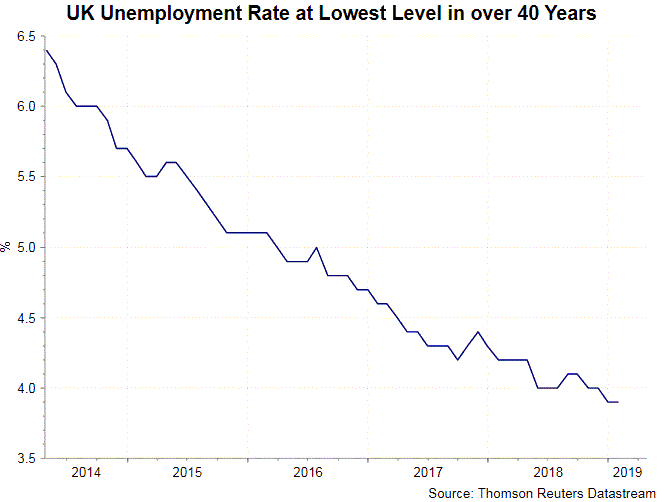
Inflation continues to hover within BOE’s target range, giving the central bank more room to stand on the sideline. Headline CPI steadied at +1.9% y/y in March. Yet, the market had anticipated a pickup to +2%. Core CPI also stayed at +1.8%, also missing expectations of +1.9%. The job market is resilient. The number of payrolls increased +179K in the three months to February. Although it has pulled back from the 222K addition in the January period and slightly missed market forecast of +180K, the unemployment rate remained at record low of 3.9%. Meanwhile, average weekly earnings growth was firm at +3.5% y/y during the period.
Brexit Uncertainty Extended
Earlier this month, European Parliament approved that Brexit would be extended further to October 31. It is possible for the UK to leave earlier should the UK Parliament approve a Withdrawal Agreement (the deal). A review of the situation would take place in June so as to check if the UK has held its part of EU parliamentary election properly. It would the first MPC meeting that the members would assess the impacts on the economic outlook of such change.
Chancellor of the Exchequer Philip Hammond noted last Friday he was optimistic that a Withdrawal Agreement would be reached eventually through cross-party talks. Yet, he cautioned about the negative impact a of no-deal Brexit. As he suggested, no-deal Brexit would "inflict serious short term turbulence on our economy and long term damage, reducing Britain’s growth level and reducing the living standards of the British people". In our opinion, while this arrangement offers temporary relief to the market as the UK avoids leaving the EU without a deal this month, the risk of no-deal Brexit is still not eliminated. As such, extending Brexit is prolonging uncertainty. This is something that BOE should take into account.
Maintaining Gradual Rate Hike Bias
On the forward guidance, we expect BOE to reiterate the stance that the policy rate would increase "at a gradual pace, and to a limited extent” over the next couple of years. and that any decision would “not be automatic and could be in either direction”. The central bank is certain to leave its Bank rate at 0.75% and the asset purchase program at 435B pound. We expect the decision would be unanimous, although some hawks, such as Michael Saunders might give some hawkish comments at the meeting.
Sunset Market Commentary
Markets:
Core bonds lost ground today. German Bunds underperformed in European dealings despite disappointing EMU eco data. US Treasuries made a catch-up move. The downleg surprisingly started after disappointing (!) March PCE deflators which disappointed! The move is even more striking as US Treasuries rallied last Friday on exactly the same output. It’s rather stretched to point today’s weakness to stronger-than-expected personal spending (0.9% M/M) even if part of Friday’s disappointment was also related to the low contribution of consumption in the Q1 US GDP release. European stock markets an oil hovered near opening levels. We won’t draw strong conclusions from today’s session with key eco data from Washington to Beijing up for release in coming days. The German yield curve bear steepens with yields 1.4 bps (2-yr) to 3.4 bps (30-yr) higher. US yields add 1.8 bps (2-yr) to 2.3 bps (10-yr) in a daily perspective. 10-yr yield spreads changes vs Germany narrows somewhat with Spain (-4 bps) outperforming with political event risk out of the way.
The Belgian debt agency successfully raised €3bn today by tapping OLO 82 (€0.94bn 0.5% Oct2024), OLO 87 (€1.17bn 0.9% Jun2029 and OLO 88 (€0.89bn 1.7% Jun2050). The total amount sold was the upper end of the €2.5-3bn target range. The total auction bid cover was a solid 1.97. The Belgian debt agency now raised around €18bn (64%) of this year’s total OLO funding need (€28bn).
Second tier EMU and US data had only a limited impact on euro and/or USD trading. Investors are looking forward to several other key data (EMU GDP, US ISM’s, payrolls) and the Fed policy meeting later this week before engaging in directional EUR/USD position taking. End last week EUR/USD rebounded cautiously off the 1.1110/20 support area as US Q1 growth failed to convince investors. The euro gained a few ticks this morning but the move stalled soon. April EC confidence data were below consensus but with little impact on the euro. EUR/USD settled in the mid 1.11 area. US March spending and income data was mixed with March spending being strong, but income and the price deflators softer than expected. The dollar’s reaction was negligible. EUR/USD is holding below 1.1177/87 previous support, suggesting underlying euro softness. USD/JPY (111.75/80 area) remains rather well bid.
Sterling also showed little directional price action today. The conservative and labour parties are still talking to find a way out of the Brexit stalemate and to avoid that the UK has to participate in the May European elections. For now, there is no indication that a workable solution might be reached in time. The BoE will meet on Thursday, but Carney and Co will probably also keep a wait-and-see modus as Brexit uncertainty persists and as most other major central banks have put policy normalization on hold. EUR/GBP is trading marginally stronger in a daily perspective (0.8635 area). Cable gained a few tick on USD softness this morning, but dropped again to the low 1.29 area later.
News Headlines:
The broad monetary aggregate M3 grew at an annual pace of 4.5% in March vs. 4.3% in February, the ECB revealed today. A separate report showed March credit growth to households and corporations eased to 3.2% (from 3.3%) and 3.5% (from 3.8%) respectively. EC economic confidence slipped more than expected and for a tenth consecutive month to 104.0 (from 105.5) with the industrial sector leading the decline. Forward looking subseries were equally disappointing, crumbling down to the lowest since 2016.
US personal income increased (0.1% MoM) less than expected (0.4%) in March while spending (0.9% MoM) topped estimates (0.7%). The PCE deflator, the most watched inflation gauge by the Fed, accelerated (0.2% MoM, 1.5% YoY) but less than anticipated (0.3% MoM, 1.6% YoY). Core PCE stalled in March.
EUR/USD Mid-Day Outlook
Daily Pivots: (S1) 1.1113; (P) 1.1144; (R1) 1.1175; More.....
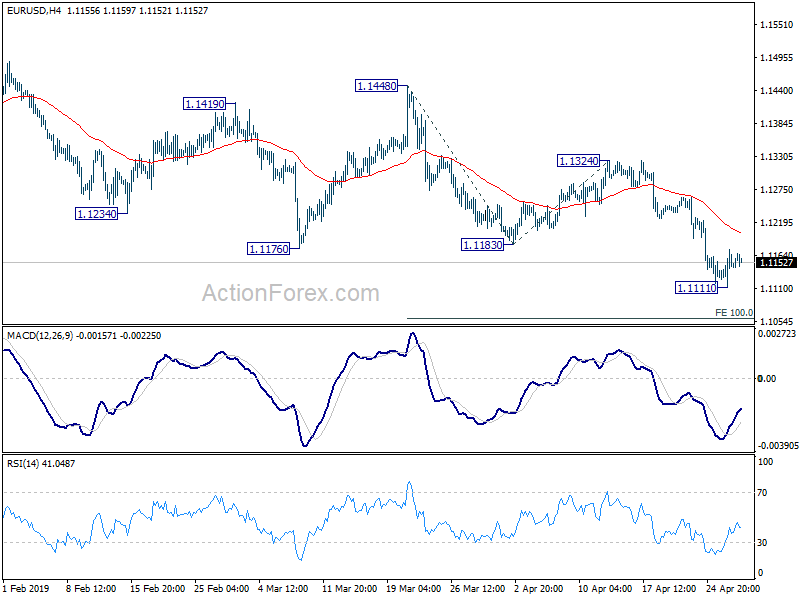
EUR/USD is staying in consolidation above 1.1111 temporary low. Intraday bias stays neutral for the moment. Upside of recovery should be limited well below 1.1324 resistance to bring fall resumption. On the downside, break of 1.1111 will extend down trend to 100% projection of 1.1448 to 1.1183 from 1.1324 at 1.1059. Break will target 161.8% projection at 1.0895.
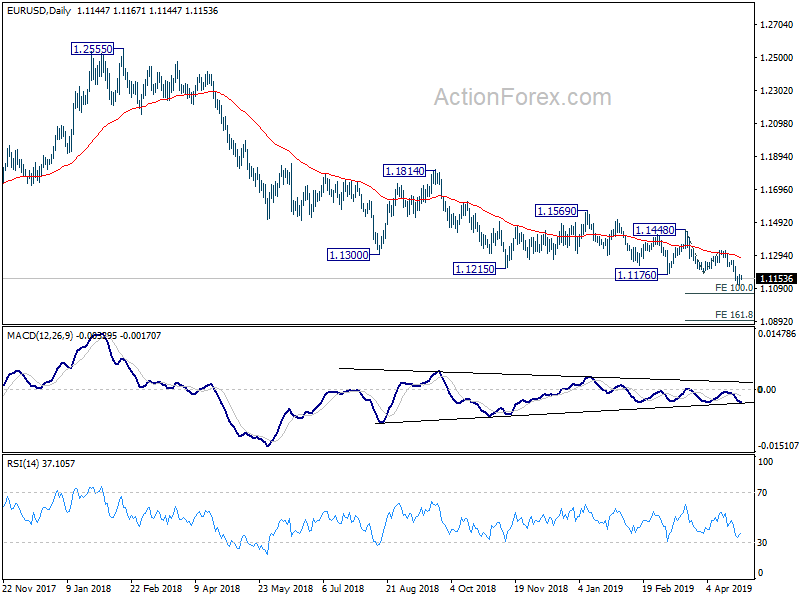
In the bigger picture, down trend from 1.2555 (2018 high) has just resumed. 61.8% retracement of 1.0339 (2016 low) to 1.2555 (2018 high) at 1.1186 was also taken out. Current fall should now target 78.6% retracement at 1.0813. Sustained break there will pave the way to retest 1.0339. On the downside, break of 1.1448 resistance is needed to be the first sign of medium term bottoming. Otherwise, outlook will stay bearish in case of rebound.
GBP/USD Mid-Day Outlook
Daily Pivots: (S1) 1.2880; (P) 1.2912; (R1) 1.2948; More....
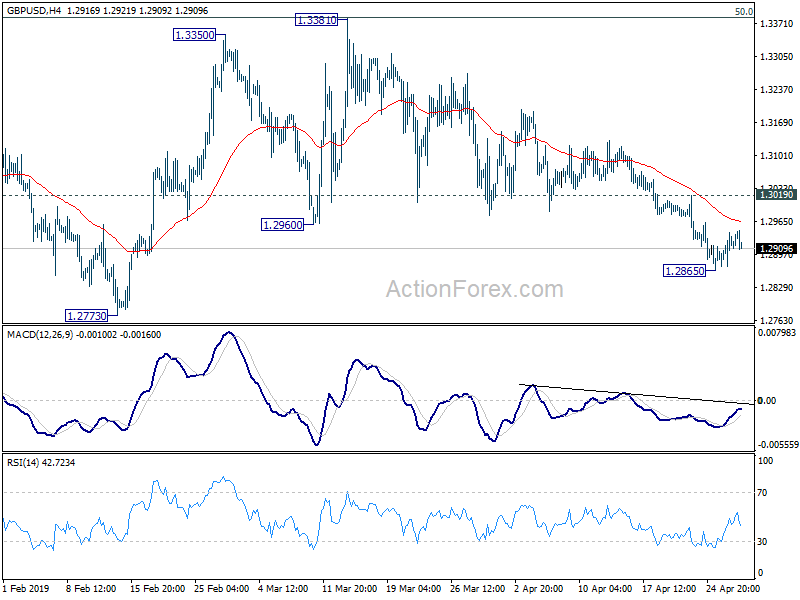
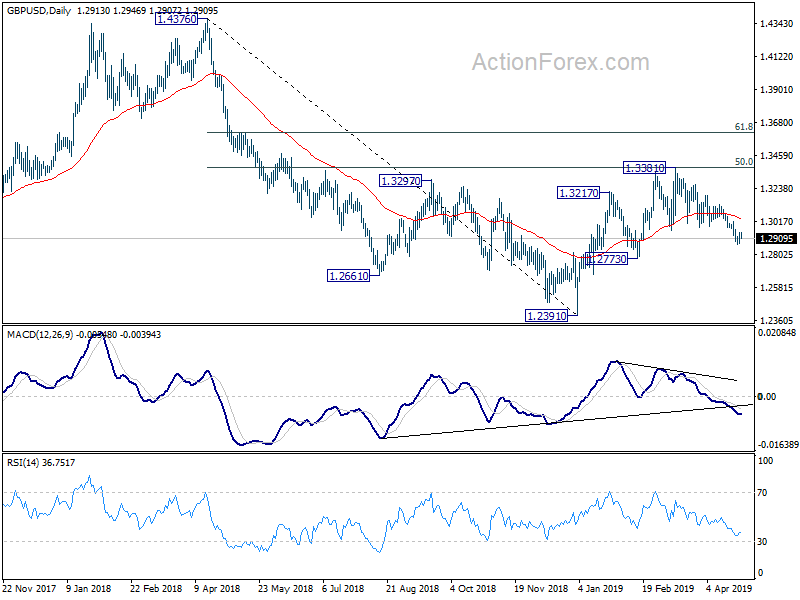
GBP/USD is staying in consolidation above 1.2865 temporary low. Intraday bias remains neutral first. In case of another recovery, upside should be limited by 1.3019 minor resistance to bring another decline. Current development suggests that rebound from 1.2391 has completed at 1.3381. On the downside, below 1.2865 will target 1.2773 support to confirm this bearish case. On the upside, however, break of 1.3019 resistance will dampen this bearish case and turn bias back to the upside for stronger rebound first.
In the bigger picture, medium term decline from 1.4376 (2018 high) halted after hitting 1.2391. Rise from 1.2391 could have completed after just missing 50% retracement of 1.4376 to 1.2391 at 1.338. Such rebound could be a correction to fall from 1.4376 only. Break of 1.2773 support will affirm this bearish case and target 1.2391. Break of 1.2391 will resume the fall from 1.4376 to 1.1946 (2016 low).
USD/JPY Mid-Day Outlook
Daily Pivots: (S1) 111.33; (P) 111.68; (R1) 111.92; More...
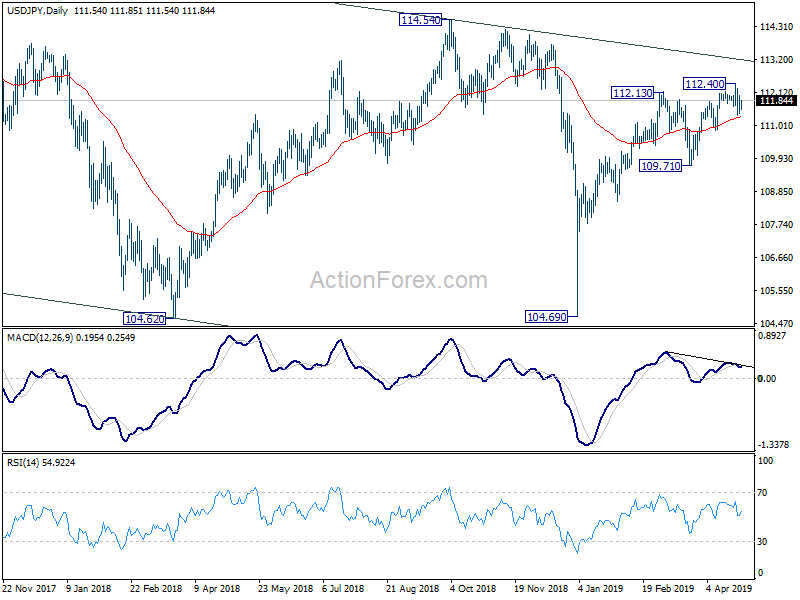
Intraday bias in USD/JPY remains neutral at this point. More consolidations could be seen below 112.40 short term top. Deeper decline remains mildly in favor. On the downside, break of 110.84 support add to the case of reversal and target 109.71 support and below. However, decisive break of 112.40 will confirm rise resumption for 114.54 resistance.
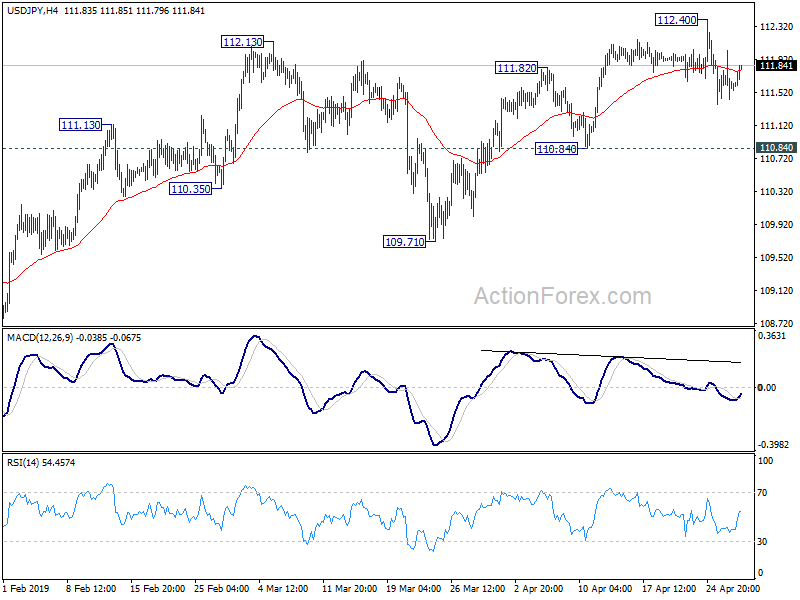
In the bigger picture, medium term outlook in USD/JPY remains a bit mixed as it's staying inside falling channel from 118.65, but there are signs of bullish reversal. On the upside, break of 114.54 resistance will revive the case the corrective fall from 118.65 has completed with three waves down to 104.69. And whole rise from 98.97 (2016 low) is resuming for 118.65 and above. But before that, outlook stays neutral first.