Sample Category Title
EUR/USD – Euro Edges Higher After Rough Week, Investors Relieved At Spanish Election Outcome
EUR/USD has started the week with gains, after losing close to 1.0% last week. On Monday, the pair is trading at 1.1162, up 0.20% on the day. On the fundamentals front, there are no major German or eurozone events. The U.S. will release Core PCE Price Index and Personal Spending for February and March. The markets are expecting a strong gain of 0.7% for Personal Spending in March. On Tuesday, Germany releases CPI and the eueozone posts GDP. In the U.S., the highlights are Chicago PMI and CB Consumer Confidence.
In Spain, Prime Minister Pedro Sanchez has led his Socialist party to victory, but he will have to share the spoils in order to form a new government. The Socialists won 123 seats of the 350 seats in Congress, and should be able to form a stable coalition in the next few weeks. The far-right VOX party made gains and will enter parliament, but investors seem pleased with the results, which should ensure stability for the eurozone’s fourth-largest economy.
In the U.S, economic data sparkled late in the week, sending EUR/USD to lower levels. Durable goods orders climbed 2.7%, crushing the estimate of 0.7%. Core durable goods orders gained 0.4%, marking a 9-month high. This was followed by an initial GDP release of 3.2% in Q1, well above the estimate of 2.2%. This was much stronger than Final GDP for Q4, which came in at 2.2%.
Euro Zone Confidence Slips Ahead Of Key Data Releases This Week
Notes/Observations
- Spain election results have Socialist PM Sanchez winning the general election but would need the backing of other groups to remain in office (likely seen partnering with either the liberal party Ciudadanos or forming a govt with left-wing Podemos and Catalan separatists
- Key week for Europe as the region as Apr inflation and Q1 GDP data comes out (Tues: France, German and Spanish CPI; Euro Zone , Spain Q1 GDP; and Friday sees Euro Zone flash CPI readings
- US-China trade talks to resume on Tuesday in Beijing, key points remain unresolved
Asia:
- China PBoC Open Market Operation (OMO): Skips reverse repo operations for 6th consecutive session
- China Mar YTD industrial Profits improve from prior 8-year lows (YoY: -3.3% v -14.0% prior)
- Senior Trump officials: there was no wind-down period or short term waiver being considered on sanctions relief for China oil purchases from Iran. Should be an easy call for China to comply with sanctions on Iran because doing business with the US was more important for them than with Iran
Europe/Mideast:
- Spain Election results saw the Socialists Party of PM Sanchez win with 123 seats but would still need to form coalition to get majority of 176 seats. Coalition likely with far left, anti-austerity Podemos
- S&P affirmed Italy sovereign rating at BBB; outlook Negative
- Both S&P and Fitch affirmed United Kingdom sovereign rating at AA; outlook Negative
Americas:
- President Trump: Have a chance to make a very good and long term trade deal with Japan; talks with Japan and China were going well; Saw possibility of US/Japan trade deal by May
- Treasury Sec Mnuchin reiterated that trade negotiation with China were in 'the final laps"
Energy:
- Weekly Baker Hughes Rig Count: 991 v 1,012 w/w (-2.1% w/w) for its steepest drop in rigs since mid-Jan
- Iran Foreign Min Zarif: US Navy ships could pass through Strait of Hormuz; Iran was committed to freedom of navigation
SPEAKERS/FIXED INCOME/FX/COMMODITIES/ERRATUM
Equities
- Indices [Stoxx600 -0.03% at 390.74, FTSE -0.06% at 7,423.50, DAX -0.10% at 12,302.99, CAC-40 -0.01% at 5,569.11, IBEX-35 -0.59% at 9,450.27, FTSE MIB +0.18% at 21,776.50, SMI -0.02% at 9,722.00, S&P 500 Futures +0.08%]
- Market Focal Points/Key Themes: European Indices trade mostly lower this morning following a mixed session in Asia and slightly higher US Index futures. The Spanish IBEX underperforms following the Spanish General Elections over the weekend. On the corporate front shares of Dutch traded Philips trades almost 3% higher after profits and Revenue which beat forecasts, with Fielmann, Strabag and Bankia among other notable risers on earnings. Covestro, Santhera Pharma and OPG Power Ventures are among the notable decliners on earnings. In other news Altice shares rise after its Portuguese unit is said to attract multiple bidders for its Fiber optic network; Ferrexpo gains on comments after the resignation of its Auditors. Looking ahead notable earners include Loews Corp, Cooper Tire and McDermott International.
Equities
- Consumer discretionary: Home24 [H24.DE] -3.5% (final earnings), Strabag [STB1.DE] +1.5% (earnings), SAS [SAS.SE] -2.5% (strikes), SMCP [SMCP.FR] +5.5% (earnings), Fielmann [FIE.DE] +3.5% (earnings)
- Financials: Bankia [BKIA.ES] +2% (earnings)
- Healthcare: Koninklijke Philips [PHIA.NL] +2% (earnings), Medivir [MVIRB.SE] -1.5% (new CFO)
- Industrials: Krones [KRN.DE] -0.5% (earnings)
Speakers
- Spain Socialist party chief: in no rush to put together a coalition govt
- China Foreign Min spokesperson Geng Shuang reiterated stance to urge the US to abide by its one China principle
- South Korea President Moon: Economy to gradually recover from Q2 but external uncertainties remained high
Currencies/Fixed Income
- USD continued to consolidate following last week's GDP data. Although the Q1 growth beat expectations dealers took notice of the build in inventories and weaker-than-expected inflation component of the release. Some analysts argued that deterioration of US data would likely occur down the road and limit the greenback's advance from current levels
- EUR/USD was steady at 1.1160 area with focu on a plethora of growth and inflation data for release over the week. Tuesday will see the release of France, German and Spanish CPI along with Euro Zone and Spain Q1 GDP. Friday will see the Euro Zone flash CPI readings
- USD/JPY was slightly higher but remaining below the 122 level. Japanese markets will be closed all week due to the Golden Week holiday.
Economic Data
- (NL) Netherlands Apr Producer Confidence Index: 6.7 v 6.1 prior
- (FI) Finland Apr Consumer Confidence Index: 15.7 v 16.1 prior; Business Confidence: -1 v +1 prior
- (ES) Spain Feb Total Mortgage Lending Y/Y: 31.2% v 16.2%; House Mortgage Approvals Y/Y: 9.2% v 22.5% prior
- (HU) Hungary Mar Unemployment Rate: 3.6% v 3.6%e
- (TR) Turkey Apr Economic Confidence: 84.7 v 81.9 prior
- (SE) Sweden Mar Trade Balance (SEK): 7.0B v 6.3B prior
- (SE) Sweden Mar Household Lending Y/Y: 5.0% v 5.2% prior
- (SE) Sweden Feb Non-Manual Workers' Wages Y/Y: 2.4% v 2.8% prior
- (CH) Swiss Weekly Total Sight Deposits (CHF): 576.7B v 576.9B prior; Domestic Sight Deposits: 479.8B v 481.9B prior
- (EU) Euro Zone Mar M3 Money Supply Y/Y: 4.5% v 4.2%e
- (IT) Italy Mar PPI M/M: 0.0% v -0.2% prior; Y/Y: 3.7% v 3.9% prior
- (PT) Portugal Apr Consumer Confidence Index: -9.3 v -9.5 prior; Economic Climate Indicator: 2.3 v 2.3 prior - (HK) Hong Kong Mar Trade Balance (HKD): -59.2B v -48.5Be; Exports Y/Y: -1.2% v -2.6%e; Imports Y/Y: -0.1% v -4.3%e
- (EU) Euro Zone Apr Business Climate Indicator: 0.42 v 0.49e; Consumer Confidence (final): -7.9 v -7.9e; Economic Confidence: 104.0 v 105.0e; Industrial Confidence: -4.1 v -2.0e; Services Confidence: 11.5 v 11.5e
- (IS) Iceland Apr CPI M/M: 0.4% v 0.5% prior; Y/Y: 3.3% v 2.9% prior
- (IT) Italy Mar Hourly Wages M/M: 0.0% v 0.0% prior; Y/Y: 1.4% v 1.7% prior
Fixed Income Issuance
- (DK) Denmark sold total DKK5.68B in 1-month and 3-month Bills
Looking Ahead
- (BR) Brazil Jan CNI Consumer Confidence: No est v 114.3 prior
- (BE) Belgium Apr CPI M/M: No est v 0.3% prior; Y/Y: No est v 2.3% prior
- 05:30 (BE) Belgium Debt Agency (BDA) to sell €2.5-3.0B in 2024, 2029 and 2050 OLO bonds
- 05:30 (ZA) South Africa announces details of upcoming I/L bond sale (held on Fridays)
- 06:00 (PT) Portugal Mar Unemployment Rate: No est v 6.3% prior
- 06:00 (IL) Israel Feb Manufacturing Production M/M: No est v 5.4% prior
- 06:00 (IE) Ireland Mar Retail Sales Volume M/M: No est v 2.1% prior; Y/Y: No est v 5.1% prior
- 06:00 (IL) Israel to sell bonds - 06:30 (IS) Iceland to sell 6-month Bills
- 06:45 (US) Daily Libor Fixing
- 07:00 (IN) India announces details of upcoming bond sale (held on Fridays)
- 07:00 (BR) Brazil Apr FGV Inflation IGPM M/M: 0.9e v 1.3% prior; Y/Y: 8.6%e v 8.3% prior
- 07:25 (BR) Brazil Central Bank Weekly Economists Survey
- 08:00 (UK) Baltic Bulk Index
- 08:30 (US) Mar Personal Income: 0.4%e v 0.2% prior; Personal Spending: 0.7%e v 0.1% prior (Jan reading); Real Personal Spending (PCE): 0.3% v 0.1% prior (Jan)
- 08:30 (US) Mar PCE Deflator M/M: 0.3% v -0.1% prior (Jan); Y/Y: 1.6%e v 1.4% prior (Jan)
- 08:30 (US) Mar PCE Core M/M: 0.1%e v 0.1% prior (Jan); Y/Y: 1.7%e v 1.8% prior (Jan)
- 09:00 (FR) France Debt Agency (AFT) to sell combined €3.4-4.6B in 3-month, 4-month, 6-month and 12-month Bills
- 09:00 (BE) Belgium Q1 Preliminary GDP Q/Q: No est v 0.3% prior; Y/Y: No est v 1.2% prior
- 10:30 (US) Apr Dallas Fed Manufacturing Activity: 10.0e v 8.3 prior
- 11:30 (US) Treasury to sell 3-Month and 6-Month Bills
USD/CHF Might Go For A Retest Of 1.0240
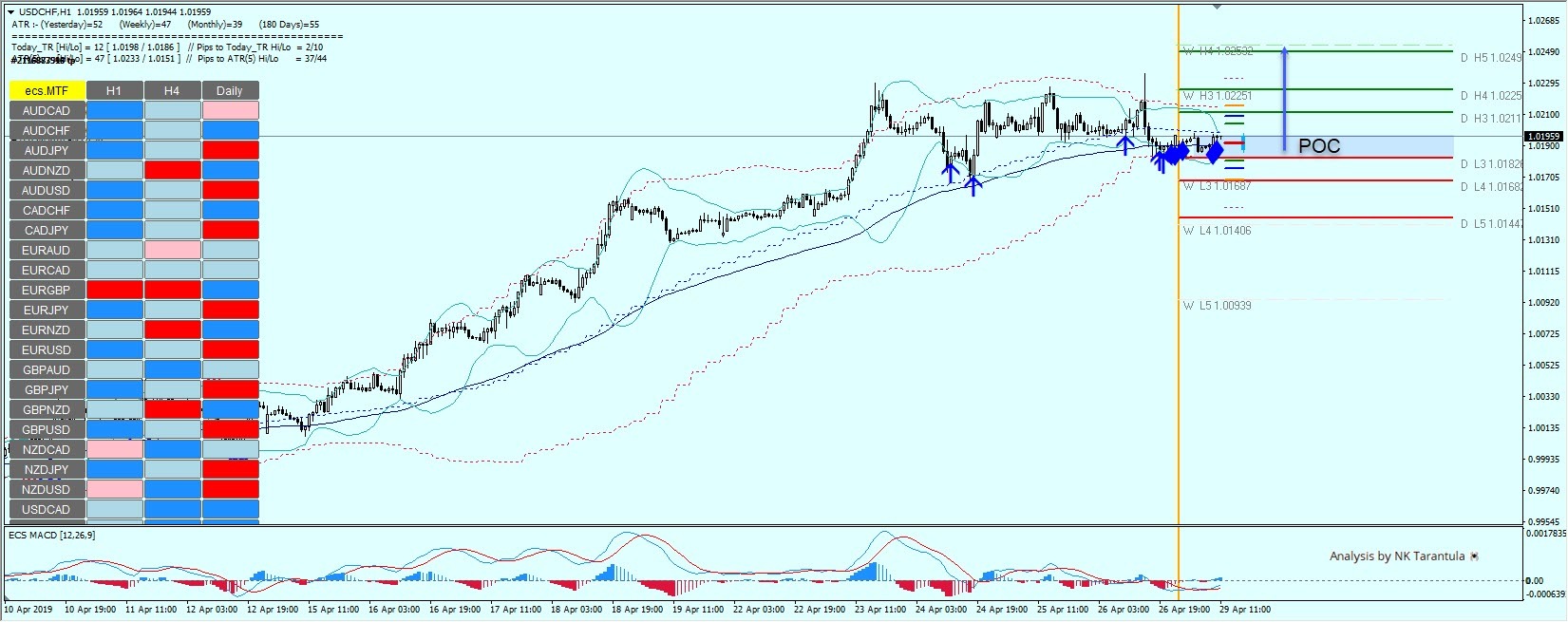
The USD/CHF has been in a bullish consolidation phase after briefly spiking to 1.0235 on Friday. 1.0185-95 might provide a fresh bullish momentum
The POC Zone is still strong as we can see from the marubozu candle and T-89 rejections at the EMA and D L3. Bollinger Bands are still congested, indicating the range but bullish momentum will persist as long as the price is kept above the W L3 – 1.0168. Targets are 1.0225 and 1.0240. If the price breaks 1.0240 it should reach 1.0253 but we shouldn’t expect a daily movement above it due to the ATR projection that shows 1.0233 as the daily projected high.
Elliott Wave Analysis: Aussie In An Interesting Pattern, More Gains Expected?
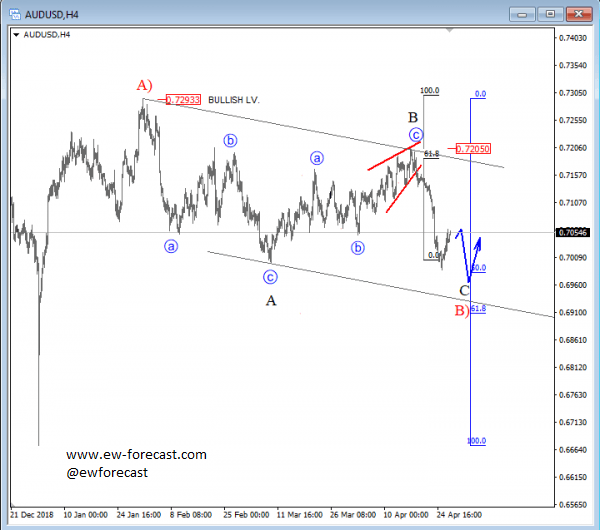
Aussie made a sharp drop last week, which was expected as we were tracking final stages of an Elliott Wave ending diagonal within sub-wave c of B. Current drop can now be labelled as wave C of a higher degree B) correction, which can unfold as a big flat correction and can look for support, and a bullish reversal around the Fibonacci ratio of 50.0 or 61.8 (0.700/0.6910 region). That said, a later sharp rally in impulsive fashion would be first sign of a completed correction, and more upside.
AUDUSD, 4h
A Flat is a three-wave pattern labeled A-B-C that generally moves sideways. It is corrective, counter-trend and is a very common Elliott pattern.
Elliott wave flat pattern:
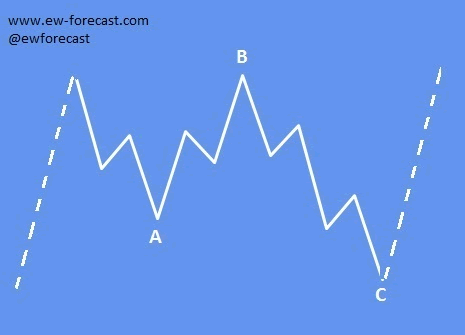
structure is 3-3-5
wave B terminates about at the level of the beginning of wave A
wave C terminates a slight bit past the end of wave A
appears in wave two or four, wave B in an A-B-C, wave X in a double or triple zig-zag, or wave Y in a triple threes
Data-Rich Week On The Markets Will Challenge The Main Trends Of The Year
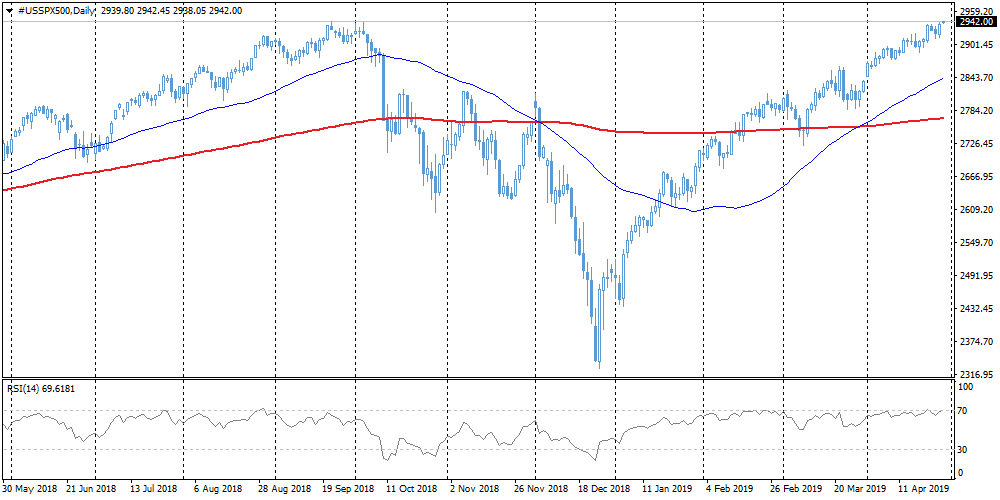
The dollar is in retreat from the recent highs. Futures on S&P500 has just touched the all-time peaks. Brent remains at $71 since the drop on Friday.
Stocks
S&P500 and Nasdaq continue their climb to the historic highs. Particularly encouraging that this growth has intensified by the end of the trading session on Friday. This dynamic indicates demand from professional market participants and, often, sets the tone for the next trading day. It works this time as the Shanghai’s China A50 index has jumped by 2.5%, while S&P500 futures has just touched all-time highs at 2945. Monday trading is usually calm but traders should pay attention to the fact that the coming days may turn out to be the turning points on the markets, due to the extremely high concentration of macroeconomic events: from FOMC and BoE meetings to US Payrolls and EU PMI and CPI.
EURUSD
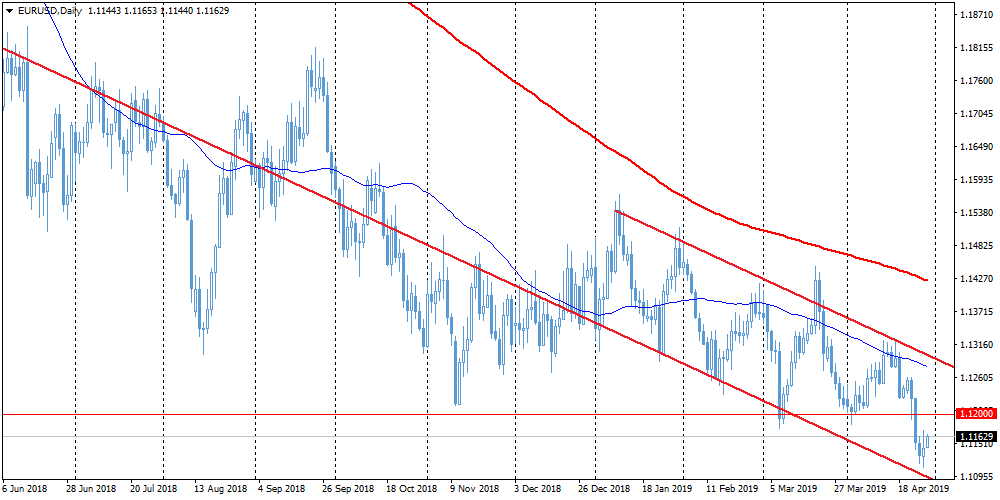
On Monday morning, the pair is near 1.1160, showing attempts to turn to growth after touching levels near 1.1100. Weak European statistics has contributed to the downtrend in EURUSD, which even managed to break through support at 1.1200. Nevertheless, the current trend has to pass an important test this week. Further softening of the Fed tone and a weak labour report are able to reverse the USD upward trend. It is also worth to remember about Trump’s possible pressure on the Fed’s actions that can cause the dollar growth.
GBPUSD
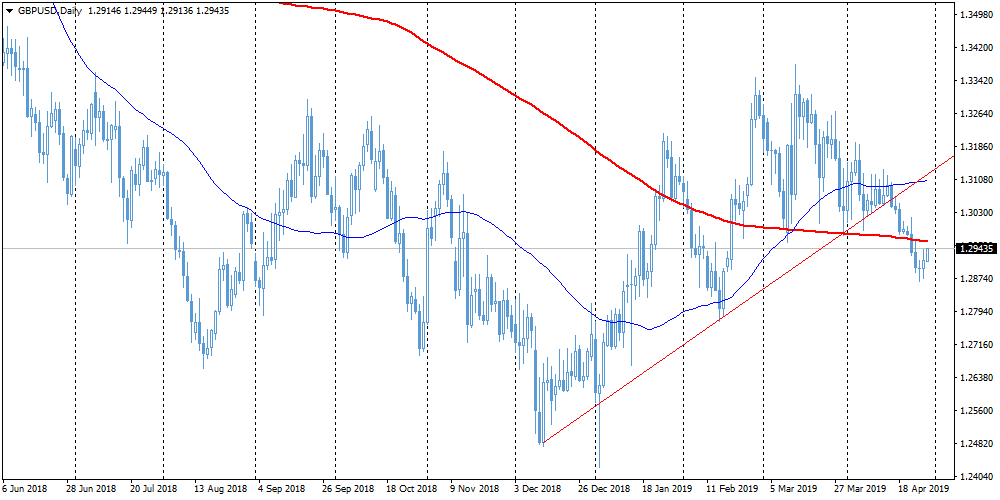
The British pound is growing cautiously Monday morning, trading at 1.2940. Fans of technical analysis should pay attention to the pair’s dynamics near 1.2960, through which the 200-day moving average passes. The return to the area above this level can increase purchases, making investors confident that GBPUSD can consolidate above 1.30.
Brent
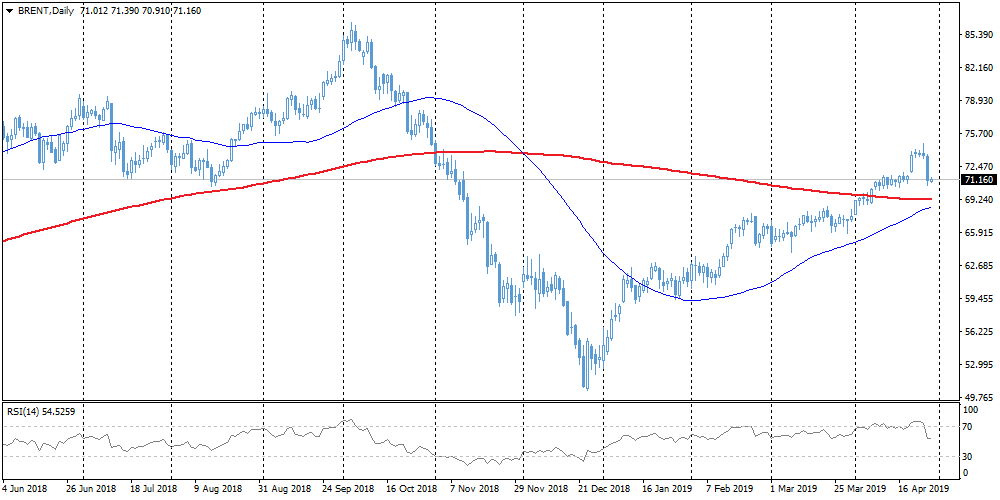
On Friday, oil declined by 5% against Thursday’s levels. It is equally important that the pressure on Brent persists this morning. By the time of writing, Brent is trading near $71, against peak levels of $74.70. It seems that now investors are waiting for the new impulses of growth above $75.
Oil Prices Continue Lower After Trump Comments
Knockout week for markets
It's going to be a very interesting week for financial markets, with an abundance of major economic events to come as well as earnings and trade talks between the world's two largest economies.
The week gets off to a slightly quieter start and yet we still have inflation – core PCE, the Fed's preferred measure - income and spending data to come from the US. We'll also get earnings from a dozen or so S&P500 companies, including Alphabet which reports after the market close. In any other week, this is probably the standout day but this week, not so much. There's much more to come in what is going to be a knockout week, after which we should have a much clearer view of where markets stand.
Oil prices continue lower after Trump comments
Oil prices are on the decline again on Monday, extending the declines that we saw on Friday which came after Donald Trump claimed to have spoken with OPEC an demanded they bring prices down. First thing to note here is that this is not the first time Trump has talked about oil prices and pointed the finger of blame at OPEC. He's also repeatedly tried to influence OPEC's decision making when it comes to output but there's been no evidence that it's been in any way successful.
So why are markets paying so much attention now? They're not really. Oil prices were looking very overextended to the upside and Trump's comments – intentionally or not – provided the perfect opportunity to cut exposure and allow the market to correct. That's why we're seeing such a decline, not because the market suddenly expects OPEC to be guided by Trump's outbursts. Still, WTI faces a very interesting test around $60.50-61.50 area, where the 200-day SMA crosses prior support and resistance.
A big week for uncertain gold market
Gold is trading a little lower at the start of the week, perhaps a sign of early profit taking after the yellow metal popped higher on the back of the US first quarter GDP data. It may have been surprising to see gold rallying in the aftermath of the data – given that the economy grew 1% more than markets were expecting – but the underlying numbers were far less impressive and pointed to weaker data in the quarters ahead.
We remain in a very uncertain period for gold though. On the one hand, the environment is primed for gold to come under more pressure – dollar is strong, US equity markets around record levels, earnings season outperforming – but when we broke through $1,280 two weeks ago, any downside momentum quickly faded. Not an encouraging sign for those that saw a break of a four month support level as a bearish signal.
That said, the dollar is relatively flat today and yet gold is off around a quarter of one percent. Profit taking on the back of such a brief jump higher could be a sign of weakness. It also came around the 50% retracement from the April peak to trough, which could key a bearish technical signal for gold. In a very interesting week for the dollar and therefore gold, we may not have to wait long to find out.
A Massive Week For Currencies, Stocks And Bonds
Monday April 29: Five things the markets are talking about
Global equites are mixed at the start of this data laden and holiday interrupted week. The ‘big’ dollar is trading steady and Treasury yields have ticked a tad higher as investors wait for further clues on global growth with a plethora of data out from the U.S., Europe and China.
Note: Markets in Japan remain closed for Golden Week, with a number of other countries set to follow suit on May 1 (CNY, CHF, GER. Fr. & ITL).
Stateside starts with the Fed’s favourite inflation reports today (U.S PCE 08:30 am EDT). Any further softness would have investors increasing their bets on a Fed interest rate cut this year – futures are currently pricing in a +50% odds for the Fed to cut this September.
For many, the big event this week will be U.S Federal Reserve monetary policy meeting, its interest rate announcement and in particular, Chair Powell press conference – will he be standing by his recent ‘dovish’ outlook?
Elsewhere, the China’s Caixin PMI then follows for a second update on Chinese manufacturing, along with German retail sales (May 1) as well as the latest Bank of England (BoE) interest rate announcement (May 2) – Brexit seems to be temporarily on the back burner.
On Friday, U.S non-farm payrolls (NFP) is expected to round off the week with another solid report.
On the Sino-U.S trade front, Trade Representative Robert Lighthizer and Treasury Secretary Steven Mnuchin announced last week that they will travel to Beijing for trade talks beginning on April 30.
On tap: ANZ Business confidence (Apr 29), CAD GDP, consumer confidence & NZD employment change (Apr 30), Bank holiday – CNY, CHF, GER. Fr. & ITL, U.S ISM manufacturing PMI, FOMC monetary policy statement & CNY Caixin manufacturing PMI (May 1), U.K inflation report, BoE monetary policy statement & AUD building approvals (May 2), non-farm payroll (May 3).
1. Some stocks get the green light
On the whole, global equities are starting the week better bid after strong U.S Q1 economic growth, coupled with data showing profits at Chinese industrial firms grew for the first time in four months.
Note: Tokyo’s Nikkei was closed for a public holiday.
Down-under, Aussie Australian shares ended lower on Monday after losses in financial stocks pulled the benchmark down from its 12-year high as investors remained cautious ahead of bank earnings. The S&P/ASX 200 index closed down -0.4%, breaking its four consecutive days of gains. The benchmark gained +0.1% to close at its highest level since December 2007. In S. Korea, the Kospi index closed out up +1.7%.
In China, the blue-chip CSI300 index rose +0.3%, while the Shanghai Composite Index closed down -0.7%. Both indexes on Friday posted their worst weekly drop in 28 on policy support worries.
Note: Data on the weekend showed that profit at China’s industrial firms grew last month, rebounding from four-months of contraction.
In Hong Kong, indexes followed suit, the Hang Seng index rose +1.0%, while the China Enterprises Index gained +1.1% on stronger U.S and China data.
In Europe, regional bourses trade mostly lower on the open following a mixed session in Asia and slightly higher U.S Index futures. The Spanish IBEX is underperforming following the Spanish General Elections (see below) over the weekend.
U.S stocks are set to open in the ‘black’ (+0.8%).
Indices: Stoxx600 -0.03% at 390.74, FTSE -0.06% at 7,423.50, DAX -0.10% at 12,302.99, CAC-40 -0.01% at 5,569.11, IBEX-35 -0.59% at 9,450.27, FTSE MIB +0.18% at 21,776.50, SMI -0.02% at 9,722.00, S&P 500 Futures +0.08%
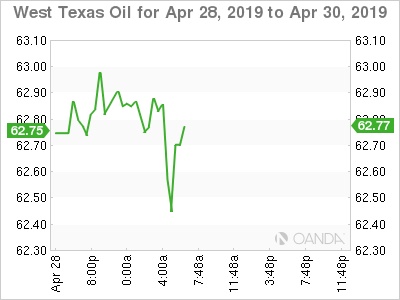
2. Oil falls after Trump presses OPEC, gold higher
Oil is starting the week under pressure, extending the end of last week slump, after President Trump demanded that OPEC+ raise output to soften the impact of U.S sanctions against Iran.
Brent crude futures are at +$71.66 per barrel, down -49c, or -0.7% from their last close. U.S West Texas Intermediate (WTI) crude futures are at +$62.87 per barrel, down -43c, or -0.7%, from Friday’s settlement.
Note: Both benchmarks fell around -3% in the previous session.
In typical Trump fashion, the U.S President told reporters that he called up OPEC and told them that gas prices must come down. The President’s actions, have at least temporarily, put a stop to crude oil’s +40% rally since the beginning of the year.
A good portion of oil’s rally occurred this month after Trump tightened sanctions against Iran by ending all exemptions that major buyers especially in Asia previously had.
Dealers have indicated that they are shifting their focus away from voluntary supply cuts, which have been led by OPEC since the start of the year, on the belief that “cooperation” may not last beyond a meeting between OPEC+ scheduled for June.
Also, Russia has indicated that it would be able to meet China’s oil demand needs – they wish to replace the imports it usually gets from Iran.
Note: Russia is also hoping to restore oil pipeline supplies to Poland and central Europe in a fortnight, after they were suspended last week over crude quality problems.
Ahead of the U.S open, gold prices trade atop of their one-week highs as the ‘big’ dollar comes under some pressure as the market focuses on soft U.S inflation data that overshadowed strong GDP numbers late last week. Spot gold is steady at +$1,285.59 per ounce, while U.S gold futures are also firm at +$1,287.70 an ounce.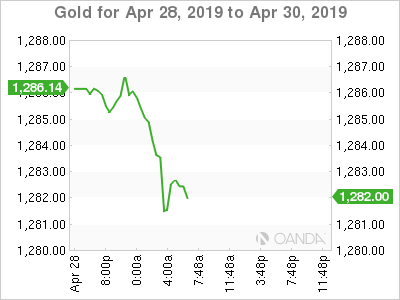
3. S&P helps boost Italian bonds; Spain steady after vote
Starting the week on better footing, Italian government bonds have rallied after S&P maintained the country’s sovereign credit rating last Friday at BBB, calming some market concerns on a possible move into junk territory. Nevertheless, the ratings agency did maintain its ‘negative outlook’ on the eurozone’s third largest economy.
Italy’s 10-year BTP yield is down -5 bps to +2.53%, while the BTP/Bund spread is at +254 bps, its tightest in over a week and well-off last week’s two-month high of +269 bps.
Staying in Europe, Spanish PM Pedro Sanchez looks set to regain power after his Socialists overcame a challenge by right-wing nationalists in elections in Spain yesterday. Nevertheless, it looks very likely that he would need the backing of other groups to remain in office – potentially partnering with either the liberal party Ciudadanos or forming a govt with left-wing Podemos and Catalan separatists. There has been little immediate impact on Spain’s bond market, with 10-year bond yields flat at +1.03%.
Elsewhere, the yield on U.S 10-year Treasuries has gained +1 bps to +2.51%, the largest gain in a week, while in the U.K, the 10-year Gilt yield rose +2 bps to +1.161%.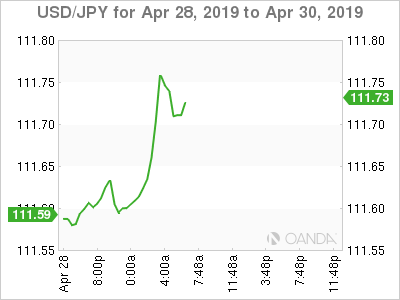
4. Dollar happy to consolidate for now
USD continued to consolidate following last week’s GDP data. Although the Q1 growth beat expectations, both dealers and investors took note of the build in inventories and weaker-than-expected inflation component of the release. Any further weaker data, specifically inflation, could provide new pressure on the ‘big’ dollar.
EUR/USD is steady at €1.1160 area with focus on a plethora of growth and inflation data for release over the coming week. Tomorrow, investors get to see the release of France, German and Spanish CPI along with Eurozone and Spanish Q1 GDP. Friday will see the Eurozone flash CPI readings.
USD/JPY (¥111.71) is a tad higher but remains below the psychological ¥112 handle. With Japanese markets closed all week due to the Golden Week holiday, expect price moves to dictated mostly by the lack of liquidity.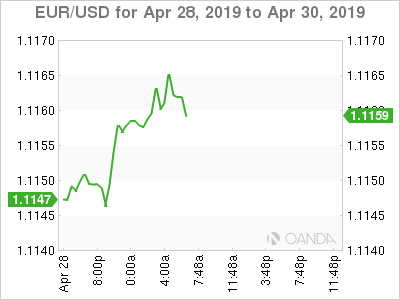
5. Eurozone lending to businesses slows
Data this morning showed that Eurozone bank lending to businesses slowed last month, following a brief pickup in February.
The ECB has indicated that lending to nonfinancial corporations grew at an annual rate of +3.5% after a revised rate of 3.8% in February – that is below the rates seen in H2 2018.
Note: For comparison, in 2007 and in the first half of 2008, bank lending to businesses was running at rates well above +12%.
Lending to eurozone households also slowed, too. Lending in the sector grew at an annual rate of +3.2% in March after +3.3% growth in February.
ECB’s Draghi had earlier indicated that “the central bank’s monetary policy measures, including a new series of targeted longer-term loans or TLTROS, would help to safeguard favorable bank lending conditions and will continue to support access to financing, in particular for small- and medium-sized enterprises.”
EUR/USD Could Trade Sideways
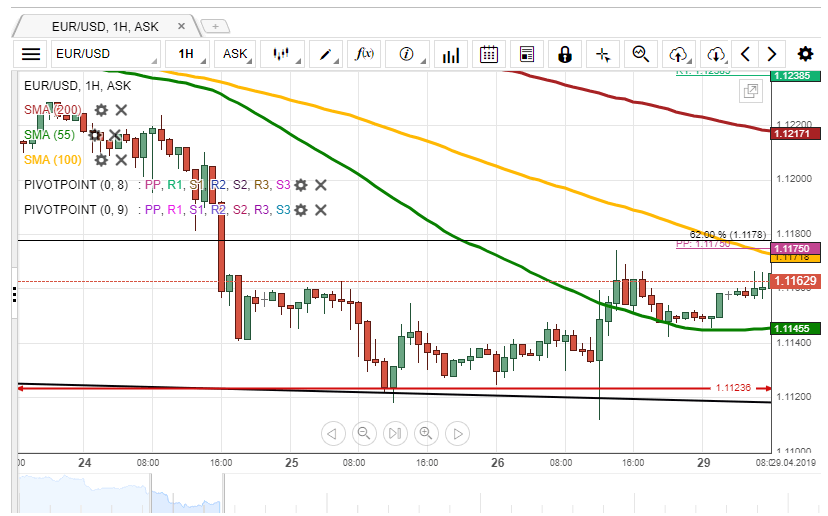
At the end of the previous week, the EUR/USD currency pair tried to surpass the 1.1160 level.
During Monday's morning, the pair was squeezed by the 55– and 100-hour moving averages, located at 1.1145 and 1.1173 respectively. Thus, it is likely, that the exchange rate could trade sideways in the short term.
However, if the given 55-hour SMA does not hold, it is expected, that some downside potential prevails in the market. The rate could re-test the lower boundary of the medium-term descending channel located circa 1.1115.
GBP/USD Supported By 55– And 100-Hour SMAs
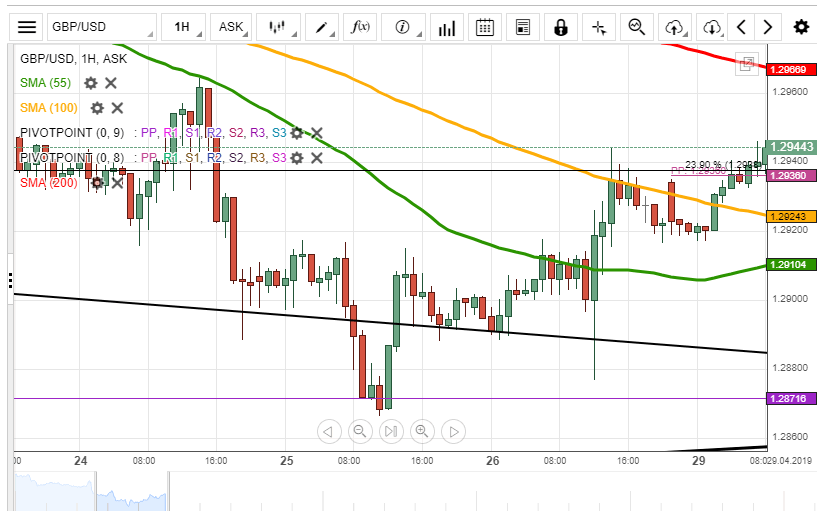
During the previous trading session, the GBP/USD exchange rate tested the Fibonacci 23.90% retracement at 1.2938.
Given that the rate is supported by the 55– and 100-hour SMAs, currently located at 1.2901 and 1.2925 , it is expected, that bulls could prevail in the market. A possible upside target is the 200-hour SMA at 1.2968.
On the other hand, if the given Fibonacci retracement holds, it is likely, that the currency pair reverses south and targets the lower boundary of the medium-term ascending channel located circa 1.2890.
USD/JPY: Two Scenarios Likely
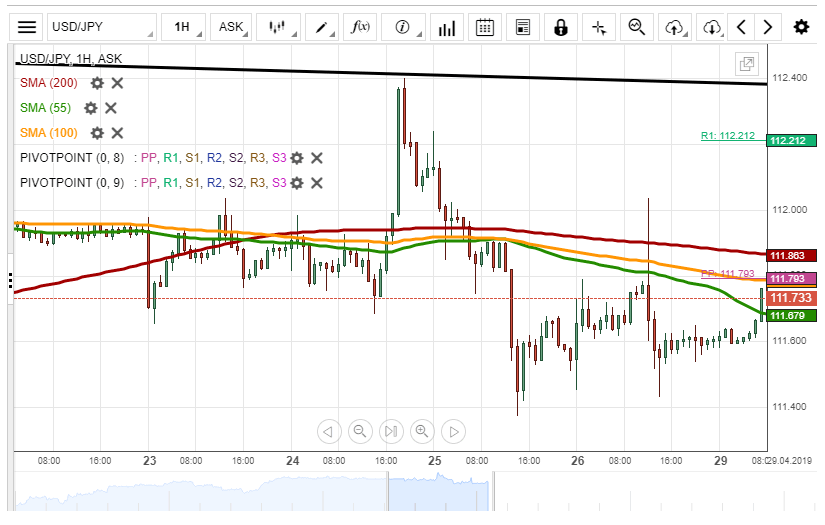
On Friday, the USD/JPY currency pair traded sideways between the 111.60 and 111.80 levels.
From a technical perspective, it is unlikely, that the pair could go upside, as it is pressured by the 55–, 100– and 200-hour SMAs located circa 111.80. Thus, it is expected, that the pair could target the psychological level at 111.40.
However, if the given resistance does not hold, it is likely, that the exchange rate could extend gains. A possible upside target is the psychological level at the 112.00 mark.