

Sample Category Title
DAX Posts Another Winning Week as April Rally Continues
The DAX index has paused on Monday, after posting strong gains last week. Currently, the DAX is at 12,311, down 0.03% on the day. There are no major German or eurozone events on the schedule. On Tuesday, Germany releases CPI and the eurozone posts GDP.
The Spanish election was closely watched by the European markets, but market reaction was muted on Monday. Prime Minister Pedro Sanchez led his Socialist party to victory, but he will have to share the spoils in order to form a new government. The Socialists won 123 seats of the 350 seats in Congress, and should be able to form a stable coalition in the next few weeks. The far-right VOX party made gains and will enter parliament, but investors appeared satisfied that the eurozone’s fourth-largest economy will remain politically stable.
Is a U.S-China trade deal imminent? Negotiations will continue on April 30, in Beijing, and U.S. Treasury Secretary Mnuchin waxed positive on Sunday, saying that the talks were in their “final laps”. However, Mnuchin cautioned that the talks could still end without an agreement. The nasty trade war between the two largest economies in the world has rocked the global economy and curbed growth. If the sides can hammer out an agreement, investor risk appetite would likely soar and boost equity markets.
Recent German numbers have been lukewarm, as the eurozone’s largest economy is experiencing a slowdown. This has weighed on the euro, but the blue-chip DAX index shows no signs of slowing down. The index has soared in April, with gains of 6.8%. This is on track for the highest monthly gain since December 2016.
USD/CHF Mid-Day Outlook
Daily Pivots: (S1) 1.0176; (P) 1.0206; (R1) 1.0229; More...
USD/CHF recovers mildly in early US session but stays below 1.0237 temporary top. Intraday bias remains neutral and more consolidation could be seen. In case of another retreat, downside should be contained by 1.0130 minor support to bring rise resumption. Prior break of 1.0128 resistance confirmed resumption of up trend from 0.9186. On the upside, above 1.0237 will target 100% projection of 0.9716 to 1.0124 from 0.9879 at 1.0287, and then 1.0342 key resistance. However, break of 1.0130 will indicate short term topping and bring deeper retreat first.
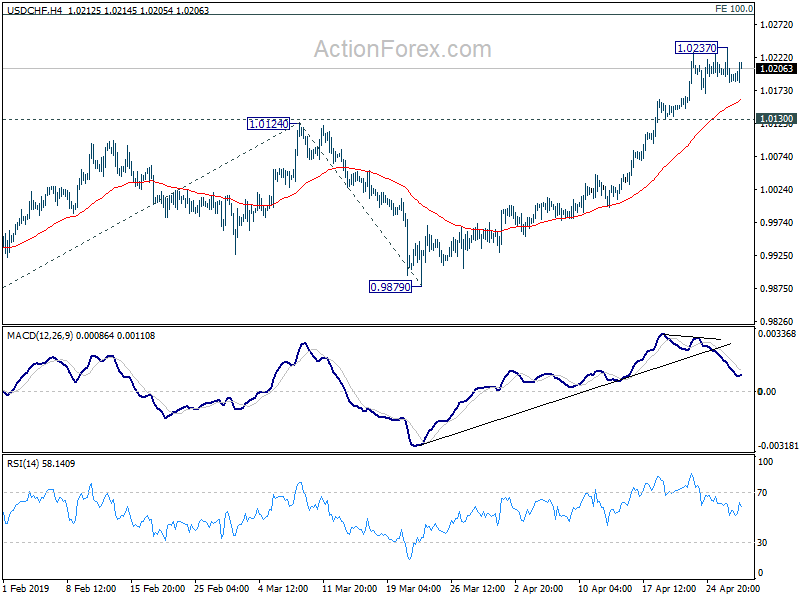
In the bigger picture, medium term up trend from 0.9186 is extending. Current rise should target 1.0342 resistance next. For now, we'd be cautious on strong resistance from there to limit upside, until we see medium term upside acceleration. On the downside, break of 0.9879 support is needed to indicate reversal. Otherwise, outlook will stay bullish in case of deep pull back.
Dollar Mildly Higher after Strong Personal Spending, Upside Capped by Cooling Core Inflation
Dollar strengthens mildly in early US session as supported by strong personal spending growth in March. Though, upside is capped by steadily cooling core inflation. For now, today's set of data is not decisive enough to trigger a breakout in the greenback yet. Dollar would likely engage in more consolidative trading, awaiting FOMC, ISM indices and NFP later in the day.
Staying in the currency markets, Australian and New Zealand Dollars are the strongest one for today so far. Both are just digesting some of recent losses. There is little chance of bullish reversal yet as inflation data from both countries pointed to rate cuts down the road. Yen is the weakest one for today, followed by Swiss Franc as risk sentiments are steady globally, while German 10-year yield recovers.
In Europe, currently, FTSE is up 0.23%. DAX is flat. CAC is up 0.05%. German 10-year yield is up 0.0265 at 0.008, turned positive. Earlier in Asia, Hong Kong HSI rose 0.97%. China Shanghai SSE dropped -0.77%. Singapore Strait Times rose 1.49%. Japan started 10-day holiday today.
Strong US personal spending supports Dollar, core inflation cools steadily
In March, US personal income rose 0.1% mom, or USD 11.4B, much lower than expectations of 0.4% mom. Personal spending rose 0.9%, or USD 123.5B, higher than expectation of 0.7% mom. That's the strongest growth in nearly a decade. Headline PCE was unchanged at 1.5% yoy while core PCE slowed from 1.7% yoy to 1.6% yoy.
In February, personal income rose 0.2% mom or USD 35.6B. Personal spending rose 0.1% mom or 11.7B. Headline PCE accelerated from 1.4% yoy to 1.6% yoy. Core PCE slowed from 1.8% yoy to 1.7% yoy.
US Mnuchin hopes to finish China trade deal with two more rounds of talks
US Treasury Secretary Steven Mnuchin told Fox Business Network that he hoped to finalize a trade agreement with two more rounds of talks. In particular, he indicated that the issue regarding enforcement is now close to finished. He said, "We hope within the next two rounds, in China and in DC, to get to the point where we can either recommend to the president that we have a deal or recommend that we don't". Mnuchin said. "I think there is a strong desire from both sides to see if we can wrap this up or move on."
Mnuchin and Trade Representative Robert Lighthizer will be in Beijing on Tuesday to start another round of trade talks with China. This week's meeting will cover issues including intellectual property, forced technology transfer, non-tariff barriers, agriculture, services, purchases, and enforcement. Chinese Vice Premier Liu He will lead a delegation to Washington for additional discussions starting on May 8.
Eurozone economic sentiment dropped for the 10th month to 2+ year low
Eurozone Economic Sentiment Indicator dropped -1.6 to 104.0 in April, missed expectation of 105.0. That's the 10th consecutive month of decline and the lowest level in more than two years. Amongst the largest Eurozone economies, the ESI rose only in the Netherlands (+0.4), while it decreased in France (-1.0) and Italy (-1.0) and, more significantly so, in Germany (-1.5) and Spain (-2.6). Industrial Confidence dropped to -4.1, down from -1.6 and missed expectation of -2.0%. Services Confidence was unchanged at 11.5, matched expectation. Consumer Confidence was finalized at -7.9.
Business Climate Indicator dropped -0.12 to 0.42, below expectation of 0.49. Managers' views of the past production, their production expectations, and their assessments of overall order books and the stocks of finished products declined significantly. Meanwhile, there was some relief in the appraisals of export order books.
Also released, Eurozone M3 money supply rose 4.5% yoy in March, above expectation of 4.2% yoy.
USD/CHF Mid-Day Outlook
Daily Pivots: (S1) 1.0176; (P) 1.0206; (R1) 1.0229; More...
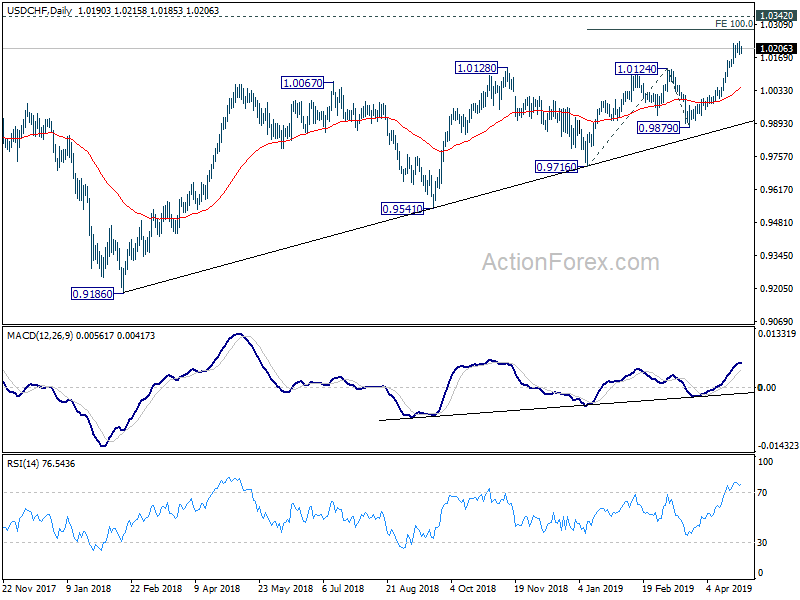
USD/CHF recovers mildly in early US session but stays below 1.0237 temporary top. Intraday bias remains neutral and more consolidation could be seen. In case of another retreat, downside should be contained by 1.0130 minor support to bring rise resumption. Prior break of 1.0128 resistance confirmed resumption of up trend from 0.9186. On the upside, above 1.0237 will target 100% projection of 0.9716 to 1.0124 from 0.9879 at 1.0287, and then 1.0342 key resistance. However, break of 1.0130 will indicate short term topping and bring deeper retreat first.
In the bigger picture, medium term up trend from 0.9186 is extending. Current rise should target 1.0342 resistance next. For now, we'd be cautious on strong resistance from there to limit upside, until we see medium term upside acceleration. On the downside, break of 0.9879 support is needed to indicate reversal. Otherwise, outlook will stay bullish in case of deep pull back.
Economic Indicators Update
| GMT | Ccy | Events | Actual | Forecast | Previous | Revised |
|---|---|---|---|---|---|---|
| 08:00 | EUR | Eurozone M3 Money Supply Y/Y Mar | 4.50% | 4.20% | 4.30% | |
| 09:00 | EUR | Eurozone Business Climate Indicator Apr | 0.42 | 0.49 | 0.53 | 0.54 |
| 09:00 | EUR | Eurozone Economic Confidence Apr | 104 | 105 | 105.5 | 105.6 |
| 09:00 | EUR | Eurozone Industrial Confidence Apr | -4.1 | -2 | -1.7 | -1.6 |
| 09:00 | EUR | Eurozone Services Confidence Apr | 11.5 | 11.5 | 11.3 | 11.5 |
| 09:00 | EUR | Eurozone Consumer Confidence Apr F | -7.9 | -7.9 | -7.9 | -7.2 |
| 12:30 | USD | Personal Spending Feb | 0.10% | 0.20% | 0.10% | |
| 12:30 | USD | PCE Deflator M/M Feb | 0.10% | 0.00% | -0.10% | |
| 12:30 | USD | PCE Deflator Y/Y Feb | 1.50% | 1.20% | 1.40% | |
| 12:30 | USD | PCE Core M/M Feb | 0.10% | 0.10% | 0.10% | |
| 12:30 | USD | PCE Core Y/Y Feb | 1.70% | 1.70% | 1.80% | |
| 12:30 | USD | Personal Income Mar | 0.10% | 0.40% | 0.20% | |
| 12:30 | USD | Personal Spending Mar | 0.90% | 0.70% | 0.10% | |
| 12:30 | USD | PCE Deflator M/M Mar | 0.20% | 0.10% | ||
| 12:30 | USD | PCE Deflator Y/Y Mar | 1.50% | 1.50% | ||
| 12:30 | USD | PCE Core M/M Mar | 0.00% | 0.10% | ||
| 12:30 | USD | PCE Core Y/Y Mar | 1.60% | 1.70% | 1.70% |
Strong US personal spending supports Dollar, core inflation cools steadily
Dollar rebounds generally in early US after strong personal spending data in March, which is the best growth in nearly a decade. Core PCE inflation slowed in both February and March, steadily. But at least, there was no steep deterioration in core inflation.
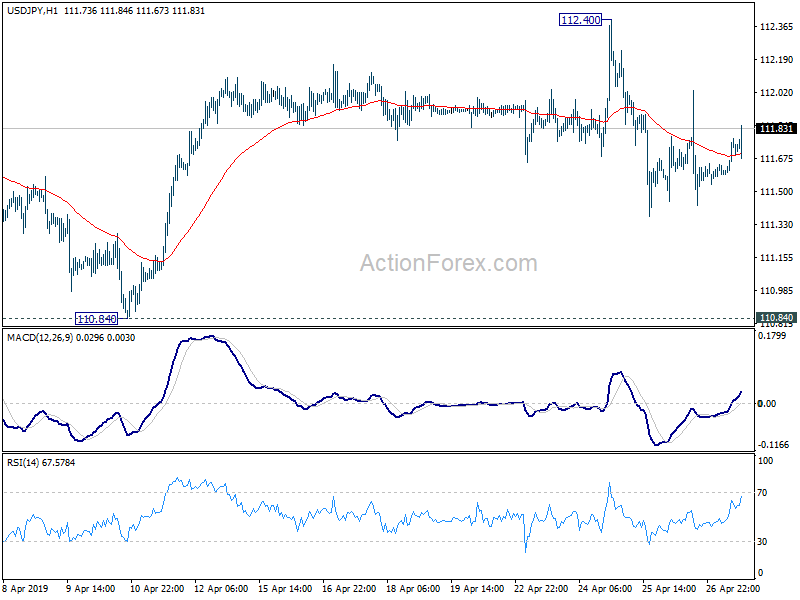
While Dollar rebounds, it's largely held in range against others, like in USD/JPY. It's just in another leg of consolidations.
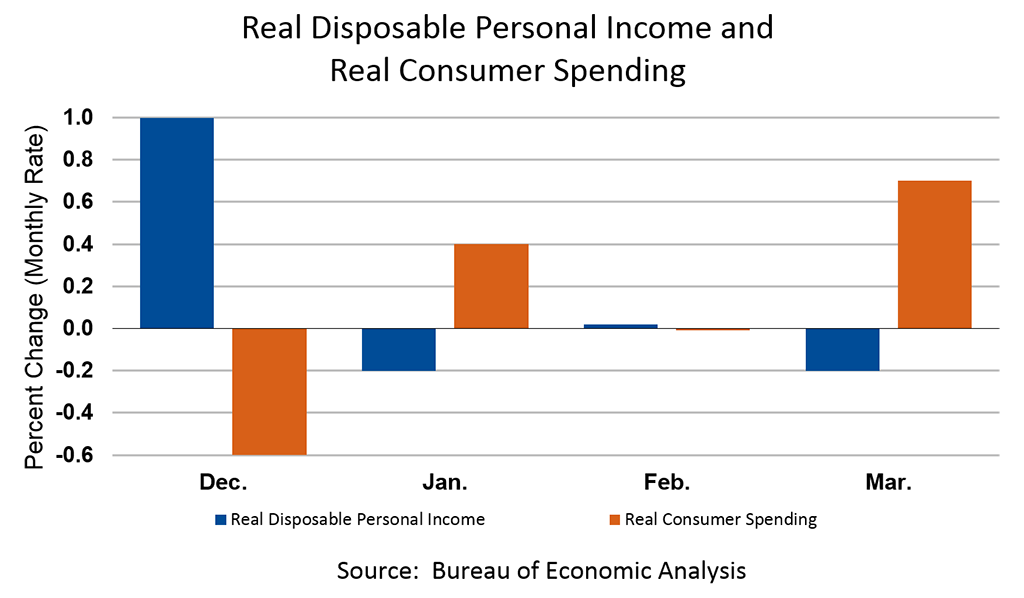
 In March, US personal income rose 0.1% mom, or USD 11.4B, much lower than expectations of 0.4% mom. Personal spending rose 0.9%, or USD 123.5B, higher than expectation of 0.7% mom. Headline PCE was unchanged at 1.5% yoy while core PCE slowed from 1.7% yoy to 1.6% yoy.
In February, personal income rose 0.2% mom or USD 35.6B. Personal spending rose 0.1% mom or 11.7B. Headline PCE accelerated from 1.4% yoy to 1.6% yoy. Core PCE slowed from 1.8% yoy to 1.7% yoy.
Australian Dollar Steady, Chinese Manufacturing PMI Next
AUD/USD is subdued in the Monday session. Currently, the pair is trading at 0.7048, up 0.06% on the day. On the release front, there are no Australian events. Later in the day, China releases manufacturing PMI, which is expected to tick up to 50.7 points in April, after a score of 50.5 in the previous release. The 50-level separates contraction from expansion, so a reading just above 50 points to stagnation. The U.S. releases Core PCE Price Index and Personal Spending for February and March. The markets are expecting a strong gain of 0.7% for Personal Spending in March. On Tuesday, the U.S. releases Chicago PMI and CB Consumer Confidence. Australia will post the AIG manufacturing index.
It was a brutal week for the Aussie, which dropped 1.5 percent. A combination of weak data out of Australia and sharp U.S. numbers sent the currency reeling. Australian CPI slowed to 0.0% in Q1, shy of the estimate of 0.2%. This marked the weakest reading since 2016. Inflation remains well below the RBA’s target band of 2-3%, and this disappointing CPI release underscores concerns that the target band will remain elusive. Soft inflation and a somber RBA have raised speculation that the RBA could lower rates in a bid to stimulate the economy, perhaps as early as this summer. Investors will now shift their attention to China, as the Aussie is sensitive to key Chinese releases. A strong Chinese manufacturing PMI could boost the Australian dollar.
Meanwhile, U.S. numbers impressed late last week, as the U.S. dollar made broad gains. Durable goods orders climbed 2.7%, crushing the estimate of 0.7%. Core durable goods orders gained 0.4%, marking a 9-month high. This was followed by an initial GDP release of 3.2% in Q1, well above the estimate of 2.2%. This was much stronger than Final GDP for Q4, which came in at 2.2%.
Gold – Pivotal Week as Bulls Fight On
A big week for uncertain gold market
Gold is trading a little lower at the start of the week, perhaps a sign of early profit taking after the yellow metal popped higher on the back of the US first quarter GDP data.
It may have been surprising to see gold rallying in the aftermath of the data – given that the economy grew 1% more than markets were expecting – but the underlying numbers were far less impressive and pointed to weaker data in the quarters ahead.
We remain in a very uncertain period for gold though. On the one hand, the environment is primed for gold to come under more pressure – dollar is strong, US equity markets around record levels, earnings season outperforming – but when we broke through $1,280 two weeks ago, any downside momentum quickly faded. Not an encouraging sign for those that saw a break of a four month support level as a bearish signal.
Gold Daily Chart
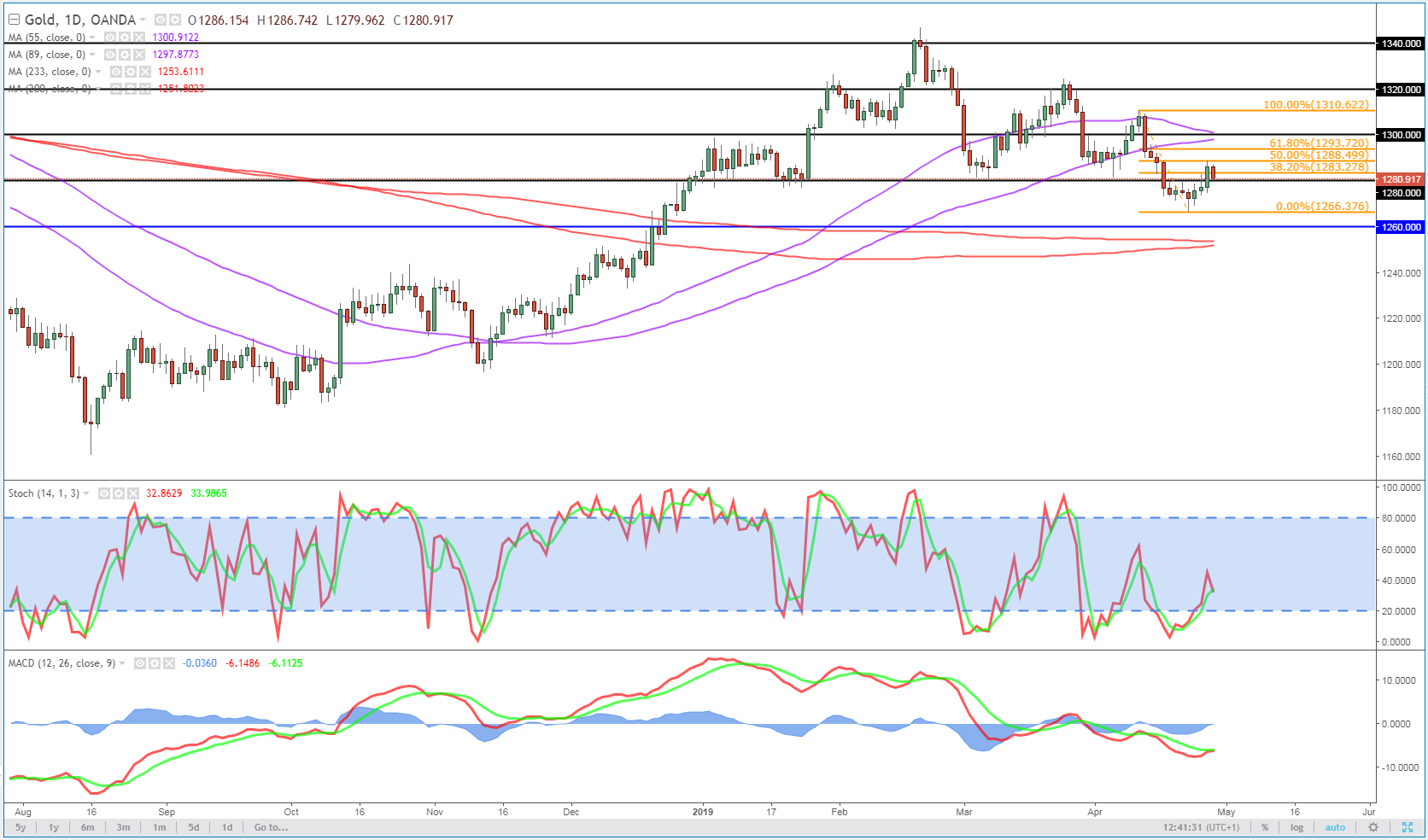
That said, the dollar is relatively flat today and yet gold is off around a quarter of one percent. Profit taking on the back of such a brief jump higher could be a sign of weakness. It also came around the 50% retracement from the April peak to trough, which could key a bearish technical signal for gold. In a very interesting week for the dollar and therefore gold, we may not have to wait long to find out.
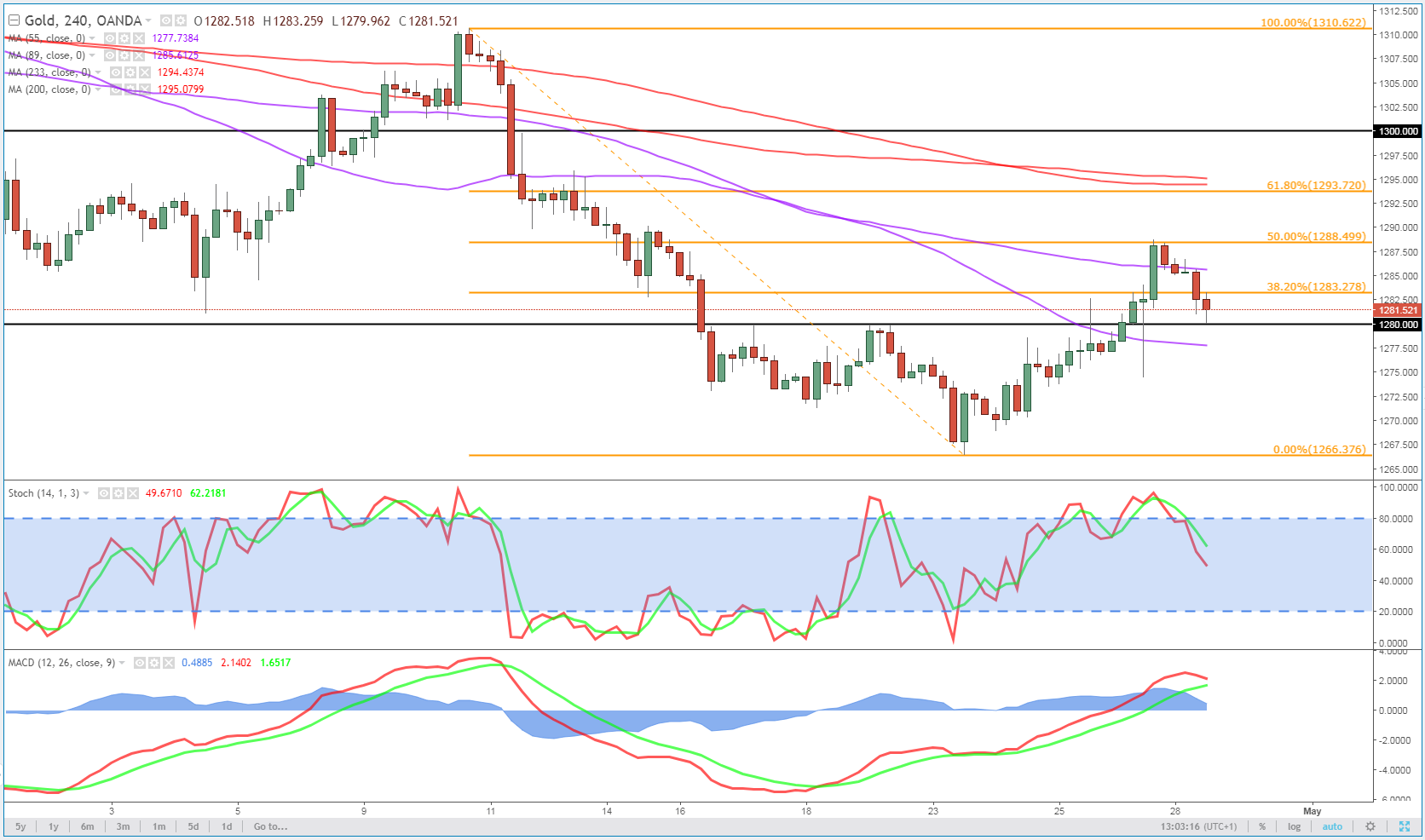
A look at the 4-hour chart only adds to the confusion and suggests bears should not get too excited yet. A rotation off the 50-fib can be a nice signal but it can also bring premature optimism. That’s not to say that I don’t think gold remains bearish, just that the corrective move may not have played out.
Gold is finding support around $1,280 from above and nothing about price action suggests the recent rally has finished. Momentum remains positive – most recent peak made on higher stochastic and MACD – which suggests further gains may come. That will make the next peak – should we see it – all the more interesting. The 61.8 fib looks a very interesting level, especially if it’s achieved on lower momentum.
Gold 4-Hour Chart
European Update – Mega Week Ahead
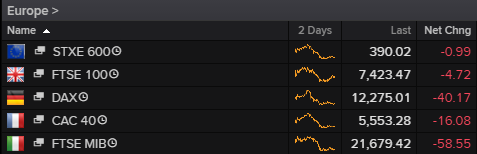
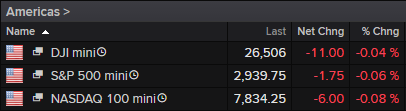
It's going to be a very interesting week for financial markets, with an abundance of major economic events to come as well as earnings and trade talks between the world's two largest economies.
The week gets off to a slightly quieter start and yet we still have inflation – core PCE, the Fed's preferred measure – income and spending data to come from the US. We'll also get earnings from a dozen or so S&P500 companies, including Alphabet which reports after the market close. In any other week, this is probably the standout day but this week, not so much. There's much more to come in what is going to be a knockout week, after which we should have a much clearer view of where markets stand.
Inconclusive election drives under-performance in IBEX
One of the more overshadowed events this week has already come and gone, although the result appears to be weighing on the country's index, the IBEX. The Spanish election produced an inconclusive result which comes as a surprise to no one and yet, does appear to be acting as a drag on the index.
The Socialists were the clear winners over the weekend but remain some way from securing a majority in the 350-seat Congreso de los Diputados, which means negotiations will now commence. There are a number of things one could point to in order to explain the Spanish under-performance today – the prospect of a more left-leaning coalition, entry of VOX – a far right party – into Parliament – but the size of it suggests there's little really to this.
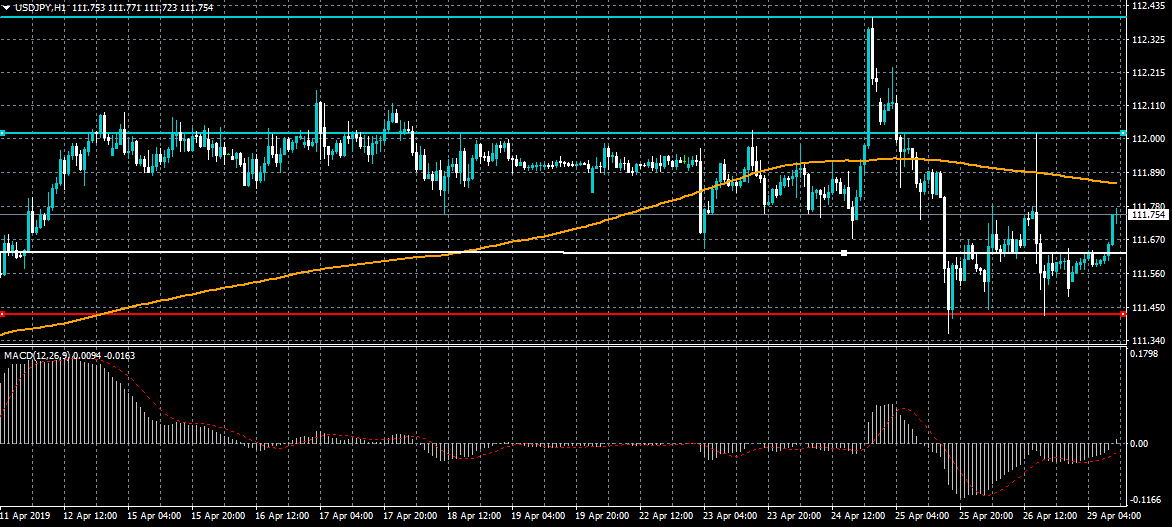
USDJPY Testing Higher
The US dollar is attempting to move higher against the Japanese yen on Monday, with the pair holding a slight bullish bias above the 111.60 level. The one-hour time frame is showing a small bearish pattern, with the 110.90 level the overall downside target. Buyers need to once again move price above the 112.00 level to invalidate the bearish pattern on the one-hour time frame.
The USDJPY pair is bullish while trading above the 111.60, key intraday resistance is found at the 111.80 and 112.00 levels.
If the USDJPY pair trades below the 111.60 level, key intraday support remains at the 111.45 and 110.90 levels.
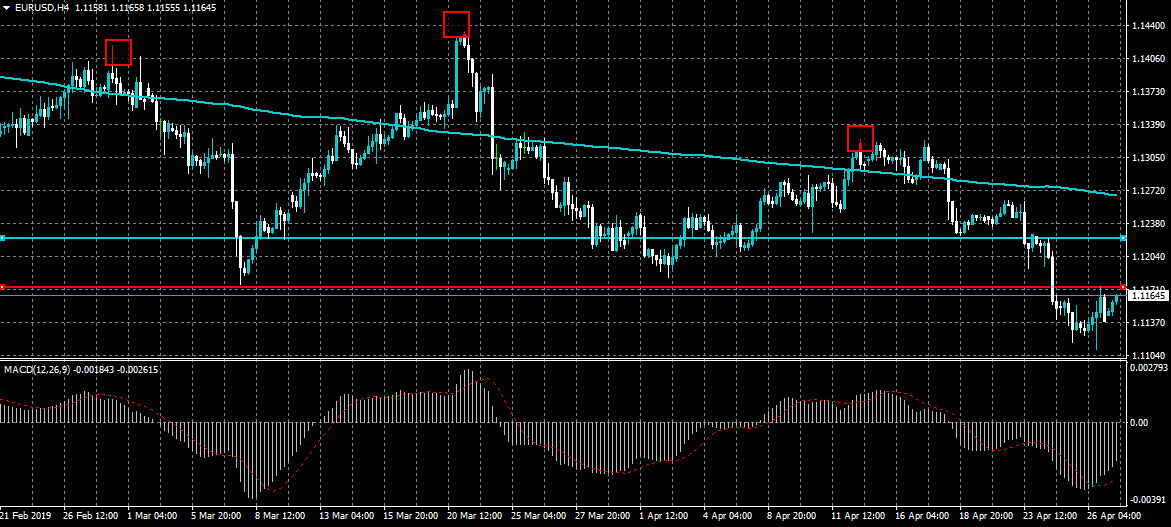
EURUSD Testing Neckline Resistance
The euro currency is testing back towards key intraday resistance against the US dollar as short-term bulls attempt to take back control of price action. If bulls can rally price above neckline resistance, the 1.1200 level may start to come into focus. The downside projection of the bearish head and shoulders pattern on the four-hour time frame extends below the 1.1000 support level.
The EURUSD pair is bearish while trading below the 1.1174 level, key technical support is found at the 1.1135 and 1.1100 levels.
If the EURUSD pair trades above 1.1174 level, key intraday resistance is found at the 1.1200 and 1.1216 levels.
Wary Of Long EURUSD Calls
Wary of long EURUSD calls
FX markets are slowly waking up at the start of this trading week. With limited news flow no one is rushing to get out of bed (end of the week brings, BoE MPC, FOMC, US jobs reports, and local UK elections). Paradoxically, US equity markets surging, volatility widely contracting yet JPY outperforming G10 peers. Confusing price action indicates that traders are having a hard time pinpointing cyclical drivers. EURUSD staged a minor bounce to 1.1175 prompting some to issue calls for buying EURUSD. Their analysis includes the forecasted stronger Q1 Eurozone GDP read and cheap relative valuations in European companies. Yet we are not convinced. Judging from last week’s weak PMI and IFO reads economic improvement has not crossed the Atlantic. Marginally shifting growth expectations in Europe will not offset very alive US equity rally and attractive real yields. Finally, ultra strong US GDP read last week (1Q 3.2% q/q) has investors rethinking the Fed pause while the ECB is nowhere near reviewing policy normalization. This divergence should benefit USD near term. We remain cautious on calls that EURUSD has built a stable base (likely short-term consolidation phase) and could easily see the establishment of a lower range.
Also limiting Euro upside potential is political uncertainty in Spain. Spain’s incumbent Prime Minister and leader of left-leaning Spanish Socialist Workers Party (PSOE) Pedro Sanchez has declared victory but with no clear majority in parliament. The market should anticipate weeks of tense coalition negotiation in a highly divisive fragmented political landscape. The most likely outcome is PM Sanchez will need to rely on Catalan separatists to form a government. This action will have a “cost” that will likely be seen as Euro negative.
The race for trade agreements is on
Now that the US slowly enters into election season, time is running out to ratify trade agreements. The US – China trade talks have been lasting longer than the Trump administration had expected, but it seems on good track as US negotiators are turning their effort towards other partners, including Japan and the EU, although further hurdles remain.
Indeed, as US Trade Representative Robert Lighthizer and Treasury Secretary Steven Mnuchin are expected to travel on Tuesday in Beijing while a second meeting in Washington will include Chinese Vice Premier Liu He next Wednesday, it seems that hopes of a trade deal by next month are rising. Progresses have been made on issues such as intellectual property and technology transfer while the enforcement mechanism framework, including a defined timeline, is still in production. Yet despite this potential breakthrough, Trump’s campaign promise of reducing trade balance deficit is still on the table. Bilateral trade talks between both US and Japan had already been confirmed last September and have only started this month while it is not expected to be a quick resolution. Both Japanese PM Shinzo Abe and US President Donald Trump have differing political schedules timing, pushing the date of a potential agreement by September 2019 earliest. The topics targeted would focus mainly on agriculture as US concerns are that the 11-country Trans-Pacific Partnership (TPP) agreement, effective since last December and which the US decided not to be part of, would allow Australia to absorb a significant market share at the expense of US farmers. In addition, discussions with the EU have not even begun yet, and a conflict in the topics to be addressed is already emerging. Whereas the EU is willing to open discussions on cutting tariffs in industrial goods (incl. automotive) and work on EU/US product standards facilitations, a red line for what concerns agriculture restrictions should stay, paving the way for further trade tit-for-tat actions.
EUR/USD is trading at 1.1165, approaching 1.1145 short-term.