Sample Category Title
USD/CHF Daily Outlook
Daily Pivots: (S1) 0.8089; (P) 0.8179; (R1) 0.8238; More…
Intraday bias in USD/CHF remains neutral for consolidations above 0.8098 temporary low. While stronger rise might be seen, upside should be limited by 55 4H EMA (now at 0.8408) to bring another fall. On the downside, break of 0.8098 will resume recent down trend to 200% projection of 0.9196 to 0.8757 from 0.8854 at 0.7976 next.
In the bigger picture, the break of 0.8332 (2023 low) confirms resumption of long term down trend from 1.0342 (2017 high). Next target is 61.8% projection of 1.0146 (2022 high) to 0.8332 from 0.9196 at 0.8075. Firm break there will target 100% projection at 0.7382.
USD/CAD Daily Outlook
Daily Pivots: (S1) 1.3831; (P) 1.3871; (R1) 1.3913; More...
Intraday bias in USD/CAD is turned neutral first with current recovery. Some consolidations would be seen above 1.3827 temporary low. But outlook will stay bearish as long as 1.4150 support turned resistance holds. Below 1.3827 will resume the fall from 1.4791 to 100% projection of 1.4791 to 1.4150 from 1.4414 at 1.3773.
In the bigger picture, the break of 1.3976 resistance turned support (2022 high) and 55 W EMA (now at 1.3983) indicates that a medium term top is already in place at 1.4791. Fall from there would either be a correction to rise from 1.2005, or trend reversal. In either case, firm break of 38.2% retracement of 1.2005 (2021 low) to 1.4791 at 1.3727 will pave the way back to 61.8% retracement at 1.3069.
UK payolled employment falls -78k, wage growth slows
UK payrolled employment falling -by 78k in March, down 0.3% mom. Median monthly pay growth also moderated to 4.8% yoy from 5.5% yoy, pointing to easing wage pressures. Meanwhile, claimant count rose by 18.7k, less than the expected 30.3k increase.
In the three months to February, unemployment rate held steady at 4.4%, in line with expectations. Wage growth came in slightly below forecasts across the board. Average earnings including bonuses rising 5.6% yoy (unchanged from the previous month) and those excluding bonuses up 5.9%, a touch softer than the anticipated 6.0% yoy.
Risk Sentiment Remains More Constructive This Morning
Markets
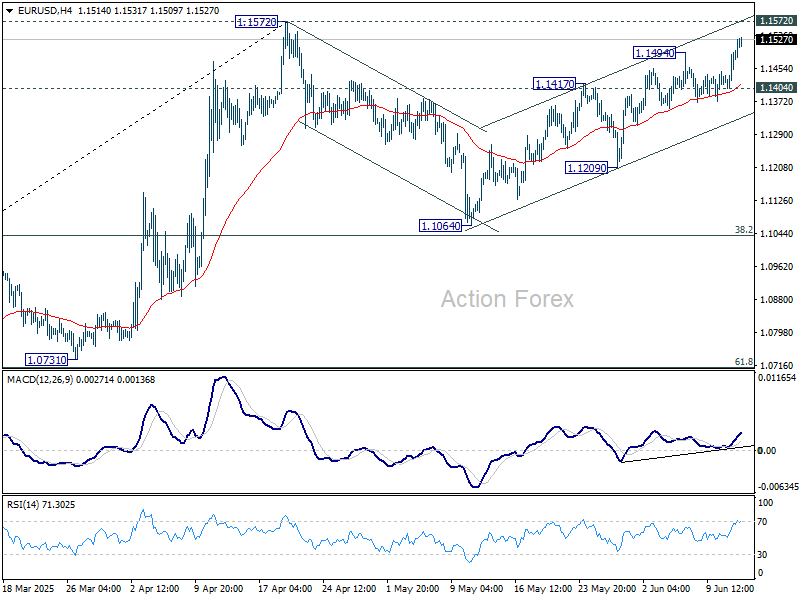
The first session of the Easter trading week evolved relatively quietly especially when compared to last week’s turbulence. US assets got some reprieve. Daily changes on the US yield curve ranged between -6.2 bps (30-yr) and -14.9 bps (5-yr). US Treasuries found some support in comments by Fed governor Waller who returned to the 2021-2022 playbook by calling the resulting inflation spike from Trump’s tariff policy as likely to be transitory. He outlined two potential scenarios, one with an average US tariff rate of 25% through 2027 and one where the average rate is negotiated down to 10%. In the latter, his base case, he expect inflation to peak close to 3% with the US economy able to withstand the growth hit. The Fed should stay put with rate cuts later this year on the table (“good news” cut scenario). In the adverse scenario, inflation is likely to peak near 5% with a significant slowdown in the economy prompting a spike in the unemployment rate. In that case, Waller argues that the Fed should start cutting rates sooner and to a greater extent in response to the deteriorating economy (“bad news” cut scenario). Waller’s comments contrast with weekend views by Minneapolis Fed Kashkari who ruled out interest rate cuts as an insurance policy against an economic slowdown instead focusing on keeping inflation expectations anchored. Atlanta Fed Bostic thinks that the uncertain outlook puts the Fed and the economy in a “big pause position”, targeting just one policy rate cut this year. US Treasury Secretary Bessent after market close also tried to sooth (Treasury) market stress by pointing out increased foreign demand at recent auctions (vs rumoured sovereign selling) and by showing readiness to act if necessary to improve liquidity (eg by expanding the buyback program for older, off the run, securities). US stock markets recovered between 0.5%-1% yesterday, helped by president Trump’s suggestion to temporarily exempt tariffs on imported vehicles and parts to buy manufacturers time in relocating production. Over the weekend, a similar exemption was given to some electronics. On the one hand, short-lived product exclusions are becoming part of the improvised tariff policy. On the other hand, probes into semiconductor and pharmaceutical imports are a prelude for more sectoral tariffs. EUR/USD traded volatile to close in the middle of the 1.13-1.14 day range. The eco calendar was thin and had no intraday impact. The NY Fed survey was the sole datapoint. It nevertheless showed short-term (1-yr) inflation expectations rising from 3.13% to 3.58%, the highest level since September 2023.
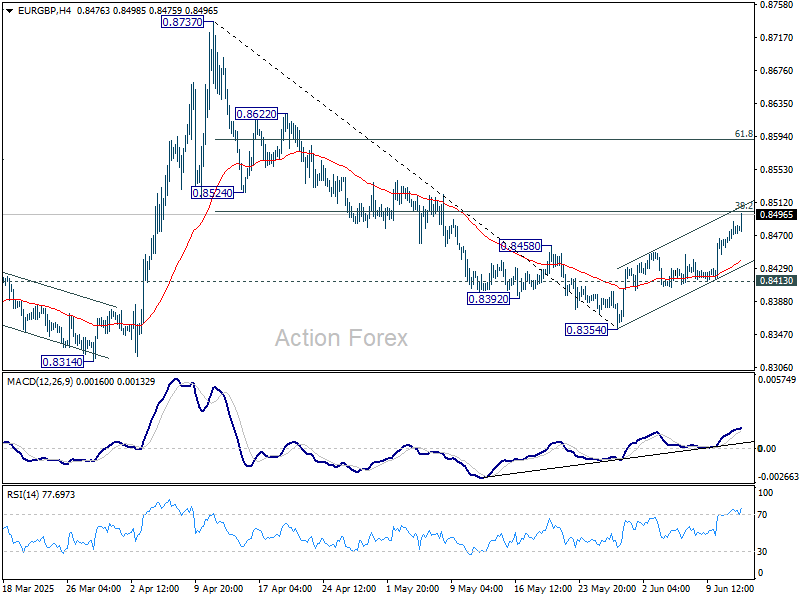
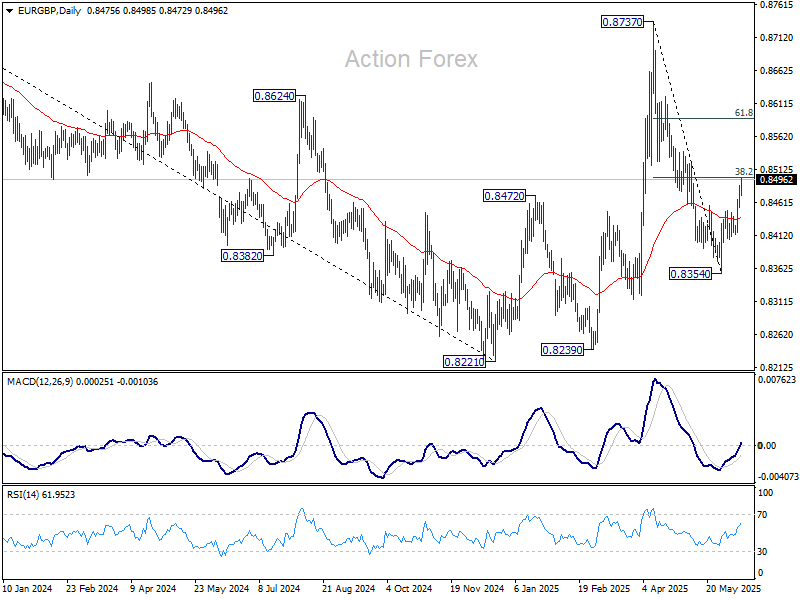
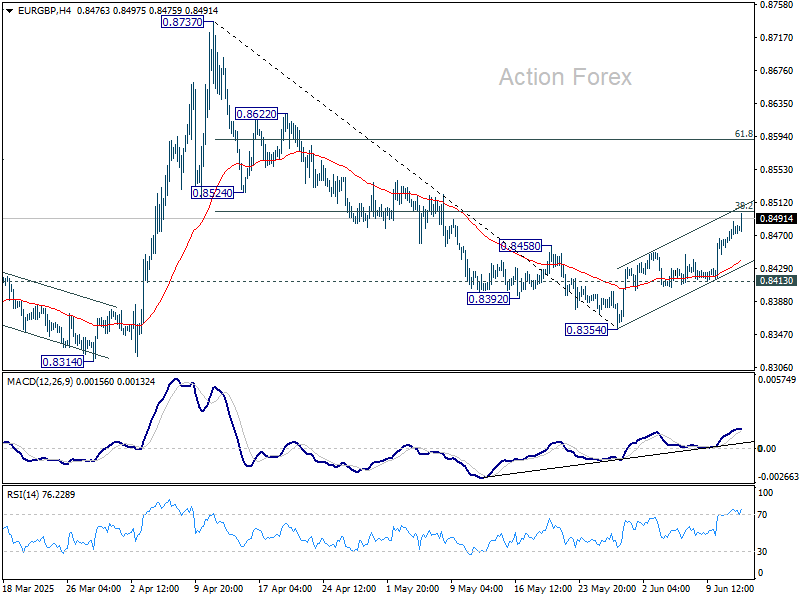
Risk sentiment remains more constructive this morning in Asian dealings. The ECB’s lending survey, German ZEW investor confidence, the US empire manufacturing survey and US import/export prices are on tap. We expect them to play second fiddle and look at the equity market for guidance. We continue to err on the side of caution and don’t think we’re already set for a sustained risk rebound. UK labour market data were close to consensus this morning and don’t effect sterling. EUR/GBP finds a bid near 0.86.
News & Views
UK’s British Retail Consortium said that retail sales in the period between March 2 and April 5 rose by 1.1% y/y and 0.9% when the same stores are polled. BRC noted this March figure is artificially lower due to the timing of Easter in 2024 (March) and this year (April) and its chief executive said that the numbers therefore mask signs of underlying strength of demand. Food sales rose 1.6% and will probably get a boost in the next update. The non-food category registered a 0.6% increase with the improving weather having made for a particularly strong final week (gardening, DIY equipment). BRC did warn for the government’s tax increase to be passed on to consumers later this year, triggering an inflation uptick and potentially capping consumer spending again.
South Korea upped a support package created last year by around 25% to KRW 33tn for its critical semiconductor industry. The government decided to do so in the face of growing uncertainty originating from US policy and rising competition from China. For the same reasons it also hiked a financial assistance programme for the sector to KRW 20tn. The news comes after the US late yesterday initiated probes into semiconductor as well as pharmaceutical imports for national security reasons. They are seen as the precursor to actual import tariffs.
Uncertainties Persist, But Treasury Pressure Remains Manageable
Markets kicked off the week on a positive note on relief regarding the consumer electronics tariffs – that will not be exempt but will be part of a different ‘tariff bucket’ (20% instead of 145% for those made in China). Then, there was some relief for auto and part makers, as well. As such, the European stocks rallied 2.70% on partial rollback of the tariffs, the US stocks kicked off the week higher,but euphoria weakened into the session end on news that the US Commerce Department launched a probe into chips and pharmaceutical imports on national security reasons. The S&P500 closed the session 0.80% higher, while the tech-heavy Nasdaq couldn’t keep more than 0.57% of this advance. Apple jumped nearly 7% at the open but ended the session 2.20% up, while Nvidia was up by almost 3% at the open but closed -0.20% lower despite announcing half a trillion worth of infrastructure investment with its bodies including TSM. TSM – on the other hand – that’s preparing to announce its Q1 results this week - closed 0.80% lower.
This morning, the futures are flat with Nasdaq futures under pressure. Sentiment is fragile on bipolar announcements from the US that’s taking a toll on companies’ and investors’ ability to make decisions...
... except for China! China this week makes the decision of not reacting anymore (which I think is the best option because I myself deal with a 4 and a6-year old everyday) Instead of responding to the US, China’s Xi visits Asian counterparts to convince them that whatever they will negotiate to avoid US tariffs – it won’t be stable enough than sealing a deal with China. Appetite for Chinese stocks remain limited with the CSI 300 near flat today and the Hang Seng index giving back early gains.
One man’s misery is another’s fortune. Volatility helps trading desks post shiny revenues. Goldman Sachs yesterday announced its best revenue for equities trading in history. Traders there made $4.2bn as clients adjusted portfolios in response to tariff-induced market swings.
We’ve seen worse
Uncertainties persist but the good news is that the pressure on the Treasuries front remains bearable – and that is one place to watch carefully to judge how dangerous volatility gets. The US 2-year yield eased to 3.85% on expectation that the Federal Reserve (Fed) would better intervene than not to keep the US economy afloat through the storm, while the 10-year yield eased to 4.35%. We are substantially above the 3.80-3.90% range of a week ago, but the easing tensions hint that the selloff across the stock markets could stabilize, as well. All that – of course – under the assumption that Trump doesn’t say anything extravagant.
If you want ultimate protection, gold is there for you at around $3230 per ounce level. Is it too high to buy? Yes, it’s relatively high. If we look at the mint ratio - the ratio between gold and silver – it spiked above 100 during last week’s risk selloff. This ratio normally trends between 60 and 80, and rises when growth expectations are cooling because silver is more tied to industrial demand, so it's riskier and more cyclical. Therefore, yes gold is valued at around 100 times the same amount of silver, and Goldman expects the price of an ounce to hit $4000 by the middle of next year. It’s high, but what’s high if China (and others) were to replace their treasury holdings by gold?
Speaking of waning growth expectations
OPEC joined others in announcing further cuts to its global demand forecast this year and the next on tariff uncertainty. They lowered their projections by 100K barrels a day for this year and the next and predict that demand will grow by 1.3mbpd (or about 1%) over the next two years. That’s still significantly higher than other agencies. EIA for example dampened its own growth forecast by 30% to 900K bpd, while GS sees demand rising by only half a mbpd. US crude is better bid after last week’s short crash to the $55pb level but risks remain tilted to the downside with the next natural target for the bears standing at the $50pb.
In the FX
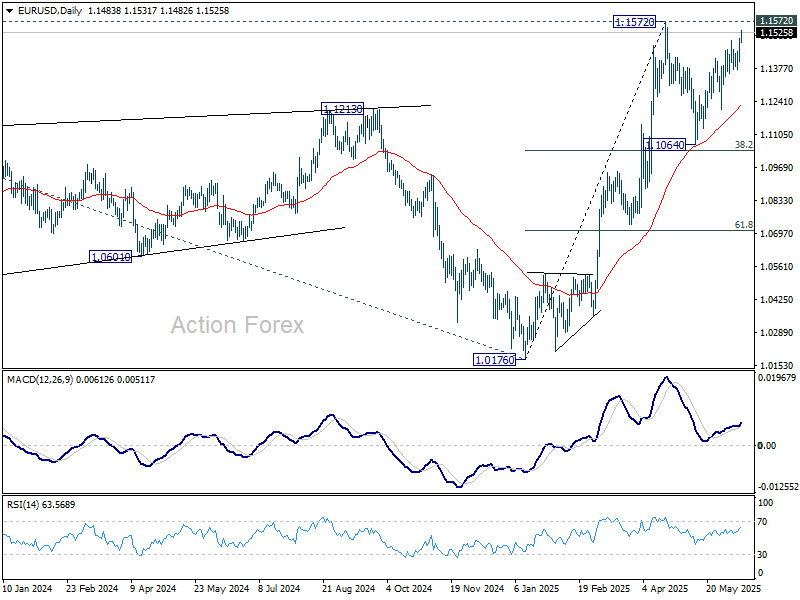
The more the US shakes the world with tariffs to get richer, the more the rest of the world dumps the dollar. The greenback remains under a decent pressure on waning growth expectations. Growth expectations are pulled lower everywhere – even in Germany that will benefit from massive defense and infrastructure spending – but the pace of deterioration of the US expectations are faster. As such, the dollar index consolidates below the 100 level this morning – the lowest levels in three years. The EURUSD remains bid above 1.13, Cable extends gains above 1.32, probably also fuelled by better than expected growth data of last Friday, the USDCAD sank below the 1.40 level and its 200-DMA last week despite the falling oil prices while the USDJPY consolidates near 142-143. The price rallies are interesting opportunities to strengthen short USDJPY positions on expectation that the Bank of Japan (BoJ) will remain supportive of the economy in the changing geopolitical spectrum.
Today, Canada and France will release their latest CPI updates, while German sentiment index and Eurozone industrial production are expected to come in soft enough to cement expectations that the European Central Bank (ECB) will cut the rates by 25bp this week and a few more times in the coming meetings if inflation remains under control. If that’s the case, the softness of the data could be good news for the euro and the European stocks.
AUD/USD Daily Report
Daily Pivots: (S1) 0.6287; (P) 0.6315; (R1) 0.6355; More...
AUD/USD's rally from 0.5913 is still in progress and intraday bias stays on the upside. Firm break of 0.6407 resistance will pave the way to 61.8% retracement of 0.6941 to 0.5913 at 0.6548, even still as a corrective move. On the downside, below 0.6180 minor support will turn intraday bias neutral first.
In the bigger picture, fall from 0.6941 (2024 high) is seen as part of the down trend from 0.8006 (2021 high). Next medium term target is 61.8% projection of 0.8006 to 0.6169 from 0.6941 at 0.5806. However, sustained trading above 55 W EMA (now at 0.6441) will argue that a medium term bottom was already formed, and set up further rebound to 0.6941 resistance instead.
Aussie Rises on Risk Rebound; RBA Keeps May Decision Open-Ended
Commodity currencies, including Australian, New Zealand, and Canadian Dollars, are trading broadly higher in today’s Asian session, buoyed by continued recovery in global stock markets. Sterling is also advancing alongside, supported by improving risk sentiment. Meanwhile, traditional safe havens like the Swiss Franc, Japanese Yen, are on the back, along with the greenback foot. Swiss Franc is particularly soft, pulling back after recent strong gains. Euro remains directionless in the middle of the pack, showing little inclination to break out against Dollar yet.
In RBA's minutes policymakers explicitly citing China’s response as a pivotal factor shaping Australia’s economic outlook and, by extension, future rate decisions. Given that China remains the only major economy actively retaliating against US tariffs, the fallout from a protracted trade war could be particularly impactful for Australia. While some analysts read the RBA’s language as a signal that a rate cut may come as soon as May, the actual odds remain more evenly balanced than market consensus might suggest. Tomorrow’s Australian employment report could help clarify the picture, at least a little bit.
Fed Governor Christopher Waller’s speech is worth a read. It offered a structured view of the unfolding US tariff regime. Waller outlined two potential paths: one focused on reshoring manufacturing and reducing trade dependency—implying a prolonged period of elevated tariffs. The other, a route aimed at leveraging tariffs to negotiate lower trade barriers from other countries. The ultimate outcome hinges on the political objectives of the Trump administration. But in reality, the likely result may lie somewhere between those extremes.
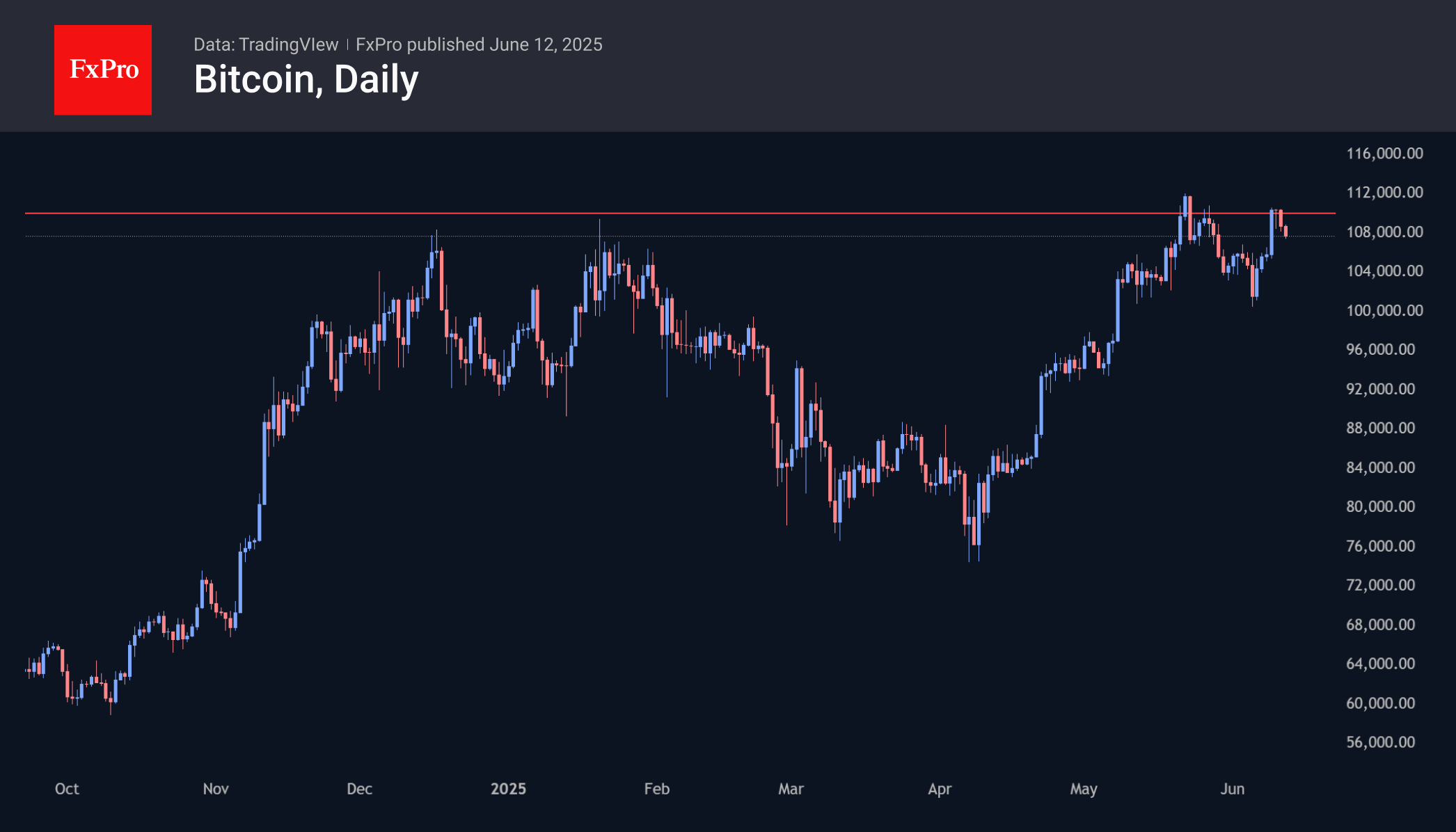
Technically, Bitcoin is showing signs of stabilizing after its recent pullback. It remains well supported by 73812 cluster support (38.2% retracement of 15452 to 109571 at 73617) for now. Bullish convergence condition in D MACD is raising chance of a near term reversal. Firm break of 88769 resistance will argue that correction from 109571 has completed already, and the larger up trend remains intact. Retest of 109571 high should then be seen next.
In Asia, at the time of writing, Nikkei is up 0.96%. Hong Kong HSI is down -0.11%. China Shanghai SSE is down -0.17%. Singapore Strait Times is up 1.75%. Japan 10-year JGB yield is up 0.032 at 1.372. Overnight, DOW rose 0.78%. S&P 500 rose 0.79%. NASDAQ rose 0.64%. 10-year yield fell -0.129 to 4.364.
Fed’s Waller weighs two tariff paths
In a speech overnight, Fed Governor Christopher Waller laid out two divergent scenarios for US tariff policy and their economic fallout.
The first scenario assumes high tariffs, near average 25% or more, and remain in place for an extended period. This reflects a structural shift toward domestic production and reduced trade dependence. The second scenario envisions a negotiated reduction in foreign trade barriers, which would lower the average tariff rate back to around 10%, closer to the levels anticipated earlier this year.
Waller warned that if the "high-tariff" regime holds, the US economy is likely to "slow to a crawl" with inflation rising to around 4% before retreating in 2026, assuming inflation expectations remain anchored. In this scenario, the unemployment rate could climb toward 5% next year as business investment weakens under higher costs and persistent uncertainty.
In contrast, if the current pause in reciprocal tariffs leads to meaningful progress in trade negotiations and the easing of barriers, Waller expects a milder economic impact. Under this "smaller tariff" path, the economy would continue to grow—albeit at a slower pace—while inflation would likely stay on a downward trend toward Fed’s 2% target. In such a case, he said, rate cuts could be warranted later this year as a “good news” policy move.
Fed's Bostic cautions against bold policy moves as trade fog stalls US economy
Atlanta Fed President Raphael Bostic warned that the Trump administration's tariff measures and broader policy ambiguity have effectively pushed the economy into a "big pause," making it difficult for the Fed to chart a clear policy path.
Bostic emphasized that this uncertainty argues against any aggressive policy shifts in either direction. “Moving too boldly with our policy in any direction wouldn’t be prudent.” He likened the current climate to a “really, really thick” fog that hampers effective decision-making.
On the inflation front, Bostic acknowledged that tariffs are likely to exert upward pressure on prices. He now sees inflation returning to that level no sooner than 2027, well beyond previous expectations.
Bostic also anticipates that economic growth will decelerate sharply, with GDP expanding just above 1% this year—less than half the pace seen in recent years.
RBA Minutes: Next rate move not predetermined, China’s tariff response a key variable
The minutes from RBA’s March 31–April 1 meeting revealed emphasized that it was "not yet possible to determine the timing of the next move in interest rates." The Board emphasized the importance that the "next decision was not predetermined".
Members agreed that the May meeting would offer a more "opportune time" for reassessment, as it would coincide with updated data on inflation, wages, employment, and global tariff developments, as well as a revised set of economic forecasts.
RBA highlighted that the economic outlook could be significantly shaped by how Chinese authorities respond to global tariff developments. Meanwhile, RBA acknowledged that risks to the outlook exist on both sides.
On one hand, global trade uncertainties and softening demand may pose disinflationary pressures, while on the other, risks such as supply chain disruptions and currency depreciation could fuel inflation.
RBA opted to keep the cash rate unchanged at 4.10% at the meeting.
Looking ahead
Germany ZEW economic sentiment, and Eurozone industrial production will be featured in European session. Later in the day, main focus is on Canada CPI. US will release Empire state manufacturing and import prices.
AUD/USD Daily Report
Daily Pivots: (S1) 0.6287; (P) 0.6315; (R1) 0.6355; More...
AUD/USD's rally from 0.5913 is still in progress and intraday bias stays on the upside. Firm break of 0.6407 resistance will pave the way to 61.8% retracement of 0.6941 to 0.5913 at 0.6548, even still as a corrective move. On the downside, below 0.6180 minor support will turn intraday bias neutral first.
In the bigger picture, fall from 0.6941 (2024 high) is seen as part of the down trend from 0.8006 (2021 high). Next medium term target is 61.8% projection of 0.8006 to 0.6169 from 0.6941 at 0.5806. However, sustained trading above 55 W EMA (now at 0.6441) will argue that a medium term bottom was already formed, and set up further rebound to 0.6941 resistance instead.
RBA Minutes: Next rate move not predetermined, China’s tariff response a key variable
The minutes from RBA’s March 31–April 1 meeting revealed emphasized that it was "not yet possible to determine the timing of the next move in interest rates." The Board emphasized the importance that the "next decision was not predetermined".
Members agreed that the May meeting would offer a more "opportune time" for reassessment, as it would coincide with updated data on inflation, wages, employment, and global tariff developments, as well as a revised set of economic forecasts.
RBA highlighted that the economic outlook could be significantly shaped by how Chinese authorities respond to global tariff developments. Meanwhile, RBA acknowledged that risks to the outlook exist on both sides.
On one hand, global trade uncertainties and softening demand may pose disinflationary pressures, while on the other, risks such as supply chain disruptions and currency depreciation could fuel inflation.
RBA opted to keep the cash rate unchanged at 4.10% at the meeting.
(RBA) Minutes of the Monetary Policy Meeting of the Reserve Bank Board
Sydney – 31 March and 1 April 2025
Members present
Michele Bullock (Governor and Chair), Andrew Hauser (Deputy Governor and Deputy Chair), Marnie Baker, Renée Fry-McKibbin, Ian Harper AO, Carolyn Hewson AO, Steven Kennedy PSM, Iain Ross AO, Alison Watkins AM
Others present
Sarah Hunter (Assistant Governor, Economic), Brad Jones (Assistant Governor, Financial System), Christopher Kent (Assistant Governor, Financial Markets)
Anthony Dickman (Secretary), David Norman (Deputy Secretary)
Meredith Beechey Osterholm (Head, Monetary Policy Strategy), Andrea Brischetto (Head, Financial Stability Department), Sally Cray (Chief Communications Officer), David Jacobs (Head, Domestic Markets Department), Michael Plumb (Head, Economic Analysis Department), Penelope Smith (Head, International Department), Claudia Seibold (Senior Manager, Domestic Markets Department, for the discussion of ‘Assessing the RBA’s government bond holdings’)
First meeting
The Governor welcomed members to the inaugural meeting of the Monetary Policy Board.
Financial conditions
Members began their discussion of financial conditions by reviewing central bank policy rates in advanced economies. All central banks had acknowledged the heightened and ongoing uncertainty surrounding both the scope and potential impact of US trade policies. Members noted that expectations for policy rates in the United States and Canada had eased over prior months. Central banks in both countries had communicated downside risks to growth and upside risks to inflation from US tariffs, though the US Federal Reserve’s central expectation was for the effect on domestic inflation to be transitory. The lower expected path for US policy rates also reflected reduced market expectations of stimulatory fiscal policies and some softer-than-expected economic data.
In other major economies, financial market expectations for central bank policy rates had been more stable. In Europe, expectations of substantial fiscal stimulus – driven by an anticipated increase in defence spending and a relaxation of fiscal rules – had tempered expectations for further policy rate cuts. Expectations that the Bank of Japan’s policy rate would be increased had risen in response to stronger-than-expected wages data and broader expectations that inflationary pressures in Japan are likely to be sustained.
In Australia, market participants’ expectations for the path of the cash rate had shifted a little higher in the near term, in response to communication following the February monetary policy meeting, but expectations had declined further out in response to international developments. Members noted that market pricing at the time was for further cuts in the cash rate totalling 50-75 basis points by the end of 2025 – with little-to-no probability of a cut at the present meeting and around a 65 per cent probability of a cut in May. The cash rate path expected by market economists was a little higher than that reflected in market pricing. Members discussed possible explanations for this, including that market pricing incorporated some probability of very adverse outcomes associated with a marked escalation in trade tensions.
Longer term sovereign bond yields in advanced economies had drifted lower in the United States and Canada but had risen slightly in Europe and Japan, in part reflecting the different shifts in expectations for central bank policy in those economies. In the United States, market-implied measures of inflation expectations derived from bond yields had increased at the two-year horizon but remained largely unchanged at longer horizons, suggesting that market participants expected the announced tariffs would not have persistent effects on US inflation. Outside of North America, market measures of inflation expectations were little changed, including in Australia.
Turning to conditions in corporate funding markets, members noted that equity prices in the United States had fallen by almost 10 per cent from their peak as risk sentiment had deteriorated and the outlook for the US economy had weakened. By contrast, European equity prices had risen by more than 10 per cent since November, in response to expectations of greater defence and infrastructure spending and increased hopes of a ceasefire between Russia and Ukraine. Equity prices had declined in Australia by less than in the United States but by a similar amount to other small open economies that were particularly exposed to declines in global trade. Members noted that despite these recent movements, measures of compensation for risk in equity and corporate bond markets remained very low in all advanced economies. An important question was whether that optimism was justified on the basis of a relatively positive outlook for global activity, or whether it indicated the potential for financial conditions to tighten considerably if outcomes deteriorated, even modestly, relative to market expectations.
In China, total social financing had increased as a result of very strong growth in Chinese Government bond issuance. Household credit growth had also picked up but remained very low, with weakness in the property sector an ongoing constraint.
The Australian dollar had depreciated slightly on a trade-weighted basis since the previous monetary policy meeting. This had been driven by depreciation against the Chinese renminbi, the euro and the yen, and mainly reflected changing interest rate differentials. Commodity prices – another key determinant of the Australian dollar historically – had been little changed for several months. In trade-weighted terms, the Australian dollar was at the bottom of the range it had moved in over recent years and close to, or a little below, the various staff estimates of its long-run equilibrium value based on current information. Members noted that the Australian dollar had been an important automatic stabiliser for the economy in the face of sizeable global shocks and was expected to continue to play that role.
Members noted that Australian households’ debt servicing payments were still around their highest levels since 2012 as a share of household disposable income. Scheduled debt payments had stabilised relative to incomes over the second half of 2024, including because of growth in household incomes. However, households had increased their extra mortgage payments over the same period to pay down debt more quickly. Members noted that the reduction in the cash rate in February would reduce required household debt servicing payments somewhat and could provide indebted households with scope to finance higher consumption.
While overall financial conditions in Australia had eased a little with the cut in the cash rate target in February, members’ assessment was that they were still restrictive. Members nonetheless explored the extent to which competition among banks over preceding years and other factors had relaxed financial conditions. Aggregate credit growth had been somewhat stronger than in the years leading into the pandemic, which was unusual during a period of relatively high interest rates and in contrast to other advanced economies. Business credit growth had strengthened further in preceding months, though housing credit growth had moderated alongside weak housing price growth. Household credit had declined a little relative to income over preceding years, and business debt had risen only slightly as a share of GDP, from low levels.
International economic conditions
Members discussed the implications for the global economy of ongoing trade policy uncertainty. The US administration had imposed tariffs on Canada and Mexico, increased tariffs on China and set 25 per cent tariffs on aluminium and steel imports from all countries. Canada, China and the European Union had announced retaliatory tariffs. The United States had signalled that it would raise tariffs further, with an announcement of additional tariffs expected shortly after the meeting.
Members noted that a range of timely indicators of US economic sentiment had declined sharply, including consumer confidence, some business surveys and equity prices. This had increased the likelihood of lower growth in US household spending and business investment. Market economists’ forecasts for output growth in North America had been downgraded following announcements of higher tariffs, though forecasts for growth in Australia’s major trading partners had been less affected so far. The overall impact on global growth would depend on the policy responses in other economies. Members noted that recent data had suggested some pick-up in growth in China. Chinese authorities had also confirmed a 5 per cent GDP growth target in 2025, backed by more supportive fiscal policy to offset headwinds from tariffs and the still-weak property sector.
Members observed that the implications of tariffs for inflation could further complicate the global economic outlook. Inflation was still above central banks’ targets in some advanced economies and progress on disinflation had stalled or even reversed a little in some cases. Against this backdrop, countries imposing tariffs could experience higher import prices, supply chain disruptions and efficiency losses (resulting from tariff-induced distortions to trade patterns). These developments would raise the price level. If they also resulted in inflationary pressures that offset the disinflationary effects of lower output growth, policymakers in countries imposing tariffs could be faced with the challenging combination of slowing output growth and higher inflation. A range of market economists saw this as the most likely outcome for the United States in the period ahead.
The extent to which these international developments would affect the Australian economy was a further source of uncertainty and depended on a range of factors. Assuming the global tariffs announced so far and that the Australian Government did not impose retaliatory tariffs, a model-based scenario showed that the effects on GDP growth and inflation in Australia could be relatively modest. This reflected Australia’s limited direct trade exposure to the United States, additional policy support in China and Australia’s flexible exchange rate. There were clear downside risks for Australian growth relative to this scenario, if tariffs and policy uncertainty have a greater effect on global growth than expected, if the spillovers to Australia are larger or if there were further material increases in tariffs in other economies, including those that are important for Australia. However, the risks to Australian inflation were more two-sided and would depend on the timing and relative size of the effects on aggregate demand and supply: weaker global demand and the possibility of trade diversion away from the United States could reduce inflation in Australia, but a larger exchange rate depreciation or more substantial global supply disruptions could increase inflation.
Members observed that concerns about US trade policy were already having a material influence on planning activities of some globally oriented Australian firms, but did not yet appear to be a widespread consideration for domestically focused firms. Similarly, trade measures were yet to have a significant effect on measured activity or inflation in Australia. Members nevertheless emphasised the importance of being alert to any signs of this changing.
Domestic economic conditions
Turning to domestic conditions, members noted that recent domestic data had been generally consistent with the forecasts in the February Statement on Monetary Policy.
GDP growth had picked up in the December quarter 2024, broadly as expected and consistent with a continued recovery in domestic demand. In per capita terms, GDP had risen for the first time since late 2022, albeit only slightly. Private demand had increased modestly in the December quarter, led by household consumption, while public demand had continued to support growth. The limited information available about activity in early 2025 suggested that the pick-up in GDP growth had been sustained. Natural disasters in parts of Queensland and New South Wales, while having a significant impact on affected areas, were expected to have only a modest impact on aggregate GDP. The 2025/26 Australian Government Budget had not conveyed material changes to the outlook for overall public demand.
Household consumption growth had started to recover in the December quarter, underpinned by the ongoing pick-up in real household incomes. While some of this recovery in consumption appeared to reflect price-sensitive consumers concentrating spending in promotional periods during the December quarter, the pick-up in spending growth among components not affected by sales events suggested there had been a genuine improvement in underlying momentum. More recent indicators signalled that some of this pick-up had been sustained.
Members noted the staff’s overall assessment that labour market conditions remained tight. The unemployment rate had increased slightly in early 2025, as expected, and was little changed since mid-2024. Underemployment had declined further to its lowest level since early 2023. Other indicators had also contributed to the assessment that labour market conditions were tight, including job vacancies, job advertisements and the share of firms reporting labour availability as a significant constraint on output. However, the quits rate – which measures the share of employees voluntarily leaving jobs – had continued to decline, perhaps signalling that inter-firm competition for labour had eased. More broadly, the NAB measure of firms’ capacity utilisation had declined a little further in February, consistent with gradually easing capacity pressures outside the labour market.
Members discussed the surprising decline in employment and the participation rate in February. Given this was only one month’s data, it seemed possible that the declines were a result of volatility in the monthly labour force data rather than an indication of softening in labour market conditions. Other sources of information were not indicating a sharp deterioration in employment growth: employment intentions from liaison and business surveys had stabilised or picked up a little recently, and income tax withholding collections had not exhibited any unusual patterns. Members agreed on the importance of monitoring employment outcomes closely over coming months.
Data on wages and labour costs received since the previous monetary policy meeting had provided somewhat contradictory signals. Year-ended growth in the Wage Price Index (WPI) had eased in the December quarter 2024, to 3.2 per cent. This pace of wages growth was in line with expectations, but revisions to the quarterly data suggested there was slightly less momentum at the end of 2024 than had been expected. By contrast, average earnings from the national accounts and unit labour costs – which are more comprehensive but more volatile measures of labour compensation and labour costs than the WPI – had grown more strongly in late 2024 than expected. Unit labour costs had increased by around 5½ per cent over 2024, significantly higher than the average growth rate over the inflation targeting period, in part reflecting ongoing weakness in measured productivity. Members noted the staff’s assessment that, on balance, the information in the data on wages and unit labour costs received in preceding weeks was broadly offsetting in terms of implications for the inflation outlook. This judgement would, however, be reviewed as part of the updated forecasts in May.
The monthly CPI indicator suggested that trimmed mean inflation would be likely to fall below 3 per cent in the March quarter, even with some likely pick-up in the quarterly outcome because of anticipated strong growth in certain administered prices and the unwinding of some temporary factors. Recent outcomes in other inflation sub-components had been consistent with the staff’s expectations. New dwelling construction prices had declined slightly in recent months, though advertised rents had been stronger than expected. Some firms continued to report in liaison that weak demand had limited the extent to which they could pass input cost pressures through to consumer prices. Members noted that the energy rebate extension announced in the Australian Government Budget would affect the profile of headline inflation in 2025 and 2026.
Financial stability assessment
Members considered the staff’s semi-annual assessment of financial stability risks. The staff assessed that the Australian financial system had continued to display a high level of resilience, and that banks were well placed to continue supporting the economy even in the event of a significant economic downturn. Accordingly, members observed that there were no immediate implications for monetary policy arising from domestic financial stability considerations.
While financial pressures remained pervasive across the Australian community, they had generally eased a little. This reflected lower inflation, the Stage 3 income tax cuts and the reduction in the cash rate in February. The share of borrowers who had fallen behind on their mortgage payments had stabilised at around pre-pandemic levels, and most mortgagors had maintained large liquidity and equity buffers. While lower income borrowers had been more likely to fall behind on their mortgages, arrears rates for these borrowers were well contained and had been declining since mid-2024. Borrowers in aggregate had continued to add to prepayment buffers over recent months. The share of borrowers in severe financial stress was likely to decline further in the period ahead under the staff’s central projections for the economy, although uncertainty about the outlook remained pronounced.
Looking further ahead, members noted that the RBA and other regulators were attentive to vulnerabilities that might build in the financial system if households responded to an actual or anticipated easing in financial conditions by taking on excessive debt. While lending standards were currently sound, historical experience both in Australia and abroad suggested that periods of lower interest rates can coincide with riskier borrowing activity, a rapid increase in house prices and, at times, a relaxation of lending standards. Historically, borrowing by investors had been particularly sensitive to changes in conditions in the mortgage market. The potential for this activity to amplify the credit and housing market cycle would be monitored closely.
Business insolvencies had continued to rise but, on a cumulative basis, were still slightly below their pre-pandemic trend. Members observed that broader spillovers to the financial system had been limited because insolvent firms were generally small and did not have significant levels of bank debt. Most business borrowers had continued to manage the pressures on their finances, and leading indicators of financial stress in the corporate sector – such as overdue trade credit – had stabilised or improved.
Notwithstanding the resilience of the domestic financial system, members recognised the potential for heightened geopolitical tensions and global trade policy uncertainty to interact with existing vulnerabilities in the global financial system. In this context, members acknowledged the work being done by the RBA and other agencies of the Council of Financial Regulators to reinforce the resilience of the financial system to withstand geopolitical risks, including risks relating to cyber threats and potentially severe operational disruptions to financial and other national infrastructure.
Members discussed several vulnerabilities in key international financial markets that also had the potential to affect the Australian financial system. Term premia for long-term advanced economy government bonds had begun to increase, after several years during which they had been unusually low, partly in response to deteriorating fiscal outlooks. Members noted the potential for more significant adjustments in global bond term premia if geopolitical or fiscal risks were to worsen. Compressed risk premia in US equity and credit markets also increased the likelihood that adverse news could spark a disorderly correction in international asset prices. The increased use of leverage and large positions established by some international hedge funds in key overseas financial markets had the potential to amplify such shocks. In an extreme scenario, a rapid and disorderly repricing in global asset markets and disruptions to funding markets had the potential to spill over to the Australian financial system.
Domestically, members noted the importance of banks and superannuation funds ensuring their liquidity risk management frameworks were able to withstand severe-but-plausible liquidity shocks. In the past, the superannuation sector had generally displayed a high level of resilience to market shocks and funds’ investment activities had tended to support financial stability, but the growth in assets under management meant that strengthening superannuation funds’ governance and risk management practices remains a focus of regulators. Members also discussed the Australian Prudential Regulation Authority’s expectations that smaller banks should take steps to improve the diversification of their liquidity portfolios.
Considerations for monetary policy
Turning to considerations for the monetary policy decision, members noted that the flow of data since the previous monetary policy meeting had been largely in line with the expectations of the staff. Inflation had continued to decline gradually. The labour market was judged to be tighter than was consistent with full employment and, at this stage, the large fall in employment in February was considered more likely to be a statistical aberration than a turning point in labour demand. Members assessed domestic financial conditions to be still somewhat restrictive. The most significant development in the period leading up to the meeting had been the significant rise in uncertainty about global trade policy, although the effect of this on sentiment and economic developments in Australia was not yet clear.
In light of this assessment, members agreed that the outlook for inflation and the labour market set out in the February Statement on Monetary Policy remained an appropriate starting point for their policy deliberations. So far, the economy appeared to be tracking in line with the staff’s forecasts, which were for underlying inflation to return to the 2-3 per cent range from mid-2025 before settling a little above the midpoint.
Members turned their discussion to the risks that were most prominent in their thinking about the economic outlook, and the relative importance of these. They agreed that the risks to the outlook were two-sided, with some that could result in economic activity and inflation in Australia being weaker than expected and others that could result in economic activity and inflation strengthening more noticeably.
Regarding risks emanating from the domestic economy, members judged that the nature and importance of these had not changed materially since the previous monetary policy meeting. They noted that several of the domestic risks could result in a tighter labour market and higher inflation were they to materialise. These risks included the potential for the tight labour market and strong growth in unit labour costs to have a more pronounced effect on inflation than anticipated. Members noted that it was also possible that the emerging recovery in domestic private demand could prove stronger than expected. They observed that this could occur if financial conditions were less restrictive than they currently assumed. Members also observed that an important assumption underpinning the forecasts was that productivity growth picked up and that this was not assured. They emphasised that the prolonged period of above-target inflation over prior years made these risks more salient and discussed the importance of not jeopardising the progress that has already been achieved in bringing inflation sustainably back to the midpoint of the target by easing monetary policy prematurely, particularly considering the experience of some other countries where disinflation appeared to have stalled.
At the same time, members noted that several other domestically generated risks could see economic activity and inflation slow by more than expected. They observed that the degree of tightness in the labour market was still uncertain and that, if there turned out to be more capacity in the labour market than the staff had assessed, inflation could return to target sooner than currently forecast. The likelihood of that possibility would increase if the slowing in wages growth in late 2024 continued or if the recent weakness in employment persisted. It was also possible that the anticipated pick-up in consumption growth again proved to be overly optimistic.
Regarding risks to the outlook for the global economy, members noted that these had increased and were tilted to the downside. They agreed that a significant further increase in global tariffs or other trade restrictions could materially disrupt global trade. Uncertainty about global economic policy settings could also lead firms and households to reduce spending and investment. If either of those consequences were to transpire, global economic activity could fall significantly, though the implications for inflation would be more complicated.
Members agreed that the implications of global developments for the Board’s policy decisions would depend on their effects on Australian activity, inflation and employment. It was possible to envisage circumstances in which the impact was significant, and members acknowledged that it is important for monetary policy to be forward-looking. However, the information to hand did not imply a significant change in the outlook, despite the substantial level of uncertainty. Even with the recent adjustments in some markets, pricing in financial and commodity markets was cautiously optimistic. And heightened global uncertainty did not yet appear to be having a significant effect on domestic spending. Members noted that while concerns about global trade policy were receiving scrutiny by Australian companies that export to the United States, sentiment among domestically focused companies had not yet adjusted downwards. The implications for Australia of global tariff settings would also depend on how Chinese authorities respond, and members noted the Chinese authorities’ stated commitment to maintaining output growth around 5 per cent. Importantly, the Board would need to monitor closely the implications of global developments for Australian inflation. Some of those developments could exert disinflationary pressure, including weak demand and the potential for trade diversion, but others could be inflationary, such as potential impairments to global supply chains and exchange rate depreciation.
In light of these considerations, members agreed that it was appropriate to maintain the cash rate target at its current level at this meeting. There had not been sufficient information to alter the central outlook for the Australian economy significantly. In addition, members judged that it was not appropriate at this stage for monetary policy to react to the potential risks that could move outcomes in either direction. It was nevertheless important to remain alert to the evolving balance of risks. Members observed that the May meeting would be an opportune time to revisit the monetary policy setting with the benefit of additional data about inflation, wages, the labour market and trends in economic activity, along with a fresh set of economic forecasts and further information about the likely evolution of global trade policies. Collectively, this information would have a considerable bearing on their decision.
Looking forward, the Board discussed the monetary policy strategy, which was to bring inflation back to the midpoint of the target band while maintaining as much of the gains in employment as possible. While the available information suggested that the strategy was on track, members agreed that it was not yet possible to determine the timing of the next move in interest rates. They noted that future decisions would, in each instance, depend on new information and its implications for the economic outlook. Members noted risks to the outlook on both sides, and that monetary policy was well placed to respond to international developments were they to have material implications for Australian activity and inflation. Given this, members agreed that it would be helpful if the Board’s public communication following the meeting made it clear that the outcome of its next decision was not predetermined.
In finalising the policy statement, members emphasised the need to be cautious and alert to the evolving economic outlook, and the importance of future decisions being guided by the incoming information and the assessment of risks. They agreed that sustainably returning inflation to target is the Board’s highest priority and that it will do what is necessary to achieve that outcome.
The decision
The Board decided to leave the cash rate unchanged at 4.10 per cent, and the rate on Exchange Settlement balances unchanged at 4.00 per cent.
Assessing the RBA’s government bond holdings
Members discussed the staff’s latest assessment of the pace at which the RBA’s holdings of government bonds were running down. The current approach – which had been endorsed by the Reserve Bank Board in December 2023 – is to hold these bonds until maturity but review it periodically. As in previous assessments, the paper considered the options of continuing with the current approach or reducing the RBA’s holdings by gradually selling bonds. Members agreed that there were no clear reasons at present to vary the pace of rundown for monetary policy or financial stability purposes, but the scale and maturity structure of the holdings did have implications for the RBA’s risks and returns. Given that, members agreed to seek the views of the Governance Board on risk and return considerations. A decision could then be made in due course on the basis of those considerations and any potential implications for monetary policy and financial stability.
Fed’s Bostic cautions against bold policy moves as trade fog stalls US economy
Atlanta Fed President Raphael Bostic warned that the Trump administration's tariff measures and broader policy ambiguity have effectively pushed the economy into a "big pause," making it difficult for the Fed to chart a clear policy path.
Bostic emphasized that this uncertainty argues against any aggressive policy shifts in either direction. “Moving too boldly with our policy in any direction wouldn’t be prudent.” He likened the current climate to a “really, really thick” fog that hampers effective decision-making.
On the inflation front, Bostic acknowledged that tariffs are likely to exert upward pressure on prices. He now sees inflation returning to that level no sooner than 2027, well beyond previous expectations.
Bostic also anticipates that economic growth will decelerate sharply, with GDP expanding just above 1% this year—less than half the pace seen in recent years.