

Sample Category Title
Aussie Shifts Focus to Australian Jobs Data
The minutes from the latest monetary policy meeting by the Reserve Bank of Australia underlined the importance of the labor market in setting interest rates on Tuesday, making the Australian employment report due on Thursday at 0130 GMT the next major event for the aussie.
After an upsetting 4.3k increase in February, the economy is expected to have created 12k new job positions in March. While, at a first glance, this could be considered as progress, the addition is still among the lowest levels reported over the past two years. The participation rate is not anticipated to excite either as the measure is seen steady at 65.6%. But the unemployment rate, which dropped to an eight-year low of 4.9% last month is projected to return to 5.0%.
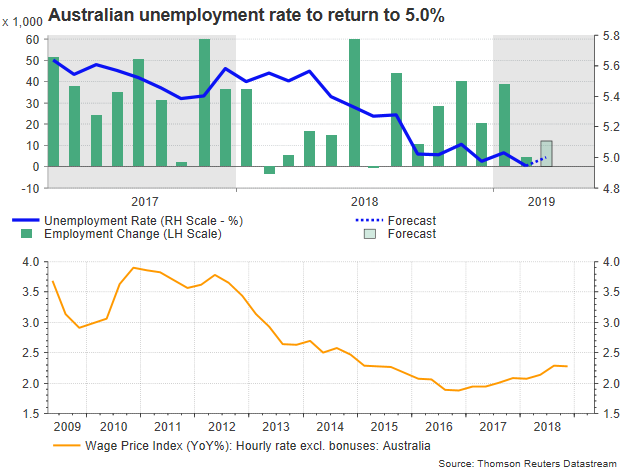
Since the RBA forecasts an unemployment rate of 5.0% in the current year, such a result would not raise much concern among policymakers. Yet, the outcome would not be welcomed either as the central bank believes that only a rate well below that level would trigger larger wage increases, consequently forcing inflation to move towards the 2.0% midpoint target.
In terms of interest rates, the RBA’s April meeting minutes have clearly messaged on Tuesday that a reduction in borrowing costs would be favorable under an upward-trending unemployment rate and a subdued inflation. Even if this is not yet the case as the jobless rate continues to hold a downtrend since last April, a failure to extend the fall in the coming months accompanied with a stubbornly tepid consumer spending and a non-responsive inflation would call for lower interest rates.
Given the country’s high exposure to global risks such as the US-Sino trade war, a 25-bps rate cut may be appropriate if economic conditions deteriorate as markets have fully priced in by October. Still, with recent headlines showcasing progress in trade talks between Washington and Beijing, and data out of China – Australia’s major export partner – recovering, the central bank may wisely search for more concrete evidence before taking any action. Besides, with a household debt-to-GDP ratio above 120%, the RBA policymakers would think twice to ease borrowing costs.
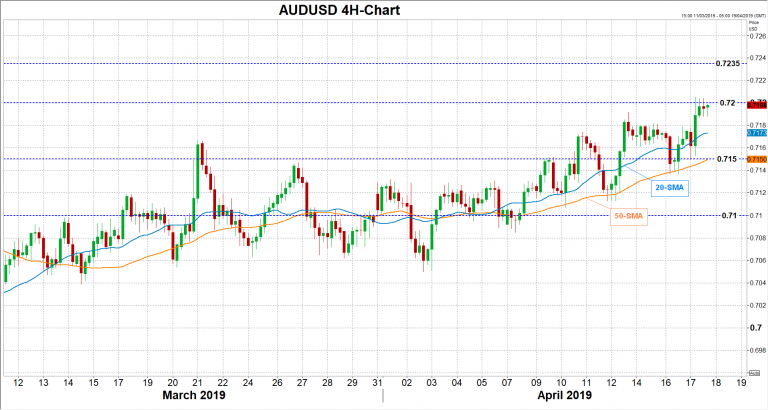
Turning to market reaction, AUDUSD may likely crawl back above 0.7200 and towards the 0.7235 resistance if the employment figures prove further tightening in labor market, particularly through a declining unemployment rate that could slash chances for a rate cut. Breaking higher, the January peak of 0.7294 may be the next target.
In the wake of disappointing readings, investors would get more convinced that the next move in interest rates may be down, with the price slipping towards the 50-period simple moving average (SMA) in the four-hour chart (currently at 0.7150). Beneath that, the 0.7100 mark could halt downside corrections as well.
EUR/USD Mid-Day Outlook
Daily Pivots: (S1) 1.1269; (P) 1.1292; (R1) 1.1303; More.....
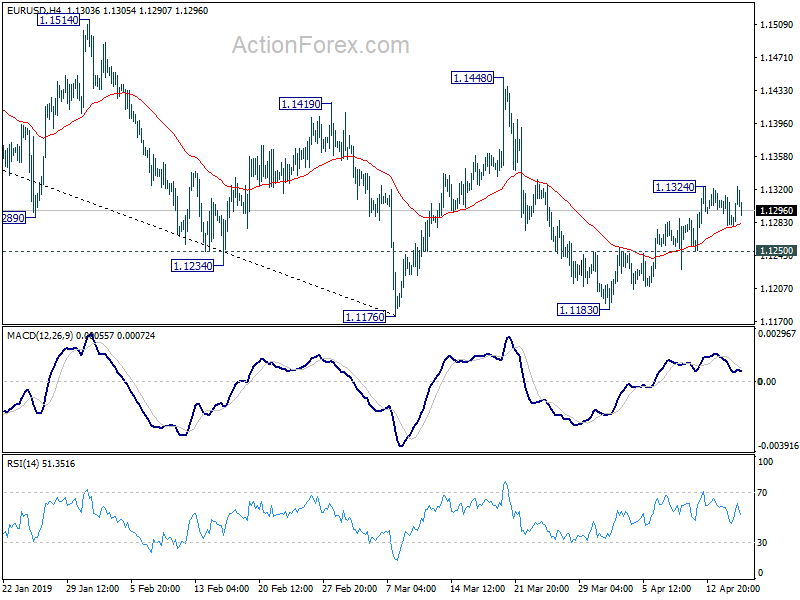
Intraday bias in EUR/USD remains neutral for the moment. With 1.1250 minor support intact, further rise is in favor to 1.1448 resistance and above. But in that case, we'd expect strong resistance between 1.1448/1569 to limit upside. On the downside, below 1.1250 minor support will turn bias to the downside. Decisive break of 1.1176 will resume the down trend from 1.2555.
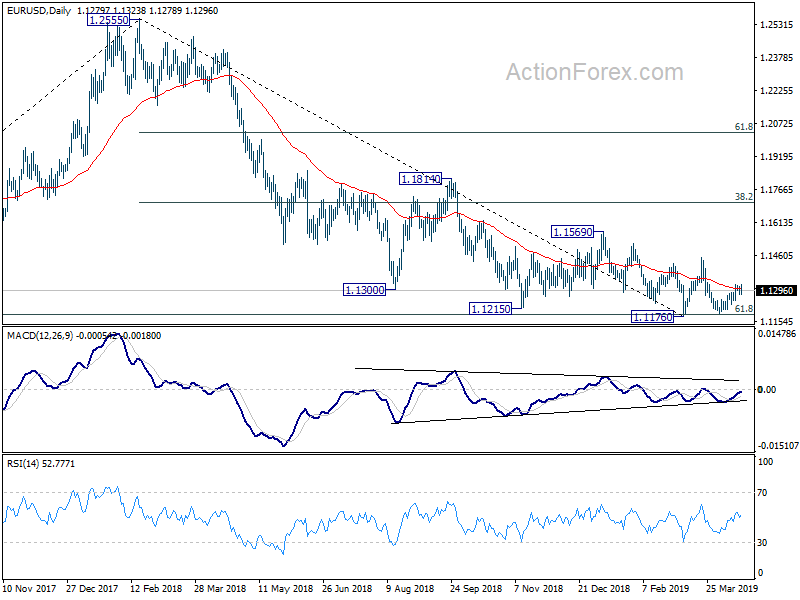
In the bigger picture, EUR/USD has been losing downside momentum around 61.8% retracement of 1.0339 (2016 low) to 1.2555 (2018 high) at 1.1186. But for now, there is no clear sign of medium term reversal yet. Downside from 1.2555 is expected to resume sooner or later as long as 1.1569 structural resistance holds. Decisive break of 1.1186. could pave the way back to 1.0339 low.
GBP/USD Mid-Day Outlook
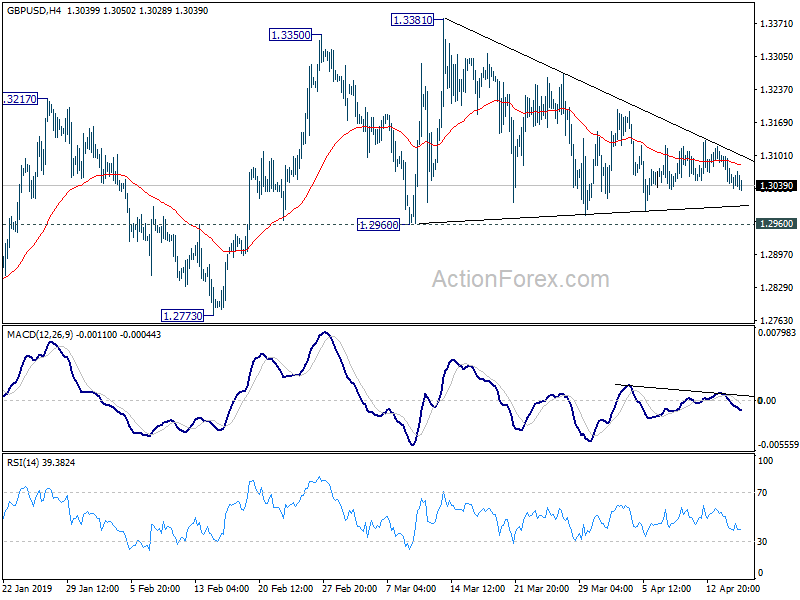
Daily Pivots: (S1) 1.3024; (P) 1.3068; (R1) 1.3094; More....
GBP/USD is still bounded in consolidation from 1.3381 and intraday bias remains neutral. Outlook is unchanged that further rise is expected with 1.2960 support intact. On the upside, decisive break of 1.3381 resistance will resume whole rise from 1.2391. Next target will be 61.8% retracement of 1.4376 to 1.2391 at 1.3618 next. However, on the downside, sustained break of 1.2960 will indicate that rebound from 1.2391 has completed earlier than expected. Deeper fall would then be seen to 1.2773 support for confirmation.
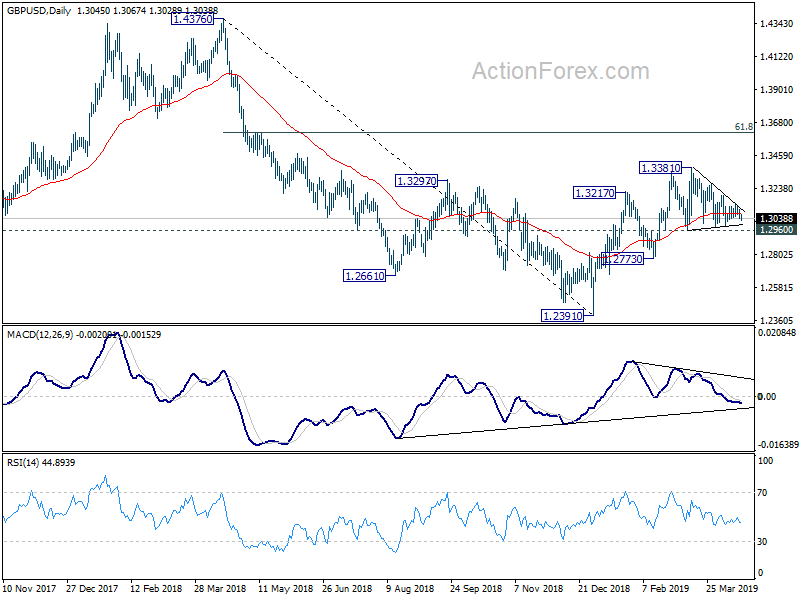
In the bigger picture, medium term decline from 1.4376 (2018 high) should have completed at 1.2391. Rise from 1.2391 is seen as the third leg of the corrective pattern from 1.1946 (2016 low). Further rise could be seen through 1.4376 in medium term. On the downside, though, break of 1.2773 support will dampen this view. Focus will be turned back to 1.2391 low and break will resume the fall from 1.4376 to 1.1946.
USD/CHF Mid-Day Outlook
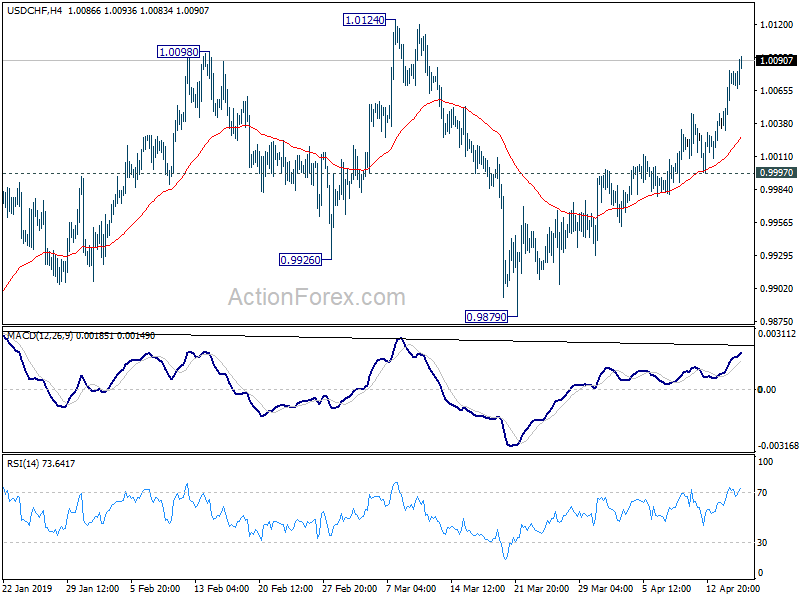
Daily Pivots: (S1) 1.0045; (P) 1.0064; (R1) 1.0096; More...
Intraday bias in USD/CHF remains on the upside for 1.0124/8 resistance. We'd be cautious on strong resistance from there to limit upside. On the downside, below 0.9997 minor support will turn bias to the downside for 0.9879 support. Nevertheless, sustained break of 1.0124/8 will confirm larger up trend resumption.
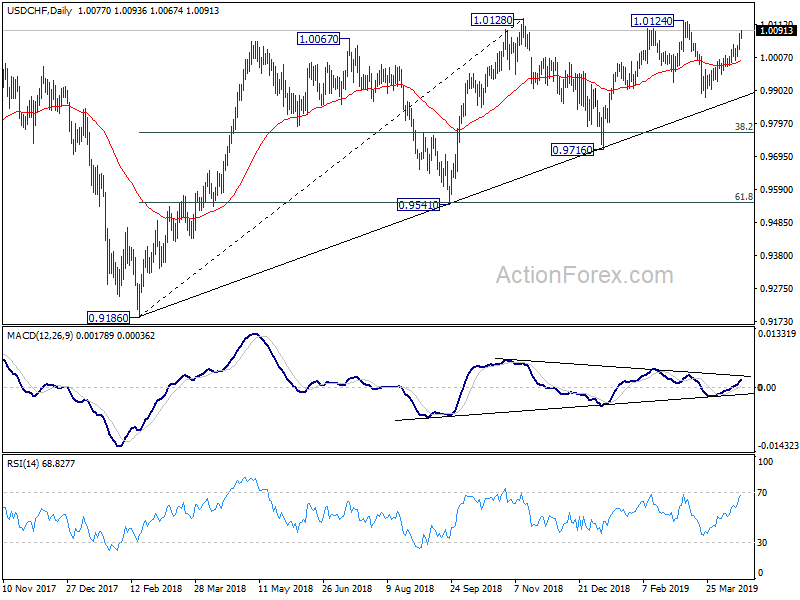
In the bigger picture, loss of upside momentum is seen is bearish divergence in daily MACD. But there is no clear sign of bearish reversal in USD/CHF yet. Rise fro 0.9186 is likely still in progress. Decisive break of 1.0128 resistance will resume this medium term rally to 1.0342 resistance next. This will remain the preferred case now, as long as 0.9716 support holds.
USD/JPY Mid-Day Outlook
Daily Pivots: (S1) 111.89; (P) 111.98; (R1) 112.12; More...
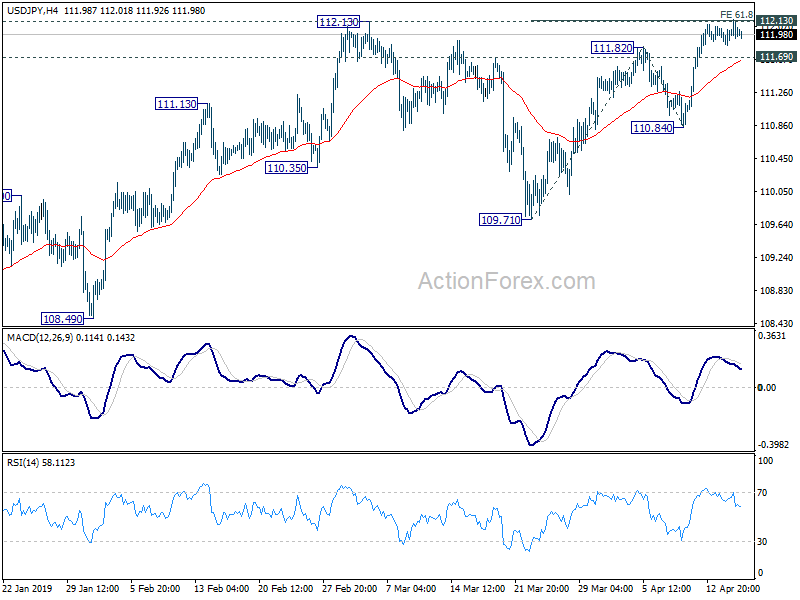
Intraday bias in USD/JPY remains neutral with focus on 112.13 key resistance. On the upside, sustained break of 112.13 will resume whole rise from 104.69 for 100 % projection of 109.71 to 111.82 and 110.84 at 112.95 first. On the downside, below 111.69 minor support will turn bias to the downside for 110.84 support. Break will bring deeper fall back to 109.71 support.
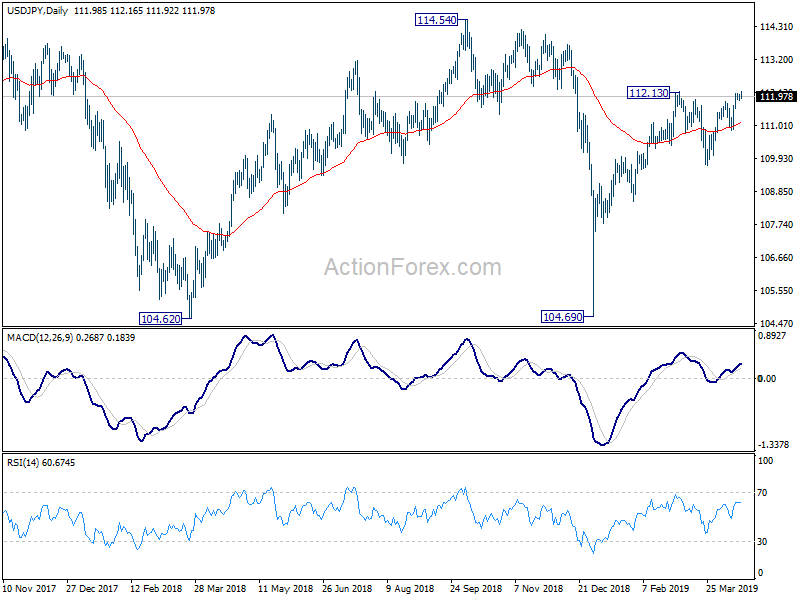
In the bigger picture, medium term outlook in USD/JPY remains a bit mixed as it's staying inside falling channel from 118.65, but there are signs of bullish reversal. On the upside, break of 114.54 resistance will revive the case the corrective fall from 118.65 has completed with three waves down to 104.69. And whole rise from 98.97 (2016 low) is resuming for 118.65 and above. But before that, outlook stays neutral first.
USD/CAD Outlook: Loonie Rises on Solid Data/Weaker Greenback
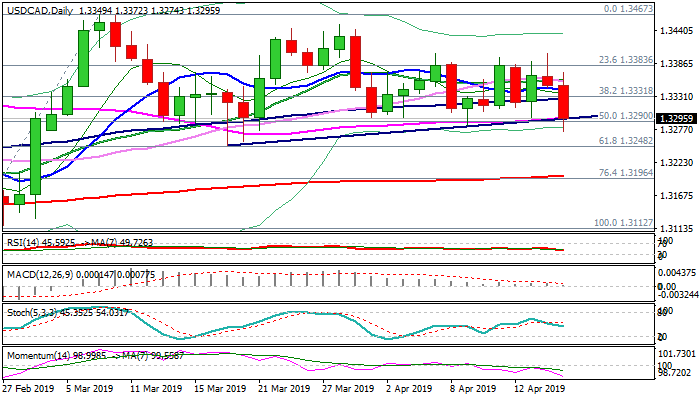
The pair accelerated lower on Wednesday, as the greenback weakened across the board on signals of stronger than expected China's economic growth, with Canada's CPI in line with expectations (Mar 1.9% vs 1.9% f/c) while trade gap unexpectedly narrowed in Feb (-2.9b C$ vs-3.5b C$ f/c). Fresh weakness dipped to one-month low at 1.3274, after breaking below the base of thinning daily cloud, reinforced by 55SMA (1.3291). Rising negative momentum helps bears along with south-heading stochastic and daily MA's (10,20,30SMA) in bearish setup. Bears need close below daily cloud to confirm negative scenario and expose supports at 1.3250/48 (19 Mar trough/Fibo 61.8% of 1.3112/1.3467). Stronger bearish acceleration could risk stretch towards next key support at 1.3199 (200SMA). Broken 100SMA (1.3327) now marks solid resistance which should keep the upside limited and maintain fresh bearish bias.
Res: 1.3327; 1.3341; 1.3356; 1.3366
Sup: 1.3290; 1.3274; 1.3250; 1.3199
Yen Remains Steady, Investors Await U.S. Retail Sales
It remains a quiet week for USD/JPY. In Wednesday’s North American session, the pair is trading at 111.94, down 0.07% on the day. In Japan, there was a trade deficit in March of JPY 0.18 trillion, better than the estimate of JPY 0.30 trillion. Industrial production rebounded with a gain of 0.7%, well below the forecast of 1.4%. Later in the day, manufacturing PMI is expected to remain in contraction territory, with an estimate of 49.4 points. There are no major U.S. events on the schedule.
There are no major U.S events until Thursday, when we’ll get a look at retail sales reports. February data was disappointing, as both retail sales and core retails recorded declines. This pointed to weak consumer spending, and sent the greenback lower. However, the markets are expecting much better news for March, with retail sales expected in at 0.9% and core retail sales at 0.7%. If the actual figures are within expectations, the U.S. dollar could respond with gains.
The global trade war has hurt the Japanese export sector, which is highly dependent on trade with the U.S. and China. This has also taken a heavy toll on the manufacturing sector, which has shown declines in recent months. There are reports of significant progress in trade talks between the U.S. and China, but last week, a senior U.S. official said that an agreement could be months away.
With the Japanese economy feeling the squeeze of the U.S.-China trade war and the BoJ offering negative interest rates, there isn’t much to attract investors to the yen unless risk appetite drops sharply. At the same time, any progress between the sides would be good news for the Japanese economy.
Sunset Market Commentary
Markets
Global core bonds managed to erase (most of) early losses today despite risk sentiment improving overnight as the Chinese first quarter GDP data outperformed expectations. Despite Chinese equities struggling to profit, core bonds fell lower on the news. However, a larger than expected drop in EU28 March car registrations stabilized the German Bund ahead of the EU opening bell. Investor sentiment remained cautiously upbeat pushing equities in green territory at the start of the day. The first outcome of March Eurozone inflation was confirmed and couldn’t surprise investors. The German ministry of Economy slashing its 2019 economic growth forecast in half (see below) was all the more surprising. The German Bund couldn’t profit on the news and even lost some additional ground as China is considering stimulus measures to bolster consumption. As investors joined trading, core bonds undid part of its intraday gains. The German yield curve is moving higher with changes in the range of -0.1 bps (2-yr) to +1.1 bp (10-yr). US Treasuries temporarily lost additional ground after the US Trade Deficit narrowed 3.4% (to $49.4bn) in February, but paired all losses as WS opened the doors. The US yield curve is moving lower with changes up to -0.6 bps (2-yr) as core bonds stage a comeback as US dealings kick in.
EUR/USD spent most of the European trading session north of 1.13, but failed to take the post-ECB high of 1.1324 out. The main upleg already occurred already in Asian trading after Chinese activity data shelved most pessimistic growth outlooks by (significantly) beating consensus. EUR/USD climbed away from yesterday’s low around 1.1280 upon the release. USD/JPY (112) for now remains below the 112.14 March high despite positive risk sentiment. Second-tier EMU eco data failed to impact trading. Germany cut its economic forecasts for a second time this year, projecting only 0.5% growth in 2019 and 1.5% in 2020. The Minister of Economy dashed all hopes on additional fiscal stimulus despite lackluster growth. This at least partly explains the single currency’s reluctance to add gains despite thriving stock markets (Chinese fiscal stimulus rumours). Investors probably also keep tomorrow’s EMU PMI’s in mind. Front end yield differentials between the EU and US remained broadly stable. As US investors enter dealings, we witness EUR/USD returning below the 1.13 mark. Speeches by Fed Harker and Bullard are wildcards tonight. The Fed’s Beige Book could show more anecdotic evidence of an activity slowdown in the US.
EUR/GBP followed EUR/USD higher for most of the day. The pair currently trades around 0.8665. UK inflation data printed a tad softer than expected in March (1.9%Y/Y for headline and 1.8% Y/Y for core reading), but UK eco data are currently the last thing on UK investors’ minds. The UK parliament’s Easter recess unfortunately bring Brexit drama to a low level as well, resulting in unattractive technical trading.
News Headlines
The German government cut its forecast for 2019 economic growth for the second time in three months, from 1% to 0.5%, as the recession in the manufacturing sector deepens. Domestic demand should help offset this weakness. For 2020, the government expects a consumption-driven rebound with 1.5% growth.
China reportedly drafted a new series of stimulus measures in a latest attempt to stimulate consumption and mitigate the effect of the trade dispute. They would include subsidies for new-energy vehicles, smartphones and home appliances. The proposals are still at a primal stage and are without guarantee of eventually being approved.
ECB Governing Council member Nowotny expects the euro-economy to at least stabilize in the second half of this year. He therefore doesn’t expect the Central Bank to significantly lower its growth forecasts in June as he assumes there will be a solution to the US-China trade conflict.
USD/CAD Mid-Day Outlook
Daily Pivots: (S1) 1.3329; (P) 1.3366; (R1) 1.3387; More...
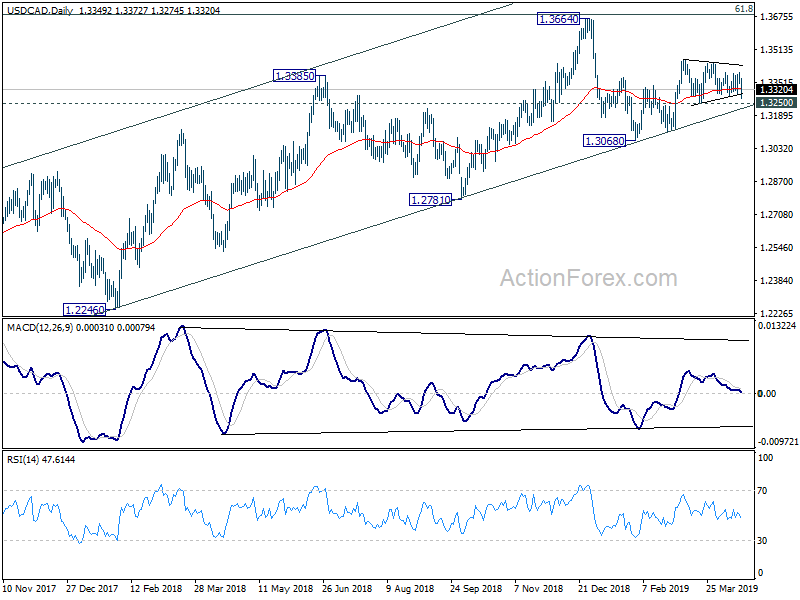
USD/CAD drops sharply to as low as 1.3274 but stays above 1.3250 support. Outlook is unchanged and intraday bias remains neutral. Consolidation from 1.3467 is in progress and could extend, but upside breakout is expected sooner or later. On the upside, firm break of 1.3467 will confirm this bullish case and target 1.3664 resistance next. However, decisive break of 1.3250 will turn bias back to the downside for 1.3068/3112 support zone instead.
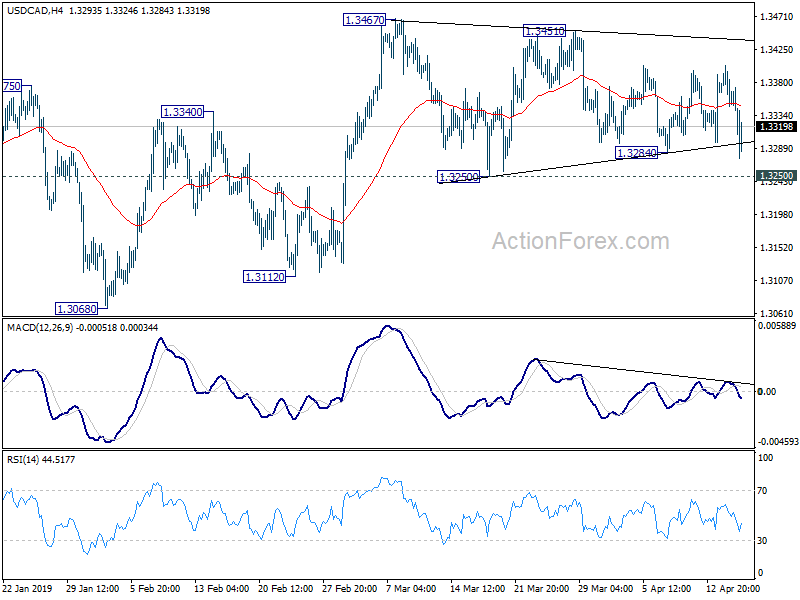
In the bigger picture, USD/CAD is staying well inside medium term rising channel (support at 1.3212). Thus, even though upside momentum and structure are unconvincing, further rise is still in favor. Decisive break of 61.8% retracement of 1.4689 (2016 high) to 1.2061 at 1.3685 and 1.3793 will pave the way to retest 1.4689 (2015 high). However, firm break of the channel support should indicate bearish reversal, after rejection by 1.3793, and bring deeper fall to 1.3068 support for confirmation.
Canadian Dollar Jumps on CPI, Treasury Yields Rise on China Data
Global treasury yields are boosted by solid data from China today. German 10-year yield hit at high as 0.104 and is now back at around 0.08. US 10-year yield breaches hit 2.614 and it's now trying to own 2.6 handle. These are both signs of improvements in market sentiments as stabilization in China's slowdown is a key factor for rebound in global economy in the second half. Though, such optimism is not much reflected in the overbought stocks, especially in the US. DOW just open the day flat, slightly in red.
In the currency markets, Australian Dollar is a clear winner for most of the day. However, Canadian takes over as the strongest one after core CPI unexpectedly accelerated in March. Euro is the third strongest for now, shrugging off German government's growth outlook downgrade. New Zealand Dollar is the weakest one for today as poor CPI data raises the chance of an imminent RBNZ rate cut at next meeting. Swiss Franc is the second weakest, followed by Sterling, while UK CPI failed to accelerate.
In the US, DOW is currently down -0.16%. S&P 500 is up 0.07%. NASDAQ is up 0.36%. 10-year yield is up 0.0030 at 2.599. In Europe, FTSE is up 0.04%. DAX is up 0.72%. CAC is up 0.66%. German 10-year yield is up 0.009 at 0.080. Earlier in Asia, Nikkei rose 0.25%. Hong Kong HSI dropped -0.02%. China Shanghai SSE rose 0.29%. Singapore Strait Times rose 0.50%. Japan 10-year JGB yield rose 0.01 to -0.01.
Canadian dollar jumps as core CPI accelerated in March
Canadian Dollar rises in early US session as core inflation came in higher than expected. Headline CPI rose 1.9% yoy in March, accelerated from 1.5% yoy but matched expectation. CPI core common was unchanged at 1.8% yoy, matched expectations. However, CPI core median accelerated to 2.0% yoy, up from 1.8% yoy and beat expectation os 1.8% yoy. CPI core trim rose to 2.1% yoy, up from 1.9% yoy and beat expectation of 1.8% yoy.
Also from released, Canada trade surplus was smaller than expected at CAD 2.9B in February. US trade deficit narrowed to USD -49.4B in February.
UK CPI unchanged at 1.9%, core at 1.8%, Sterling steady
In March, UK CPI was unchanged at 1.9% yoy, below expectation of 2.0% yoy. Core CPI was also unchanged at 1.8% yoy, below expectation of 1.9% yoy. RPI slowed to 2.4% yoy, down from 2.5% yoy and miss expectation of 2.6% yoy.
PPI input dropped -0.2% mom, rose 3.7% yoy, below expectation of 0.3% mom, 3.9% yoy. PPI output rose 0.3% mom, 2.4% yoy, versus expectation of 0.2% mom, 2.1% yoy. PPI output core rose 0.02% mom, 2.2% yoy versus expectation of 0.1% mom, 2.2% yoy.
House price index rose 0.6% yoy in February, well below expectation of 1.3% yoy.
Eurozone CPI confirmed at 1.4%, core at 0.8%
Eurozone CPI was finalized at 1.4% yoy in March, unrevised, down from 1.5% yoy in February. Core CPI was finalized at 0.8% yoy, unchanged from February's reading. EU28 inflation was confirmed at 1.6% yoy.
The highest contribution to the annual euro area inflation rate came from energy (+0.52 percentage points, pp), followed by services (+0.51 pp), food, alcohol & tobacco (+0.34 pp) and non-energy industrial goods (+0.04 pp).
Germany halves 2019 growth forecast to 0.5%
Germany's Economy Ministry lowered 2019 growth forecast to a mere 0.5%, just half of January's projection of 1.0% (downgraded from 1.8%). If realized, that would be slowest growth in six years. For 2020m, growth is projected to pick up to 1.5%.
Economy Minister Peter Altmaier said externally, slowing global growth, trade tensions and Brexit uncertainty are weighing on the economy. Internally, introduction of the new car emission regulations and unusually low Rhine water levels are negative factors.
The ministry also noted that global economy should regain some momentum ahead. Strong import would mean a negative contribution to growth in 2019, "purely mathematically".
China Q1 GDP grew 6.4%. Production, sales, investment rebounded
Another batch of data from China released today surprised on the upside. GDP growth came in at 6.4% yoy in Q1, unchanged from prior quarter and beat expectation of 6.3% yoy.
In March, industrial production rose strongly by 8.5% ytd yoy, accelerated from 5.3% and beat expectation of 5.6%. Retail sales rose 8.7% ytd yoy, up fro 8.2% and beat expectation of 8.3%. Fixed asset investment rose 6.3% ytd yoy, up from 6.1% yoy and matched expectation of 6.3%. Jobless rate also improved from 5.3% to 5.2%.
Recent data from China continued to paint the picture of stabilization in slowdown, and raised hope that recovery is on the way. That's an important condition for improvement in global outlook.
New Zealand CPI slowed to 1.5%, solidifies need for imminent RBNZ easing
New Zealand Dollar drops sharply after worse than expected consumer inflation data. CPI rose 0.1% qoq in Q1, below expectation of 0.3% qoq. Annually, CPI slowed to 1.5% yoy, down from 1.9% yoy and missed expectation of 1.7% yoy. Tradeable CPI dropped -0.4% yoy while non-tradeable CPI rose 2.8% yoy.
CPI has been persistently weak and remained below mid-point of RBNZ's 1-3% target range for the eight consecutive quarter. Indeed, CPI has only breached 2% level once in Q1 2017 (2.2%) since 2011. Yesterday, RBNZ Governor Adrian Orr noted that "possibilities of first quarter inflation numbers being undershot have already being factored in the RBNZ's dovish bias". The downside surprise is giving Orr an even worse picture and solidifies the imminent need for policy easing.
From Australia, Westpac leading index rose 0.2% mom in March.
Japan exports slumped in March, raised concerns of Q1 GDP contraction
In March, in trend terms, Japan's exports dropped -2.4% yoy to JPY 7.20T. Imports rose 1.1% yoy to JPY 6.67T. Trade surplus came in at JPY 0.53T, up from prior month's JPY 0.33T. In seasonally adjusted terms, exports dropped -1.0% yoy to JPY 6.61T. Imports rose 2.1% yoy to JPY 6.78T. Trade deficit was at JPY -0.18T.
Exports to China, Japan's largest trading partner, dropped -9.4% yoy, reversing from 5.6% growth in February. Exports to Asia as a whole dropped -5.5% yoy, a fifth straight month of decline. The slump in exports could drag down capital expenditure and private consumption growth . And it raised concerns that the economy contracted again in Q1.
Also from Japan, industrial production was finalized at 0.7% mom in February.
USD/CAD Mid-Day Outlook
Daily Pivots: (S1) 1.3329; (P) 1.3366; (R1) 1.3387; More...
USD/CAD drops sharply to as low as 1.3274 but stays above 1.3250 support. Outlook is unchanged and intraday bias remains neutral. Consolidation from 1.3467 is in progress and could extend, but upside breakout is expected sooner or later. On the upside, firm break of 1.3467 will confirm this bullish case and target 1.3664 resistance next. However, decisive break of 1.3250 will turn bias back to the downside for 1.3068/3112 support zone instead.
In the bigger picture, USD/CAD is staying well inside medium term rising channel (support at 1.3212). Thus, even though upside momentum and structure are unconvincing, further rise is still in favor. Decisive break of 61.8% retracement of 1.4689 (2016 high) to 1.2061 at 1.3685 and 1.3793 will pave the way to retest 1.4689 (2015 high). However, firm break of the channel support should indicate bearish reversal, after rejection by 1.3793, and bring deeper fall to 1.3068 support for confirmation.
Economic Indicators Update
| GMT | Ccy | Events | Actual | Forecast | Previous | Revised |
|---|---|---|---|---|---|---|
| 22:45 | NZD | CPI Q/Q Q1 | 0.10% | 0.30% | 0.10% | |
| 22:45 | NZD | CPI Y/Y Q1 | 1.50% | 1.70% | 1.90% | |
| 23:50 | JPY | Trade Balance (JPY) Mar | -0.18T | -0.30T | 0.12T | 0.03T |
| 00:30 | AUD | Westpac Leading Index M/M Mar | 0.20% | 0.00% | ||
| 02:00 | CNY | GDP Y/Y Q1 | 6.40% | 6.30% | 6.40% | |
| 02:00 | CNY | Industrial Production YTD Y/Y Mar | 8.50% | 5.60% | 5.30% | |
| 02:00 | CNY | Retail Sales YTD Y/Y Mar | 8.70% | 8.30% | 8.20% | |
| 02:00 | CNY | Fixed Assets Ex Rural YTD Y/Y Mar | 6.30% | 6.30% | 6.10% | |
| 02:00 | CNY | Surveyed Jobless Rate Mar | 5.20% | 5.30% | ||
| 04:30 | JPY | Industrial Production M/M Feb F | 0.70% | 1.40% | 1.40% | |
| 08:00 | EUR | Eurozone Current Account (EUR) Feb | 26.8B | 33.2B | 36.8B | |
| 08:30 | GBP | CPI M/M Mar | 0.20% | 0.20% | 0.50% | |
| 08:30 | GBP | CPI Y/Y Mar | 1.90% | 2.00% | 1.90% | |
| 08:30 | GBP | Core CPI Y/Y Mar | 1.80% | 1.90% | 1.80% | |
| 08:30 | GBP | RPI M/M Mar | 0.00% | 0.20% | 0.70% | |
| 08:30 | GBP | RPI Y/Y Mar | 2.40% | 2.60% | 2.50% | |
| 08:30 | GBP | PPI Input M/M Mar | -0.20% | 0.50% | 0.60% | 1.00% |
| 08:30 | GBP | PPI Input Y/Y Mar | 3.70% | 4.10% | 3.70% | 4.00% |
| 08:30 | GBP | PPI Output M/M Mar | 0.30% | 0.30% | 0.10% | 0.30% |
| 08:30 | GBP | PPI Output Y/Y Mar | 2.40% | 2.20% | 2.20% | 2.40% |
| 08:30 | GBP | PPI Output Core M/M Mar | 0.00% | 0.10% | 0.10% | 0.20% |
| 08:30 | GBP | PPI Output Core Y/Y Mar | 2.20% | 2.20% | 2.20% | 2.30% |
| 08:30 | GBP | House Price Index Y/Y Feb | 0.60% | 1.30% | 1.70% | |
| 09:00 | EUR | Eurozone Trade Balance (EUR) Feb | 19.5B | 16.8B | 17.0B | 17.4B |
| 09:00 | EUR | Eurozone CPI M/M Mar | 1.00% | 0.30% | 0.30% | |
| 09:00 | EUR | Eurozone CPI Y/Y Mar F | 1.40% | 1.40% | 1.50% | |
| 09:00 | EUR | Eurozone CPI Core Y/Y Mar F | 0.80% | 0.80% | 0.80% | |
| 12:30 | CAD | International Merchandise Trade (CAD) Feb | 2.90B | 3.50B | -4.25B | -3.09B |
| 12:30 | CAD | CPI M/M Mar | 0.70% | 0.60% | 0.70% | |
| 12:30 | CAD | CPI Y/Y Mar | 1.90% | 1.90% | 1.50% | |
| 12:30 | CAD | CPI Core - Common Y/Y Mar | 1.80% | 1.80% | 1.80% | |
| 12:30 | CAD | CPI Core - Median Y/Y Mar | 2.00% | 1.80% | 1.80% | |
| 12:30 | CAD | CPI Core - Trim Y/Y Mar | 2.10% | 1.80% | 1.90% | |
| 12:30 | USD | Trade Balance (USD) Feb | -49.4B | -53.5B | -51.1B | |
| 14:00 | USD | Wholesale Inventories M/M Feb | 0.40% | 1.20% | ||
| 14:30 | USD | Crude Oil Inventories | 1.6M | 7.0M | ||
| 18:00 | USD | Federal Reserve Beige Book |