

Sample Category Title
Currencies: EMU PMI’s To Keep EUR/USD Deadlocked
- Rates: Err on the cautious side for eco data
Key EMU and US eco data will be released today. We still prefer to err on the side of caution. Core bonds have an upward bias this morning, while the S&P 500 shows a tentative bearish engulfing pattern. USD/JPY failed to take out resistance. All this signals suggest more difficult times ahead from a risk perspective. - Currencies: EMU PMI's to keep EUR/USD deadlocked
EUR/USD fails to choose sides recently, oscillating near the 1.13 mark. Markets are looking for clues in data to confirm the growth sentiment turnaround that occurred end of last week. Today's EMU PMI's are in the picture but we warn reading too much in a (modest) recovery. EUR/GBP is set for more technical trading during the parliamentary recess.
The Sunrise Headlines
- US equity markets closed yesterday's session little lower with the S&P 500 Index underperforming (-0.23%). Asian equities are tracking WS bourses this morning with Japanese and Korean indices underperforming.
- The US and China have set up a new timeline in their trade negotiations. They planned two rounds of face-to-face meetings to wrap up the deal end of April/early May and aim for a signing ceremony in late May or early June. (WSJ)
- A Japanese official said that Japan's government could postpone a sales tax increase for a third time if economic conditions deteriorate further. Meanwhile, the Nikkei PMI manufacturing slightly rebounded in April, from 49.2 to 49.5.
- The US Fed's Beige Book saw a “slight-to-moderate” pace of growth in recent weeks, while some sectors expect growth to pick up in the coming months. The survey also shows moderate wage growth and tight labor markets.
- Australia's economy added 26k jobs in March, rebounding from a 7k drop a month before, spurred by 48k new full time employments. The participation rate increases to 65.7%. Aussie dollar gains remain muted.
- North Korea said it had tested a new short-range tactical weapon. While the description doesn't suggest the weapon is of any nuclear kind, it does send a message to the US about the risk of allowing talks to fall apart.
- Today's US eco calendar contains retail sales (Mar), the Philly Fed business outlook (Apr) and jobless claims. PMI's are printed for the EMU, Germany and France. Fed's Bostic speaks today. Corporate earnings season continues
Currencies: EMU PMI's To Keep EUR/USD Deadlocked
EMU PMI's to keep EUR/USD deadlocked
Strong Chinese growth data yesterday prompted a recovery of EUR/USD above 1.13. The move's momentum quickly stalled however. A turnaround occurred during early European hours. The couple eventually closed just an inch below 1.13 (1.1296) amidst a lacklustre US session, yet still up from Tuesday's 1.1281. Germany cutting its growth outlook again can at least partially explain yesterday's price action. Markets weren't impressed by the Fed's beige book which showed its districts aren't too negative going forward. USD/JPY held ground above 112.
Asian stocks already wash away part of yesterday's post Chinese growth gains. Most indices colour red in the wake of a rather poor Wall Street performance. EUR/USD oscillates near 1.13, awaiting possibly crucial PMI's later today. USD/JPY fails to retain the 112 barrier (111.87 at the moment). Australia published a strong jobs report. The Aussie dollar spiked to 0.72 but immediately retraced most of the gains.
Today's EMU PMI's are expected to recover in the manufacturing sector after the steep decline in recent months. Services PMI's will probably more or less stabilize. We side with consensus but warn that a (modest) recovery from the current depressed levels, notably in the manufacturing PMI, provides little reason for cheering. US retail sales will probably rebound from a weak February result but we see risks tilted to the downside in core measures due to weatherrelated and Easter effects.
The euro fails to choose sides recently. EUR/USD hovers near 1.13 as the economic situation remains fragile. Today's EMU PMI's are to show signs of bottoming after an impressive decline over the last months. However, we don't expect them to provide much momentum for the euro given the indicators still wander in contraction territory. US data probably won't be very convincing either, keeping EUR/USD deadlocked for the time being. If any, 1.13 might prove difficult to capture/hold. We maintain the view however that a EUR/USD break lower isn't evident.
Slightly softer than expected March CPI in the UK had little to zero impact on sterling trading. EUR/GBP closed a technical trading session in the 0.866's (up from 0.864). Today's retail sales will probably be ignored by markets also. Given the lack of brexit news during the current parliamentary recess, we expect more low-volume, directionless technical trading for the coming days. In a broader perspective we stay cautious on sterling as long as Brexit and the political impasse drags on
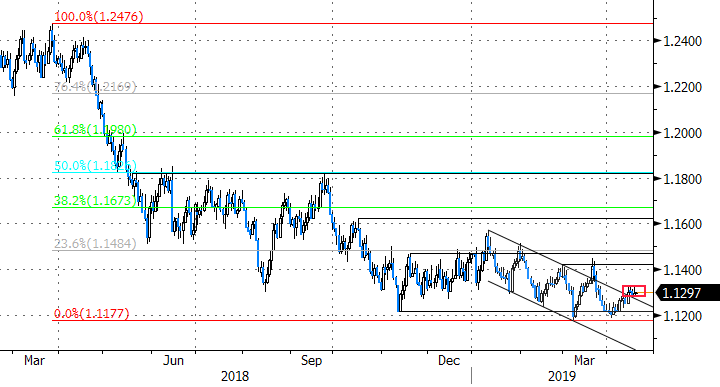
EUR/USD oscillates near 1.13 recently. Are EMU PMI's to break the deadlock?
AUD/USD Daily Outlook
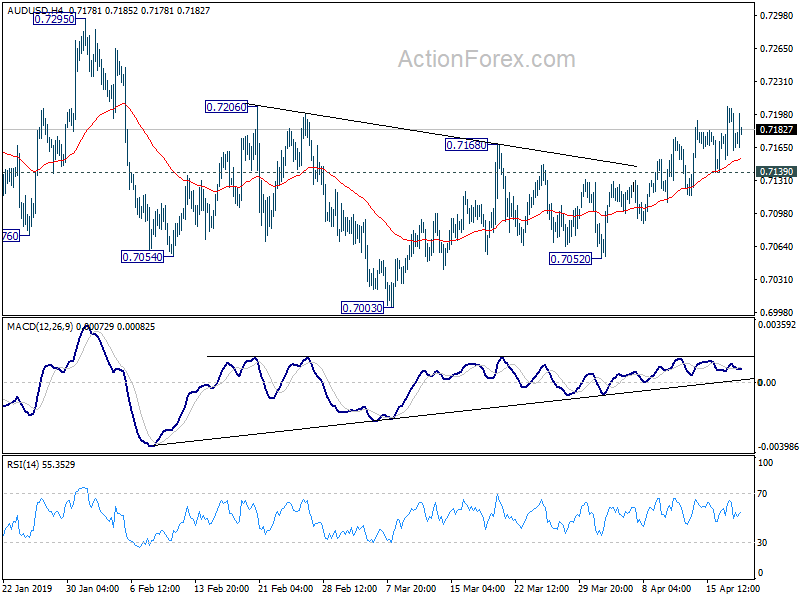
Daily Pivots: (S1) 0.7153; (P) 0.7179; (R1) 0.7206; More...
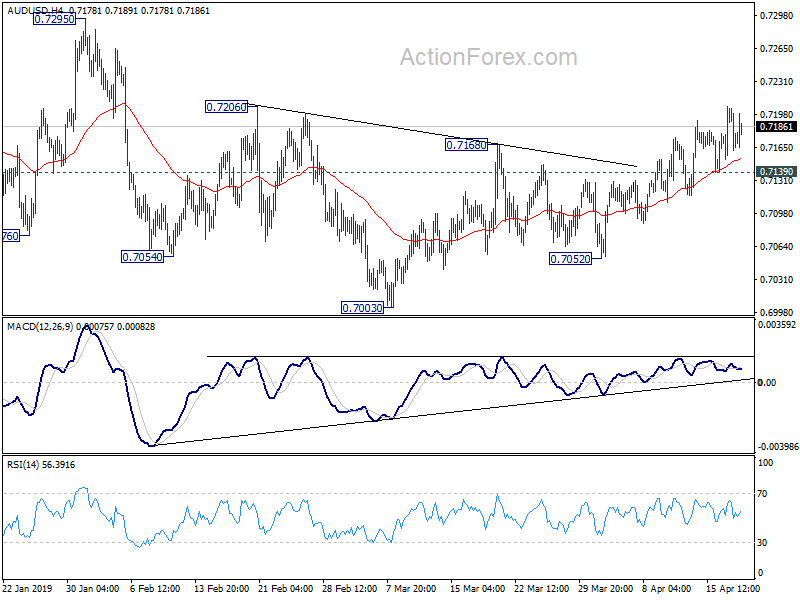
While upside momentum in AUD/USD is unconvincing as seen in 4 hour MACD, with 0.7139 minor support intact, further rise is in favor for 0.7295 resistance. Since the structure of the recovery is corrective looking, upside could be limited by 0.7295 to bring near term reversal. On the downside, break of 0.7139 minor support will turn intraday bias back to the downside for 0.7003/7052 support zone.
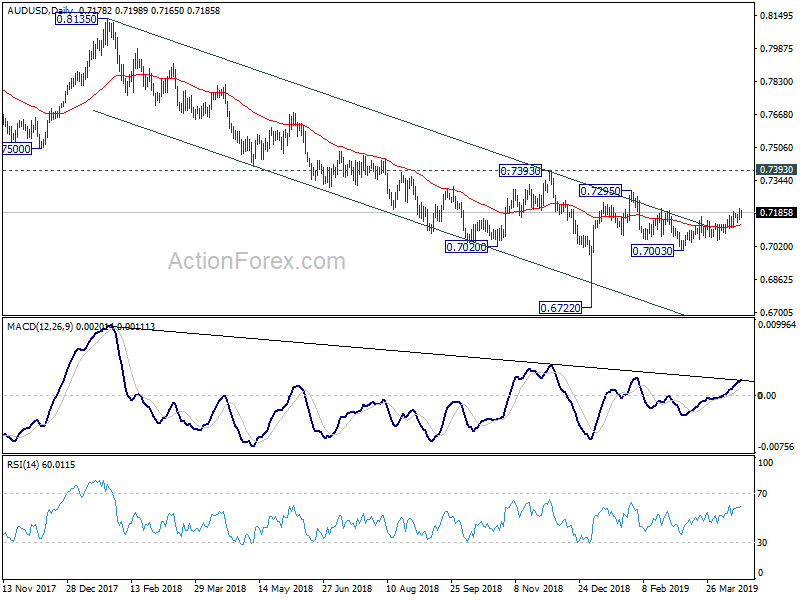
In the bigger picture, break of medium term channel resistance is the first sign of bullish reversal. But there is no confirmation yet. As long as 0.7393 resistance holds, larger fall from 0.8135 is still expected to resume later. Such decline is seen as resuming long term down trend from 1.1079 (2011 high). Decisive break of 0.6826 (2016 low) will confirm this bearish view and resume the down trend to 0.6008 (2008 low). However, firm break of 0.7393 will argue that fall from 0.8135 has completed. And corrective pattern from 0.6826 has started the third leg, targeting 0.8135 again.
Eurozone PMIs, Retail Sales from UK, US and Canada Watched
Asian markets turned softer today, ahead of long weekend. Major indices are trading in slightly in red as traders lighten up positions. In the currency markets, Yen is so far the strongest one for today, naturally. Australian Dollar is the second strongest, as lifted slightly by solid employment data. However, gain is so far rather limited. On the other hand, Canadian Dollar is the weakest one, paring much of yesterday's post CPI gains. New Zealand Dollar is the second weakest.
A lot of important economic data are scheduled for today, including Eurozone PMIs, UK retail sales, Canada retail sales and US retail sales. Some more volatility would likely be seen before entering into holiday mode.
In Asia, Nikkei closed down -0.84%. Hong Kong HSI is down -0.60%. China Shanghai SSE is down -0.36%. Singapore Strait Times is down -0.20%. Japan 10-year JGB yield is down -0.0152 at -0.024. Overnight, DOW dropped -0.01%. S&P 500 dropped -0.23%. NASDAQ dropped -0.05%. 10-year yield closed flat at 2.592.
Australia employment rose 25.7k, no imminent need for RBA cut
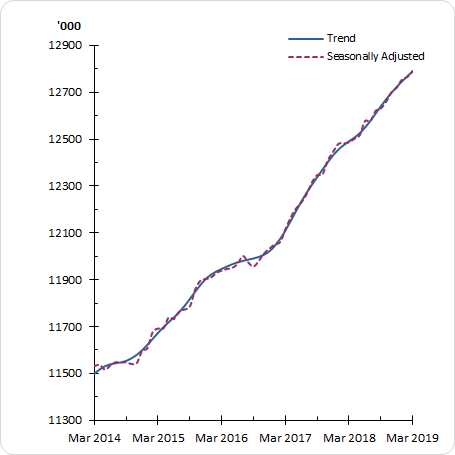
Australia employment grew 25.7k in March, much better than expectation of 15.2k. Full time employment rose 48.3k while part time jobs dropped -22.6k. Unemployment rate rose from 4.9% to 5.0%, matched expectations. Participation rate also rose from 65.6% to 65.7%.
The largest increase in employment was in Queensland (up 10.4k), followed by Victoria (up 10.0k) and South Australia (up 8.5k). The largest decrease was in New South Wales (down 2.6k) followed by Tasmania (down 1.8k). The seasonally adjusted unemployment rate increased in Queensland (up 0.7 pts to 6.1%), South Australia (up 0.2 pts to 5.9%), Tasmania (up 0.2 pts to 6.7%), Western Australia (up 0.1 pts to 6.0%) and New South Wales (up 0.1 pts to 4.3%). The only decrease in the unemployment rate was observed in Victoria (down 0.1 pts to 4.6%).
The strong gain in full time jobs underlines the robustness in the employment market. However, unemployment rate rose in all regions, only except Victoria, which is a concern. At this point, there is no imminent push for an RBA rate cut in the first up. But situation could worsen ahead that trigger the expected two cuts in the second half. The key will lie in upcoming economic projections in May.
Australia NAB business conditions continued broad based easing
Australia NAB Business Confidence dropped to -1 in Q1, down from 1. Current Business Conditions dropped to 4, down from 9. Business Conditions for the next two months dropped slightly to 22, down from 25. Capex plans dropped to 22, down from 25.
Alan Oster, NAB Group Chief Economist noted that easing of business conditions continued through 2018 into 2019. And they're only "just above average". Together with "negative conditions and forwards orders", they suggest outlook "remains weak". And the easing in conditions has been "broad based across most industries and all states", in particular retail.
Oster also said: "For now, we will wait and see how leading indicators of the labour market evolve, though we think it is likely the RBA will act to cut the cash rate and bolster the economy should the labour market deteriorate on the back of weaker activity data".
Japan PMI manufacturing improved to 49.5, remained stuck in its rut
Japan PMI manufacturing rose to 49.5 in April, up from 49.2 and beat expectation of 49.4. Nevertheless, it's still the third straight month of sub-50 reading. Markit pointed out that weaker demand from domestic and international markets persists, leading output to fall further. But manufacturing employment remains resilient.
Joe Hayes, Economist at IHS Markit said: "Japan's manufacturing sector remained stuck in its rut at the start of Q2, with the factors which have prohibited any growth such as US-Sino relations, growth fears in China and the turn in the global trade cycle, all remaining prominent risks. Export orders dipped at a stronger rate in April, domestic demand for goods was similarly weak and firms cut their stocks and scaled back production. Yet again, the service sector will need to pick up any slack to help keep Japan's economy afloat."
EU announced tariff lists countering unfair US subsides on Boeing
Yesterday, EU formally announced the list of US imports to be targeted for tariffs as countermeasures on US subsidies to Boeing. The list covers a range of items, from aircrafts to chemicals and agri-food products (including everything from frozen fish and citrus fruits to ketchup), that overall represent around USD20B of US exports into EU. The final list will take into account results of public consultation and WTO arbitrator's decision.
EU Trade Commissioner Cecilia Malmström said: "European companies must be able to compete on fair and equal terms. The recent WTO ruling on U.S. subsidies for Boeing is important in this respect. We must continue to defend a level-playing field for our industry. But let me be clear, we do not want a tit-for-tat. While we need to be ready with countermeasures in case there is no other way out, I still believe that dialogue is what should prevail between important partners such as the EU and the U.S., including in bringing an end to this long-standing dispute. The EU remains open for discussions with the U.S., provided these are without preconditions and aim at a fair outcome."
Looking ahead
Also released, Germany PPI dropped -0.1% mom, rose 2.4% yoy in March. Swiss trade surplus widened to CHF 3.18B in March. Eurozone PMIs and UK retail sales are the main focuses in European session. In particular, Eurozone PMIs will have to show more evidence of resilience to solidify the optimism on stabilization in the slowdown.
Later, Canada will release retail sales. Yesterday's upside surprise in core CPI couldn't put Canadian Dollar out of range. Let's see if retail sales could. US will release retail sales, Philly Fed survey, jobless claims, leading indicator and business inventories.
AUD/USD Daily Outlook
Daily Pivots: (S1) 0.7153; (P) 0.7179; (R1) 0.7206; More...
While upside momentum in AUD/USD is unconvincing as seen in 4 hour MACD, with 0.7139 minor support intact, further rise is in favor for 0.7295 resistance. Since the structure of the recovery is corrective looking, upside could be limited by 0.7295 to bring near term reversal. On the downside, break of 0.7139 minor support will turn intraday bias back to the downside for 0.7003/7052 support zone.
In the bigger picture, break of medium term channel resistance is the first sign of bullish reversal. But there is no confirmation yet. As long as 0.7393 resistance holds, larger fall from 0.8135 is still expected to resume later. Such decline is seen as resuming long term down trend from 1.1079 (2011 high). Decisive break of 0.6826 (2016 low) will confirm this bearish view and resume the down trend to 0.6008 (2008 low). However, firm break of 0.7393 will argue that fall from 0.8135 has completed. And corrective pattern from 0.6826 has started the third leg, targeting 0.8135 again.
Economic Indicators Update
| GMT | Ccy | Events | Actual | Forecast | Previous | Revised |
|---|---|---|---|---|---|---|
| 1:30 | AUD | NAB Business Confidence Q1 | -1 | 1 | ||
| 1:30 | AUD | Employment Change Mar | 25.7K | 15.2K | 4.6K | |
| 1:30 | AUD | Unemployment Rate Mar | 5.00% | 5.00% | 4.90% | |
| 6:00 | EUR | German PPI M/M Mar | -0.10% | 0.20% | -0.10% | |
| 6:00 | EUR | German PPI Y/Y Mar | 2.40% | 2.70% | 2.60% | |
| 6:00 | CHF | Trade Balance (CHF) Mar | 3.18B | 2.87B | 3.13B | 2.94B |
| 7:15 | EUR | France Manufacturing PMI Apr P | 50 | 49.7 | ||
| 7:15 | EUR | France Services PMI Apr P | 49.8 | 49.1 | ||
| 7:30 | EUR | Germany Manufacturing PMI Apr P | 45.2 | 44.1 | ||
| 7:30 | EUR | Germany Services PMI Apr P | 55 | 55.4 | ||
| 8:00 | EUR | Eurozone Manufacturing PMI Apr P | 48.1 | 47.5 | ||
| 8:00 | EUR | Eurozone Services PMI Apr P | 53.1 | 53.3 | ||
| 8:30 | GBP | Retail Sales Inc Auto Fuel M/M Mar | -0.40% | 0.40% | ||
| 8:30 | GBP | Retail Sales Inc Auto Fuel Y/Y Mar | 4.60% | 4.00% | ||
| 8:30 | GBP | Retail Sales Ex Auto Fuel M/M Mar | -0.30% | 0.20% | ||
| 8:30 | GBP | Retail Sales Ex Auto Fuel Y/Y Mar | 4.00% | 3.80% | ||
| 12:30 | CAD | Retail Sales M/M Feb | -0.30% | |||
| 12:30 | CAD | Retail Sales Ex Auto M/M Feb | 0.10% | |||
| 12:30 | USD | Retail Sales Advance M/M Mar | 0.80% | -0.20% | ||
| 12:30 | USD | Retail Sales Ex Auto M/M Mar | 0.70% | -0.40% | ||
| 12:30 | USD | Philadelphia Fed Business Outlook Apr | 11 | 13.7 | ||
| 12:30 | USD | Initial Jobless Claims (APR 13) | 207K | 196K | ||
| 13:45 | USD | US Manufacturing PMI Apr P | 53 | 52.4 | ||
| 13:45 | USD | US Services PMI Apr P | 55 | 55.3 | ||
| 14:00 | USD | Leading Index Mar | 0.40% | 0.20% | ||
| 14:00 | USD | Business Inventories Feb | 0.30% | 0.80% | ||
| 14:30 | USD | Natural Gas Storage | 25B |
Japan PMI manufacturing improved to 49.5, remained stuck in its rut
Japan PMI manufacturing rose to 49.5 in April, up from 49.2 and beat expectation of 49.4. Nevertheless, it's still the third straight month of sub-50 reading. Markit pointed out that weaker demand from domestic and international markets persists, leading output to fall further. But manufacturing employment remains resilient.
Commenting on the Japanese Manufacturing PMI survey data, Joe Hayes, Economist at IHS Markit, which compiles the survey, said:
"Japan's manufacturing sector remained stuck in its rut at the start of Q2, with the factors which have prohibited any growth such as US-Sino relations, growth fears in China and the turn in the global trade cycle, all remaining prominent risks. Export orders dipped at a stronger rate in April, domestic demand for goods was similarly weak and firms cut their stocks and scaled back production. Yet again, the service sector will need to pick up any slack to help keep Japan's economy afloat."
Australia NAB business conditions continued broad based easing
Australia NAB Business Confidence dropped to -1 in Q1, down from 1. Current Business Conditions dropped to 4, down from 9. Business Conditions for the next two months dropped slightly to 22, down from 25. Capex plans dropped to 22, down from 25.
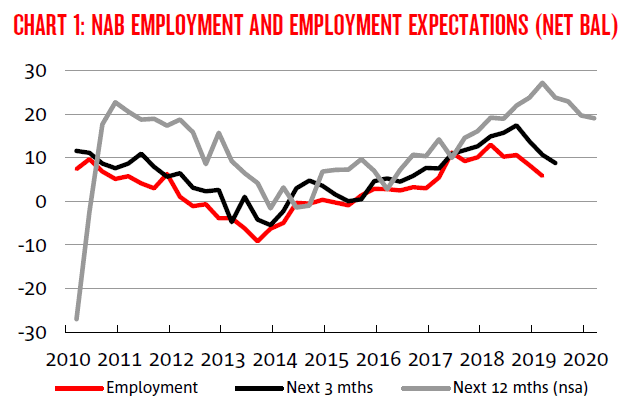
Alan Oster, NAB Group Chief Economist noted that easing of business conditions continued through 2018 into 2019. And they're only "just above average". Together with "negative conditions and forwards orders", they suggest outlook "remains weak". And the easing in conditions has been "broad based across most industries and all states", in particular retail.
Oster also said: "For now, we will wait and see how leading indicators of the labour market evolve, though we think it is likely the RBA will act to cut the cash rate and bolster the economy should the labour market deteriorate on the back of weaker activity data".
Elliott Wave View: Further Correction In Gold Expected
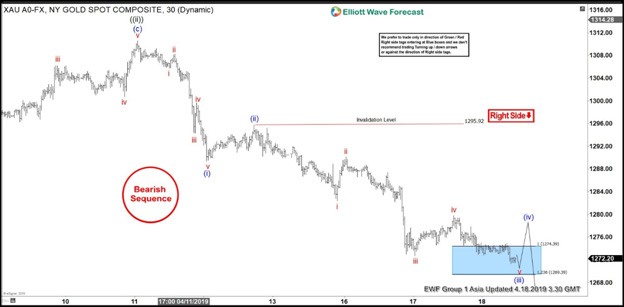
After forming a high on February 20, 2019 at $1346.75, Gold has continued to correct lower. The structure of the pullback from February 20 high appears incomplete. This suggests further downside is possible. The decline is unfolding as a zigzag Elliott Wave structure where the yellow metal is currently within wave C. In a zigzag, typically wave C is equal in length to wave A. A 100% – 123.6% Fibonacci extension in wave C can see the metal reaching $1242.31 – $1258.04 before finding support.
The internal of wave C subdivides as an impulse where wave ((ii)) ended at $1310.60 as the chart below shows. The yellow metal then extends lower within wave ((iii)) of C which also subdivides as an impulse of lesser degree. Down from $1310.6, wave (i) ended at $1289.4 and wave (ii) ended at $1295.80. Expect wave (iii) to end soon and the yellow metal to bounce in wave (iv) to correct the decline from $1295.92 before the metal extends lower again. We do not like buying Gold in the shorter cycle and still favor more downside as far as pivot at $1295.92 remains intact.
1 Hour Gold Elliott Wave Chart Asia Update
UJ Waves 1804
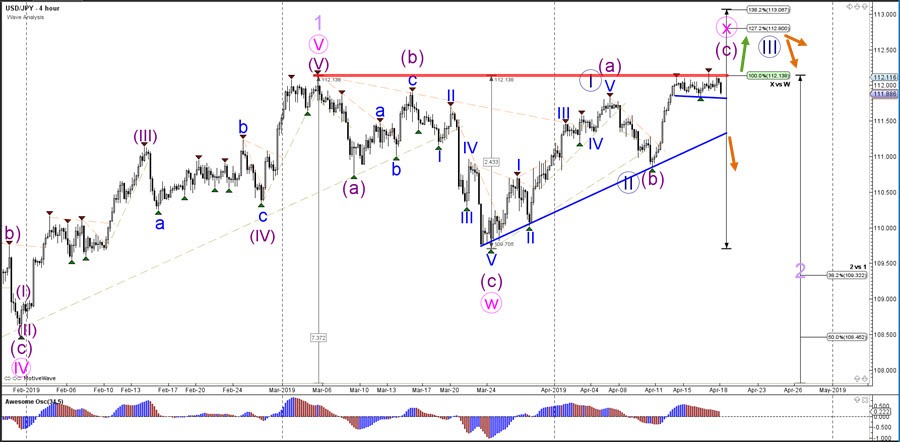
The USD/JPY bull flag chart pattern usually suggests that price will continue higher with the uptrend but the strong daily resistance (red) line could be a tough level to break. A bearish bounce however could simply be a retracement within the uptrend, which is why a bearish reversal becomes more likely when price breaks below the next support trend line as indicated by the orange arrow. A break above the 100% Fibonacci level could see price make that bull break.
The USD/JPY seems to be in a wave 4 (blue) corrective pattern, which is why the Fibonacci levels of wave 4 vs 3 could act as support and potential bouncing spot. The wave 4 pattern becomes less likely if price breaks below the 61.8% Fibonacci retracement. A bullish break first aims at 112.50 and then 112.80.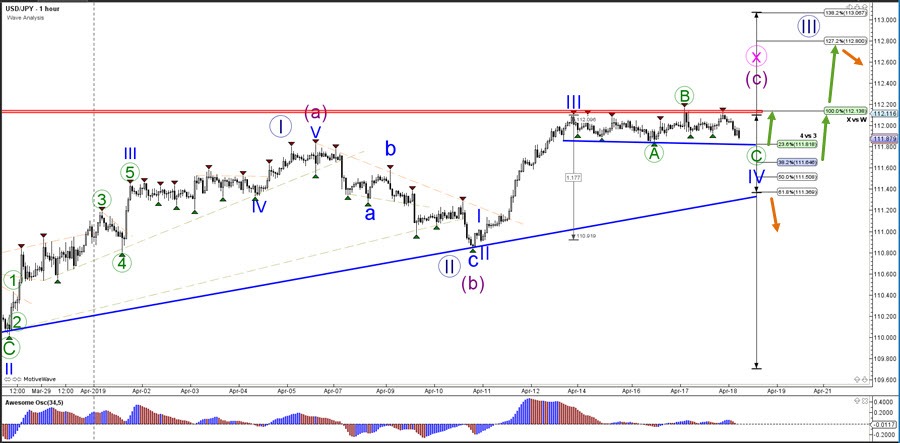
Asian Equities Trade Generally Lower, In Line With US Session
General Trend:
- Shanghai Property index extends declines seen in prior session
- Press speculation Japan sales tax increase could again be delayed
- Little reaction seen to better Aussie employment change, certain forward looking indicators show caution; markets still expect RBA rate cut
- Bank of Korea cuts growth and inflation forecasts, implies less likelihood of rate hike
Headlines/Economic Data
Australia/New Zealand
- ASX 200 opened +0.3%
- (AU) AUSTRALIA MAR EMPLOYMENT CHANGE: 25.7K V +15.0KE; UNEMPLOYMENT RATE: 5.0% V 5.0%E
- (AU) Australia Q1 NAB Business Confidence: -1 v 1 prior
China/Hong Kong
- Shanghai Composite opened -0.1%, Hang Seng -0.1%
- (CN) US and China reportedly have set a tentative timeline for next round of face-to-face trade discussions; seek to sign deal as soon as late May – press
- (CN) Pres Trump: China trade talks are moving along nicely; "you'll be hearing about" a China deal shortly
- (CN) China Human Resources Ministry: Yu Jianhua appointed as Vice Commerce Minister & Deputy International Trade Negotiation Representative
- (CN) China State Planner NDRC said to be drafting a series of stimulus measures of autos and electronics - financial press
- (CN) China NDRC: Looking into speculation about car stimulus - Chinese media
- (CN) China Cabinet reiterates stance to continue implementing prudent monetary policy
- (CN) China said to encourage brokers to issue credit default swaps (CDS) related to private sector bonds - Chinese Press
- (CN) China PBoC sets yuan reference rate: 6.6911 v 6.7110 prior (strongest CNY fix since March 21st)
- (CN) China PBoC Open Market Operation (OMO): Injects CNY80B in 7-day reverse repo v CNY160B injected in 7-day reverse repos prior: Net: CNY80B injection v CNY160B injection prior
Japan
- Nikkei 225 opened flat
- (JP) Japan Oct 2019 increase of sales tax might be delayed, cites LDP lawmaker Hagiuda - Local Press
- (JP) Japan Finance Min Aso may discuss forex issues with US Treasury Sec Mnuchin next week; Aso is expected to travel to the US on April 25th (Thursday) - Japanese press
- (JP) Japan Finance Min Aso: Deflationary mindset of company executives is changing; trade issues such as Brexit and China still present risks
- (JP) JAPAN APR PRELIMINARY PMI MANUFACTURING 49.5 V 49.2 PRIOR
Korea
- Kospi opened +0.1%
- (KR) BANK OF KOREA (BOK) LEAVES 7-DAY REPO RATE UNCHANGED AT 1.75%; AS EXPECTED; sees GDP growth and inflation below Jan projection; Omission of some references seen in prior statement does not mean easing of policy is now under discussion
- (KR) North Korea leader Kim has overseen a test of a new tactical guided weapon – KCNA
- (KR) South Korea Fin Min Hong: South Korea is not considering currency re-denomination - Yonhap
Other Asia
- Indonesia Rupiah rises amid focus on election results
North America
- (US) NY Fed's Logan: Might need to respond to unanticipated changes in reserves by conducting repo operations; any discussion of a standing repo facility is in its early stages
Levels as of 1:20 ET
- Nikkei 225, -0.8%, ASX 200 -0.1%, Hang Seng -0.6%; Shanghai Composite -0.2%; Kospi -1.2%
- Equity Futures: S&P500 -0.2%; Nasdaq100 -0.2%, Dax -0.3%; FTSE100 -0.2%
- EUR 1.1301-1.1289 ; JPY 112.08-111.87 ; AUD 0.7199-0.7165 ;NZD 0.6732-0.6711
- Gold -0.2% at $1,273/oz; Crude Oil -0.1% at $63.73/brl; Copper -0.2% at $2.954/lb
Australia employment rose 25.7k, no imminent need for RBA cut
Australia employment grew 25.7k in March, much better than expectation of 15.2k. Full time employment rose 48.3k while part time jobs dropped -22.6k. Unemployment rate rose from 4.9% to 5.0%, matched expectations. Participation rate also rose from 65.6% to 65.7%.
The largest increase in employment was in Queensland (up 10.4k), followed by Victoria (up 10.0k) and South Australia (up 8.5k). The largest decrease was in New South Wales (down 2.6k) followed by Tasmania (down 1.8k). The seasonally adjusted unemployment rate increased in Queensland (up 0.7 pts to 6.1%), South Australia (up 0.2 pts to 5.9%), Tasmania (up 0.2 pts to 6.7%), Western Australia (up 0.1 pts to 6.0%) and New South Wales (up 0.1 pts to 4.3%). The only decrease in the unemployment rate was observed in Victoria (down 0.1 pts to 4.6%).
The strong gain in full time jobs underlines the robustness in the employment market. However, unemployment rate rose in all regions, only except Victoria, which is a concern. At this point, there is no imminent push for an RBA rate cut in the first up. But situation could worsen ahead that trigger the expected two cuts in the second half. The key will lie in upcoming economic projections in May.
AUD/USD's reaction to the data is rather muted. Further rise is in favor with 0.7139 minor support intact. But so far, AUD/USD bulls are continuing to hesitate to respond to positive news.
Green Shoots Or Rogue Weeds?
Executive Summary
Today’s constructive activity data confirmed the encouraging signs seen from recent Chinese PMI surveys while, for now, Chinese authorities seem unlikely to pullback on current stimulus measures. Early 2019 data also suggest Eurozone Q1 GDP might surprise to the upside, although there is less confidence that strength will be sustained.
Chinese Data Constructive, Eurozone Data Hopeful
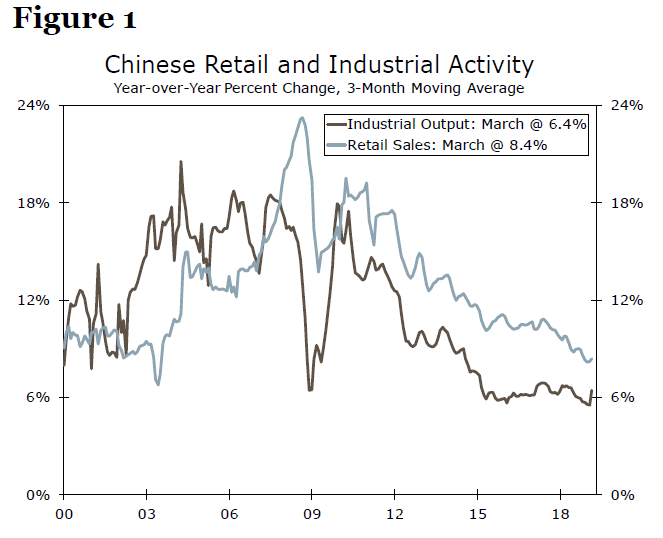
Today’s key currency market driver, supporting gains in many risk-sensitive emerging and some G10 currencies, has been a constructive batch of Chinese economic data. China’s Q1 GDP surprised to the upside, holding steady at 6.4% year-over-year, while there were also indications the first quarter ended on a relatively solid note. March retail sales firmed to 8.7% year-over-year, services production firmed to 7.6% year-over-year and industrial output firmed to 8.5% year-over-year (Figure 1). These activity data reinforce the message from China’s March PMI surveys, which were encouraging in tone.
Of course, one swallow does not make a summer and one month does not make a trend, and market participants will be monitoring to see whether the strength in China’s March data flows over into the coming months as well. Meanwhile, although an improvement in growth could eventually see Chinese authorities pull back on their monetary and fiscal stimulus, it appears unlikely for now. In fact, also among today’s headlines were reports that China is considering measures to boost sales of cars and electronics, while China’s State Council announced measures to lower the cost and increase the availability of credit to small companies. Finally, another potential positive on the policy front would be a resolution of trade tensions between the United States and China—recent media reports suggest the two sides are moving closer to an agreement.
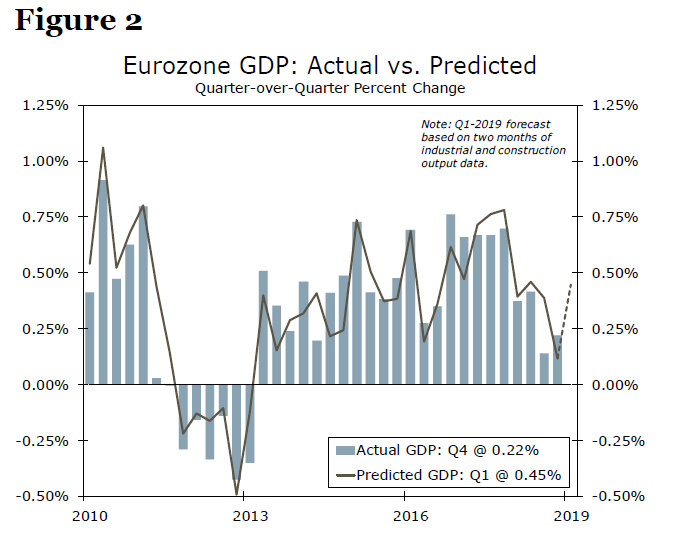
While not as compelling as Chinese developments, it is also possible that Eurozone Q1 GDP growth could surprise to the upside. The Eurozone services PMI improved in March, while for January-February, industrial and construction activity are both running above their Q4 level. March did see a sharp slump in the Eurozone manufacturing PMI however, so a decline in March industrial and construction activity is possible and, indeed, probable. That said, using a “nowcast”-type approach with the services PMI as a proxy for services output, and taking into account monthly data on industrial and construction activity, the current estimate points to a 0.45% quarter-over-quarter rise in Eurozone Q1 GDP (Figure 2), suggesting upside risk to the current consensus estimate of 0.2%. Even if Q1 growth is firmer however, there is less confidence on the part of policymakers and market participants that stronger growth will be sustained through 2019. And as in China, any move towards less policy stimulus in the Eurozone still seems some way away.
Tomorrow sees the release of the Eurozone PMI surveys for April. Most focus will be on to what extent the services PMI can sustain its March gain (it is expected to ease to 53.1) and to what extent the manufacturing PMI can bounce back (it is expected to rise to 48.0). Should the Eurozone PMIs meet or beat expectations, it’s possible the constructive market mood could extend further in the near-term.