

Sample Category Title
EUR/CHF Daily Outlook
Daily Pivots: (S1) 1.1382; (P) 1.1403; (R1) 1.1440; More...
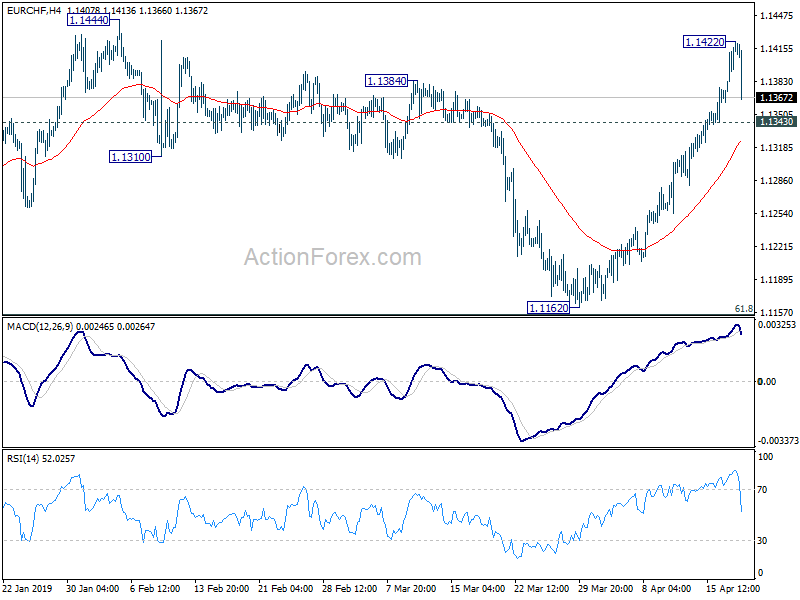
EUR/CHF drops sharply after hitting 1.1422, ahead of 1.1444 key resistance. Intraday bias is turned neutral first. For now, further rise is mildly in favor as long as 1.1343 minor support holds. Decisive break of 1.1444 will indicate larger bullish reversal. However, break of 1.1343 will argue that the whole rebound from 1.1162 has completed. Intraday bias will be turned back to the downside for retesting 1.1154 long term fibonacci support.
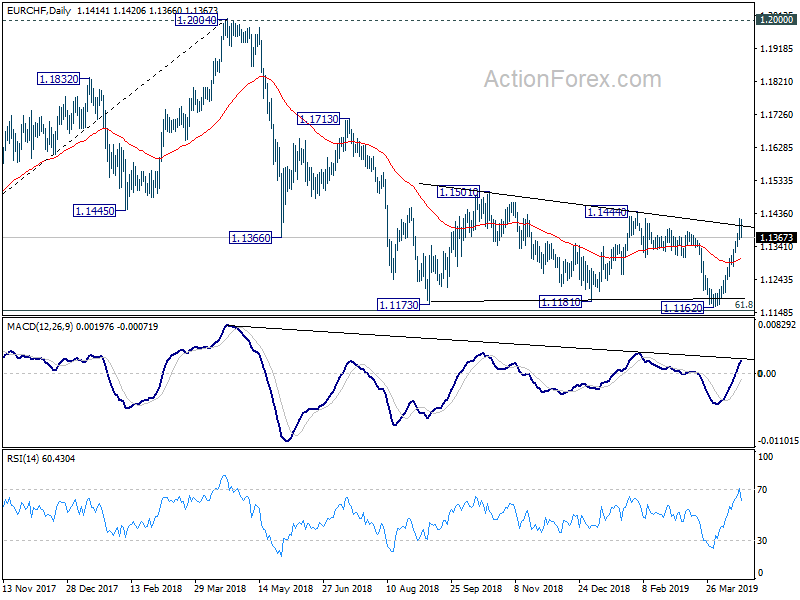
In the bigger picture, focus is back on 1.1444 resistance with current rebound. Decisive break there will indicate completion of the decline from 1.2004, with support from 61.8% retracement of 1.0629 to 1.2004 at 1.1154. In this case, further rise should be seen to 1.1713 resistance next. On the downside, firm break of 61.8% retracement of 1.0629 to 1.2004 at 1.1154 is now needed to confirm down trend resumption. Otherwise, medium term outlook will be neutral at worst.
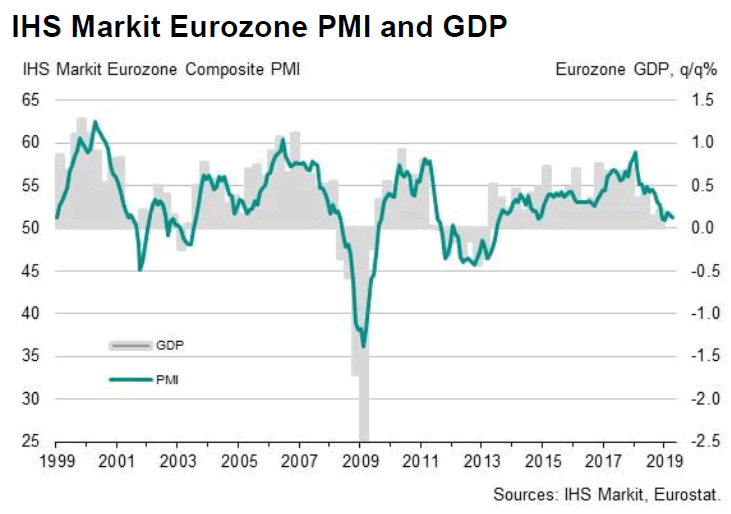
Eurozone PMIs: Disappointing start to Q2, suggest under 0.2% GDP growth
Eurozone PMI manufacturing rose to 47.8, up from 47.5 but missed expectation of 48.1. PMI services dropped to 52.5, down from 53.3 and missed expectation of 53.1. PMI composite dropped to 51.3, down from 51.6, and hit a 3-month low.
Commenting on the flash PMI data, Chris Williamson, Chief Business Economist at IHS Markit said:
"The eurozone economy started the second quarter on a disappointing footing, with the flash PMI falling to one of the lowest levels seen since 2014. The data add to worries that the economy has failed to rebound with any conviction from one-off factors that dampened activity late last year, and continues to show only very modest growth in the face of headwinds from slower global demand growth and subdued economic sentiment.
"The surveys indicate that quarterly eurozone GDP growth has slowed to just under 0.2%. A similar 0.2% rate of expansion is being signalled for Germany but France stagnated and the rest of the region has moved closer to stalling.
"Manufacturing remained the key area of concern, with output continuing to contract at one of the fastest rates seen over the past six years. Forward -looking indicators showed some signs of improvement but remain deeply in negative territory to suggest the factory malaise has further to run.
"The slowdown also showed further signs of engulfing the service sector, where growth cooled again to one of the weakest rates seen since 2016. Some encouragement can be gleaned from an improvement in employment growth, although even here the pace of hiring is among the lowest seen for two-and-a-half years.
"The persistence of the business survey weakness raises questions over the economy's ability to grow by more than 1% in 2019."
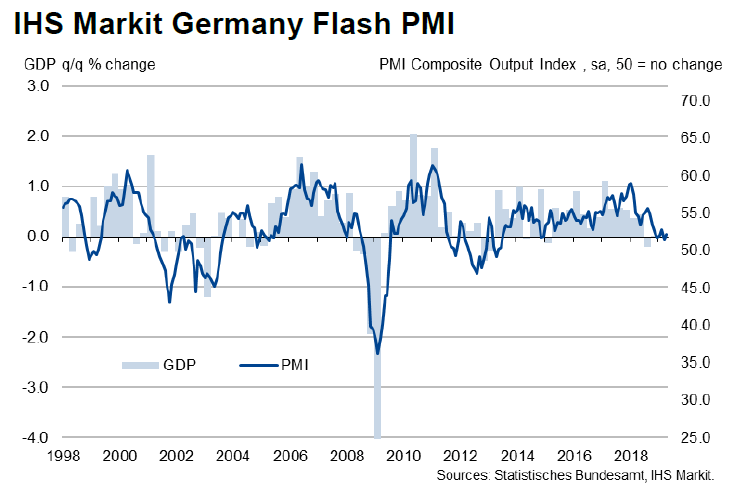
Germany PMI manufacturing ticked up 0.4 from 69-month low to 44.5
Germany PMI manufacturing rose to 44.5 in April, up from 44.1 but missed expectation of 45.2. It's staying deep in contraction below 50. PMI services rose to 55.6, up from 55.4, beat expectation of 55.0. PMI composite rose to 52.1, up from 51.4.
Commenting on the flash PMI data, Phil Smith, Principal Economist at IHS Markit said:
"The overall picture for Germany's private sector has changed very little according to April's flash data, with strong growth across the services economy continuing to counteract the export-led weakness in manufacturing. Though the PMI has ticked up from March's 69-month low, it's merely signalling the same modest rate of underlying growth as seen on average over the opening quarter of the year.
"Slight upticks in the manufacturing indices for output, new orders and employment saw the headline Manufacturing PMI post its first rise in nine months, albeit with the latest reading nonetheless the second-lowest since mid-2012. Amid reports of a declining car industry, strong competition across Europe and generally subdued global demand, the data showed another steep drop in German goods exports and the lowest confidence among manufacturers for six-and-a-half years.
"The survey continues to highlight strong job creation across the service sector, which is in turn supporting wage growth and means we should see consumer demand continue to rise during the second quarter."
France PMI manfacutring dropped to 49.6, 32-month low, underlying slowdown in demand remains evident
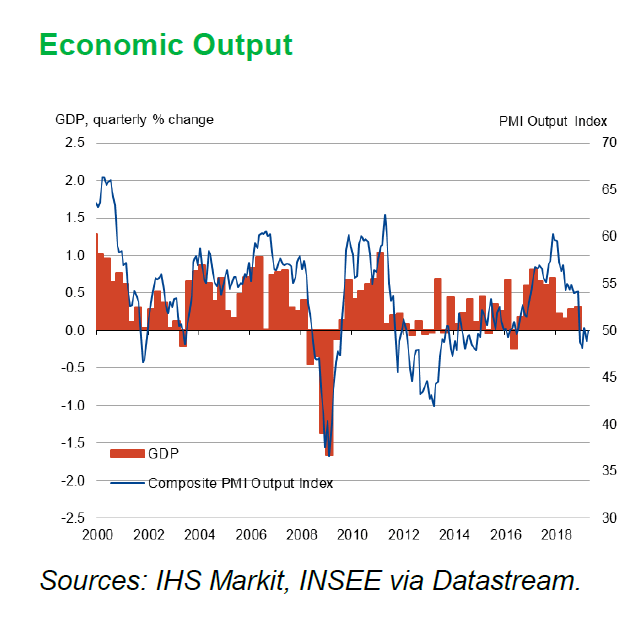
France PMI manufacturing dropped to 49.6 in April, down from 49.7 and missed expectation of 50.0. That's the lowest level in 32 months. PMI services, on the other hand, improved to 50.5, up from 49.1 and beat expectation of 49.8. PMI composite rose to 50.0, up from 48.9.
Commenting on the Flash PMI data, Eliot Kerr, Economist at IHS Markit said:
"The stabilisation of output in April is further evidence of the dwindling economic impact of the 'gilets jaunes' demonstrations. Protestor numbers have fallen to approximately 10% of their peak and the remaining disruption has been limited.
"However, protests aside, an underlying slowdown in demand remains evident in the French PMI data. New orders fell for the fifth month in a row during April, partly driven by a sixth consecutive contraction in exports. Although the rate of deterioration in new business eased, many panellists mentioned a decline in activity at their clients.
"More positively, firms were able to brush aside recruitment difficulties and increase staff numbers at a faster pace than in March. Although a mismatch between skills and open vacancies remains apparent, businesses continue to demonstrate the ability to overcome the adverse conditions."
GBP/USD Outlook: Sterling Holds In Red Ahead Of UK Retail Sales
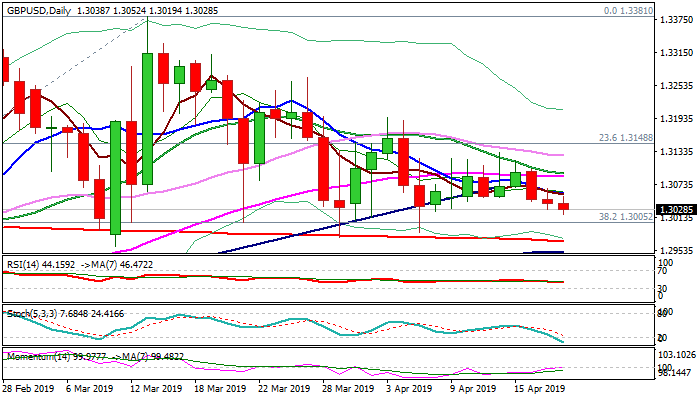
Cable stands at the back foot ahead of release of UK retail sales on Thursday, after being pressured further from weaker than expected UK inflation data and ended Wednesday's trading in red. Fresh weakness in past few sessions retested the floor of near-term congestion and eyes psychological 1.30 support (also Fibo 38.2% of larger 1.2397/1.3381) violation of which would open way for attack at key 200SMA support (1.2970). Weak retail sales results (Mar m/m -0.3% f/c vs 0.4% prev) would support negative scenario. Falling 10SMA (1.3056) caps the action for the second straight day and marks initial barrier, guarding pivots at 1.3087/93 (converging 55/20SMA's).
Res: 1.3056, 1.3075, 1.3093, 1.3127
Sup: 1.3000, 1.2970, 1.2952, 1.2889
EUR/USD Outlook: Positive Tone Ahead Of EU Data But Key Barriers Continue To Cap
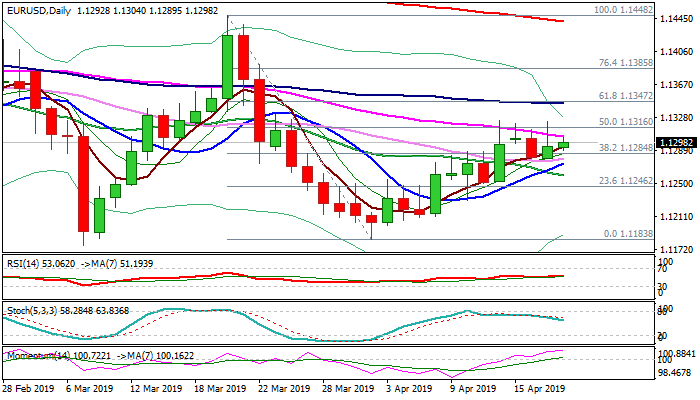
The Euro holds positive tone in early Thursday's trading and probes again into daily cloud, despite Wednesday's strong upside rejection at 1.1323 and repeated daily close below cloud base/55SMA (1.1303/05). Fourth consecutive failure to clearly break above pivotal barriers provided by daily cloud base, 55SMA and Fibo 50% of 1.1448/1.1183 (1.1316) keeps the downside vulnerable as thick daily cloud continues to heavily weigh on near-term action. Daily studies remain mixed (bullish momentum continues to rise, stochastic heads south, RSI is flat in neutral zone while MA's are in mixed setup) and lack clearer direction signal. Eventual break of above mentioned barriers is required to signal continuation of recovery leg from 1.1183 that would unmask targets at 1.1347 (100SMA/Fibo 61.8% of 1.1448/1.1183) and 1.1372 (daily cloud top). Converging 30/20SMA's offer solid supports at 1.1279/73, close below which will be bearish. The Euro was boosted by strong data from China on Wednesday, which revived risk mode and focuses series of PMI data from EU countries for fresh signals.
Res: 1.1295, 1.1305, 1.1316, 1.1323
Sup: 1.1289, 1.1279, 1.1273, 1.1259
Gold Extends Losses For The Fifth Consecutive Session
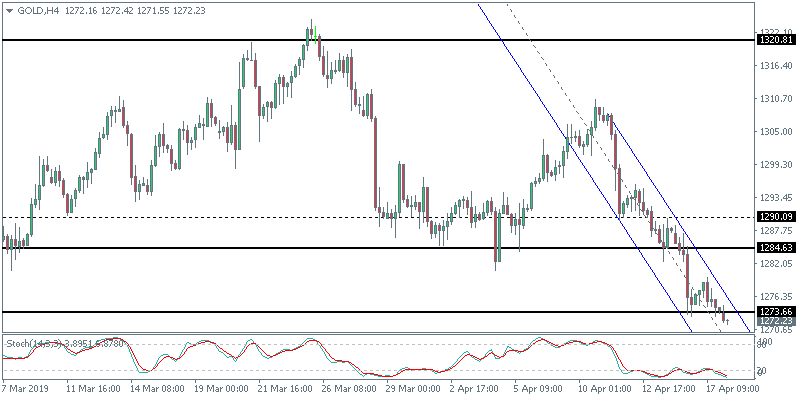
Gold prices continued to fall for the fifth consecutive session, though the pace of declines has become limited. The Fed's beige book report was upbeat as the report indicates that the US economy expanded at a moderate pace in March and early April. Some of the regional districts even reported strengthening.
Is it Time for a Correction in XAUUSD?
After declining for five sessions, gold prices could attempt to post a minor correction. This comes as price sits near the 200-day MA on the daily chart. An intraday close above 1273.50 is needed to confirm this view. The previously held support at 1285 – 1290 remains the prime target for resistance to be tested but further gains are unlikely.
Oil Slips Despite Weekly Draw
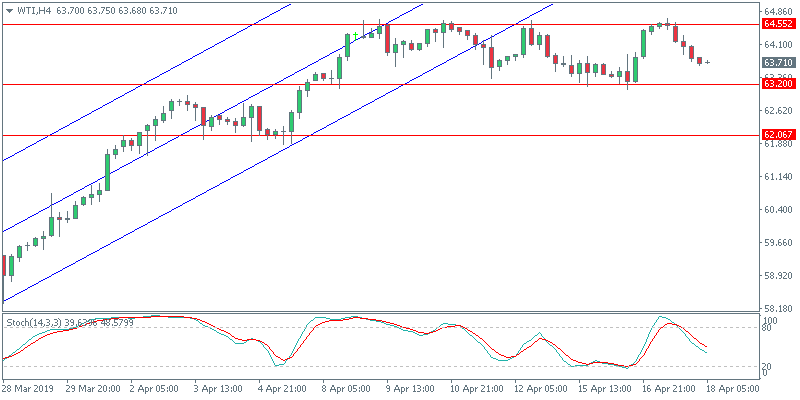
WTI crude oil prices failed to capitalize on the gains from Tuesday as it slipped close to 0.95% yesterday. The EIA's weekly crude oil inventory report showed a draw of 1.4 million barrels. This was against the estimates of a 1.6 million build up. Tuesday's API inventories already signaled a draw in the inventories earlier this week which pushed oil prices higher on Tuesday.
Can Oil Decline Further?
The reversal in crude oil comes as price initially rallied to test the previous highs near 64.55. However, failure to gain traction led to oil prices giving up Tuesday's gains. Crude oil prices seem to have settled within the range of 64.55 and 63.20. A breakout from this range is needed to establish further direction in the commodity.
Eurozone Trade Surplus Rises To 11-Month High
The trade surplus in the eurozone grew to the highest levels in a year in February.
Data from the statistics agency Eurostat showed that on a seasonally adjusted basis, trade surplus grew to 19.5 billion euro from 17.4 billion in January. This was the biggest jump since March 2018. However, the euro did not react much to the data.
EURUSD Eases Back to the Trendline
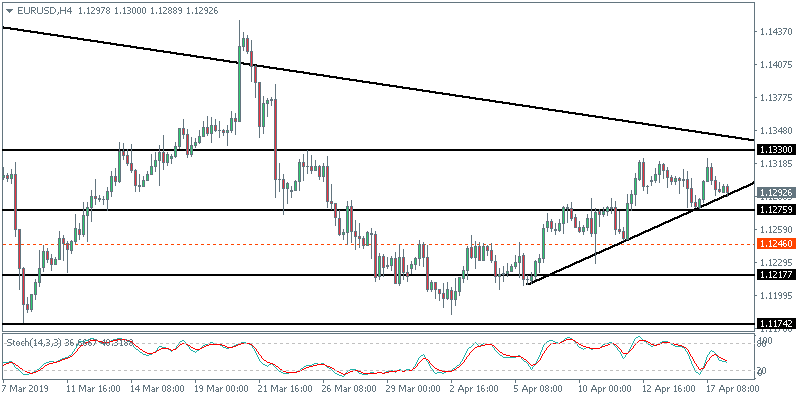
The lack of momentum in the currency pair has pushed it back to test the minor rising trend line. As long as prices remain supported by the trendline, we expect to see some upside with the 1.1330 level of resistance as the target.
The flash PMI's are due out later today. The data could potentially decide the outcome in the direction. The lower support at 1.1276 could hold the declines, if any, in the short term.
Investors On The Sidelines Ahead Of The long Weekend
Equity markets moved in different directions yesterday, as positive Chinese data failed to boost risk appetite. The S&P 500 slipped 0.23% on Wednesday, dragged down by the healthcare industry which fell 2.86% on concerns over possible changes to the US healthcare system, including calls for lower drug prices. However, European markets stood at a near six-month high, with auto and banking stocks leading the rally.
Asian equities followed Wall Street lower today, with only the Jakarta Stock Exchange moving against the trend on early, unofficial “quick count” results indicating that President Joko Widodo is on course to win a second term.However, the official results will only be announced on May 22.
The rebound in China’s economy did little to excite investors despite GDP, retail sales, industrial production and fixed asset investments all showingsigns of improvement. It’s difficult to justify why the positive data hasn’t translated into higher equities but it could be for two reasons;the expansion in economic activity was not led by the private sector, suggesting that it may not be sustainable in the longer term. Additionally, the lower likelihood of further aggressive monetary stimulus being implemented is another reason why investors will have refrained from taking on more risk. That’s why a trade agreement is becoming a necessity for equities to take another leg higher.
Better-than-expected job numbers out of Australia have sent the Australian Dollar 0.4% higher, but that was not enough to break above the key resistance level of 0.72. The Australian economy added 25,700 jobs in March, more than double the expected figure of 12,000. Unemployment ticked slightly higher to 5% from 4.9%, but with good reason, as more people joined the labor force to look for jobs. More encouraging is that jobs were dominated by full-time roles, suggesting better quality jobs. The positive report will givethe RBA more timeto decide on whether it should lower interest rates;if inflation figures next week also surprise to the upside, the chance of AUDUSD rallying beyond 0.72 becomes highly likely.
In Europe, investors will turn their attention to the latest batch of PMI reports before they head into the Easter holidays. If it’s true that the global economy has started to stabilize, we will need to see this reflected in today’s release.