Sample Category Title
EUR/USD – Euro Dips On German Manufacturing PMI Decline
EUR/USD has lost ground on Thursday. Currently, the pair is trading at 1.1252, down 0.41% on the day. It’s a busy day for fundamentals. German manufacturing PMI dropped to 44.5 in March, shy of the estimate of 45.2 points. The all-eurozone manufacturing PMI posted a decline of 47.8, missing the forecast of 48.1 points. Over in the U.S., consumer spending is expected to rebound in March. Retail sales is forecast to improve to 0.9% and core retail sales is projected to climb 0.7%. The Philly Fed manufacturing index is forecast to dip down to 11.2, while unemployment claims is projected to rise to 207 thousand. On Friday, the U.S. releases building permits and the Treasury Department releases the semi-annual currency report.
Services good. Manufacturing bad. There were no surprises from the German and eurozone PMIs for March. The manufacturing sector continues to post declines, as the global trade war has reduced demand for German and eurozone exports, and taken a toll on the auto industry. German manufacturing PMI has slowed for nine successive months, and the worrisome trend shows no signs of changing until the U.S and China hammer out a trade agreement. The services sector, which is more reflective of domestic demand, is in better shape. German services PMI improved to 55.6, while the eurozone indicator showed slight expansion, with a reading of 52.5 points.
Eurozone inflation is steady, but remains well below the ECB target of 2.0 percent. The eurozone annual inflation rate edged lower to 1.4% in March, compared to 1.5% in February. Low inflation means that the ECB is not under pressure to raise interest rates. After last week’s policy meeting, Mario Draghi noted that the economic outlook for the eurozone remains weak. With no interest hikes in sight and a sluggish eurozone economy, the euro will have likely have trouble making headway against the U.S. dollar.
Why S&P500, EUR, GBP, Brent, And Gold Are Falling
Stocks
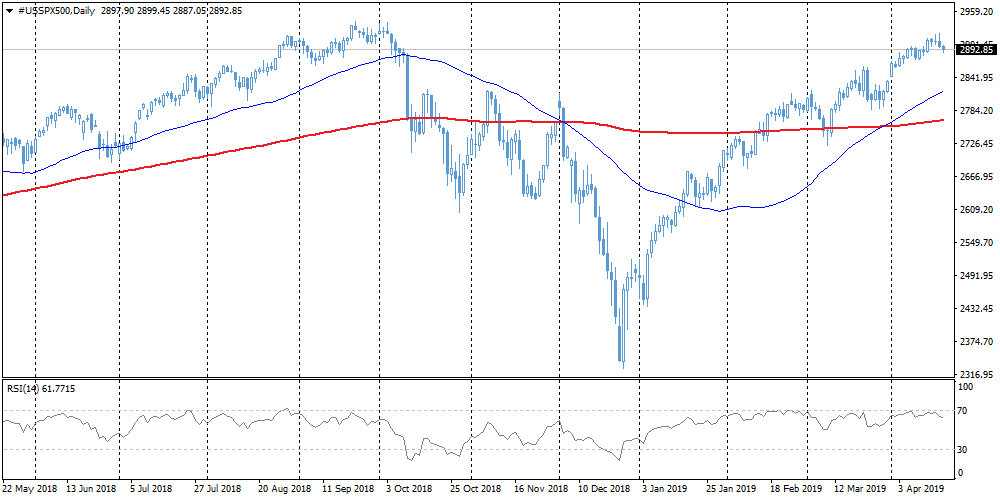
S&P500 futures have been falling since the second half of Wednesday, losing more than 1% from the peak levels. Market participants are trying to stick to thier profits after the recent rally, which sent the US and Chinese indices to multi-month highs. The JPY has touched lows against the dollar since mid-January. The moderate demand for protective assets on the background of relatively good data is a sign of cautions of the markets before the long weekend in Europe due to Easter Holidays.
EURUSD
The single currency lost more than 50 points (0.4%) to 1.1250 in response to disappointing PMIs. Indicators for the euro area were significantly worse than expected. The manufacturing index has remained below 50 since February, signalling a reduction in production. The indicator for the service sector declined from 53.3 to 52.5. Composite PMI remains dangerously close to 50, which separates growth from decline. This is not the first time this year when the euro falls under pressure after disappointing PMIs, considered to be a reliable indicator of business activity several months before the official estimates. Continued decline returns to the agenda a downward trend in the pair.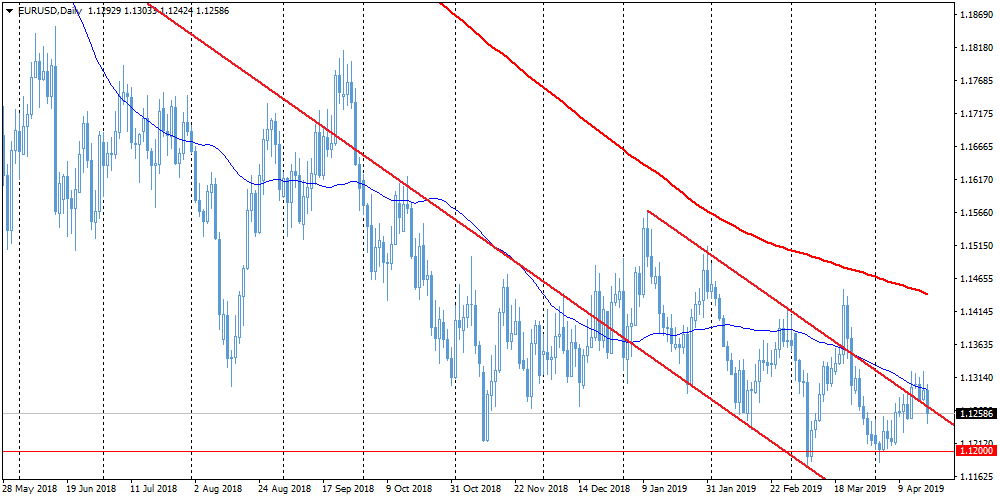
GBPUSD
GBPUSD has been falling for the third day in a row, coming close to the psychologically important 1.30 level. The pressure on the pair is caused by confrontation in the Parliament, as well as disappointing data from the eurozone. At the same time, fresh retail sales data turned out to be extremely strong. Instead of the expected decline in March by 0.3%, there was an increase of 1.1%. These are pro-inflation news that can help the British pound to swim against the stream, despite the general wary mood in the markets. It is worth paying attention to the dynamics near 1.30 and at 1.2970 - where the pair has received support for the last 2 months.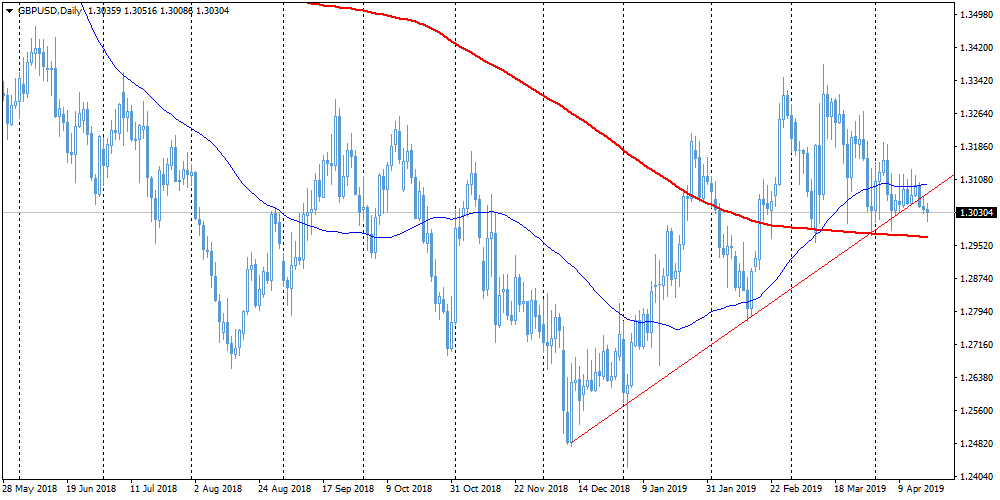
Brent
Despite the sanctions against Venezuela, oil is under pressure on Thursday. After updating the semi-annual highs at 71.80 per barrel of Brent, black gold declined, trading at the time of writing near 70.90. It is important that the RSI fell under 70, returning from the overbought zone, which may cause an increase in pressure, becoming a signal to start profit taking.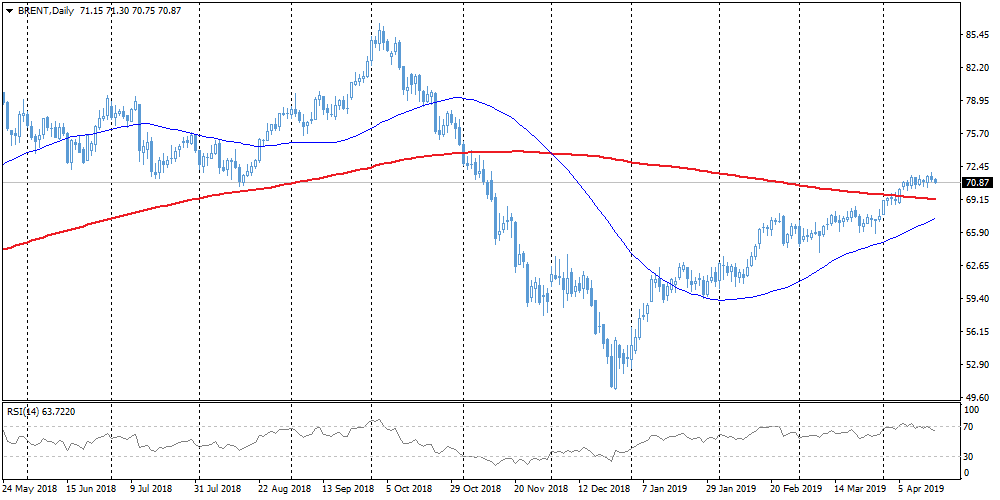
Gold
Impressive global markets optimism put pressure on gold prices since the beginning of the year. The growth in US bond yields and multi-month highs in stock indices were probably one of the reasons for the sharp weakening this week. In addition, seasonal factors also play against gold, as it rarely manages to grow between March and August. The closest significant support level is at 1250 - an important level, plus MA(200) passes through it at the moment.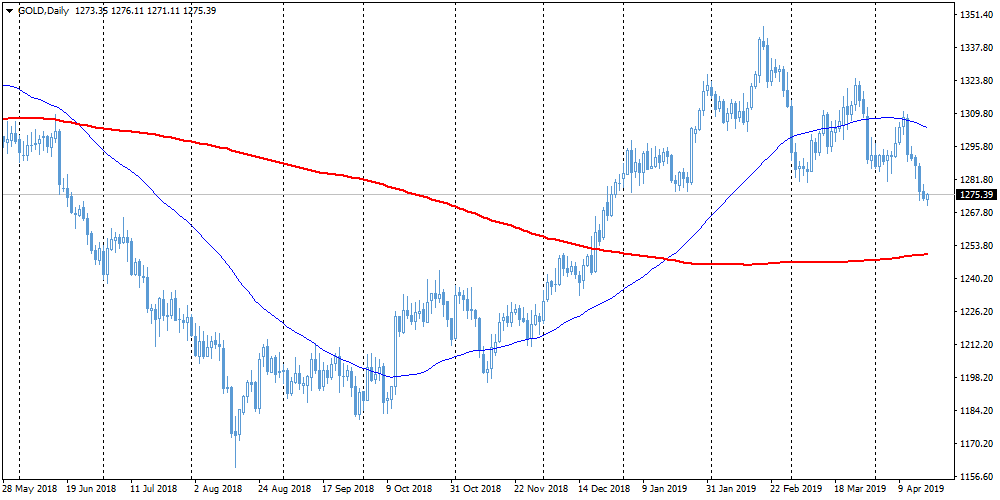
AUD/JPY 4H Chart: Bullish Sentiment To Continue
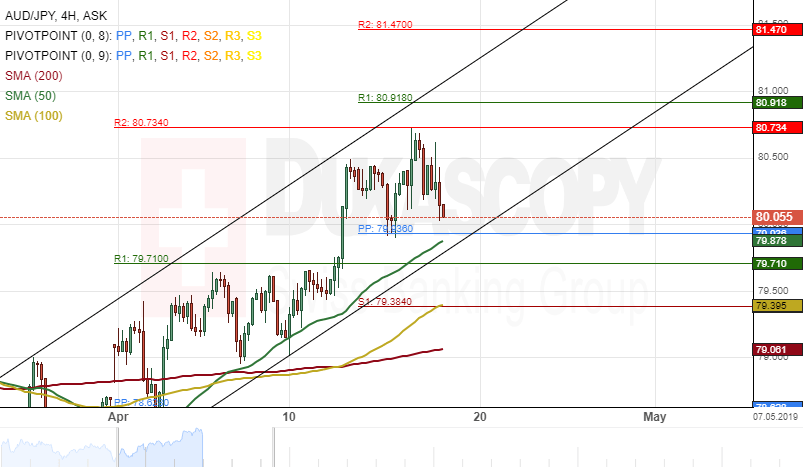
The AUD/USD exchange rate has been trading within a narrow ascending channel pattern since the end of March.
Given that the currency pair is being pressured by the 50-, 100– and 200-hour simple moving averages, it is likely that an upside potential prevails in the short-term. Most likely, the Aussie will aim for the upper channel line located at the 81.00 mark.
Although, the currency exchange rate has to surpass the monthly resistance level at 80.73. If the given resistance level holds, a reversal south could occur during the following trading sessions.
GBP/JPY 4H Chart: Set For Breakout
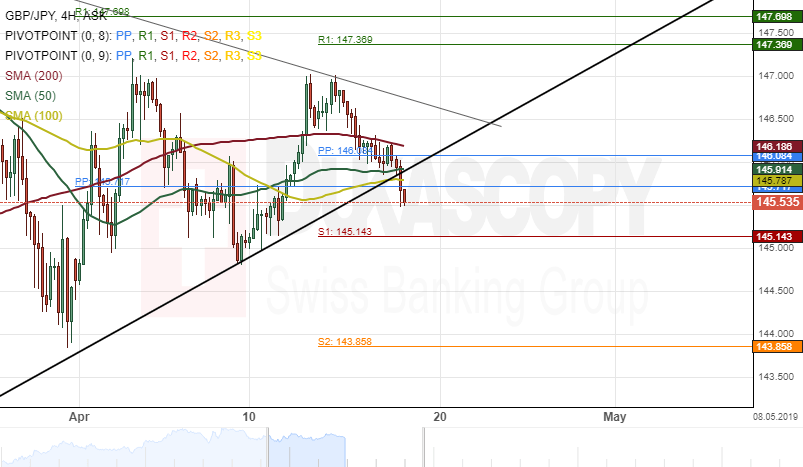
The British Pound has appreciated about 9.79% in value against the Japanese Yen since the beginning of January. This movement was guided in an ascending channel pattern.
Currently, the currency pair is testing a support level formed by the lower boundary of a four-month ascending channel and the 50-hour simple moving average at 145.79.
If the GBP/JPY passes the support level, a decline towards a swing low of 144.00 could be expected. However, if the given channel holds, it is likely that an upside reversal could occur in the nearest future.
Euro Zone PMI Data Raises Questions About The Region’s Ability To Rebound With Any Conviction
Notes/Observations
- Green shoots in China's economy failed to find its way into EU data as Brexit uncertainty had been deferred rather than resolved; session saw a search for safe haven plays
- Major European Apr Preliminary Manufacturing PMI data missed expectations and remained in contraction territory; data raised questions over whether the economy would be able to grow by more than 1% in 2019
- UK March Retail Sales data beats expectations as rising earnings and growth in jobs have supported household consumption despite the hit to consumer confidence from Brexit
Asia:
- Australia Mar Employment Change: +25.7K v +15.0Ke; Unemployment Rate: 5.0% v 5.0%e
- Bank of Korea (BoK) left the 7-Day Repo Rate unchanged at 1.75% (as expected); cut its growth and inflation forecasts (implied less likelihood of another rate hike)
- Japan Apr Preliminary PMI Manufacturing saw its 3rd straight contraction (49.5 v 49.2 prior) with new export orders falling at fastest pace in 3 years
- LDP lawmaker Hagiuda noted that Japan Oct 2019 increase of sales tax might be delayed (Note: would be the 3rd such delay of this planned hike)
- Japan Finance Min Aso might discuss forex issues with US Treasury Sec Mnuchin next week;
- US and China reportedly have set a tentative timeline for next round of face-to-face trade discussions; seek to sign deal as soon as late May
- North Korean leader Kim Jong Un said to oversee the test-firing of a "new-type tactical guided weapon,"
Europe:
- Ireland PM Varadkar stated that PM May accepted that the withdrawal agreement would not be reopened but cautioned that the risk of no deal Brexit was not fully averted Americas:
- Fed Beige Book noted that March economic activity expanded at a slight-to-moderate pace. Labor markets remained tight across districts, restraining growth while prices had risen modestly since prior report. Consumer spending was mixed; saw sluggish sales for general retailer and auto dealers while most Fed districts reported stronger home sales
- NY Fed's Logan: Might need to respond to unanticipated changes in reserves by conducting repo operations; any discussion of a standing repo facility was in its early stages
- Fed's Bullard (Dove, voter): inflation expectations data has been concerning; low inflation and joblessness data show dormant Phillips curve
- Potential Fed nominee Herman Cain: I won't withdraw from consideration for Fed Board; believe I have a 50/50 chance of being confirmed if nominated
- President Trump: China trade talks were moving along nicely; "you'll be hearing about" a China deal shortly
SPEAKERS/FIXED INCOME/FX/COMMODITIES/ERRATUM
Equities
- Indices [Stoxx600 -0.20% at 388.82, FTSE -0.31% at 7,448.19, DAX -0.16% at 12,133.15, CAC-40 -0.38% at 5,542.18, IBEX-35 -0.62% at 9,490.55, FTSE MIB -0.78% at 21,828.50, SMI -0.24% at 9,574.00, S&P 500 Futures -0.21%]
Market Focal Points/Key Themes:
Equities
- European Indices trade lower this morning following misses on April Flash PMI data out of France, Germany and the Eurozone. Some weakness also being observed in U.S. futures following yesterday mixed session where S&P Futures trade down 0.2%. Major European earners this morning Unilever and Nestle both trade 2.5% and 1% higher, respectively, on results and affirmed outlooks. The CAC 40 trades under pressure as major component Gucci brand-owner Kering trades lower following Q1 sales data. Schneider Electric trades higher after better than expected Sales data and affirming outlook while alcoholic beverages producer Pernod-Ricard trades 2% lower after in-line results and raised FY19 guidance. In the U.K. Rentokil Initial trades marginally higher following earnings. Avast Software and MoneySupermarket.com also trade higher after positive read from trading updates. Elsewhere in Netherlands, Arcadis trades almost 12% higher after providing positive colour on outlook and reporting results. In Germany, ADVA Optical Networking fell sharply following results. On the corporate front, OSRAM Licht in Frankfurt trades down almost 7% on press report that Bain and Carlyle confidence in takeover bid for company shrinks. Looking ahead notable earners include Honeywell, American Express, Sketchers, Philip Morris and Blackstone.
- Consumer discretionary: Unilever [UNA.NL] +2.5% (earnings), Nestle [NESN.CH] +1% (earnings), Pernod-Ricard [RI.FR] -2% (earnings), Kering [KER.FR] -4.5% (sales), Beter Bed Holding [BBED.NL] -6% (earnings), zooplus [ZO1.DE] +5% (earnings), Rentokil Initial [RTO.UK] +1% (earnings)
- Healthcare: Roche Holding [ROG.CH] -1% (study update)
- Industrials: Schneider Electric [SU.FR] +2% (earnings), Arcadis [ARCAD.NL] +8.5% (earnings), Trifast [TRI.UK] +7% (trading update)
- Technology: MoneySupermarket.com [MONY.UK] +8% (trading update), OSRAM Licht [OSR.DE] -6.5% (reports on progress in merger talks), ADVA Optical Networking [ADV.DE] -15% (earnings), Avast Software [AVST.UK] +3% (trading update)
Speakers
- France Fin Min Le Maire reiterated that global growth was weak due to political factors
- Bank of England (BOE) Quarterly Credit Conditions & Bank Liabilities Surveys noted that demand for corporate lending decreased in quarter and that credit card defaults increased significantly in Q1
- Russia Central Bank Dep Gov Yudayeva: To tell banks to raise reserves for FX depositis; could introduce limits
- Japan Chief Cabinet Sec Suga reiterated govt stance that planned sales tax increase to go-ahead as planned for Oct unless there is a Lehman-type of shock
- Japan Cabinet Office (Govt) Apr Monthly Economic Report maintained its overall economic assessment but downgraded its assessment of corporate sentiment
- China Commerce Ministry (MOFCOM) Spokesman Gao Feng: Continuous new progress begin made in US trade talks but plenty of work still needed to be done
Currencies/Fixed Income
- EUR/USD was soft in the session following disappointing PMI Manufacturing data out of Europe. Misses by France, Germany on the data sent the pair to a one-week low while German bund yields fell. Dealers noted that continued rejection of the 1.13 area suggested a downward bias for the pair. The data raised questions over whether the economy would be able to grow by more than 1% in 2019
- GBP/USD was off its worst level of the session after UK Mar retail sales data handily beat expectations. Pair holding above the 1.30 level. Analysts noted that rising earnings and growth in jobs had supported household consumption despite the hit to consumer confidence from Brexit
Economic Data
- (DE) Germany Mar PPI M/M: -0.1% v +0.2%e; Y/Y: 2.4% v 2.7%e
- (CH) Swiss Trade Balance (CHF): 3.2B v 2.9B prior; Real Exports M/M: 0.1% v 1.5% prior; Real Imports M/M: -3.2% v -3.0% prior; Watch Exports Y/Y: 4.4% v 3.6% prior
- (FR) France Apr Preliminary PMI Manufacturing: 49.6 v 50.0e (2nd straight contraction); PMI Services: 50.5 v 49.8e; PMI Composite: 50.0 v 49.7e
- (DE) Germany Apr Preliminary PMI Manufacturing: 44.5 v 45.0e (4th straight contraction)PMI Services: 55.6 v 55.0e; PMI Composite: 52.1 v 51.7e
- (SE) Sweden Mar Unemployment Rate: 7.1% v 6.6%e; Unemployment Rate (Seasonally Adj): 6.7% v 6.2%e; Trend Unemployment Rate: 6.3% v 6.3% prior
- (EU) Euro Zone Apr Preliminary PMI Manufacturing: 47.8 v 48.0e (3rd straight contraction); PMI Services: 52.5 v 53.2e; PMI Composite: 51.3 v 51.8e
- (IT) Italy Feb Industrial Sales M/M: 0.3% v 3.1% prior; Y/Y: 1.3% v 0.7% prior
- (IT) Italy Feb Industrial Orders M/M: -2.7% v +2.1% prior; Y/Y: -2.9% v -0.6% prior
- (PL) Poland Mar Sold Industrial Output M/M: 9.8% v 8.6%e; Y/Y: 5.6% v 4.5%e
- (PL) Poland Mar PPI M/M: 0.2% v 0.3%e; Y/Y: 2.5% v 2.6%e
- (UK) Mar Retail Sales (Ex-auto /fuel) M/M: +1.2% v -0.3%e; Y/Y: 6.2% v 4.0%e
- (UK) Mar Retail Sales (Including auto/fuel) M/M: +1.1% v -0.3%e; Y/Y: 6.7% v 4.5%e
- (HK) Hong Kong Mar Unemployment Rate: 2.8% v 2.8%e (matched lowest level since Jan 1998)
Fixed Income Issuance
- (FR) France Debt Agency (AFT) sold total €9.249B vs. €7.75-9.25B indicated range in 2022, 2023 and 2025 bonds
- Sold €4.204B in 0.00% Feb 2022 Oat; Avg Yield: -0.43% v -0.38% prior; Bid-to-cover: 3.76x v 5.14x prior
- Sold €1.290B in 1.75% May 2023 Oat; Yield: -0.33% v -0.18% prior; bid-to-cover: 3.04x v 2.77x prior
- Sold €3.755B in new 0.0% Mar 2025 Oat; Avg Yield: -0.08% v +0.42% prior; Bid-to-cover: 2.66x v 4.85x prior
Looking Ahead
- (SA) Saudi Arabia Feb Oil Production: No est v 10.243M bdp prior ; Exports: No est v 7.25M bpd prior- JODI
- 05:30 (HU) Hungary Debt Agency (AKK) to sell 12-month bills
- 05:30 (IN) India to sell combined INR170B in 2021, 2026, 2032, 2039 and 2055 bonds
- 05:50 (FR) France Debt Agency (AFT) to sell €1.0-1.5B in Inflation-linked 2022, 2028 and 2047 bonds (Oatei)
- 06:00 (IE) Ireland Mar PPI M/M: No est v -1.2% prior; Y/Y: No est v -9.4% prior
- 06:00 (UK) DMO to sell €3.5B in 1-month, 3-month and 6-month bills £0.5B, £1.0B and £2.0B respectively)
- 06:45 (US) Daily Libor Fixing - 08:00 (PL) Poland Central Bank (NBP) Apr Minutes
- 08:30 (US) Mar Advance Retail Sales M/M: +1.0%e v -0.2% prior; Retail Sales Ex-Auto M/M: +0.7%e v -0.4% prior; Retail Sales (Ex-auto/gas): +0.4%e v -0.6% prior; Retail Sales Control Group: +0.4%e v -0.2% prior
- 08:30 (US) Initial Jobless Claims: 205Ke v 196K prior; Continuing Claims: 1.72Me v 1.713M prior
- 08:30 (US) Apr Philadelphia Fed Business Outlook: 10.5e v 13.7 prior
- 08:30 (CA) Canada Feb Retail Sales M/M: +0.4%e v -0.3% prior; Retail Sales Ex-auto M/M: 0.2%e v 0.1% prior
- 08:30 (CA) Canada Mar ADP Payroll Estimates: No est v K prior
- 08:30 (US) Weekly USDA Net Export Sales
- 09:00 (RU) Russia Mar Unemployment Rate: 4.9%e v 4.9% prior; Real Wages Y/Y: 0.9%e v 0.7% prior;
- 09:00 (RU) Russia Real Retail Sales Y/Y: 1.6%e v 2.0% prior
- 09:00 (RU) Russia Gold and Forex Reserve w/e Apr 12th: No est v $489.1B prior
- 09:45 (US) Apr Preliminary Markit Manufacturing PMI: 52.8e v 52.4 prior; Services PMI: 55.0e v 55.3 prior; Composite PMI: No est v 54.6 prior
- 10:00 (US) Mar Leading Index: 0.4%e v 0.2% prior
- 10:00 (US) Feb Business Inventories: 0.3%e v 0.8 % prior
- 10:30 (US) Weekly EIA Natural Gas Inventories
- 11:30 (US) Treasury to sell 4-Week and 8-Week Bills
- 12:10 (US) Fed's Bostic (dove, non-voter)
- (US) DOJ to release redacted version of Mueller
- 13:00 (US) Weekly Baker Hughes Rig Count data
- 13:00 (US) Treasury to sell 5-Year TIPS Report:
- (IT) Italy Debt Agency (Tesoro) announcement for upcoming CTZ and BTPei auction for Apr 24th
PMIs, Markets, USD, Gold, Oil
Markets recover from initial post-PMI weakness
European equity markets have recovered from earlier weakness, following another disappointing batch of PMIs from the euro area, with stocks being supported by a weaker euro.
It's going from bad to worse for the eurozone, with the latest PMIs for the region once again highlighting just how worrying the outlook has become. The block started to slow last year but the decline appears to have accelerated in recent months, with the manufacturing survey now giving contractionary readings for Germany, France and the euro area as a whole, with the former being well into the territory despite rebounding slightly to 44.5.
It's been a staggering drop off that has forced Italy into recession, pushed Germany to the brink and weighed heavily on the currency just as the central bank was planning to bring a decade of stimulus to an end with a first rate hike this year since 2011. That plan has collapsed before it really got going and instead we have new TLTROs and it won't be long until people are asking questions about whether more QE will be necessary, only a matter of months after new purchases were brought to an end.
Naturally the euro is not responding well to the news, as it dipped below 1.13 against the dollar to trade in the mid-1.12 range. While we're still a little bit from the recent lows, the path of least resistance certainly looks below as it becomes clear just how fragile the region still is. This is keeping the dollar well supported as other currencies win the race to the bottom, even as the Fed dramatically lowers its interest rate expectations and an economic slowdown and possible earnings recession looms. The grass is simply less green everywhere else.
Can gold break $1,280 again?
What's interesting is that the stronger dollar is not really holding gold back this morning, which has been the opposite trend to what we've been seeing recently. Gold is holding onto gains early in the session, although it's still trading below $1,280 which had previously been a strong support zone for the yellow metal. It already tested this from below on Wednesday and held but another run may be on the cards.
The bears won't have been filled with confidence earlier this morning as we barely made a new low – and with flagging momentum – before prices started to rise again. Coming even as the dollar rallied doesn't provide any additional comfort either. A break back above $1,280 doesn't necessarily signal the end of the decline in gold prices but it will make the bears nervous coming so soon.
Oil finding resistance after inventory data
Oil is trading marginally lower so far today, with a stronger dollar potentially being a drag on WTI and Brent crude. Yesterday's inventory report from EIA may also have taken some of edge off the rally, with the drawdown having been lower than that reported by API a day earlier. Oil is in an interesting place though because on the one hand it recently broke through notable technical resistance but on the other it did so as momentum lagged.
Reports of a tighter oil market even as the US pumps at record rates will be encouraging to OPEC+ given the efforts made this year to rebalance, although it will cast significant doubt over Russia's participation in any extension to the end of the year, with current cuts set to expire in June.
EUR/USD Likely To Decline
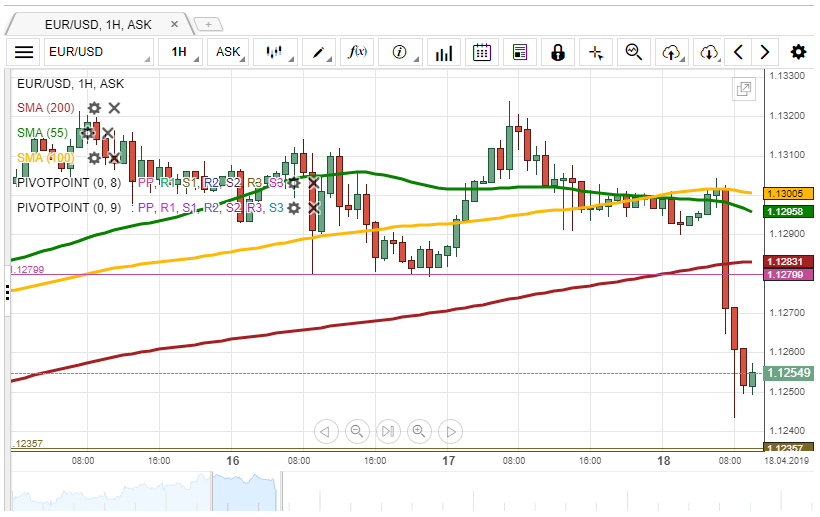
Yesterday, the EUR/USD currency pair tried top surpass the support level formed by the 55– and 100-hour SMAs at 1.1299. During Thursday's morning, the Euro significantly depreciated against the US Dollar.
It is likely, that the Euro stays under pressure in the nearest future, and the pair continues trading down. A possible downside target is the psychological level at the 1.1240 mark.
Otherwise, it is expected, that the exchange rate trades sideways around the psychological level at 1.1260. Also, it is unlikely, that the rate could reverse north and jump higher than 1.1280 due to the resistance formed by the 200-hour SMA, as well the weekly and monthly PPs.
GBP/USD Could Reach 1.3000
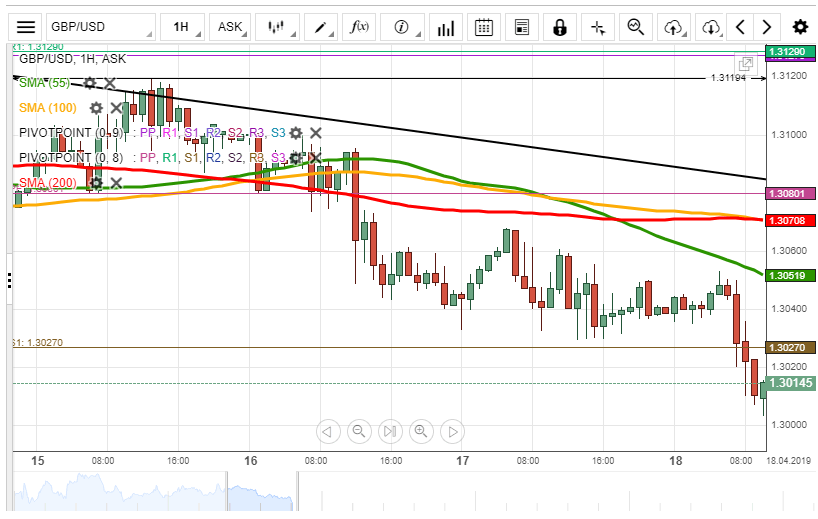
On Wednesday, the GBP/USD exchange rate tested the support level—the weekly S1 at 1.3027. During today's morning, the rate surpassed the given support.
Given that the currency pair is pressured by the 55-, 100– and 200-hour SMAs, currently located in the 1.3053/1.3071 range, it is expected, that the pair steps lower than the psychological level at the 1.3000 mark.
Otherwise, it is likely, that the pair trades sideways around the given support level. It is unlikely, that bulls could prevail in the market in the short term.
USD/JPY: Two Scenarios Likely
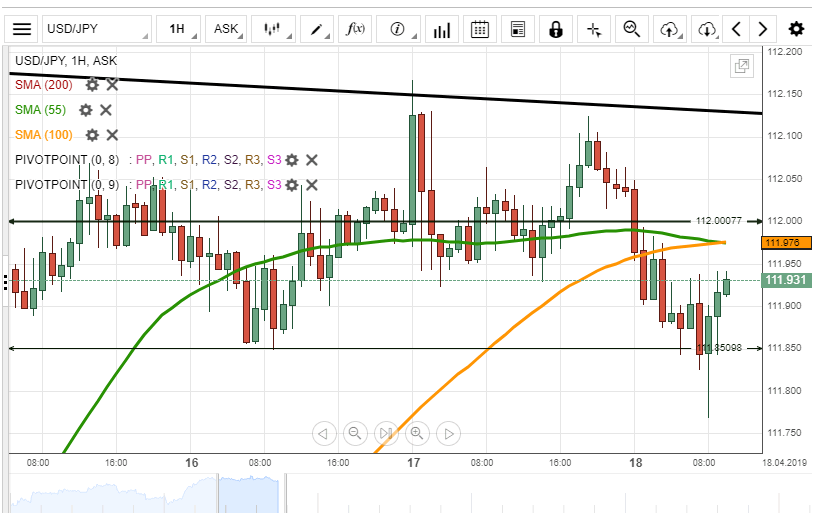
During previous trading session, the USD/JPY currency pair resumed trading sideways between the resistance level—the monthly R1 at 112.11 and the support level at 111.85.
If the given resistance and support hold, it is likely, that the exchange rate could continue to trade sideways in the nearest future.
On the other hand, given that the rate is pressured by the 55– and 100-hour SMAs, the pair could breach the given support and decline to the weekly PP at 111.66.
XAU/USD Pressured By 55-Hour SMA
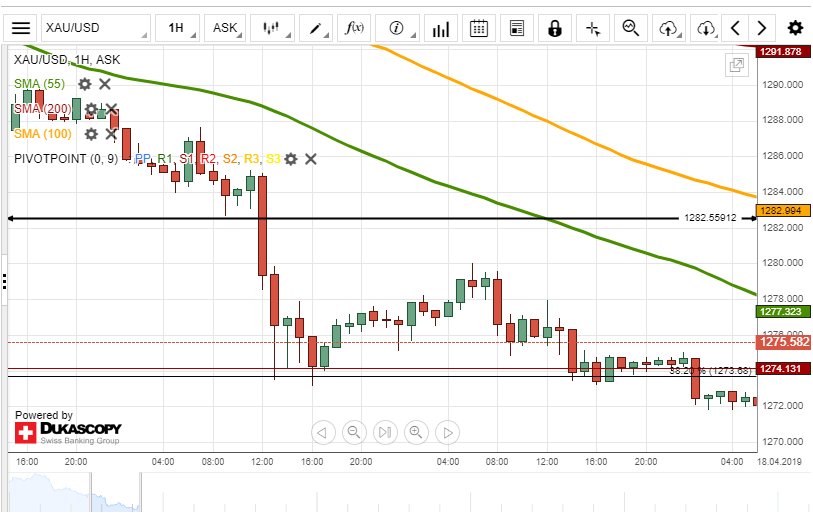
Yesterday, the XAU/USD exchange rate tried to surpass the support level formed by a combination of the monthly S1 and the Fibonacci 38.20% retracement at 1,275.00.
Given that the rate is being pressured by the 55-hour SMA, currently located at 1,277.32, it is likely, that some downside potential prevails in the market. A possible downside target is the 1,265.00/1,270.00 range.
On the other hand, the rate could trade sideways, trying to surpass the given resistance. It is unlikely, that the price for gold could surpass the 100-hour SMA at 1,282.99.