

Sample Category Title
Easter Lull in Activity
Notes/Observations
- Easter lull in activity with market holidays in various countries in Asia, Europe and North America
Asia:
- Japan Mar National CPI Y/Y: 0.5% v 0.5%e; CPI Ex Fresh Food (core) Y/Y: 0.8% v 0.7%e; CPI Ex Fresh Food, Energy (core-core) Y/Y: 0.4% v 0.4%e
- BOJ announcement related to daily bond buying operation saw a cut in purchases of 10-25 year and over 25 year JGBs with some analysts calling it a form of tapering
- Japanese LDP officials continue to debate sales tax increase amid speculation it could again be delayed
- Japan Fin Min Aso expected to discuss forex issues with US Treasury Sec Mnuchin next week
Americas:
- Fed's Kaplan (dove, non-voter): Fed growth estimates have been firming since beginning of the year; getting more confident about 2019 economic growth
- Fed's Bostic (dove, non-voter): Rates might go up or down; preserving optionality
Energy:
- Weekly Baker Hughes Rig Count 1,012 v 1,022 w/w (-1% w/w)
SPEAKERS/FIXED INCOME/FX/COMMODITIES/ERRATUM
Equities
- closed for Easter holiday
Speakers
- Italy Dep PM Di Maio (5-Star): League threatening to make govt fall and appear to have contact with ex-premier Berlusconi for another executive
- Japan Top Currency Official Asakawa commented following meeting of senior MoF, BoJ, and FSA officials on financial markets that they discussed possible high volatility during upcoming Golden Week holiday break
- BOJ said to consider trimming its economic growth forecast in its upcoming Quarterly Outlook for Economic Activity and Prices (**Reminder: On Apr 18th reports circulated that BOJ could slightly cut its FY19/20 GDP and CPI forecasts at the upcoming Quarterly Outlook for Economic Activity and Prices. It added that FY21/22 CPI (3-year out) would still be below the 2% target)
- South Korea Vice Fin Min Lee: extra budget could raise GDP growth by 0.1%
Economic Data
- (CN) Weekly Shanghai copper inventories (SHFE): 236.7K v 245.2K tons prior
- (RU) Russia Narrow Money Supply w/e Apr 12th (RUB): 10.27 v 10.16T prior
- (IT) Italy Apr Consumer Confidence Index: 110.5 v 111.3e; Manufacturing Confidence: 100.6 v 100.9e; Economic Sentiment: 98.7 v 99.1 prior
Fixed Income Issuance
- None seen
Looking Ahead
- 07:30 (TR) Turkey Central Bank TCMB Survey of Expectations: 12-month inflation expectation: No est v 15.5% prior
- 07:30 (IN) India Weekly Forex Reserves w/e Apr 12th: No est v $413.8B prior
- 08:30 (US) Mar Housing Starts: 1.225Me v 1.162M prior; Building Permits: 1.300Me v 1.291M prior (revised from 1.296M)
EUR/USD Outlook: The Euro is Recovering after Thursday’s 0.6% Fall
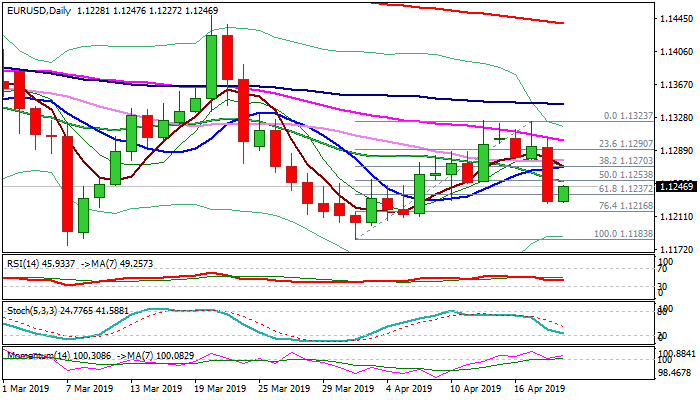
The Euro bounces from new two-week low at 1.1226, posted after Thursday's 0.6% fall (the biggest one-day loss since 22 Mar). Bears accelerated after weaker than expected Eu members PMI data on Thursday and were boosted by rally of the dollar after upbeat US data. Bearish signal on Thursday's close below 1.1237 (Fibo 61.8% of 1.1183/1.1323 upleg) keeps risk of further weakness, as daily MA's are in negative configuration and stochastic heads south. On the other side, momentum regained traction after reversing just above its 7-SMA / centerline and boosts recovery. Broken 20SMA offers immediate resistance at 1.1252, which should ideally cap upticks and guard pivotal 10SMA barrier at 1.1270 (also broken Fibo 38.2% 1.1183/1.1323), violation of which would sideline bears and shift focus towards key barriers at 1.1300 (55SMA) and lower platform at 1.1323.
Res: 1.1252; 1.1270; 1.1300; 1.1323
Sup: 1.1226; 1.1216; 1.1200; 1.1183
USD/JPY Daily Chart Suggests Pair Approaching Crucial Resistance
Key Highlights
- The US Dollar settled above the 110.60 and 111.50 resistances against the Japanese Yen.
- USD/JPY could attempt to surpass a crucial bearish trend line at 112.60 on the daily chart.
- The US Retail Sales in March 2019 increased 1.6% (MoM), more than the +0.9% forecast.
- The US Housing Starts in March 2019 could increase 6.5% (MoM), whereas the last was -8.7%.
USDJPY Technical Analysis
The US Dollar started a strong upward move from the 109.80 support area against the Japanese Yen. The USD/JPY broke the 110.60 and 111.50 resistances to move into a positive zone.
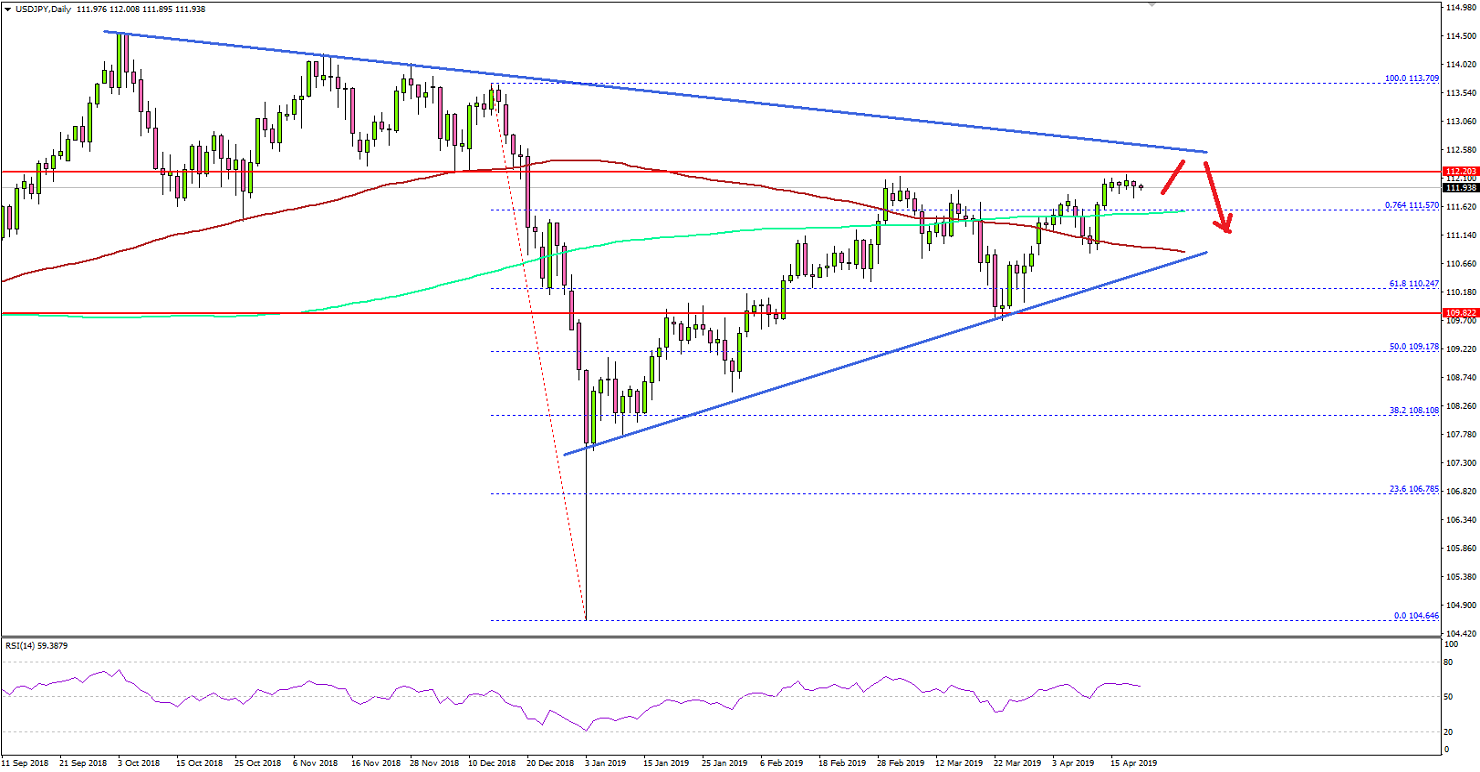
Looking at the daily chart, the pair followed a solid bullish path from the 109.70 swing low and traded above the key 110.60 resistance plus the 100-day simple moving average (red).
It opened the doors for more gains above 111.00 and the 76.4% Fib retracement level of the significant drop from the 113.70 high to 104.64 low. The pair even settled above 111.50 and the 200-day simple moving average (green).
However, there is an important resistance formed near 112.50 and a crucial bearish trend line at 112.60 on the same chart. It seems like the pair is likely to struggle near 112.50-112.60 in the near term.
If there is a clear break above the 112.50 resistance and the trend line, there could be further upsides above 113.00 and 113.50. On the flip side, a failure to clear the trend line could trigger a downside correction towards the 110.60 support and the 100-day SMA.
Fundamentally, the US Retail Sales report for March 2019 was released by the US Census Bureau. The market was looking for an increase of 0.9% in sales in March 2019, compared with the previous month.
The actual result was better than the forecast, as there was a 1.6% rise in sales, which was a lot better compared to the last decline of 0.2%. Looking at the Retail Sales ex Autos, there was an increase of 1.2%, more than the 0.7% forecast.
The report added that:
Total sales for the January 2019 through March 2019 period were up 2.9 percent (±0.7 percent) from the same period a year ago. The January 2019 to February 2019 percent change was unrevised from down 0.2 percent (±0.2 percent)*.
Overall, the USD/JPY could make an attempt to surpass the 112.50 and 112.60 resistance levels, but it won’t be easy for the bulls to gain strength above the trend line.
Economic Releases to Watch Today
- US Housing Starts March 2019 (MoM) – Forecast 1.230M, versus 1.162M previous.
- US Building Permits March 2019 (MoM) – Forecast 1.230M, versus 1.219M previous.
GBP/USD Outlook: Bears Taking a Breather above Key 200SMA Support
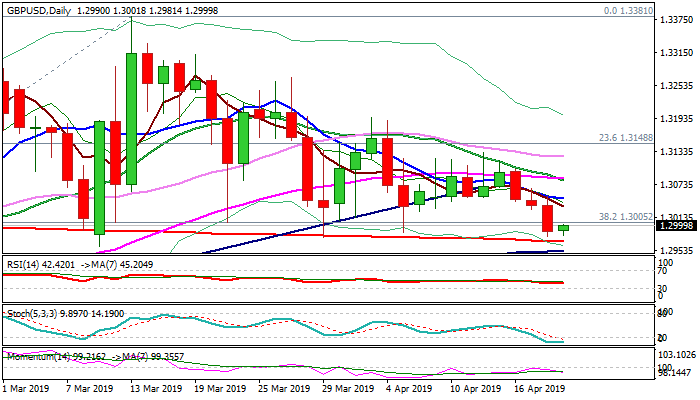
Cable consolidates within narrow range above three-week low at 1.2978 in holiday-thinned Friday's trading. The pair fell on Thursday, dragged by fresh weakness of Euro on weak EU PMI data, with little help seen from upbeat UK retail sales readings. Bears managed to close below psychological/double-Fibo 1.30 support (Fibo 38.2% of larger 1.2397/1.3381 ascend/Fibo 61.8% of 1.2772/1.3381 upleg) and came close to key 200SMA support at 1.2969. Techs are expected to be the main driver today on absence of economic indicators, with lower volumes keeping the price action more vulnerable of sudden moves. Daily momentum heads south and made bear-cross with its 7-d SMA, supporting negative scenario, however, slow stochastic bottomed in deep oversold territory, suggesting that bears may take a breather before fresh attack at 200SMA. Eventual break below 200SMA, which kept the downside protected in past two months, will generate very strong bearish signal. Falling 10SMA (1.3049) is expected to ideally limit corrective upticks and keep intact upper trigger at 1.3085 (converged 20/55SMA's).
Res: 1.3005; 1.3049; 1.3085; 1.3125
Sup: 1.2978; 1.2969; 1.2953; 1.2889
Gold Posts Modest Gains After a 5-day Losing Streak
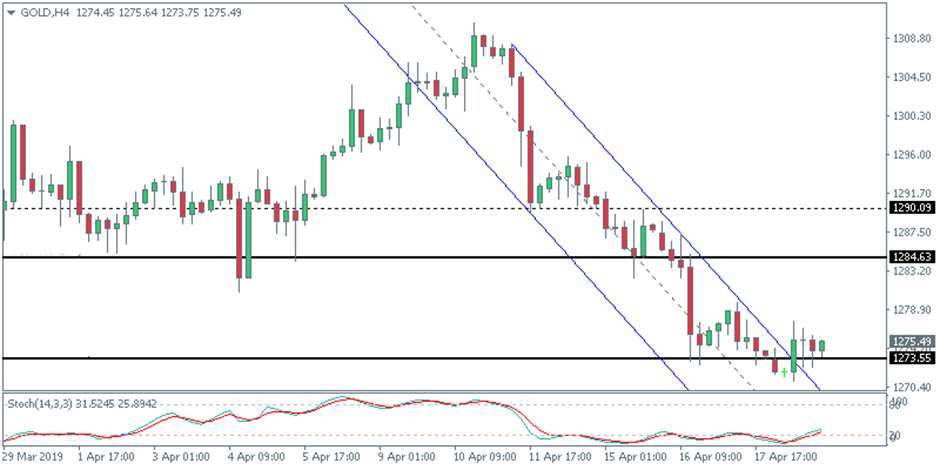
The precious metal was seen posting some modest gains right after prices set a new yearly low for 2019. Gold prices recovered but only slightly. The gains were mostly attributed to the weekly squaring off of positions. Economic data is slowing, bringing back the optimism that the US economy is regaining the momentum in growth.
Is XAUUSD Set for a Rebound?
XAUUSD was seen closing with some modest gains on Thursday. The rebound in price came near the 1271 – 1274 region. This also coincides with price breaking out from the falling price channel. With the support level at 1284 – 1285 breached, this is the ideal upside target if the rebound is sustained. To the downside, if gold slips below the previous lows, we could expect further continuation to the downtrend.
US Crude Turns Flat
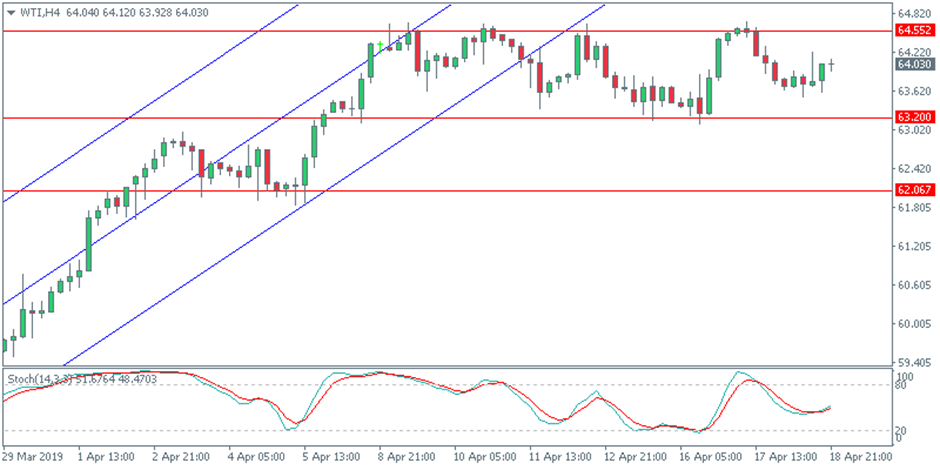
Oil prices turned flat at the top end of the rally with price rising only modestly on Thursday. Reports showed that Saudi Arabia’s oil exports fell by 277,000 barrels per day to just under 7 billion bps in February. Supply of crude oil came under pressure after Venezuela joined the US sanctions list alongside Iran.
Will Crude Oil Maintain the Range?
Oil prices failed to make any fresh highs, leaving price to trade flat within the 64.55 – 63.20 level. On the weekly chart, we see the doji pattern taking shape which could signal a temporary pause to the rally. Oil prices will need to close bearish in order to confirm that the top has been established. Watch for price to break out to the downside within the range to confirm this view.
Euro Slips on Soft Flash PMI Data
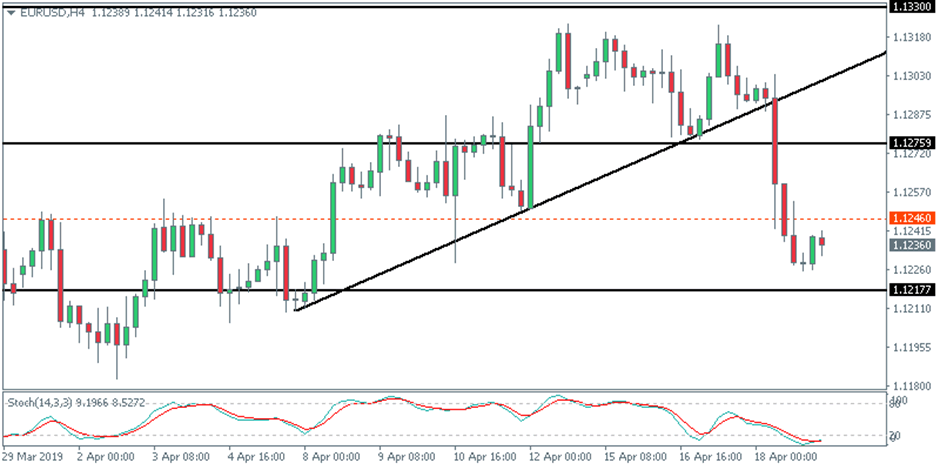
The euro was down 0.57% on the day on Thursday. The strong declines came as the flash PMI reports for the eurozone came out weaker than forecast. The eurozone’s manufacturing PMI eased to 47.8 while services PMI was at 52.5. The data suggests that the economic growth in the eurozone was still weak. Economists were hoping to see a rebound in business activity.
Will the EURUSD Recover from the Declines?
The EURUSD gave up the gains as price fell to a weekly low. However, the reversal looks to be taking place following the doji candlestick on the 4-hour chart. The currency pair will need to break out from 1.1246 in order to post any meaningful correction to the upside. A retest of the 1.1276 level will see the resistance area being tested once again.
Equities Trade Generally Flat, Few Catalysts Seen amid Market Holidays
Asia Market Update: Equities trade generally flat, few catalysts seen amid market holidays; Aussie CPI and US/Japan currency talks seen next week, US Treasury currency report also in focus
General Trend:
- On Friday, there are market holidays in various countries in Asia, Europe and North America
- Shanghai Property index reversed gains, extends recent losses as some focus on PBoC policy outlook
- China Minsheng Investments said it sees 'uncertainty' in bond payment due April 21st
- Equity markets in Japan and Korea rise after declines on Thursday
- Nintendo rises over 15%, speculation related to Switch console launch in China cited
- Nissan declines on speculation related to global production cut
- Japanese materials firm Lixil declines over 4%, cut guidance and announced management changes
- Parcel delivery firm Yamato declines over 9% in Japan, cut guidance
- Taiwan Semi rises after recent earnings report and guidance
- Japanese LDP officials continue to debate sales tax increase amid speculation it could again be delayed
- Japan's CPI remains below BoJ's 2% target
- BoJ speculated to plan to cut its GDP and inflation forecasts, central bank is due to meet April 24-25th
- BoJ cuts daily bond purchases of 10-25 yr and over 25-yr JGBs, analysts continue to examine whether daily operations have any implications for overall monetary policy
- US appears to be unfazed by North Korea's recent weapons test
- Aussie Q1 CPI data due on April 24th (Wed)
- Japan Fin Min Aso is expected to discuss forex issues with US Treasury Sec Mnuchin next week, Aso is expected to travel to the US on April 25th (Thursday)
- There is some press speculation that the US Treasury Department may release its semi-annual currency report in the near-term
Headlines/Economic Data
Australia/New Zealand
- ASX 200 closed
China/Hong Kong
- Shanghai Composite opened flat, Hang Seng closed
- (CN) China PBoC Open Market Operation (OMO): Injects CNY20B in 7-day reverse repos v CNY80B injected in 7-day reverse repos prior; Net: CNY20B injection v CNY80B injection prior
- (CN) China PBoC sets yuan reference rate:6.7043 v 6.6911 prior
- (CN) U.S. won WTO ruling against China over grain import quotas
- (CN) China Finance Ministry (MOF) sells 30-yr bonds: yield 3.9479% v 3.92%e
- (CN) Near-term China RRR cut is not likely after earlier this week the PBoC resumed liquidity injections - China Securities Journal
Japan
- Nikkei 225 opened +0.7%
- (JP) BOJ could slightly cut its FY19/20 GDP and CPI forecasts at the upcoming meeting - financial press
- (JP) JAPAN MAR NATIONAL CPI Y/Y 0.5% V 0.5%E; CPI EX FRESH FOOD (CORE) Y/Y: 0.8% V 0.7%E
- (JP) Japan Cabinet Office (Govt) Apr Monthly Economic Report: Maintains overall economic assessment
- (JP) Japan Chief Cabinet Sec Suga: US President Trump to visit Japan May 25-28
- (JP) Japan MoF: Senior officials from MoF, BoJ, and FSA to discuss financial markets on Friday 07:00 GMT; Japan Top Currency Official Asakawa to hold briefing after meeting on financial markets
Korea
- Kospi opened +0.4%
- (KR) South Korea Mar PPI M/M: +0.3% v 0.1% prior; Y/Y: 0.1% v -0.2% prior
- (KR) US State Dept said the US is ready to continue nuclear talks with North Korea - South Korean press
North America
- (US) MAR ADVANCE RETAIL SALES M/M: 1.6% V 1.0%E; RETAIL SALES EX-AUTO M/M: 1.2% V 0.7%E
- T-Mobile [TMUS]: Follow Up: T-Mobile CEO said to defend merger with Sprint to the US DoJ following the recent concerns expressed by Justice Dept officials - US financial press
Levels as of 1:20 ET
- Nikkei 225, +0.4%, ASX 200 closed, Hang Seng closed; Shanghai Composite +0.2%; Kospi +0.3%
- EUR 1.1244-1.1228 ; JPY 112.01-111.89 ; AUD 0.7153-0.7141 ;NZD 0.6692-0.6678
- Gold flat at $1,277/oz; Crude Oil +0.4% at $64.00/brl; Copper +0.2% at $2.918/lb
The Weekly Bottom Line: Spring is Coming
U.S. Highlights
- Spring is coming to the U.S. economy after a tough winter. An impressive bounce back in retail sales in March indicates that consumer spending will bounce back in the second quarter after a disappointing start.
- First quarter GDP growth is released next week, and it is likely going to be messy. A strong headline is likely to belie weakness domestically, while the reverse is likely to be the case in Q2.
- Overall growth in the first half of the year is tracking close to our March forecast, the quarterly pattern is somewhat reversed. The overall story that the economy has slowed from its 2018 pace, but remains above trend, remains intact.
Canadian Highlights
- This week saw a slew of data releases confirming the moderating growth narrative, ranging from a slight change in tone in the Business Outlook Survey, weak manufacturing and trade data releases, and modest upticks in retail and home sales.
- Consumer price inflation was the odd one out, showing a firming in both headline and core measures nearer to the Bank of Canada's target.
- Regionally, Alberta's provincial elections saw the UCP win a majority government, while Newfoundland & Labrador's government tabled its pre-election FY2019-20 budget.
U.S. - Spring is Coming
The U.S. economy had a tough winter. A government shutdown, stock market rout, and some bad weather patterns weighed on activity. The good news is that spring is coming.
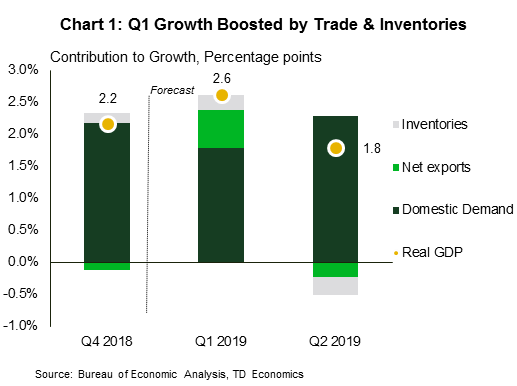
The first estimate of Q1 economic growth will be released next week. The story is likely to be muddy. Headline GDP is forecast to post a reassuring 2.6% print, but that hides a much softer picture for domestic demand (1.7%, annualized). The combination of an inventory build and a decline in imports is forecast to add nearly a percentage point to growth (Chart 1). Domestic demand, meanwhile, was held back by weakness in both consumer spending (+1.2%) and business investment (+1.6%).
Soft consumer spending is likely to prove temporary. The combination of plummeting stock markets, government shutdown, and bad weather helped send consumers into hibernation at the end of 2018 and early 2019. But, March retail sales showed consumers awakening from their slumber, enough to lift consumer spending to roughly 2 ½% in the second quarter.
Headline retail sales rebounded 1.7% in March, after falling in three of the last four months. That was a bit stronger than we had anticipated, and it lifted our tracking for growth in the first quarter by 0.2 percentage points. Strength was broad based. Sales at motor vehicle dealers were up sharply, as expected, and in line with the bounce reported in unit sales.
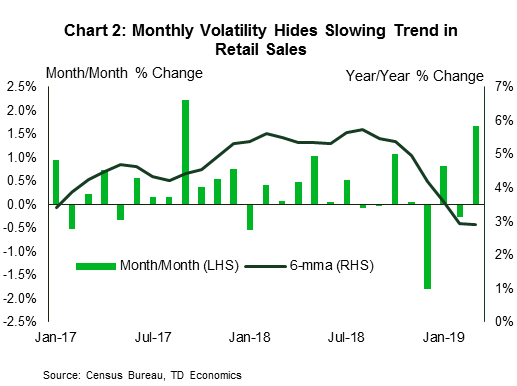
Retail weakness had stood out against stronger fundamentals in terms of income growth, low unemployment and confidence surveys. That said, the 3%-plus readings on real consumer spending we saw last year are behind us. We expect continued solid quarterly growth in outlays in the 2-2.5% range for the remainder of the year. This downshift in growth is apparent in the smoothed year-on-year growth in retail sales (Chart 2).
The Fed's latest Beige Book – its qualitative snapshot of the U.S. economy – reinforces this view of the economy slowing from last year's pace, but still growing solidly. Labor markets were characterized as tight, restraining hiring growth in some regions. Some weakness is evident in manufacturing, consistent with weaker demand from abroad. Trade uncertainty restrained expansions in some districts. The clouds hovering over the global outlook have not cleared, despite a better-than-expected first quarter growth report out of China.
Trade peace with China and Europe would certainly help global sentiment. China and U.S. negotiators plan two more rounds of face-to-face talks, and are working towards a signing ceremony in late May/early June. It remains to be seen whether a deal lifts the tariffs already in place, or if these are kept on as an incentive for compliance. If they are lifted, it would provide a tailwind to Chinese, and likely global, growth.
Canada - Data Reinforces View of a Q1 Disappointment
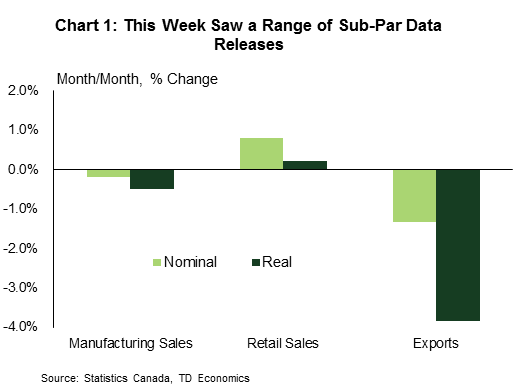
Canadian financial markets were quiet this week, with the S&P/TSX up 1%, and the loonie and oil prices relatively flat. Instead, this week's news flow was heavily dominated by a slew of data releases (Chart 1), which together served to reinforce the view that the Canadian economy started the year in a soft spot. Provincial developments were also in the spotlight, with Alberta's election front and center.
On the consumer side, existing home sales kicked off the release schedule, with a modest 0.9% m/m uptick. The lacklustre recovery left overall Q1 sales down 2.7%. Prices disappointed further, with annual growth in the composite price index now at its slowest pace since late-2009. Rounding off the week was a ho-hum retail sales report, where the above-consensus headline print (0.8% against 0.4%) came with only a modest volume uptick (0.2%) and negative revisions to January's data. Retail sales volumes look set to contract in Q1, absent a strong March rebound.
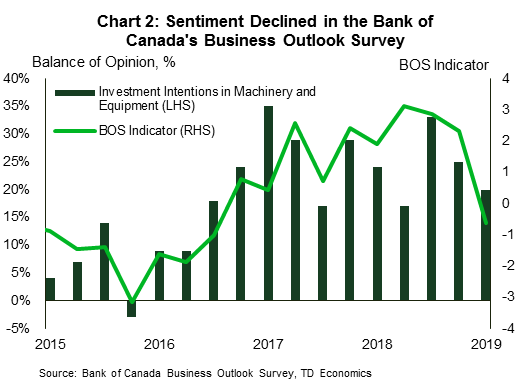
Business-related indicators didn't fare better. The Bank of Canada's Business Outlook Survey for Q1 offered a slight change of tone relative to prior surveys. Its summary indicator fell into negative territory for the first time since 2016, suggesting weakening business sentiment (Chart 2). At the same time, forward-looking indicators of investment intentions, and indicators of capacity constraints, while still positive, have moderated. There can be a disconnect between the survey and Statistics Canada data, but the change in tone matches recent disappointments in business investment and moderation in manufacturing and exports.
Canadian financial markets were quiet this week, with the S&P/TSX up 1%, and the loonie and oil prices relatively flat. Instead, this week's news flow was heavily dominated by a slew of data releases (Chart 1), which together served to reinforce the view that the Canadian economy started the year in a soft spot. Provincial developments were also in the spotlight, with Alberta's election front and center.
On the consumer side, existing home sales kicked off the release schedule, with a modest 0.9% m/m uptick. The lacklustre recovery left overall Q1 sales down 2.7%. Prices disappointed further, with annual growth in the composite price index now at its slowest pace since late-2009. Rounding off the week was a ho-hum retail sales report, where the above-consensus headline print (0.8% against 0.4%) came with only a modest volume uptick (0.2%) and negative revisions to January's data. Retail sales volumes look set to contract in Q1, absent a strong March rebound.
Business-related indicators didn't fare better. The Bank of Canada's Business Outlook Survey for Q1 offered a slight change of tone relative to prior surveys. Its summary indicator fell into negative territory for the first time since 2016, suggesting weakening business sentiment (Chart 2). At the same time, forward-looking indicators of investment intentions, and indicators of capacity constraints, while still positive, have moderated. There can be a disconnect between the survey and Statistics Canada data, but the change in tone matches recent disappointments in business investment and moderation in manufacturing and exports.
U.S.: Upcoming Key Economic Releases
U.S. Real GDP - Q1 Advanced
Release Date: April 26, 2019
Previous: 2.2%
TD Forecast: 2.6%
Consensus: 2.0%
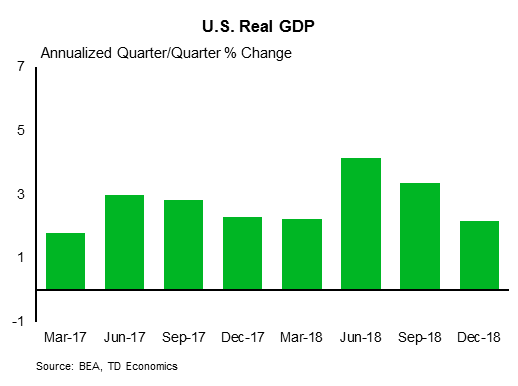
We expect GDP to advance 2.6% q/q saar in Q1. The strong headline is likely to be flattered by an inventory build and a decline in imports. Domestic demand is forecast to be weaker thanks a notable slowdown in consumer spending. Also notable, and reflecting the recent pick-up in the housing sector, residential investment likely contributed positively to growth for the first time since 2017. All in, a more solid Q1 print will likely borrow from Q2 growth, which is currently forecast to come in below 2%.
Canada: Upcoming Key Economic Releases
Bank of Canada Rate Decision
Release Date: April 24, 2019
Previous: 1.75%
TD Forecast: 1.75%
Consensus: 1.75%
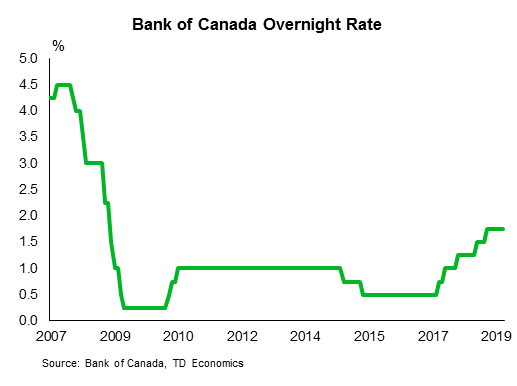
We look for the Bank of Canada to hold rates unchanged at 1.75% at next week's meeting while updated projections and a tweak to forward looking language should give a dovish tone. We except the MPR to include a 0.2pp downgrade to 2019 GDP growth and with the softer outlook, we look for the Bank to all but confirm market pricing and remove the reference to future rate increases in the communique. We also look for the Bank to shift its range for the neutral rate 0.25% lower (leaving the lower bound at 2.25%) although we still think the Bank will end the cycle at 1.75%.
Canadian Dollar Lower as US Dollar Gains Retail Sales Boost
The Canadian dollar fell 0.28 percent on Thursday. US economic data was the deciding factor as the dollar rose against the loonie despite crude prices heading higher. Canadian retail sales had strong gains but could not overcome their US counterpart. American retail sales exceeded expectations and boosted the dollar against the board.
Oil prices softened the fall of the CAD as crude is still supported by supply disruptions as US sanctions on Iranian and Venezuelan exports remain and the military actions in Libya continue. OPEC+ efforts are the main factor in adding stability to prices, despite rising US production. The pivotal moment for crude prices will come when the group meets at the end of the current agreement term to discuss what are the next steps.
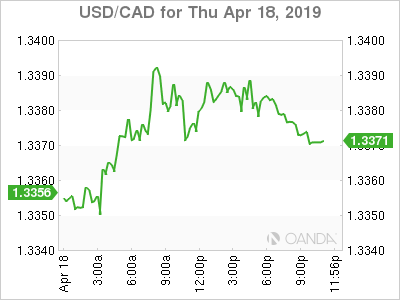
Canada has extended the Trans Mountain oil pipeline decision to June 18. The pipeline has been beset by regulatory and ecological group pressures, but it promises to almost triple output from the oil sands into British Columbia.
The US dollar is higher against most major pairs after retail sales in the United States exceeded expectations with a 1.6 percent gain. Solid data ahead of the Easter holiday gave the greenback the edge against other currencies. European data, in particular manufacturing PMIs keep dropping putting more pressure on the euro. The European Central Bank (ECB) has been dovish as growth in the Union is running out of traction.
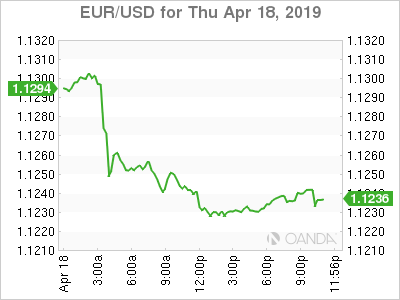
The USMCA was in the news again as the US International Trade Commission reported that the deal between the US, Mexico and Canada would boost growth in the US. The quasijudicial Federal agency is giving thumbs up for the trade agreement as it needs to be ratified by all three members.
OIL – Oil Rises as Saudi Arabia Keeps Cutting Production
Crude prices rose on Thursday. Brent gained 0.4 percent and WTI 0.27 percent despite a rebound in the US dollar. Better than expected retail sales in the US boosted the currency ahead of the Easter long weekend. Energy prices ended higher as Saudi Arabia continues to report drops in crude exports. The OPEC+ agreement to cut production has been led by example by the Kingdom now cutting 227,000 daily barrels in February.
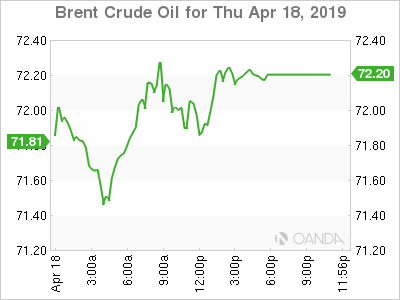
The Energy Information Administration (EIA) report showed a drawdown of 1.4 million barrels with gasoline and distillates also showing reductions.
Supply concerns persists with US sanctions against Iran and Venezuela and the civil war in Libya, but the OPEC+ agreement has been the bigger factor. The deal to limit production has stabilized prices working against rising US production.
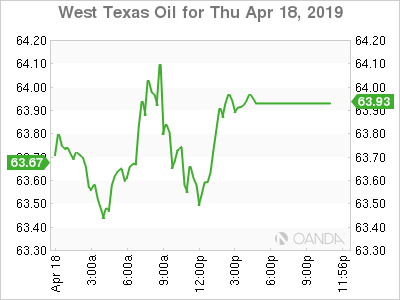
Energy demand was given a positive signal as China grew 6.4 percent in the first quarter of 2019.
The biggest obstacle for higher prices is the same factors that got them here in the first place. US sanctions against Iran and Venezuela could get tighter, but it could trigger an end to the OPEC+ deal. Russia and other major producers have hinted that they could ramp up production.
US shale expectations point to more supply, so a repeat of 2014 when prices fell off a cliff could present itself if Saudi Arabia does not manage to convince major producers to keep the production cuts active.
GOLD – Yellow Metal Flat with Safe Haven Appeal Diminishing
Gold was flat on Thursday but is headed for a 1.4 percent weekly drop as investors sold safe havens looking for higher returns. Risk events have been pushed out to the medium term and with uncertainty easing gold is on the back foot.
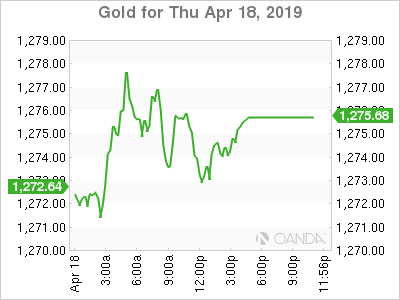
The rise of the dollar after positive economic news put more downward pressure on the metal, but while anxiety around geopolitical events has eased into the background, there was no closure with Brexit, US-China trade war and other events sure to pop back up again which is why gold could once again be used as a safe haven.
Physical demand of gold has been on the rise with some central banks buying large quantities to diversify their reserves away from the US dollar. Retail investors have also taken opportunistic positions with current prices on the decline and the timing has worked out for Indian jewellers ahead of the Akshaya Tritiya festival.
STOCKS – US Indicators Boost Markets Despite European Woes
Global stocks were mostly in positive territory despite sell offs in specific sectors. The retail sales data point boosted the market as its injected confidence in the US. Earlier European data had cast doubts on economic growth going forward and put downward pressure on the euro.
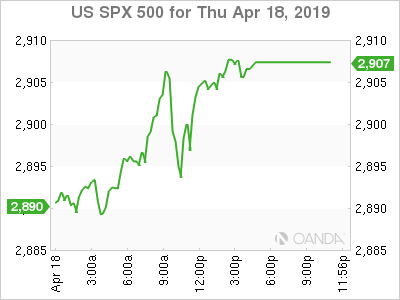
Geopolitical risk was less present this week with the Muller report failing to get a strong reaction from investors. Growth concerns remain as mixed data has been the norm but now with less pressure from risk events there will be more focus on fundamental data.