

Sample Category Title
European Update – Stocks Bounce after PMI Setback
Markets recover from initial post-PMI weakness
European equity markets have recovered from earlier weakness, following another disappointing batch of PMIs from the euro area, with stocks being supported by a weaker euro.
It’s going from bad to worse for the eurozone, with the latest PMIs for the region once again highlighting just how worrying the outlook has become. The block started to slow last year but the decline appears to have accelerated in recent months, with the manufacturing survey now giving contractionary readings for Germany, France and the euro area as a whole, with the former being well into the territory despite rebounding slightly to 44.5.
It’s been a staggering drop off that has forced Italy into recession, pushed Germany to the brink and weighed heavily on the currency just as the central bank was planning to bring a decade of stimulus to an end with a first rate hike this year since 2011.
That plan has collapsed before it really got going and instead we have new TLTROs and it won’t be long until people are asking questions about whether more QE will be necessary, only a matter of months after new purchases were brought to an end.
Euro dips on weaker figures
Naturally the euro is not responding well to the news, as it dipped below 1.13 against the dollar to trade in the mid-1.12 range. While we’re still a little bit from the recent lows, the path of least resistance certainly looks below as it becomes clear just how fragile the region still is.
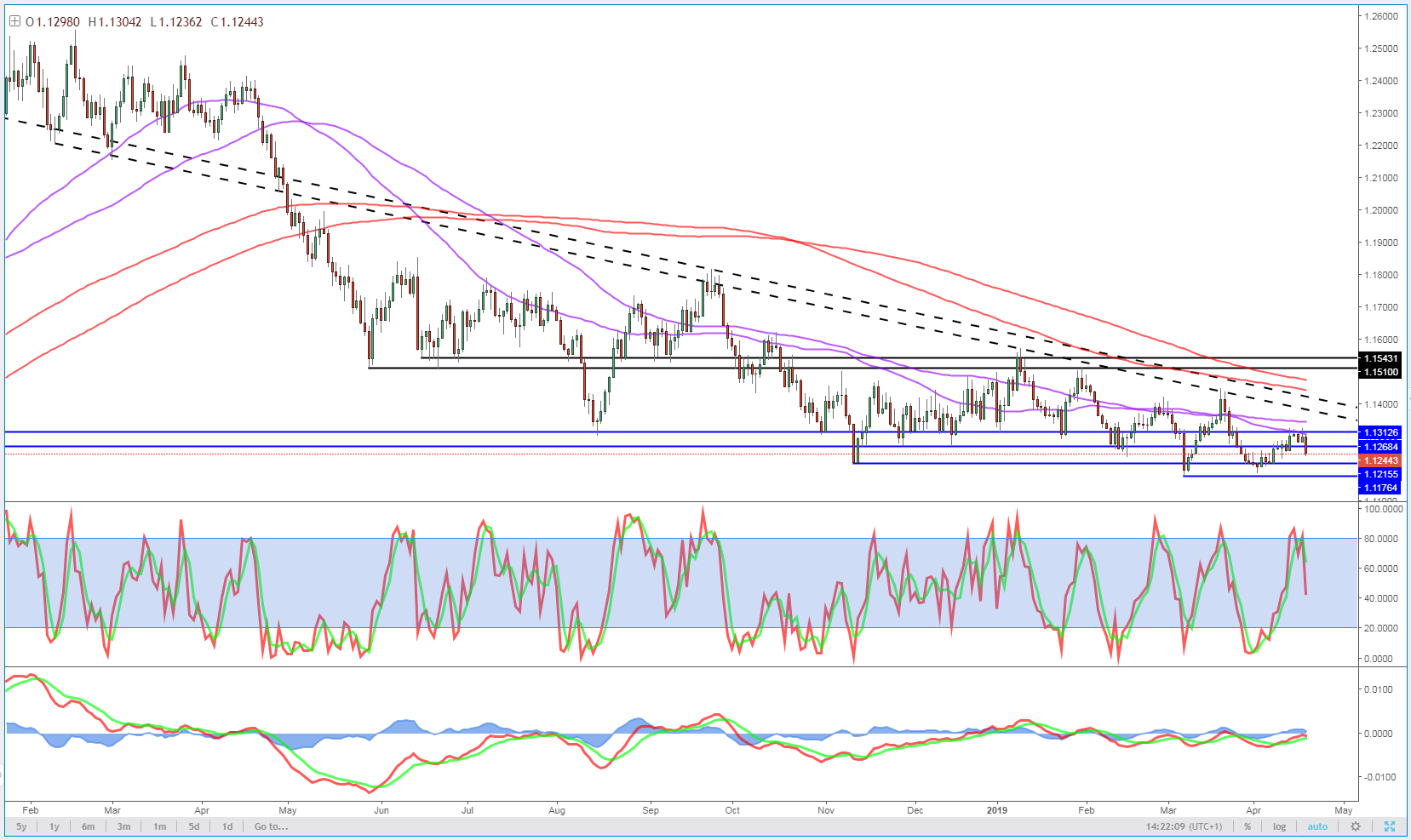
This is keeping the dollar well supported as other currencies win the race to the bottom, even as the Fed dramatically lowers its interest rate expectations and an economic slowdown and possible earnings recession looms. The grass is simply less green everywhere else.
US: Retail Sales Surge in March
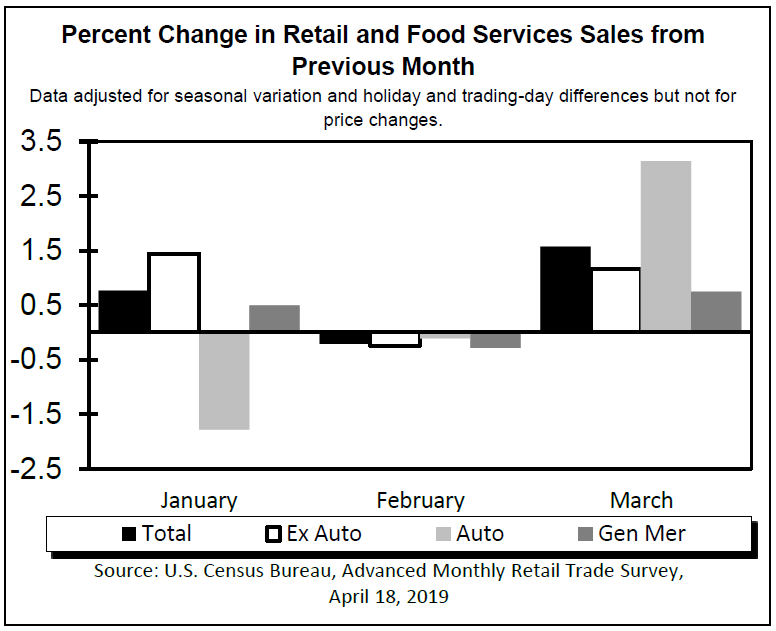
- Retail sales rose a robust 1.6% in March, beating solid consensus expectations for a 1.0% gain.
- The two biggest gainers were gas stations (+3.5%) and autos (+3.1%), but even outside of these categories, sales were up 0.9% on the month.
- Excluding the most volatile components (gas, autos, building materials, and food services), the retail sales 'control group' rose 1.0% on the month – also beating expectations for a 0.4% gain.
- Delving further into the details, sales appeared strongest in categories that had pulled back in prior months. Clothing rose 2.0% (-1.8% in February), food & beverages up 1.0% (-1.9% in February), and miscellaneous grew 1.8% (-1.1% prior).
Key Implications
- The strong bounce back in consumer spending is reassuring that the soft patch to start the year is behind us. The growth in March provides a solid set up for the second quarter, which is good news because other sectors (investment, net-exports) are looking a tad soft heading into it.
- The fundamentals for consumer spending are solid – strong job growth, accelerating wages, and, as an added bonus, lower interest rates. While the pace of gains are unlikely to match the stimulus-fueled pace of the past year, they will put a solid foundation under economic growth that is likely to average around the 2% mark over the remainder of 2019.
Canadian Retail Sales Edged Up in February
- Retail sales rose 0.8% in February, stemming from strength in general merchandise stores and motor vehicle and parts dealers. Within the latter, only sales at new car dealers led the growth – while all other store types declined.
- Sales were up in 5 subsectors.
- Excluding prices, volume sales were inched up 0.2% in February. They are still up 1.7% year-over-year.
The February retail numbers came out slightly stronger than expected but part of the increase reflected higher gas prices that pushed up sales at the pump by 1.9%. Volume sales inched up but by a modest 0.2%. Weather might have been a factor slowing sales in some categories, but downward revisions to earlier months also imply overall consumer spending is still slow. We still see much of the softness in overall economic growth in Q1 as transitory in nature, with a bounce-back expected in Q2 as weather related effects wear off and oil production cuts ease. But household spending is unlikely to be the main driver of growth.
USD/CHF Mid-Day Outlook
Daily Pivots: (S1) 1.0076; (P) 1.0094; (R1) 1.0124; More...
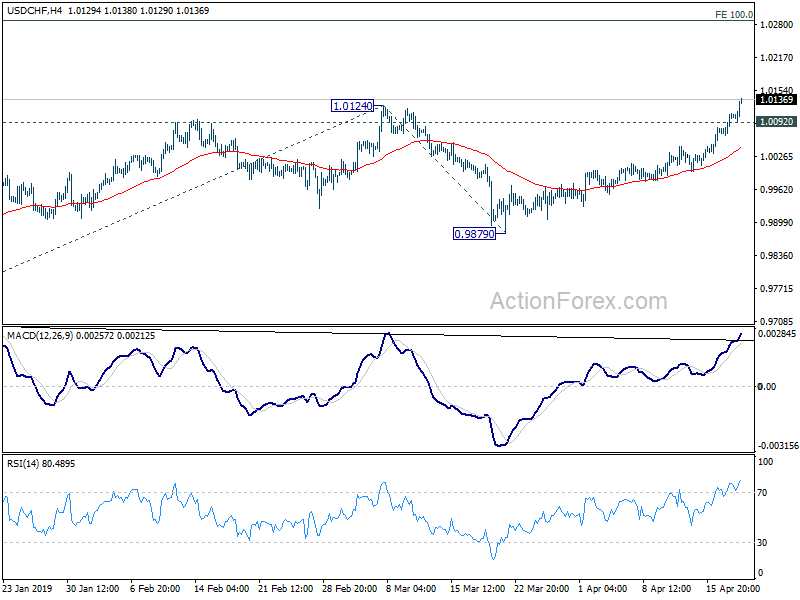
USD/CHF's rally accelerates to as high as 1.0137 so far. Break of 1.0128 resistance confirms larger up trend resumption. Intraday bias stays on the upside for 100% projection of 0.9716 to 1.0124 from 0.9879 at 1.0287 next. On the downside, below 1.0092 minor support will turn intraday bias neutral and bring consolidations, before staging another rise.
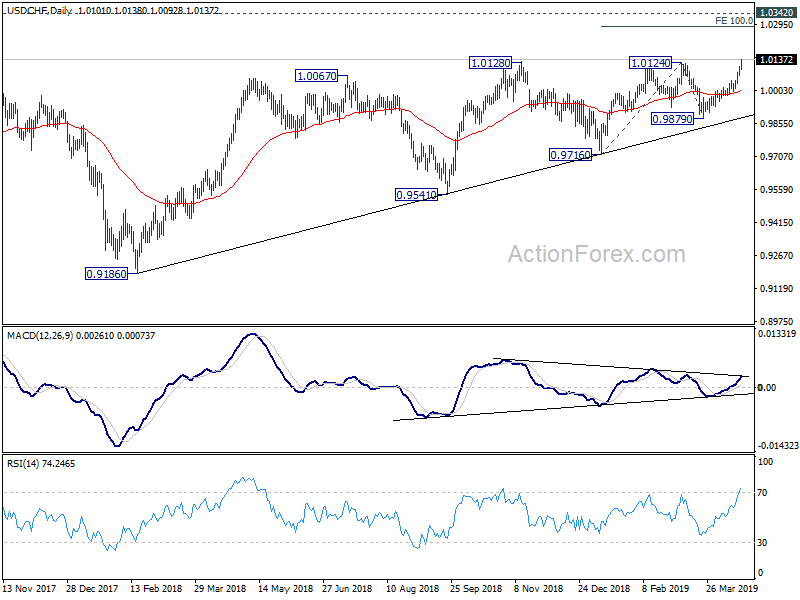
In the bigger picture, medium term up trend from 0.9186 is resuming. Current rise should now target 1.0342 resistance next. For now, we'd be cautious on strong resistance from there to limit upside, until we see medium term upside acceleration. On the downside, break of 0.9879 support is needed to indicate reversal. Otherwise, outlook will stay bullish in case of deep pull back.
Strong Retail Sales and Jobless Claims Boost Dollar, But Yen Outperforms
Dollar jumps broadly in early US session after very strong retail sales and jobless claims. Yen is the only one stronger than the greenback, thanks to pull back in global treasury yields. Euro, as well as benchmark German yield tumble as poor PMIs dent hope for a recovery in Q2. New Zealand Dollar is the only weaker one for today. Despite strong Canadian retail sales and Australian Employment, both are among the weakest ones. For the week, Yen is now the strongest one, followed by Dollar and then Aussie. Kiwi is the weakest one, followed by Swiss Franc and then Euro.
Technically, USD/CHF break of 1.0128 resistance now suggests resumption of medium term up trend from 0.9186 towards 1.0342 key resistance. EUR/USD's break of 1.1250 minor support now put focus back to 1.1176 low. Break will resume medium term down trend from 1.2555. 111.69/112.13 range in USD/JPY will be watched as the pair will have to decide whether to break through or reverse. USD/CAD is range bound but break of 1.3467 is mildly in favor. AUD/USD will look at 0.7139 minor support to indicate completion of near term recovery.
In Europe, currently, FTSE is down -0.05%. DAX is up 0.32%. CAC Is up 0.24%. German 10-year yield is down -0.046 at 0.038, still way above 0%. Earlier in Asia, Nikkei dropped -0.54%. China Shanghai SSE dropped -0.40%. Hong Kong HSI dropped -0.54%. Singapore Strait Times dropped -0.03%. Japan 10-year JGB yield dropped -0.0179 to -0.026.
US initial jobless claims trending down again, retail sales also strong
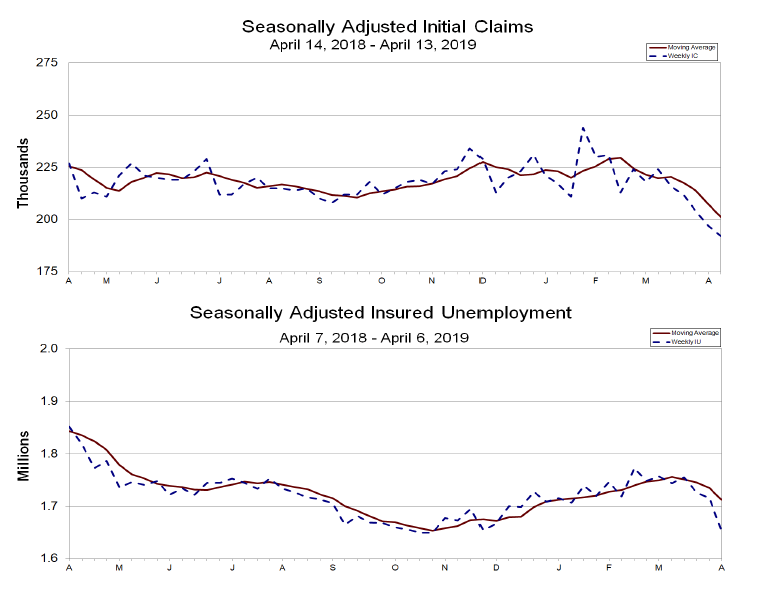
Initial jobless claims dropped -5k to 192k in the week ending April 13, below expectation of 207k. It's also the lowest since September 6, 1969 when it was 182k. Four week moving average of initial claims dropped -6k to 201.25k, lowest since November 1, 1969. And the series seem to be trending down again. Continuing claims dropped -64k to 1.653m. Four week moving average of continuing claims dropped 022.75k to 1.713m.
Headline retail sales rose 1.6% mom in March versus expectation of 0.8% mom. That's also the strongest rise since September 2017. Meanwhile, 12 of 13 major retail categories increased. Ex-auto sales rose 1.2% mom versus expectation of 0.7% mom. Total sales from January through March rose 2.9% yoy.
Philadelphia Fed Manufacturing Business Outlook, however, dropped to 8.5, down from 13.7 and missed expectation of 11.0.
From Canada, retail sales rose 0.8% mom in February versus expectation of 0.4% mom. Ex-auto sales rose 0.6% mom versus expectation of 0.2%. Both figures are also strong.
Eurozone PMIs: Disappointing start to Q2, suggest under 0.2% GDP growth
Eurozone PMI manufacturing rose to 47.8, up from 47.5 but missed expectation of 48.1. PMI services dropped to 52.5, down from 53.3 and missed expectation of 53.1. PMI composite dropped to 51.3, down from 51.6, and hit a 3-month low. The surveys indicate that quarterly eurozone GDP growth has slowed to just under 0.2%.
Chris Williamson, Chief Business Economist at IHS Markit said: "The eurozone economy started the second quarter on a disappointing footing, with the flash PMI falling to one of the lowest levels seen since 2014. The data add to worries that the economy has failed to rebound with any conviction from one-off factors that dampened activity late last year, and continues to show only very modest growth in the face of headwinds from slower global demand growth and subdued economic sentiment."
Germany PMI manufacturing rose to 44.5 in April, up from 44.1 but missed expectation of 45.2. It's staying deep in contraction below 50. PMI services rose to 55.6, up from 55.4, beat expectation of 55.0. PMI composite rose to 52.1, up from 51.4.
France PMI manufacturing dropped to 49.6 in April, down from 49.7 and missed expectation of 50.0. That's the lowest level in 32 months. PMI services, on the other hand, improved to 50.5, up from 49.1 and beat expectation of 49.8. PMI composite rose to 50.0, up from 48.9.
Also release in European session, UK retail sales include auto and fuel rose 1.1% mom, 6.7% yoy in March versus expectation of -0.4% mom, 4.6% yoy. Retail sales exclude auto and fuel rose 1.2% mom, 6.2% yoy in March versus expectation of -0.3% mom, 4.0% yoy. Germany PPI dropped -0.1% mom, rose 2.4% yoy in March. Swiss trade surplus widened to CHF 3.18B in March.
Australia employment rose 25.7k, no imminent need for RBA cut
Australia employment grew 25.7k in March, much better than expectation of 15.2k. Full time employment rose 48.3k while part time jobs dropped -22.6k. Unemployment rate rose from 4.9% to 5.0%, matched expectations. Participation rate also rose from 65.6% to 65.7%.
The largest increase in employment was in Queensland (up 10.4k), followed by Victoria (up 10.0k) and South Australia (up 8.5k). The largest decrease was in New South Wales (down 2.6k) followed by Tasmania (down 1.8k). The seasonally adjusted unemployment rate increased in Queensland (up 0.7 pts to 6.1%), South Australia (up 0.2 pts to 5.9%), Tasmania (up 0.2 pts to 6.7%), Western Australia (up 0.1 pts to 6.0%) and New South Wales (up 0.1 pts to 4.3%). The only decrease in the unemployment rate was observed in Victoria (down 0.1 pts to 4.6%).
The strong gain in full time jobs underlines the robustness in the employment market. However, unemployment rate rose in all regions, only except Victoria, which is a concern. At this point, there is no imminent push for an RBA rate cut in the first up. But situation could worsen ahead that trigger the expected two cuts in the second half. The key will lie in upcoming economic projections in May.
Australia NAB business conditions continued broad based easing
Australia NAB Business Confidence dropped to -1 in Q1, down from 1. Current Business Conditions dropped to 4, down from 9. Business Conditions for the next two months dropped slightly to 22, down from 25. Capex plans dropped to 22, down from 25.
Alan Oster, NAB Group Chief Economist noted that easing of business conditions continued through 2018 into 2019. And they're only "just above average". Together with "negative conditions and forwards orders", they suggest outlook "remains weak". And the easing in conditions has been "broad based across most industries and all states", in particular retail.
Oster also said: "For now, we will wait and see how leading indicators of the labour market evolve, though we think it is likely the RBA will act to cut the cash rate and bolster the economy should the labour market deteriorate on the back of weaker activity data".
Japan PMI manufacturing improved to 49.5, remained stuck in its rut
Japan PMI manufacturing rose to 49.5 in April, up from 49.2 and beat expectation of 49.4. Nevertheless, it's still the third straight month of sub-50 reading. Markit pointed out that weaker demand from domestic and international markets persists, leading output to fall further. But manufacturing employment remains resilient.
Joe Hayes, Economist at IHS Markit said: "Japan's manufacturing sector remained stuck in its rut at the start of Q2, with the factors which have prohibited any growth such as US-Sino relations, growth fears in China and the turn in the global trade cycle, all remaining prominent risks. Export orders dipped at a stronger rate in April, domestic demand for goods was similarly weak and firms cut their stocks and scaled back production. Yet again, the service sector will need to pick up any slack to help keep Japan's economy afloat."
USD/CHF Mid-Day Outlook
Daily Pivots: (S1) 1.0076; (P) 1.0094; (R1) 1.0124; More...
USD/CHF's rally accelerates to as high as 1.0137 so far. Break of 1.0128 resistance confirms larger up trend resumption. Intraday bias stays on the upside for 100% projection of 0.9716 to 1.0124 from 0.9879 at 1.0287 next. On the downside, below 1.0092 minor support will turn intraday bias neutral and bring consolidations, before staging another rise.
In the bigger picture, medium term up trend from 0.9186 is resuming. Current rise should now target 1.0342 resistance next. For now, we'd be cautious on strong resistance from there to limit upside, until we see medium term upside acceleration. On the downside, break of 0.9879 support is needed to indicate reversal. Otherwise, outlook will stay bullish in case of deep pull back.
Economic Indicators Update
| GMT | Ccy | Events | Actual | Forecast | Previous | Revised |
|---|---|---|---|---|---|---|
| 01:30 | AUD | NAB Business Confidence Q1 | -1 | 1 | ||
| 01:30 | AUD | Employment Change Mar | 25.7K | 15.2K | 4.6K | |
| 01:30 | AUD | Unemployment Rate Mar | 5.00% | 5.00% | 4.90% | |
| 06:00 | EUR | German PPI M/M Mar | -0.10% | 0.20% | -0.10% | |
| 06:00 | EUR | German PPI Y/Y Mar | 2.40% | 2.70% | 2.60% | |
| 06:00 | CHF | Trade Balance (CHF) Mar | 3.18B | 2.87B | 3.13B | 2.94B |
| 07:15 | EUR | France Manufacturing PMI Apr P | 49.6 | 50 | 49.7 | |
| 07:15 | EUR | France Services PMI Apr P | 50.5 | 49.8 | 49.1 | |
| 07:30 | EUR | Germany Manufacturing PMI Apr P | 44.5 | 45.2 | 44.1 | |
| 07:30 | EUR | Germany Services PMI Apr P | 55.6 | 55 | 55.4 | |
| 08:00 | EUR | Eurozone Manufacturing PMI Apr P | 47.8 | 48.1 | 47.5 | |
| 08:00 | EUR | Eurozone Services PMI Apr P | 52.5 | 53.1 | 53.3 | |
| 08:30 | GBP | Retail Sales Inc Auto Fuel M/M Mar | 1.10% | -0.40% | 0.40% | 0.60% |
| 08:30 | GBP | Retail Sales Inc Auto Fuel Y/Y Mar | 6.70% | 4.60% | 4.00% | |
| 08:30 | GBP | Retail Sales Ex Auto Fuel M/M Mar | 1.20% | -0.30% | 0.20% | 0.40% |
| 08:30 | GBP | Retail Sales Ex Auto Fuel Y/Y Mar | 6.20% | 4.00% | 3.80% | |
| 12:30 | CAD | Retail Sales M/M Feb | 0.80% | 0.40% | -0.30% | -0.40% |
| 12:30 | CAD | Retail Sales Ex Auto M/M Feb | 0.60% | 0.20% | 0.10% | -0.60% |
| 12:30 | USD | Retail Sales Advance M/M Mar | 1.60% | 0.80% | -0.20% | |
| 12:30 | USD | Retail Sales Ex Auto M/M Mar | 1.20% | 0.70% | -0.40% | |
| 12:30 | USD | Philadelphia Fed Business Outlook Apr | 8.5 | 11 | 13.7 | |
| 12:30 | USD | Initial Jobless Claims (APR 13) | 192K | 207K | 196K | 197K |
| 13:45 | USD | US Manufacturing PMI Apr P | 53 | 52.4 | ||
| 13:45 | USD | US Services PMI Apr P | 55 | 55.3 | ||
| 14:00 | USD | Leading Index Mar | 0.40% | 0.20% | ||
| 14:00 | USD | Business Inventories Feb | 0.30% | 0.80% | ||
| 14:30 | USD | Natural Gas Storage | 25B |
Dollar jumps on strong retail sales and jobless claims
Dollar surges broadly in early US session after generally positive economic data.
Headline retail sales rose 1.6% mom in March versus expectation of 0.8% mom. That's also the strongest rise since September 2017. Meanwhile, 12 of 13 major retail categories increased. Ex-auto sales rose 1.2% mom versus expectation of 0.7% mom. Total sales from January through March rose 2.9% yoy.
Initial jobless claims dropped -5k to 192k in the week ending April 13, below expectation of 207k. It's also the lowest since September 6, 1969 when it was 182k. Four week moving average of initial claims dropped -6k to 201.25k, lowest since November 1, 1969. And the series seem to be trending down again. Continuing claims dropped -64k to 1.653m. Four week moving average of continuing claims dropped 022.75k to 1.713m.
Philadelphia Fed Manufacturing Business Outlook, however, droppped to 8.5, down from 13.7 and missed expectation of 11.0.
Oil Volatility is about to Kick into High Gear
2019 has delivered for the most part a one-way move higher for oil prices as OPEC + production cuts have successfully stabilized prices. WTI crude has rallied over 40% this year and prices could be ripe for a massive pullback despite uncertainty to major geopolitical risks (Libyan impending war, Mexican crude about to collapse, and Venezuelan production disruptions).
Many expected a rebound in eurozone’s private sector activity but they were disappointed this morning. The global demand picture remains mixed but so far signs are looking optimistic for a pickup in the second half of the year with a China-US trade deal expected by early June at the latest.
OPEC punted their extraordinary meeting to see what the US will do regarding Venezuela and Iran sanctions, but that could have been a mistake, as Russian support for continued cuts could be waning.
The big risk to lower oil prices remains the US, whether it’s Trump’s tactics to talk down oil by threatening using their reserves or the continued rise in US production. Rigs are building up again and by summer time we could see start to see many question OPECs relevance again.
British Pound Edges Lower Despite Strong UK Retail Sales
GBP/USD has posted slight losses in the Thursday session. In North American trade, GBP/USD is trading at 1.3015, down 0.20% on the day. On the release, British retail sales jumped 1.1% in March, crushing the estimate of -0.3%. Over in the U.S., retail sales is forecast to improve to 0.9% and core retail sales is projected to climb 0.7%. The Philly Fed manufacturing index is forecast to dip down to 11.2, while unemployment claims is projected to rise to 207 thousand. On Friday, the U.S. releases building permits and the Treasury Department releases the semi-annual currency report.
The Brexit drama has taken a short hiatus this week, so investors are paying more attention to economic numbers, particularly consumer spending and inflation numbers. Retail sales impressed in March, with a strong gain of 1.1 percent. This comes on the heels of inflation releases, with CPI unchanged at 1.9%. This is just below the BoE target of 2.0%, so inflation could be a factor in favor of maintaining interest rates at 0.75% at the next policy meeting in early May.
In the U.S., the expectations are for strong retail sales numbers. Retail sales and core retail sales both recorded declines in February, but a rebound is projected for March, with estimates of 0.9% for retail sales and 0.7% for core retail sales. If the actual figures are within expectations, the U.S. dollar could respond with gains.
GBPCAD Meets Support at 1.7350 Again; Loses Momentum
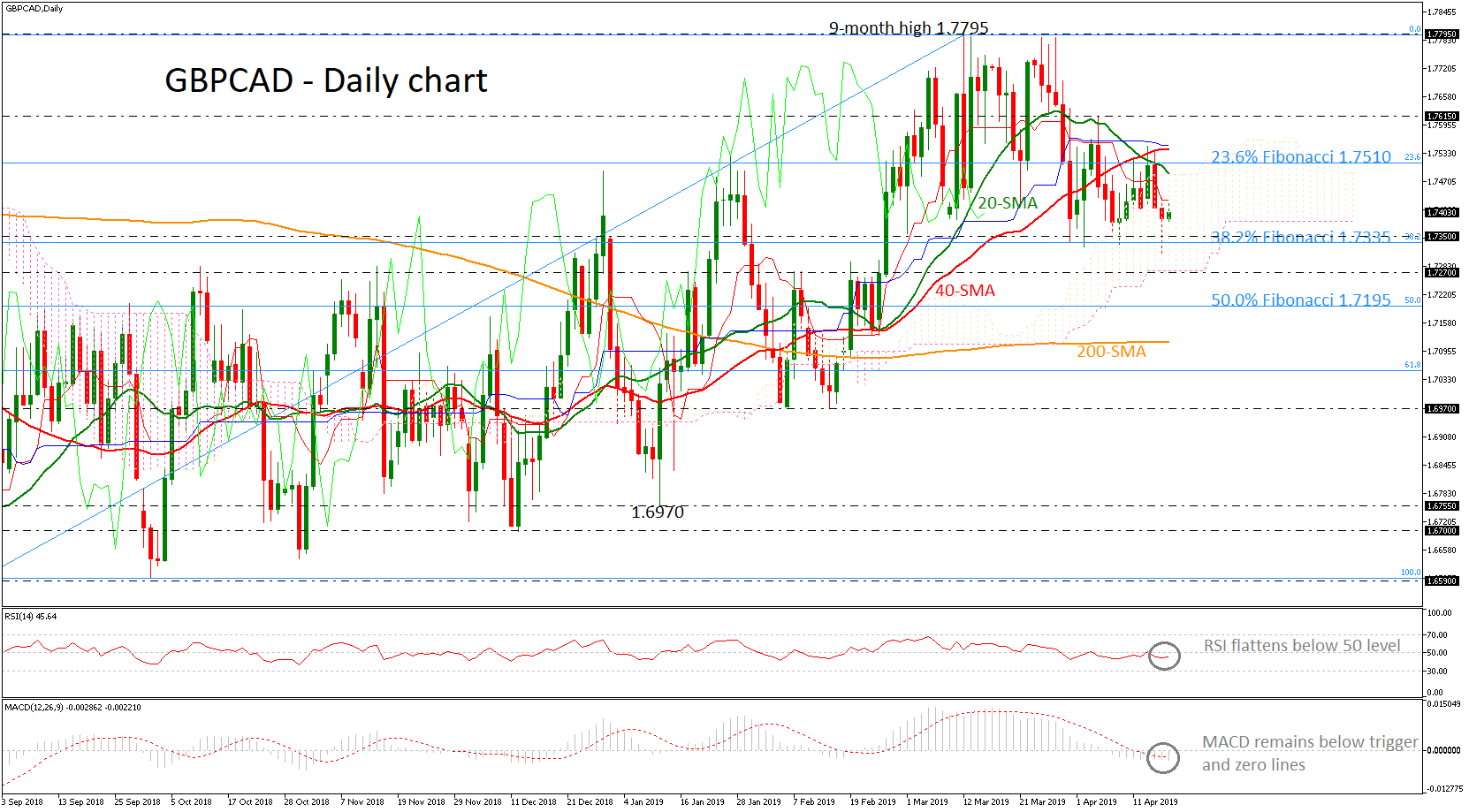
GBPCAD touched the 38.2% Fibonacci retracement level of the upleg from 1.6590 to 1.7795 around 1.7335 once again, failing to decline further. Currently, the price is developing within the Ichimoku cloud, while the 20- and 40-simple moving averages (SMAs) posted a bearish crossover in the preceding sessions. The RSI indicator is flattening, mirroring the market’s behavior over the last few days and the MACD is moving marginally below the trigger line in the negative area.
In case of increases, the price could meet the 20- and 40-day SMAs, which currently stand around the 23.6% Fibonacci of 1.7510. More bullish actions could push the market until the 1.7615 resistance before resting near the nine-month high of 1.7795.
Alternatively, if the pair changes its short-term direction further to the downside, the bears would probably challenge the 1.7350 support and the 38.2% Fibonacci of 1.7335, which has been a congested area over the last month. A break lower, could last until the 1.7270 barrier.
In brief, in the more medium-term picture, the slightly bullish correction shifted to a stronger positive tendency, however, it failed several times over the last sessions to post a higher high above 1.7795.
DAX Higher As Progress Made In U.S-China Trade Talks
The DAX index continues to point upwards and has posted gains for a seventh straight session. On Thursday, the DAX is at 12,201, up 0.40% on the day. It’s been all ‘April flowers’ for the DAX, which has soared 5.9% this month. In economic news, German manufacturing PMI dropped to 44.5 in March, shy of the estimate of 45.2 points. The all-eurozone manufacturing PMI posted a decline of 47.8, missing the forecast of 48.1 points. The services numbers were stronger, with German services PMI climbing to 55.6 and the eurozone indicator coming in at 52.5 points.
There were no surprises from the German and eurozone PMIs for March, with bleak news from the manufacturing front. The sector continues to post declines, as the global trade war has reduced demand for German and eurozone exports, and taken a toll on the auto industry. German manufacturing PMI has slowed for nine successive months, and the worrisome trend shows no signs of changing until the U.S and China hammer out a trade agreement. The services sector, which is more reflective of domestic demand, is in better shape and continues to indicate expansion.
Eurozone inflation is steady, but remains well below the ECB target of 2.0 percent. The eurozone annual inflation rate edged lower to 1.4% in March, compared to 1.5% in February. Low inflation means that the ECB is not under pressure to raise interest rates. After last week’s policy meeting, Mario Draghi noted that the economic outlook for the eurozone remains weak. With no interest hikes in sight and a sluggish eurozone economy, investors may lose interest in the euro and opt for equities instead.