Sample Category Title
Oil Prices Rise on Supply Concerns: Japan’s Golden Week Holiday on the Radar
Asia Market Update: China property index continues to under perform amid higher rates, gov't comments; Oil prices rise on supply concerns: Japan's Golden Week holiday on the radar, Aussie CPI expected on Wed
General Trend:
- Market participation still limited due to holidays
- Various markets are closed on today's session including HK, Australia, NZ , most of Europe
- Brent Crude rises over 1% as US said to plan to end sanctions waivers related to Iran oil imports
- Canadian dollar tracks rise in oil prices
- Higher oil prices weigh on emerging market currencies (including Philippines Peso and Indian Rupee)
- Chinese financials decline as some see near-term RRR cut as less likely
- Concerns related to competition probe weigh on cement makers in China
- ZTE rises in China after Q1 sales figures from Huawei
- South Korea April 1-20th exports worsen from levels seen earlier in the month; chip exports -24.7% y/y
- China expected to hold its 2nd plenary meeting this week, areas of focus expected to include property rights and the securities law.
- Analysts continue to reassess the likelihood of a Q2 RRR cut in China
- Australia Q1 CPI data is due to release on April 24th (Wed)
- Japan PM Abe reacts to the ruling LDP Party's by-election losses ahead of upper house elections
- Japan Fin Min Aso is expected to discuss forex issues with US Treasury Sec Mnuchin this week, Aso is expected to travel to the US on April 25th (Thursday)
- Bank of Japan (BOJ) is due to meet April 24-25th
- Japan's Golden Week holiday is approaching. Japan's exchanges are due to be closed between April 27 (Saturday) to May 6th (Monday)
- There is some press speculation that the US Treasury Department may release its semi-annual currency report in the near-term
Headlines/Economic Data
Australia/New Zealand
- ASX 200 closed for holiday
- SYD.AU CEO Culbert: Decline in Q1 passengers (first decline in 5-yrs) may be due to changed travel plans because of longer gap between Easter and Lunar New Year – AFR
- (AU) Hail storms in Sydney and flooding in Townsville cost Australia insurers A$2.4B - AFR
Japan
- Nikkei 225 opened -0.1%
- (JP) Japan ruling Liberal Democratic Party (LDP) lost the Lower House by-elections in Okinawa and Osaka - Japanese Press
- (JP) Japan Finance Ministry (MOF) Currency Head Asakawa: Cannot relax during long holiday given FOMC, US jobs data and China PMI data
Korea
- - Kospi opened +0.1%
- 005930.KR Delaying Galaxy fold media event in China, reaffirms plans to launch foldable smartphone in the US on April 26th - Yonhap
- (KR) South Korea President Moon may deliver a message from US President Trump to North Korea leader Kim if a new inter-Korean summit takes place – Yonhap
- (KR South Korea Apr 1-20 Exports y/y: -8.7% v -4.9% prior; Imports y/y: -1.2% v -3.4% prior; Chip exports y/y: -24.7% v -25% prior; Exports to China y/y: -12.1% v -12.6% prior
- (KR) Bank of Korea (BOK) sells KRW840B in 1-yr Monetary Stabilization Bonds (MSB) avg yield 1.80% v 1.82% prior
- (KR) South Korea FTC plans to conduct extensive review of consumer regulations related to game companies - local press
China/Hong Kong
-
- Hang Seng opened closed for holiday; Shanghai Composite opened +0.2%
- (CN) China Politburo: Sees downward economic pressure as structural in nature, external economic environment is 'tightening'; Will stick with principle of houses are for living and not for speculation (released on April 19th)
- (CN) China is considering changes to its Drug Administration Law which may include tighter rules over the production and sale of drugs – Xinhua
- (CN) China State Administration of Press and Publication (SAPP) plans to introduce new approval process for game publishers in April - Chinese press
- (CN) China PBoC Open Market Operation (OMO): Skips v CNY20B injected in 7-day reverse repos prior; Net: CNY0B injection v CNY20B injection prior
- (CN) China PBoC sets yuan reference rate: 6.7035 v 6.7043 prior
- HUAWEI.CN Reports Q1 (CNY) Rev 179.7B, +39% y/y
Other Asia
- (SL) Sri Lanka confirms series of explosions at a church and hotels killing 290, leaving 500 injured; 8 people arrested related to the blasts - press
- North America
- (US) INITIAL JOBLESS CLAIMS: 192K V 205KE (lowest since Dec 1969); CONTINUING CLAIMS: 1.65M V 1.72ME (Friday)
- BA Boeing workers raise concerns about shoddy manufacturing practices at 787 plant in South Carolina – NYT
- (US) US expected to announce end of sanctions waivers for Iran oil imports, announcement may come on Monday - US press
- TSLA Sent team to examine report that a parked car in Shanghai exploded - press
- (US) US financial press: Fed officials start to talk about thresholds for rate cuts, cites recent interviews and public comments by Fed officials
- Europe
- (IR) Iran Supreme Leader Ayatollah Ali Khamenei has named Brigadier General Hossein Salami as the head of the country's Revolutionary Guards (first change since late 2007) - financial press
- (UR) Comedian Volodymyr Zelenskiy wins Ukraine presidential race with 73% of the vote, beating incumbent Petro Poroshenko (25% of vote) - press
Levels as of 01:20ET
- Hang Seng closed; Shanghai Composite -1.3%; Kospi -0.2%; Nikkei225 +0.5%; ASX 200 closed
- Equity Futures: S&P500 -0.2%; Nasdaq100 -0.2%, Dax closed; FTSE100 closed
- EUR 1.1236-1.1248; JPY 111.86-112.00; AUD 0.7135-0.7155; NZD 0.6673-0.6690
- Commodity Futures: Gold +0.4% at $1,281/oz; Crude Oil +2.4% at $65.59/brl; Copper +0.1% at $2.91/lb
CFTC Commitments of Traders – Net Length for Precious Metals Trimmed Markedly as Yields Soared
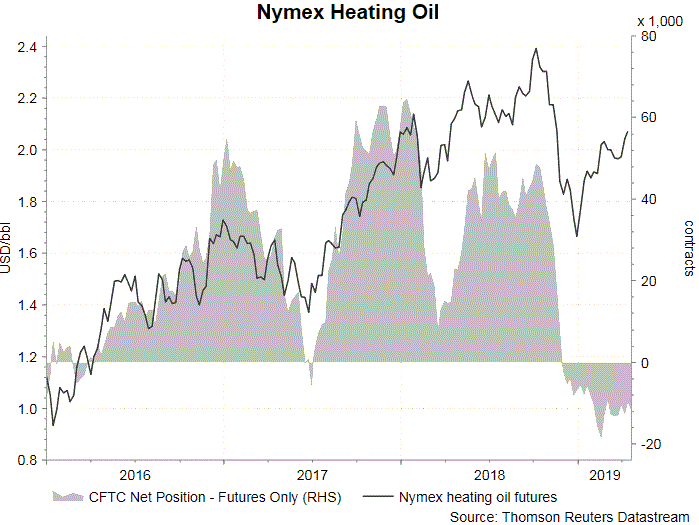
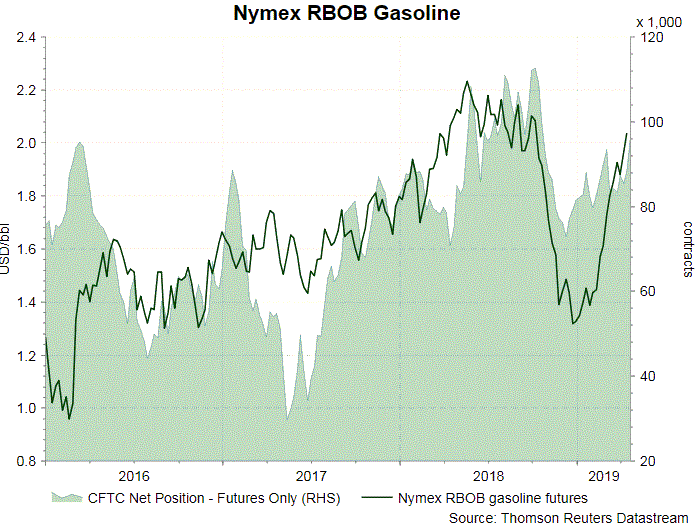
According to the CFTC Commitments of Traders report for the week ended April 16, NET LENGTH for crude oil futures dropped -1 404 contracts to 515 258 for the week. Speculative long positions fell -5 656 contracts while shorts dropped -4 252. Oil price rally might continue after Easter holiday as the US announced the end of Iranian sanction waiver. For refined oil products, NET LENGTH for gasoline jumped +8 297 contracts to 96 798, while NET SHORT for heating oil rose +1 991 contracts to 11 733 contracts for the week. NET SHORT for natural gas futures soared +15 027 contracts to 50 121 contracts for the week. Natural gas price plunged to the lowest level 3 years.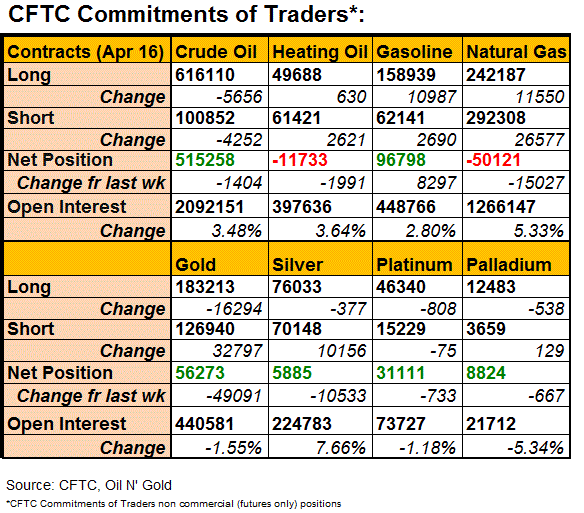
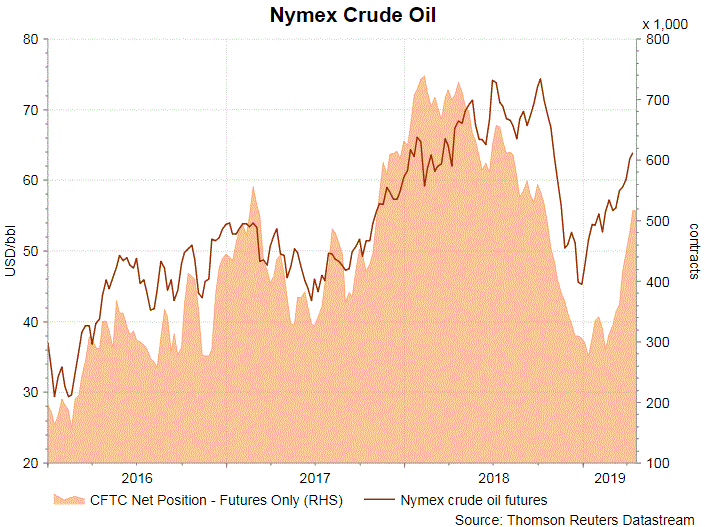
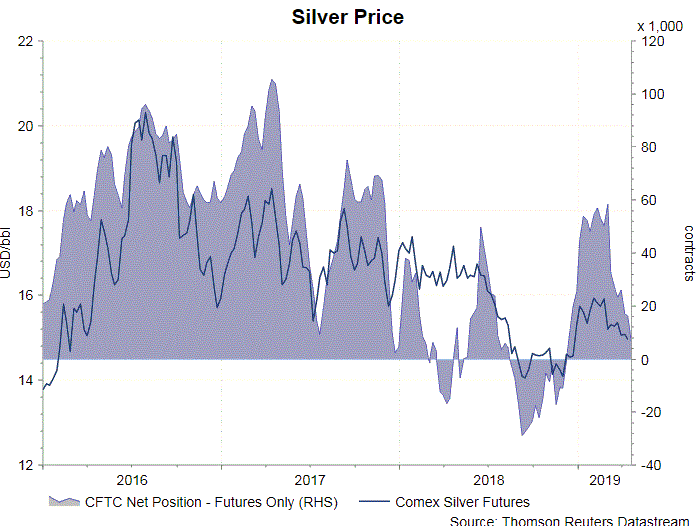
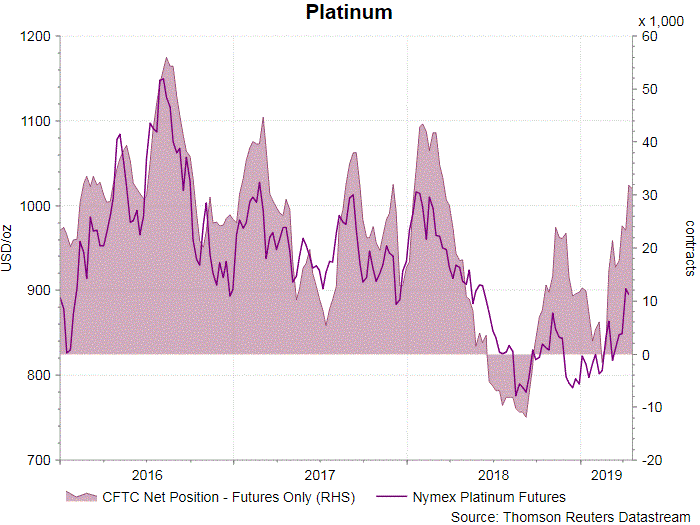
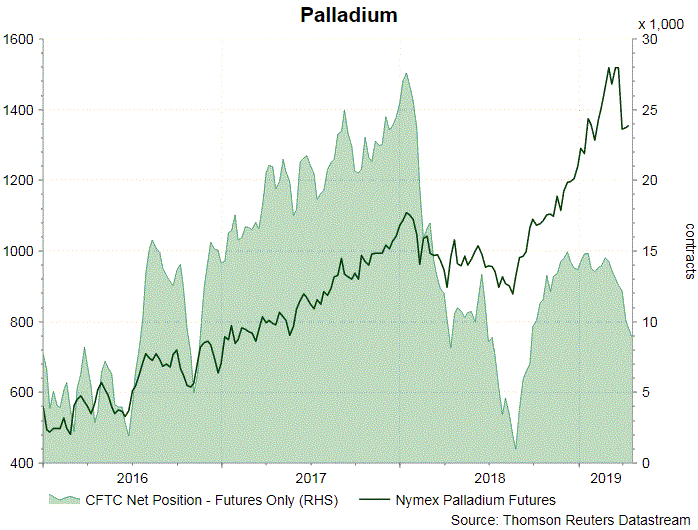
On the precious metal complex, NET LENGTH for gold futures slumped -49 091 contracts, to 56 273 last week. Speculative long positions plunged -16 294 contracts, while shorts soared +32 797, resulting in a decline in NET LENGTH. Rally in US Treasury yields dampened demand for gold. For silver futures, speculative long positions dropped -377 contracts while shorts rose +10 156. These resulted in a sharp decline in NET LENGTH, by -10 533 contracts, to 5 885 contracts. For PGMs, NET LENGTH of Nymex platinum futures fell -733 contracts to 31 111 while that for palladium dipped -667 contracts to 8 824. 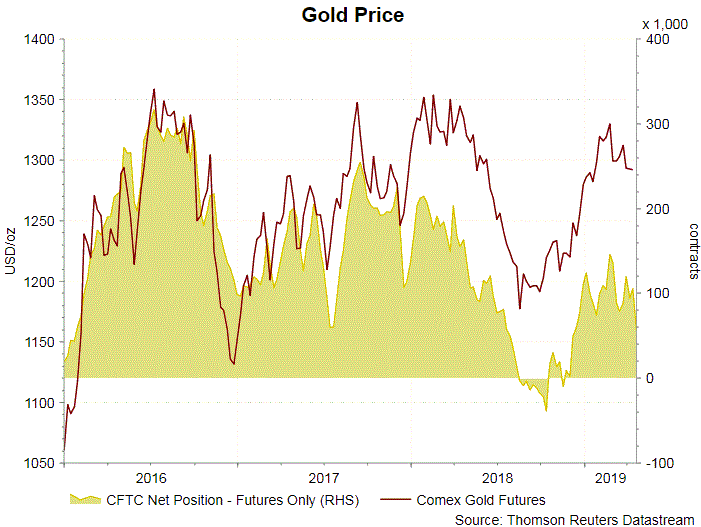
CFTC Commitments of Traders – Net Short Increased in Safe- Haven Currencies as Risk Appetite Improved
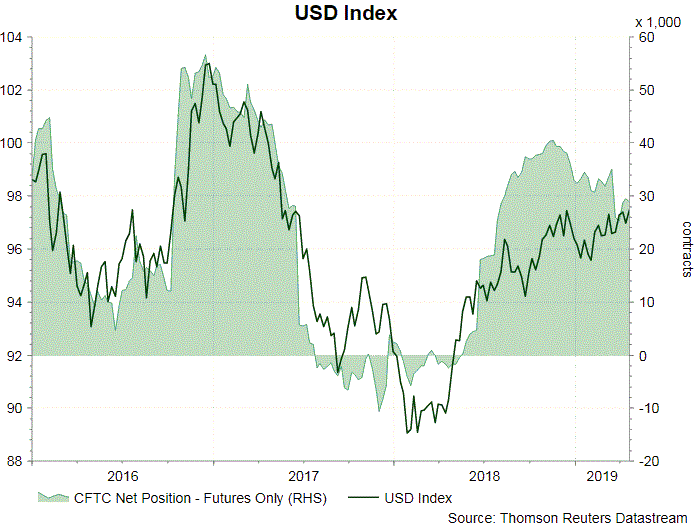
As suggested in the CFTC Commitments of Traders report in the week ended April 16, NET LENGTH in USD Index decreased -508 contracts to 28 938. Both speculative long and short positions dropped during the week. All other major currencies stayed in NET SHORT positions.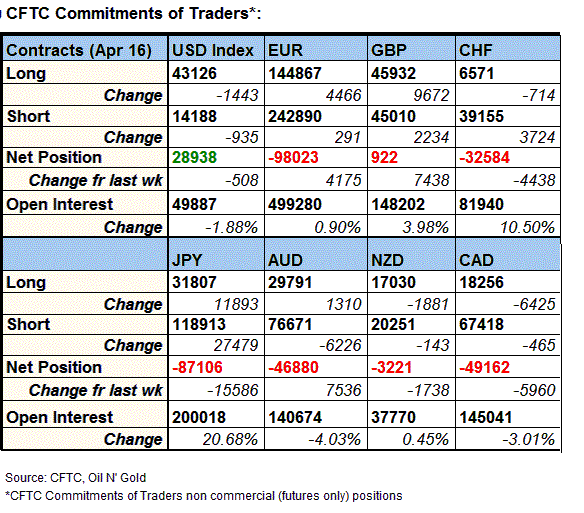
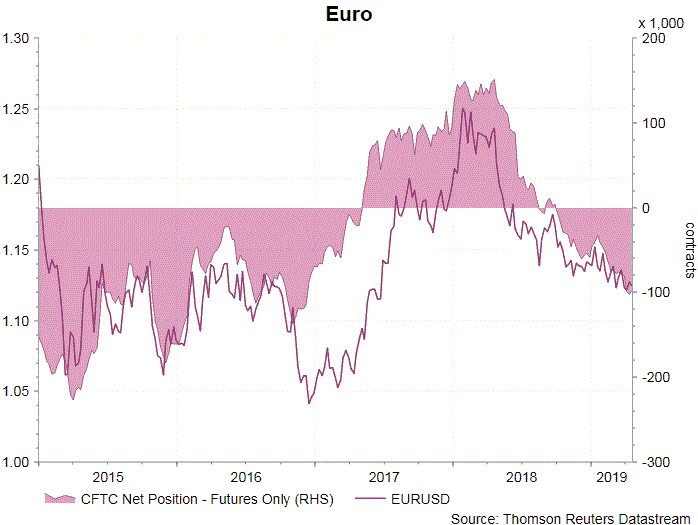
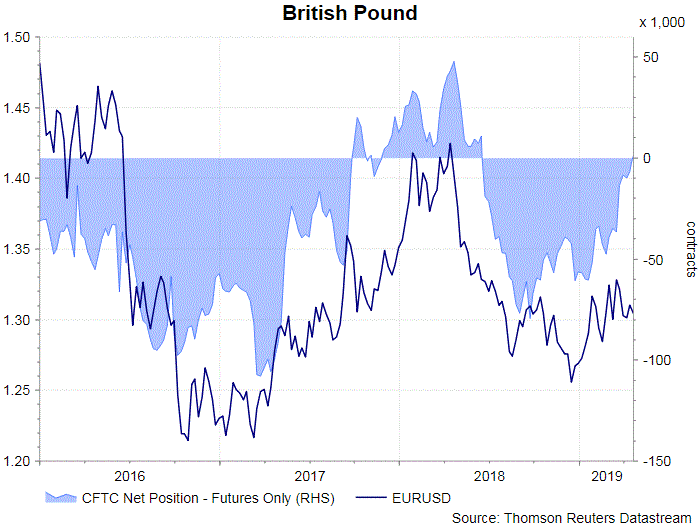
Concerning European currencies, NET SHORT for euro futures declined -4 175 contracts to 98 023 with bets decreased on both sides. NET SHORT for GBP futures slumped -7 438 contracts to 922. Speculative long positions jumped -9 672 contracts while speculative shorts gained +2 234 contracts for the week.
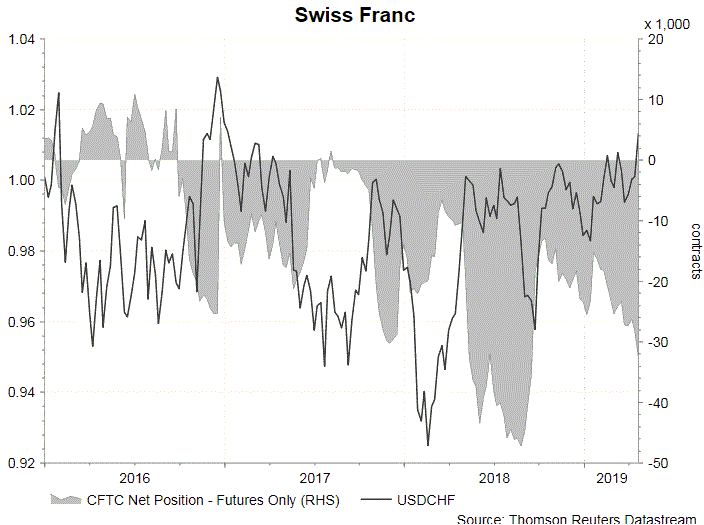
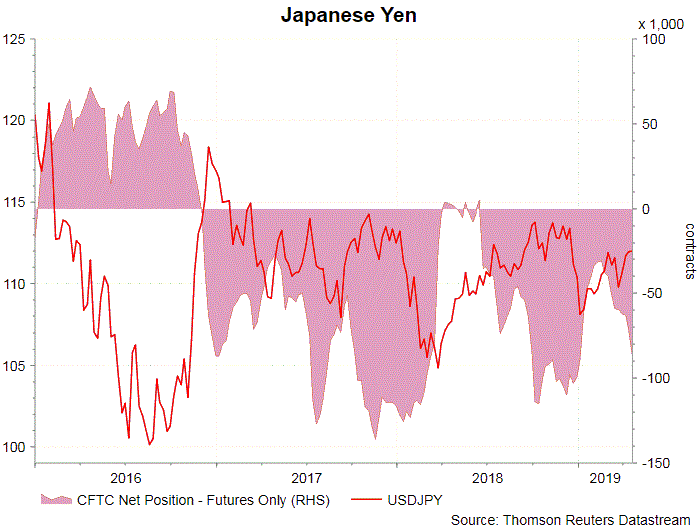
On safe-haven currencies, Net SHORT for CHF futures rose +1 4 438 contracts to 32 584. NET SHORT for JPY futures jumped +15 586 contracts to 87 106 during the week. Speculative long positions soared +11 893 contracts while shorts rose 27 497 contracts.
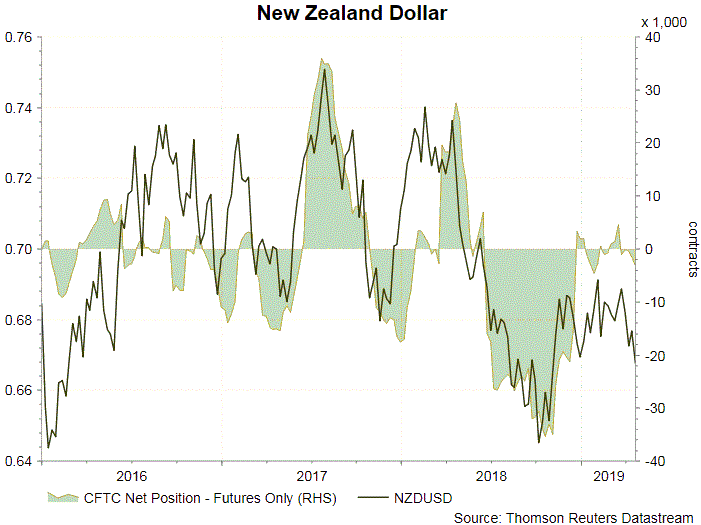
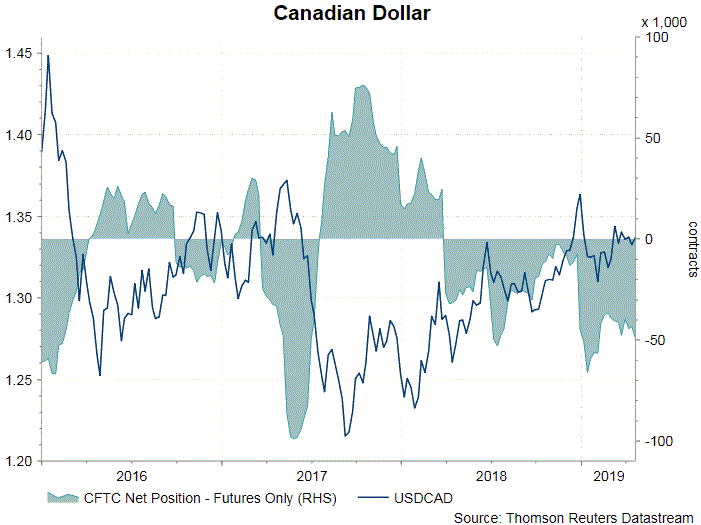
On commodity currencies . NET SHORT for AUD futures dropped -7 536 contracts to 46 880. Speculative long positions gained +1 310 contracts while shorts fell -6 226 contracts. NET SHORT for NZD increased +1 738 contracts last week, with both speculative long and shorts position decreased last week. NET SHORT for CAD futures gained +5 960 contracts to 49 162. 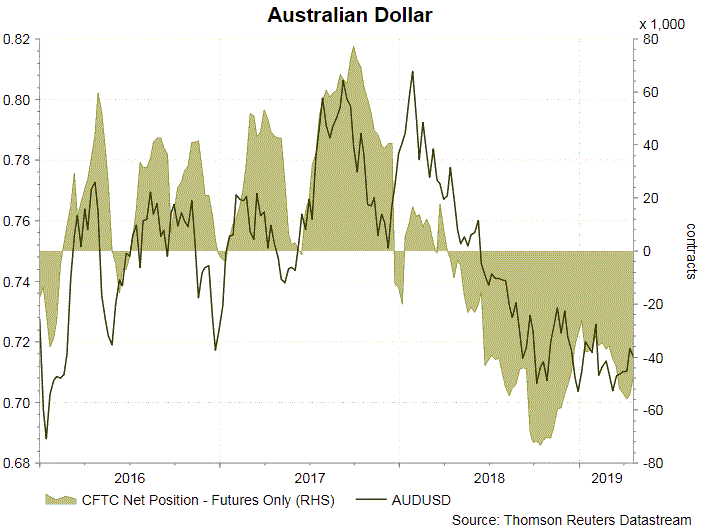
US to end Iranian oil sanction waivers for China, Greece, India, Italy, Japan, South Korea, Taiwan and Turkey
Oil price jumps sharply today on news that US is preparing to stop all Iranian oil sanction waivers. The announce could be made as soon as on Monday. Currently, China, Greece, India, Italy, Japan, South Korea, Taiwan and Turkey are buying Iranian oil without facing US sanctions. But such waivers would expire on May 2 and US will not be renewing it them.
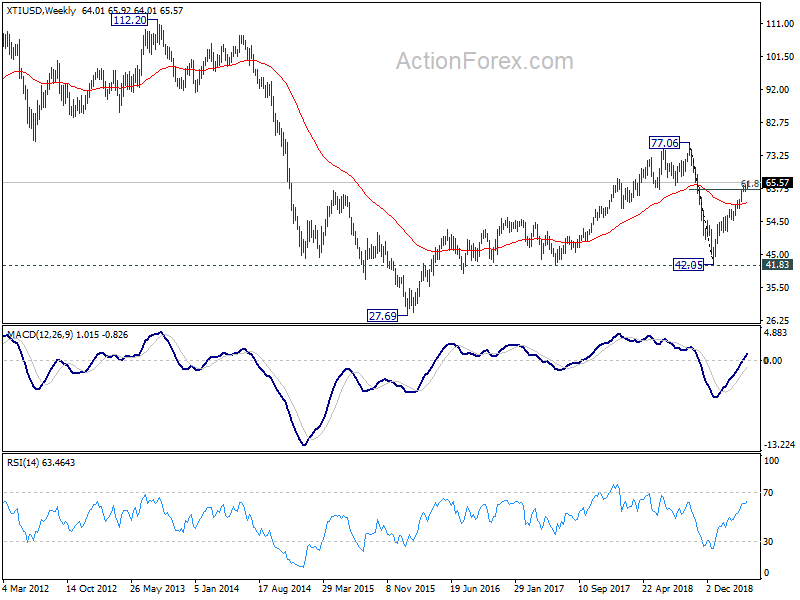
WTI crude oil surges to as high 65.92 so far today. 61.8% retracement of 77.06 to 42.05 at 63.68 is considered completely got rid of. Near term outlook will stay bullish as long as 63.08 support holds. Further rise should be seen back to 77.06 key resistance.
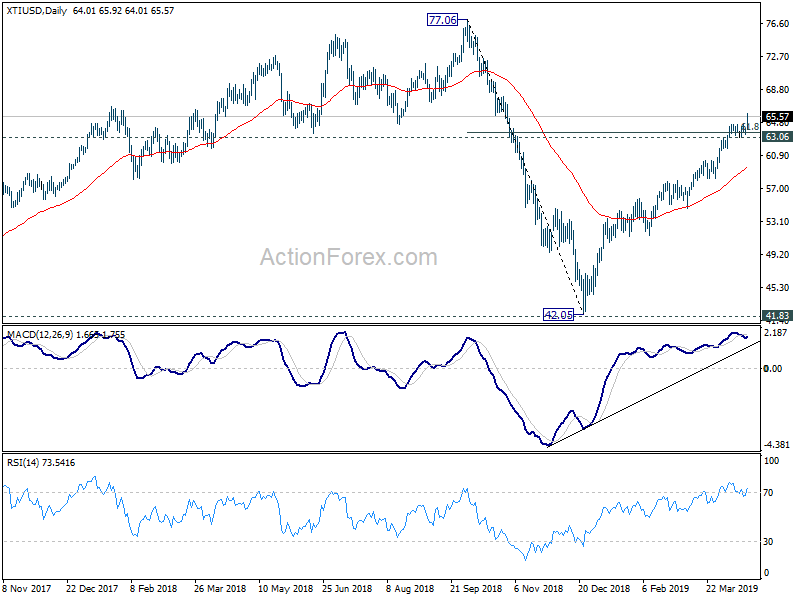
In the bigger picture, there is no clear sign of range break out yet. Rise from 42.05 is seen as just a leg inside the sideway pattern from 77.06. Thus, upside should be limited by 77.06 to bring another medium term fall.
EUR/USD Showing Signs of Weakness Below 1.1300
Key Highlights
- The Euro failed to break the 1.1325 resistance and declined sharply against the US Dollar.
- EUR/USD traded below a crucial bullish trend line with support at 1.1290 on the 4-hours chart.
- The US Housing Starts in March 2019 decreased 0.3% (MoM), whereas the forecast was +6.5%.
- The US Existing Home Sales in March 2019 could dip 2.3% (MoM), whereas the last was +11.8%.
EURUSD Technical Analysis
This past week, the Euro made a couple of attempts to break the 1.1325-1.1330 resistance against the US Dollar, but it failed. As a result, the EUR/USD pair started a strong decline below the 1.1300 support.
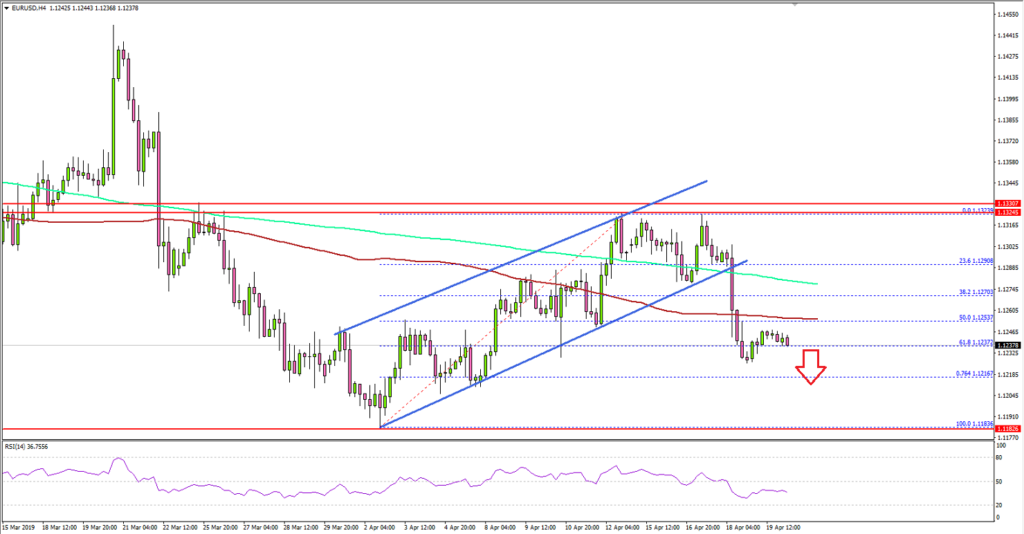
Looking at the 4-hours chart, the pair topped near the 1.1323 level and traded below the 1.1300 and 1.1280 support levels. More importantly, the pair surpassed a crucial bullish trend line with support at 1.1290.
There was also a break below the 100 simple moving average (4-hours, red), 200 simple moving average (4-hours, green), and the 50% Fib retracement level of the last major wave from the 1.1183 low to 1.1323 high.
Recently, the pair even dipped below the 1.1250 support level and the 61.8% Fib retracement level of the last major wave from the 1.1183 low to 1.1323 high.
On the downside, the main support is at 1.1215. If there is a break below the 1.1215 support, the pair is likely to revisit the 1.1180 support area. On the upside, an initial resistance is at 1.1268, above which the pair is likely to test the 200 simple moving average (4-hours, green).
Only a successful close above 1.1300 could push EUR/USD back in a positive zone. It not, there is a risk of a downside extension below 1.1215 and 1.1180 in the coming days.
Fundamentally, the US Housing Starts report for March 2019 was released by the US Census Bureau. The market was looking for an increase of 6.5% in March 2019, compared with the previous month.
The actual result was disappointing as there was a decline of 0.3% in the US Housing Starts. The last reading was also revised from -8.7% to -12.0%.
The report added that:
Privately‐owned housing units authorized by building permits in March were at a seasonally adjusted annual rate of 1,269,000. This is 1.7 percent (±1.4 percent) below the revised February rate of 1,291,000 and is 7.8 percent (±1.9 percent) below the March 2018 rate of 1,377,000.
To sum up, both EUR/USD and GBP/USD are currently trading in a bearish zone, with a risk of more downsides in the near term.
Economic Releases to Watch Today
- Chicago Fed National Activity Index for March 2019 – Forecast -0.25, versus -0.29 previous.
- US Existing Home Sales for March 2019 (MoM) – Forecast -2.3%, versus +11.8% previous.
US Sanctions Waiver Asia
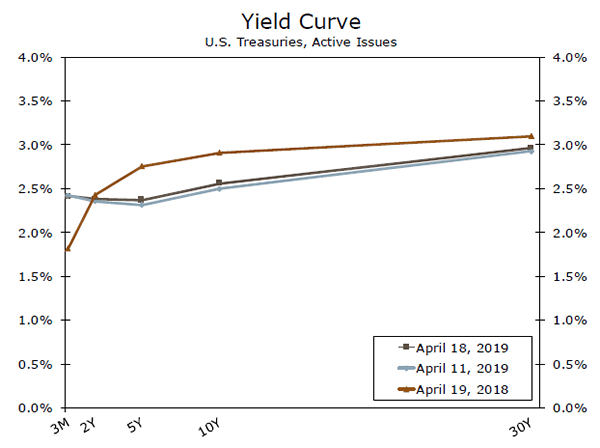
Robust US retail data and a continuing positive procession of Q1 earnings data lifted Wall Street and the dollar on Friday. However, the bond market continues to be more circumspect among all the upbeat noise from earnings – or perhaps relieved – with yields falling slightly across the curve.
The divergence is worth noting, especially if it continues throughout the week. Wall Street has an avalanche of Q1 earnings inbound from tech and industrial heavyweights this week. Given the out-performance of results thus far, a lot of positive expectations are being baked into equity prices at these levels, with the S&P just shy of all-time highs as an example. The end of the week, therefore, should provide more clarity over whether the equity markets are being irrationally exuberant, or the bond markets overly cynical.
The US dollar continues to confound pundits and remain stubbornly strong, riding again on Friday with the dollar index climbing 0.45% to 97.45. This was helped by weak PMI data from Germany and France sending the Euro (EUR) lower. My continued thesis is that the dollar will disappoint circling bears for all of 2019 for one simple reason: US yields among developed markets are the highest out there, with the Federal Reserve having at least partially normalised rates ahead of the next slowdown. A dovish Fed will give no solace to dollar bears as every other major central bank has now moved to an on-hold/dovish stance as well. They are, for the most part, in no position to cut rates much further ahead of a slowdown, should it occur later in 2019.
The week brings two rate decisions, Canada on Wednesday and locally, the Bank of Japan on Thursday. The devil will be in the detail with Canada in particular – a newly-minted member of the dovish central bank club. No change is expected from either, but investors will be watching for what they do or don’t say rather than the decisions themselves. The week culminates on Friday with the release of the US GDP data.
With Hong Kong, Australia and all of Europe (yes that includes Britain) still chasing Easter bunnies, and no data of note regionally, local markets should expect a quiet day. The US though has just announced it is tightening the screws on Iran and eliminating sanctions waivers. With Asia’s significant economies all heavy oil importers, this may cause some adverse reactions across the region.
Equities
Asian markets may struggle to follow Wall Street’s lead this morning as the US-Iran sanction waiver could spook investors. Regional heavyweights such as Japan, South Korea and China are all huge oil importers, and with oil already higher on the news, equity markets are unlikely to view higher energy prices.
FX
The US dollar continues to outperform as economic data and yields offer structural support. Weak data from Europe has seen the single currency give up its recent gains and slip to 1.1240 this morning. The British pound (GBP) also gave up the 1.3000 psychological level on Friday and trades at 1.2990 today.
The oil price spike will likely support the Indonesian rupiah (IDR) and Malaysian ringgit (MYR) today. Net importing heavyweights China, India, South Korea and Japan may find their currencies coming under pressure in the short-term on the Iran news.
Oil
Oil finished the week strong and has spiked higher this morning as the US government announced it will end the Iran waiver scheme. Brent Crude jumped 1.70% to USD73.25 a barrel, while WTI jumped 1.80% to USD65.00 a barrel. This could leave regional heavyweights scrambling to find alternative supplies in the near term in what is already a very tight structural supply situation globally. For now, geopolitical factors rule the roost on energy markets.
Gold
Gold has climbed slightly in Asian trading to USD1,277.50 an ounce, benefiting from higher oil prices driven by geopolitical tensions. With regional equity markets possibly coming under pressure today as a result, gold could be a principal beneficiary in today’s session, although a strong US dollar will temper gains.
Eco Data 4/22/19
[php_everywhere instance="1"]
USDCHF Faces Risk Of Price Extension On Bullishness
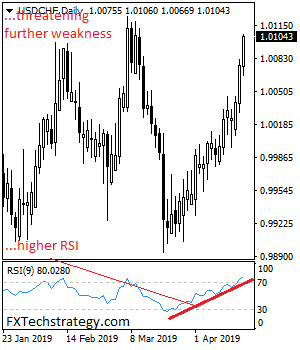
USDCHF faces risk of price extension on bullishness following its past week strength. Resistance stands at the 1.0150 level. A break of there will clear the way for a run at the 1.0200 level. Above here, resistance lies at the 1.0250 level and then the 1.0300 level. On the downside, support is seen at the 1.0100 level. A turn below here will set the stage for more decline towards the 1.0050 level. And then the 1.0000 level. Further down, support resides at the 0.9950 level. All in all, USDCHF faces risk of price extension on bullishness as we enter a new week.
Forex Forecast and Cryptocurrencies Forecast
First, a review of last week’s events:
EUR/USD. Most experts (65%) expected that the pair would go down. This forecast was supported by signals from a third of the oscillators indicating that the pair was overbought. All this happened: the weekly amplitude of fluctuations was about 100 points, and the low was fixed at 1.1225.
Perhaps the fall of the euro on Thursday, April 18, would not have been so strong if it had not been for the short working week before Catholic Easter, when many banks and exchanges were closed on Good Friday. The main reasons for the fall were disappointing market data on business activity in the Eurozone and dollar-friendly data on retail sales in the United States.
On Friday evening, the European currency, however, managed to win back some of the losses, and the pair completed the week at 1.1240;
GBP/USD. This pair showed a slightly larger amplitude - 140 points. At the same time, the experts indicated the precise low to which it should sink. Actually, with the forecast at 1.2985, the pair felt the bottom at the horizon 1.2978 - inside the support zone, which it has been unsuccessfully trying to break through for two months already;
USD/JPY. Some experts expected the growth of this pair, some thought it would fall. However, fluctuations with a maximum range of 40 points can hardly be attributed to bullish or bearish trends. For the whole week, we were able to observe the classic sideways trend, which started at 112.00 and ended at 111.92;
Cryptocurrencies. As has been said many times, the cryptocurrency movement is largely motivated by the news background, which this week was mildly positive. The "guru" Involved in the crypto business continued to repeat the mantra of the imminent rise of Bitcoin. For example, Tom Lee, a former financial analyst at JPMorgan, and now co-founder of Fundstrat Global Advisors, said that given the success of the first cryptocurrency this spring, Bitcoin's exchange rate to the dollar will show growth throughout the year and reach $10,000 by its end. And according to the head of the BitMEX exchange Arthur Hayes, in just a few years we will see BTC/USD quotes around $50,000. The main positive news of the week, in our opinion, was the message that the World Bank and the International Monetary Fund jointly launched an internal cryptocurrency. So far, only for the educational purposes of their employees. But as they say, the first step is the hardest.
As for our forecast, it came true almost 100%: the standard cryptocurrency stayed in the range of $4,975-5,370, adding about 3.5% over the week. Ethereum (ETH/USD) and Litecoin ((LTC/USD) showed an increase of about 4%, but the growth of Ripple (XRP/USD) was less than 2%.
As for the forecast for the coming week, summarizing the opinions of a number of analysts, as well as forecasts made on the basis of a variety of methods of technical and graphical analysis, we can say the following:
EUR/USD. The world economy is moving towards recession, and much in Europe depends on how well EU leaders can withstand the negative trends. It is not only about how the political situation will develop in the EU countries, and not only about how the ECB will behave in an effort to stabilize the economic situation in the euro area, but also about how, for example, the US-China trade negotiations will end and how President Trump will behave after that. Many analysts believe that today, Europe is prepared for the global economic recession and external attacks worse than other economic blocs.
The past week brought the euro back within the 15-week downward channel. And 70% of experts, supported by graphical analysis on H4, believe that the European currency will continue to give up its positions, falling to the zone of the 2019 lows - 1.1175-1.1185. It is only 30% of analysts that hope that the pair will be able to return to 1.1325. At the same time, attention should be paid to the data on the US GDP, which will be published on Friday, April 26. According to forecasts, the GDP growth will be only 1.8%, which is significantly lower than the previous value of 2.2%. If this prediction turns out to be correct, bulls can move the pair to the next target at the height of 1.1420;
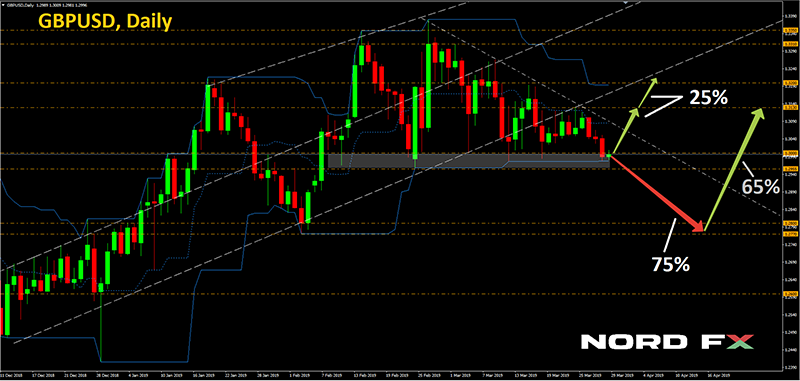
GBP/USD. The pair completed the previous five days in the support zone of 1.2975, which it has been trying to break through for eight weeks already. Most experts (75%) believe that it will succeed and will be able to descend to the zone of 1.2770-1.2830. However, some analysts hope that amid the dovish rhetoric of the ECB and the US Federal Reserve, the Bank of England will nevertheless decide to raise the interest rates. One can add to this the still persistent euphoria caused by the delay of Brexit. taken together, these factors let the bulls hope for the pair to return above the 1.3100 mark. The nearest resistance levels are 1.3130 and 1.3200. It is only 25% of analysts who agree that this will happen next week. But in the transition to the monthly forecast, 60% of the experts and graphical analysis on D1 side with the bulls. As for the readings of oscillators, 15% of them signal that the pair is oversold, which means, if not a complete reversal of the trend, then at least a quick correction of the pair upwards;
USD/JPY. We expect the Bank of Japan’s interest rate decision and a press conference on the monetary policy of this Bank on Thursday, April 25. However, both of these events are unlikely to present any surprises. The side trend of this pair is also not conducive to forecast accuracy. That is why analysts' opinions on its behavior in the next five days have been divided almost equally: a third are for for its growth, a third are for a fall, and a third are for a continuation of the lateral movement.
However, in the longer term, 65% of the experts, supported by graphical analysis on D1, vote for the pair to fall. 25% of oscillators also give signals that it is overbought. At the moment, the pair is still in the reversal zone near the upper boundary of the medium-term channel 109.70-112.15, and, in the case of its downward movement, the targets for it will be the support levels 110.85, 110.35 and the lower boundary of the channel 109.70.
If the dollar continues to grow against the Japanese currency, then its immediate task will be to consolidate in the zone of 112.20-113. 25 The next resistance is at 113.70;
Cryptocurrencies. Despite a more or less positive news background, 65% of experts remain pessimistic, believing that in the near future the BTC/USD pair will not be able to break through the resistance of $5,500. Moreover, according to their forecasts, bears will have a certain advantage in this market, pressing the pair to support $4,600. However, during the transition to the medium-term forecast, the alignment of forces changes to the opposite, and here already 60% of analysts believe that Bitcoin quotes at $5,750-5,800 are realistic.
Weekly Economic and Financial Commentary: Trade to Buoy U.S. GDP…at Least in the First Quarter
U.S. Review
Outlook for Q1 GDP Is Brighter, But Can it Be Sustained?
- Two indicators this week turned the tables on what to expect out of next week's GDP report. We now look for an annualized growth rate of 2.6% for the economy in the first quarter.
- An unexpected narrowing in the trade deficit is one rationale, as this indicates a big boost from trade. A surge in civilian aircraft exports was a key factor and one that we do not see as sustainable.
- Retailers posted the best monthly increase in a year and a half, which means less of a slowdown in consumer spending than many had feared. Thanks to a solid labor backdrop and other positive fundamentals, the consumer spending story has legs.
Trade to Buoy U.S. GDP…at Least in the First Quarter
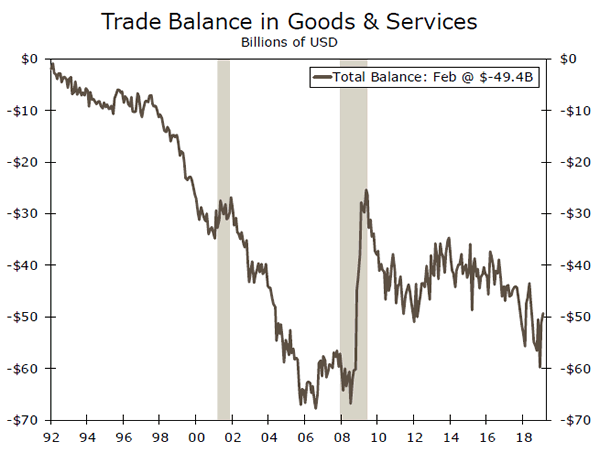
Perhaps the most impactful economic development this week was news that the trade deficit unexpectedly narrowed in February as exports surged 1.1% and imports rose just 0.2%. Of the roughly $2.3 billion increase in exports, $2.2 billion came from just one category: civilian aircraft. Given Boeing's challenges with its 737 MAX line of aircraft, we expect this dynamic to unwind in coming months. For more on the impact to growth from Boeing, see our recent special report.
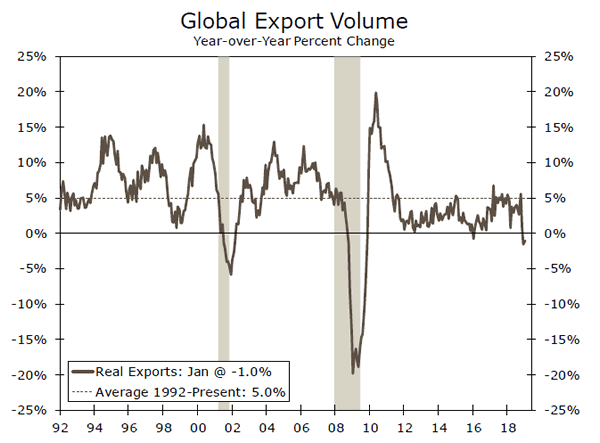
The one-off surge in aircraft exports was a bit of a surprise, but another reason that the narrowing in the trade deficit caught most forecasters off-guard is the fact that this is occurring amid ongoing tariff disputes and a deterioration in the outlook for global GDP growth. Global export volumes, for example, are down 1.0% on a year-over-year basis and as the middle chart shows, this is something that rarely occurs outside of a U.S. recession. If global trade continues to dry up, eventually U.S. exports will be vulnerable to that slowing.
For now however, trade is on track to provide a sizable boost to GDP growth in the first quarter. According to our latest tally, net exports will add about 0.7 percentage points to the annualized rate of GDP growth in the first quarter before becoming a drag in the second quarter.
Consumers on Track to Offer Sustainable Support to GDP
Although we have concerns about the ability of net exports to be a sustainable driver of GDP growth in subsequent quarters, the consumer is poised to be a more sustainable driver, and here we also got some good news this week.
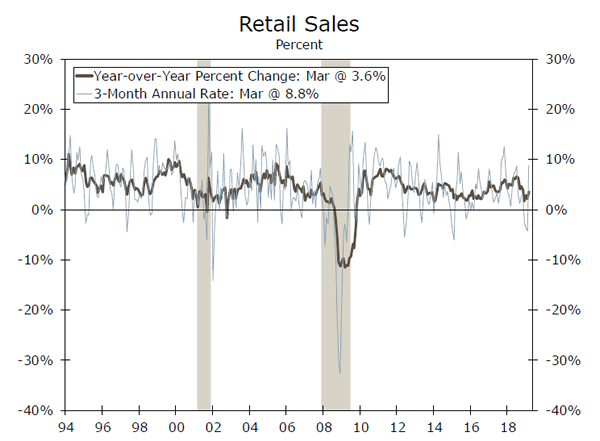
We had been bracing for a slowdown in the pace of Q1 consumer spending, but after this week's solid report on March retail sales, it now appears that the slowdown in spending will be more modest than feared.
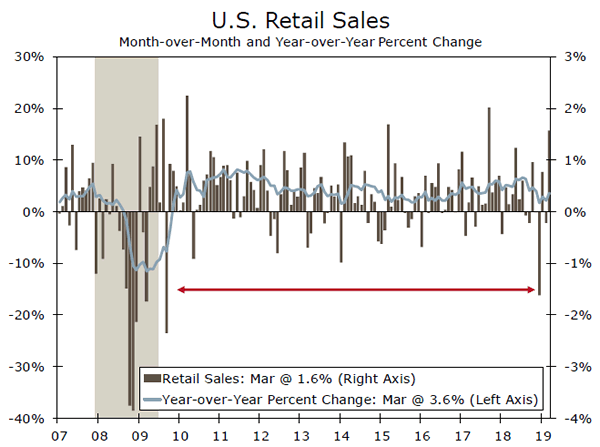
Even after retail sales fell in two out of three months leading up to this week's report for March, we have maintained the view that this was a soft patch rather than the beginning of a sustained retrenchment in consumer spending. That assessment gained credibility with news that retailers saw a 1.6% pop in March sales. That was the best month in the past year and a half and takes some of the sting out of recent disappointing reports.
Control group retail sales excludes some of the more volatile categories and feeds into the personal consumption expenditure line in the GDP report. This category notched a solid 1.0% gain in March. That may not be enough to meaningfully lift Q1 consumer spending, but it indicates a higher starting point and some momentum going into the second quarter.
Unlike the boost from trade which is likely to be a flash-in-the-pan, the improvement in consumer spending is on track to remain supportive of GDP growth in coming quarters. The tight labor market is at last generating average hourly earnings growth north of 3% and that ought to be sufficient to allow consumers to continue to spend as the year progresses.
U.S. Outlook
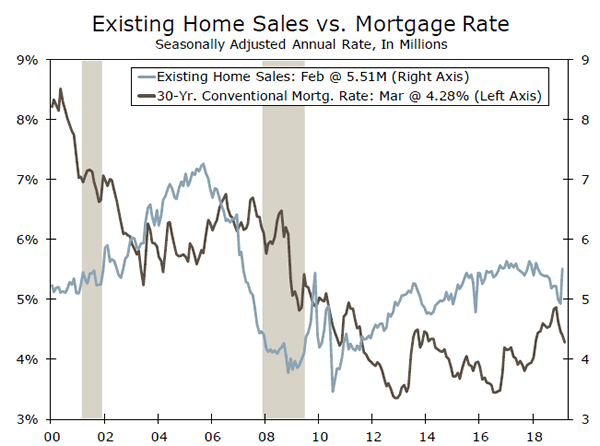
Existing Home Sales • Monday
Next week begins with existing home sales data for March. Given February's 11.8% surge, we expect a modest pull back in sales for the month. Pending home sales, which reflect purchase contracts and precede existing sales by one to two months, registered a small decline in February, meaning March closings will likely exhibit a similar pattern. However, the return of winter weather likely influenced pending contracts, and February's weakness masks an overall improvement in buying conditions in recent months, which should be supportive of sales moving forward. Underlying demand continues to be solid, marked by low unemployment and rising wages. As the Fed maintains a more dovish monetary policy stance, mortgage rates continue to track lower, which has induced a steady rise in mortgage purchase applications. Overall, existing home sales appear set for modest improvement this year compared to relatively sluggish activity experienced throughout much of 2018.
Previous: 5.51M Wells Fargo: 5.38M Consensus: 5.30M
Durable Goods Orders • Thursday
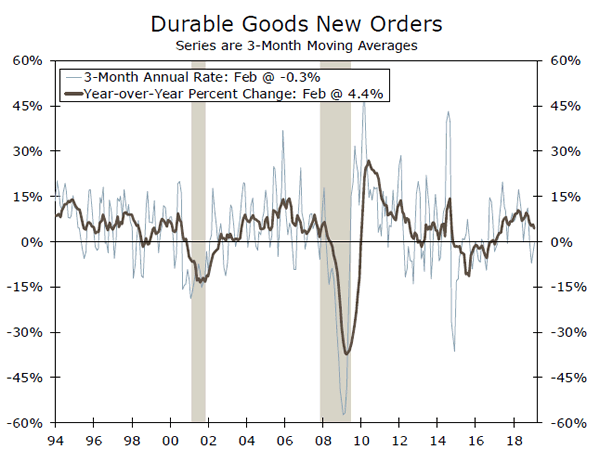
Thursday brings the advanced report for durable goods orders. Total orders declined 1.6% in February, and we expect orders partially rebounded during March. February's decline was owed to a 31.1% decline in commercial aircraft orders. Orders excluding the volatile transportation sector fared slightly better, rising 0.1% during the month. On the topic of aircraft orders, the grounding of the Boeing 737 MAX will likely not affect new orders this month, as only one airline has cancelled an order and widespread cancellations are unlikely. That said, deliveries of the 737 MAX have been suspended, which we suspect will drag down durable good shipments during March. In February, nondefense capital goods shipments increased 0.6%, but followed a sizable 1.5% drop in January, dimming the prospect for a strong showing from equipment spending in the first quarter.
Previous: -1.6% Wells Fargo: 0.9% Consensus: 0.7%
GDP • Friday
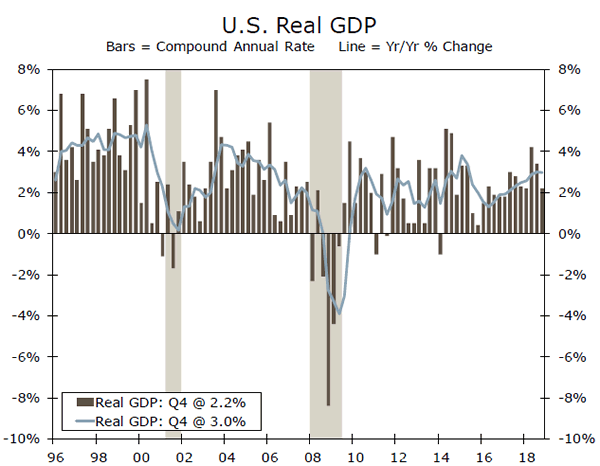
Capping off the week is a first look at real GDP growth during the first quarter of 2019. On a quarter-over-quarter annualized basis, we expect real GDP rose 2.6% in Q1, a modest pick-up relative to the 2.2% pace registered in Q4. Consumer spending will likely moderate somewhat compared to the robust pace experienced for much of last year, but stronger-than-expected retail sales indicate less of a dropoff in spending from Q4. A narrowing of the trade deficit will also provide a boost, as a recent rise in exports has outweighed more modest growth in imports. Business investment will continue to add to GDP growth, but likely slowed in Q1 alongside trade tensions and slower global growth. Meanwhile, residential investment should finally provide some modest support, as lower mortgage rates have breathed new life into the housing market. Government purchases are also poised to expand, while we look for a fairly strong contribution from inventories. . Previous: 2.2% Wells Fargo: 2.6% Consensus: 2.2% (Quarter-over-Quarter)
Global Review
Some Signs of Life for the Global Economy
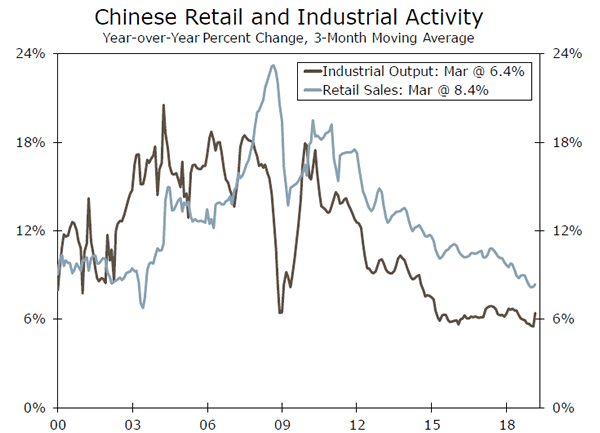
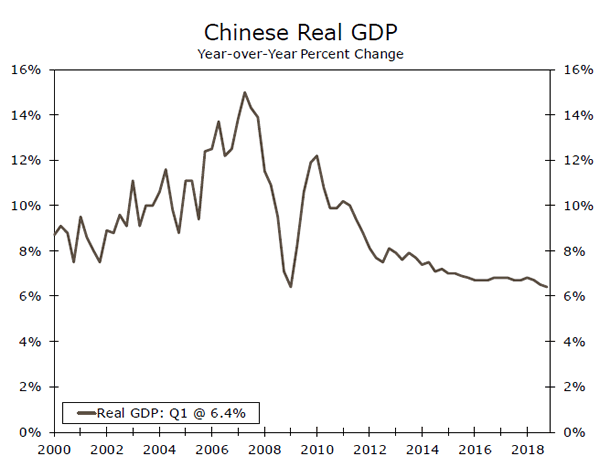
- The past week has seen some more hopeful signs for the global economy. In particular, China's Q1 GDP beat expectations, holding steady at 6.4% year-over-year, while March retail sales and industrial output quickened from their January-February pace.
- Developments from Europe were mixed. U.K. economic figures remain resilient overall even in the face of Brexit uncertainty, including a sizable gain in March retail sales. However, Eurozone April manufacturing confidence rose less than expected, while service sector confidence fell more than expected.
Chinese Economic Data Improve
The main international economic development this week was a constructive batch of Chinese economic data. Q1 GDP surprised to the upside as growth unexpectedly held steady at 6.4% year-over-year. Meanwhile, the first quarter also finished on a solid note as March activity figures not only accelerated, but also beat consensus forecasts. March retail sales firmed to 8.7% year-over-year, while industrial production firmed to 8.5%. Altogether, these activity figures reinforce the message from China's March PMI surveys, which were encouraging in tone.
With the United States and China representing the world's key global economies, trends in China's economy have important implications for Asia, emerging markets and the global economy more broadly. The more upbeat figures suggest China's monetary and fiscal stimulus may finally be starting to take in supporting growth, and, for now, there appears to be no let up from Chinese authorities with respect to stimulus. We will be watching Chinese data for potential further upside surprises, a development that would be positive for the global economy and financial markets.
Eurozone Data Mixed, But Disappoints Overall
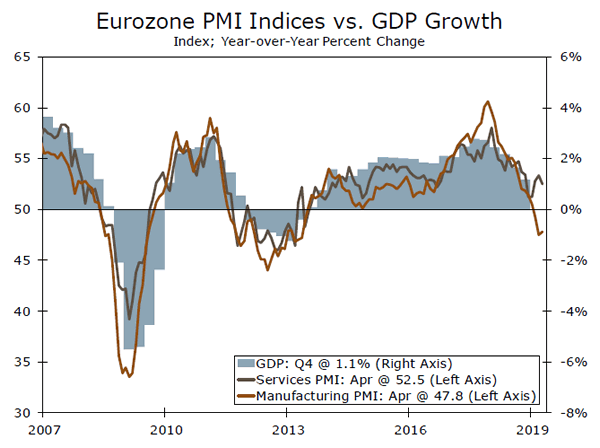
Investor concern about the state of the Eurozone economy persists, and recent activity and survey data have at best mixed, which has not allayed those concerns. The release of the April Eurozone PMI indices saw the manufacturing PMI recover less than expected to 47.8. Meanwhile, the services PMI fell more than expected to 52.5, reversing its March increase. Those PMI surveys offset more positive—but less important—news from earlier in the week as February construction output rose 3% month-over-month. So far, both industrial and construction out are up in January-February compared to Q4-2018. Indeed, based on PMI surveys for the first quarter and activity data through February, the current Eurozone Q1 GDP estimate based solely on the incoming data flow is for a gain of 0.45% quarter-over-quarter. Even with some probable weakness in March activity figures there could be a slight firming in Eurozone Q1 GDP from the 0.2% gain seen in the fourth quarter, although the April PMIs offer less confidence that any strength will be sustained through 2019.
U.K. Economic Figures Back in Focus
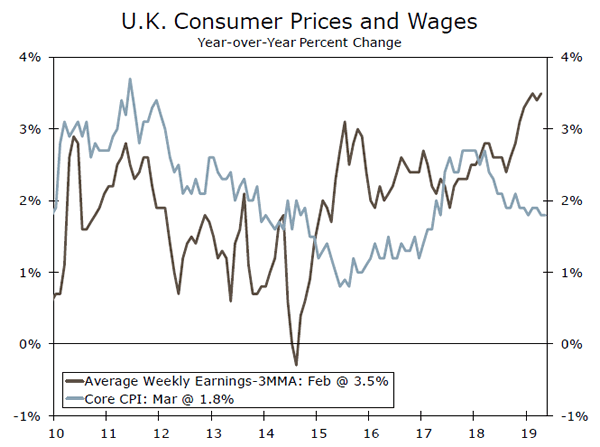
With Brexit on the backburner for now as the "exit date" extended to October 31, the focus returned to U.K. data this week. Overall, those economic figures were mixed. Wage growth remains sturdy, with average weekly earnings rising 3.5% year-over-year in the three months through February. The March CPI was benign, as the headline CPI rose 1.9% year-over-year, while March retail sales jumped 1.1% month-over-month, after solid gains in both January and February.
More broadly, U.K. growth has been remarkably resilient—as evidenced by gains in January and February GDP—considering the Brexit uncertainty that is still hanging over the economy. Even with those steady figures we do not expect a Bank of England rate hike until Brexit issues are resolved, and we forecast the central bank to begin raising interest rates starting in 2020.
Global Outlook
Australia CPI • Wednesday
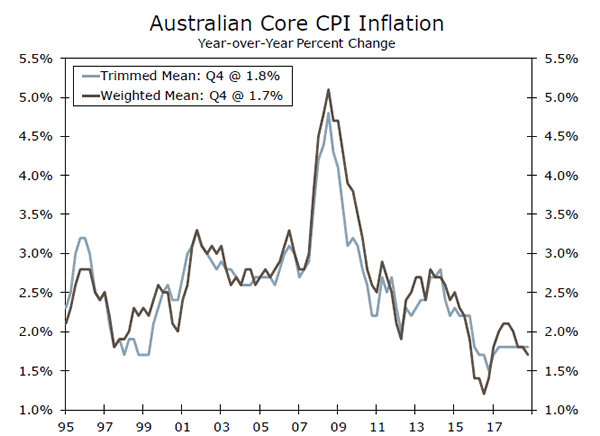
Australia's Q1 CPI figures will likely indicate a continued absence of inflation pressures. The Q4 CPI slowed to 1.8% year-over-year, while core inflation measures were also slightly below the Reserve Bank of Australia's 2%-3% medium-term target range. Inflation pressures were benign across the spectrum, with goods and services inflation both running at just 1.7%.
The Q1 CPI is expected to slow even further to 1.5% year-over-year, while the consensus forecast is for the core inflation measures to ease as well. In addition to modest inflation, Australian economic growth is also subdued. Q4 GDP rose just 0.2% quarter-over-quarter and falling house prices indicate a slowing housing market, although labor market trends remain resilient. That said, with inflation and economic growth both subdued Australia's central bank is widely expected to ease policy further, with a 25 bp rate cut within the next 12 months more than fully priced into markets.
Previous: 1.8% Consensus: 1.5% (Year-over-Year)
Bank of Canada • Wednesday
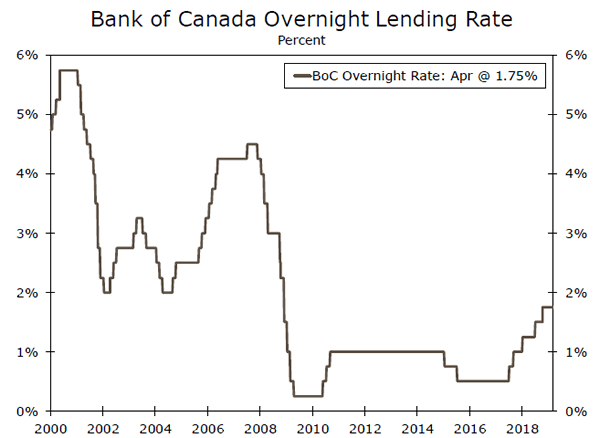
The Bank of Canada announces its monetary policy decision next week and is expected to hold its policy interest rate steady at 1.75%. In March, the central bank said there was "increased uncertainty" about the timing of future rate increases. While subsequent economic figures have shown some improvement, it is still likely too early for the Bank of Canada to contemplate a rate increase. February retail sales rose 0.8% month-over-month and the March CPI quickened to 1.9% year-over-year, while employment figures have been solid overall. If the overall strengthening of economic growth were to continue, we would expect the Bank of Canada to raise its policy rate a further 25 bps this year.
Sweden's central bank also announces monetary policy next week. The central bank raised rates 25 bps to -0.25% in December, but with growth slowing and inflation reasonably steady, we expect the policy rate to remain unchanged at this meeting.
Previous: 1.75% Wells Fargo: 1.75% Consensus: 1.75%
Japan Industrial Production • Friday
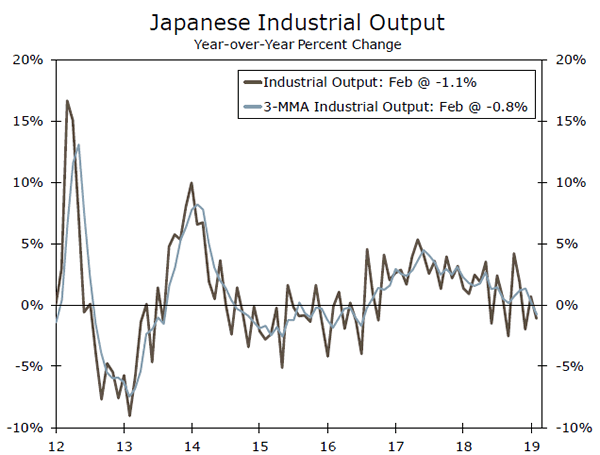
Japanese activity data released next week are likely, in our view, to portray an overall slowing economy. Industrial output has been up and down in recent months and is expected to edge only slightly higher in March, by 0.1% month-over-month. That would keep growth negative on an annual basis, with the consensus forecast for a fall of 3.8% year-over-year. Meanwhile, activity in the retail sector has also been somewhat subdued in recent months. In February, retail sales rose a modest 0.6% year-over-year, although for March, some firming in sales growth is expected to 0.8% year-over-year.
The subdued activity data are consistent with the Q1 Tankan survey, which foreshadowed a slowdown in growth. Given sluggish momentum, the chances of less accommodative Bank of Japan policy have dissipated. The central bank announces monetary policy next week and should keep its stance unchanged, while the risks are tilted toward a further cut in the central bank's GDP and CPI forecasts.
Previous: 0.7% Consensus: 0.1% (Month-over-Month)
Point of View
Interest Rate Watch
Fed Speakers Emphasize Patience
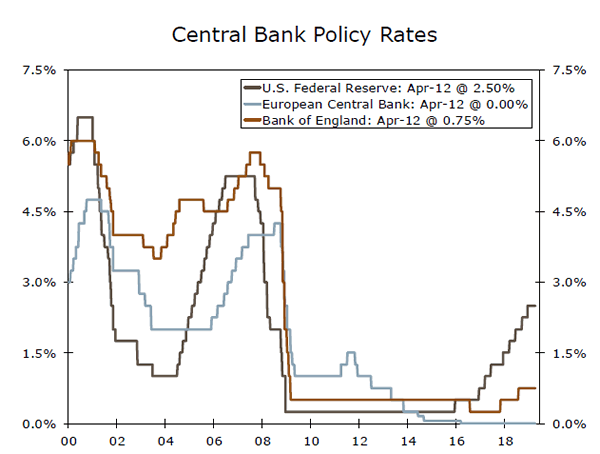
There were a number of Fed speakers who were busy making public statements this week before the blackout period ahead of the May 1 FOMC meeting took effect. Crucially, none of the speakers sought to change the narrative that the Fed likely will be on hold for the foreseeable future.
Chicago Fed President Evans, a voting member of the FOMC this year, said that the Fed should "embrace inflation modestly above 2 percent 50 percent of the time." With the PCE deflator up only 1.4% on a year-ago basis at present, it does not seem likely that Evans will be arguing for a rate hike anytime soon. Boston Fed President Rosengren, also a FOMC voter this year, said that the economy is doing well but that inflation is under the Fed's 2% objective, which is another implicit acknowledgement that the FOMC does not need to hike rates anytime soon. James Bullard (voting member from St. Louis) expressed sympathy for nominal GDP targeting, which, if adopted, would imply that the Fed should support strong nominal GDP growth with an accommodative policy stance. Patrick Harker (non-voter from Philadelphia) struck a slightly more hawkish tone when he said that the FOMC could potentially hike rates once "at most" in 2019. But Harker also acknowledged that he too is in a "wait-and-see mode" at present.
Not only does the FOMC look at "hard" data on the economy, but it also pays attention to anecdotal evidence that is collected by the Federal Reserve Banks. This evidence is summarized in the so-called Beige Book, which is usually released two weeks ahead of a FOMC meeting. The anecdotes contained in this week's Beige Book suggest that "economic activity expanded at a slightto- moderate pace in March and early April." Contacts also used the word "moderate" when describing the pace of employment growth, and prices were reported to have risen "modestly" since the last FOMC meeting. Words like "moderate" and "modestly" do not connote a great deal of urgency. Consequently, it seems that the Fed will be on hold for the foreseeable future.
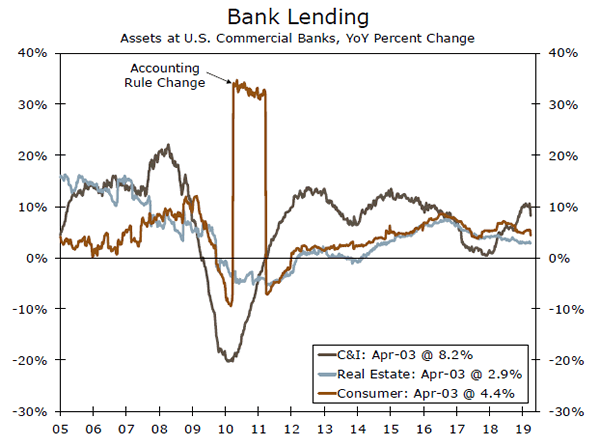
Credit Market Insights
Greater Opportunity Zone Clarity
The Treasury Department released a new set of regulations this week related to opportunity zones, which should provide commercial real estate investors with greater clarity and help to bring more capital in off the sidelines. Created as part of the Tax Cuts and Jobs Act at the end of 2017, opportunity zones aim to incentivize capital investment into more than 8,700 low income areas across the United States via advantageous tax provisions. The program allows the deferment of capital gains until 2026 as well as the elimination of taxes on capital gains if investments within these distressed communities are held for 10 years or more. Yet, there has been significant uncertainty surrounding the program's stipulations, which has acted to restrain investor appetite for new projects.
The new regulations detail a set of flexible requirements for businesses to qualify for the incentives and affirm that tax benefits can carry over to new investments after a sale of a qualified property, among other provisions. On balance, this suggests the benefits of these zones are applicable to a wider swath of business and capital than previously known (or known with certainty, at least). Opportunity zones have already sparked tremendous interest, and dozens of funds have launched to focus on these areas. With this new set of rules providing greater clarity and flexibility, we expect to see a pickup of capital investment into commercial real estate projects, helping to sustain the economic expansion.
Topic of the Week
Potential GDP Growth
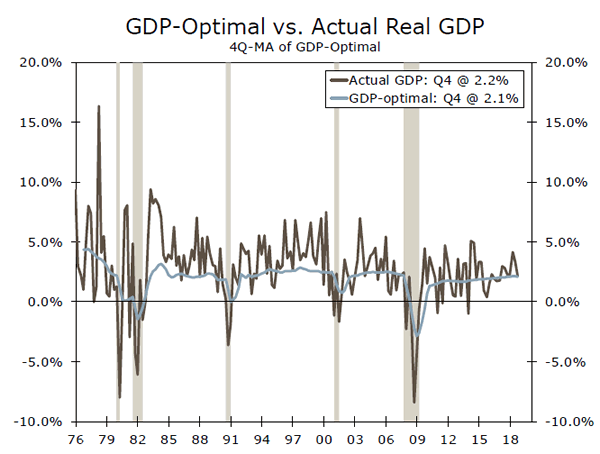
We published a report this week in which we estimate that the potential GDP growth rate of the U.S. economy is 2.1% at present. (Potential GDP growth is the rate at which an economy can grow in the long run without generating inflationary or dis-inflationary pressures.) As shown in the top chart, our estimate of the economy's potential growth rate, which we refer to as GDP-optimal, is more stable than the actual GDP growth rate. That said, GDP-optimal is not constant but rather varies over time. We estimate that potential GDP growth at present is the midpoint (2.1%) of a 1.6% to 2.6% range.
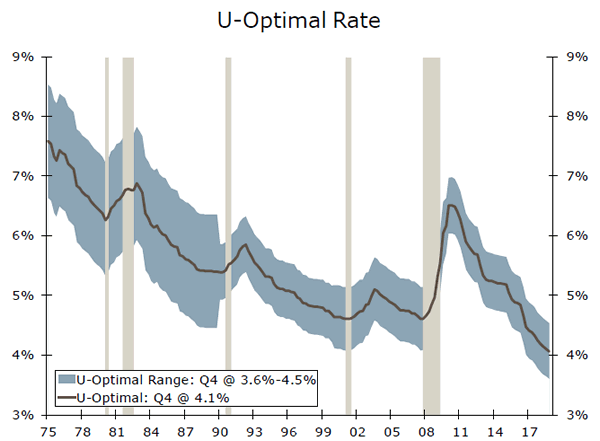
In a report published in October 2018, we estimated that the "natural" unemployment rate, which we call u-optimal, also changes over time (bottom chart). The current 3.8% unemployment rate is a bit below our 4.1% point estimate of u-optimal. That said, the actual unemployment rate at present is within the 3.6% to 4.5% range that we estimate contains u-optimal. Finally, we have written in a previous report that the "neutral" fed funds rate, which we call r-optimal, also varies over time.
Our estimates of the changing nature of the economy's potential growth rate, the "natural" rate of unemployment and the "neutral" fed funds rate should be seen in the context of an August 2018 speech by Fed chairman Powell. He discussed the complications that arise in monetary policymaking when the navigational "stars" of the economy are not fixed. Powell argued that the changing structure of the economy necessitates that the Fed needs to be "data dependent" rather than on some preset course.
Like the Fed, we do not navigate our forecasts entirely by the unobserved variables of potential GDP growth and the "natural" unemployment rate. But our estimate of these variables, in conjunction with our estimate that the current fed funds rate is only one quarter percentage point above r-optimal, gives us some comfort that our view of unchanged Fed policy through most of next year is reasonably correct.