

Sample Category Title
AUD/USD Daily Outlook
Daily Pivots: (S1) 0.7124; (P) 0.7140; (R1) 0.7153; More...
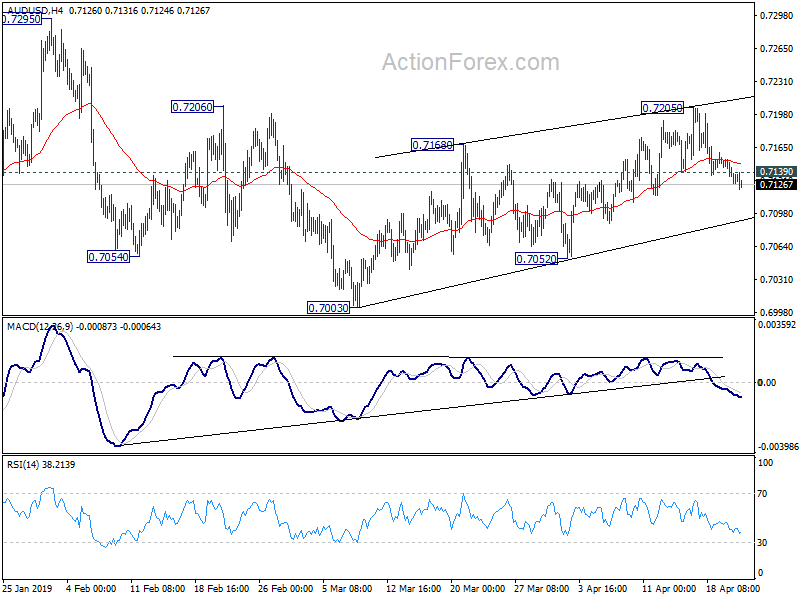
AUD/USD's break of 0.7139 minor support suggests that corrective rise from 0.7003 could have completed with three waves up to 0.7205 already. Intraday bas is turned back to the downside for 0.7052 support first. Break there will likely resume whole fall from 0.7295 through 0.7003 support. On the upside, break of 0.7205 is needed to confirm resumption of the rebound from 0.7003. Otherwise, risk will stay mildly on the downside in case of recovery.
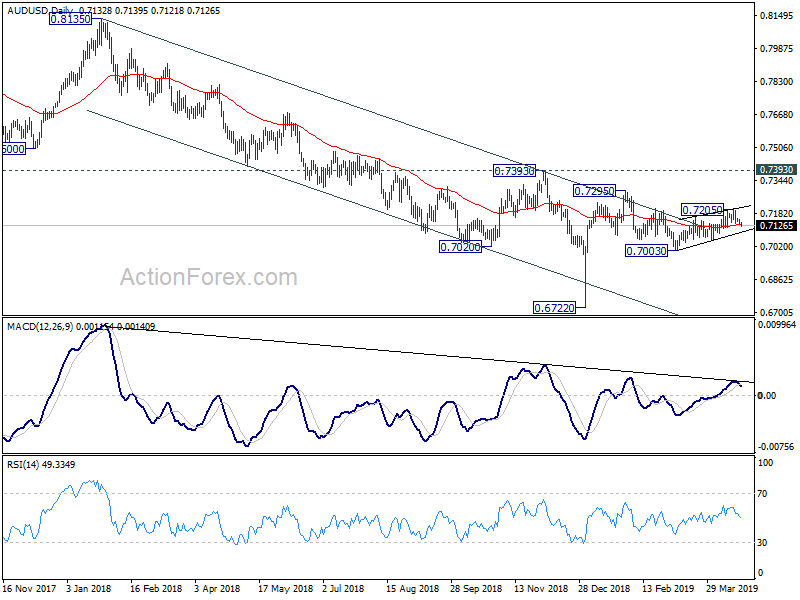
In the bigger picture, break of medium term channel resistance is the first sign of bullish reversal. But there is no confirmation yet. As long as 0.7393 resistance holds, larger fall from 0.8135 is still expected to resume later. Such decline is seen as resuming long term down trend from 1.1079 (2011 high). Decisive break of 0.6826 (2016 low) will confirm this bearish view and resume the down trend to 0.6008 (2008 low). However, firm break of 0.7393 will argue that fall from 0.8135 has completed. And corrective pattern from 0.6826 has started the third leg, targeting 0.8135 again.
USD/CAD Daily Outlook
Daily Pivots: (S1) 1.3322; (P) 1.3361; (R1) 1.3386; More...
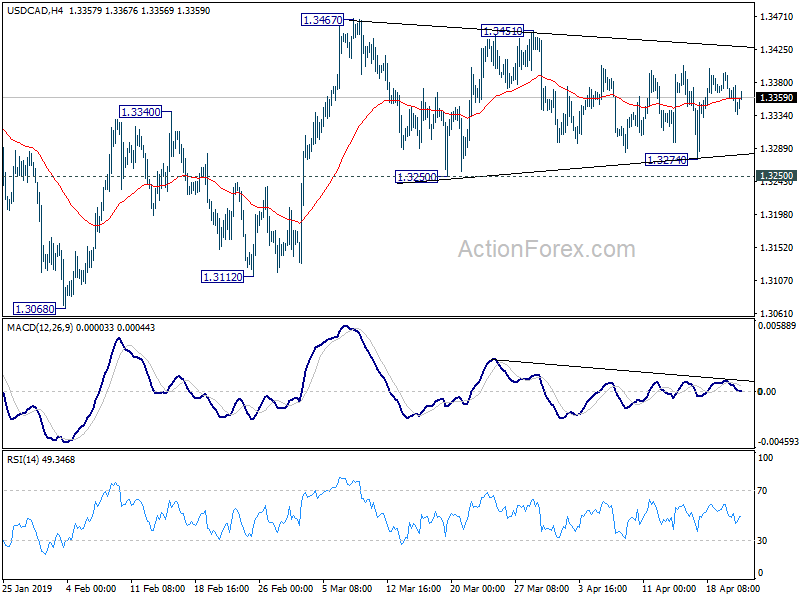
USD/CAD is staying in consolidation from 1.3467 and intraday bias remains neutral first. More sideway consolidation could still be seen but upside breakout is expected sooner or later. On the upside, firm break of 1.3467 will confirm this bullish case and target 1.3664 resistance next. However, decisive break of 1.3250 will turn bias back to the downside for 1.3068/3112 support zone instead.
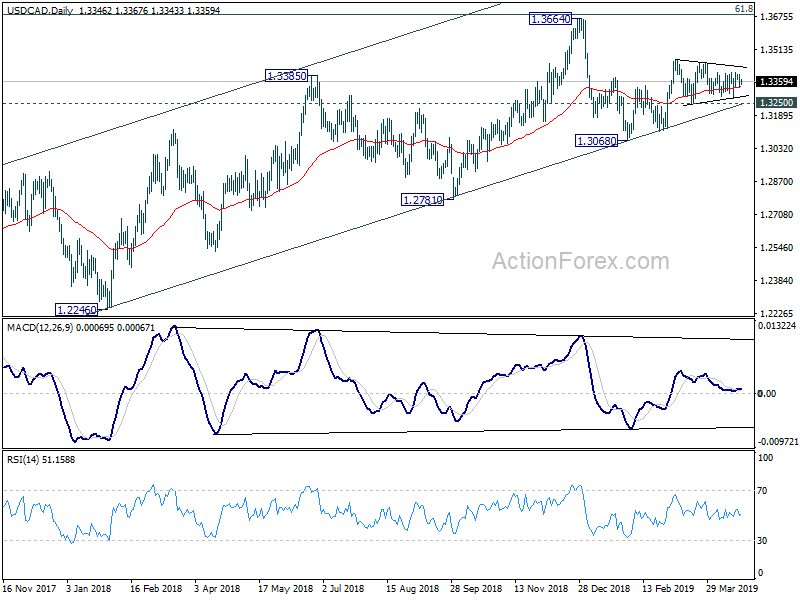
In the bigger picture, USD/CAD is staying well inside medium term rising channel (support at 1.3212). Thus, even though upside momentum and structure are unconvincing, further rise is still in favor. Decisive break of 61.8% retracement of 1.4689 (2016 high) to 1.2061 at 1.3685 and 1.3793 will pave the way to retest 1.4689 (2015 high). However, firm break of the channel support should indicate bearish reversal, after rejection by 1.3793, and bring deeper fall to 1.3068 support for confirmation.
Forex Markets Tread Water as Impact of Oil Rally Fades
The forex markets remain relatively quiet in Asian session today. Canadian Dollar surged briefly yesterday as lifted by rally in oil price. WTI crude oil remains firm in at 65.80, after rising on news that US is ending Iranian oil sanction wavier for eight countries. But the boost to the Loonie is rather brief while it turns soft ahead of BoC meeting later in the week.
As for today, Yen is the strongest one so far as Asian markets turn soft coming back from holiday. Sterling follows as the second as yesterday's selloff lost momentum. Dollar is third with some support from rebound in US yields. Nevertheless, 2.6 remains a hurdle to overcome for 10-year yield. Australian, Canadian and New Zealand Dollar are the weakest.
Technically, both USD/JPY and EUR/JPY breach 111.69 and 125.61 minor supports today. But there is no following through selling. EUR/USD's recovery also lost steam just ahead of 4 hour 55EMA. The three-way actions will remain in focus today.
In other markets, Nikkei is down -0.24%. Hong Kong HSI is down -0.22%. China Shanghai SSE is down -0.72%. Singapore Strait Times is down -0.15%. Japan 10-year yield is down -0.0036 at -0.03, staying negative. Overnight, DOW dropped -0.18%. S&P 500 rose 0.10%. NASDAQ rose 0.22%. 10-yeary yield rose 0.030 to 2.590.
Maeda: BoJ ready to use combinations of measures to ease further if needed
Eiji Maeda, BoJ Executive Director of International Affairs, reiterated the central bank stands ready to ease monetary policy further if needed.
He said in the Diet that "if the economy's momentum for achieving our price target is threatened, we are ready to ease monetary policy as necessary". And, "we'll continue to take steps as needed, including a combination of them, with an eye on their effects and side-effects" on the financial system.
Separately Finance Minister Taro Aso said there is no plan for the government to test a heterodox modern monetary theory. That is, countries issuing their own currencies can never run out of money".
Japans sees little impact from end of Iran oil sanction waiver
Japan is seeing limited impact as US ends the Iranian oil sanction waiver for the country. Trade and Industry Minister Hiroshige Seko said in a regular press conference that Japan has been lowering its reliance on Iranian oil import, which only accounts for 3%. And, there is no need to tap the national oil reserve with decision of the US.
Though, he noted, "we will closely watch international oil markets and exchange views with Japanese companies involved in crude imports and may consider taking necessary measures."
The US decision to end the waiver will force eight countries, including China, Greece, India, Italy, Japan, South Korea, Taiwan and Turkey, to switch their oil supplies from Iran to other countries, starting May 2.
On the data front
The economic calendar remains relatively light today. Eurozone will release consumer confidence. Canada will release wholesale sales. US will release house price index and new home sales.
USD/CAD Daily Outlook
Daily Pivots: (S1) 1.3322; (P) 1.3361; (R1) 1.3386; More...
USD/CAD is staying in consolidation from 1.3467 and intraday bias remains neutral first. More sideway consolidation could still be seen but upside breakout is expected sooner or later. On the upside, firm break of 1.3467 will confirm this bullish case and target 1.3664 resistance next. However, decisive break of 1.3250 will turn bias back to the downside for 1.3068/3112 support zone instead.
In the bigger picture, USD/CAD is staying well inside medium term rising channel (support at 1.3212). Thus, even though upside momentum and structure are unconvincing, further rise is still in favor. Decisive break of 61.8% retracement of 1.4689 (2016 high) to 1.2061 at 1.3685 and 1.3793 will pave the way to retest 1.4689 (2015 high). However, firm break of the channel support should indicate bearish reversal, after rejection by 1.3793, and bring deeper fall to 1.3068 support for confirmation.
Economic Indicators Update
| GMT | Ccy | Events | Actual | Forecast | Previous | Revised |
|---|---|---|---|---|---|---|
| 12:30 | CAD | Wholesale Trade Sales M/M Feb | 0.10% | 0.60% | ||
| 13:00 | USD | House Price Index M/M Feb | 0.60% | 0.60% | ||
| 14:00 | EUR | Eurozone Consumer Confidence Apr A | -7 | -7.2 | ||
| 14:00 | USD | New Home Sales Mar | 647K | 667K |
Can GBP/USD Bounce Back In Near Term?
Key Highlights
- The British Pound declined steadily recently below the 1.3080 support against the US Dollar.
- GBP/USD traded below a major bullish trend line with support at 1.3070 on the daily chart.
- The US Existing Home Sales in March 2019 declined 4.9% (MoM), more than the -2.3% forecast.
- The US Housing Price Index in Feb 2019 could rise 0.3% (MoM), less than the last +0.6%.
GBPUSD Technical Analysis
After the British Pound topped near the 1.3380 level, it declined steadily against the US Dollar. The GBP/USD pair broke the 1.3200 and 1.3080 support levels to move into a bearish zone.
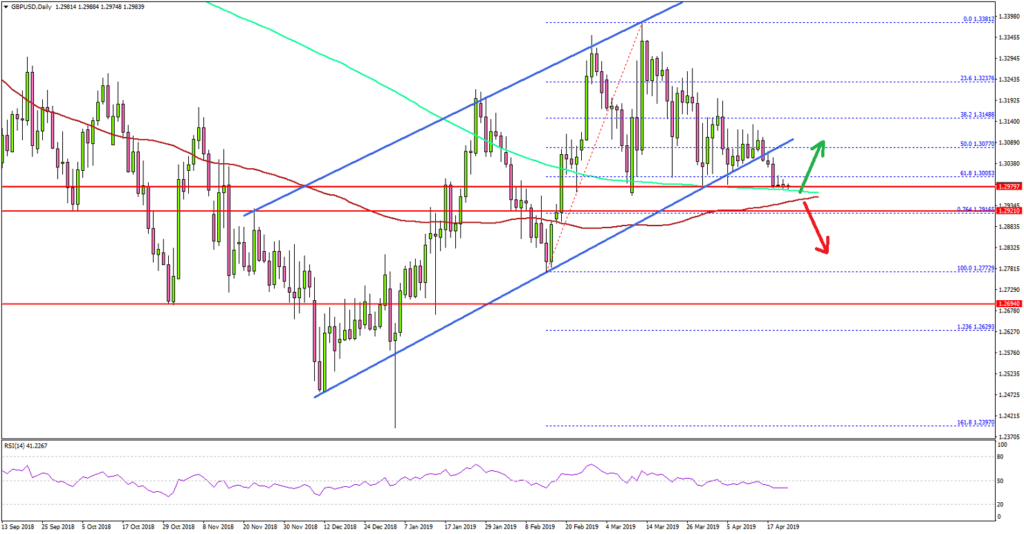
Looking at the daily chart, there are many bearish signs visible below the 1.3080 support area. The pair even broke a major bullish trend line with support at 1.3070, opening the doors for more losses.
During the decline, the pair traded below the 50% Fib retracement level of the last major wave from the 1.2772 low to 1.3381 high. The pair even broke the 1.3000 support recently, plus the 61.8% Fib retracement level of the last major wave from the 1.2772 low to 1.3381 high.
These all are negative signs, suggesting more losses below the 1.2950 level. However, there is a major support waiting on the downside near the 1.2940 level and the 100-day simple moving average (red).
Only if there is a daily close below the 100-day simple moving average (red), the pair could decline further towards the 1.2800 support area. Conversely, the pair could bounce back sharply after testing or forming a support near the 100-day SMA.
Fundamentally, the US Existing Home Sales report for March 2019 was released by the National Association of Realtors. The market was looking for a decline of 2.3% in sales in March 2019, compared with the previous month.
The actual result was disappointing as there was a decline of 4.9% in the US Existing Home Sales. The last reading was also revised down from +11.8% to +11.2%.
Commenting on the report, Lawrence Yun, NAR’s chief economist, stated:
It is not surprising to see a retreat after a powerful surge in sales in the prior month. Still, current sales activity is underperforming in relation to the strength in the jobs markets. The impact of lower mortgage rates has not yet been fully realized.
Overall, GBP/USD remains at a risk of more losses if it fails to stay above the 100-day SMA and 1.2950 in the next few days.
Economic Releases to Watch Today
- US Housing Price Index for Feb 2019 (MoM) – Forecast +0.3%, versus +0.6% previous.
- US New Home Sales for March 2019 (MoM) – Forecast 0.0650M, versus 0.667M previous.
- Euro Zone Consumer Confidence April 2019 (Preliminary) – Forecast -7.1, versus -7.2 previous.
Maeda: BoJ ready to use combinations of measures to ease further if needed
Eiji Maeda, BoJ Executive Director of International Affairs, reiterated the central bank stands ready to ease monetary policy further if needed.
He said in the Diet that "if the economy's momentum for achieving our price target is threatened, we are ready to ease monetary policy as necessary". And, "we'll continue to take steps as needed, including a combination of them, with an eye on their effects and side-effects" on the financial system.
Separately Finance Minister Taro Aso said there is no plan for the government to test a heterodox modern monetary theory. That is, countries issuing their own currencies can never run out of money".
Japans sees little impact from end of Iran oil sanction waiver
Japan is seeing limited impact as US ends the Iranian oil sanction waiver for the country. Trade and Industry Minister Hiroshige Seko said in a regular press conference that Japan has been lowering its reliance on Iranian oil import, which only accounts for 3%. And, there is no need to tap the national oil reserve with decision of the US.
Though, he noted, "we will closely watch international oil markets and exchange views with Japanese companies involved in crude imports and may consider taking necessary measures."
The US decision to end the waiver will force eight countries, including China, Greece, India, Italy, Japan, South Korea, Taiwan and Turkey, to switch their oil supplies from Iran to other countries, starting May 2.
US Sparks Asia Oil Rush
US sparks Asia oil rush
A jump in oil stocks following the shock ending of the Iran oil waiver programme by the US government could not save Wall Street from a mediocre day. Except for oil prices, trading in major markets definitely had a holiday feel about it, with much of the world still closed for Easter/Passover. Wall Street limped over the line with the S&P rising 0.1%, the Nasdaq up 0.2% and the Dow down 0.2%.
Earlier in the day, China markets scared themselves as official government documents mentioned deleveraging the shadow banking sector. As a result, the CSI 300 composite index fell 2.3%. Coming on the back of the spike in oil prices earlier in the session, the country that has made opaque financing and leverage an art form, saw both the Shanghai and Shenzhen exchanges in full retreat. My interpretation is that officials have become concerned at the pace of the galactic rally in Chinese stock markets this year and have decided to put a few gentle “shots across the bow” to curb the enthusiasm.
One thing China, India, South Korea and Japan will not be enthusiastic about is the US cessation of the Iran oil waiver programme from May 2. All four regional heavyweights are large importers of Iranian crude under the waiver scheme and will now be scrambling to find alternative supplies. The US may be playing with geopolitical fire here, with Iran threatening to close the Straits of Hormuz. Unlikely as that is, all four countries will probably be seething in private at perceived extra-judicial strong-arm tactics by Uncle Sam. It will be interesting to see if this affects the current US trade negotiations with China and Japan.
A lull in Wall Street’s earnings season overnight will pick up steam tonight with a plethora of tech heavyweights due to report. Asia however, has a light data session ahead except for Hong Kong and Singapore’s inflation reports this afternoon. Singapore will be followed in particular, as the street searches for signs of Monetary Authority of Singapore’s policy stance, coming after previously reported poor export figures.
Currencies
Currency trading was very muted overnight as the FX markets continue to remain in hibernation, as has been the case for most of 2019. A lack of excitement in other markets – along with holiday-thinned trading overnight – likely implies a quiet day for Asia as we await Europe’s return this afternoon. London is, after all, the world’s largest FX market.
The Indonesian rupiah, Malaysian ringgit and Australian dollar still have the potential to outperform in today’s session as oil holds its gains from yesterday.
Equities
Australia’s resource-heavy market may receive a boost as it returns from holiday, following oil’s massive rally yesterday. Investors may take a dimmer view of other regional oil-importing heavyweights though as the street digests the implications of the end of the oil waiver scheme.
With a quiet night on Wall Street and with Europe returning to work this afternoon, regional markets will probably adopt a wait-and-see attitude, following Wall Street’s lead.
Oil
What a day that was, with Brent Crude rocketing 3% higher to USD74.20 a barrel. WTI also climbed 2.5% to USD65.70 a barrel following the Iran waiver news. Major importing economies in the region will be scrambling to find alternative supplies from May in what was an already tight market. China and co. may find the assurances from the US that Saudi Arabia and the U.A.E will “take up the slack” somewhat empty.
With refineries in Asia optimised for Brent Crude rather than the lighter US shale-derived oil, nervousness in the region will ratchet higher about supply disruptions. This should ensure that Brent continues to outperform relative to WTI and any pullbacks will meet plenty of buyers in the near term.
Gold
Gold held steady overnight around the USD1,275.00 an ounce region, supported by geopolitical ructions in the oil markets. However, that alone is not enough to cause a structural turn in sentiment for now with the rally from last Thursday’s low looking like a dead cat bounce.
A retest of USD1,270.00 looks to be on the cards unless either stocks or the greenback head south first – an unlikely outcome at this stage.
Are Sanctions On Iranian Oil Purchases A ‘Big Deal’?
Iran Is World’s 6th Largest Oil Producer
The Trump administration announced today that it will not renew waivers that currently allow countries to buy Iranian oil without facing American sanctions. The move is intended to put more pressure on the Iranian regime, which relies on the money that it earns from oil exports to help finance its expenditures. Prices of Brent crude and West Texas Intermediate, which have been trending higher since the beginning of the year, moved up another 2% or so on the news. Does this announcement move have major economic and financial market implications?
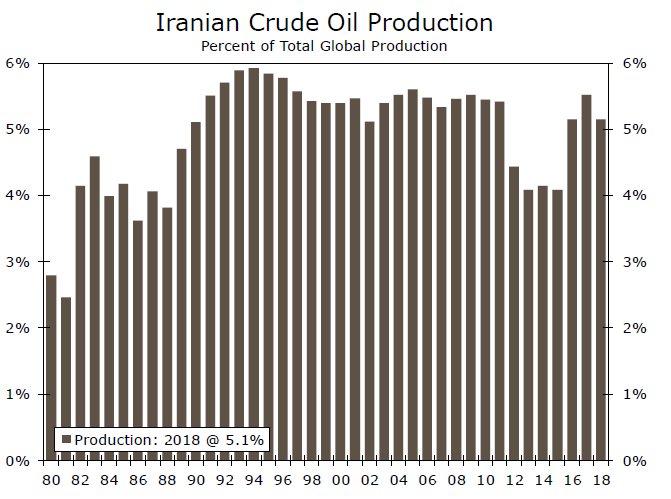
Iran currently produces more than 4 million barrels per day (bpd) of crude oil, and it exports nearly 3 million bpd. At present, Iran accounts for 5% of global production of crude oil, which has been its run-rate over the past few decades (top chart). According to the U.S. Energy Information Agency, China buys roughly one-quarter of Iranian oil exports. Other important customers include India, which buys 18% of Iranian oil exports, South Korea (14%), and Turkey (9%). If these countries want to steer clear of U.S. sanctions, they will need to find other sources of oil supply. Will they be able to do so?
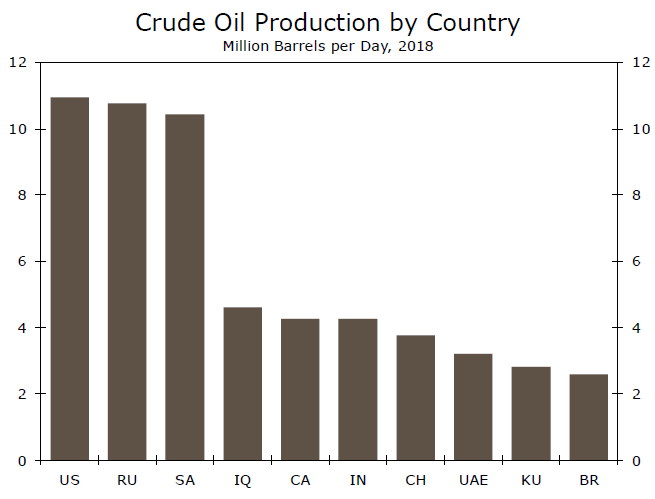
As noted above, Iran pumps a bit more than 4 million bpd, which makes it the world’s sixth most important producer of crude oil. But Iran’s production is well below the production levels of the United States, Russia and Saudi Arabia, which all pump more than 10 million bpd (middle chart). Although other producers will not be able to replace nearly 3 million bpd of Iranian oil exports overnight (assuming that U.S. sanctions compel countries to completely stop buying Iranian oil), Saudi Arabia has the capacity to replace some Iranian oil exports. In addition, the United States has been ramping up production significantly in recent years—production has doubled since 2011—and oil prices in excess of $60/barrel encourage American oil producers to drill even more wells.
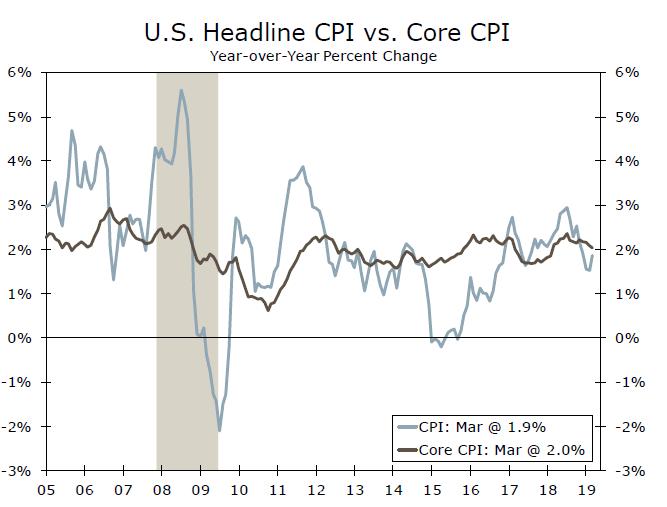
Oil prices have risen about $20/barrel since the beginning of the year, which already has pushed up gasoline prices about 80 cents/gallon. Gas prices likely will trend even higher, at least in the near term, due to today’s news. Could this rise in gasoline prices lead to higher inflation in the United States? The overall rate of CPI inflation has already edged a bit higher this year (bottom chart) due to the rise in oil prices to date. Our forecast, which has been predicated on the assumption that the administration would continue to take a hard line with Iran, looks for CPI inflation to rise to 2.5% early next year. That said, unless the increase in gasoline prices filters into the 'core' rate of inflation, which excludes food and energy prices and which is reflective of the underlying trend in inflation, the Federal Reserve likely would look through any increase in gasoline prices. Consequently, we continue to believe that the Fed will remain on hold for the foreseeable future.
USD/CAD Canadian Dollar Higher On End Of US Waivers On Iranian Oil
The Canadian dollar rose 0.30 percent on Monday due to the rapid rise of oil prices after the end of the US waivers on Iranian crude. The announcement by the White House feed into one of the biggest factors driving oil prices as supply disruptions took crude 3 percent higher at the start fo the week. The loonie rose boosted by energy prices ahead of the Bank of Canada (BoC) on Wednesday. The central bank is not expected to change its interest rate at 1.75 percent, but there could be a case for more dovish language when it publishes its Monetary Policy Report and during the press conference with Governor Stephen Poloz.
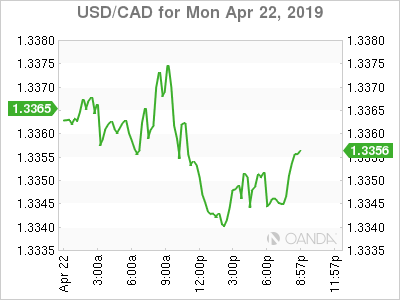
Oil Rises After End of Waivers on Iranian Oil Exports
Oil prices rose after the White House is ready to end the waivers on Iranian oil. US sanctions were brought back after the US ended its support of the nuclear deal, but the waivers limited the impact on crude exports. The decision to put more pressure on Iran by using the sanctions to send oil pressures to zero. Supply disruptions in this case the sanctions against Iran and Venezuela added to the military actions in Libya to bring oil prices higher.
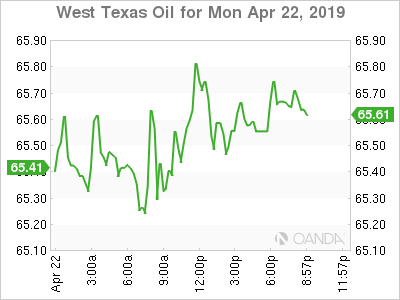
The OPEC+ agreement to cut production is scheduled to end in June, but taken into consideration that Iran, Venezuela and Libya were exempt from it, the group could be tempted to rise production to offset the disruptions to supply.
President Trump once again put pressure on Saudi Arabia and the rest of the OPEC to close the supply gap, but lately the US-Saudi relationship has not been as strong as it was in the past.
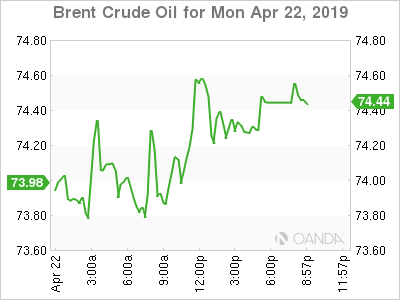
Saudi Arabia issued a statement aimed at keeping prices stable as it said it would ensure the availability of oil supplies. The effect of higher prices with the end of the production cut agreement could lead to an end to the OPEC+ just as US production is predicted to ramp up.
Eco Data 4/23/19
[php_everywhere instance="1"]