

Sample Category Title
Switzerland’s Real Retail Sales Dropped For The Fourth Straight Month In February
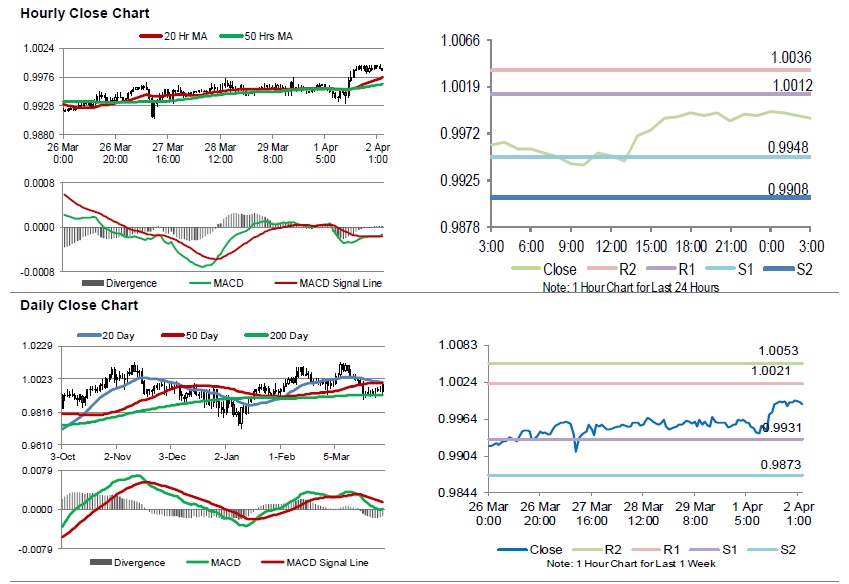
For the 24 hours to 23:00 GMT, the USD rose 0.28% against the CHF and closed at 0.9990.
On the data front, Switzerland's SVME manufacturing PMI declined to a level of 50.3 in March, more than market consensus for a fall to a level of 53.6. The PMI had registered a level of 55.4 in the prior month. Moreover, the nation's real retail sales slid 0.2% on an annual basis in February, declining for the fourth straight month. Real retail sales had registered a revised similar fall in the previous month.
On the other hand, Switzerland's total sight deposits rose to a level of CHF576.1 billion in the week ended 29 March, from CHF575.9 billion in the previous week.
In the Asian session, at GMT0300, the pair is trading at 0.9988, with the USD trading a tad lower against the CHF from yesterday's close.
The pair is expected to find support at 0.9948, and a fall through could take it to the next support level of 0.9908. The pair is expected to find its first resistance at 1.0012, and a rise through could take it to the next resistance level of 1.0036.
Trading trend in the Swiss Franc today, is expected to be determined by Switzerland's consumer price index for March, slated to release in a few hours.
The currency pair is trading above its 20 Hr and 50 Hr moving averages.
Canada’s RBC Manufacturing PMI Declined In March
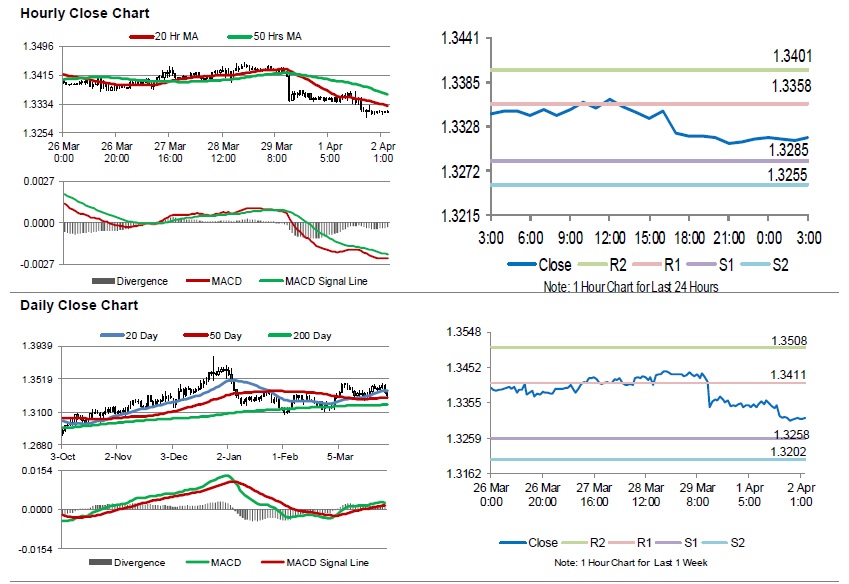
For the 24 hours to 23:00 GMT, the USD declined 0.31% against the CAD and closed at 1.3312.
Data indicated that Canada's RBC manufacturing PMI fell to a level of 50.5 in March, following a reading of 52.6 in the prior month. Meanwhile, the nation's MLI leading indicator remained unchanged in February, compared to a revised fall of 0.1% in the preceding month.
In the Asian session, at GMT0300, the pair is trading at 1.3315, with the USD trading marginally higher against the CAD from yesterday's close.
The pair is expected to find support at 1.3285, and a fall through could take it to the next support level of 1.3255. The pair is expected to find its first resistance at 1.3358, and a rise through could take it to the next resistance level of 1.3401.
Amid lack of economic releases in Canada today, traders would focus on global macroeconomic events for further direction.
The currency pair is trading below its 20 Hr and 50 Hr moving averages.
RBA Held Its Key Interest Rate Steady At 1.50%
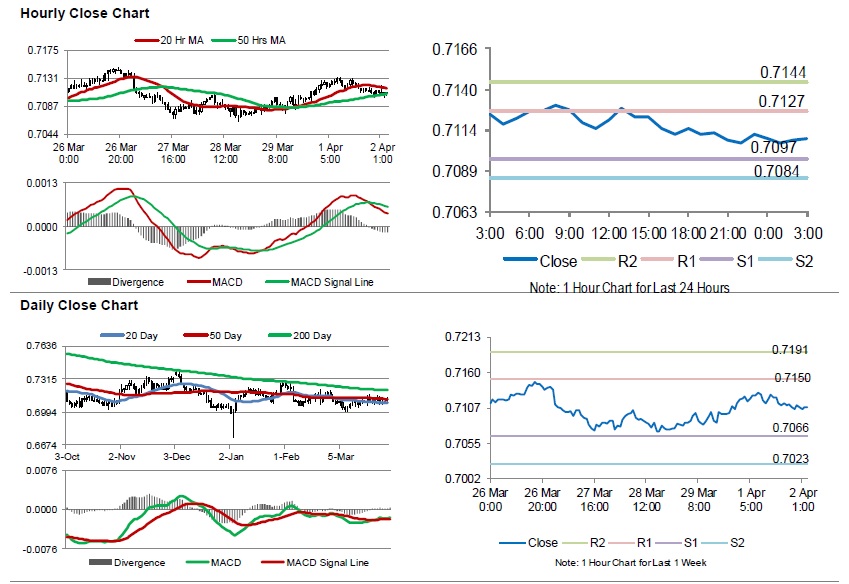
For the 24 hours to 23:00 GMT, the AUD declined 0.14% against the USD and closed at 0.7112.
LME Copper prices rose 0.2% or $13.0/MT to $6498.0/MT. Aluminium prices declined 0.6% or $12.0/MT to $1888.0/MT.
In the Asian session, at GMT0300, the pair is trading at 0.7109, with the AUD trading marginally lower against the USD from yesterday’s close.
Overnight data showed that Australia’s seasonally adjusted building approvals unexpectedly soared 19.1% on a monthly basis in February, defying market expectations for a decline of 1.8%. In the prior month, building approvals had recorded a revised gain 2.3%.
The Reserve Bank of Australia (RBA), in its latest monetary policy meeting, kept its key interest rate steady at 1.50%, as widely expected, supported by robust employment data and positive developments in the infrastructure spending and private investment.
The pair is expected to find support at 0.7097, and a fall through could take it to the next support level of 0.7084. The pair is expected to find its first resistance at 0.7127, and a rise through could take it to the next resistance level of 0.7144.
Looking forward, traders would await Australia’s AiG performance of service index and CBA services PMI, both for March along with retail sales and trade balance data, both for February, slated to release overnight.
The currency pair is trading below its 20 Hr moving average and showing convergence with its 50 Hr moving average.
Gold: Yellow Metal Trading Slightly Lower In The Morning Session
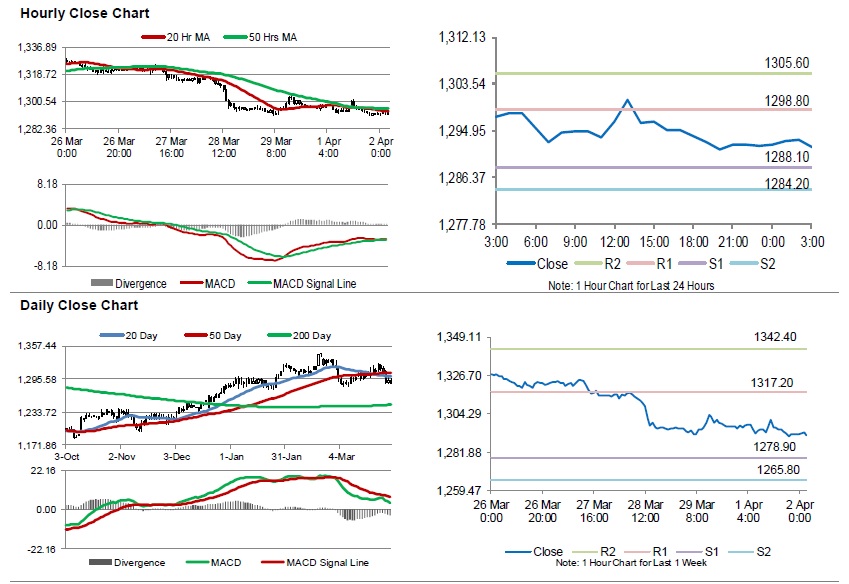
For the 24 hours to 23:00 GMT, Gold declined 0.32% against the USD and closed at USD1292.40 per ounce, amid rise in the global equities, following upbeat Chinese economic data.
In the Asian session, at GMT0300, the pair is trading at 1292.00, with gold trading a tad lower against the USD from yesterday’s close.
The pair is expected to find support at 1288.10, and a fall through could take it to the next support level of 1284.20. The pair is expected to find its first resistance at 1298.80, and a rise through could take it to the next resistance level of 1305.60.
The yellow metal is showing convergence with its 20 Hr and 50 Hr moving averages.
Silver: White Metal Trading On A Weaker Footing In The Asian Session
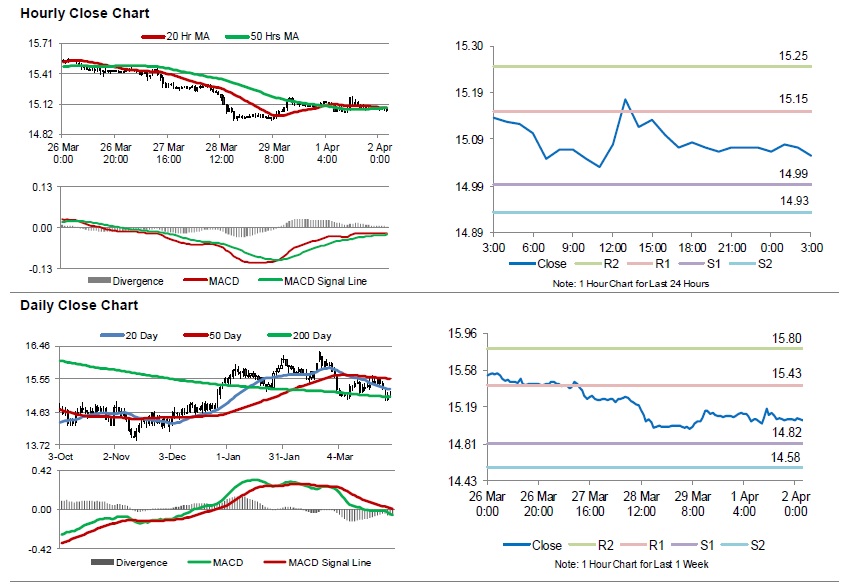
For the 24 hours to 23:00 GMT, Silver declined 0.33% against the USD and closed at USD15.08 per ounce, tracking losses in gold prices.
In the Asian session, at GMT0300, the pair is trading at 15.06, with silver trading 0.13% lower against the USD from yesterday’s close.
The pair is expected to find support at 14.99, and a fall through could take it to the next support level of 14.93. The pair is expected to find its first resistance at 15.15, and a rise through could take it to the next resistance level of 15.25.
The white metal is showing convergence with its 20 Hr and 50 Hr moving averages.
Crude Oil: Oil Trading Higher, Ahead Of API’s Weekly Crude Oil Stockpiles Data
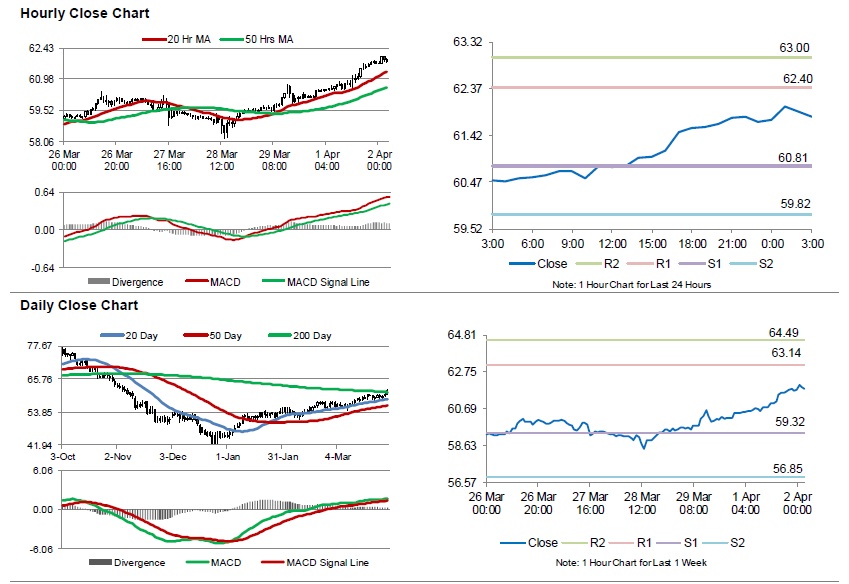
For the 24 hours to 23:00 GMT, Crude Oil rose 2.03% against the USD and closed at USD61.69 per barrel, as prospects of tightening supplies and diminishing worries over global economic growth boosted demand outlook for the commodity.
In the Asian session, at GMT0300, the pair is trading at 61.79, with oil trading 0.16% higher against the USD from yesterday's close, helped by strong Chinese economic data that eased demand concerns and US sanctions against Iran and Venezuela.
The pair is expected to find support at 60.82, and a fall through could take it to the next support level of 59.82. The pair is expected to find its first resistance at 62.39, and a rise through could take it to the next resistance level of 63.00.
Crude oil is trading above its 20 Hr and 50 Hr moving averages.
RBA Governor Makes Significant Change to his Statement
For the first time since he was appointed in September 2016 the RBA Governor changed the last sentence in his Statement. The revised sentence gives greater emphasis to the current fluidity of the policy environment rather than signalling a long period of no change.
As expected, the Reserve Bank Board decided to leave the cash rate unchanged at 1.50%.
However, our research shows that there has been a very significant change in the Governor’s Statement for this month. Recall that Governor Lowe has not changed monetary policy since he became Governor in September 2016. Also note that the key concluding sentence, which has been used in every Statement since October 2016 has been “the Board judged that holding the stance of monetary policy unchanged at this meeting would be consistent with sustainable growth in the economy and achieving the inflation target over time”. The clear implication behind that statement is an expectation that policy was likely to be on hold for a considerable period. As we have seen, that was an accurate assessment.
In the April Statement, he has changed this language for the first time ever. He still notes that “the Board judged that it was appropriate to hold the stance of policy unchanged at this meeting”. However, he then changes tact with a new sentence. “The Board will continue to monitor developments and set monetary policy to support sustainable growth in the economy and achieve the inflation target over time”. Although, a cursory glance at this sentence might not indicate any change in stance, it does give greater emphasis to the fluidity of the current situation. If this change was not intended, then clearly he would have continued with the approach that has marked his time as Governor.
Therefore this change appears to be a very clear intention to signal that policy is much more ‘live’ than has been the case since the Governor was appointed.
This signal is consistent with Westpac’s expectation that the Board is likely to adopt an easing bias following the May Board meeting. Our thinking behind that approach has been that the Statement on Monetary Policy for May will include a downward revision of the Bank’s growth forecasts. Further support for this view is apparent in the exclusion of the RBA’s current growth forecasts in the April Governor’s Statement. Arguably , this indicates an uneasiness with the 3 per cent for 2019 and the 2 ¾ per cent for 2020.
In the RBA’s defence, note that the March Governor’s Statement came before the release of the December quarter National Accounts, which showed that six month annualised growth had slowed to 1 per cent in the second half of 2018. We expect that the RBA will lower its 2019 growth forecast from 3 per cent to 2 ¾ per cent, and the 2020 forecast from 2 ¾ per cent to 2 ½ per cent. Those forecasts are either at or below ‘potential growth’ (assessed as 2 ¾ per cent).
In commenting on the low growth rate for 2018 of 2.3%, the Governor pointed out “the GDP data paint a softer picture of the economy than do the labour market data”. Arguably, the RBA may hold off from a specific easing bias( despite forecasting below trend growth), attributing this tension in the data as key to the outlook for policy.
Westpac has argued that the actual rate cut will not occur until August, when a further downward revision of forecast growth will be required and evidence will be building of a slowdown in the labour market.
Last week, we wrote on the potential impact of tonight’s Federal Budget on monetary policy. If the Governor saw the Budget as a significant swing factor in his thinking, it is unlikely that he would have chosen to change the language in the Statement just before the announcement.
It is our view that a boost to disposable income from tax cuts will certainly be of some assistance to the economy, but is unlikely to sufficiently offset the near term drag on incomes and spending from the negative wealth effect from falling house prices; weak wages growth; and a major downturn in activity in the housing market.
Conclusion
We were a little surprised with the Governor’s change in stance but find it consistent with our general view that the RBA is on track to adopt an easing bias in May and cut the overnight cash rate in August and November.
RBA Review – Holding Rate On Record Low and Turning More Dovish on Economic Outlook
Unsurprisingly, RBA left the cash rate unchanged at 1.5% for a 29th meeting.
While the members acknowledged more downside risks on the economic outlook, they maintained the monetary policy forward guidance unchanged. However, Aussie weakened after the announcement, amidst heightened expectations that the central bank would cut the policy rate later this year or in early 2020.
The mild change in the policy statement nonetheless reflected a more dovish stance on the economic outlook. Concerning the global developments, RBA retained the view that “the outlook for the global economy remains reasonable” and “downside risks have increased”. It added that “growth has slowed” and removed the language that the global economy “grew above trend in 2018”. On international trade, the central bank acknowledged that growth has “declined and investment intentions have softened in a number of countries”.
Domestically, the central bank remained upbeat about the employment market, noting that it remained “strong” and “there has been a significant increase in employment”. However, the members removed the expectations that the unemployment rate would “further decline” to 4¾% “over the next couple of years”. Yet, the members acknowledged softer economic growth, as suggested by GDP data. they acknowledged that “GDP rose by just 0.2% in the December quarter to be 2.3% higher over 2018”. As such, they removed the forecast that the domestic ecoony would “growth by 3% this year”. The members attributed that moderation in household spending growth to “the protracted period of weakness in real household disposable income and the adjustment in housing markets”. They also noted the negative impact of “the drought in parts of the country”. These drawbacks were offset by the rise in government spending on public infrastructure and an upswing in private investment.
Policymakers retained that inflation remained “low and stable”. They expect core inflation to pick up in coming year, adding that the process would be gradual and “has been taking a little longer than earlier expected”.
On the financial market situation, the members suggested that “risk premiums remain low”. They also noted that Australia’s “long-term bond yields have fallen to historically low levels and short-term bank funding costs have moderated further”. All in all, the members still judged the global monetary policy situation remained accommodative. Comments on Australia’s housing market were largely unchanged. The only difference was the first sentence, at which RBA noted that “the adjustment in established housing markets is continuing, after the earlier large run-up in prices in some cities”. In previous meeting, it pointed out the slowdown was mainly in Sydney and Melbourne.
The forward guidance on the monetary policy remained largely unchanged. The RBA indicated that “it was appropriate to hold the stance of policy unchanged at this meeting”. It added this time the pledge to “monitor developments and set monetary policy to support sustainable growth in the economy and achieve the inflation target over time”. This stressed that the next rate move would be data-dependent.
EU Juncker tells China: It can’t stay like this. It can’t work like this.
European Commission President Jean-Claude Juncker complained the practices of the bloc's "systematic rivals" in front of lawmakers in Germany yesterday. He said "Chinese companies have free access to our markets in Europe, but we don't to the markets in China", and "it can't stay like this".
Also, "one country isn't able to condemn Chinese human rights policy because Chinese investors are involved in one of their ports," Juncker added "it can't work like this".
Though, he's not against China's Belt and Road initiative "as long as the conditions are right". He said, "if you don't only meet Chinese workers on these construction sites but also European workers, then this is all feasible."
BoC Poloz: Recent data suggests below-potential growth just temporary
BoC Governor Stephen Poloz sounded confident in his speech yesterday. He noted that Canada is adjusting the challenges in the domestic and global economies. And after taking into account the structural adjustments to oil prices, he said "we can see many area of encouraging economic growth".
He added that the global economy is performing less well than expected and "Canada is feeling the effects". Housing markets is also taking longer to "digest the combined effect of stricter mortgage guidelines and higher interest rates".
However, Poloz said "recent economic data have been generally consistent with our expectation that the period of below-potential growth will prove to be temporary."