

Sample Category Title
BCC: UK businesses hitting the brakes hard on ongoing Brexit impasse
According to the British Chambers of Commerce's quarterly economic survey, found that key indicators of UK economic health weakened considerably in Q1. In particular balance of services companies reporting rise in exports sales dropped to lowest in a decade. Balance of firms reporting improved cashflow turned negative for the first time since 2012. Also, investment intentions in manufacturing and services were at lowest in eight years.
BCC Director General Adam Marshall said "our findings should serve as a clear warning that the ongoing impasse at Westminster is contributing to a sharp slowdown in the real economy across the UK. Business is hitting the brakes – hard." Also, "the prospect of a messy and disorderly exit from the EU is weighing heavily on the UK economy, and must still be avoided"
Marshall also complained that "for too long Brexit tunnel-vision has distracted government from fixing the fundamentals to support growth here in the UK."
BoC: Poloz Keeps His Cards Close
Bank of Canada Governor Stephen Poloz spoke this afternoon in Iqaluit, NU. His remarks focused on international trade developments.
As is often the case in these speeches, we were given a historic overview of trade developments. Early offshoring has now given way to reshoring in Poloz's view, as the cost of labour has become less of a deciding factor in locating global production. The result has been a reduction in the 'intensity' of global trade and slowing trade growth globally.
At the same time, Service exports have been rising in line with the service sector more generally. The Governor noted that Canada now sells about $120 billion per year in services to the rest of the world (about 17% of total exports), and they have been outpacing growth in goods exports. This category includes professional services, financial services, tourism, and others.
Staying with the services theme, Governor Poloz suggests that the rise of services more generally can help explain the disconnect between soft economic growth of late and still robust labour markets, noting that it can be difficult for statisticians to fully account for the impact of services in the GDP numbers.
Conversely, the Governor also reflected on the ongoing adjustments in the oil sector, and the ongoing risk of a global trade war. He noted that the developments to date have had a scarring effect on the Canadian economy.
Ultimately, the Bank still believes that things will work out, pointing to healthy domestic fundamentals and new trade agreements. Despite a global economy "performing less well than we believed only a few months ago", and housing sector taking "longer than previously expected to digest" changes to mortgage guidelines and higher rates, the Bank continues to see both the need for the current stimulative (in their view) policy rate, and that the run of below-potential growth will be temporary.
Key Implications
This was an interesting speech, covering a lot of ground on how trade, and economies more generally, have been evolving since the global financial crisis. But, for those of us looking for hints as to their next move, it was slim pickings.
The rate-specific communication hewed closely to recent messaging. Recent headwinds are seen as temporary, if somewhat more prolonged than the Bank of Canada had previously thought. Gone were any references to future rate increases, but the current policy rate is still seen as below the 'neutral range'. It seems we will have to wait until the next Monetary Policy Report on April 24th to see what change, if any, the Bank will have in its assessment of this range.
The press conference was a bit more exciting. Asked about the inversion of the Canadian yield curve (the yield on 10 year government debt stood at 1.70%, below the 1.75% overnight rate at time of writing), Poloz referred to it as an 'innocent inversion', emphasizing that he does not see a recession coming, that it is less useful as a signal in Canada, and that other indicators are not corroborating the story.
Market moves appeared to reflect the dearth of new information. Market implied odds of a rate cut fell a bit, but still price a greater than one in five chance of cut by September, and the loonie was little changed in the wake of the speech.
We agree that the current soft patch is likely to be temporary, but, while Governor Poloz was silent on changes to the outlook (their current 1.7% growth forecast for 2019 appears optimistic, even in light of January's strong GDP figures), we don't expect to see much above-trend growth any time soon. With growth set to shift back only to trend, there will likely be little in the way of inflationary pressures, and so little scope for a higher monetary policy interest rate. We may already be home.
UK parliament rejected all four Brexit alternatives again, but customs union option was close
Sterling weakened mildly as the UK House of Commons, unsurprisingly, rejected all four Brexit alternatives in yesterday's indicative votes again. The closest one to get a majority was Conservative MP Kenneth Clarke's Customs Union option, which was defeated 276-273. The most voted one was Labour Peter Kyle's Confirmatory Public Vote, which was defeated 292-280.
Brexit Minister Steven Barclay complain in the Parliament after the votes that "this House has continuously rejected leaving without a deal just as it has rejected not leaving at all." And he reiterated that " the only option is to find a way through which allows the U.K. to leave with a deal." He also noted "if the house were to agree a deal this week, it would still be possible to avoid holding European parliamentary elections." It's taken as a hint that Prime Minister Theresa May could put the thrice-defeated Brexit deal to a fourth vote this week.
RBA kept cash rate at 1.50%, no dovish shift in statement
RBA left cash rate unchanged at 1.50% as widely expected. There is no dovish shift in the statement yet. The central bank continues to sound non-committal and noted "the Board will continue to monitor developments and set monetary policy to support sustainable growth in the economy and achieve the inflation target over time."
There are little changes in substances in the statement too. RBA noted that GDP data paint a "softer picture" of the economy than job data. It acknowledged the mere 0.2% growth in Q4 and 2.3% over 2018. It also noted that "growth in household consumption is being affected by the protracted period of weakness in real household disposable income and the adjustment in housing markets."
Employment and inflation outlook are unchanged. RBA expects "continued improvement in the labour market is expected to see some further lift in wages growth over time", gradually. Inflation is expected to pick up gradually over the next couple of years. The central scenario is unchanged for inflation to hit 2% in 2019 and 2.25% in 2020.
Here is the full statement:
Statement by Philip Lowe, Governor: Monetary Policy Decision
At its meeting today, the Board decided to leave the cash rate unchanged at 1.50 per cent.
The outlook for the global economy remains reasonable, although growth has slowed and downside risks have increased. Growth in international trade has declined and investment intentions have softened in a number of countries. In China, the authorities have taken steps to ease financing conditions, partly in response to slower growth in the economy. Globally, headline inflation rates have moved lower following the earlier decline in oil prices, although core inflation has picked up in a number of economies. In most advanced economies, unemployment rates are low and wages growth has picked up.
Global financial conditions remain accommodative and have eased recently. Long-term bond yields have declined further, consistent with the subdued outlook for inflation and lower expectations for future policy rates in a number of advanced economies. Across a range of markets, risk premiums remain low. Equity markets have also risen and are being supported by growth in corporate earnings. In Australia, long-term bond yields have fallen to historically low levels and short-term bank funding costs have moderated further. The Australian dollar has remained within its narrow range of recent times. While the terms of trade have increased over the past couple of years, they are expected to decline over time.
The Australian labour market remains strong. There has been a significant increase in employment and the unemployment rate is at 4.9 per cent. The vacancy rate remains high and there are reports of skills shortages in some areas. The stronger labour market has led to some pick-up in wages growth, which is a welcome development. Continued improvement in the labour market is expected to see some further lift in wages growth over time, although this is still expected to be a gradual process.
The GDP data paint a softer picture of the economy than do the labour market data. GDP rose by just 0.2 per cent in the December quarter to be 2.3 per cent higher over 2018. Growth in household consumption is being affected by the protracted period of weakness in real household disposable income and the adjustment in housing markets. The drought in parts of the country has also affected farm output. Offsetting these factors, higher levels of spending on public infrastructure and an upswing in private investment are supporting the growth outlook, as is the steady growth in employment.
The adjustment in established housing markets is continuing, after the earlier large run-up in prices in some cities. Conditions remain soft and rent inflation remains low. Credit conditions for some borrowers have tightened a little further over the past year or so. At the same time, the demand for credit by investors in the housing market has slowed noticeably as the dynamics of the housing market have changed. Growth in credit extended to owner-occupiers has eased. Mortgage rates remain low and there is strong competition for borrowers of high credit quality.
Inflation remains low and stable. Underlying inflation is expected to pick up gradually over the next couple of years, although this has been taking a little longer than earlier expected. The central scenario is for underlying inflation to be 2 per cent this year and 2¼ per cent in 2020. In the near term, headline inflation is expected to decline because of lower petrol prices earlier in the year, while underlying inflation is expected to remain broadly stable.
The low level of interest rates is continuing to support the Australian economy. Further progress in reducing unemployment and having inflation return to target is expected, although this progress is likely to be gradual. Taking account of the available information, the Board judged that it was appropriate to hold the stance of policy unchanged at this meeting. The Board will continue to monitor developments and set monetary policy to support sustainable growth in the economy and achieve the inflation target over time.
(RBA) Statement by Philip Lowe, Governor: Monetary Policy Decision
At its meeting today, the Board decided to leave the cash rate unchanged at 1.50 per cent.
The outlook for the global economy remains reasonable, although growth has slowed and downside risks have increased. Growth in international trade has declined and investment intentions have softened in a number of countries. In China, the authorities have taken steps to ease financing conditions, partly in response to slower growth in the economy. Globally, headline inflation rates have moved lower following the earlier decline in oil prices, although core inflation has picked up in a number of economies. In most advanced economies, unemployment rates are low and wages growth has picked up.
Global financial conditions remain accommodative and have eased recently. Long-term bond yields have declined further, consistent with the subdued outlook for inflation and lower expectations for future policy rates in a number of advanced economies. Across a range of markets, risk premiums remain low. Equity markets have also risen and are being supported by growth in corporate earnings. In Australia, long-term bond yields have fallen to historically low levels and short-term bank funding costs have moderated further. The Australian dollar has remained within its narrow range of recent times. While the terms of trade have increased over the past couple of years, they are expected to decline over time.
The Australian labour market remains strong. There has been a significant increase in employment and the unemployment rate is at 4.9 per cent. The vacancy rate remains high and there are reports of skills shortages in some areas. The stronger labour market has led to some pick-up in wages growth, which is a welcome development. Continued improvement in the labour market is expected to see some further lift in wages growth over time, although this is still expected to be a gradual process.
The GDP data paint a softer picture of the economy than do the labour market data. GDP rose by just 0.2 per cent in the December quarter to be 2.3 per cent higher over 2018. Growth in household consumption is being affected by the protracted period of weakness in real household disposable income and the adjustment in housing markets. The drought in parts of the country has also affected farm output. Offsetting these factors, higher levels of spending on public infrastructure and an upswing in private investment are supporting the growth outlook, as is the steady growth in employment.
The adjustment in established housing markets is continuing, after the earlier large run-up in prices in some cities. Conditions remain soft and rent inflation remains low. Credit conditions for some borrowers have tightened a little further over the past year or so. At the same time, the demand for credit by investors in the housing market has slowed noticeably as the dynamics of the housing market have changed. Growth in credit extended to owner-occupiers has eased. Mortgage rates remain low and there is strong competition for borrowers of high credit quality.
Inflation remains low and stable. Underlying inflation is expected to pick up gradually over the next couple of years, although this has been taking a little longer than earlier expected. The central scenario is for underlying inflation to be 2 per cent this year and 2¼ per cent in 2020. In the near term, headline inflation is expected to decline because of lower petrol prices earlier in the year, while underlying inflation is expected to remain broadly stable.
The low level of interest rates is continuing to support the Australian economy. Further progress in reducing unemployment and having inflation return to target is expected, although this progress is likely to be gradual. Taking account of the available information, the Board judged that it was appropriate to hold the stance of policy unchanged at this meeting. The Board will continue to monitor developments and set monetary policy to support sustainable growth in the economy and achieve the inflation target over time.
Market Morning Briefing: Euro Has Come Down To Test Immediate Support At 1.12
STOCKS
Global equities remain broadly positive with a chance to dip from current levels in the near term before moving further higher. Shanghai looks much stronger among all and could be gearing-up for fresh rally in the coming weeks.
Dow (26258.42, +329.74, +1.27%) has risen breaking above the resistance at 26060 mentioned yesterday and has closed around the next resistance level of 26250 . A pull-back from current levels to 26000 cannot be ruled out. But as long as Dow remains above 26000, the outlook is bullish for a rally to 27000 and 27250.
DAX (11681.99, +155.95, +1.35%) has breached its resistance at 11542 and is heading towards 11720 as expected. A decisive break above 11720 will pave way for a test of 11900.
Nikkei (21561.01, +51.98, +0.24%) has resistance at 21640 which if holds can drag it to 21400 in the near term . But an eventual break above 21640 will see the index targeting 21900 and 22000.
Shanghai (3181.15, +10.79, +0.34%) is giving confirmation of the resumption of its uptrend. Support for the index is at 3120. As long as it trades above this support a rally to 3250 and 3280 is possible in the coming weeks.
Sensex (38871.87, +198.96, +0.51%) has failed to get strong follow-through buyers above 39000 yesterday. A decisive close above 39000 is needed to boost the momentum and take the index to 39500 and higher levels. While below 39000, a dip to 38500 cannot be ruled out.
Nifty 50 (11669.15, +45.25, +0.39%) has come-off from the day's high of 11738. An intermediate dip to 11550 looks likely before we see a rally to 11800.
COMMODITIES
Gold and Silver may consolidate in the near term while copper has to break a key resistance to move higher. Oil has broken its key resistance and is likely to move higher.
Gold (1283) fell to a low around 1283 and has bounced slightly from there. If it consolidates between 1280 and 1290 as was seen in early March, then a bounce to 1300-1305 cannot be ruled out going forward. A strong break below 1280 is needed to renew the downside pressure and drag it to 1275 and 1270.
Silver (15.10) can remain range-bound between its support at 15 and resistance at 15.2 for some time. A breakout on either side of 15 or 15.2 will then decide the next move.
Copper (2.93) spiked to 2.99 and has come-off sharply from there. Supports are at 2.92 and 2.90. Resistance is at 2.97, a strong close above which is needed to target 3.02 and 3.05 level in the short term.
WTI (61.85) has risen as expected and is closer to the level of 62 mentioned yesterday. Key resistance is in between 62 and 62.30, a strong break above which can take WTI further higher to 63.5 and 64.
Brent (69.3) has risen breaking above 68.5. An immediate resistance is in between 69.7 and 70. A strong break above it can pave way for a test of 72 and 72.5 in the short term. The region between 68.5 and 68.35 will now act as a good support.
FOREX
Dollar-Index (97.33) fell towards 97 but managed to bounce back from there without continuing to fall below 97. While 97 holds, Dollar Index could move up to test 97.75 on the upside. Near term looks bullish.
Euro (1.1203) has come down to test immediate support at 1.12. Break on the downside could extend the current fall towards 1.11 which is an important medium term support and could push the pair back towards 1.1250-1.1300 levels in the longer run.
Euro-Yen (124.70) is trading lower. 125.20 is an interim resistance and above that at 125.40 there is 21-day Ma which may act as a decent resistance too in the near term. A break above 125.40 is needed for a rise towards 126.80; else a fall back to levels near 123.60 could be possible. Movements are narrow and small just now.
Dollar Yen (111.32) is headed towards immediate resistance near 111.5 and 112.0 respectively which could hold and produce a rejection back to 110 in the near term.
Aussie (0.7105) also has resistances near 0.7150 and 0.72 respectively which could hold in the near term. Only on a break above 0.72 would we turn bullish towards 0.73 or higher. For now we prefer a rejection from 0.72-0.7150 levels.
Brexit proposal was again rejected in the indicative vote yesterday. Despite that the Pound (1.3071) rose yesterday as the manufacturing PMI levels came out higher than expected. Although Pound looks weak in the longer run, we could see a near term bounce in Pound towards 1.3150.
USDCNY (6.7202) has immediate support at 6.70 which if holds could push the pair back towards 6.74 in the near term. A break below 6.70, if seen could turn bearish where the Yuan could strengthen towards 6.68-6.67 levels.
Dollar-Rupee (69.16) could see a fall towards 69 or lower today after the RBI announced another 3-yr FX Buy/Sell Swap auction scheduled on 23rd April for $5 bln. While this would bring down the forward premia lower, we could see some strength in Rupee as well.
INTEREST RATES
The RBI announced another 3-yr USDINR Buy/Sell swap auction scheduled on 23rd April. This would be for $5 bln with an aim to infuse Rupee liquidity into the system. The forward premia for 6mnth (4.11%) and 12 mnth (3.78%) is likely to see a dip towards 3.90% and 3.65% or lower.
RBI bi-monthly policy meet is due on 4th April and announcement of the swap auction prior to the policy meet is indicative that RBI is in favor of keeping the interest rates lower.
The 10YR GOI (7.4858%) could possibly attempt a break below 7.45% today.
The German-Us 10YR (-2.5%) is headed towards support near -2.55% and while that holds and produces a bounce, Euro could be bullish for the medium term. While the spread falls euro is likely to test 1.11.
The US-JGB 10YR (2.55%) is sharply rising and looks bullish for the near term, in line with a rise n the Dollar-Yen towards 111.50-112.00 mentioned in the FOREX section above.
GBP/USD Rebound Could Face Strong Resistance
Key Highlights
- The British Pound found support near 1.2980 and recently recovered against the US Dollar.
- A major bearish trend line is in place with resistance at 1.3190 on the 4-hours chart of GBP/USD.
- The UK Manufacturing PMI in March 2019 increased from 52.1 to 55.1.
- The UK Construction PMI for March 2019 is likely to rise from 49.5 to 49.8.
GBPUSD Technical Analysis
This past week, there was a sharp decline in the British Pound from the 1.3270 swing high against the US Dollar. The GBP/USD pair traded below the 1.3120 support level and tested the key 1.2980 support area.
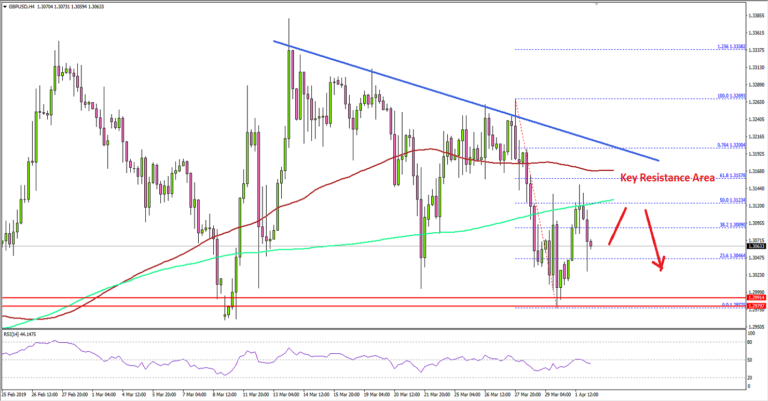
Looking at the 4-hours chart, the pair traded as low as 1.2977 and later rebounded above the 1.3050 resistance. Buyers even pushed the price above the 1.3100 level and cable tested the 50% Fib retracement level of the last decline from the 1.3269 high to 1.2977 low.
To the topside, there are many resistances for buyers, starting with the 200 simple moving average (4-hours, green) and 1.3125. The next key resistance is near 1.3160 and the 100 simple moving average (4-hours, red). Besides, the 61.8% Fib retracement level of the last decline from the 1.3269 high to 1.2977 low is also near the 1.3160 level.
There is also a major bearish trend line in place with resistance at 1.3190 on the same chart. Therefore, if the pair continues to rise, it is likely to face a strong resistance near 1.3160, 1.3190 and 1.3200.
A successful close above 1.3200 might push the pair back in a bullish zone. Conversely, a failure to clear the 1.3160 or 1.3190 resistance could trigger a fresh decline below 1.3050.
Fundamentally, the UK Manufacturing PMI for March 2019 was released by both the Chartered Institute of Purchasing & Supply and the Markit Economics. The market was looking for a decline from the last reading of 52.0 to 51.0.
The actual result was better than the forecast, as there was a sharp increase in the UK Manufacturing PMI to 55.1. Besides, the last reading was revised up from 52.0 to 52.1.
The report added:
Companies stepped up production to build-up inventories in advance of Brexit and also meet rising inflows of new work (mainly reflecting stockpiling at clients). New business improved from both domestic and export markets. This had a positive impact on staff hiring, with jobs growth recorded following back-to-back reductions at the start of the year.
GBP/USD was boosted after the release, but it won’t be easy for buyers to gain bullish momentum above the 1.3160 level.
Economic Releases to Watch Today
- UK’s Construction PMI for March 2019 – Forecast 49.8, versus 49.5 previous.
- US Durable Goods Orders for Feb 2019 – Forecast -1.8% versus +0.3% previous.
Daily Markets Broadcast
Wall Street rally extends as data matches China's rebound
The rebound in China's PMI numbers was echoed in the US, pushing Wall Street indices higher for a third day. It's the RBA rate meeting today with a chance of a dovish bias. Brexit is still not decided.
US30USD Daily Chart
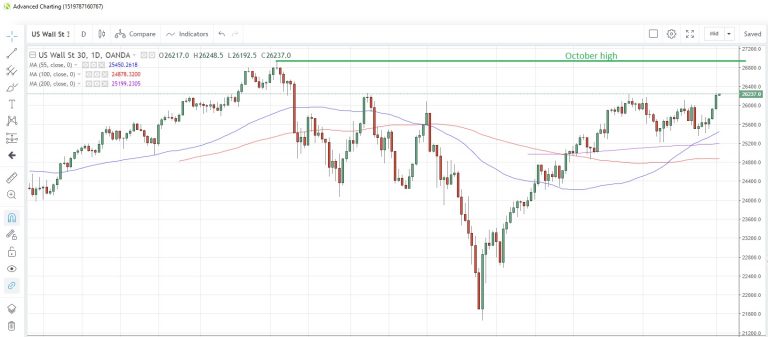
The US30 index rallied for a third day yesterday, touching the highest since October, as the March ISM manufacturing PMI beat estimates
The next possible resistance point could be the October high of 26,940
The ISM March manufacturing PMI hit 55.3, higher than economists' forecast of 54.5. Today sees the release of durable goods orders for February, which are expected to fall 1.8% m/m.
DE30EUR Daily Chart
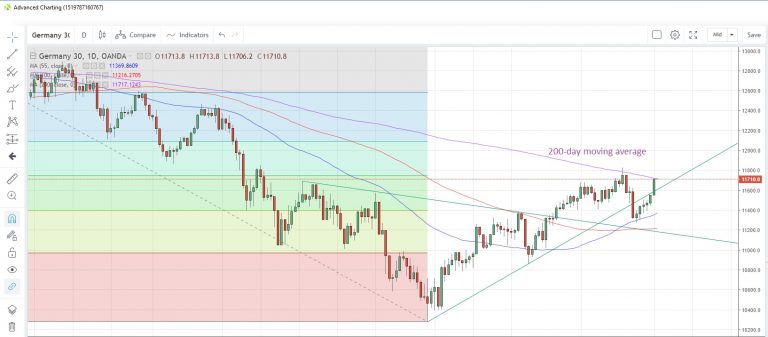
The Germany30 index ignored below-forecast PMI readings for Germany and the Eurozone yesterday, instead building on the positive sentiment from the China numbers and advancing for a sixth straight day, the longest winning streak since July last year
The index is testing the 200-day moving average resistance at 11,717. That average has capped prices on a closing basis since July 31
German Markit manufacturing PMI weakened to 44.1, below estimates of 44.7 while the Euro-zone equivalent came in at 47.5, missing estimates of a 47.6 reading. ECB's Praet is scheduled to speak today.
AU200AUD Daily Chart
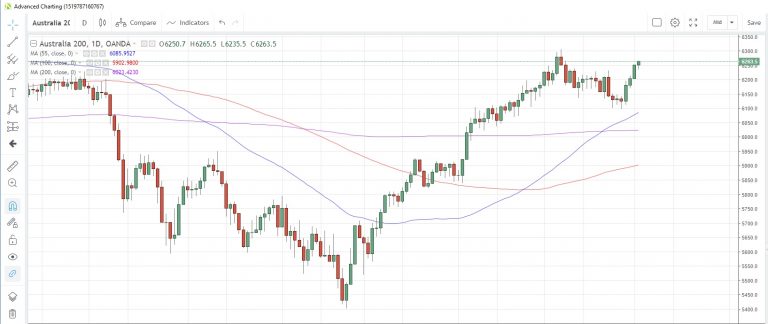
The Australia200 index looks poised to rally for a fourth straight day today as the market awaits the RBA's rate decision
The index has advanced to the highest in 3-1/2 weeks on hopes the RBA will adopt a more-dovish stance on interest rates, similar to other central banks in the region
Building permits were strong in February, rising 19.1% m/m after a 2.5% gain in January. The RBA announcement is scheduled for 1130 SGT.
It’s All About China
It's all about China
As the stock market rally continued unabated overnight and bond yields rose in lock-step, perhaps the one lesson to heed is the importance of China in the great macro-economic game of chess. Weak US retail data, yet another miss on German manufacturing data and a low print (again) on Eurozone inflation, were all put in the too-hard box as the equity markets basked in the warm after-glow of a rebound in China manufacturing yesterday.
To be fair, purchasing manager indices (PMIs) across Asia and even the US overnight all showed a rebound. The Eurozone is quickly becoming the new English Patient just as it's about to get an economic slap from Brexit, or not. Meanwhile, the US and especially Asia appear to be showing some green shoots, a term I personally hate as they are also easily eaten by pests. The lesson to take from the overnight session is that China matters and the US-China trade talks remain the only game in town for 2019.
Following Asia's rally, Europe's Eurofirst 300 rallied 1.10%; the S&P rose 1.16%, the Nasdaq was up 1.29%, and the Dow Jones jumped 1.27%. Oil also bought into the China recovery story in a big way with Brent leaping 2.31% and WTI 2.61%. US 10-year bonds gave back some of their recent gains with yields rising to just under the psychological 2.50%.
Trade talks recommence tomorrow in Washington DC but for Asia, today's main event will be the Reserve Bank of Australia (RBA) rate decision at 11.30 Singapore time followed by the Federal Budget this afternoon. Whether the Australian budget will be full of pre-election goodies is likely a moot point, as the markets will be concentrating on the RBA. Having been on hold forever in a do-nothing, wait-and-see mode, will the RBA hint today that they too will release the doves? It's likely a 50/50 call at this stage. Rates will remain unchanged for this meeting, but any hints of dovishness could see the Australian (AUD) marked sharply lower.
The pound gave up most of its pre-vote gains late in New York as the UK Parliament released its second album in as many weeks, Welcome To Your Delusion II. Parliament failed for the second time to agree if any one of their eight alternate Brexit visions could command an indicative majority. The question remains will the speaker be consistent and refuse to allow the third vote? A customs union came closest, but the votes are not binding, and no one has asked the Government or the European Union. Keep up the good work chaps.
FX
The US dollar was mixed overnight, rising against a struggling euro (EUR) and Japanese yen (JPY) while falling against the GBP and AUD initially. The Aussie dollar rose sharply yesterday following China's manufacturing data but gave back most of those gains to finish at 0.7110 as a potentially dovish RBA slides into view this morning. GBP rose to 1.3150 ahead of the votes but slipped just as quickly to 1.3070 after as the street repriced higher on the odds of a hard Brexit.
Regional currencies should continue to perform well today following the excellent performance of Wall Street overnight.
Equities
With a lighter data calendar in Asia today, the focus should be on the performance of stock markets overnight. Given the sea of green continued through Europe and US sessions, it implies a positive start to Asia trading. The China recovery story has enough legs for another day at least suggesting Asia stock markets are in for a positive day overall.
Oil
Oil raced higher overnight on the China recovery story, with both Brent and WTI posting around 2.50% gains to USD69.10 and USD61.70 a barrel, respectively. The positive outlook, combined with OPEC+ cuts, should keep sentiment positive and see plenty of buyers on any dips today. The technical picture is starting to look very overbought in the short-term, however, and with official inventories in the US tonight, traders should perhaps be a little circumspect at these levels.
Gold
Gold sank USD4 to USD1,287.00 overnight as investors rotated aggressively out of safe-haven plays. This is largely due to the China and global economic recovery stories, and gold will just have to weather the storm in the absence of any other supportive factors. The USD1,275.00 to USD1,280.00 an ounce level remains the key longer-term support.
Australian Dwelling Approvals: Rogue High Rise Jump Hides Weak Result
Feb 19.1%mth, –12.5%yr (vs mkt –1.8%). Approvals ex high rise down 3.4%mth.
Dwelling approvals jumped 19.1% in Feb driven by a big spike in high rise approvals. The spike is almost certainly a one-off making the headline result a misleading 'rogue'. Indeed, approvals ex high rise look to have been significantly weaker than expected. The consensus forecast going into the release was for total approvals to decline 1.8%. Approvals ex high rise instead look to have fallen 3.4%.
The detail showed a 3.6% fall in detached house approvals in the month, the 3mth rolling average down 4% on Nov and 10.9%yr, the significant deterioration since mid 2018 clearly carrying into early 2019. Around units, our estimates suggest 'high rise' approvals jumped 135% in the month, led by spectacular rises in NSW (+130%mth) and Vic (+213%) the latter coming from an extreme low in Jan. The fact that both states recorded big gains indicates the spike is not due to just a single project. However, the gain comes very much against the run of play for housing and this specific segment and runs counter to the evidence we have around site purchases. As such it is almost certainly a 'rogye' result. Medium density units were down about 2.4% in the month.
The high rise spike dominated the state breakdown, with big gains in NSW and Vic. Ex high rise, approvals look to have been particularly weak in NSW with apparent declines in Vic and WA as well but a solid gain in Qld. All major states are seeing significant declines in non high rise approvals – on a rolling 3mth basis, NSW is down 14.5%yr, Vic is down 12.6%yr, Qld is down 22%yr and WA is down 13.2%yr.
The total value of renovation approvals rose 4.4%mth to be up 3.6% on a rolling 3mth average basis, with a decent uptrend in place. The state detail shows solid gains coming through in Qld and WA but a less convincing uptrend in NSW and Vic.
The total value of non res building approvals rose 2.1%mth but is still down 8%yr on a rolling 3mth basis. Abstracting from monthly volatility, which is never that easy for this segment, the last few months has shown some lift in offices and steady reads for retail, warehouses and industrial approvals but softer reads for hotels, education, health and other social sectors.
Overall the monthly rise in total dwelling approvals should clearly be ignored – Australia's high rise building boom is not about to reignite any time soon, with the key takeaway instead the more disappointing momentum evident in non high rise approvals. Other housing market indicators have hinted at some stabilisation in conditions in recent weeks, although the evidence remains only tentative. The flow through to new construction could be much slower given funding difficulties and the substantial increases in new supply coming through.