

Sample Category Title
EUR/USD Mid-Day Outlook
Daily Pivots: (S1) 1.1203; (P) 1.1225; (R1) 1.1240; More.....
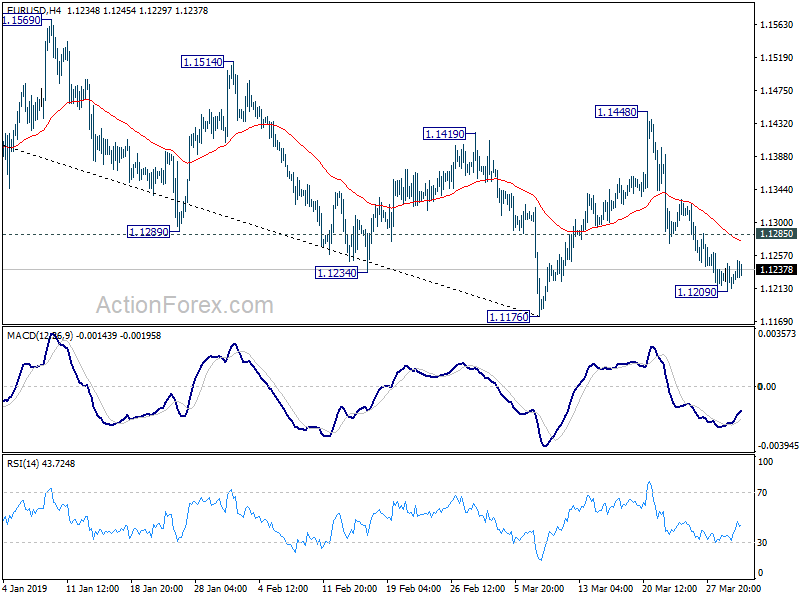
Intraday bias in EUR/USD remains neutral at this point. With 1.1285 minor resistance intact, further decline is in favor. Below 1.1209 will target 1.1176 low. Firm break there will resume whole decline from 1.2555. On the upside, however, break of 1.1285 minor resistance will turn bias back to the upside for 1.1448 instead.
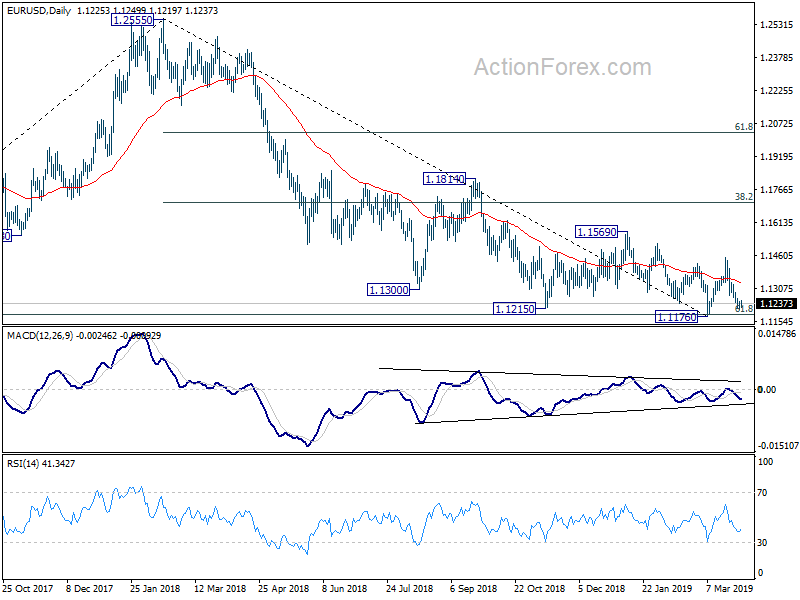
In the bigger picture, medium term weakness was revived as the weak rebound from 1.1176 was rejected well below 55 week EMA and failed to sustain above 55 day EMA. Focus is back on 1.1176 low, with 61.8% retracement of 1.0339 (2016 low) to 1.2555 (2018 high) at 1.1186. Decisive break there will resume whole down trend from 1.2555. Such decline target 1.0339 low next. On the upside, firm break of 1.1569 resistance is needed to be the first sign of medium term bottoming. Otherwise, downside breakout will be in favor.
GBP/USD Mid-Day Outlook
Daily Pivots: (S1) 1.2962; (P) 1.3049; (R1) 1.3120; More....
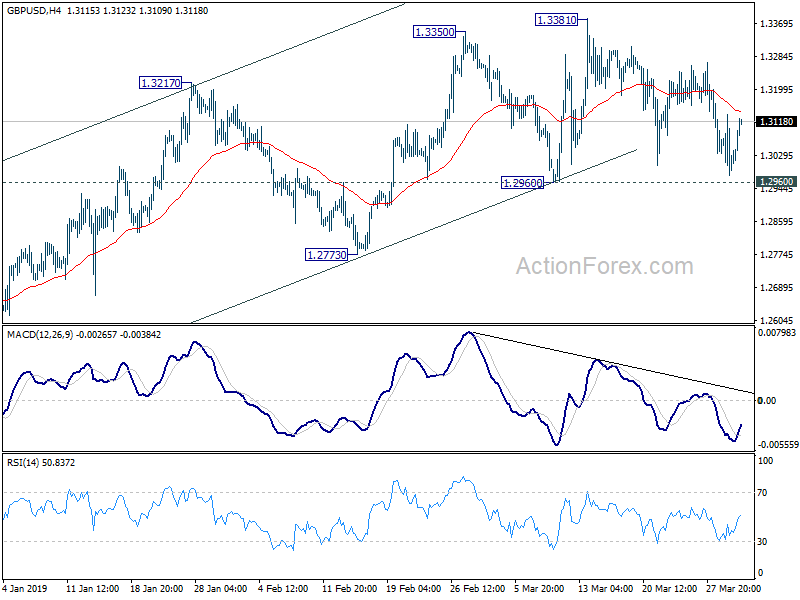
Intraday bias in GBP/USD remains neutral as it's staying in consolidation from 1.3381. As long as 1.2960 support holds, further rise is mildly in favor. On the upside, firm break of 1.3381 will target 61.8% retracement of 1.4376 to 1.2391 at 1.3618 next. However, on the downside, firm break of 1.2960 will indicate that rebound from 1.2391 has completed earlier than expected. Deeper fall would then be seen to 1.2773 support for confirmation.
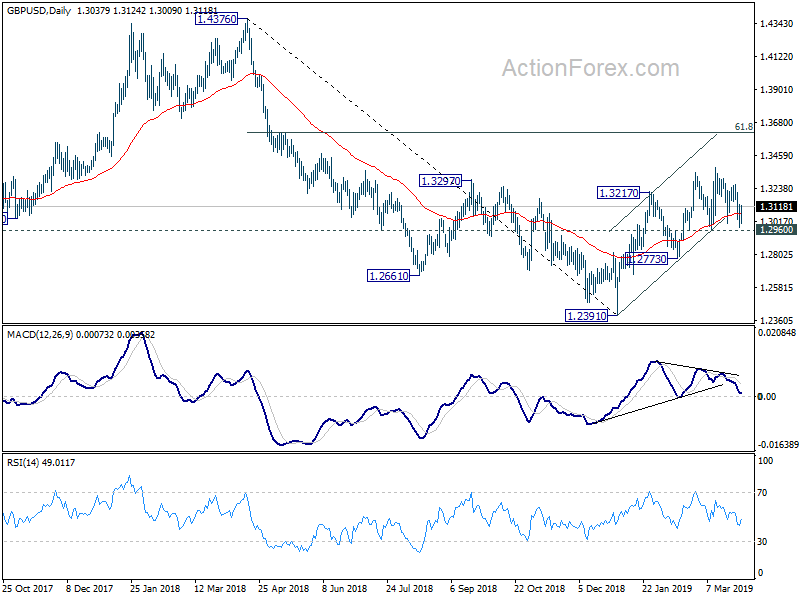
In the bigger picture, medium term decline from 1.4376 (2018 high) should have completed at 1.2391. Rise from 1.2391 is seen as the third leg of the corrective pattern from 1.1946 (2016 low). Further rise could be seen through 1.4376 in medium term. On the downside, though, break of 1.2773 support will dampen this view. Focus will be turned back to 1.2391 low and break will resume the fall from 1.4376 to 1.1946.
USD/CHF Mid-Day Outlook
Daily Pivots: (S1) 0.9938; (P) 0.9957; (R1) 0.9969; More...
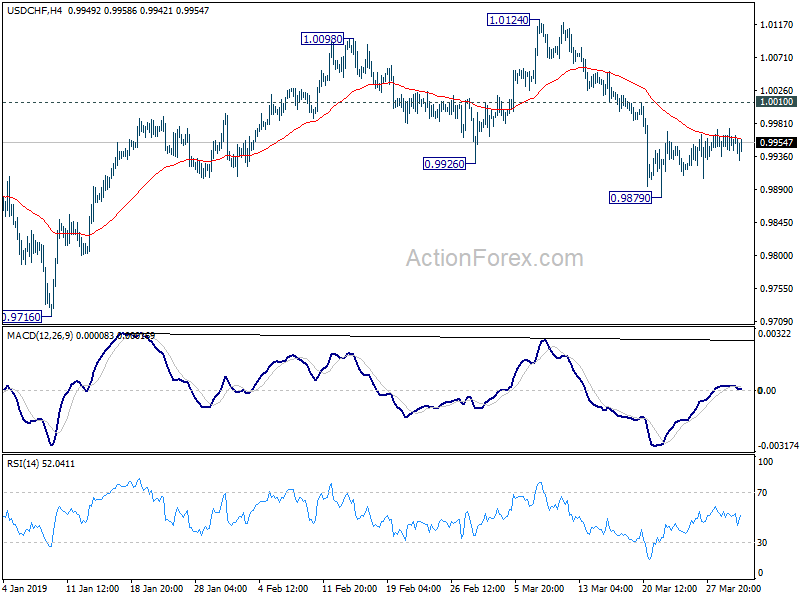
USD/CHF is staying in consolidation from 0.9879 temporary low and intraday bias stays neutral. As long as 1.0010 resistance holds, further decline remains in favor. On the downside, below 0.9879 will resume the fall from 1.0124 to 0.9716 key support. Nevertheless, break of 1.0010 will turn bias back to the upside for 1.0124/28 resistance zone.
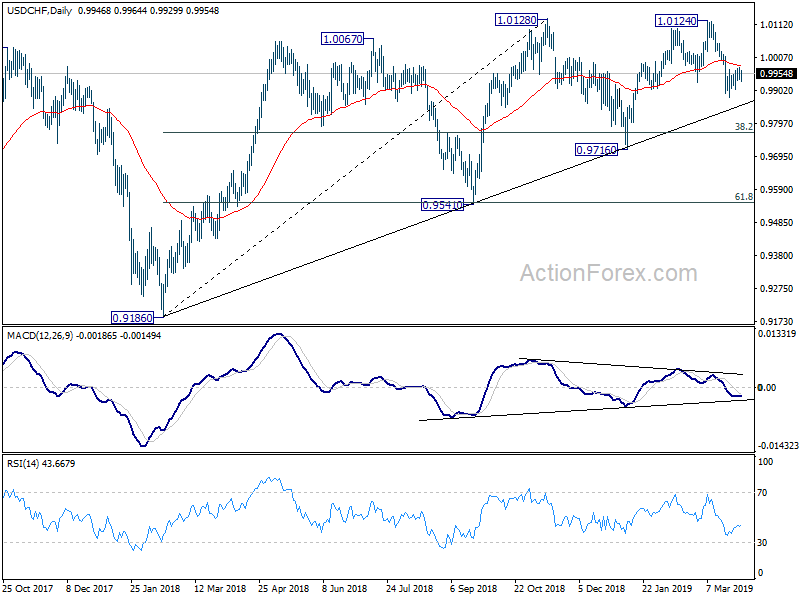
In the bigger picture, focus is back on medium term trend line (now at 0.9849). Decisive break there will argue that whole rise from 0.9186 has completed. Further break of 0.9716 will confirm reversal and target next support level at 0.9541. Nevertheless, there is still a chance that price action from 1.0128 are forming a consolidative pattern with fall from 1.0124 as third leg. If this is the case, stronger support should be seen between 0.9716 and the trend line to contain downside.
WTI Oil Outlook: WTI Hits New 2019 High, Supported by Supply Concerns
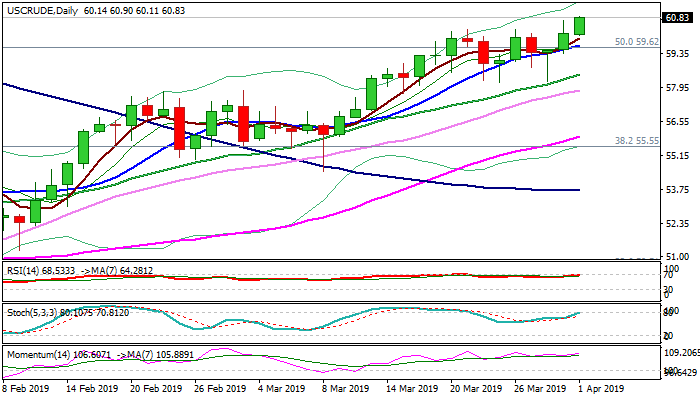
WTI oil price advances further on Monday and on track to mark eventual break above two-week congestion, after last Friday's spike to $60.71 proved to be false break. Tighter oil market on OPEC+ production cut and sanctions on Iran and Venezuela continues to prop oil prices. Report on reduced number of US oil rigs, released on Friday, added to positive sentiment. Fresh advance posted new 2019 high at $60.90, coming closer to target at $61.55 (200SMA). Today's close above former high at $60.37 (two-week congestion top) would confirm fresh bulls and signal continuation of larger uptrend from $42.36 (2018 low). Daily indicators in bullish setup support scenario. Rising 10SMA (currently at $59.70) continues to track the advance and mark pivotal support which needs to hold and keep bulls firmly in play.
Res: 61.00; 61.55; 63.00; 63.69
Sup: 60.37; 60.00; 59.70; 59.38
USD/JPY Mid-Day Outlook
Daily Pivots: (S1) 110.58; (P) 110.78; (R1) 111.04; More...
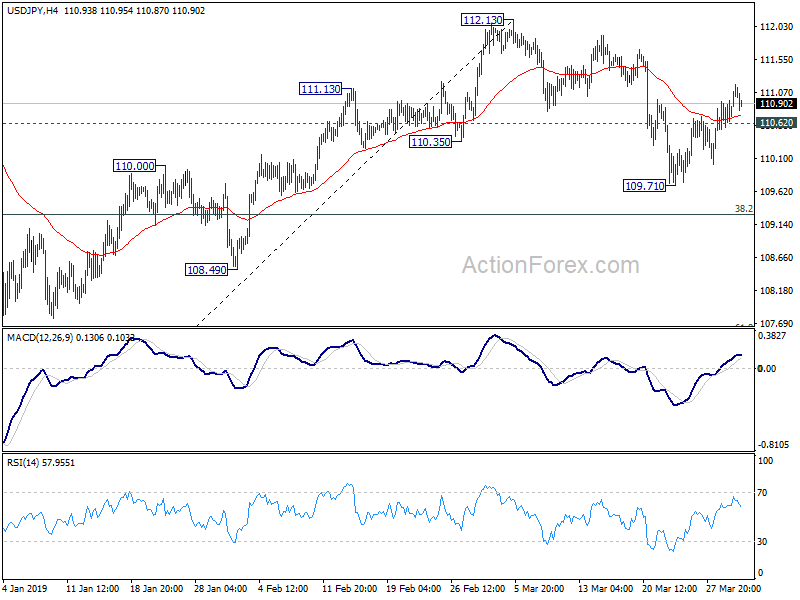
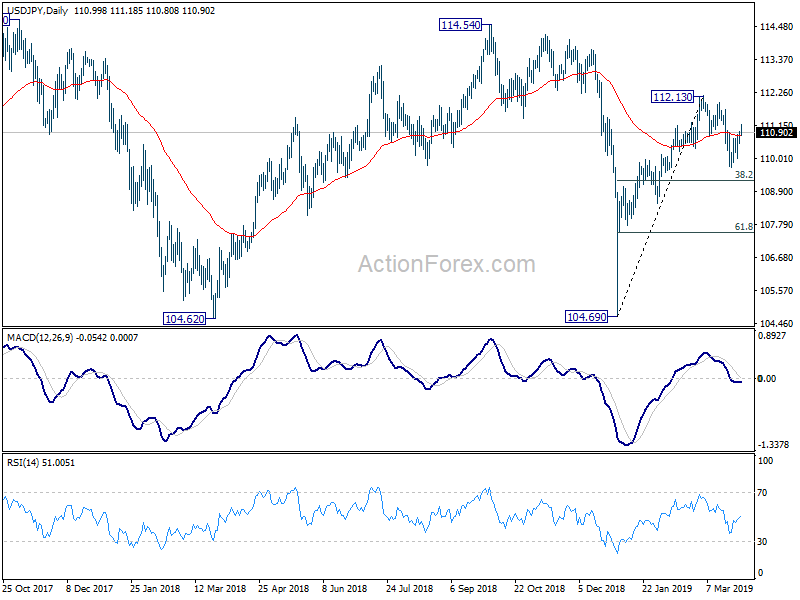
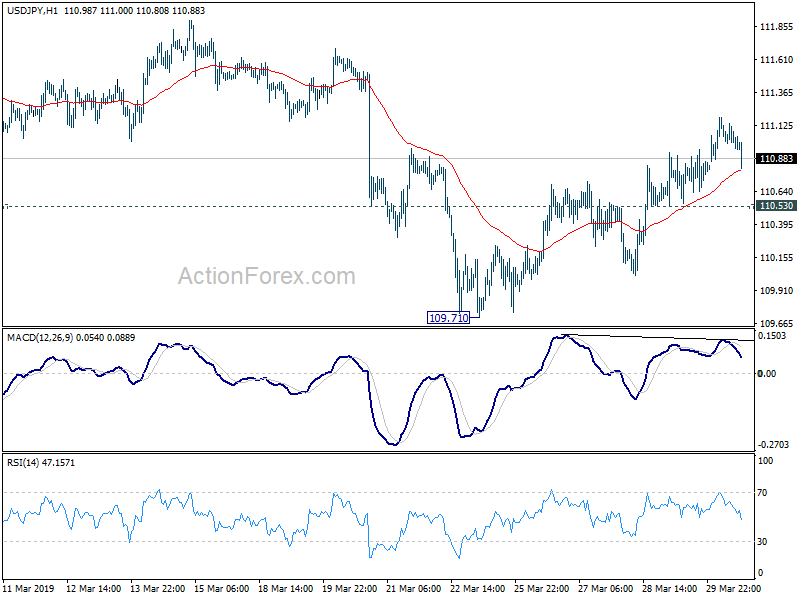
USD/JPY retreats mildly after hitting 111.18. But with 110.62 minor support intact, intraday bias stays mildly on the upside. The pull back from 112.13 should have completed with three waves down to 109.71. Further rise would be seen to 112.13 resistance. Decisive break there will resume whole rise from 104.69 to 114.54 key resistance next. On the downside, below 110.53 minor support will turn bias back to the downside for 109.71 and possibly further to 38.2% retracement of 104.69 to 112.13 at 109.28.
In the bigger picture, while the rebound from 104.69 was strong, USD/JPY failed to sustain above 55 week EMA (now at 110.80), and was kept well below 114.54 resistance. Medium term outlook is turned mixed and we'll wait for the structure of the fall from 112.13 to unveil to make an assessment later. For now, more range trading is expected between 104.69 and 112.13 first.
US Retail Sales Disappointment Raises Doubts on Optimism from Chinese Data
Global markets are generally in risk-on mode today as recession fears eased mildly after improvement in Chinese manufacturing data. While sentiments remain generally positive in early US session, there is a slight bit of cautiousness after disappointment retail sales from he US. Headline sales dropped -0.2% mom in February, below expectation of 0.3% mom. Ex-auto sales dropped -0.4% mom versus expectation of 0.4% mom.
While China manufacture PMIs turned above 50, they're hardly very encouraging readings. At the same time, there is no clear improvements in other major economies yet, including Eurozone, Japan ann even Swiss and Australia. UK PMI manufacturing posted strong upside price, but that's primarily due to pre-Brexit stock building. It could indeed be a major headwind moving forward.
Also, the never-ending Brexit impasse still posts big risks ahead. the House Commons will hold a second session of indicative votes on Brexit today. Debate might center around options of customs union, single market or a combination. Also, there would be debates on confirmatory referendum. Prime Minister Theresa May could decide what she'd do next after having the results from the indicative votes.
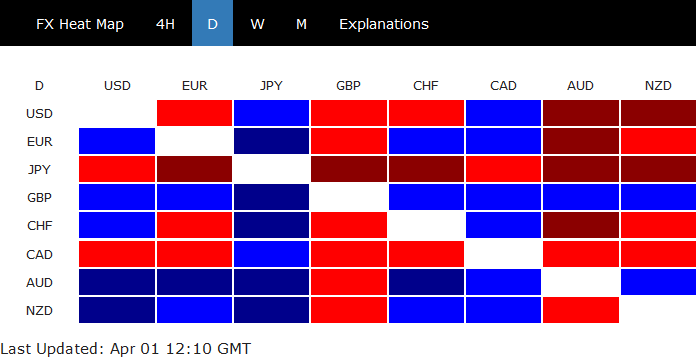
In the currency markets, Sterling is surprisingly the strongest one for today so far, followed by Australian and New Zealand Dollar. Yen is the weakest naturally, followed by Canadian and than Dollar. In Europe, currently, FTSE is up 0.63%. DAX is up 1.02%. CAC is up 0.71%. German 10-year yield is up 0.0256 at -0.043, still negative. Earlier in Asia, Nikkei rose 1.43%. Hong Kong HSI rose 1.76%. China Shanghai SSE rose 2.58%. Singapore Strait Times rose 1.17%. Japan 10-year JGB yield rose 0.0113 to -0.079.
UK PMI manufacturing rose to 13-month high, stepping up Brexit preparations
UK PMI manufacturing rose to 55.1 in March, up from 52.1 and beat expectation of 51.2. It's also the highest level in 13 months. Markit noted that stocks of inputs and finished goods rise at record rates. Also, trends in output, new orders and employment strengthen.
Rob Dobson, Director at IHS Markit, said: "Manufacturers reported a surge of business activity in March as companies stepped-up their preparations for potential Brexit-related disruptions... The stock-building boost introduces a major headwind for demand, output and jobs growth moving forward.... The survey is also picking up signs that EU companies are switching away from sourcing inputs from UK firms as Brexit approaches. It looks as if the impact of Brexit preparations, and any missed opportunities and investments during this sustained period of uncertainty, will reverberate through the manufacturing sector for some time to come."
BDI: Disorderly Brexit could slash Germany GDP by 0.5% to just 0.7% in 2019
President Federation of German Industries (BDI), Dieter Kempf, warned that "in the case of the disorderly exit of the British from the EU in the current year threatens a relapse to only 0.7 percent increase in gross domestic product". That would be 0.5% lower than current forecast of 1.2% growth for 2019.
Kempf also complained that "the extension of the time limit for the self-imposed departure of the British from the EU continues the exhausting uncertainty for our companies". And, "there is a risk that British policymakers once again buy expensive time at the expense of the economy - without wanting to take responsibility for the bill."
Eurozone unemployment rate unchanged at 7.8%, CPI slowed to 1.4%
Eurozone unemployment rate was unchanged at 7.8% in February, matched expectations. It's the lowest level since October 2008. EU28 unemployment was was also unchanged at 6.5% . It's the record low since the start of series in January 2000.
Among the member states, lowest unemployment rates in February 2019 were recorded in Czechia (1.9%), Germany (3.1%) and the Netherlands (3.4%). The highest unemployment rates were observed in Greece (18.0% in December 2018), Spain (13.9%) and Italy (10.7%).
Eurozone CPI closed to 1.4% yoy in March, down from 1.5% yoy and missed expectation of 1.5% yoy. CPI core dropped to 0.8% yoy, down from 1.0% yoy and missed expectation of 1.0% yoy.
Eurozone PMI manufacturing finalized at 47.5, lowest since 2013
Eurozone PMI manufacturing was finalized at 47.5 in March, revised down from 47.6, down from February's 49.3. It's also the lowest level since April 2013, and the second straight months of sub-50 reading. Markit noted there was the biggest monthly decline in new orders since late 2012. Also, confidence hits lowest level in over six years.
Among the countries, Germany PMI manufacturing was revised further lower to 44.1, an 80-month low. Italy PMI manufacturing was at 47.4, 70-month-low. France PMI manufacturing was revised down to 49.7, below 50, but it's just a 3-month low. Australian PMI manufacturing was at 48-month low at 50.0. Netherlands PMI manufacturing was at 33-month low at 52.5. However, Greece PMI manufacturing was at 54.7, 12-month high.
Chris Williamson, Chief Business Economist at IHS Markit said: "The March PMI data indicate that the eurozone's manufacturing sector is in its steepest downturn since the height of the region's debt crisis in 2012.... January rebound from one-off factors late last year seen in the latest official data is likely to prove short lived... Looking at the forward-looking indicators, downside risks have intensified, and the trend could clearly deteriorate further in the second quarter."
China Caixin PMI manufacturing rose to 50.8, employment expands again after five years
China Caixin PMI manufacturing rose to 50.8 in March, up from 49.9 and beat expectation of 50.0. The reading is back in expansionary region and is the highest since July 2018. Markit noted that production and total new work both increase at quicker rates. Also, employment expands for first time in over five years.
Dr. Zhengsheng Zhong, Director of Macroeconomic Analysis at CEBM Group said the reading indicates "a notable improvement in the manufacturing industry." "Overall, with a more relaxed financing environment, government efforts to bail out the private sector and positive progress in Sino-U.S. trade talks, the situation across the manufacturing sector recovered in March. The employment situation improved greatly."
China official PMI manufacturing rose to 50.5, economy still in a critical period of stabilization
Released over the weekend, official China PMI manufacturing rose to 50.5 in March, up from 49.2 and beat expectation of 49.6. That's firstly the largest monthly rise since 2012. Secondly, it's also the highest level in six months. The improvement from February's 3-yer low suggests stabilization in the slowdown in the sector. PMI non-manufacturing rose to 54.8, up from 54.3, and beat expectation of 54.5 too.
In the release, it's noted the improvement stemmed from post Chinese New Year production recovery and effect of growth stabilization policies. However, overall recovery in market demand is still not apparent. Export orders rebounded while expectations also improved. The positive signals from Sino-US trade negotiations have begun to take effect.
But overall, the statement noted that the current economy is still in a "critical period of stabilization and recovery". And, it is necessary to "further consolidate and enhance confidence recovery, and to restore market demand and stabilize economic growth.
Japan Tankan large manufacturing dropped to 12, lowest since 2017, large fall since 2012
Japan Tankan large manufacturing index dropped to 12 in Q1, down from 19 and even missed expectation of 13. That's also the lowest level since March 2017. The quarterly decline was sharpest since 2012. Large non-manufacturing index dropped to 21, down from 24 and missed expectation of 22. It's also the lowest level since March 2017.
Large manufacturing outlook also dropped to 8 down from 15 and missed expectation of 13. Large non-manufacturing outlook was unchanged at 20, matched expectations. All industry capex rose 1.2% in Q1, suggesting large firms expect to increase capital expenditure by a mere 1.2% in the year that begins in April. It's sharply lower than prior 14.3% but beat expectation of 0.8%.
The overall set of numbers are weak, suggesting worsening outlook and deeper slowdown in the Japanese economy. Down the road, if the trend continues, BoJ might be force to re-evaluate its own monetary policy.
Japan PMI manufacturing finalized at 48.9, worst quarterly performance since 2016
Japan PMI manufacturing was finalized at 49.2 in March, up[ from February's 48.9, signalling slowdown continues. Markets noted that demand remains sluggish, pulling output lower. Firms push resources to clearing backlogs due to lack of new work. And business confidence remains among lowest on record.
Joe Hayes, Economist at IHS Markit, said: "The final manufacturing PMI print of Q1 for Japan points to the worst quarterly performance in the sector since Q2 2016... The economic backdrop for the manufacturing sector in Japan remains fiercely challenging. Asian goods producers face headwinds from slowing growth in Europe and China, while global trade risks are yet to be mitigated by a breakthrough in US-Sino relations."
Australia NAB business conditions improved, but confidence dropped
Australia NAB Business Conditions rose 3 pts to 7 in March, beat expectation of 2.On the positive side, employment index rose 2 pts to 7. It remains "well above average, suggesting that for now, survey indicators of labour demand remain favourable." Trading and profitability also rebounded.
However, Business Confidence dropped -2 pts to 0, missed expectation of 4. It also "continued the below average run. "Other forward looking indicators – capacity utilisation and forward orders – showed some improvement but remain at or below average. Also, it's noted that "overall survey measures of prices and inflation remain weak."
AiG Performance of Manufacturing index dropped -3 pts to 51 in March, indicating slower pace of expansion. Some respondents attributed the down trend since mid-2018 to "general slowing in the economy". Some said their customers are "delaying orders" until after Federal election. Also, downturn in housing construction also affect demand.
TD securities inflation accelerated to 0.4% mom in March.
USD/JPY Mid-Day Outlook
Daily Pivots: (S1) 110.58; (P) 110.78; (R1) 111.04; More...
USD/JPY retreats mildly after hitting 111.18. But with 110.62 minor support intact, intraday bias stays mildly on the upside. The pull back from 112.13 should have completed with three waves down to 109.71. Further rise would be seen to 112.13 resistance. Decisive break there will resume whole rise from 104.69 to 114.54 key resistance next. On the downside, below 110.53 minor support will turn bias back to the downside for 109.71 and possibly further to 38.2% retracement of 104.69 to 112.13 at 109.28.
In the bigger picture, while the rebound from 104.69 was strong, USD/JPY failed to sustain above 55 week EMA (now at 110.80), and was kept well below 114.54 resistance. Medium term outlook is turned mixed and we'll wait for the structure of the fall from 112.13 to unveil to make an assessment later. For now, more range trading is expected between 104.69 and 112.13 first.
Economic Indicators Update
| GMT | Ccy | Events | Actual | Forecast | Previous | Revised |
|---|---|---|---|---|---|---|
| 21:30 | AUD | AiG Performance of Manufacturing Index Mar | 51 | 54 | ||
| 23:50 | JPY | Tankan Large Manufacturing Index Q1 | 12 | 13 | 19 | |
| 23:50 | JPY | Tankan Large Manufacturers Outlook Q1 | 8 | 13 | 15 | |
| 23:50 | JPY | Tankan Large Non-Manufacturing Index Q1 | 21 | 22 | 24 | |
| 23:50 | JPY | Tankan Non-Manufacturing Outlook Q1 | 20 | 20 | 20 | |
| 23:50 | JPY | Tankan Large All Industry Capex Q1 | 1.20% | 0.80% | 14.30% | |
| 23:50 | JPY | Tankan Small Manufacturing Index Q1 | 6 | 10 | 14 | |
| 23:50 | JPY | Tankan Small Manufacturing Outlook Q1 | -2 | 6 | 8 | |
| 23:50 | JPY | Tankan Small Non-Manufacturing Index Q1 | 12 | 9 | 11 | |
| 23:50 | JPY | Tankan Small Non-Manufacturing Outlook Q1 | 5 | 5 | 5 | |
| 00:00 | AUD | TD Securities Inflation M/M Mar | 0.40% | 0.10% | ||
| 00:30 | AUD | NAB Business Conditions Mar | 7 | 2 | 4 | |
| 00:30 | AUD | NAB Business Confidence Mar | 0 | 4 | 2 | |
| 00:30 | JPY | PMI Manufacturing Mar F | 49.2 | 48.9 | ||
| 01:45 | CNY | Caixin PMI Manufacturing Mar | 50.8 | 50 | 49.9 | |
| 06:30 | CHF | Retail Sales Real Y/Y Feb | -0.20% | -0.80% | -0.40% | -0.20% |
| 07:30 | CHF | PMI Manufacturing Mar | 50.3 | 53.5 | 55.4 | |
| 07:45 | EUR | Italy Manufacturing PMI Mar | 47.4 | 47.5 | 47.7 | |
| 07:50 | EUR | France Manufacturing PMI Mar F | 49.7 | 49.9 | 49.8 | |
| 07:55 | EUR | Germany Manufacturing PMI Mar F | 44.1 | 44.7 | 44.7 | |
| 08:00 | EUR | Eurozone Manufacturing PMI Mar F | 47.5 | 47.7 | 47.6 | |
| 08:30 | GBP | PMI Manufacturing Mar | 55.1 | 51.2 | 52 | 52.1 |
| 09:00 | EUR | Eurozone Unemployment Rate Feb | 7.80% | 7.80% | 7.80% | |
| 09:00 | EUR | Eurozone CPI Estimate Y/Y Mar | 1.40% | 1.50% | 1.50% | |
| 09:00 | EUR | Eurozone CPI Core Y/Y Mar A | 0.80% | 1.00% | 1.00% | |
| 12:30 | USD | Retail Sales Advance M/M Feb | -0.20% | 0.30% | 0.20% | 0.70% |
| 12:30 | USD | Retail Sales Ex Auto M/M Feb | -0.40% | 0.40% | 0.90% | 1.40% |
| 13:30 | CAD | Manufacturing PMI Mar | 52.6 | |||
| 13:45 | USD | Manufacturing PMI Mar F | 52.5 | 52.5 | ||
| 14:00 | USD | ISM Manufacturing Mar | 54.3 | 54.2 | ||
| 14:00 | USD | ISM Prices Paid Mar | 49.4 | |||
| 14:00 | USD | ISM Employment Mar | 52.3 | |||
| 14:00 | USD | Construction Spending M/M Feb | -0.10% | 1.30% | ||
| 14:00 | USD | Business Inventories Jan | 0.40% | 0.60% |
Canadian Dollar Steady, US Durables Next
The Canadian dollar has started the week with slight gains. Currently, the pair is trading at 1.3365, up 0.14% on the day. On the release front, Canada releases manufacturing PMI, which has slowed for three straight months. Will we see a rebound in the March release? In the U.S., retail sales are expected to tick up to 0.3%. On Tuesday, the U.S. posts durable goods orders.
The Canadian dollar ended the week with strong gains, as Canada’s GDP posted a gain of 0.3% in January. This beat the estimate and came after two successive declines, which has raised concerns about the health of the Canadian economy. The slowdown in the fourth quarter has forced the BoC to turn more dovish and shelve any plans of hiking interest rates. There has even been calls for a rate cut from the bank, but the GDP gain in January will lessen the pressure on the BoC to stimulate the economy.
Investors are keeping a close eye on the ebb and flow of the U.S.-China trade talks, which continues to affect the movement of currency markets. The negotiations between the sides continues and there have been reports of progress. However, optimism waned on Thursday, after a senior U.S. official said that it could be months before a deal is reached. These remarks have raised risk aversion and boosted the dollar.
DAX Jumps after Chinese Manufacturing PMI Improves
European equity markets have started the week with strong gains, and the German DAX is up 1.13% in Monday trade. Currently, the DAX is trading at 11.652, up 1.1% on the day. In economic news, German and eurozone manufacturing PMIs missed their estimates, with readings of 44.1 and 44.7, respectively. The Eurozone CPI Flash Estimate inflation in March came in at 1.5%, just shy of the estimate of 1.4%. On Tuesday, the eurozone releases PPI.
German and eurozone manufacturing sectors remain mired in contraction territory. This is largely due to the global trade war, which has lowered the demand for exports, such as German cars and auto parts. German manufacturing PMI dropped to 44.1, losing ground for an eighth straight month. This reading was the lowest since 2012. The all-eurozone release has also been steadily falling and is pointing to significant weakness in manufacturing.
The German markets ignored the weak eurozone numbers, focusing on Chinese data instead. The Chinese Caixin Manufacturing PMI didn’t sparkle, but improved to 50.8 and easily beat the estimate of 50.1 points. Investors cheered as the indicator climbed to an 8-month high, after posting three successive releases indicating contraction. The Chinese economy has been hit hard by the trade war with the U.S., and a piece of good news was enough to raise the confidence levels of investors.
US retail sales dropped -0.2%, ex-auto sales dropped -0.4%, USD/JPY dips
US retail sales report post another disappointment today. Headline sales dropped -0.2% mom in February, below expectation of 0.3% mom. Ex-auto sales dropped -0.4% mom versus expectation of 0.4% mom
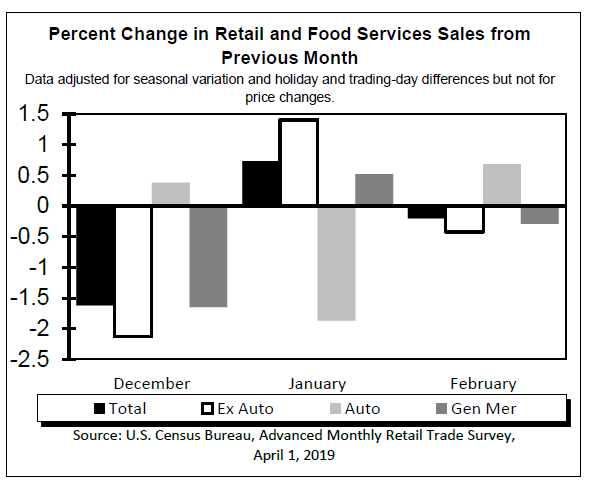
USD/JPY dips notably just after the release.
Into US session: Sterling strongest despite Brexit uncertainty, Yen dives on risk appetite
Entering into US session, Sterling is surprisingly the strongest one today. Much stronger than expected UK manufacturing PMI might be a positive factor for the Pound. But it should noted that the improvements could mainly reflect pre-Brexit stock-building. It could indeed be a major headwind moving forward. At the time same, the House Commons will hold a second session of indicative votes on Brexit today. Debate might center around options of customs union, single market or a combination. Also, there would be debates on confirmatory referendum. Prime Minister Theresa May could decide what she'd do next after having the results from the indicative votes.
Staying in the currency markets, Yen is the weakest one on global risk market rally. Stronger than expected manufacturing PMIs from China raised hope that the worst is over for the Chinese economy. However, such improvement is not seen elsewhere yet, including Eurozone, Japan and even Australia. The ISM manufacturing index from US to be released today needs to give more positive signs to secure investor confidence.
In Europe, currently:
- FTSE is up 0.71%.
- DAX is up 1.13%.
- CAC is up 0.76%.
- German 10-year yield is up 0.0332 at -0.035, staying negative.
Earlier in Asia:
- Nikkei rose 1.43%.
- Hong Kong HSI rose 1.76%.
- China Shanghai SSE rose 2.58%.
- Singapore Strait Times rose 1.17%.
- Japan 10-year JGB yield rose 0.0113 to -0.079.