Sample Category Title
USD/JPY Daily Outlook
Daily Pivots: (S1) 110.97; (P) 111.20; (R1) 111.60; More...
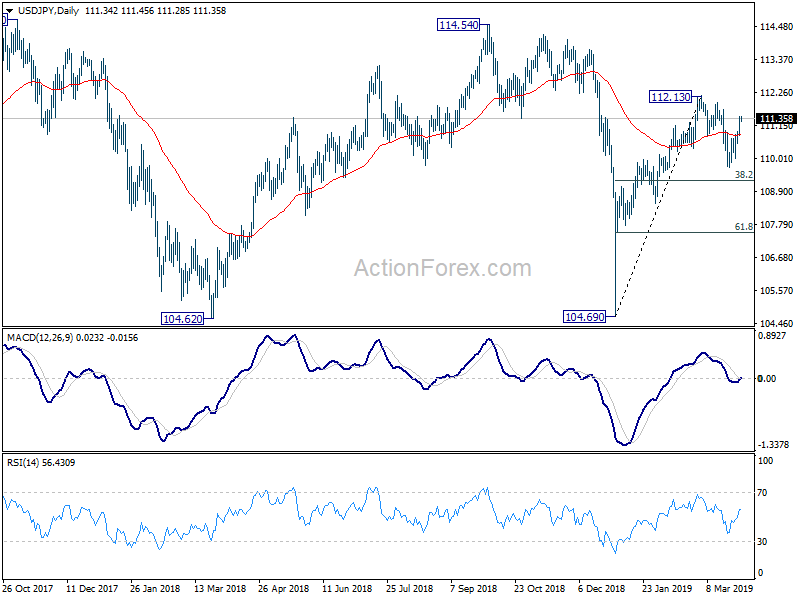
USD/JPY's rebound from 109.71 is still in progress. Intraday bias remains on the upside for 112.13 resistance. Decisive break there will resume whole rise from 104.69 to 114.54 key resistance next. On the downside, below 110.71 minor support will turn bias back to the downside for 109.71 and possibly further to 38.2% retracement of 104.69 to 112.13 at 109.28.
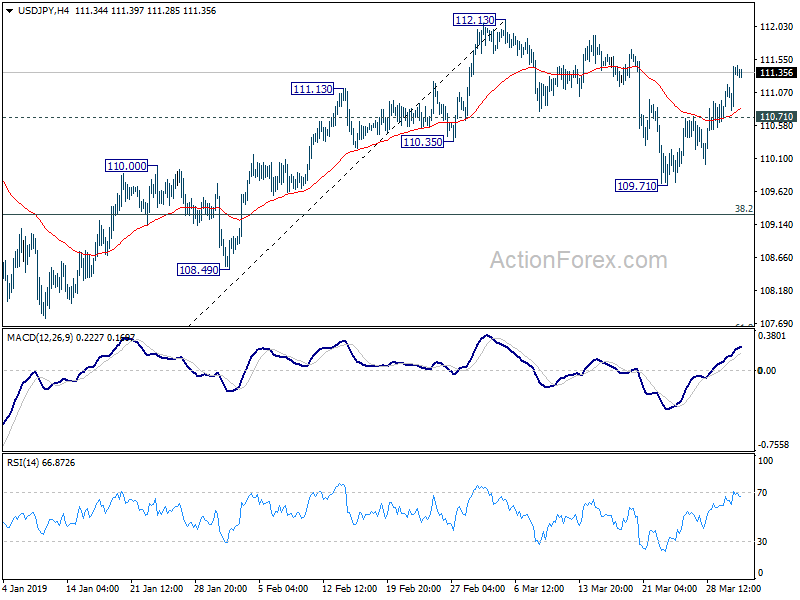
In the bigger picture, while the rebound from 104.69 was strong, USD/JPY failed to sustain above 55 week EMA (now at 110.80), and was kept well below 114.54 resistance. Medium term outlook is turned mixed and we'll wait for the structure of the fall from 112.13 to unveil to make an assessment later. For now, more range trading is expected between 104.69 and 112.13 first.
USD/CHF Daily Outlook
Daily Pivots: (S1) 0.9950; (P) 0.9973; (R1) 1.0014; More...
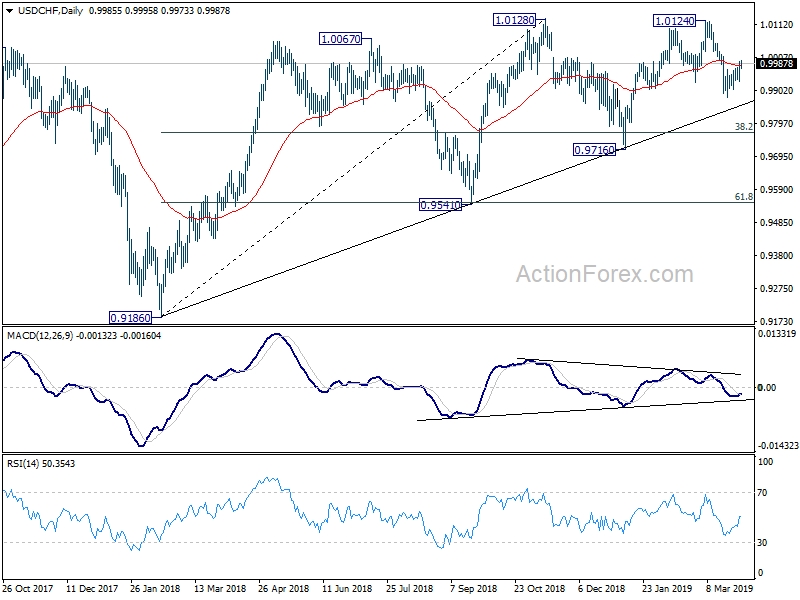
USD/CHF's recovery from 0.9879 extends higher, but stays below 1.0010 minor resistance. Intraday bias remains neutral first and further decline remains mildly in favor. On the downside, below 0.9879 will resume the fall from 1.0124 to 0.9716 key support. Nevertheless, break of 1.0010 will turn bias back to the upside for 1.0124/28 resistance zone.
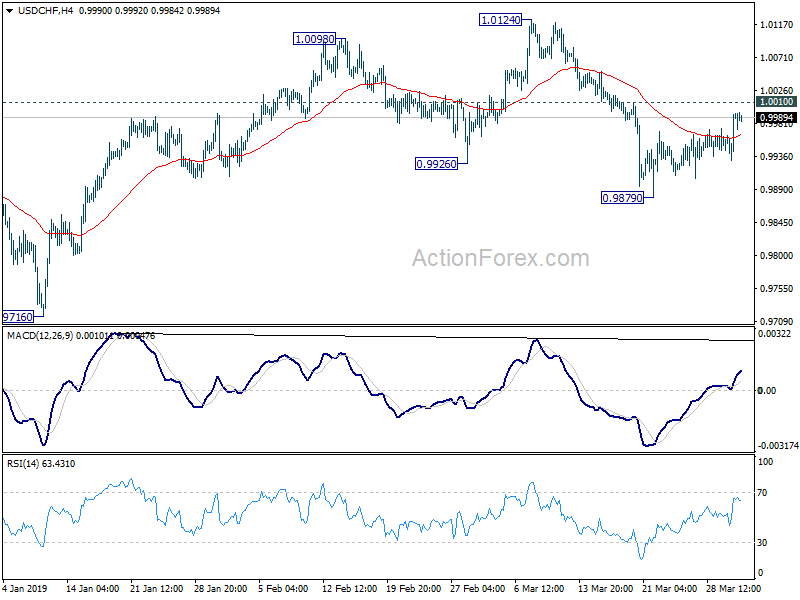
In the bigger picture, focus is back on medium term trend line (now at 0.9849). Decisive break there will argue that whole rise from 0.9186 has completed. Further break of 0.9716 will confirm reversal and target next support level at 0.9541. Nevertheless, there is still a chance that price action from 1.0128 are forming a consolidative pattern with fall from 1.0124 as third leg. If this is the case, stronger support should be seen between 0.9716 and the trend line to contain downside.
USD/CAD Daily Outlook
Daily Pivots: (S1) 1.3280; (P) 1.3326; (R1) 1.3353; More...
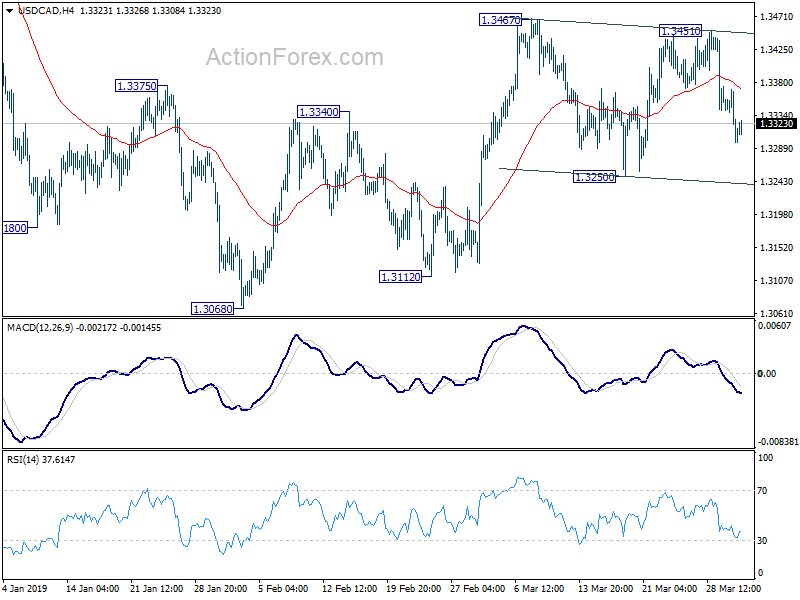
No change in USD/CAD's outlook. Intraday bias remains mildly on the downside for 1.3250 support first. Firm break there will indicate completion of whole rebound from 1.3068. In that case, deeper fall would be seen back to 1.3068/3112 support zone. On the upside, break of 1.3467 will resume the rebound from 1.3068 and target a test on 1.3664 high.
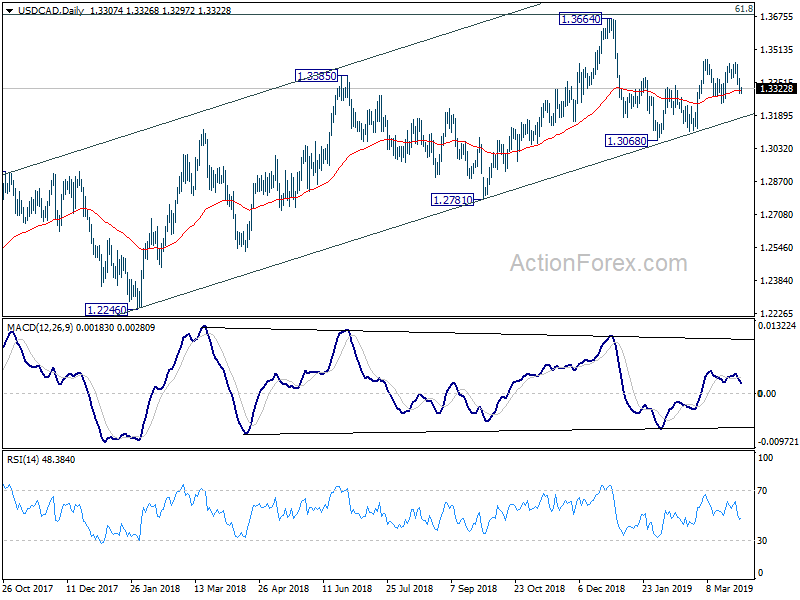
In the bigger picture, structure of the medium term rise from 1.2061 (2017 low) to 1.3664 is not clearly impulsive. Hence, we'd stay cautious on strong resistance from 61.8% retracement of 1.4689 (2016 high) to 1.2061 at 1.3685 and 1.3793 resistance to limit upside, and bring medium term topping. But in any case, medium term outlook will stay bullish as long as channel support (now at 1.3210) holds. Sustained break of 1.3793 will pave the way to retest 1.4689 (2015 high). However, firm break of the channel support should confirm reversal and target 1.2061 low again.
Elliott Wave View: Oil Can See Profit Taking Soon
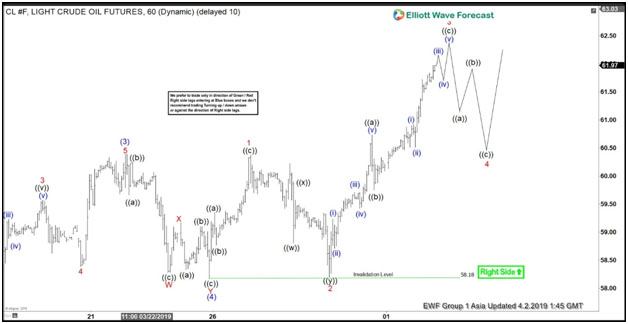
After forming the low on December 24, 2018 low at $42.36, Oil has continued to recover. The rally from Dec 24 last year looks to be unfolding as a zigzag Elliott Wave Structure. The instrument should soon reach the minimum 100% target at $63 – $65.8 and this area can potentially end the cycle from Dec 24, 2018 low. Expect some profit taking and larger 3 waves pullback when Oil reaches this area.
Near term, Oil is within wave ((C)) of the zigzag structure. As zigzag is a 5-3-5 structure, wave ((C)) subdivides into 5 waves. In the 1 hour chart below, we can see the wave (3) and (4) of this ((C)) leg. Rally to $60.39 ended wave (3) and pullback to $58.18 ended wave (4). Wave (5) is in progress as an ending diagonal. Up from $58.18, wave 1 ended at $60.38 and wave (2) pullback ended at $58.20
Expect wave 3 to end soon and wave 4 pullback to commence. While the dips stay above $58.18, oil should do 1 more leg higher in wave 5 of (5). This push higher should also end wave ((C)) of the zigzag from Dec 24, 2018 low. Afterwards, expect profit taking and larger pullback in Oil.
1 Hour Oil Elliott Wave Chart
New Growth Optimism, But Certainly Not In The Euro Zone
Market movers today
After the House of Commons once again rejected all Brexit versions on the table (see more below), PM Theresa May is meeting with her Cabinet today. Watch out for any statements on what's next during the day.
Danmarks Nationalbank (DN) is set to publish March's FX reserve numbers today. We expect no intervention as EUR/DKK did not trade as high as in December and January.
In the US, core capex numbers for February are released, which have showed some weakness in recent months. Overall, we expect investments to continue growing in 2019 but at a slower pace compared with 2017 and 2018.
Selected market news
Global growth optimism got a boost yesterday after the stronger-than-expected Chinese PMI data and a 55.3 reading for the ISM with a very strong new orders and employment index. The numbers kick-started a global risk rally that pushed global equity markets and yields higher. At the US close, 10Y US treasury yields were 10bp higher than the level at close on Friday night. PMI was also stronger in Asian countries and the UK.
However, the apparent global growth optimism is still not visible in the Euro zone. Euro area inflation figures for March disappointed yesterday by dropping to 0.8% y/y in March from 1.0% in February. Final PMI for the Euro zone also for March dropped another notch to 47.5 from 47.6 previously. In Germany, new orders dropped to 39.3. Hence, the Euro zone manufacturing sector remains in recession and the best we can say is that the PMI numbers are not getting significantly worse, but it cannot conceal that a Euro zone recovery is far away. The disappointing readings are bad news for the ECB and it underlines that ECB policy will likely be dovish for a very long time. Our expectations for next week's ECB meeting do not point to new policy measures; however, a continued cautious tone from Draghi should be expected given yesterday's news.
Yesterday's second round of indicative Brexit votes showed there is still no majority for anything in the House of Commons. That said, the three options (customs union, "Common Market 2.0" and a confirmatory public vote) were rejected by smaller margins than May's deal on Friday (but also got fewer ayes due to MPs abstaining). The Customs Union proposal was defeated by just three votes, while the confirmatory public vote got the most ayes (but still more noes). If some of the softer versions of Brexit (customs union or Common Market 2.0) make it at a later stage, PM Theresa May will find herself in a difficult position - party or country? - given the opposition to the customs union within her own party. We cannot rule out a general election if the Conservative Party implodes. With only 10 days left to Brexit, our base case remains a long extension but it may require EU leaders accepting there is no plan at the moment. The extraordinary EU summit takes place on 10 April. We think the probability of a no deal Brexit is low but not negligible.
AUD/USD Daily Outlook
Daily Pivots: (S1) 0.7101; (P) 0.7117; (R1) 0.7130; More...
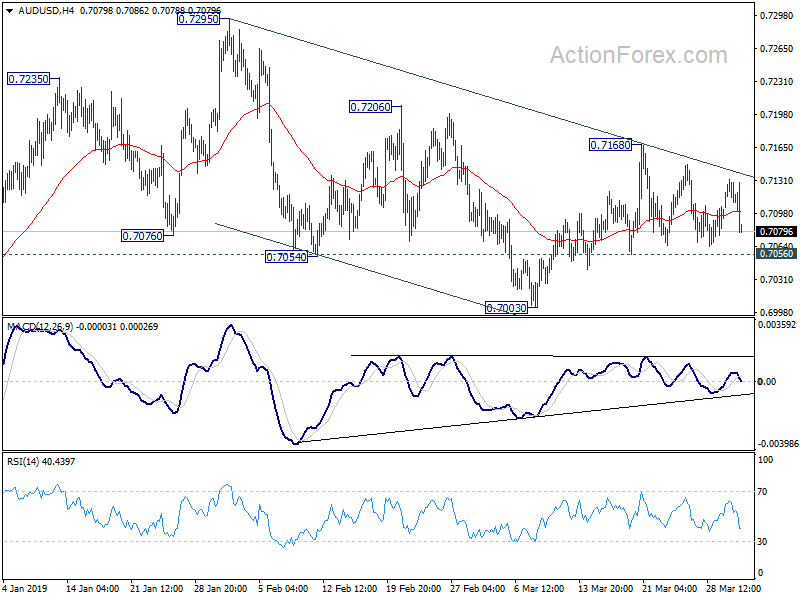
AUD/USD is staying in range between 0.7056 and 0.7168 and intraday bias remains neutral for the moment. On the downside, break of 0.7056 minor support will turn bias to the downside for 0.7003 first. Break will resume the whole decline from 0.7295. On the upside, break of 0.7168 will resume the rise from 0.7003 and turn bias to the upside for 0.7295 resistance. Break will extend the whole rebound from 0.6722 to 0.7393 key resistance level.
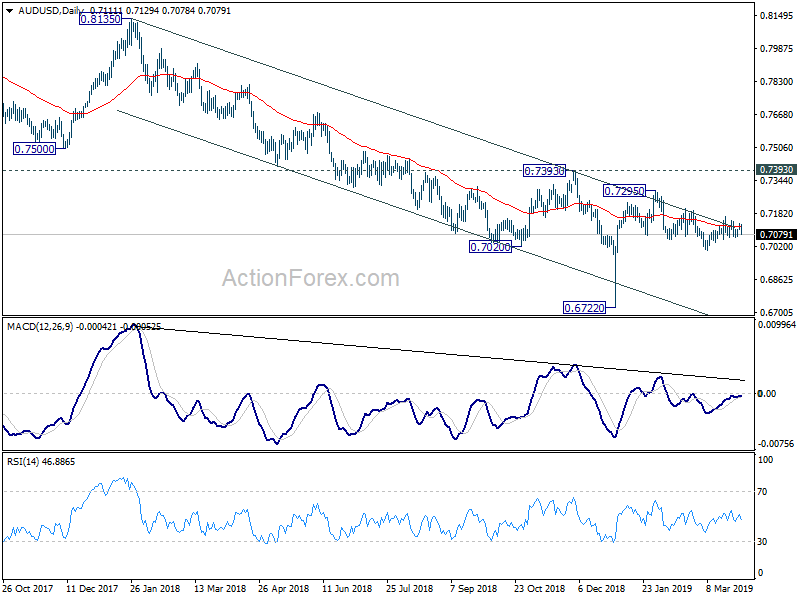
In the bigger picture, as long as 0.7393 resistance holds, we'd treat fall from 0.8135 as resuming long term down trend from 1.1079 (2011 high). Decisive break of 0.6826 (2016 low) will confirm this bearish view and resume the down trend to 0.6008 (2008 low). However, firm break of 0.7393 will argue that fall from 0.8135 has completed. And corrective pattern from 0.6826 has started the third leg, targeting 0.8135 again.
Australian Dollar Tumbles as RBA Signals It’s Ready to Move
Australian Dollar trading broadly lower today after RBA kept interest rate unchanged. While there was no clear dovish shift, the statement suggests that RBA is starting to get ready for a move. Weakness in Aussie takes New Zealand Dollar lower too. Sterling is the third weakest so far after UK Parliament rejected all Brexit alternatives again. As for today, Swiss Franc is the strongest so far, followed by Yen and than Dollar.
Technically, one development is note is the EUR/AUD recovers strongly after breaching 1.5721 low, suggesting recent consolidation is probably extending. Though, Euro is mildly vulnerable as EUR/USD is heading to 1.1176 low. Break will resume larger down trend from 1.2555 and could prompt selloff in Euro elsewhere. US 10-year yield jumped to close at 2.497 overnight, just missed 2.5 handle. USD/JPY rode on this and is on track to retest 112.13 resistance.
In Asia, Nikkei closed up 0.03%. Hong Kong HSI is up 0.12%. China Shanghai SSE is up 0.29%. Singapore Strati Times is up 0.68%. Japan 10-year JGB yield is up 0.0079 at -0.07. Overnight, DOW rose 1.27%. S&P 500 rose 1.16%. NASDAQ rose 1.29%. 10-year yield rose 0.083 to 2.497. to-year yield rose 0.068 to 2.890.
RBA kept cash rate at 1.50%, no dovish shift but hints on data dependency
RBA left cash rate unchanged at 1.50% as widely expected. There is one very subtle change in the statement that's picked up by the markets. Back on March 5, RBA concluded by saying "Board judged that holding the stance of monetary policy unchanged at this meeting would be consistent with sustainable growth in the economy and achieving the inflation target over time."
In today's statement, RBA said "the Board judged that it was appropriate to hold the stance of policy unchanged at this meeting. The Board will continue to monitor developments and set monetary policy to support sustainable growth in the economy and achieve the inflation target over time."
That is, RBA added some development-dependency on monetary policy. That hinted RBA could be ready to move in economic data warrant so and interest rate might not stay there for long. Given that markets are expecting two cuts this year, RBA's change in statement is a small step affirming this view.
There are little changes in other parts of the statement though. RBA noted that GDP data paint a "softer picture" of the economy than job data. It acknowledged the mere 0.2% growth in Q4 and 2.3% over 2018. It also noted that "growth in household consumption is being affected by the protracted period of weakness in real household disposable income and the adjustment in housing markets."
Employment and inflation outlook are unchanged. RBA expects "continued improvement in the labour market is expected to see some further lift in wages growth over time", gradually. Inflation is expected to pick up gradually over the next couple of years. The central scenario is unchanged for inflation to hit 2% in 2019 and 2.25% in 2020.
UK parliament rejected all four Brexit alternatives again, but customs union option was close
Sterling weakened mildly as the UK House of Commons, unsurprisingly, rejected all four Brexit alternatives in yesterday's indicative votes again. The closest one to get a majority was Conservative MP Kenneth Clarke's Customs Union option, which was defeated 276-273. The most voted one was Labour Peter Kyle's Confirmatory Public Vote, which was defeated 292-280.
Brexit Minister Steven Barclay complain in the Parliament after the votes that "this House has continuously rejected leaving without a deal just as it has rejected not leaving at all." And he reiterated that " the only option is to find a way through which allows the U.K. to leave with a deal." He also noted "if the house were to agree a deal this week, it would still be possible to avoid holding European parliamentary elections." It's taken as a hint that Prime Minister Theresa May could put the thrice-defeated Brexit deal to a fourth vote this week.
BCC: UK businesses hitting the brakes hard on ongoing Brexit impasse
According to the British Chambers of Commerce's quarterly economic survey, found that key indicators of UK economic health weakened considerably in Q1. In particular balance of services companies reporting rise in exports sales dropped to lowest in a decade. Balance of firms reporting improved cashflow turned negative for the first time since 2012. Also, investment intentions in manufacturing and services were at lowest in eight years.
BCC Director General Adam Marshall said "our findings should serve as a clear warning that the ongoing impasse at Westminster is contributing to a sharp slowdown in the real economy across the UK. Business is hitting the brakes – hard." Also, "the prospect of a messy and disorderly exit from the EU is weighing heavily on the UK economy, and must still be avoided"
Marshall also complained that "for too long Brexit tunnel-vision has distracted government from fixing the fundamentals to support growth here in the UK."
EU Juncker tells China: It can't stay like this. It can't work like this.
European Commission President Jean-Claude Juncker complained the practices of the bloc's "systematic rivals" in front of lawmakers in Germany yesterday. He said "Chinese companies have free access to our markets in Europe, but we don't to the markets in China", and "it can't stay like this".
Also, "one country isn't able to condemn Chinese human rights policy because Chinese investors are involved in one of their ports," Juncker added "it can't work like this".
Though, he's not against China's Belt and Road initiative "as long as the conditions are right". He said, "if you don't only meet Chinese workers on these construction sites but also European workers, then this is all feasible."
BoC Poloz: Recent data suggests below-potential growth just temporary
BoC Governor Stephen Poloz sounded confident in his speech yesterday. He noted that Canada is adjusting the challenges in the domestic and global economies. And after taking into account the structural adjustments to oil prices, he said "we can see many area of encouraging economic growth".
He added that the global economy is performing less well than expected and "Canada is feeling the effects". Housing markets is also taking longer to "digest the combined effect of stricter mortgage guidelines and higher interest rates".
However, Poloz said "recent economic data have been generally consistent with our expectation that the period of below-potential growth will prove to be temporary."
On the data front
Japan monetary base rose 3.8% yoy in March, below expectation of 4.4%. Australian building approvals jumped sharply by 19.1% mom in February versus expectation of -1.8% mom. Swiss will release CPI in European session. Eurozone will release PPI. UK will release PMI construction. Later in the data, US durable goods orders will be the main focus.
AUD/USD Daily Outlook
Daily Pivots: (S1) 0.7101; (P) 0.7117; (R1) 0.7130; More...
AUD/USD is staying in range between 0.7056 and 0.7168 and intraday bias remains neutral for the moment. On the downside, break of 0.7056 minor support will turn bias to the downside for 0.7003 first. Break will resume the whole decline from 0.7295. On the upside, break of 0.7168 will resume the rise from 0.7003 and turn bias to the upside for 0.7295 resistance. Break will extend the whole rebound from 0.6722 to 0.7393 key resistance level.
In the bigger picture, as long as 0.7393 resistance holds, we'd treat fall from 0.8135 as resuming long term down trend from 1.1079 (2011 high). Decisive break of 0.6826 (2016 low) will confirm this bearish view and resume the down trend to 0.6008 (2008 low). However, firm break of 0.7393 will argue that fall from 0.8135 has completed. And corrective pattern from 0.6826 has started the third leg, targeting 0.8135 again.
Economic Indicators Update
| GMT | Ccy | Events | Actual | Forecast | Previous | Revised |
|---|---|---|---|---|---|---|
| 23:50 | JPY | Monetary Base Y/Y Mar | 3.80% | 4.40% | 4.60% | |
| 0:30 | AUD | Building Approvals M/M Feb | 19.10% | -1.80% | 2.50% | 2.30% |
| 3:30 | AUD | RBA Rate Decision | 1.50% | 1.50% | 1.50% | |
| 6:30 | CHF | CPI M/M Mar | 0.40% | 0.40% | ||
| 6:30 | CHF | CPI Y/Y Mar | 0.50% | 0.60% | ||
| 8:30 | GBP | Construction PMI Mar | 49.7 | 49.5 | ||
| 9:00 | EUR | Eurozone PPI M/M Feb | 0.20% | 0.40% | ||
| 9:00 | EUR | Eurozone PPI Y/Y Feb | 3.10% | 3.00% | ||
| 12:30 | USD | Durable Goods Orders Feb P | -1.20% | 0.30% | ||
| 12:30 | USD | Durables Ex Transportation Feb P | 0.30% | -0.20% |
Euro-Zone’s Manufacturing PMI Contracted To Its Lowest Level In Six Years In March
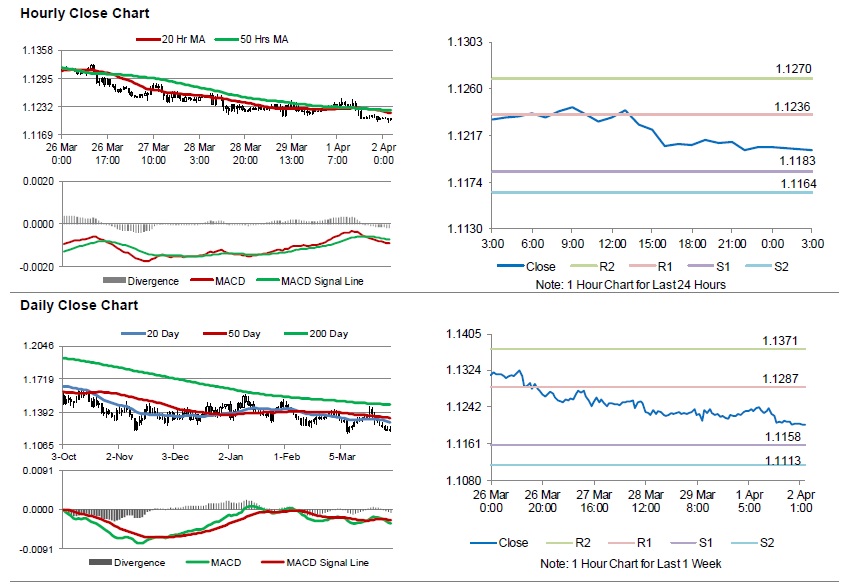
For the 24 hours to 23:00 GMT, the EUR declined 0.17% against the USD and closed at 1.1206, weighed down by steep losses in manufacturing activity in the euro area.
Data showed that the Euro-zone's final manufacturing PMI tumbled to a level of 47.5 in March, contracting to its lowest level in six years, amid decline in demand and production. Market participants and preliminary figures had envisaged the PMI to fall to a level of 47.6. The PMI had registered a reading of 49.3 in the prior month. Additionally, the final consumer price index (CPI) recorded a less-than-expected rise of 1.4% on an annual basis in March, compared to a rise of 1.5% in the prior month. The preliminary figures had indicated a rise of 1.5%. Meanwhile, the region's unemployment rate remained unchanged at 7.8% in February, in line with market expectations.
Separately, in Germany, the Markit manufacturing PMI contracted to a level of 44.1 in March, hitting its lowest level since July 2012 and compared to market consensus for a fall to a level of 44.7. In the previous month, the PMI had registered a reading of 47.6.
In the US, data revealed that the US final Markit manufacturing PMI fell to a level of 52.4 in March, compared to preliminary figures and market expectations for a drop to a level of 52.5. The PMI had recorded a reading of 53.0 in the prior month. Moreover, the nation's advance retail sales unexpectedly eased 0.2% on a monthly basis in February, defying market consensus for a rise of 0.2%. Advance retail sales had registered a revised rise of 0.7% in the preceding month.
On the contrary, the ISM manufacturing activity index rose to a level of 55.3 in March, compared to a reading of 54.2 in the prior month. Market participants had envisaged the index to rise to 54.5. Additionally, the US construction spending surprisingly advanced to a 9-month high level of 1.0% on a monthly basis in February, defying market anticipations for a drop of 0.2%. In the previous month, construction spending had registered a revised rise of 2.5%. Moreover, business inventories advanced 0.8% on a monthly basis in January, more than market forecast and compared to a revised similar rise in the previous month.
In the Asian session, at GMT0300, the pair is trading at 1.1203, with the EUR trading slightly lower against the USD from yesterday's close.
The pair is expected to find support at 1.1183, and a fall through could take it to the next support level of 1.1164. The pair is expected to find its first resistance at 1.1236, and a rise through could take it to the next resistance level of 1.1270.
Looking ahead, traders would keep an eye on the Euro-zone's producer price index for February, set to release in a few hours. Later in the day, the US durable goods orders for February, will keep investors on their toes.
The currency pair is trading below its 20 Hr and 50 Hr moving averages.
UK’s Manufacturing PMI Unexpectedly Climbed In March
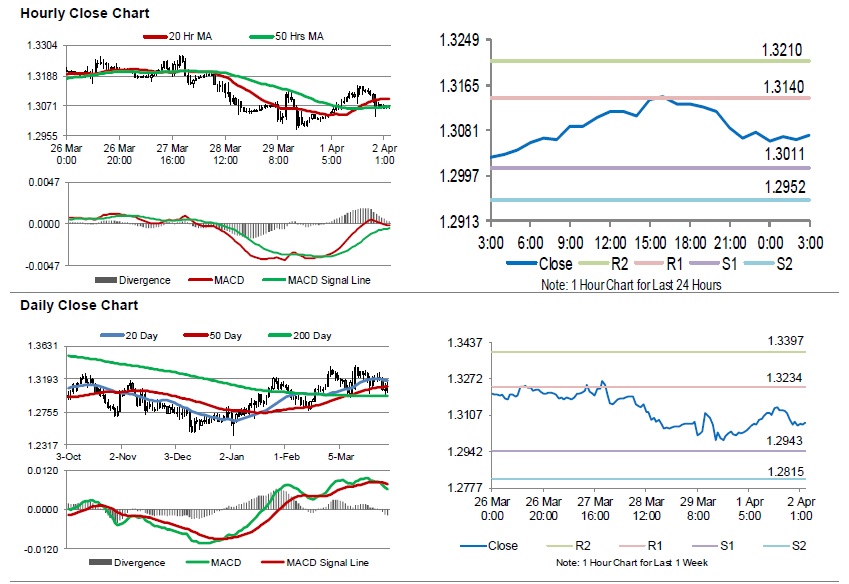
For the 24 hours to 23:00 GMT, the GBP rose 0.42% against the USD and closed at 1.3077.
In the economic news, UK's manufacturing PMI unexpectedly climbed to a level of 55.1 in March, notching its highest level in 13 months. In the prior month, the PMI had recorded a revised level of 52.1, while market participants had envisaged the PMI to ease to a level of 51.2.
In the Asian session, at GMT0300, the pair is trading at 1.3071, with the GBP trading 0.05% lower against the USD from yesterday's close.
The pair is expected to find support at 1.3011, and a fall through could take it to the next support level of 1.2952. The pair is expected to find its first resistance at 1.3140, and a rise through could take it to the next resistance level of 1.3210.
Going forward, investors would await UK's Markit construction PMI for March, scheduled to release in a few hours.
The currency pair is trading below its 20 Hr moving average and showing convergence with its 50 Hr moving average.
Japanese Yen Reverses Its Losses In The Asian Session
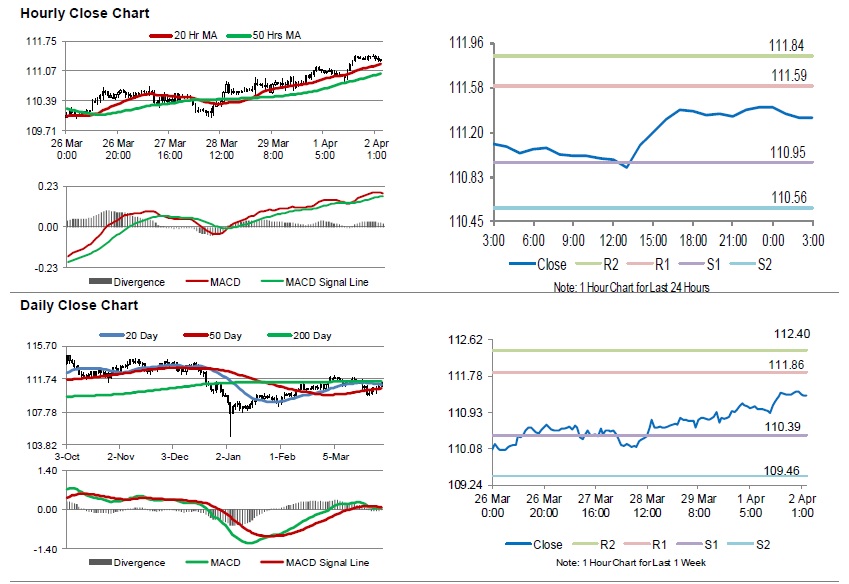
For the 24 hours to 23:00 GMT, the USD rose 0.23% against the JPY and closed at 111.41.
In the Asian session, at GMT0300, the pair is trading at 111.33, with the USD trading 0.07% lower against the JPY from yesterday’s close.
The pair is expected to find support at 110.95, and a fall through could take it to the next support level of 110.56. The pair is expected to find its first resistance at 111.59, and a rise through could take it to the next resistance level of 111.84.
Moving ahead, traders would closely monitor Japan’s Nikkei services PMI for March, set to release overnight.
The currency pair is trading above its 20 Hr and 50 Hr moving averages.