

Sample Category Title
Kiwi Crashes On Dovish Shift By RBNZ
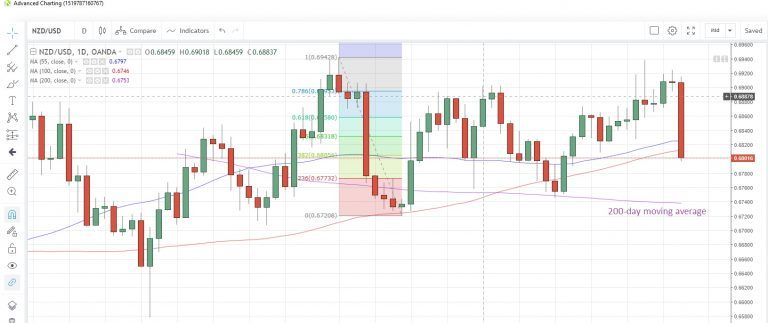
NZD/USD at two-week low
The Reserve Bank of New Zealand kept rates unchanged at today’s meeting, as expected but it was the accompanying statement that impacted the most. The Bank shifted to a more dovish stance, joining a host of other central banks that have adopted that bias since the Fed stopped hiking rates. The Bank said the next rate adjustment would likely be lower (at previous meetings they had stated that the next move could be up or down) and that it would keep the current expansionary stance for a “considerable period”.
It expects low interest rates, increased government spending and investment to support growth in 2019 while acknowledging that the world economy is weaker and the risk of a pronounced global downturn has increased.
Money markets are now giving a near 50% chance of a rate cut by May and a 75% chance of one by August. The kiwi was immediately marked lower and crashed to the lowest level versus the US dollar since March 11, crossing below the 100-day moving average at 0.6812 with ease. The next possible support level could be the 200-day moving average at 0.6738, which has supported prices on a closing basis since February 13.
NZD/USD Daily Chart
China industrial profits slump
Further indication of a slowing China economy was seen in the industrial profits totals for January-February. Companies saw their profits fall 14% to 708 billion yuan (about $105.4 billion) as the economic slowdown and the ongoing trade war with the US took their toll. That was the worst result since 2011, according to data from the National Bureau of Statistics.
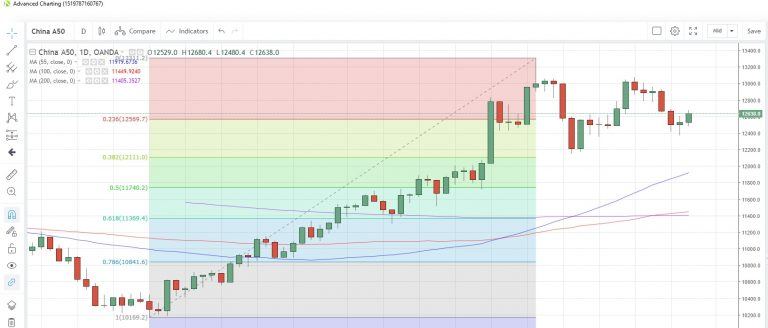
Despite the disappointing data, China shares held on to gains, taking their cue from Wall Street’s advance yesterday and rising for a second straight day.
China A50 Daily Chart
ECB speakers out in force
Whilst the data calendar is relatively quiet today, the ECB is not. A plethora of speakers fill the day, ranging from Draghi at 0800GMT followed by Praet, Lautenschlager, De Guidos and ending with Mersch at 1330GMT. Maybe we will get hints as to what the ECB really thinks growth will be, with rumours circulating it could be even lower that the official downgraded forecast of 1.1%.
The rest of the calendar is populated with the US trade numbers for January, with the deficit expected to improve to $57.0 billion from $59.8 billion in December, while Canada’s deficit for the same month is seen contracting to CAD 3.5 billion on lower imports.
The UK Parliament holds yet another vote on Brexit with news overnight suggesting PM May’s proposed deal is garnering a bit more support. Whether it will be enough to pass the deal before Friday’s EU deadline is doubtful. Meanwhile the pound has been remarkably steady so far this week.
EUR/USD And USD/JPY: Dollar Bulls In Action
EUR/USD declined heavily recently below the 1.1340 and 1.1280 support levels. USD/JPY broke the key 110.25 resistance area to move into a positive zone.
Important Takeaways for EUR/USD and USD/JPY
- The Euro faced an increase in selling pressure and broke the 1.1340 support area.
- There is a crucial bearish trend line in place with resistance at 1.1285 on the hourly chart of EUR/USD.
- USD/JPY formed a solid support base near 109.70 and later corrected higher.
- There was a break above two bearish trend lines with resistance near 110.30 on the hourly chart.
EUR/USD Technical Analysis
The Euro rallied recently towards the 1.1450 resistance level against the US Dollar. The EUR/USD pair faced a strong selling interest, resulting in a sharp decline below the 1.1400 and 1.1340 support levels.
Sellers took control and pushed the pair below the 1.1300 support and the 50 hourly simple moving average. There was even a break below the key 1.1280 support level and the pair traded to a new weekly low at 1.250 on FXOpen

At the moment, the pair seems to be trading in a strong downtrend below 1.1300 and the 50 hourly simple moving average. An initial resistance is near the 1.1270 and the 23.6% Fib retracement level of the recent decline from the 1.1325 high to 1.1250 low.
There is also a crucial bearish trend line in place with resistance at 1.1285 on the hourly chart of EUR/USD. The trend line coincides with the 50% Fib retracement level of the recent decline from the 1.1325 high to 1.1250 low.
Therefore, if the pair corrects higher in the short term, it could face a strong selling interest near the 1.1270 and 1.1285 resistance levels.
On the downside, an initial support is near the 1.1250 level. If there are more losses, the pair might decline heavily towards the 1.1220 or 1.1200 support level in the coming sessions.
USD/JPY Technical Analysis
After a strong decline, the US Dollar found support near the 109.70 level against the Japanese Yen. The USD/JPY pair traded as low as 109.71 and later started a decent upward move.
There was a decent upward move above the 110.00 resistance and the 50 hourly simple moving average. Moreover, there was a break above the 50% Fib retracement level of the last decline from the 110.95 high to 109.71 low.

Besides, there was a break above two bearish trend lines with resistance near 110.30 on the hourly chart. It has opened the doors for more gains above the 61.8% Fib retracement level of the last decline from the 110.95 high to 109.71 low.
The current price action is positive above the 110.40 level. An immediate resistance is near the 110.75 level, above which the pair could gain traction above the 111.00 level in the near term.
The next key resistance is near the 111.15 and 111.25 levels. On the downside, if there is a downside correction, the pair might find support near 110.30 level. Besides, the main support is near the 110.25 level and the 50 hourly simple moving average, where buyers are likely to emerge.
Market Morning Briefing: Aussie Is Bearish While Below 0.7150
STOCKS
Equities like the Dow, DAX and Nikkei are broadly mixed to negative in the short term with chances of a slight uptick in the near term before a fresh fall. Shanghai is turning bearish and looks vulnerable for a corrective fall. Indian equities looks relatively stronger than the global indices.
Dow (25657.73, +140.90, +0.55%), though has moved higher looks mixed on the daily candles. The 21-day moving average at 25755 is a key resistance to watch. A strong break above it is needed the Dow to ease the downside pressure and rise to 26000 levels again. But while below 25755, the outlook remains negative and a fall to 25200-25180 cannot be ruled out.
DAX (11419.48, +72.83, +0.64%) remains above 11300 and has bounced as expected. A test of 11500-11520 is possible as mentioned yesterday.
Nikkei (21297.73, -130.66, -0.61%) looks mixed in the near term. It has support at 21227 (100-day moving average) which if holds can take the index higher to 21500 and 21700 in the near term.
Shanghai (3013.57, +16.47, +0.55%) seems to be coming under pressure. The sharp fall below the 21-day moving average support level of 3035 has turned the possibility high for Shanghai to break below 2950 and fall to 2900 in the coming days. Resistances are at 3022 and 3035
Sensex (38233.41, +424.50 +1.12%) and Nifty 50 (11483.25, +129.00, +1.14%) have risen sharply contrary to our expectation for a fall. The supports at 37650 on the Sensex and 11320 on the Nifty 50 seems to have held very well. While above 11400 Nifty can test 11600 in the near term. Sensex can target 38500 or even higher levels while it sustains above 38000.
COMMODITIES
Gold remains positive but may move higher at a slow pace. Silver can consolidate in a narrow range for some time before moving up. Copper looks vulnerable for a further fall. Oil is bullish in the near term.
Gold (1317) has come-off from its high around 1324. But with support in between 1315 and 1310, the outlook continues to remain bullish for it to test 1330 in the near term.
Silver (15.45) is stuck in between its support at 15.35 and resistance at 15.65. A breakout on either side of 15.45 or 15.65 will decide the next move. The possibility looks high for silver to breach 15.65 and surge to 15.8 and 16 going forward.
Copper (2.87) can test the resistance at 2.89 and may reverse lower again to 2.84 or even 2.82.
Brent (68) has inched higher and is likely to test 68.5 as mentioned yesterday. A strong break above 68.5 will pave way for the next target of 69.8 and 70. But a pull-back from 68.5 can drag it to 67 and 66.5. In that case Brent can continue to trade between 66 and 68.5 for some more time.
WTI (60) remains bullish for a rise to 61.5 and 62 in the near term.
FOREX
Dollar looks strong for the next few sessions and could help the other currencies strengthen a bit.
Dollar-Index (96.90) is looking bullish and could continue to rise towards 97.50/75 in the near term. Note 97.75 is a decent resistance.
Euro (1.1256) is trading lower and looks strongly bearish towards 1.12/11 in the coming sessions.
Euro-Yen (124.41) needs to rise above 125.20 to remain bullish towards 126.80.Else the pair could face rejection from levels near 125.20-124.60 and again fall back towards 123.60 or lower.
Dollar Yen (110.53) has risen from levels near 110 seen yesterday. As mentioned yesterday, while the pair trades above 109.50 we could see a further rise to 112.00/50 in the near term.
Aussie (0.7105) is bearish while below 0.7150. There is enough room on the downside towards 0.70-0.6950 levels.
Pound (1.3180) came down slightly from 1.3250 yesterday. Downside could be limited to 1.3150/3100. On the upside there is room towards 1.34.
USDCNY (6.7131) is likely to trade within 6.68-6.72 region with a preferred fall to 6.68 in the coming sessions.
Dollar-Rupee (68.87) is likely to come down towards 68.60/55 before again bouncing back towards 69.00-69.25 in the medium term.
INTEREST RATES
The Reserve Bank of India yesterday carried out an FX buy/sell swap auction of $5 bln for a 3-yr period, setting a cut off premium of Rs.7.76. This is at an annualized rate of 3.75% which was lower than the premium of 3.82% seen yesterday morning. The 12-mnth (3.69%) and 6mnth (3.95%) forward premia is expected to fall but downside could be limited to 3.35% and 3.60% respectively which could be followed by a rise in the medium term.
The MIFOR rate for 3Yr came down sharply yesterday from 6.22% to 6.1050%. MIFOR is likely to remain low today also but this could be short lived as it could soon start rising again.
The 10YR GOI (7.4871%) was almost stable yesterday rising from 7.4711%. It would be important to see if it tests 7.45% or breaks on the downside to turn bearish for the medium term targeting 7.35%. Else a bounce from current levels can be expected.
The US yields are trading low and look strongly bearish just now. The 10Yr (2.41%) and the 30YR (2.87%) can possibly fall further towards 2.40/35% and 2.8% respectively before pausing. Near term trend is down.
NZD dives as RBNZ turns dovish, next move is rate cut
New Zealand Dollar dives sharply after RBNZ kept OCR unchanged at 1.75% and shifted to a clear dovish stance. It now expected that "the more likely direction of our next OCR move is down".
In the statement, it also noted that balance of risks to the outlook has "shifted to the downside". At the same time, risk of a "more pronounced global downturn has increased", and 'low business sentiment continues to weigh on domestic spending." Though, on the upside, "inflation could rise faster if firms pass on cost increases to prices to a greater extent."
Markets are raising bets of an RBNZ rate cut this year, which might happen as soon as in May.
With today's sharp fall, the first line of defense for NZD/USD is now on 0.6744 support. Break there will raise the chance that corrective pattern from 0.6424 is completed and bring deeper decline to 0.6424/6551 support zone.

Official Cash Rate Unchanged at 1.75 Percent
The Official Cash Rate (OCR) remains at 1.75 percent. Given the weaker global economic outlook and reduced momentum in domestic spending, the more likely direction of our next OCR move is down.
Employment is near its maximum sustainable level. However, core consumer price inflation remains below our 2 percent target mid-point, necessitating continued supportive monetary policy.
The global economic outlook has continued to weaken, in particular amongst some of our key trading partners including Australia, Europe, and China. This weaker outlook has prompted central banks to ease their expected monetary policy stances, placing upward pressure on the New Zealand dollar.
Domestic growth slowed in 2018, with softness in the housing market and weak business investment contributing.
We expect ongoing low interest rates, and increased government spending and investment, to support economic growth over 2019. Low interest rates, and continued employment growth, should support household spending and business investment. Government spending on infrastructure, housing, and transfer payments also supports domestic demand.
As capacity pressures build, consumer price inflation is expected to rise to around the mid-point of our target range at 2 percent.
The balance of risks to this outlook has shifted to the downside. The risk of a more pronounced global downturn has increased and low business sentiment continues to weigh on domestic spending. On the upside, inflation could rise faster if firms pass on cost increases to prices to a greater extent.
We will keep the OCR at an expansionary level for a considerable period to contribute to maximising sustainable employment, and maintaining low and stable inflation.
Meitaki, thanks.
RBNZ Review – Next Move would be Rate Cut as Risks to Growth Skewed to Downside
As we expected, RBNZ has turned more dovish in March. A more pessimistic view about the domestic and global economic outlook has led members to adjust their forward guidance on the monetary policy stance. The members now expect to cut the policy rate in the next move. The market has priced in a rate cut in November, The kiwi slumped after the announcement.
While reiterating that the employment situation remains close to the maximum sustainable level and core inflation is soft, the central bank added that “Domestic growth slowed in 2018, with softness in the housing market and weak business investment contributing”. Globally, the central bank acknowledged that “the global economic outlook has continued to weaken”, especially among some of New Zealand “key trading partners including Australia, Europe, and China”. In February, the member expected growth in trading partners would “further moderate”. RBNZ noted that the easing monetary policy stance adopted by other central banks has lifted New Zealand dollar.
The members eventually admitted that the risks to the growth outlook are “shifted to the downside” and the “risk of a more pronounced global downturn has increased and low business sentiment continues to weigh on domestic spending”. This was compared with February’s rhetoric that “there are upside and downside risks to this outlook”.
RBNZ has therefore shifted the monetary policy stance to dovish from neutral.. As suggested in the opening paragraph, “given the weaker global economic outlook and reduced momentum in domestic spending, the more likely direction of our next OCR move is down”. Meanwhile, the members signaled that the low interest rate environment would be “ongoing” while government spending and investment would increase. The statement also suggested that, in addition to government spending on infrastructure and housing, “transfer payments” would be used to stimulate domestic demand.
As we mentioned in the preview, RBNZ would find it challenging to maintain the neutral stance in light of the deteriorating economic outlook. We believe the downgrade in the economic assessment and the more dovish stance on the monetary policy outlook are appropriate, albeit belated.
(RBNZ) Official Cash Rate Unchanged at 1.75 Percent
The Official Cash Rate (OCR) remains at 1.75 percent. Given the weaker global economic outlook and reduced momentum in domestic spending, the more likely direction of our next OCR move is down.
Employment is near its maximum sustainable level. However, core consumer price inflation remains below our 2 percent target mid-point, necessitating continued supportive monetary policy.
The global economic outlook has continued to weaken, in particular amongst some of our key trading partners including Australia, Europe, and China. This weaker outlook has prompted central banks to ease their expected monetary policy stances, placing upward pressure on the New Zealand dollar.
Domestic growth slowed in 2018, with softness in the housing market and weak business investment contributing.
We expect ongoing low interest rates, and increased government spending and investment, to support economic growth over 2019. Low interest rates, and continued employment growth, should support household spending and business investment. Government spending on infrastructure, housing, and transfer payments also supports domestic demand.
As capacity pressures build, consumer price inflation is expected to rise to around the mid-point of our target range at 2 percent.
The balance of risks to this outlook has shifted to the downside. The risk of a more pronounced global downturn has increased and low business sentiment continues to weigh on domestic spending. On the upside, inflation could rise faster if firms pass on cost increases to prices to a greater extent.
We will keep the OCR at an expansionary level for a considerable period to contribute to maximising sustainable employment, and maintaining low and stable inflation.
Meitaki, thanks.
Australia: Will Federal Budget impact Monetary Policy?
Unlike most other Federal Budgets the 2019 Budget, being partly targeted at households, is likely to attract the interest of the Reserve Bank. In this note we weigh the various issues with respect to our policy forecast that the Bank will be cutting the cash rate in August.
In previous years the Reserve Bank has generally observed that fiscal policy has had only a very limited bearing on monetary policy decisions.
It is reasonable to contemplate whether 2019 will be different.
Firstly, if we take the expected approach from the Budget (an expansionary budget with a focus on supporting households) then the Reserve Bank will be much more interested than in previous years.
We have estimated (see Federal Budget preview) that the government will have around $3bn to allocate before June 30; and $5bn in 2019/20. In addition there will be the $2.5bn in 2019/20 which was earmarked in MYEFO as “allocated but not announced”.
Taken together, $10.5bn represents 0.8% of households’ annual disposable income or around 1.0% of annual consumer spending. By way of context, ‘trend’ consumer spending is around 2.8% a year, or 0.7% per quarter, while in 2018 it grew by only 2.0%. In this analysis, we assume that of any boost to household income half is saved and half is spent.
We can speculate as to how the new policy measures may be delivered. If they all take the form of direct payments impacting in a single quarter, then this represents a sizeable injection. If for instance, the $3bn was paid in direct one-off payments to households in late 2018/19 (say end June) and the additional $7.5bn was also paid as direct payments in early 2019/20 (say July) there would be an immediate cumulative injection of $10.5bn, representing 3.5% of quarterly disposable income or 4% of quarterly consumer spending. On the basis that, say, half the payments were saved then total consumer spending could be expected to lift by around 2.7% in the quarter, well in excess of the “trend” of around 0.7%.
If instead the new policy measures are delivered as a more staggered mix of payments and tax cuts then the impact may be less dramatic. For instance, if the $3bn was paid as a lump sum (1.14% of quarterly consumption) in, say, June 2019 then consumer spending could lift by an additional 0.57% in the June quarter on the basis of saving half the payment.
If the additional $7.5bn was allocated to a tax cut which was spread over the year then disposable income growth would be boosted by 0.6% over the year and consumer spending (spend half the tax cut) would be boosted by 0.35%.
In addition to the $10.5bn we have identified above, we have to consider the $4.1bn which is estimated to be received by households in extra tax rebates (as set out in the 2018 Budget). However, the economic impact is unclear as this 2018 Budget initiative was fully funded by measures cracking down on the “black economy”. It may be that timing issues mean that, taken together, these new policies might give a one-off boost to spending.
However there are numerous complications to these calculations – suggesting that the ultimate impact on consumers and on the economy of the 2019 Federal Budget will be less than these estimates indicate.
Firstly it is highly unlikely that the government would budget for a $10.5bn “handout”. That is likely to be viewed as a lopsided approach. A mix of $3.0bn in “handouts” and $7.5bn in tax cuts, effective from July 1 2019, seems to be a more balanced approach.
A complication is around the effective timing of any new measures. It is uncertain as to whether new budget initiatives can be legislated before the election with both houses of Parliament only sitting for one day after the Budget announcement.
This full allocation of the $10.5bn to personal income tax cuts and cash payments looks extreme given the government’s need to consider other interest groups apart from households, including regional Australia and infrastructure and accelerated depreciation allowances to boost investment by small business.
From the perspective of GDP and employment this response in spending is also likely to have a substantial leakage through imports.
First impressions of the RBNZ’s March OCR Review
The Reserve Bank has surprised us by shifting to an easing bias for the OCR.
The RBNZ is now saying that "the more likely direction of the next OCR move is down." It also said that the balance of risks to the economic outlook "has shifted to the downside." This is very different to February, when the RBNZ said the next move could be "up or down" and that there were "both upside and downside risks."
With only a few paragraphs to go on, it is difficult to discern exactly how serious the RBNZ is about cutting the OCR. The additional spanner in the works is that a committee will take over the decision making from 1 April, and the committee could chose a different stance. But clearly, the odds of an OCR reduction this year have increased.
We were very surprised by this change of stance, because the economic situation has not changed much since the RBNZ's last missive in February. Perhaps the main reason for the change of stance was the actions of other central banks. The RBNZ said that a weakening global economic outlook had "prompted central banks to ease their expected monetary policy stances, placing upward pressure on the New Zealand dollar." In other words, the RBNZ might have tailored this statement to meet the expectations of financial markets, who are pricing OCR cuts, thereby avoiding a lift in the exchange rate.
The RBNZ also cited global risks, reduced momentum in domestic spending, softness in the housing market, weak business investment and low business confidence - that surprises us, since none of these factors is much different to the forecasts laid out in the RBNZ's last missive.
Over the coming month or two, the domestic factors cited are unlikely to improve much. We think domestic spending is showing a lot of momentum, but there is only one minor read on that between now and the May MPS. Business confidence is likely to fall further, inflation will be low due to petrol prices, and the housing market will continue to lose momentum.
Markets interpreted the statement as a major dovish surprise. NZD/USD fell from 0.6910 to 0.6815, AUD/NZD rose from 1.0320 to 1.0440, 2yr swap rates fell 7bp from 1.81% to 1.74%, and 10yr swap rates fell 7bp from 2.21% to 2.14%. We would expect these reactions to extend further over the next day or two.
Full RBNZ statement
The Official Cash Rate (OCR) remains at 1.75 percent. Given the weaker global economic outlook and reduced momentum in domestic spending, the more likely direction of our next OCR move is down.
Employment is near its maximum sustainable level. However, core consumer price inflation remains below our 2 percent target mid-point, necessitating continued supportive monetary policy.
The global economic outlook has continued to weaken, in particular amongst some of our key trading partners including Australia, Europe, and China. This weaker outlook has prompted central banks to ease their expected monetary policy stances, placing upward pressure on the New Zealand dollar.
Domestic growth slowed in 2018, with softness in the housing market and weak business investment contributing.
We expect ongoing low interest rates, and increased government spending and investment, to support economic growth over 2019. Low interest rates, and continued employment growth, should support household spending and business investment. Government spending on infrastructure, housing, and transfer payments also supports domestic demand.
As capacity pressures build, consumer price inflation is expected to rise to around the mid-point of our target range at 2 percent.
The balance of risks to this outlook has shifted to the downside. The risk of a more pronounced global downturn has increased and low business sentiment continues to weigh on domestic spending. On the upside, inflation could rise faster if firms pass on cost increases to prices to a greater extent.
We will keep the OCR at an expansionary level for a considerable period to contribute to maximising sustainable employment, and maintaining low and stable inflation.
Meitaki, thanks.
AUD/USD Recovery Facing Uphill Task
Key Highlights
- The Aussie Dollar found support near 0.7060 and rebounded above 0.7100 against the US Dollar.
- A crucial bearish trend line is formed with resistance near 0.7160 on the 4-hours chart of AUD/USD.
- The US Housing Starts in Feb 2019 (MoM) fell 8.7%, down from the last +11.7% (revised).
- The US Trade Balance in Jan 2019 could post a deficit of $-57.0B, down from the last $-59.8B.
AUDUSD Technical Analysis
The Aussie Dollar remained well supported above 0.7050 and it recently climbed higher against the US Dollar. The AUD/USD pair broke the 0.7100 resistance, but there is a strong resistance waiting near 0.7160.

Looking at the 4-hours chart, the pair traded as low as 0.7065 and later climbed above the 0.7100 resistance, plus the 200 simple moving average (4-hours, green) and 100 simple moving average (4-hours, red).
The pair even broke the 50% Fib retracement level of the last drop from the 0.7168 high to 0.7065 low. Therefore, there are high chances of more gains above the 0.7140 level.
However, there is a strong resistance waiting on the upside near the 0.7160 and 0.7170 levels. There is also a crucial bearish trend line formed with resistance near 0.7160 on the same chart. A successful close above the 0.7170 resistance might clear the path for more gains above 0.7200.
Conversely, if the pair fails to climb above 0.7170, there could be a fresh decline towards the 0.7100 support or the 100 simple moving average (4-hours, red).
Fundamentally, the US Housing Starts report for Feb 2019 was released by the US Census Bureau, at the Department of Commerce. The market was looking for a sharp decline of more than 10% in the Housing Starts.
The actual result was better than the forecast, with a decline of 8.7% in the Housing Starts (MoM). However, the current reading was disappointing compared with the last increase of 11.7% (revised).
The report added:
Privately‐owned housing units authorized by building permits in February were at a seasonally adjusted annual rate of 1,296,000. This is 1.6 percent (±1.2percent) below the revised January rate of 1,317,000 and is 2.0 percent (±1.7 percent) below the February 2018 rate of 1,323,000.
Overall, AUD/UD may continue to rise, but it is likely to face a strong resistance near the 0.7160 and 0.7170 levels.
Economic Releases to Watch Today
- US Trade Balance Jan 2019 – Forecast $-57.0B, versus $-59.8B previous.
- US Goods Trade Balance Jan 2019 – Forecast $-78.80B, versus $-80.39B previous.
Daily Markets Broadcast
Wall Street edges higher as slowdown fears ease
Soothing words from analysts suggesting the inversion in the US yield curve does not mean an instant recession helped risk appetite yesterday, allowing US indices to edge higher.
US30USD Daily Chart

The US30 index rose for a second straight day yesterday amid improving risk appetite
The index held above the 55-day moving average at 25,299, which has underscored prices since January 23
The US trade deficit is seen improving last month from January's extreme, with estimates suggesting -$57.0 billion from -$59.8 billion.
DE30EUR Daily Chart

The Germany30 index extended Monday's rebound to a second day yesterday, helped by a pickup in risk appetite
The 55-day moving average at 11,318 was again tested yesterday, and again it held on a closing basis. The moving average has supported prices on a closing basis since February 8
Germany's Gfk consumer confidence survey for April missed estimates, coming in at 10.4 rather than 10.8. There are no major data releases today, though we do have speeches from ECB's Draghi, Praet, Lautenschlager, De Guindos and Mersch.
CN50USD Daily Chart

The China50 index snapped a two-day losing streak yesterday after rebounding off two-week lows
The rising 55-day moving average at 11,883 provides underlying support, as it has done since January 18
The US International Trade Commission is about to propose an import ban on iPhones made in China as they say it infringes a Qualcomm patent.