

Sample Category Title
US: Housing Starts Take a Step Back in February
U.S. housing starts in February declined 8.7% to 1.16 million units (annualized) from an upwardly revised 1.27 million units in January. The outturn was much weaker than consensus forecast which expected a 1.6% increase.
The decline was concentrated in the single family segment. Single-family starts plunged 17.0% to 805k, while multi-family starts posted a gain of 17.8% to 357k, bucking the declines recorded in the two previous months.
Building permits also edged lower, falling by 1.6% in February. The decline was concentrated in the volatile multi-family segment which was down 4.2%. Single family permits were unchanged.
On a regional basis, gains were limited to the Midwest (+26.8%), while declines were recorded for the Northeast (-29.5%), West (-18.9%) and the South (-6.8%).
Key Implications
After posting strong gains the previous month, much of the gain in housing starts was clawed back in February. The unexpected drop in February was the largest decline in eight months, and the falloff in single-family starts was the lowest in four years. The decline may partially reflect weather related influences in February which was colder than normal.
The pullback may also reflect tight capacity constraints faced by builders, including higher labor and material costs, which limit their ability to ramp up supply of new homes, especially in lower priced market segments.
Nevertheless, moderating homes prices, declining mortgage rates, and higher wages should continue to buoy housing demand. With solid demand, underpinned by fundamentals, we continue to anticipate a moderate pick-up in residential construction relative to the lackluster performance last year. This should give a boost to U.S. economic activity later this year.
US consumer confidence dropped to 124.1, point to moderation in economic growth
Conference Board US Consumer Confidence Index dropped to 124.1 in March, down from 131.4 and missed expectation of 132.0. Present Situation Index dropped from 172.8 to 160.6. Expectations Index dropped to 103.8 to 99.8.
"Consumer Confidence decreased in March after rebounding in February, with the Present Situation the main driver of this month's decline," said Lynn Franco, Senior Director of Economic Indicators at The Conference Board.
"Confidence has been somewhat volatile over the past few months, as consumers have had to weather volatility in the financial markets, a partial government shutdown and a very weak February jobs report. Despite these dynamics, consumers remain confident that the economy will continue expanding in the near term. However, the overall trend in confidence has been softening since last summer, pointing to a moderation in economic growth."
USD/JPY Mid-Day Outlook
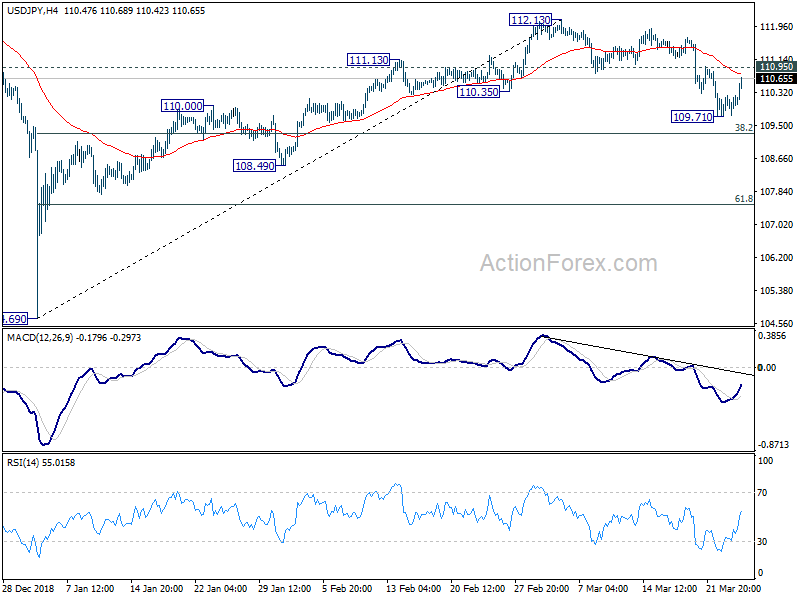
Daily Pivots: (S1) 109.71; (P) 109.97; (R1) 110.23; More...
USD/JPY rebounds strongly today but stays below 110.95 minor resistance. Intraday bias remains neutral and another fall is in favor. On the downside, below 109.71 will resume the fall from 112.13 to 38.2% retracement of 104.69 to 112.13 at 109.28. Break of 109.28 will target 61.8% retracement at 107.53 next. On the upside, break of 110.95 minor resistance will turn bias back to the upside for retesting 112.13 instead.
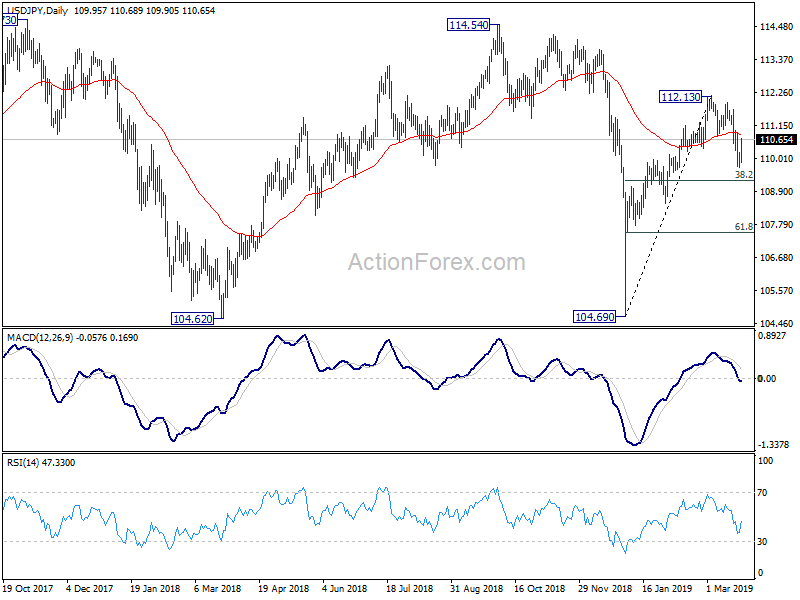
In the bigger picture, while the rebound from 104.69 was strong, USD/JPY failed to sustain above 55 week EMA (now at 110.91), and was kept well below 114.54 resistance. Medium term outlook is turned mixed and we'll wait for the structure of the fall from 112.13 to unveil to make an assessment later. For now, more range trading is expected between 104.69 and 112.13 first.
USD/CHF Mid-Day Outlook
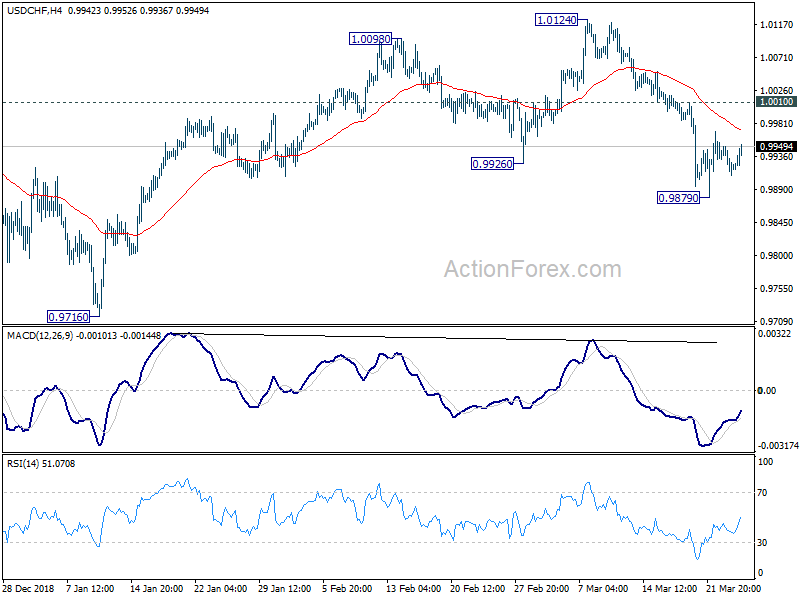
Daily Pivots: (S1) 0.9906; (P) 0.9928; (R1) 0.9947; More.....
USD/CHF is staying in consolidation above 0.9879 temporary low. Intraday bias stays neutral for more consolidations. As long as 1.0010 minor resistance holds, further decline is mildly in favor. On the downside, below 0.9879 will resume the fall from 1.0124 to 0.9716 key support. Nevertheless, break of 1.0010 will turn bias back to the upside for 1.0124/28 resistance zone.
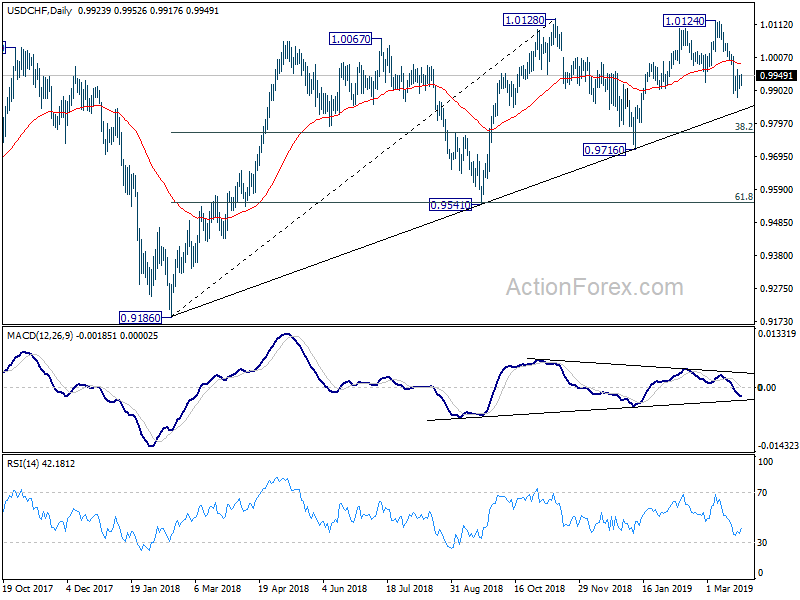
In the bigger picture, focus is back on medium term trend line (now at 0.9846). Decisive break there will argue that whole rise from 0.9186 has completed. Further break of 0.9716 will confirm reversal and target next support level at 0.9541. Nevertheless, there is still a chance that price action from 1.0128 are forming a consolidative pattern with fall from 1.0124 as third leg. If this is the case, stronger support should be seen between 0.9716 and the trend line to contain downside.
GBP/USD Mid-Day Outlook
Daily Pivots: (S1) 1.3158; (P) 1.3202; (R1) 1.3244; More....
Intraday bias in GBP/USD remains neutral for consolidation inside range of 1.2960/3381. For now, as long as 1.2960 support holds, further rally remains in favor. On the upside, firm break of 1.3381 will resume the rebound from 1.2391 to 61.8% retracement of 1.4376 to 1.2391 at 1.3618 next. However, on the downside, decisive break of 1.2960 will indicate that rebound from 1.2391 has completed earlier than expected. Deeper fall would then be seen to 1.2773 support for confirmation.
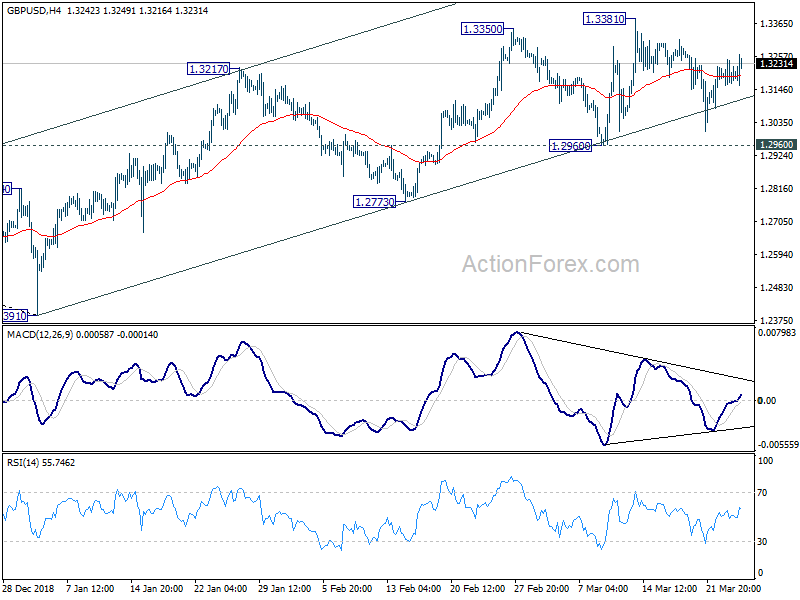
In the bigger picture, medium term decline from 1.4376 (2018 high) should have completed at 1.2391. Rise from 1.2391 is now seen as the third leg of the corrective pattern from 1.1946 (2016 low). Further rise could be seen through 1.4376 in medium term. On the downside, though, break of 1.2773 support will dampen this view. Focus will be turned back to 1.2391 low and break will resume the fall from 1.4376 to 1.1946.
EUR/USD Outlook: Softer Risk Sentiment after Weak US Housing Data Sends Euro Lower
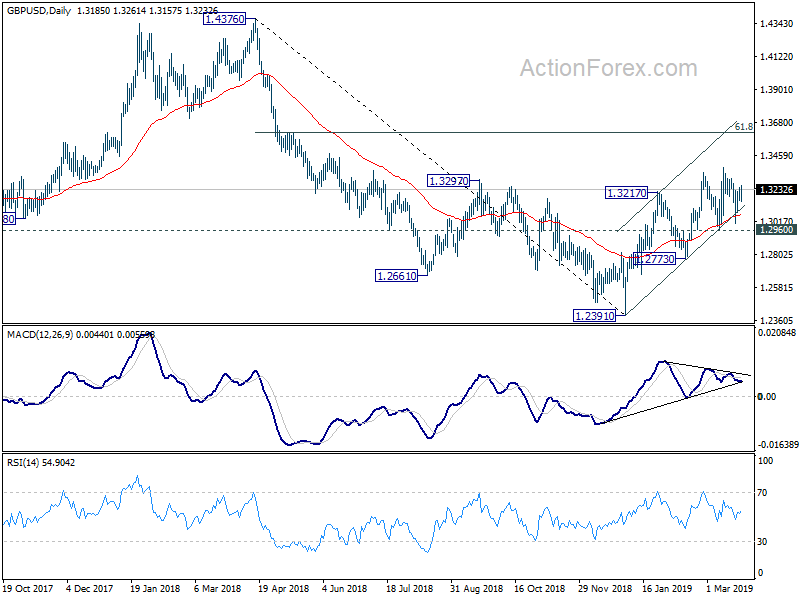
The Euro accelerated lower in early US session on Tuesday and pressures key Fibo support at 1.1280 (61.8% of 1.1176/1.1448) as weaker than expected US housing data turned existing risk mode down.
US building permits fell 1.6% in Feb, beating forecast for -1.3% and Jan 1.4%, while housing starts slumped in Feb (-8.7% vs -0.8% f/c and 11.7% previous month).
Negative tone is expected to persist while the price holds below 20SMA (1.1320) which repeatedly capped upticks on Mon/Tue. Eventual break of 1.1280 Fibo support would risk extension towards 1.1240 (Fibo 76.4%) with stronger bearish acceleration to expose psychological 1.1200 support and key 1.1176 support (2019 low, posted on 7 Mar).
Fresh bearish momentum is emerging and adds to pressure from thick daily cloud and daily MA's in negative setup. Lift above 20 SMA would ease bearish pressure, while sustained break above 10SMA (1.1334) is needed to sideline bears.
Res: 1.1320; 1.1334; 1.1344; 1.1363
Sup: 1.1280; 1.1240; 1.1200; 1.1176
Risk On Morning as Bond Yields Stabilize
- Brexit – May fights to the end
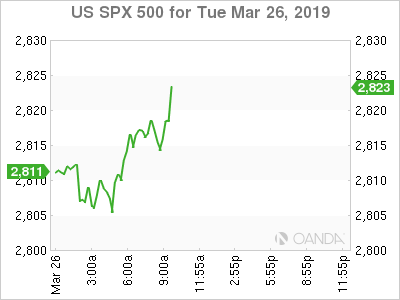
- Stocks – Yields rise driving stocks higher
- Trump – Wants courts to abolish Obamacare
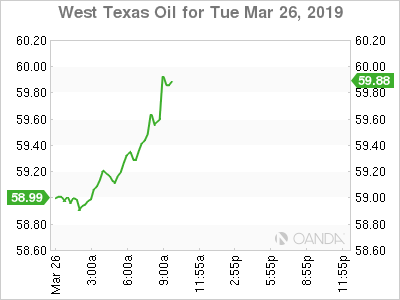
- Oil – benefits on risk-on move; inventories seen falling by 1.2M barrels
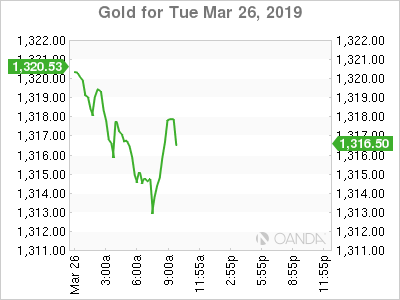
- Gold – stock rally triggers profit taking
Brexit
Parliament took control over the Brexit process, but if they can’t agree on anything, PM May could get another chance to push her deal through. Yesterday’s late 329-302 defeat in the House of commons set up Parliament’s chance on Wednesday to vote on anything, including a second referendum, staying in the customs union, or even cancelling a Brexit. The risk of a no-deal Brexit still exists, but financial markets appear to believe that as the least likely outcome. Today, MPs will decide what alternative Brexit options they want to suggest for tomorrow’s indicative votes.
PM May did receive some good news after Brexit hardliner Jacob Rees-Mogg noted he is willing to support her deal. After consecutive humiliating defeats, if PM May does get a third meaningful vote, she may stand a chance of getting this divorce agreement finally pushed through.
Stocks
US equities are poised to open sharply higher as global bond yields stabilized. Today’s rebound is supporting the growing belief that this yield curve inversion is not a definitive sign a recession is coming and more importantly that the current economic cycle is not over. The key spread between the 10-year and 2-year Treasuries widened to 15.8 basis points.
Today, housing data came in softer than expected, confirming weakness with the housing market. Housing starts for February came in at 1.162 million, missing the analysts’ consensus of 1.3 million and lower than the prior 1.27 million reading.
Trump
Fresh off his victory of Mueller not finding enough evidence of collusion with Russia, President Trump is trying to have courts abolish Obamacare. A controversial move, that has the potential of removing healthcare from millions of Americans. Trump is claiming the Affordable Care Act (ACA) is unconstitutional, this may be more of a campaigning angle he will take to appease his base, but he could lose votes as many senior citizens are rely on ACA to save money on Medicare.
Oil
Crude prices rose sharply, benefitting from the last night’s risk-on rally. Last week, West Texas Intermediate crude plunged after inventories plunged by almost 10 million barrels. This week, we could see inventories draw 1.9 million barrels.
Oil prices are supported by the OPEC + production cuts, but once we see the next wave of the US shale revolution, we could see OPEC lose some relevance. Current expectations are for US crude exports to rise to a record 5 million barrels by late 2020, a near 70% jump from current levels.
Gold
The precious metal pulled back as investors used the positive trading environment to lock in some profits. While gold has been stuck in a very wide trading range over the past few years, we could see the dovish stances delivered by the Fed and the ECB keep the metal making a push for those upper boundaries.
Canadian Dollar Subdued as Fed Leaves Investors With Sour Taste
The Canadian dollar is almost unchanged on Tuesday. In the North American session, the pair is trading a t1.3408, down 0.03%. In the U.S., building permits slowed to 1.30 million, shy of the estimate of 1.32 million. CB consumer confidence is expected to improve to 132.1 points. On Wednesday, Canada releases trade balance.
Stock markets dived on Friday after U.S. treasury bonds indicated the dreaded inverted yield curve, which is considered a recession indicator. Canadian bonds are also the inverted yield curve, pointing to a growing risk of recession. The Bank of Canada has taken a page out of the Federal Reserve playbook, freezing rates so far in 2019. If economic data remains lukewarm, the bank may have to consider a rate cut later in the year.
The Federal Reserve has become ever more dovish, leaving investors in a glum mood. At last week’s meeting, policymakers indicated they had no plans to raise interest rates in 2019 and also lowered its growth forecast for 2019 to 2.1%, down from 2.3% in December. There was more bad news on Friday, as the spread between 3-month and 10-year Treasury notes turned negative for the first time since 2007, pointing to an inverted yield curve. All eyes will be on U.S. Final GDP, which will be released on Thursday. If GDP is weaker than expected, investors could lose their risk apetite and the Canadian dollar could lose ground.
EUR/USD Mid-Day Outlook
Daily Pivots: (S1) 1.1292; (P) 1.1312; (R1) 1.1336; More.....
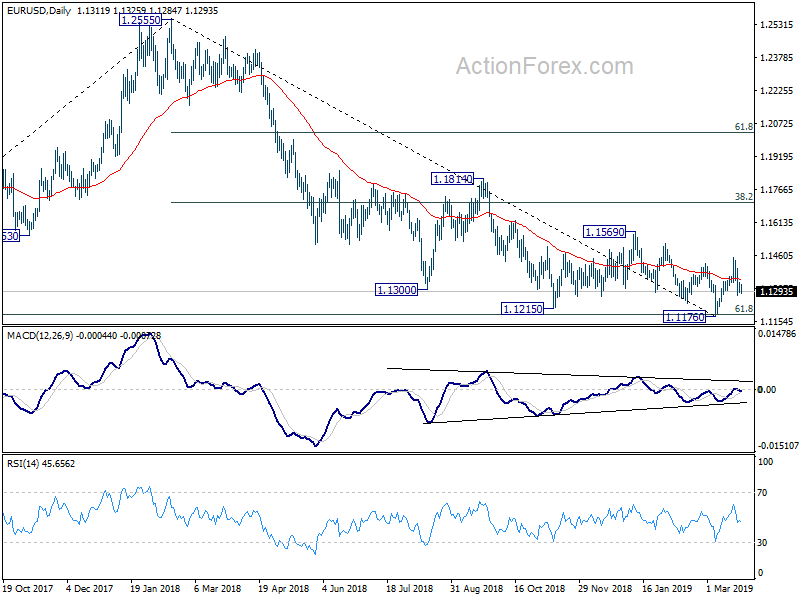
Intraday bias in EUR/USD remains neutral for consolidation above 1.1273 temporary low. For now, another fall remains mildly in favor and break of 1.1273 will target a test on 1.1176 low. Decisive break there will resume whole decline from 1.2555. On the upside, above 1.1448 will resume the rebound from 1.1176 to 1.1569 resistance instead.
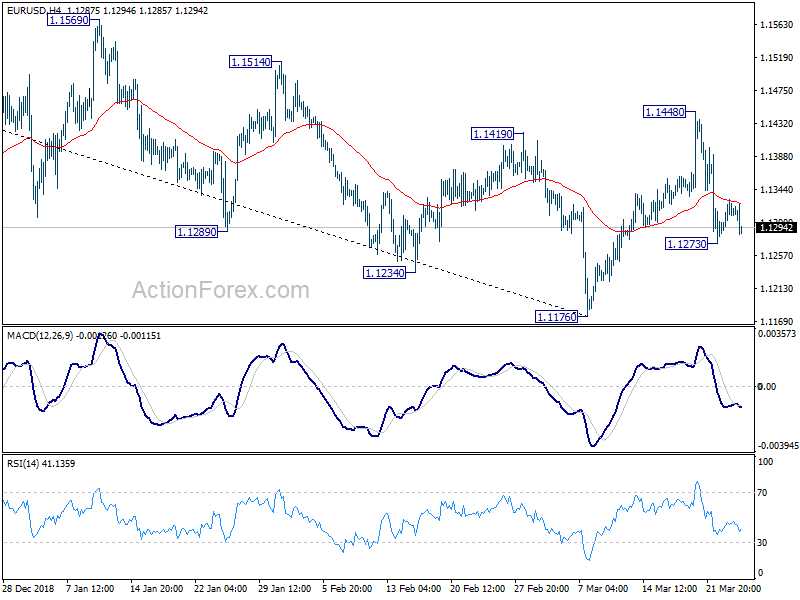
In the bigger picture, medium term outlooks is a bit mixed for now as there are conflicting signals. We'll turn neutral first. On the downside, decisive break of 61.8% retracement of 1.0339 (2016 low) to 1.2555 (2018 high) at 1.1186 will resume the whole down trend from 1.2555. Next target will be 1.0339 low. Nevertheless, break of 1.1569 resistance should confirm medium term bottoming. Stronger rebound should be seen back to 38.2% retracement of 1.2555 to 1.1176 at 1.1703. In that case, the structure of the rise from 1.1176 and reaction to 1.1703 fibonacci level will be watched for making an assessment on whether medium term trend has reversed, or rebound form 1.1176 is merely a correction.
Yen Lower as CAC Leads European Stocks Higher, Sterling Rises on Revived Brexit Hope
The forex markets are staying in consolidative mode today. Sterling rises notably as some Brexiteers are finally agreeing that Prime Minister Theresa May's deal is better than no Brexit. At least, there is a chance for future governments to adjust the relationship with EU further. But in any case, traders will likely stay cautious ahead of tomorrow's vote on Brexit alternatives. Following the Pound, Australian Dollar is the second strongest, followed by Dollar.
Meanwhile, CAC leads European stocks higher as Airbus secured a giant deal with China during President Xi Jinping's EU visit. But after all, major pairs and crosses are bounded in familiar range. Yen is the weakest one for today as risk sentiments improved. Euro's is surprisingly the second weakest, followed by Swiss Franc.
Technically, there is no clear sign of break out in most pairs yet. Though, EUR/USD is rejected by 4 hour 55 EMA as yesterday's recovery lost stem. Immediate focus is back on 1.1273 temporary low and break will extend the fall from 1.1448 to 1.1176 low. WTI crude oil is back above 60 and focus will be on last week's high at 60.36. Break will resume medium term up trend.
In Europe, FTSE is currently up 0.22%. DAX is up 0.30%. CAC is up 0.74%. German 10-year yield is up 0.011 at -0.014. Earlier in Asia, Nikkei rose 2.15%. Hong Kong HSI rose 0.15%. China Shanghai SSE dropped -1.51%. Singapore Strait Times rose 0.55%. Japan 10-year JGB yield rose 0.0176 to -0.66.
Released from US, housing starts dropped to 1.16M annualized rate in February, below expectation of 1.22M. Building permits dropped to 1.30M, missed expectation of 1.32M. House price index rose 0.6% mom in January. S&P Case-Shiller 20 cities house price rose 3.6% yoy in January.
Fed Evans: Scale of China and Europe slowdown watched to determine impact on Fed policy
Chicago Fed President Charles Evans said today that Fed will monitor the slowdown in China and Europe to determine any policy actions. And, "it depends a lot on how large the slowdown would be in China, and how big the headwinds would be from European deceleration as well".
Evans also referred to what happened in the past few years on monetary policy. "We were about ready to start raising rates then additional uncertainty pushed us off until December 2015," he said. "And then the uncertainty of 2016 made us wait again until end of 2016."
In the same event in Hong Kong, Boston Fed President Eric Rosengren said policymakers are "really focused on domestic economic conditions generally in the United States," but "to the extent that it does affect the United States, we fully take that into account."
Rees-Mogg and Fabricant agree May's Brexit deal is better than not leaving at all
Brexit hardliner Jacob Rees-Mogg reiterated his backing to Prime Minister Theresa May's deal as it's better than no Brexit. He tweeted that "The choice seems to be Mrs May's deal or no Brexit." Also, Rees-Mogg explained in the Monday Moggcast podcast that "I've always thought that no deal is better than Mrs. May's deal, but that Mrs. May's deal is better than not leaving at all." While May's deal is "in no way a good deal, Rees-Mogg said: "against that there are the threats of a long delay, and many people in Parliament who want to frustrate the result of the referendum."
Conservative MP Michael Fabricant echoed as that it's the "dreadful conclusion" he came to too. And "a new PM can then negotiate a better and more distanced relationship with the EU after Brexit. (Of course this is the least worst option but the only practical way forward for now.)" Fabricant also said: "The practical alternatives are far worse that the Withdrawal Agreement including keeping us in the Customs Union and Single Market indefinitely so no control of immigration or having to obey EU directives."
Yesterday, the UK Parliament seized control over Brexit from the government after passing a cross-party amendment by 329 to 302. It gives MPs a series of votes on alternatives to Prime Minister Theresa May's Brexit deal, including a second referendum, staying the the customs union, no-deal and even revoking article 50. The votes will be carried out on Wednesday.
Chinese Xi meets EU leaders as Juncker called for trade reciprocity
Chinese President Xi-Jingping met European leaders in Pair today, including European Commission President Jean-Claude Juncker, German Chancellor Angela Merkel, and the host French President Emmanuel Macron. Xi said that cooperation is the mainstream in China-Europe relations, and even if there are differences and competition, it is benign competition.
Juncker called for China to open up the markets for the EU. He urged clearer reciprocity so that "European businesses could have the same degree of access to the Chinese market as Chinese businesses have in Europe." Macron said: "We would like to make progress renovating multilateralism. We have divergences, obviously in the history of humanity power does not go without rivalry, none of us are naive," Macron added "But we respect China and are determined to have dialogue and cooperation."
Also, during the trip, China announced to purchase EUR 30B in air jets from Airbus. The giant deal include 290 A320-series narrow-body planes and 10 A350 wide-bodies. The A320 is the chief global rival of Boeing's 737 Max and the latter just had two fatal crashes in five months.
Gfk: German consumers certainly not assuming recession this year
German Gfk consumer sentiment for April, dropped slightly to 10.4, down from 10.7 and missed expectation of 10.8. Gfk noted that consumer mood looks "somewhat more balanced" than in previous months. And more importantly, decline in economic expectation halted, "at least temporarily. The index rose 7 pts to 11.2 even though it's way off last year's 45.9.
Consumers are "certainly not assuming that Germany will fall into recession this year", just a "noticeable cooling off of economic activity". Gfk k added that this is due to the so called "Five Sages" have lowered lowered their original growth forecast for this year from 1.7 to just 0.8 percent.
Also, the downturn is more due to foreign than domestic economic factors, including the "lack of decisiveness" regarding Brexit data and nature, as well as US-EU trade conflicts.
Abenomics architect said BoJ ought to buy government bonds more aggressively
Kozo Yamamoto, a senior ruling LDP lawmaker and a key architect of Abenomics, complained that BoJ made a mistake in 2016 to change its policy to target interest rate under than yield curve control, instead of the pace of monetary base expansion. He said BoJ "ought to buy government bonds more aggressively". But it's difficult under the current YCC.
Also, Yamamoto said he opposes the plan sales tax hike in October and discussed with Prime Minister Shinzo Abe. But he cannot convince Abe to put off the twice-delayed sales tax hike. He said, "the prime minister told me while I may be theoretically right, it was politically difficult".
BoJ opinions: Downside risks to economy clearly heightening recently
In the summary of opinions at the March 14/15 monetary policy meeting, BoJ noted that "while uncertainties regarding overseas economies started to become apparent from around last autumn, slowdowns have materialized.". And, "reflecting these developments, downside risks to Japan's economy clearly have been heightening recently."
Also, it is concerning that developments toward an economic downturn could heighten, depending on developments in overseas economies and the effects of the scheduled consumption tax hike.
On monetary policy, BoJ maintained that it should "persistently continue with the current monetary policy stance". But it also emphasized that "in case developments in economic activity and prices undergo a phase shift, it is important to make preemptive policy responses."
On the data front
Japan corporate service price rose 1.1% yoy in February versus expectation of 1.2% yoy. New Zealand trade surplus came in at NZD 12M versus expectation of NZD -200M deficit. Germany Gfk consumer sentiment dropped to 10.4 in April, below expectation of 10.8.
Looking ahead, UK will release BBA mortgage approvals in European session. US will release housing starts and building permits, house price indices later in the day. But most attention will likely be on consumer confidence.
EUR/USD Mid-Day Outlook
Daily Pivots: (S1) 1.1292; (P) 1.1312; (R1) 1.1336; More.....
Intraday bias in EUR/USD remains neutral for consolidation above 1.1273 temporary low. For now, another fall remains mildly in favor and break of 1.1273 will target a test on 1.1176 low. Decisive break there will resume whole decline from 1.2555. On the upside, above 1.1448 will resume the rebound from 1.1176 to 1.1569 resistance instead.
In the bigger picture, medium term outlooks is a bit mixed for now as there are conflicting signals. We'll turn neutral first. On the downside, decisive break of 61.8% retracement of 1.0339 (2016 low) to 1.2555 (2018 high) at 1.1186 will resume the whole down trend from 1.2555. Next target will be 1.0339 low. Nevertheless, break of 1.1569 resistance should confirm medium term bottoming. Stronger rebound should be seen back to 38.2% retracement of 1.2555 to 1.1176 at 1.1703. In that case, the structure of the rise from 1.1176 and reaction to 1.1703 fibonacci level will be watched for making an assessment on whether medium term trend has reversed, or rebound form 1.1176 is merely a correction.
Economic Indicators Update
| GMT | Ccy | Events | Actual | Forecast | Previous | Revised |
|---|---|---|---|---|---|---|
| 21:45 | NZD | Trade Balance (NZD) Feb | 12M | -200M | -914M | -948M |
| 23:50 | JPY | BOJ Summary of Opinions | ||||
| 23:50 | JPY | Corporate Service Price Y/Y Feb | 1.10% | 1.20% | 1.10% | 1.00% |
| 07:00 | EUR | German GfK Consumer Confidence Apr | 10.4 | 10.8 | 10.8 | 10.7 |
| 09:30 | GBP | BBA Mortgage Approvals Feb | 35.3K | 39.4K | 40.6K | 39.6K |
| 12:30 | USD | Housing Starts Feb | 1.16M | 1.22M | 1.23M | 1.27M |
| 12:30 | USD | Building Permits Feb | 1.30M | 1.32M | 1.32M | |
| 13:00 | USD | House Price Index M/M Jan | 0.60% | 0.40% | 0.30% | |
| 13:00 | USD | S&P/Case-Shiller Composite-20 Y/Y Jan | 3.60% | 4.00% | 4.18% | 4.10% |
| 14:00 | USD | Consumer Confidence Index Mar | 132 | 131.4 |