Sample Category Title
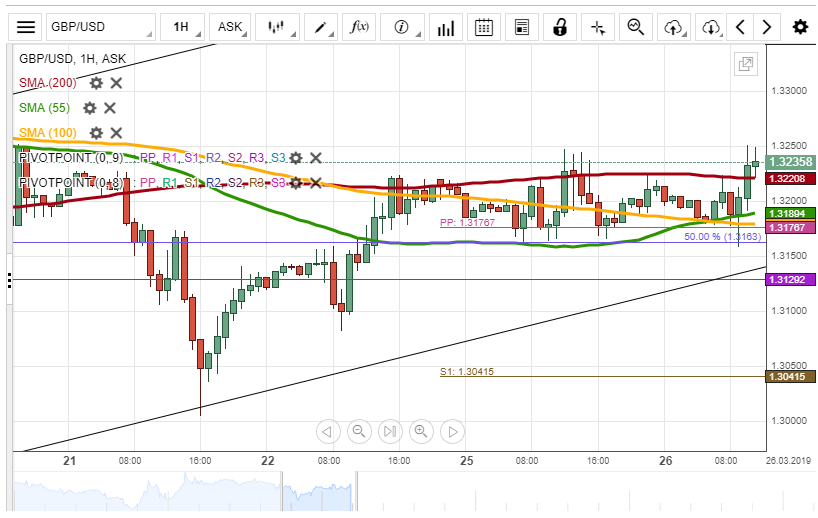
GBP/USD Could Break 200-Hour SMA
During Monday's trading session, the currency exchange rate traded sideways between the 55-hour and the 200-hour simple moving averages at 1.3150 level. On Tuesday morning, the rate was supported by the 55-hour simple moving average to trade at the 1.3209 mark.
The rate could continue to trade sideways to stay near the weekly pivot point at 1.3176 to end the trading session at the 1.3200 level.
However, the support levels of the 55-hour and the 100-hour SMAs together with the support level of the weekly pivot point could retrace the rate to push it to break the resistance level of the 200-hour SMA to end the day at 1.3250.
USD/JPY Might Fall To 109.80
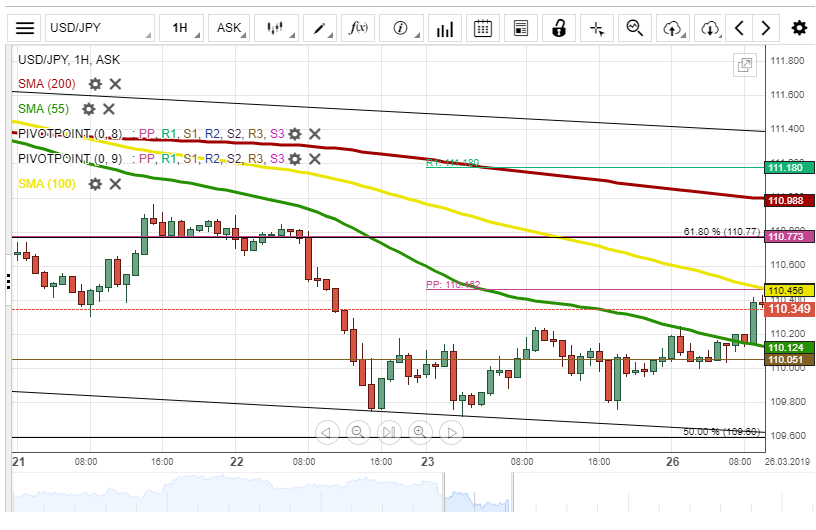
During Monday's trading session, the currency exchange rate traded sideways to end the trading day at 110.20. On Tuesday morning, the rate was supported by the 55-hour simple moving average to trade at the 110.38 mark.
Most likely, the 100-hour simple moving average together with the resistance level of the weekly pivot point at 110.46 will retrace the rate to the 109.80 level.
On the other hand, the support level of the 55-hour simple moving average could push the rate to pass through the resistance levels to end the trading session near the 61.80% Fibonacci retracement level at the 110.77 mark.
XAU/USD Falls To Medium Pattern
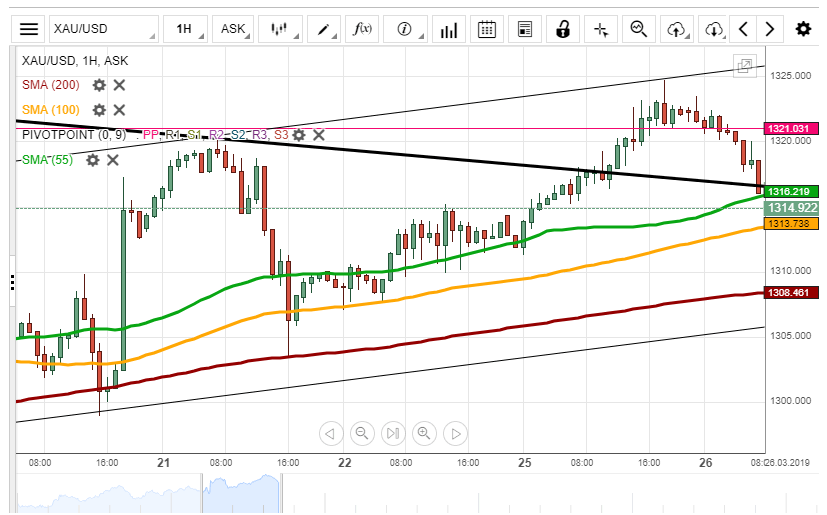
During yesterday's trading session, the yellow metal broke through the resistance of the medium pattern line at the 1,318.00 mark as it was expected! On Tuesday morning, the rate depreciated against the US Dollar to fit back to the medium pattern line to trade at the 1314.47 mark.
It is expected that gold will continue depreciating against the US Dollar to end the day at the 1,310.00 level!
However, the 100-hour SMA could support the rate to push it to break the medium pattern to the 1,320.00 level.
Note, the chart was fully reviewed to make a new pattern line that follows the current trend!
Investors Are Nervous About A Possible US Recession
Stock markets lost more than 2.5% during sell-off since the end of last week on fears that debt markets give a signal of an imminent U.S. recession.
However, the global currency markets remained calm, and this, in our opinion, provides an important inside about market sentiment.
At the same time, investors very nervously perceived a partial inversion of the US government bonds yield curve, and now the debt markets show a 75% chance of lowering the Fed rates in the coming year, according to the Fed Watch tool.
Yesterday, in the period of the most intensive sales, this indicator reached even up to 100%.
All other things being equal, such a revision of expectations would have caused a sharp weakening of the dollar, but it, on the contrary, it continued to grow at the end of last week and only slightly fell on Monday.
In general, the currency market is largely avoiding panic. Thus, the Japanese yen received support after strengthening below 110 per dollar. The weakening of national currency supported demand for the Tokyo Stock Exchange assets.
Moreover, the Swiss franc keep even more calm, has stabilized near 0.9930 since the middle of last week.
It is worth noting that the developing countries' currencies, which are most exposed to decline in the event of a market panic, quickly turned to growth, offsetting a significant part of their losses.
Thus, the wave of sales on the stock markets was provoked, rather, by the cautious mood of investors after a long rally, than by justified fears. At the very least, this explanation looks the most rational at the moment.
Now it is worth paying close attention to the debt markets, where the intensifying of pressure on the long-term US government bonds yield is able to return the wary mood of investors.
WTI OIL Outlook: Oil Price Regains Traction After Shallow Pullback
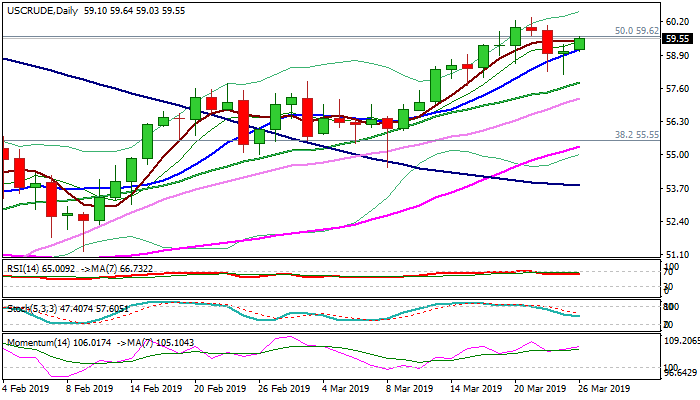
WTI oil price rises on Tuesday after shallow pullback from new 2019 high at $60.37 found footstep and managed to close twice above cracked 10SMA (currently at $58.87), keeping broader bulls intact.
Limited pullback was price adjustment ahead of fresh advance as overall picture remains bullish.
Positive sentiment was dented by weak data in past few sessions but traders eye OPEC+ action in reduction and US sanctions on other key oil exporters, Iran and Venezuela, as key support factors that will continue to boost oil price.
Fresh bulls eye again cracked psychological $60 barrier, with final break and close above it expected to signal for further advance towards next key barrier at $61.66.
Strong bullish momentum on daily chart supports scenario.
Focus turns towards releases of US crude inventories reports (API report is due later today and EIA will release its report on Wednesday.
Last week's unexpectedly strong draw in crude stocks boosted oil prices and repeated positive results would offer further support.
Rising 10SMA continues to track and bullish stance will remain intact while it holds.
Res: 60.05, 60.37, 61.00, 61.66
Sup: 58.87, 58.16, 57.81, 57.22
AUD/USD Outlook: Aussie Extends Recovery, Fresh Risk Mode Supports Advance
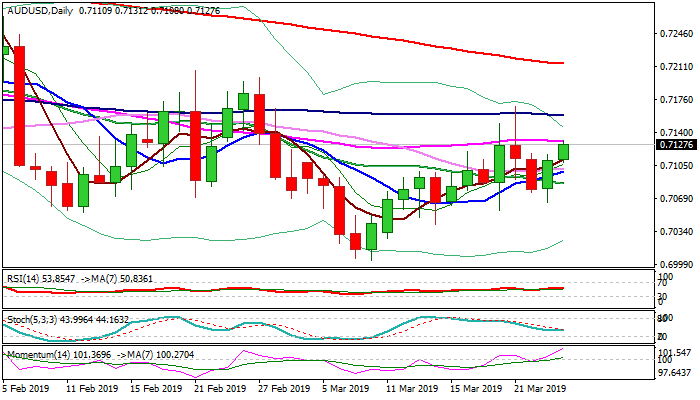
The Aussie dollar extends higher on Tuesday after Monday's recovery managed to close above a cluster of daily MA's (between 0.7085 and 0.7101) and generated positive signal. Fresh extension higher cracks pivotal barriers at 0.7129/30 (Fibo 61.8% of 0.7168/0.7065 pullback/55SMA), helped by rising bullish momentum and renewed risk appetite, as well as RBA's positive tone on the economy. Sustained break above 0.7130 would open way for test of key barriers at 0.7158/68 (100SMA/daily cloud top/21 Mar spike high). Converging 30/10SMA's offer solid supports at 0.7106/01 which is expected to hold and keep fresh bulls in play.
Res: 0.7130, 0.7143, 0.7158, 0.7168
Sup: 0.7116, 0.7101, 0.7085, 0.7065
EUR/USD – Euro Remains Listless, German Consumer Confidence Slips
EUR/USD continues to drift this week. Currently, the pair is trading at 1.1325, up 0.11% on the day. On the release front, German GfK Consumer Climate fell to 10.4, shy of the estimate of 10.8 points. In the U.S., building permits is projected to dip to 1.32 million. CB consumer confidence is expected to improve to 132.1 points.
German consumer confidence disappointed in March. The indicator slipped to 10.4, after two successive readings of 10.8 points. With the eurozone mired in an economic slowdown and German numbers pointing to weaker growth, it’s not surprising that the German consumer is less optimistic. This release comes on the heels of German business confidence, which improved slightly in March, with a reading of 99.6 points. The markets have been accustomed to releases above the 100-level, and the February reading of 98.5 was the weakest since November 2014. The survey noted that any improvement was confined to domestic sectors, such as construction and retail services. The manufacturing sector remains weak, battered down by the ongoing global trade war, which has dampened the appetite for German exports, such as vehicles and auto parts. Germany’s economy slowed down in the fourth quarter, and this bodes poorly for the rest of the eurozone.
Is a recession in the cards for the U.S. economy? At last week’s policy meeting, the Federal Reserve indicated it had no plans to raise interest rates in 2019 and also lowered its growth forecast for 2019 to 2.1%, down from 2.3% in December. There was more bad news on Friday, as the spread between 3-month and 10-year Treasury notes turned negative for the first time since 2007. This is known as an inverted yield curve, which is considered a recession indicator. All eyes will be on U.S Final GDP, which will be released on Thursday. If GDP is weaker than expected, investors could lose their risk apetite and the Canadian dollar could lose ground.
Pound Unfazed By Latest Brexit Development
Tuesday March 26: Five things the markets are talking about
Global equities have rallied overnight after two session of losses as the U.S 10-year Treasury yields backed away from this year’s low yield print, but the outlook remains somewhat uncertain as investors weigh the possibility of the U.S slipping into a recession.
Note: The 10-year note has backed up to +2.442%, having lost -5 bps yesterday and dropped temporary below the three-month bill.
U.K MP’s take control for a day
In FX, sterling (£1.3185) has edged lower after PM Theresa May lost control over the Brexit process in a U.K Parliament vote late last night. MP’s may now be able to demand that the PM pursues radical Plan B options, potentially including a second referendum, keeping Britain in the EU union, or even canceling Brexit. Remember, a no-deal Brexit does remain on the table!
MP’s are expected to vote on a range of Brexit options tomorrow (Mar 27), basically looking to agree on a deal with closer ties to Brussels – and then try to drive the government in that direction.
In commodities, oil prices have rallied for the first time in a number of days amid rising tensions in Venezuela that again threaten to further curb supplies.
On tap: U.S consumer confidence & RBNZ monetary policy announcement (Mar 26), CAD trade balance & NZD business confidence (Mar 27), U.S final GDP (Mar 28), GBP current a/c, CAD GDP & U.K Parliament vote (Mar 29).
1. Stocks given the ‘green’ light
In Japan, the Nikkei rallied aggressively from its five-week lows print on Monday to close sharply higher overnight as cyclical stocks rose on short-covering. The market is also being supported by investor purchases of stocks before they go ex-dividend at the end of March. The Nikkei share average ended +2.15% higher, while the broader Topix rallied +2.57%.
Down-under, Aussie shares closed marginally higher overnight, helped by mining shares and an uptick in U.S Treasury yields. The S&P/ASX 200 index firmed nearly +0.1%. The benchmark fell -1.1% on Monday. In S. Korea, the Kospi stock index rose slightly (+0.18%) overnight as foreigners turned net buyers following Monday’s sharp selloff. The index has risen +5.28% so far this year and fallen -1.5% in the previous 30 trading sessions.
In China, shares fell overnight, extending this week’s sharp losses as investors remain concerned over the outlook for global growth and the next round of China-U.S trade talks to take place later this week (Mar 28/29). At the close, the Shanghai Composite index was down -1.51%, while the blue-chip CSI300 index was down -1.13%.
In Hong Kong, equities were steady after Monday’s heavy losses, but investor sentiment remains fragile as concerns over the possibility of a U.S recession happening, and as China and the U.S prepare for this week’s high-level trade talks. At the close of trade, the Hang Seng index was up +0.15%.
In Europe, regional indices trade mostly higher following on from a stronger session in Asia overnight and higher U.S futures this morning.
U.S stocks are set to open in the ‘black’ (+0.25%).
Indices: Stoxx600 +0.29% at 375.42, FTSE +0.41% at 7,207.25, DAX -0.06% at 11,340.28, CAC-40 +0.35% at 5,279.12, IBEX-35 +0.04% at 9,183.12, FTSE MIB +0.15% at 21,090.50, SMI +0.52% at 9,354.10, S&P 500 Futures +0.25%
2. Oil prices rise amid ongoing supply cuts, but recession fears loom, gold lower
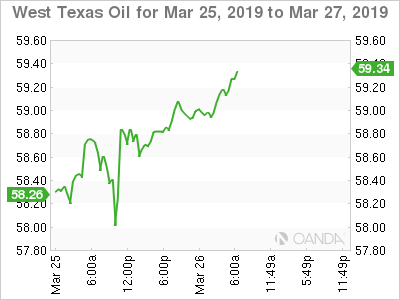
Oil prices have rallied overnight, pushed up by supply cuts led by OPEC+ and U.S sanctions against Iran and Venezuela, although investor concerns about a potential recession is keeping a lid on the market for now.
Brent crude oil futures are at +$67.48 per barrel, up +27c, or +0.4%, from yesterday’s close.
U.S West Texas Intermediate (WTI) futures are at +$59.35 per barrel, up +53c, or +0.9%, from Monday’s settlement.
Oil prices have been supported for much of this year by efforts by OPEC+, who have pledged to withhold around +1.2M bpd of supply this year to prop up markets.
Market consensus believes that OPEC is likely to extend its current supply cut deal for the duration of 2019 when they next meet in Vienna in June. Russia has been a reluctant partner in the supply cuts but is expected to opt to preserve the deal and retain a leadership role within the group that accounts for +45 % of total global oil output.
Support for the ‘black stuff’ has also come from U.S sanctions against OPEC-members Iran and Venezuela.
Note: Iranian crude oil shipments have averaged just over +1M bpd this month, down from +1.3M bpd in February, while in Venezuela, production has plummeted from +3M bpd in 2000 to +1M bpd in 2019.
However, recession risk is at an 11-year high, and it’s this fear that could dent global fuel consumption.
Ahead of the U.S open, gold prices have eased overnight, after hitting a one-month high in Monday’s session, as a recovery in equity prices and U.S Treasury yields help reduce some of the ‘yellow’ metal’s safe-haven appeal. Spot gold is down -0.3% at +$1,317.46 per ounce, after touching its highest since Feb. 28 at +$1,324.33 yesterday. U.S gold futures are down -0.4% at +$1,317.10 an ounce.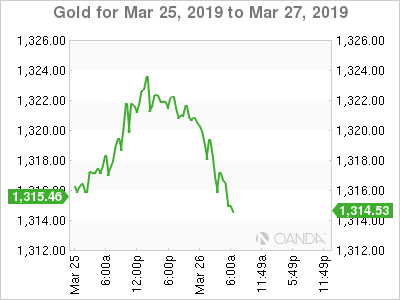
3. Sovereign yields back up, but recession fears loom
Ten-year German government Bund yield remains below the psychological zero print as recession fears dominate market sentiment and Brexit troubles drain market liquidity.
U.K MP’s voted Monday to take control of parliament for a day from PM May, meaning they are now expected to vote on various Brexit options tomorrow.
However, a ‘no-deal’ Brexit actually occurring would see a massive swing to owning more German bunds, which could push the 10-year Bund yield much deeper into negative territory and trigger more flattening of the long end of the German yield curve, and a very strong widening of credit indices.
Currently, German Bund yields remain atop of their three-year low at -0.027%, as fears of global economic slowdown continue to dictate investment strategies along with Brexit.
The U.S 10-year Treasury yield (+2.428%) fell to their lowest since December 2017 yesterday, causing the curve between three-month bills and 10-year notes to invert further as investors evaluated last week’s “dovish” pivot by the Fed.
Elsewhere, Aussie 10-year yields hit a fresh record low overnight before rising about +5 bps to +1.83%.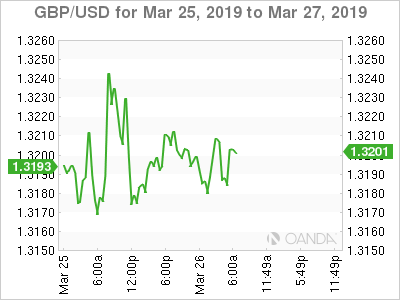
4. Pound unfazed by latest Brexit development
Sterling (£1.3175) trades largely flat after posting a modest rise yesterday after the U.K parliament voted to take control of the Brexit process. Market consensus believes the majority of MP’s would prefer a move toward a permanent custom union option, which would in turn would require an extension of Article 50 by the year-end. The downside is that a long extension to Brexit would bring “prolonged uncertainty.” EUR/GBP is at €0.8576. U.K MP’s will now decide whether to back ‘indicative’ votes on alternatives to U.K PM May’s divorce deal.
Elsewhere, the yen has slipped -0.2% to ¥110.15, while the offshore yuan is steady at ¥6.7144 and the EUR is little changed at €1.1317.
Note: The focus is on the Hungary Central bank rate decision where the MNB is likely to begin its ‘normalization’ process.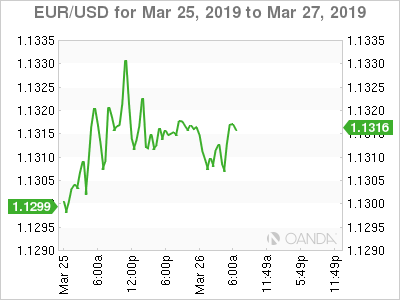
5. German consumer morale slips despite job market
German data this morning shows that German consumers are less optimistic heading into April despite a renewed growth outlook and a vibrant labour market.
Market research firm GfK’s forward-looking monthly barometer stood at 10.4 points for April, down on 10.7 for March.
The gap has “once again narrowed” between rising consumer expectations of changing economic conditions and declining earnings-related conditions, against the backdrop of strong labour market performance, the GfK noted.
“The coming months will show whether this is the beginning of a turnaround,” said GfK in a statement.
The pollsters said consumers “do not expect Germany to slip into a recession this year”.
They do however expect a noticeable slowdown in the economy, like Germany’s ‘wise men’ panel advising the government who last week lowered their GDP growth forecast for this year to just 0.8 percent.
Also weighing on the GfK survey was a drop in both expectations of income and desire to consume, the latter of which has fallen to a level last seen two years ago.
Note: German unemployment remains at historic lows, with just +5.0% of people out of work in Europe’s largest economy.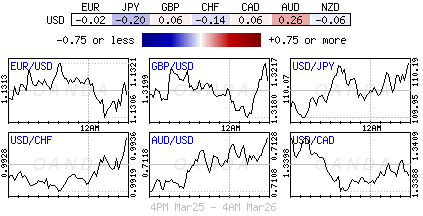
Brexit Out Of Control
Brexit out of control
After the UK Parliament took control of Brexit on Monday, the pound sterling stabilised at around USD 1.32, showing that all options remain on the table. Investors are buying short-term protection against a depreciation of the pound: 1-week implied volatility rose to 16%, while the 25-delta risk reversal measure eased to -1.44% from -0.30 a week ago. In equity markets, reaction was similar with the Footsie edging up 0.02%. Overall, the UK outlook has barely changed: Brexit needs to be addressed!
Prime Minister Theresa May lost control of Brexit on Monday, when Parliament voted (329 versus 302) to grant itself votes on a series of alternative solutions, ranging from leaving without a deal to holding a second referendum. Given that most parliamentarians are in the “remain” camp, the worst that can happen is a soft Brexit. We won’t be surprised if Parliament pushes for a second referendum. It wouldn’t be the first time that a country’s initial decision about the EU is not respected (see France’s and Netherland’s rejection of the EU constitutional treaty in 2005).
Fed Backstops Risk
To watchers of the US Federal Reserve, the biggest surprise lately was an announcement to end balance sheet reduction in September. This should keep assets near USD3.5 trillion, significantly higher than previously indicated. The Fed is also reducing the cap on US treasuries allowed to mature each month from USD30 billion to USD215 billion in May. Anxieties about a scarcity of reserves in the banking system are the driver. Regulatory shifts since the financial crisis demand banks to maintain safe capital that can be used in case of an economic shock. This has increased the demand for “safe” US T-bills. Interest rates may have peaked: this should put a floor on US equities.
The US domestic economy has failed to generate inflation above the Fed’s 2% target. The risk of a pre-emptive hike would be to push the USD higher and further slow economic activity. The Fed has downgraded its economic growth estimate. GDP growth was lowered for 2019 to 2.10% from a previous estimate of 2.3%. Unemployment is forecast to rise to 3.7% in 2019 against 3.5% at the December 2018 meeting. The Fed’s median for inflation is set at 1.8% in 2019 and 1.9% in 2020 and 2021.
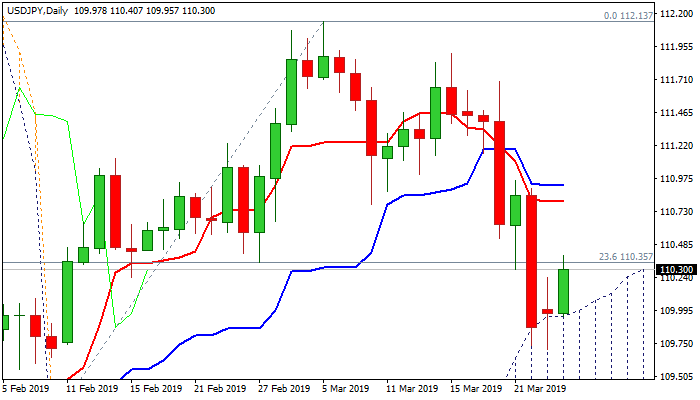
USD/JPY Outlook: Bears Face Strong Headwinds From Rising Daily Cloud
The pair bounces on Tuesday after rising and thickening daily cloud contained recent weakness and Monday's action ended in Doji after Friday's strong fall. Recovery pressures initial barrier at 110.26 (55SMA) which capped Monday's action and sustained break higher is needed to complete reversal pattern and signal further advance. Daily momentum turn higher and stochastic is oversold that could help recovery, but daily MA's in strong bearish setup may partially offset positive signals. Current bounce could be seen as positioning for fresh downside as last week's long red weekly candle weighs. The pair is moving in the fourth corrective wave of five-wave cycle from 112.13, which should be ideally capped by falling 10SMA (110.88) to keep bearish bias for renewed attack at daily cloud. Sustained break above 10SMA would sideline downside risk, but further recovery would face strong headwinds from plethora of daily MA's between 111.02 and 111.43 (30, 20, 100, 200SMA's) and only break here would neutralize bears.
Res: 110.40, 110.88, 111.02, 111.18
Sup: 109.95, 109.71, 109.25, 109.15