

Sample Category Title
Fed Powell: Common-sense risk-management approach served well
Fed Chair Jerome Powell reiterated his recent messages in a speech in New York today. He noted that "nearly all job market indicators are better than a few years ago, and many are at their most favorable levels in decades." Business-sector productivity growth also "moved up in the first three quarters of 2018." Price stability side of Fed's mandate is "in a good place" as "inflation by our preferred measure averaged roughly 2 percent last year" but "signs of upward pressure on inflation appear muted despite the strong labor market".
Powell also noted again that "over the past few months we have seen some crosscurrents and conflicting signals about the near-term outlook." Those include slowdown in major economies, particularly China and Europe. There is elevated uncertainty around unresolved government policy issues including Brexit and trade negotiations. Financial markets conditions have tightened since last fall. Also, "some surveys of business and consumer sentiment have moved lower. Unexpectedly weak retail sales data for December also give reason for caution."
All in all, Fed will be "patient as we determine what future adjustments to the target range for the federal funds rate". He also added that "common-sense risk-management approach has served the Committee well in the past."
Japan PMI manufacturing finalized at 48.9, sharper reductions in output and demand
Japan PMI manufacturing was finalized at 48.9 in February, revised up from 48.5. It's the first contractionary reading since August 2016. Demand conditions in Japan deteriorated at stronger rate while business outlook was broadly neutral having fallen for the ninth straight month.
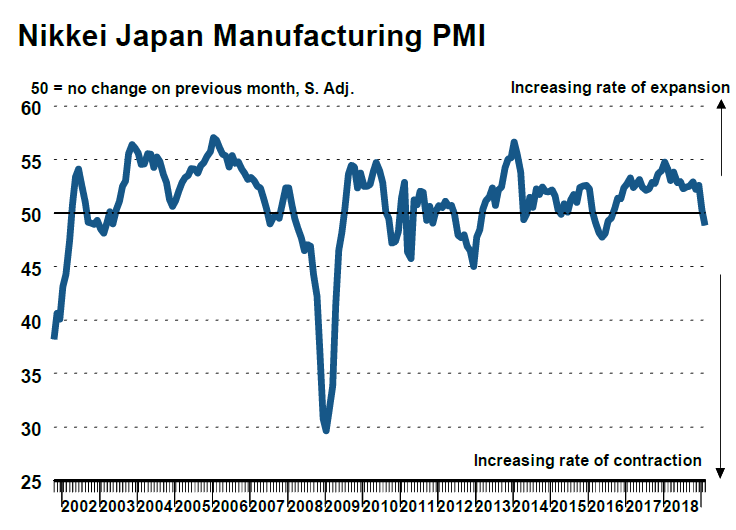
Commenting on the Japanese Manufacturing PMI survey data, Joe Hayes, Economist at IHS Markit, which compiles the survey, said:
"Sharper reductions in output and demand drove the Japanese manufacturing economy into contraction during the midway point of Q1, compounding reductions already recorded in January. Global trade frictions and weak domestic manufacturing demand pose considerable risks to Japan's goods producers. As such, firms pared back expectations to near-neutrality. The rebound seen in the official Q4 GDP estimate does not appear to be reflective of underlying economic conditions in Japan.
"With the consumption tax hike set to come into play later this year, weak domestic demand will only heighten fears that the economy could be poised for a downturn. Focus turns towards service sector data, which will need to show signs of resilience in order to offset the manufacturing drag."
Also from Japan, unemployment rate rose 0.1% to 2.5% in January, versus expectation of 2.4%. Tokyo CPI core was unchanged at 1.1% yoy in February, versus expectation of 1.0% yoy. Capital spending rose 5.7% in Q4 versus expectation of 4.5%.
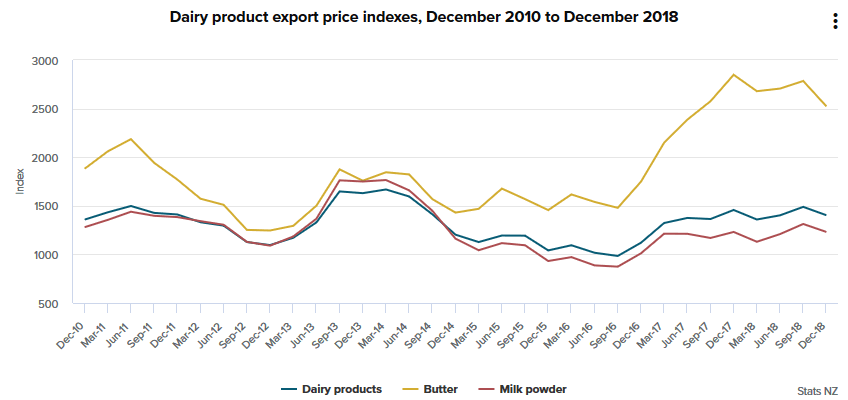
New Zealand terms of trade dropped -3%, largest fall since 2015
New Zealand terms of trade index dropped -3.0% qoq in Q4, much worse than expectation of -1.0% qoq. It's also the largest decline since September 2015 quarter. Also ,falling global prices for milk powder and butter meant overall export prices dropped -1.7%. However, Stats NZ noted that "despite the latest fall, the terms of trade remained near the historic high in the December 2017 quarter."
Also from New Zealand, building permits rose 16.5% mom in January.
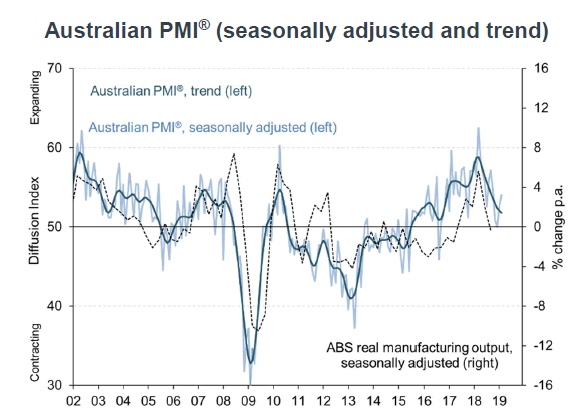
Australia manufacturing PMI rose to 54, but conditions appear to be diverging
Australia AiG Performance of Manufacturing Index rose 1.5 to 54.0 in February. That's the best monthly result since Ocotber 2018 and signals a better month of recovery following and "unreasonably slow summer". While it's still the 30th month of expansion, the trend has suggested "slowing growth rates since its recent peak in March 2018".
Also, AiG noted that "conditions appear to be diverging" acrtoss the larger manufacturing sectors and their main locations. Three of the six sectors expanded, one was stable and two contracted. And, "the downturn in housing construction is already affecting some sectors, as is the uncertainty of impending elections".
Fed Kaplan: Could take a few months to see how much the slowdown is
Dallas Fed President Robert Kaplan said yesterday that it could take a few months to see how much the US economy is slowing. And he added that "I don't think we should be taking any action on the fed funds rate". His comments are in line with the expectations that Fed should at least stand pat through the first half of the year.
Meanwhile, Kaplan also echoed other Fed official's comments that there will be decision regarding the balance sheet runoff in the "not-too-distant future". Though, he declined to comment whether the decision will be made by March FOMC meeting.
He also indicated that the balance is a "critical tool" that Fed need to have as "one of the several tools in the event of a down turn". And the balance needs to have the capacity to respond to the next downturn.
Eco Data 3/1/19
[php_everywhere instance="1"]
US Treasurer Mnuchin working on a 150-page document for “significant”, “structural” commitments from China
US Treasury Secretary Steven Mnuchin said in a CNBC interview that the trade deal with China is "not done yet". But he added "we have made a lot of process" and "we still have more work to do". They're working on a 150-page, very detailed, document for "significant", "structural" commitments from China. Mnuchin hoped to "make progress this month". And, "if we do, there will be a summit of the Presidents".
At the same time, the White House and cabinet are "completely united" on the positions. Mnuchin went further and said ""Whether it's myself, or Ambassador Lighthizer, Secretary Ross, Larry Kudlow or Peter Navarro — we're all working very closely together and we have a common vision in executing and getting a real agreement".
Separately, National Economic Council Director Larry Kudlow said the negotiations are making "fantastic" progress last week. And, "We're making great headway on nontariff barriers and tariffs regarding various commodities such as soybeans and energy and beef. We have mechanisms with regard to enforcement, which is — I think — unparalleled."
Kudlow also hailed that "Lighthizer has worked miracles on this Chinese deal," and "we've never come this far on China trade."
British Pound Rally Takes Pause as US GDP Beats Expectations
GBP/USD has paused on Thursday, after recording gains throughout the week. In the North American session, the pair is trading at 1.3296, down 0.10% on the day. In economic news, there are no major British events. In the U.S., Advance GDP expanded 2.6% in the fourth quarter, above the estimate of 2.2%. Chicago PMI is expected to rise to 57.3 and unemployment claims is forecast to rise to 221 thousand. On Friday, the U.K. releases Manufacturing PMI and Net Lending to Individuals. The U.S. will release Core PCE Price Index and UoM Consumer Sentiment.
With the clock ticking down towards Brexit Day on March 29, there is a flurry of activity in Westminster. Earlier in the week, Prime Minister May made headlines when she announced another vote on the government’s withdrawal agreement, which is scheduled for March 12. If lawmakers reject that proposal, they will vote the next day on two separate proposals – one on a no-deal Brexit, and the second on requesting the EU to extend Article 50 and delay Brexit past March 29. Investors are confident that this makes a no-deal scenario even more unlikely, which has resulted in gains of 2.0% for the pound this week. However, with plenty of turmoil and uncertainty around the Brexit withdrawal, we could see volatility from the pound in the days leading to the parliamentary votes.
The Federal Reserve’s new dovish stance was reinforced by Fed Chair Powell’s testimony on Capitol Hill on Tuesday and Wednesday. Powell preached patience with regard to changes in interest rate levels. The Fed chair stated that the Fed was in “no rush to make a judgment” and made reference to “conflicting signals in the economy”. The labor picture remains bright, with strong hiring and low unemployment. At the same time, consumer spending and business investment have been soft. Powell was optimistic about the U.S. economy, but said that the lower global growth and uncertainty over trade was weighing on the economy. The markets are expecting the Fed to remain on the sidelines in May and June, meaning that the first hike of 2019 may be on hold until the second half of the year.
Fed Clarida: Inflation at lower end of range of price stability
Fed Vice Chair Richard Clarida said in a speech that inflation is estimated to have been "a little bit below 2 percent of late", largely because of "recent decline in energy prices". But the better indicator of future inflation, core PCE, is estimated to have been "about 2 percent". AT the same time, market-base measures of inflation compensation have "moved lower, on net". Some survey-based measures of longer-term inflation expectations are little changed. Taken together, Clarida said "evidence suggests that measures of expected inflation are at the lower end of a range that I consider to be consistent with our price-stability goal of 2 percent PCE inflation."
But he also noted that "a number of crosscurrents that are buffeting the economy bear careful scrutiny". He echoed Fed Chair Jerome Powell's comments and pointed to slowing global growth, "in particular in China an Europe", global policy uncertainty, volatile financial market conditions. And they are "making efforts to extract signal from noise more challenging."
Clarida also reiterated Fed's position that "with employment and inflation now at or close to our dual-mandate objectives, the FOMC in its January statement indicated it can afford to be patient as we assess the need for further adjustments in our policy stance".
He added that going forward, Fed needs to be "cognizant of the balance we must strike between (1) being forward looking and (2) maximizing the odds of being right given the reality that the models that we consult are not infallible."
EU Barnier: There could be Brexit extension, but what for?
EU chief Brexit negotiator Michel Barnier said today that the March 29 exit date could be extended. But that should be for a reason. He said "If it is asked, European leaders will say 'What for?' and the duration of this potential extension will be linked to 'What for?'".
He added that a "technical" extension could last until European parliament election in May. And, longer than that, there will be issues regarding Britons voting in the European election.