Sample Category Title
UK’s Nationwide House Price Index Unexpectedly Eased In February
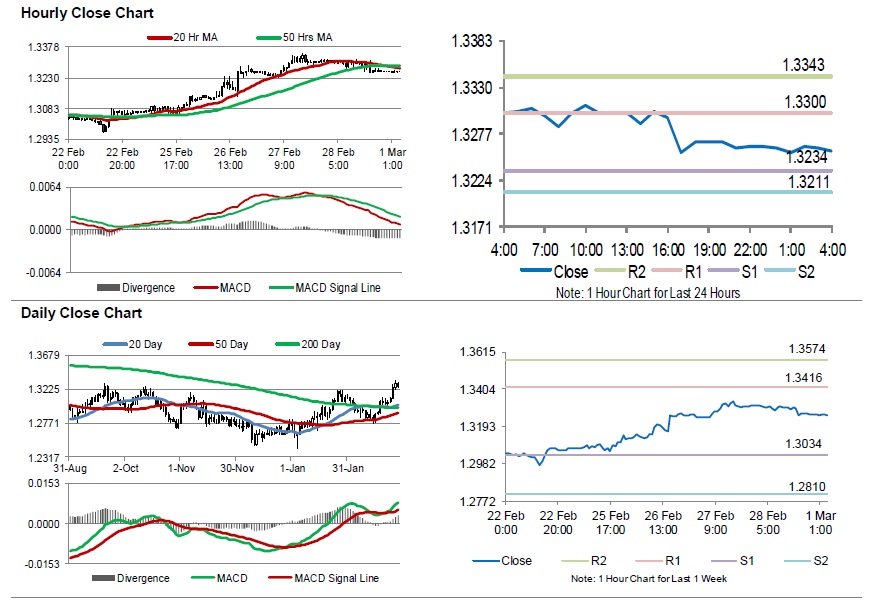
For the 24 hours to 23:00 GMT, the GBP declined 0.38% against the USD and closed at 1.3262.
Data indicated that UK's Nationwide house price index unexpectedly retreated 0.1% on a monthly basis in February, defying market expectations for an unchanged reading. The index had recorded a revised rise of 0.2% in the prior month.
In the Asian session, at GMT0400, the pair is trading at 1.3258, with the GBP trading marginally lower against the USD from yesterday's close.
The pair is expected to find support at 1.3234, and a fall through could take it to the next support level of 1.3211. The pair is expected to find its first resistance at 1.3300, and a rise through could take it to the next resistance level of 1.3343.
Looking forward, traders would keep an on UK's mortgage approvals and consumer credit data, both for January and the Markit manufacturing PMI for February, scheduled to release in a few hours.
The currency pair is trading below its 20 Hr and 50 Hr moving averages.
USD/JPY Daily Outlook
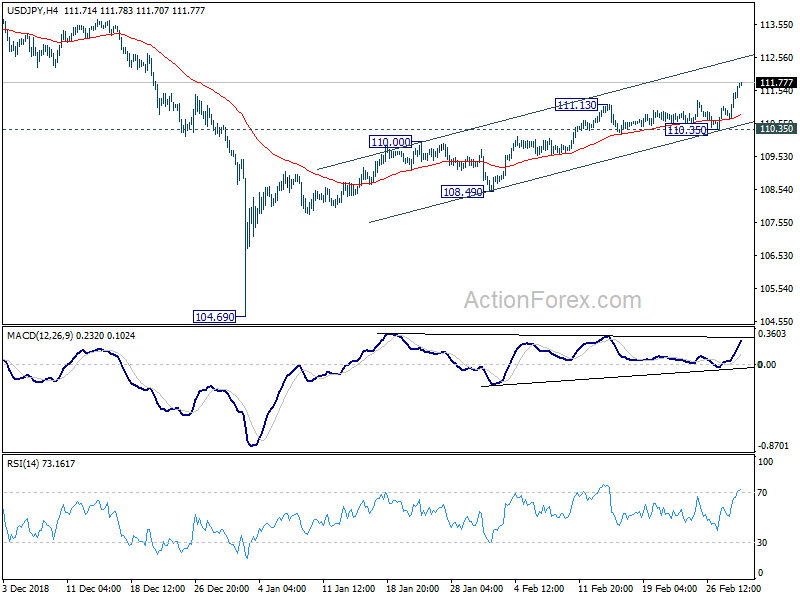
Daily Pivots: (S1) 110.87; (P) 111.18; (R1) 111.70; More...
USD/JPY's rise from 104.69 resumed and accelerates to as high as 111.76 so far. Intraday bias remains on the upside. Current rise should now target 114.54 resistance next. On the downside, break of 110.35 support is needed to indicate short term topping. Otherwise, outlook will now remain bullish in case of retreat.
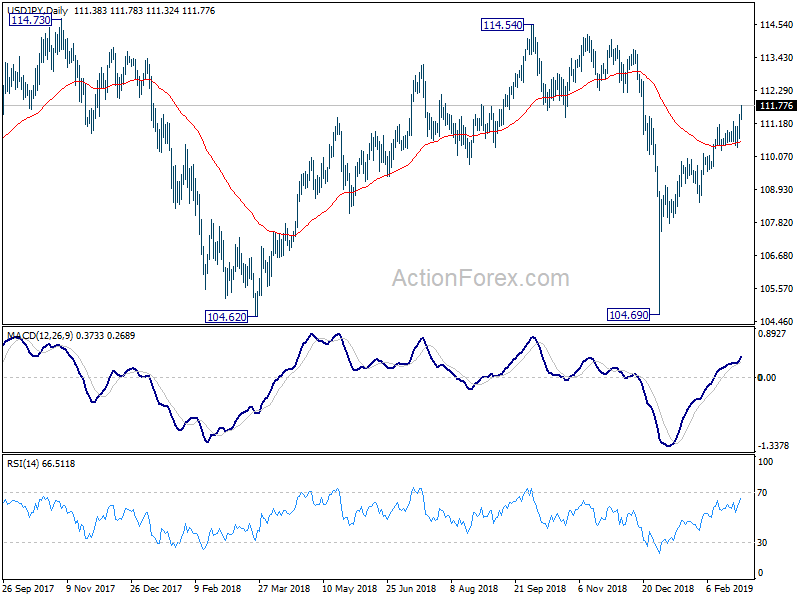
In the bigger picture, current strong rebound from 104.69 argues that decline from 118.65 (2016 high) has completed with three waves down to 104.69, after failing 104.62. More importantly, the rise from 98.97 (2016 low) could be resuming. Focus now turns back to 114.54 resistance, decisive break there will add more credence to this bullish case and target 118.65. This will now be the favored case as long as 55 day EMA (now at 110.59) holds.
Yen Decline Accelerates on Widening Yield Spreads
Yen's decline continues today and remains the weakest one for the week. Widening treasury yields is seen as the main driving force behind Yen's selloff. German 10-year yield at 0.186 is now heading back towards 0.2 handle. The rebound on improving outlook is remarkable, considering it closed at 0.096 last week. US yields also followed with 10-year yield closed up 0.018 at 2.711 overnight, reclaiming 2.7 handle. Meanwhile, Japan 10-year JGB yield stays negative at 0.015.
Staying in the currency markets, Dollar tried to rally overnight after stronger than expected Q4 GDP. But for the week, it's still down against Europeans. Focus will now turn to ISM manufacturing and PCE inflation. Commodity currencies are trying to recovery today but remains the weakest ones for the week. Europeans are the strongest, led by Sterling.
Technically, a focus today is whether European majors will reverse this week's recovery today. EUR/USD and USD/CHF are clearly losing some momentum. Break of 1.1316 and 1.0014 will indicate come back of Dollar. But for now, GBP/USD and GBP/JPY appear safe with their bullish run. Aussie is another one to note as AUD/USD might take on 0.7054 support. EUR/AUD could take on 1.6060 resistance. Break could trigger broad based selloff in Aussie.
In Asia, Nikkei closed up 1.08%. Hong Kong HSI is up 0.32%. China Shanghai SSE is up 0.33%. Singapore Strait Times rose 0.27%. Overnight DOW dropped -0.27%. S&P 500 rose -0.28%. NASDAQ dropped -0.29%. 10-year yield rose 0.018 to 2.711. 30-year yield rose 0.014 to 3.083.
Fed Powell: Common-sense risk-management approach served well
Fed Chair Jerome Powell reiterated his recent messages in a speech in New York today. He noted that "nearly all job market indicators are better than a few years ago, and many are at their most favorable levels in decades." Business-sector productivity growth also "moved up in the first three quarters of 2018." Price stability side of Fed's mandate is "in a good place" as "inflation by our preferred measure averaged roughly 2 percent last year" but "signs of upward pressure on inflation appear muted despite the strong labor market".
Powell also noted again that "over the past few months we have seen some crosscurrents and conflicting signals about the near-term outlook." Those include slowdown in major economies, particularly China and Europe. There is elevated uncertainty around unresolved government policy issues including Brexit and trade negotiations. Financial markets conditions have tightened since last fall. Also, "some surveys of business and consumer sentiment have moved lower. Unexpectedly weak retail sales data for December also give reason for caution."
All in all, Fed will be "patient as we determine what future adjustments to the target range for the federal funds rate". He also added that "common-sense risk-management approach has served the Committee well in the past."
Japan PMI manufacturing finalized at 48.9, sharper reductions in output and demand
Japan PMI manufacturing was finalized at 48.9 in February, revised up from 48.5. It's the first contractionary reading since August 2016. Demand conditions in Japan deteriorated at stronger rate while business outlook was broadly neutral having fallen for the ninth straight month.
Joe Hayes, Economist at IHS Markit noted that "Sharper reductions in output and demand drove the Japanese manufacturing economy into contraction during the midway point of Q1, compounding reductions already recorded in January. Global trade frictions and weak domestic manufacturing demand pose considerable risks to Japan's goods producers. As such, firms pared back expectations to near-neutrality. The rebound seen in the official Q4 GDP estimate does not appear to be reflective of underlying economic conditions in Japan.
"With the consumption tax hike set to come into play later this year, weak domestic demand will only heighten fears that the economy could be poised for a downturn. Focus turns towards service sector data, which will need to show signs of resilience in order to offset the manufacturing drag."
Also from Japan, unemployment rate rose 0.1% to 2.5% in January, versus expectation of 2.4%. Tokyo CPI core was unchanged at 1.1% yoy in February, versus expectation of 1.0% yoy. Capital spending rose 5.7% in Q4 versus expectation of 4.5%. Consumer confidence dropped -0.4 to 41.5 in February, slightly missed expectation of 41.6.
China Caixin PMI manufacturing rose to 49.9, easing of the economic downturn
China Caixin PMI manufacturing rose to 49.9 in February, up from 48.3 and beat expectation of 48.7. The key points are "renewed rise in output as total new business picks up, "backlogs continue to rise, but employment trend remains subdued", and "selling prices increase for first time in four months".
Zhengsheng Zhong, Director of Macroeconomic Analysis at CEBM Group said "Overall, with the early issuances of local governments' special-purpose bonds and targeted adjustments to monetary policy, the situation in the manufacturing sector recovered markedly in February due to the effect of increased infrastructure investment. Prices of industrial products also picked up due to improving demand and the rebound in international commodity prices. However, the pressure on manufacturers' capital turnover became obvious again, which may reflect that the financing environment was not easing as expected, and the effect of credit expansion is not yet significant."
Suggested reading on China: China's February PMI Sent Mixed Message. Update on PBOC's New Tool...
Australia manufacturing PMI rose to 54, but conditions appear to be diverging
Australia AiG Performance of Manufacturing Index rose 1.5 to 54.0 in February. That's the best monthly result since October 2018 and signals a better month of recovery following and "unreasonably slow summer". While it's still the 30th month of expansion, the trend has suggested "slowing growth rates since its recent peak in March 2018".
Also, AiG noted that "conditions appear to be diverging" across the larger manufacturing sectors and their main locations. Three of the six sectors expanded, one was stable and two contracted. And, "the downturn in housing construction is already affecting some sectors, as is the uncertainty of impending elections".
New Zealand terms of trade dropped -3%, largest fall since 2015
New Zealand terms of trade index dropped -3.0% qoq in Q4, much worse than expectation of -1.0% qoq. It's also the largest decline since September 2015 quarter. Also ,falling global prices for milk powder and butter meant overall export prices dropped -1.7%. However, Stats NZ noted that "despite the latest fall, the terms of trade remained near the historic high in the December 2017 quarter." Also from New Zealand, building permits rose 16.5% mom in January.
Looking ahead
It's another busy day before weekly close. Swiss will release PMI manufacturing and retail sales. Germany will release retail sales and unemployment. Eurozone will release PMI manufacturing final, and more importantly, CPI flash and unemployment rate. UK will release PMI manufacturing, mortgage approvals and M4 money supply. Later in the day, Canada will release GDP and PMI manufacturing. US will release personal income and spending and ISM manufacturing.
USD/JPY Daily Outlook
Daily Pivots: (S1) 110.87; (P) 111.18; (R1) 111.70; More...
USD/JPY's rise from 104.69 resumed and accelerates to as high as 111.76 so far. Intraday bias remains on the upside. Current rise should now target 114.54 resistance next. On the downside, break of 110.35 support is needed to indicate short term topping. Otherwise, outlook will now remain bullish in case of retreat.
In the bigger picture, current strong rebound from 104.69 argues that decline from 118.65 (2016 high) has completed with three waves down to 104.69, after failing 104.62. More importantly, the rise from 98.97 (2016 low) could be resuming. Focus now turns back to 114.54 resistance, decisive break there will add more credence to this bullish case and target 118.65. This will now be the favored case as long as 55 day EMA (now at 110.59) holds.
Economic Indicators Update
| GMT | Ccy | Events | Actual | Forecast | Previous | Revised |
|---|---|---|---|---|---|---|
| 21:30 | AUD | AiG Performance of Manufacturing Index Feb | 54 | 52.5 | ||
| 21:45 | NZD | Building Permits M/M Jan | 16.50% | 5.10% | 5.40% | |
| 21:45 | NZD | Terms of Trade Index Q/Q Q4 | -3.00% | -1.00% | -0.30% | -0.10% |
| 23:30 | JPY | Jobless Rate Jan | 2.50% | 2.40% | 2.40% | |
| 23:30 | JPY | Tokyo CPI Core Y/Y Feb | 1.10% | 1.00% | 1.10% | |
| 23:50 | JPY | Capital Spending Q4 | 5.70% | 4.50% | 4.50% | |
| 0:30 | JPY | PMI Manufacturing Feb F | 48.9 | 48.5 | 48.5 | |
| 1:45 | CNY | Caixin PMI Manufacturing Feb | 49.9 | 48.7 | 48.3 | |
| 5:00 | JPY | Consumer Confidence Feb | 41.5 | 41.6 | 41.9 | |
| 7:00 | EUR | German Retail Sales M/M Jan | 1.90% | -4.30% | ||
| 7:30 | CHF | Retail Sales Real Y/Y Jan | 0.40% | -0.30% | ||
| 8:30 | CHF | PMI Manufacturing Feb | 53.6 | 54.3 | ||
| 8:45 | EUR | Italy Manufacturing PMI Feb | 47 | 47.8 | ||
| 8:50 | EUR | France Manufacturing PMI Feb F | 51.4 | 51.4 | ||
| 8:55 | EUR | Germany Manufacturing PMI Feb F | 47.6 | 47.6 | ||
| 8:55 | EUR | German Unemployment Change Feb | -5K | -2K | ||
| 8:55 | EUR | German Unemployment Claims Rate Feb | 5.00% | 5.00% | ||
| 9:00 | EUR | Eurozone Manufacturing PMI Feb F | 49.2 | 49.2 | ||
| 9:30 | GBP | Mortgage Approvals Jan | 63K | 64K | ||
| 9:30 | GBP | Money Supply M4 M/M Jan | 0.30% | 0.40% | ||
| 9:30 | GBP | PMI Manufacturing Feb | 52 | 52.8 | ||
| 10:00 | EUR | Italian Annual GDP (2018) | 0.80% | 1.50% | ||
| 10:00 | EUR | Eurozone Unemployment Rate Jan | 7.90% | 7.90% | ||
| 10:00 | EUR | Eurozone CPI Estimate Y/Y Feb | 1.50% | 1.40% | ||
| 10:00 | EUR | Eurozone CPI Core Y/Y Feb A | 1.10% | 1.10% | ||
| 13:30 | CAD | GDP M/M Dec | 0.00% | -0.10% | ||
| 13:30 | USD | Personal Income Jan | 0.30% | 0.20% | ||
| 13:30 | USD | Personal Spending Dec | 0.10% | 0.40% | ||
| 13:30 | USD | PCE Deflator M/M Dec | 0.00% | 0.10% | ||
| 13:30 | USD | PCE Deflator Y/Y Dec | 1.70% | 1.80% | ||
| 13:30 | USD | PCE Core M/M Dec | 0.20% | 0.10% | ||
| 13:30 | USD | PCE Core Y/Y Dec | 1.90% | 1.90% | ||
| 14:30 | CAD | Manufacturing PMI Feb | 53 | |||
| 14:45 | USD | Manufacturing PMI Feb F | 53.7 | 53.7 | ||
| 15:00 | USD | ISM Manufacturing Feb | 56 | 56.6 | ||
| 15:00 | USD | ISM Prices Paid Feb | 52 | 49.6 | ||
| 15:00 | USD | ISM Employment Feb | 55.5 | |||
| 15:00 | USD | U. of Mich. Sentiment Feb F | 95.8 | 95.5 |
Japan’s Nikkei Manufacturing PMI Contracted At Its Fastest Pace In 2.5 Years In February
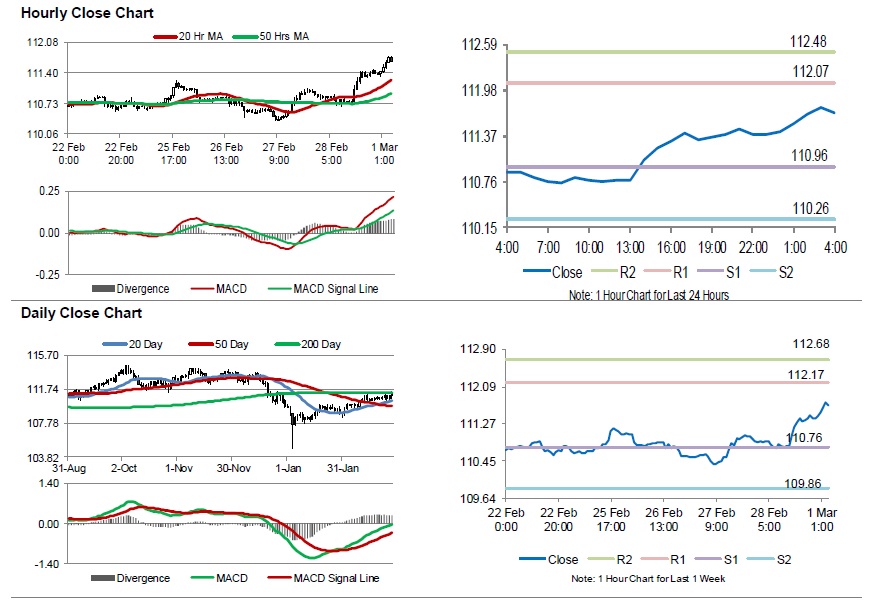
For the 24 hours to 23:00 GMT, the USD rose 0.41% against the JPY and closed at 111.39.
In the Asian session, at GMT0400, the pair is trading at 111.67, with the USD trading 0.25% higher against the JPY from yesterday's close.
Overnight data showed that Japan's unemployment rate unexpectedly advanced to 2.5% in January, defying market expectations of a steady reading. In the previous month, unemployment rate had registered a reading of 2.4%. Meanwhile, the nation's Nikkei final manufacturing PMI contracted to a level of 48.9 in February, declining at its fastest pace in 2.5 years, amid glut in factory productions and reducing exports. In the prior month, the PMI had recorded a level of 50.3, while preliminary figures had recorded a drop to 48.5.
Early morning data revealed that Japan's consumer confidence index fell to a level of 41.5 in February, compared to market expectations for a fall to a level of 41.6. In the prior month, the index had recorded a level of 41.9.
The pair is expected to find support at 110.96, and a fall through could take it to the next support level of 110.26. The pair is expected to find its first resistance at 112.07, and a rise through could take it to the next resistance level of 112.48.
The currency pair is trading above its 20 Hr and 50 Hr moving averages.
Switzerland’s Gross Domestic Product Climbed In 4Q 2018
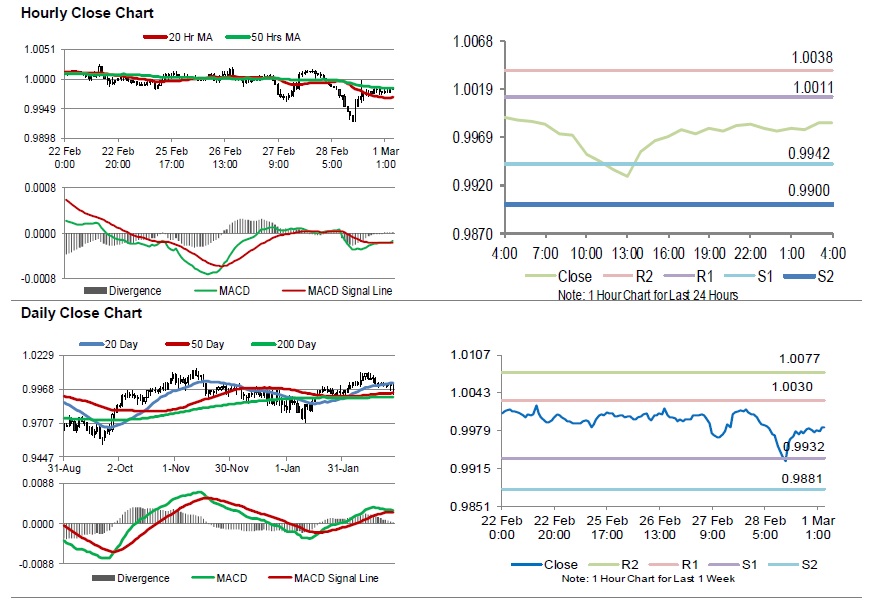
For the 24 hours to 23:00 GMT, the USD declined 0.30% against the CHF and closed at 0.9979.
On the data front, Switzerland’s gross domestic product (GDP) advanced 1.4% on a yearly basis in 4Q 2018, less than market expectations for a rise of 1.7% and compared to an advance of 2.4% in the prior quarter. Meanwhile, the nation’s KOF economic barometer declined to a level of 92.4 in February, more than market consensus for a fall to a level of 95.0. The KOF economic barometer had registered a revised reading of 96.2 in the previous month.
In the Asian session, at GMT0400, the pair is trading at 0.9984, with the USD trading 0.05% higher against the CHF from yesterday’s close.
The pair is expected to find support at 0.9942, and a fall through could take it to the next support level of 0.9900. The pair is expected to find its first resistance at 1.0011, and a rise through could take it to the next resistance level of 1.0038.
Trading trend in the Swiss Franc today, is expected to be determined by Switzerland’s retail sales real for January and the manufacturing PMI for February, slated to release in a while.
The currency pair is trading above its 20 Hr moving average and showing convergence with its 50 Hr moving average.
Canada’s Current Account Deficit Widened More-Than-Estimated In 4Q 2018
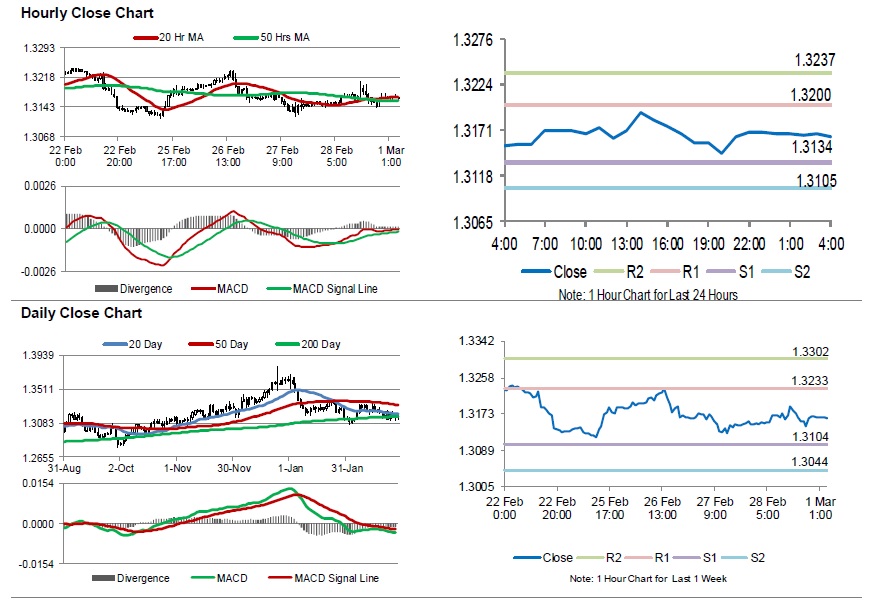
For the 24 hours to 23:00 GMT, the USD rose 0.14% against the CAD and closed at 1.3168.
Data showed that Canada's CFIB business barometer climbed to a level of 59.0 in February, following a level of 56.1 in the prior month.
Meanwhile, the nation's current account deficit widened to a level of CAD15.48 billion in 4Q 2018, compared to a revised deficit of CAD10.11 billion in the previous quarter.
In the Asian session, at GMT0400, the pair is trading at 1.3164, with the USD trading marginally lower against the CAD from yesterday's close.
The pair is expected to find support at 1.3134, and a fall through could take it to the next support level of 1.3105. The pair is expected to find its first resistance at 1.3200, and a rise through could take it to the next resistance level of 1.3237.
Moving ahead, traders would await Canada's gross domestic product for December and the MLI leading indicator for January, set to release later in the day.
The currency pair is showing convergence with its 20 Hr and 50 Hr moving averages.
Aussie Extends Its Losses In The Asian Session
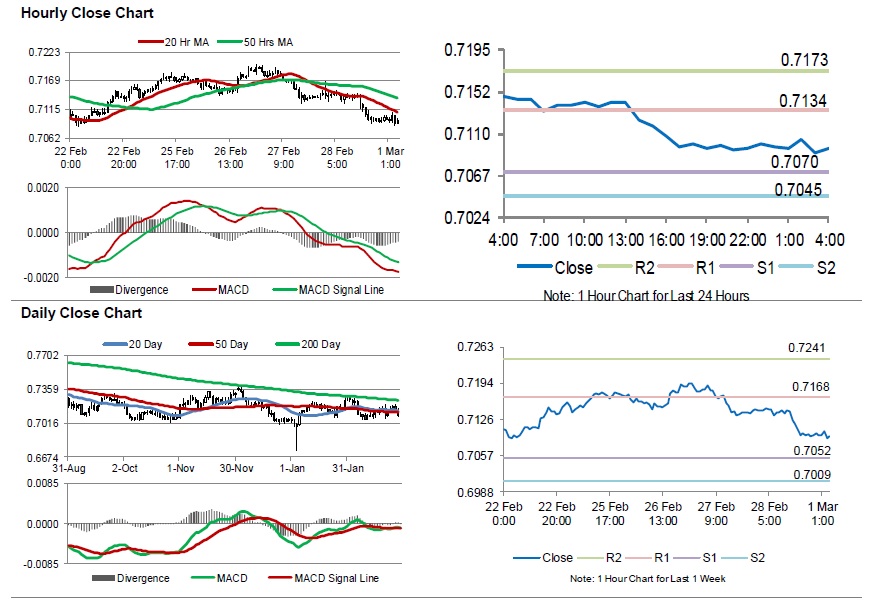
For the 24 hours to 23:00 GMT, the AUD declined 0.62% against the USD and closed at 0.7099.
LME Copper prices rose 0.1% or $3.0/MT to $6536.0/MT. Aluminium prices declined 0.3% or $5.5/MT to $1893.0/MT.
In the Asian session, at GMT0400, the pair is trading at 0.7094, with the AUD trading 0.07% lower against the USD from yesterday’s close.
Overnight data showed that, in Australia, the CBA manufacturing PMI dropped to a level of 52.9 in February, compared to a reading of 53.1 in the previous month. However, the AiG performance of manufacturing index registered a rise to 54.0 in February. In the prior month, the index had recorded a level of 52.5.
Elsewhere in China, Australia’s largest trading partner, the Caixin/Markit manufacturing PMI contracted to a level of 49.9 in February, higher than market consensus for a gain to a level of 48.5. The PMI had registered a level of 48.3 in the previous month.
The pair is expected to find support at 0.7070, and a fall through could take it to the next support level of 0.7045. The pair is expected to find its first resistance at 0.7134, and a rise through could take it to the next resistance level of 0.7173.
Going forward, traders would closely monitor Australia’s building approvals, CBA services PMI,
trade balance data and retail sales along with the Reserve Bank of Australia’s interest rate decision, all scheduled to release next week.
The currency pair is trading below its 20 Hr and 50 Hr moving averages.
Gold: Yellow Metal Trading A Tad Lower In The Morning Session
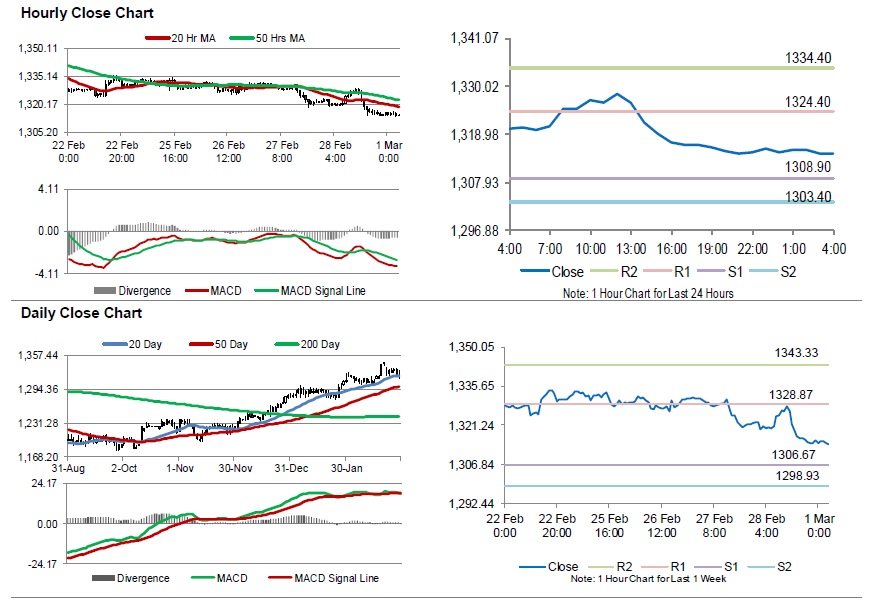
For the 24 hours to 23:00 GMT, Gold declined 0.54% against the USD and closed at USD1314.70 per ounce, amid strength in the US dollar.
In the Asian session, at GMT0400, the pair is trading at 1314.40, with gold trading a tad lower against the USD from yesterday’s close.
The pair is expected to find support at 1308.90, and a fall through could take it to the next support level of 1303.40. The pair is expected to find its first resistance at 1324.40, and a rise through could take it to the next resistance level of 1334.40.
The yellow metal is trading below its 20 Hr and 50 Hr moving averages.
Silver: White Metal Extends Its Losses This Morning
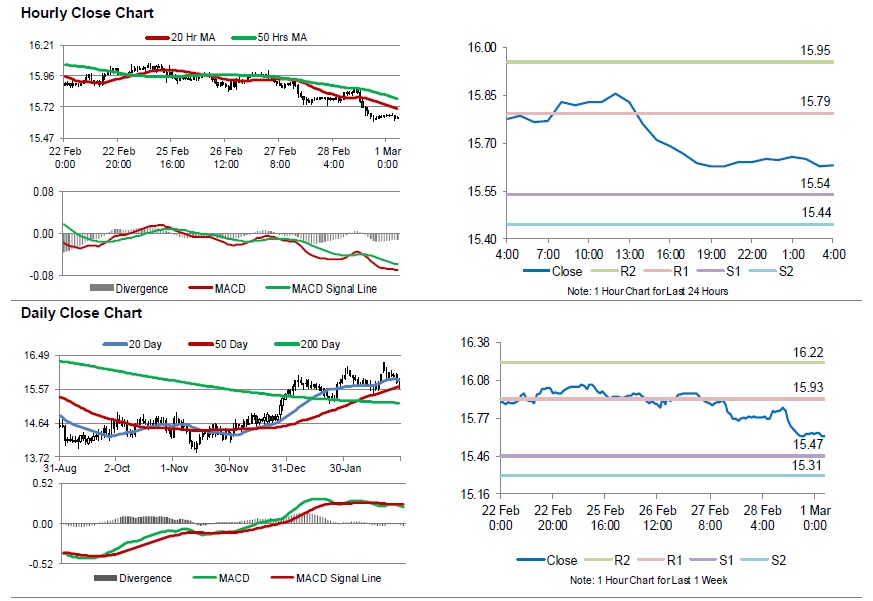
For the 24 hours to 23:00 GMT, Silver declined 0.86% against the USD and closed at USD15.65 per ounce, tracking losses in gold prices.
In the Asian session, at GMT0400, the pair is trading at 15.63, with silver trading 0.13% lower against the USD from yesterday’s close.
The pair is expected to find support at 15.54, and a fall through could take it to the next support level of 15.44. The pair is expected to find its first resistance at 15.79, and a rise through could take it to the next resistance level of 15.95.
The white metal is trading below its 20 Hr and 50 Hr moving averages.
Crude Oil: Oil Trading Higher, Ahead Of Baker Hughes Weekly Rig Count Data
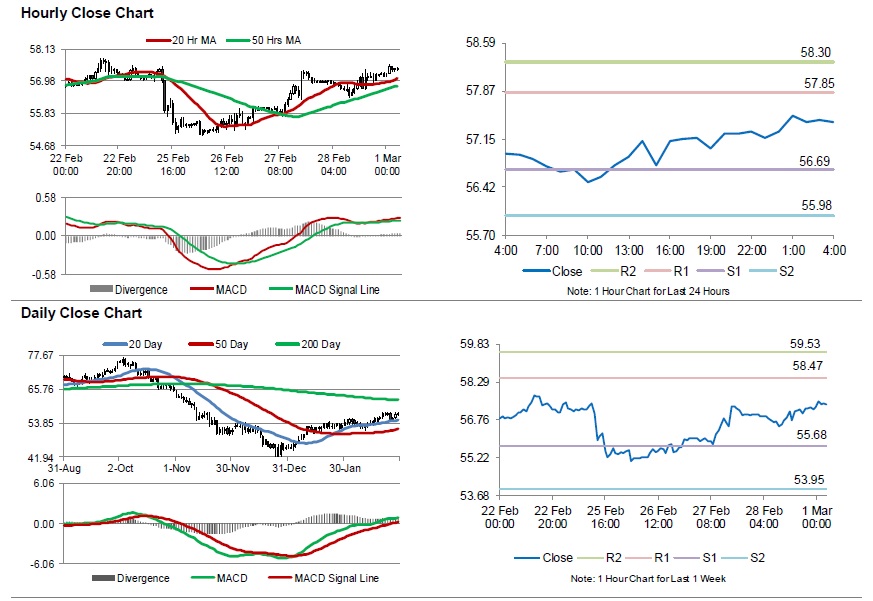
For the 24 hours to 23:00 GMT, Crude Oil rose 0.37% against the USD and closed at USD57.17 per barrel, on OPEC-led supply cuts.
In the Asian session, at GMT0400, the pair is trading at 57.40, with oil trading 0.40% higher against the USD from yesterday’s close.
The pair is expected to find support at 56.69, and a fall through could take it to the next support level of 55.98. The pair is expected to find its first resistance at 57.85, and a rise through could take it to the next resistance level of 58.3.
Crude oil is trading above its 20 Hr and 50 Hr moving averages.