Sample Category Title
Dollar Surges as US Q4 GDP Grew 2.6%, Eyes on Treasury Yields for More Strength
Dollar regains some ground in early US session after stronger than expected Q4 GDP report. But at the time of writing, it's still trailing behind Euro and Swiss Franc. The common currency is boosted up by strong rally in German 10-year yield, which is up 0.028 at 0.178. Swiss Franc, on the other hand, strengthens after Trump-Kim summit in Vietnam collapsed without an agreement, not even a joint statement. Meanwhile, commodity currencies, including Canadian, Australian and New Zealand Dollar are the weakest.
The immediate focus will now be on whether US treasury yield will follow German yield and extends yesterday's strong rally. In particular, US 10 year yield might set to take on 2.7 handle again, and a firm break there could push Dollar further higher, and even reverse against Euro. Technically, 111.23 resistance in USD/JPY is now an immediate focus. Firm break there will indicate medium term strength for 114.54 key resistance. EUR/JPY has already taken out 126.30 rather decisively. It's now likely heading to 129.25 resistance next.
In Europe, at the time of writing, FTSE is down -0.46%. DAX is down -0.08%. CAC is up 0.03%. German 10-year yield is up 0.028 at 0.178. Earlier in Asia:, Nikkei dropped -0.79%. Hong Kong HSI dropped -0.43%. China Shanghai SSE dropped -0.44%. Singapore Strait Times dropped -1.15%. Japan 10-year JGB yield dropped -0.0021 to -0.027.
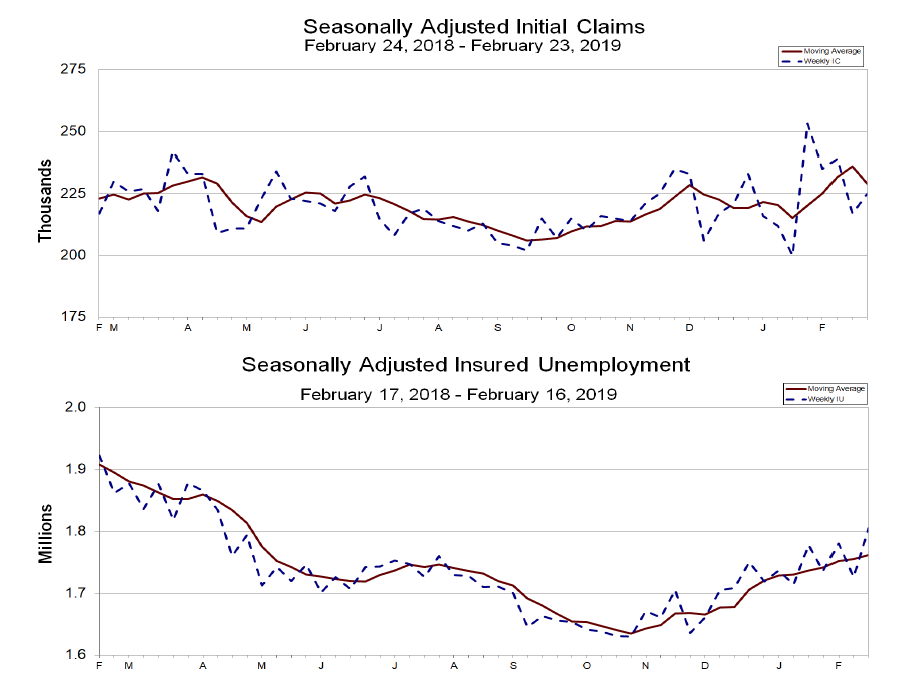
US GDP grew 2.6% annualized in Q4, initial jobless claims rose to 225k
US GDP growth slowed to 2.6% annualized in Q4, down from 3.4% but beat expectation of 2.5%. GDP price index rose 1.8%, beat expectation of 1.7%. The increase in real GDP in the fourth quarter reflected positive contributions from personal consumption expenditures (PCE), nonresidential fixed investment, exports, private inventory investment, and federal government spending. Those were partly offset by negative contributions from residential fixed investment, and state and local government spending.
Initial jobless claims rose 8k to 225k in the week ending February 23. Four-week moving average of initial claims dropped -7k to 229k. Continuing claims rose 79k to 1.805M in the week ended February 16. Four-week moving average of continuing claims rose 6.75k to 1.762M.
From Canada, current account deficit widened to CAD -15.48B in Q4. IPPI dropped -0.3% mom in January while RMPI rose 3.8% mom.
Trump-Kim summit collapsed, it's all about the sanctions
Trump in a press conference that he walked away from the summit with North Korean leader Kim Jong-un. But he emphasized that "it was a friendly walk". The meeting in Vietnam was cut short and ended without an agreement and not even a joint statement.
Trump said "it was all about the sanctions". He added "basically they wanted the sanctions lifted in their entirety, and we couldn't do that". On the other hand, Trump said Kim offered to dismantle North Korea's main nuclear facility at Yongbyon, but "it wasn't enough" to the US.
Trump also added that he could've signed an agreement today but it wasn't the right time. He emphasized he'd "rather do it right".
French GDP grew 0.3% in Q4, positive contribution from foreign trade
French GDP grew 0.3% qoq in Q4, matched expectations. Over the year, growth slowed to 1.5% in 2018, down from 2.3% in 2017. Looking at the details, final domestic demand excluding inventory changes decelerated: it contributed 0.2 points to GDP growth, after 0.5 points in the previous quarter. Foreign trade balance contributed positively to GDP growth again: +0.3 points, after +0.2 points in Q3. Conversely, changes in inventories contributed negatively to GDP growth again (−0.2 points after −0.4 points).
From Germany, import price index dropped -0.2% mom in January versus expectation of 0.2% mom. CPI accelerated to 1.6% yoy in February, up from 1.4% yoy and beat expectation of 1.5% yoy.
Swiss GDP grew 0.2% qoq, confirmed slowdown
Swiss GDP grew 0.2% qoq in Q4, rebounded from Q3's -0.3% qoq contraction, but missed expectation of 0.4% qoq. SECO noted that "as in other European countries, this confirms a slowdown of the economy compared to the first half of the year."
Looking at the details, manufacturing grew 1.5%, benefited from the strong international demand for Swiss products: exports of goods**(+5.6%) grew substantially. Development in the service industry varied and remained below the historical average, curbed by declining exports of services (−2.6 %) and a final domestic demand which remains sluggish (−0.0%). Consumption expenditures of private households (+0.3%) saw a moderate rise.
Swiss KOF dropped to 92.4, deteriorating sentiment extended from manufacturing to others
KOF economic Barometer dropped to 92.4 in February, down from 96.2 and missed expectation of 96.0. KOF noted that recent downward tendency " continued unabated", and the Swiss economy can expect to experience a "weak phase" in the coming months. And, the marked decline is predominantly due to negative impulses from the manufacturing industry; but the deteriorating sentiment has meanwhile also extended to the other components of this barometer.
BoJ Suzuki: Absolutely no need to ramp up monetary easing
BoJ board member Hitoshi Suzuki said today that there is "absolutely no need" to ramp up monetary easing. He added, "if the momentum for hitting the price target is lost, the BOJ will consider taking appropriate action. But many board members, including myself, believe the momentum is sustained."
Nevertheless, Suzuki noted it's the current massive stimulus program is still needed. He said "there's a risk inflation won't accelerate much for a prolonged period, as companies remain cautious of raising wages and households are sensitive to price rises.
Released from Japan, industrial production dropped -3.7% mom in January versus expectation of -2.5% yoy. Retail sales rose 0.6% yoy in January, below expectation of 1.5% yoy. Housing starts rose 1.1% yoy in January. versus expectation of 10.3% yoy.
China PMI manufacturing dropped to 49.2, new export orders hit decade low
The official China PMI manufacturing dropped to 49.2 in February, down from 49.5 and missed expectation of 49.5. That's the third straight month of sub-50 reading. Looking at the details new export orders index dropped -1.7 to 45.2, its lowest level in 10 years, suggesting trade war with the US continues to have an impact on exports. Production dropped -1.4 to 49.5. Employment dropped -0.3 to 47.5. PMI services dropped to 54.3, down from 54.7, missed expectation of 54.5.
However, analyst Zhang Liqun tried to talk down the deterioration in the statement. He noted that the decline in PMI was mainly due to Lunar New Year factor. He pointed to the significant decline in the production, the purchase volume, and the raw material inventory as indications.
ANZ business confidence dropped to -30.9, RBNZ to cut in November
New Zealand ANZ Business Confidence dropped to -30.9 in February, down from -24.1. Activity Outlook dropped to 10.5, down fro 13.6. ANZ noted that recent improvement in business activity stalled. Export intentions fell to the weakest since March 2009. Pricing intentions remain range-bound.
ANZ also noted that "Clearly the economy is stretched at the moment, but it does appear that momentum has waned markedly over the last six months." And it expects RBNZ to become "less certain that core inflation will continue rising towards the midpoint of the target band". ANZ forecasts a cut in OCR in November.
Also from down under, Australia private capital expenditure rose 2.0% in Q4 versus expectation of 1.0%. Private sector credit rose 0.2% mom in January versus expectation of 0.3% mom.
USD/JPY Mid-Day Outlook
Daily Pivots: (S1) 110.53; (P) 110.81; (R1) 111.26; More...
USD/JPY rebounds notably in early US session but it's staying in range of 110.25/111.23, intraday bias remains neutral first. On the upside, decisive break of 111.23 will firstly confirm resumption of whole rebound from 104.69. Secondly, that will indicate strong support from 55 day EMA, and likely firm break of 61.8% retracement of 114.54 to 104.69 at 110.77 too. In that case, further rise should be seen back to 114.54 key resistance next. On the downside, though, break of 110.25 minor support will suggest rejection by 110.77. And in that case, the rebound from 104.69 has likely completed. Intraday bias will be turned back to the downside for 108.49 support for confirmation.
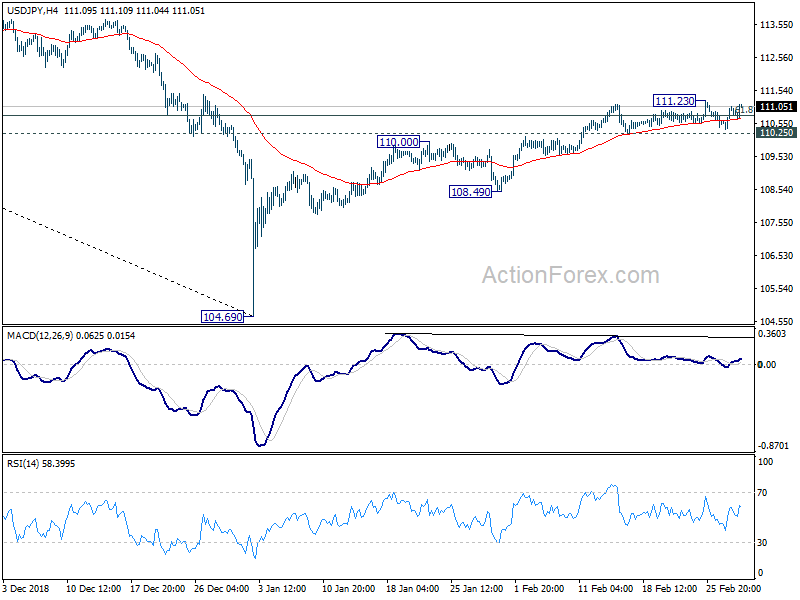
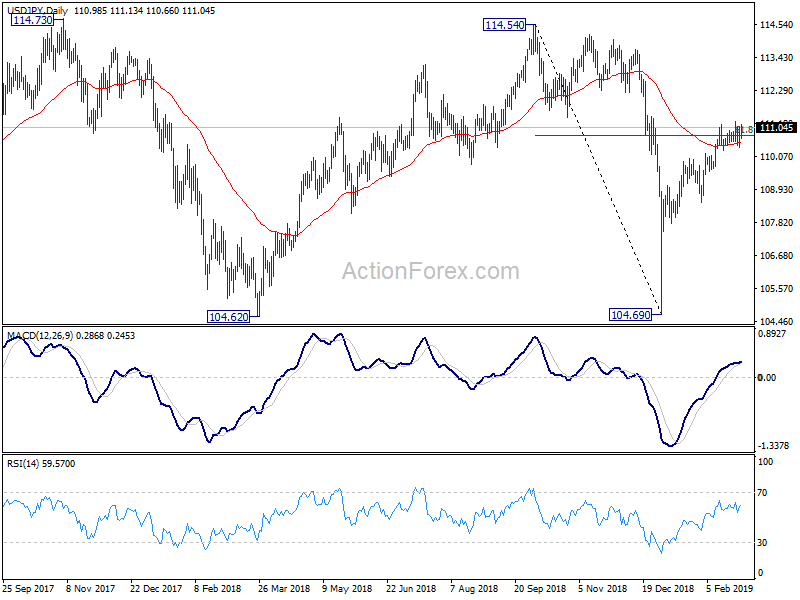
In the bigger picture, while the rebound from 104.69 was stronger than expected, it's struggle to get rid of 55 day EMA completely. Outlook is turned mixed first. On the downside, break of 108.49 support will revive that case that such rebound was a correction. And, larger down trend is still in progress for another low below 104.62. But sustained trading above 55 day EMA will turn focus to 114.54. Decisive break there will confirmation completion of the decline from 118.65 (2016 high).
Economic Indicators Update
| GMT | Ccy | Events | Actual | Forecast | Previous | Revised |
|---|---|---|---|---|---|---|
| 23:50 | JPY | Industrial Production M/M Jan P | -3.70% | -2.50% | -0.10% | |
| 23:50 | JPY | Retail Trade Y/Y Jan | 0.60% | 1.50% | 1.30% | |
| 00:00 | NZD | ANZ Business Confidence Feb | -30.9 | -24.1 | ||
| 00:01 | GBP | GfK Consumer Confidence Feb | -13 | -15 | -14 | |
| 00:30 | AUD | Private Capital Expenditure Q4 | 2.00% | 1.00% | -0.50% | 0.00% |
| 00:30 | AUD | Private Sector Credit M/M Jan | 0.20% | 0.30% | 0.20% | |
| 01:00 | CNY | Manufacturing PMI Feb | 49.2 | 49.5 | 49.5 | |
| 01:00 | CNY | Non-manufacturing PMI Feb | 54.3 | 54.5 | 54.7 | |
| 05:00 | JPY | Housing Starts Y/Y Jan | 1.10% | 10.30% | 2.10% | |
| 06:45 | CHF | GDP Q/Q Q4 | 0.20% | 0.40% | -0.20% | -0.30% |
| 07:00 | EUR | German Import Price Index M/M Jan | -0.20% | 0.20% | -1.30% | |
| 07:45 | EUR | French GDP Q/Q Q4 P | 0.30% | 0.30% | 0.30% | |
| 08:00 | CHF | KOF Leading Indicator Feb | 92.4 | 96 | 95 | 96.2 |
| 13:00 | EUR | German CPI M/M Feb P | 0.50% | 0.50% | -0.80% | |
| 13:00 | EUR | German CPI Y/Y Feb P | 1.60% | 1.50% | 1.40% | |
| 13:30 | CAD | Current Account Balance Q4 | -15.48B | -$14.01b | -$10.34b | -10.11B |
| 13:30 | CAD | Industrial Product Price M/M Jan | -0.30% | 0.30% | -0.70% | -0.80% |
| 13:30 | CAD | Raw Materials Price Index M/M Jan | 3.80% | 4.10% | 3.80% | |
| 13:30 | USD | Initial Jobless Claims (FEB 23) | 225K | 221K | 216K | 217K |
| 13:30 | USD | GDP Annualized Q/Q Q4 A | 2.60% | 2.50% | 3.40% | |
| 13:30 | USD | GDP Price Index Q4 A | 1.80% | 1.70% | 1.80% | |
| 14:45 | USD | Chicago PMI Feb | 57.8 | 56.7 | ||
| 15:30 | USD | Natural Gas Storage | -172B | -177B |
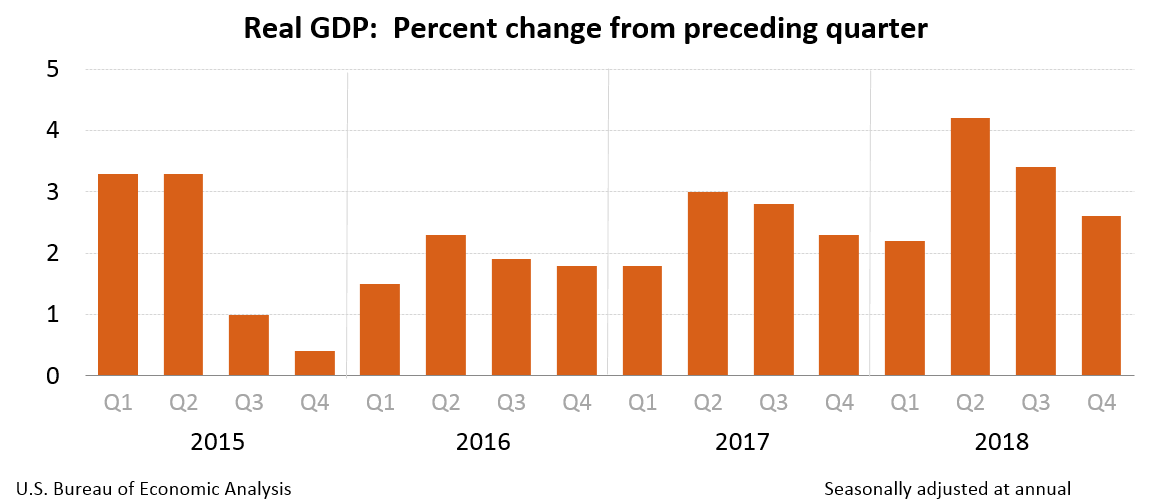
US GDP grew 2.6% annualized in Q4, initial jobless claims rose to 225k
US GDP growth slowed to 2.6% annualized in Q4, down fro 3.4% but beat expectation of 2.5%. GDP price index rose 1.8%, beat expectation of 1.7%. The increase in real GDP in the fourth quarter reflected positive contributions from personal consumption expenditures (PCE), nonresidential fixed investment, exports, private inventory investment, and federal government spending. Those were partly offset by negative contributions from residential fixed investment, and state and local government spending.
Initial jobless claims rose 8k to 225k in the week ending February 23. Four-week moving average of initial claims dropped -7k to 229k. Continuing claims rose 79k to 1.805M in the week ended February 16. Four-week moving average of continuing claims rose 6.75k to 1.762M.
Canadian Dollar Steady ahead of U.S. GDP
The Canadian dollar is steady in the Thursday session. Currently, the pair is trading at 1.3168, up 0.09% on the day. On the release front, Canada releases current account, with the deficit expected to widen to C$14.0 billion. In the U.S., Advance GDP is projected at 2.2%, after a gain of 2.3% in the fourth quarter. Chicago PMI is expected to rise to 57.3 and unemployment claims is forecast to rise to 221 thousand. On Friday, we’ll get a look at ISM Manufacturing PMI and the UoM Consumer Sentiment.
Will 2019 be the year of the dove for the Federal Reserve? After an aggressive 2018, when the Fed hiked rates four times, the Fed is yet to make a move in 2019. The dovish stance was reinforced by Fed Chair Powell’s testimony on Capitol Hill on Tuesday and Wednesday. Powell preached patience with regard to changes in interest rate levels. The Fed chair stated that the Fed was in “no rush to make a judgment” and made reference to “conflicting signals in the economy”. The labor picture remains bright, with strong hiring and low unemployment. At the same time, consumer spending and business investment have been soft. Powell was optimistic about the U.S. economy, but said that the lower global growth and uncertainty over trade was weighing on the economy. The markets are expecting the Fed to remain on the sidelines in May and June, meaning that the first hike of 2019 may be on hold until the second half of the year.
Canada’s economic numbers have been mixed, making it difficult for the Bank of Canada to step in and raise rates for the first time in 2019. Similar to the Federal Reserve, the BoC was aggressive in 2018, but has applied the brakes in 2019. The Bank hiked rates three times last year, but has since stayed on the sidelines, with the benchmark rate pegged at 1.75%. It’s unlikely that the bank will make any rate moves unless the Canadian economy shows clear signs of gathering steam. Consumer spending data in December was a disappointment, with retail sales and core retail sales posting declines. If inflation remains weak, there will be little pressure on the bank to raise rates in the next few months.
Into US session: CHF rises as Trump-Kim summit collapsed, Euro follows German yield higher
Entering into US session, Swiss Franc and Euro are the strongest ones for today. It's partly due to extended rally in German yields. But more so, judging that Yen is the third strongest, it likely due to collapse of Trump-Kim summit.
Sterling is the weakest one for today, paring some of this week's strongest gains. Canadian Dollar is the second weakest as WTI crude oil retreats.
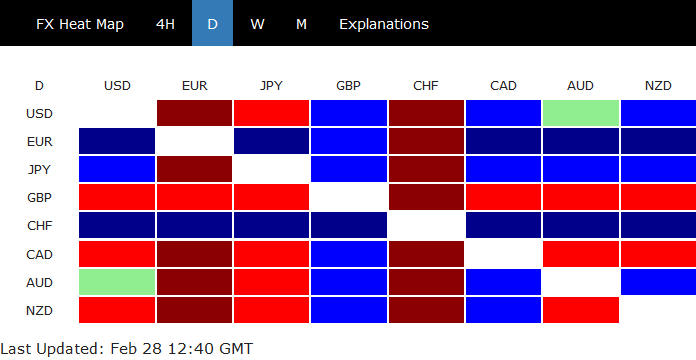
For the week, Sterling remains the strongest one, followed by Swiss Franc. Canadian is the weakest one, followed by Yen.
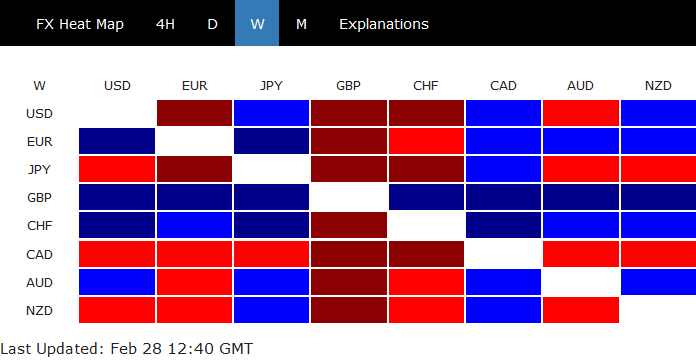
Looking ahead, US Q4 GDP will takes center stage, with Chicago PMI and jobless claims featured. Canada will release current account, IPPI and RMPI but they're unlikely to trigger any reaction.
In Europe, currently:
- FTSE is down -0.56%.
- DAX is down -0.21%.
- CAC is down -0.12%.
- German 10 year yield is up 0.0142 at 0.163.
Earlier in Asia:
- Nikkei dropped -0.79%.
- Hong Kong HSI dropped -0.43%.
- China Shanghai SSE dropped -0.44%.
- Singapore Strait Times dropped -1.15%.
- Japan 10-year JGB yield dropped -0.0021 to -0.027.
EUR/USD – Euro Climbs To 3-Week High, German CPI Next
EUR/USD has climbed higher in the Thursday session. Currently, the pair is trading at 1.1419, up 0.42% on the day. In the eurozone, the focus is on German CPI, which is expected to rebound with a gain of 0.5%. In the U.S., Advance GDP is projected at 2.2%, after a gain of 2.3% in the fourth quarter. Chicago PMI is expected to rise to 57.3 and unemployment claims is forecast to rise to 221 thousand. Friday will also be busy. Germany releases retail sales and manufacturing PMI, while the eurozone releases CPI estimates. In the U.S., we’ll get a look at ISM Manufacturing PMI and the UoM Consumer Sentiment.
The ECB has finally terminated its massive stimulus program, but any speculation that the bank will raise rates in the near term appears remote. The ECB has held rates at a flat 0.00% since March 2016, and there are two main factors weighing on a rate hike. First, the eurozone economy is grappling with a slowdown, and the German locomotive has also posted sluggish numbers. As well, inflation levels remain well shy of the ECB target of 2 percent. Unless the economic conditions show a sharp improvement, we may not see a rate hike before 2020.
The Federal Reserve is in dovish mode, and this stance was reinforced by Fed Chair Powell’s testimony on Capitol Hill on Tuesday and Wednesday. Powell preached patience with regard to changes in interest rate levels. The Fed chair stated that the Fed was in “no rush to make a judgment” and made reference to “conflicting signals in the economy”. The labor picture remains bright, with strong hiring and low unemployment. At the same time, consumer spending and business investment have been soft. Powell was optimistic about the U.S. economy, but said that the lower global growth and uncertainty over trade was weighing on the economy. The markets are expecting the Fed to remain on the sidelines in May and June, meaning that the first hike of 2019 may be on hold until the second half of the year.
Swiss Economy To Grow Slower
2018 showed a real GDP gain of 2.5%, a level not seen since 2010’s 3% and despite a slight decline in Q3. Still, the outlook for the coming months is less rosy. A downturn that started in the second half of 2018 is continuing. February’s economic barometer fell, the 5th consecutive drop that brings it to its April 2015 range, when EUR was almost at parity with CHF after the Swiss National Bank discontinued the minimum exchange rate of 1.20.
Negative impulses are emerging in manufacturing side. Other sectors are below average as order books and overall business deteriorates. The economy is expected to slow in coming months, hinting towards weaker corporate earnings for the first half of 2019, particularly in manufacturing and construction. Currently trading at 1.1342, EUR/CHF is expected to strengthen, heading along 1.1390.
Gold Up, Equities Down After No Deal News
Another failure for Trump or just unproductive meeting? Investors are trying to figure this out as president Trump abruptly finished the meeting with North Korea’s leader in Hanoi. Traders were quick in reacting to the news and the gold price moved higher on the back of this. This is because if the US is not ready to lift the sanctions on North Korea, then it means more trouble ahead. We can also say that everything was no short of any stage show.
Simply put, the precious metal moved higher because investors are concerned that the situation between the US and North Korea would become tense again. If the US is not ready to lift the sanctions on North Korea, it is highly likely that the country may go back to its old days of testing rockets. However, we do not think we have reached the same cliff edge yet. This is also because president Trump said: Kim has promised to not test any more rockets. However, there is a big question mark on this statement because of its reliability.
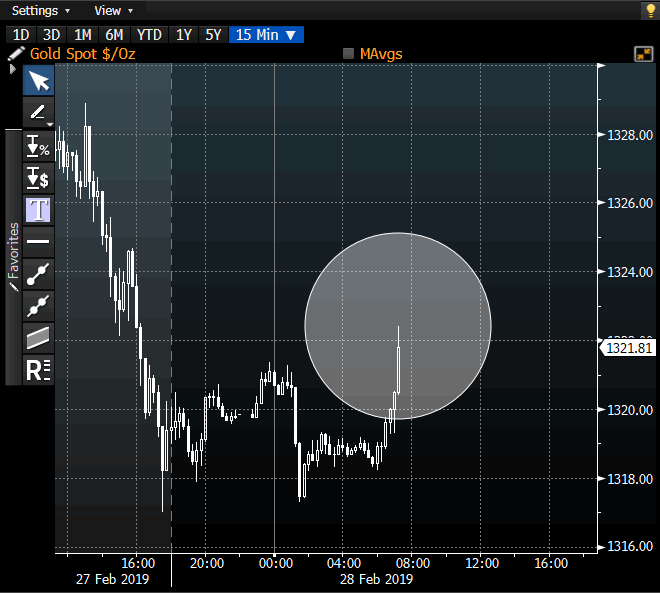
Gold price is still trading above the 1300 mark which is the most critical price level for bulls and bears. I do believe that as long as the price stays above this, the odds are in favor of higher price.
European stocks and US futures are set for another cautious start following a topsy-turvy U.S. session that pushed the S&P 500 finish nearly flat. In the absence of any significant new impetus, the global equity rally is losing steam. The Chinese manufacturing data released overnight painted a very disappointing picture for the markets. The manufacturing number came in at 49.2 which was below the consensus and most importantly this is the third consecutive month that we have seen the reading below the level of 50. Clearly a global economic slowdown is impacting the economy and this is the chief reason that we have not seen any sign of life for the new export orders as well, it plunged to 45.2 from its previous reading of 46.9.
Overall, the flow of news has dampened the sentiment for the equity markets and we think this is going to be the main theme today.
The Analytical Overview Of The Main Currency Pairs
The EUR/USD currency pair
Technical indicators of the currency pair:
Prev Open: 1.13892
Open: 1.13694
% chg. over the last day: -0.10
Day's range: 1.13651 – 1.13908
52 wk range: 1.1214 – 1.2557
EUR has stabilized. The EUR/USD quotes are moving sideways. The key support and resistance levels are 1.13700 and 1.14000. The investors are evaluating the stream of the geopolitical news. The US President Donald Trump and the leader of the PRK Kim Jeong Un could not reach an aggreement on the denuclearization of Korea on the summit in Vietnam. The European comision is worried about the Italian debt. The attention of the market participants is on the preliminary data on the US GDP. You should open positions from the key levels.
The Economic News Feed for 28.02.2019:
GDP report (US) – 15:30 (GMT+2:00);
Number of the primary requests for unemployment benefits (EU) – 15:30 (GMT+2:00);
Also, keep an eye on the comments made by the FOMC representatives.
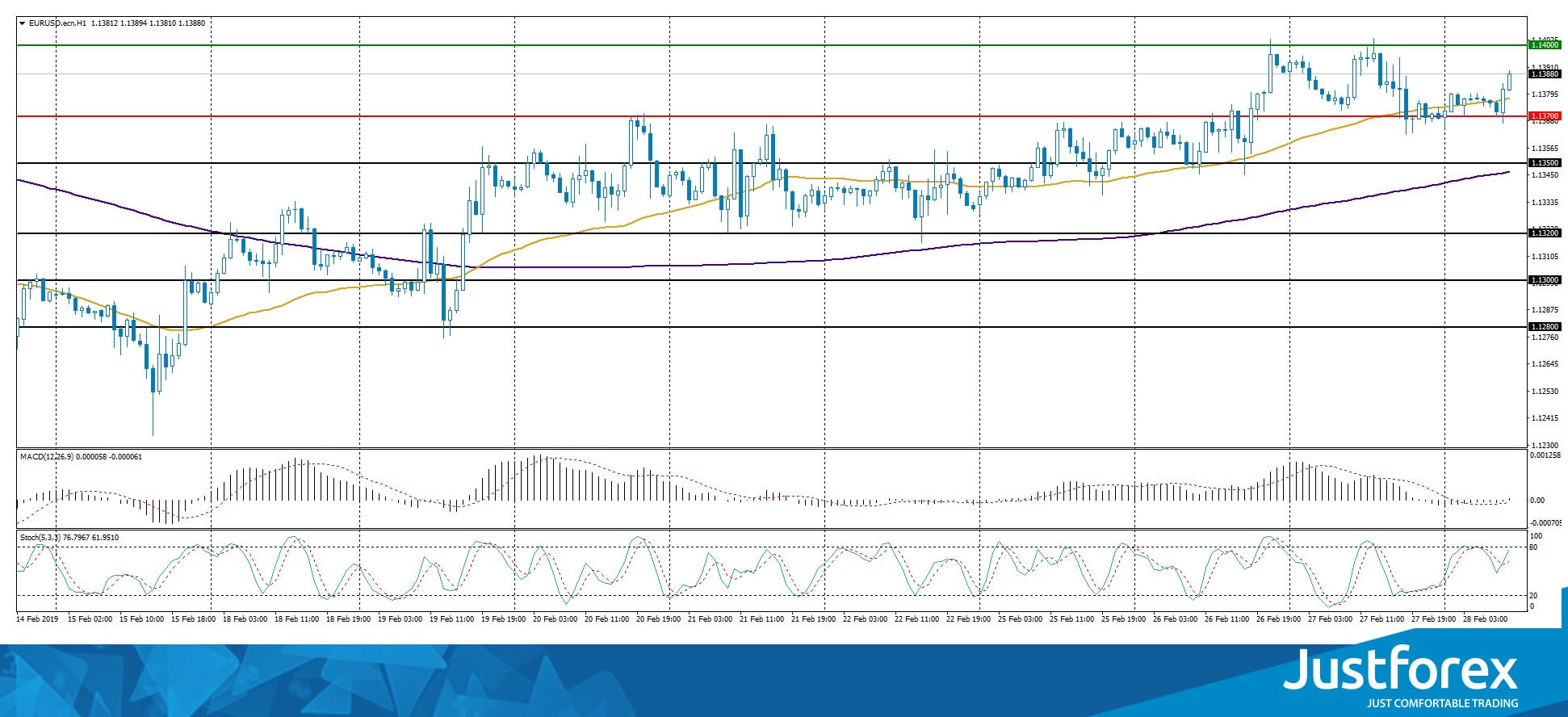
The indicators do not provide precise signals, the price has crossed 50 MA.
The MACD histogram is close to 0.
The Stochastic Oscillator is in the neutral zone, the %K line is above %D line, which points to the bullish mood.
Trading recommendations
Support levels: 1.13700, 1.13500, 1.13200
Resistance levels: 1.14000, 1.14500
If the price fixes above the round 1.14000, expect the quotes to grow toward 1.14300-1.14500.
Alternatively, the quotes can correct toward 1.13500-1.13300.
The GBP/USD currency pair
Technical indicators of the currency pair:
Prev Open: 1.32519
Open: 1.33068
% chg. over the last day: +0.50
Day's range: 1.32730 – 1.33193
52 wk range: 1.2438 – 1.4378
GBP/USD keeps showing a positive trend. Yesterday the quotes grew by 60 points. The pound teached the 1.33 USD. Earlier Theresa May offered the British lawmakers to offer for posponing Brexit, in order to prevent a chaotical exit without an aggreement. Right now the quotes are consolidating around 1.32750-1.33450. You should open positions from these levels.
The Economic News Feed for 28.02.2019 is calm.
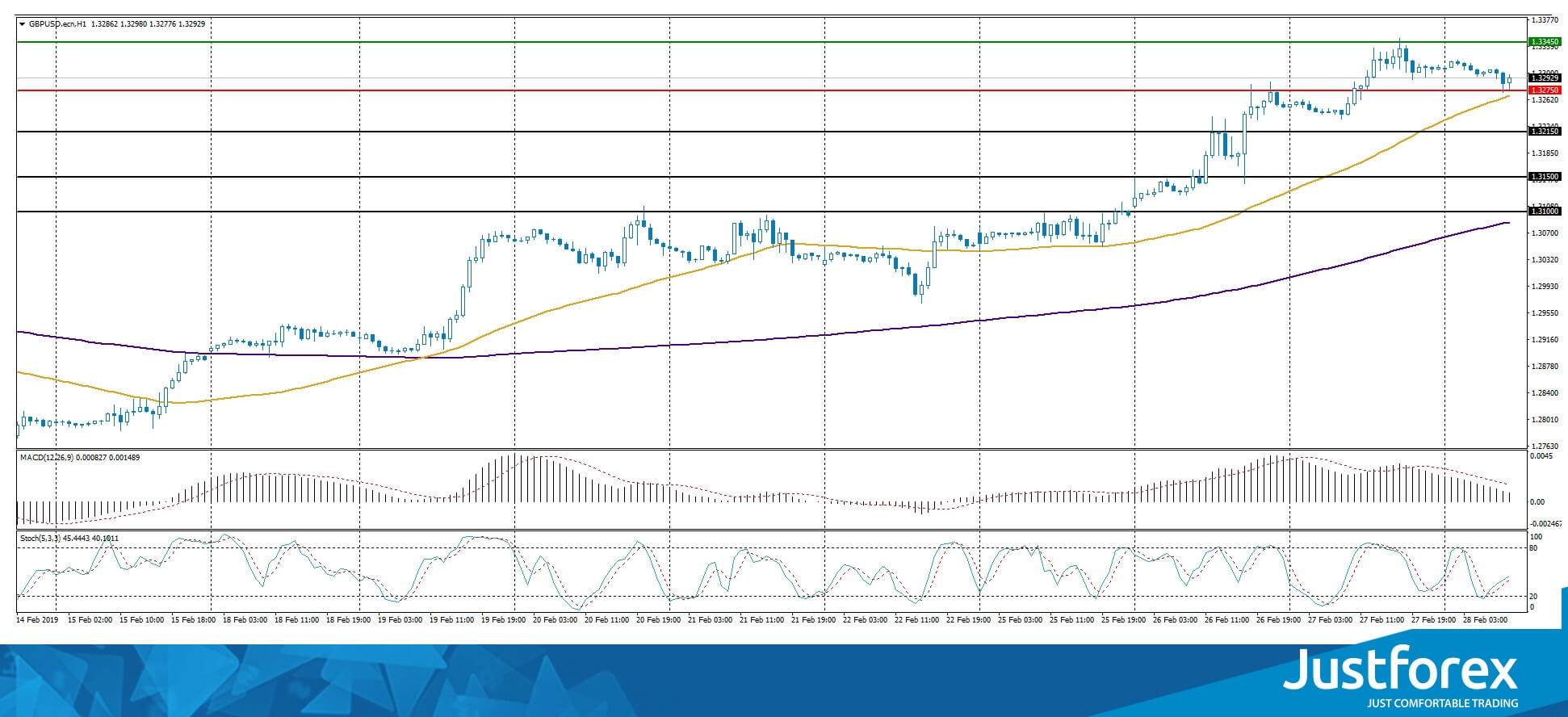
The price fixed above 50 MA and 200 MA which points to the power of the buyers.
The MACD histogram is in the positive zone, but below the signal line, which gives a weak signal to buy GBP/USD.
The Stochastic Oscillator is in the neutral zone, the %K line is above the %D line, which points to the bullish mood.
Trading recommendations
Support levels: 1.32750, 1.32150, 1.31500
Resistance levels: 1.33450, 1.34000
If the price fixes above 1.33450, expect the quotes to grow toward 1.34000.
Alternatively, the quotes can correct toward 1.32150-1.31800.
The USD/CAD currency pair
Technical indicators of the currency pair:
Prev Open: 1.31657
Open: 1.31543
% chg. over the last day: -0.20
Day's range: 1.31410 – 1.31762
52 wk range: 1.2248 – 1.3664
USD/CAD is showing an ambiguous technical picture. The trading instrument is moving sideways. The local support and resistance levels are 1.31500 and 1.31850. The financial market participants are waiting for additional drivers. Keep an eye on the US GDP. You should open positions from the key levels.
The Economic News Feed for 28.02.2019 is calm.
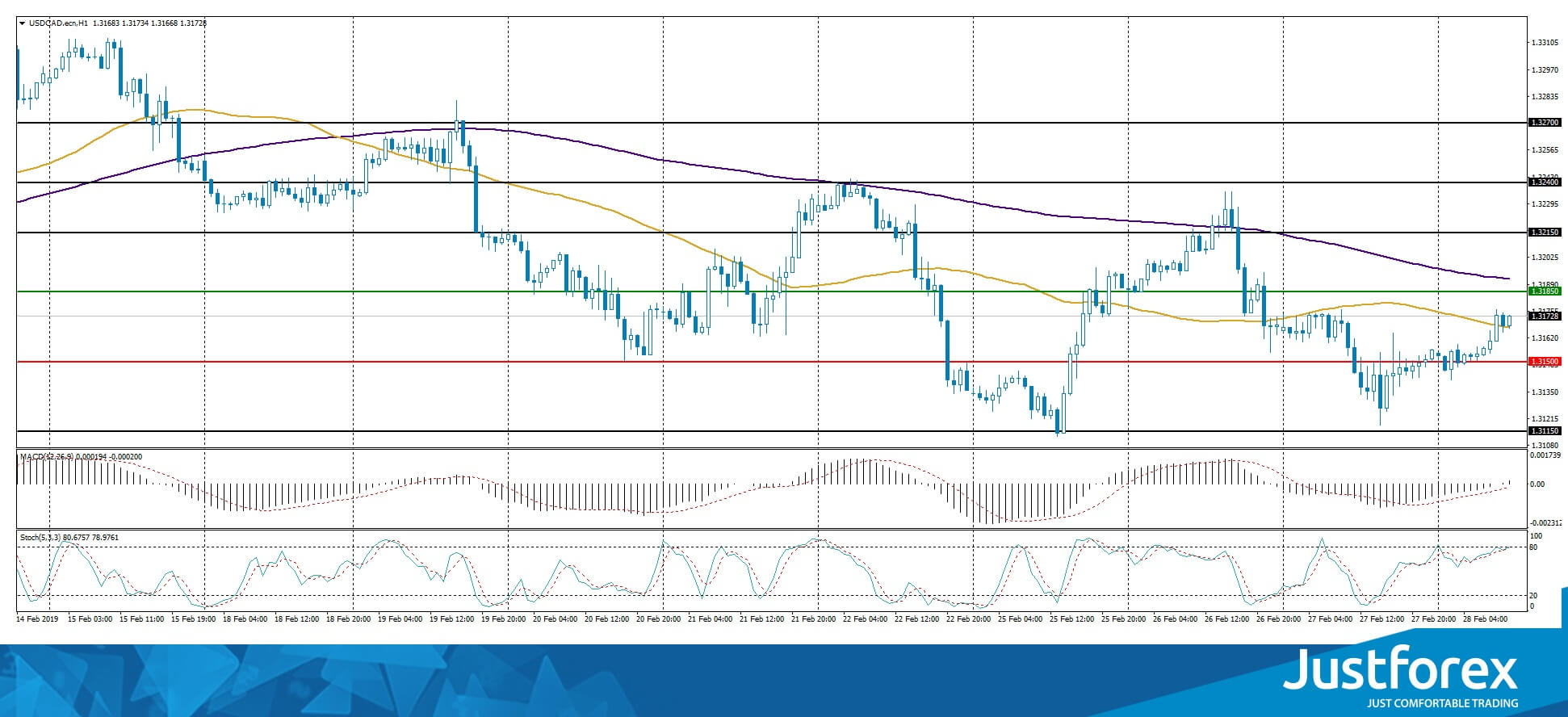
The indicators do not provide precise signals, the price has crossed 50 MA.
The MACD histogram is in the positive zone, which gives a signal to buy USD/CAD.
The Stochastic Oscillator is in the overbought zone, the %K line is crossing the %D line. There are no signals at the moment.
Trading recommendations
Support levels: 1.31500, 1.31150, 1.31000
Resistance levels: 1.31850, 1.32150, 1.32400
If the price fixes below 1.31500, expect the quotes to fall toward the round 1.31000.
Alternatively, the quotes can grow toward 1.32150-1.32400.
The USD/JPY currency pair
Technical indicators of the currency pair:
Prev Open: 110.568
Open: 110.984
% chg. over the last day: +0.26
Day's range: 110.661 – 110.997
52 wk range: 104.56 – 114.56
From the beginning of the week, USD/JPY is very active. There is no single definitive trend. Right now there is no safe haven currency. The local support and resistance levels are 110.650 and 110.850. You should open positions from these levels. Keep an eye on the economic reports and the bond dynamics.
During the Asian trading session, Japan published weak reports on the Japanese production volume and retail sales.
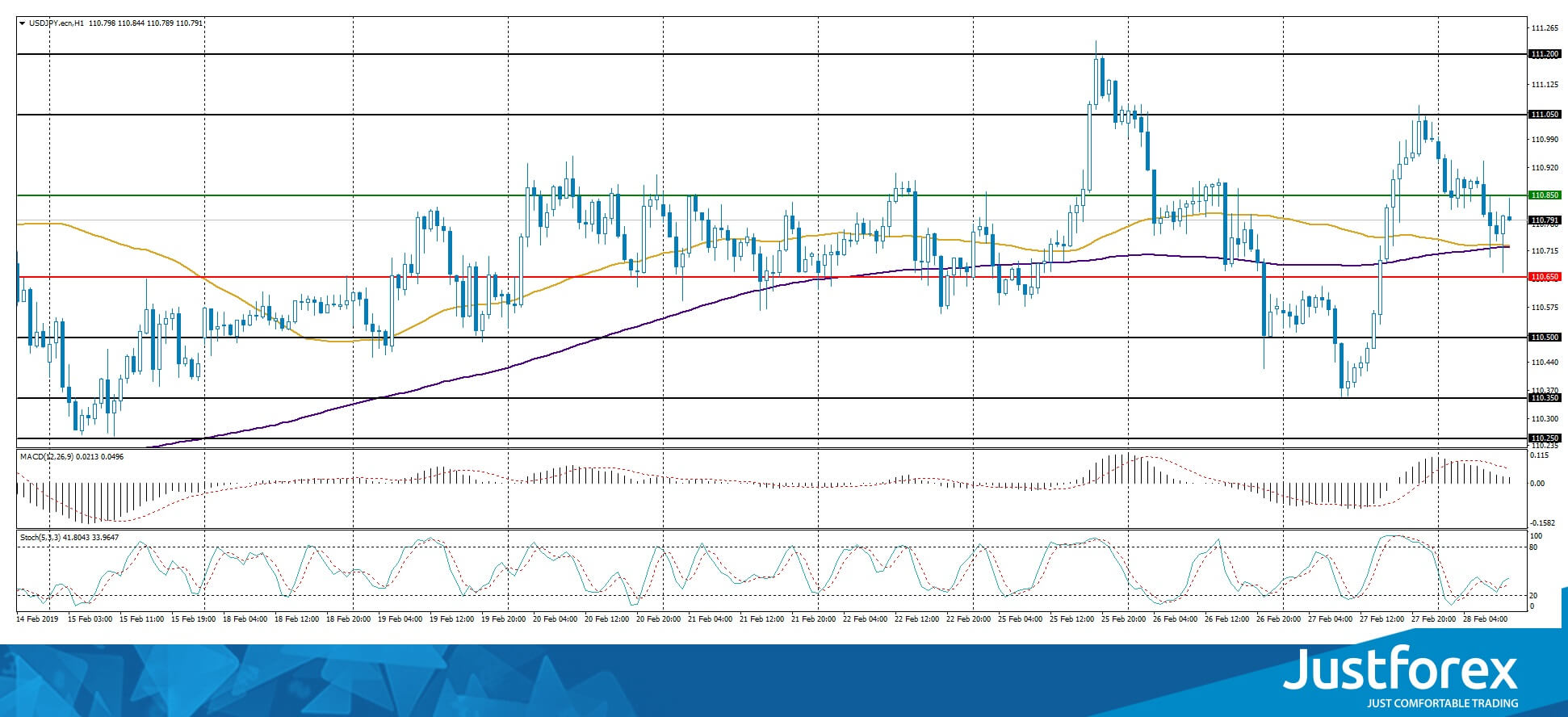
The indicators do not provide precise data, 50 MA has crossed 200 MA.
The MACD histogram is in the positive zone but above the signal line, which gives a weak signal to buy USD/JPY.
The Stochastic Oscillator is in the neutral zone, the %K line is above the %D line, which points to the bullish mood.
Trading recommendations
Support levels: 110.650, 110.500, 110.350
Resistance levels: 110.850, 111.050, 111.200
If the price fixes below 110.650, expect the quotes to fall toward 110.400-110.250.
Alternatively, the qtuoes can grow toward 111.100-111.300.
Investors Are Focused On Geopolitical Events
Yesterday, the US dollar recovered some losses against a basket of major currencies. The dollar index (#DX) closed in the positive zone (+0.18%). Financial market participants evaluate the news flow. Fed Chairman Powell confirmed that the regulator would adhere to the "dovish sentiment" in relation to monetary policy and would not raise the interest rate in the near future. The US currency was supported by positive economic data. Thus, pending home sales index in the US rose by 4.6% in January instead of 0.8%, as experts expected.
The Chinese yuan weakened against the US currency after the release of weak economic statistics. Today, during the Asian trading session, Chinese manufacturing PMI has been published, which has counted to 49.2 in February and has occured to be worse than the expected 49.5. This suggests that the difficult trade relations between the US and China have a negative impact on the economy of China.
At the moment, investors are focused on the relationship between US President Donald Trump and DPRK leader Kim Jong Un. As it became known, the leaders met yesterday in Vietnam but did not reach an agreement. Let us recall that the United States tried to achieve the denuclearization of the DPRK. Earlier, Trump promised to provide security guarantees for the DPRK, and Kim Jong Un – to help the United States return home the remains of US service members who were taken as prisoners during the Korean War. However, Kim Jong Un demanded in response to cancel the US sanctions against North Korea completely, but Trump did not agree to do that.
Also, financial market participants are concerned about the conflict between India and Pakistan. Yesterday, countries announced that they launched air strikes on each other's territory for the first time since the war in 1971. The conflict between India and Pakistan began to escalate since mid-February when Indian military police officers died due to a suicide murderer's attack in Kashmir. The militant group Jaish-e-Muhammad claimed the responsibility for that.
The "black gold" prices have been declining after a sharp rise during yesterday's trading session. At the moment, futures for the WTI crude oil are testing $56.75 per barrel.
Market Indicators
- Yesterday, the bearish sentiment was observed in the US stock market: #SPY (-0.04%), #DIA (-0.26%), #QQQ (-0.06%).
- The 10-year US government bonds yield has been growing. At the moment, the indicator is at the level of 2.66-2.67%.
The news feed on 28.02.2019:
- Preliminary data on US GDP at 15:30 (GMT+2:00);
- Initial jobless claims in the US at 15:30 (GMT+2:00).
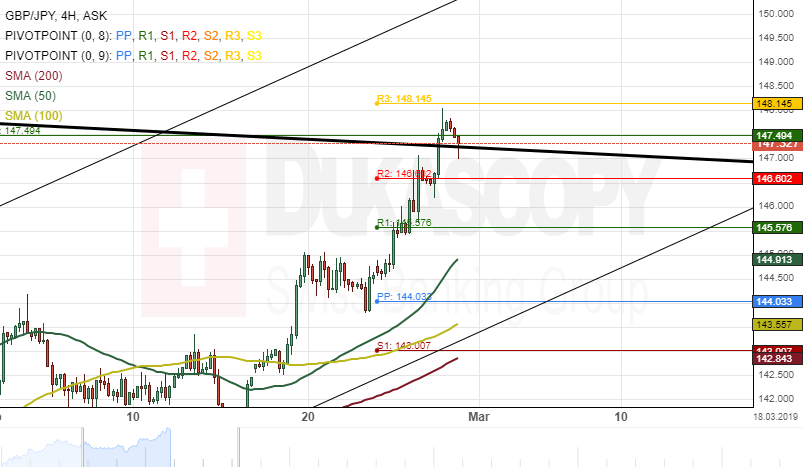
GBP/JPY 4H Chart: Breakout Occurs
Upside risks dominated the British Pound versus the Japanese Yen during the past week. The currency pair appreciated about 2.89% during last week's trading session.
A breakout occurred through the upper boundary of a dominant descending channel at 147.00 at the end of Wednesday's trading session.
Given that a breakout had occurred, it is likely that the GBP/JPY exchange rate continues to gain strength.
However, it is expected that the currency exchange rate makes a brief retracement down towards a support level at 144.03 in the short-term.