Sample Category Title
Canada’s Retail Sales Fell In December
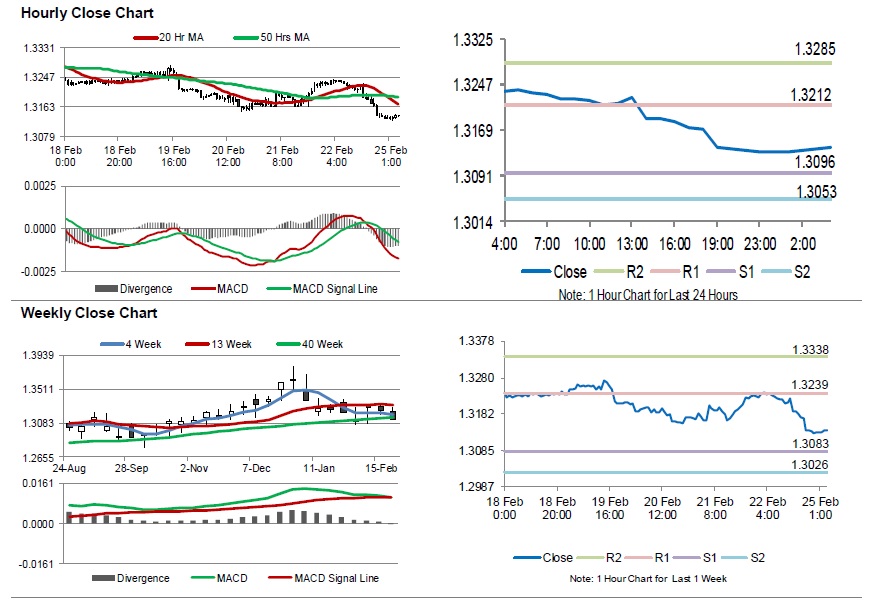
For the 24 hours to 23:00 GMT, the USD declined 0.72% against the CAD and closed at 1.3138 on Friday.
Macroeconomic data indicated that Canada's retail sales declined 0.1% on a monthly basis in December, compared to a fall of 0.9% in the previous month. Market participants had expected retail sales to drop 0.3%.
In the Asian session, at GMT0400, the pair is trading at 1.3140, with the USD trading a tad higher against the CAD from Friday's close.
The pair is expected to find support at 1.3096, and a fall through could take it to the next support level of 1.3053. The pair is expected to find its first resistance at 1.3212, and a rise through could take it to the next resistance level of 1.3285.
The currency pair is trading below its 20 Hr and 50 Hr moving averages.
Aussie Extends Its Losses In The Asian Session
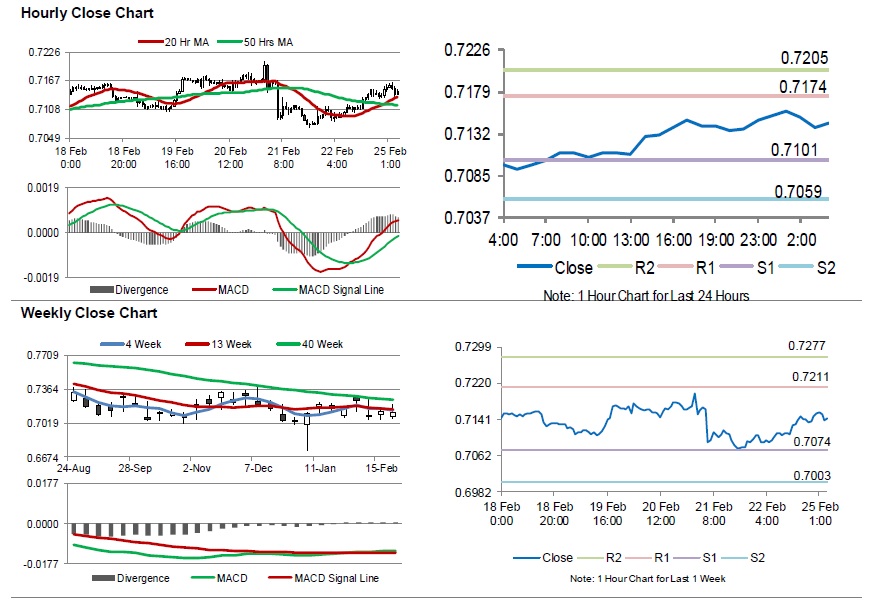
For the 24 hours to 23:00 GMT, the AUD declined 0.98% against the USD and closed at 0.7097.
LME Copper prices rose 0.6% or $39.5/MT to $6391.0/MT. Aluminium prices rose 1.6% or $29.0/MT to $1858.5/MT.
In the Asian session, at GMT0400, the pair is trading at 0.7096, with the AUD trading slightly lower against the USD from yesterday’s close.
Elsewhere in China, Australia’s largest trading partner, new home prices rose at its weakest
pace since April 2018 by 0.6% on a monthly basis in January, compared to reading of 0.8% in the prior month.
The pair is expected to find support at 0.7055, and a fall through could take it to the next support level of 0.7013. The pair is expected to find its first resistance at 0.7153, and a rise through could take it to the next resistance level of 0.7209.
The currency pair is showing convergence with its 20 Hr moving average and trading below its 50 Hr moving average.
Gold: Yellow Metal Extends Its Gains This Morning
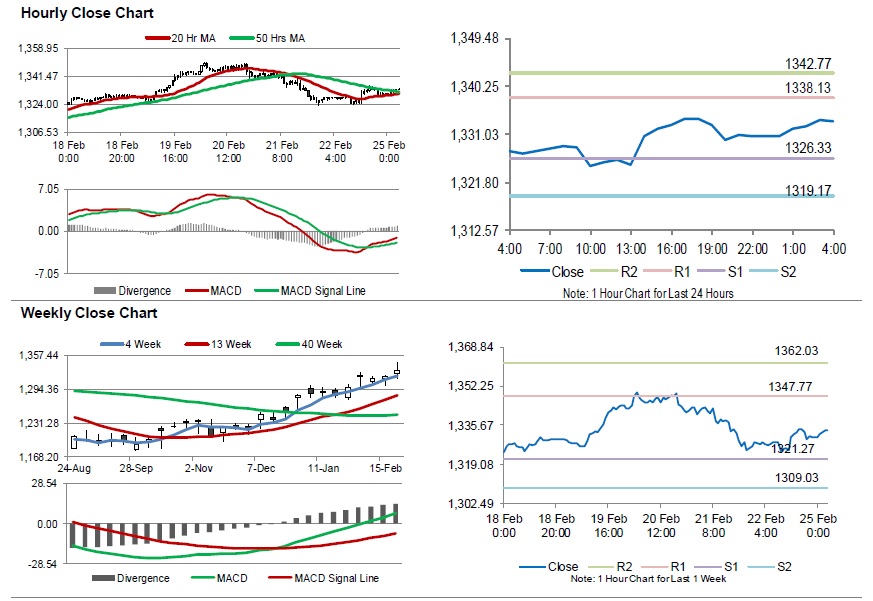
For the 24 hours to 23:00 GMT, Gold rose 0.46% against the USD and closed at USD1332.80 per ounce on Friday, amid broad weakness in the US dollar.
In the Asian session, at GMT0400, the pair is trading at 1333.50, with gold trading 0.05% higher against the USD from Friday’s close.
The pair is expected to find support at 1326.33, and a fall through could take it to the next support level of 1319.17. The pair is expected to find its first resistance at 1338.13, and a rise through could take it to the next resistance level of 1342.77.
The yellow metal is trading above its 20 Hr and 50 Hr moving averages.
Don’t Hold Your Breath Too Long While Under Water
The headline of this educational feature pertains not to swimming but to trading. Most professional traders do not hold onto their losing positions for very long. Once a trading position goes "under water" most professional traders will immediately begin looking for an exit strategy-if they do not already have one in place (and most do) via protective stops.
I had lunch with my trading mentor the other day and he shared a very good story with me. It went something like this: There once was a trader whose trading decisions were based upon using a "plumb-bob." (For those who have never worked on a construction site or in the land-surveying business, a plumb-bob is a turnip-shaped weight that is attached to a string to help determine if a structure is straight.) When this trader dangled the plumb-bob and it swung back and forth from north to south, he would buy. If the trader dangled the plumb-bob and it swung back and forth from east to west, he would sell. The trader had success using this methodology--with one simple rule applied: At the end of the first day, if his position was "under water," he exited his trade first thing the next trading day.
The moral of the story is: Traders can (and do) have all kinds of trading strategies, but prudent money management is paramount. In other words, cut losses short!
Over the years I have received emails and telephone calls from traders who were way "under water" and had not prudently liquidated their losing trading positions. These traders were "hoping" the markets would turn around and losses would be reversed. Any time a trader has losses which are so big that "hope" comes into play, it's usually a situation where prudent money management has not been employed.
It's also important to mention that traders who know they have waited way too long to exit a losing position should not think already-big losses can't get even bigger--much bigger. I've heard many traders say, "Well, I've lost so much already that now I might as well wait for the market to turn around because it can't go much farther against me." That's a recipe for disaster and potential financial ruin. This is where the saying, "Never meet a margin call" comes into play. If a trader gets a margin call from his or her broker, it's best just to close out the losing position and look for trading opportunities in other markets.
I've often mentioned the old trading adage: "A market will do anything and everything possible to frustrate the largest amount of traders." Guess who are the traders that get most frustrated? It's the ones who are hanging on to losing trading positions, waiting and hoping for the market to turn around so they can get their money back. "I just want to get back to even" is a desperate quote that comes from some traders who are under water. That "hope" is usually never realized.
One of the most interesting aspects of trading futures is that there are a few basic and effective rules that have been used by successful traders for years. However, adhering to these rules on a continual basis can be most difficult for many traders--including the experienced veterans. Why is this? It is because some of the most effective rules in futures trading go against the grain of human nature. Indeed, the "psychology of trading" plays such an important role in trading success.
The article is written by our old partner Jim Wyckoff at TradingEducation.com
Silver: White Metal Trading On A Stronger Footing In The Morning Session
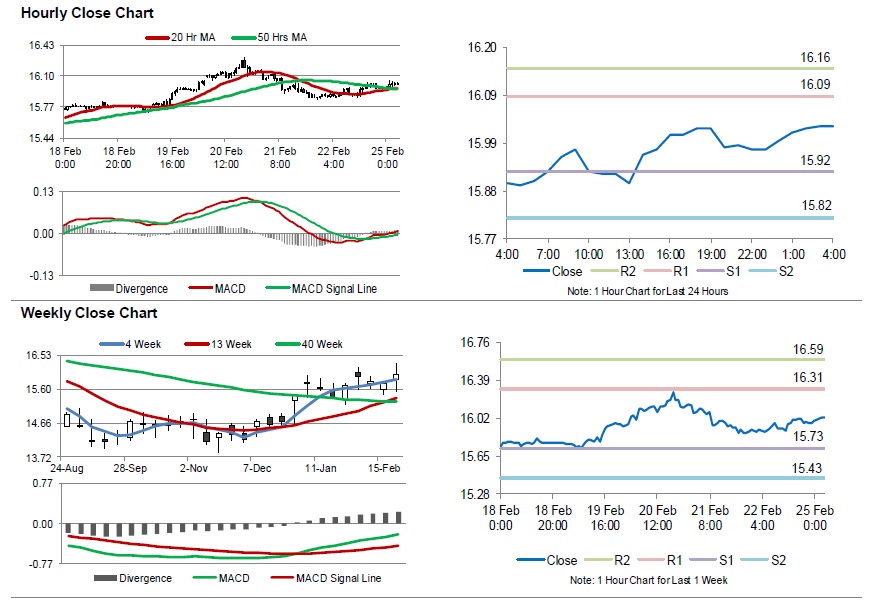
For the 24 hours to 23:00 GMT, Silver rose 0.57% against the USD and closed at USD15.98 per ounce on Friday.
In the Asian session, at GMT0400, the pair is trading at 16.03, with silver trading 0.31% higher against the USD from Friday’s close.
The pair is expected to find support at 15.92, and a fall through could take it to the next support level of 15.82. The pair is expected to find its first resistance at 16.09, and a rise through could take it to the next resistance level of 16.16.
The white metal is trading above its 20 Hr and 50 Hr moving averages.
The Single MOST IMPORTANT Aspect of Futures Trading
Okay, traders: Do you know what is the most important aspect of successful futures trading? Is it identifying the trading opportunity? Is it proper entry into the market? Is it the trading "tools" you are using? Is it an exit strategy that is the most important aspect of trading? The answer is: None of the above (although an exit strategy is close).
The most important factor in successful futures trading is money management. One still has to be savvy at chart forecasting and-or fundamental analysis, but it's the money-management factor that will make or break a futures trader. The huge leverage involved with trading futures absolutely requires pinpoint money managing.
Over the years, I have listened to the best traders in the business talk about what makes them succeed in this challenging arena, and nearly every one emphasizes the importance of sound money management. A few years ago I attended a TAG (Technical Analysis Group) trader's conference in Las Vegas. One of the featured speakers stressed that becoming a successful futures trader should be more an act of survival in the early going than scoring winning trades.
Surviving in the futures market absolutely requires practicing sound money management. Even a rookie trader who starts out with a hot hand will eventually find that at least some trades are not going to go his way. And if he has not employed good money- management principles on those losing trades, he will likely have squandered his trading profits and his entire trading account.
Conversely, the novice trader who uses good, conservative money management techniques will be able to withstand some losses and be able to trade another day. The ability to take a loss and trade another day is the key to survival--and ultimate success-- in the futures trading arena.
Here's an important point to consider, regarding money management and successful futures trading: Most successful futures traders will tell you that during the span of a year they have more losing trades than winning trades. Then why are they successful? It is because of good money management. Successful traders set tight stops to get out of losing positions quickly; and they let the winners ride out the trend. On the balance sheet, a few bigger winning trades will more than offset the more numerous smaller losers. Good money management allows for that to happen.
Good money management" is a relative principle. A good money- management practice for one trader might not be a good money- management practice for another. Here's a real-life example: I had a fellow email me a while back, saying he was up $3,000 in a sugar trade, and that his total trading account was $4,000. Although I don't provide specific trading advice to individuals, I told the trader that if I had only a $4,000 trading account and had racked up 3 grand in profits on one trade, I would seriously think about ringing the cash register on that trade and building up my account so that I could withstand those drawdowns and losers that will eventually occur.
On the other hand, if a trader with a $30,000 account had a $3,000 winning sugar trade, he may want to let the winner ride a little longer, as pocketing the profit would not nearly double his trading account, as it would the smaller-capitalized trader.
In other words, don't be a greedy trader. There's an old trading adage that says there is room for bulls and bears in the marketplace, but pigs get slaughtered.
Let me emphasize here there is nothing wrong with starting out with, or keeping, a smaller-capitalized futures trading account. But I strongly suggest that those smaller accounts use the very strictest of money management.
There are dozens of good futures and stock trading books available, and most spend at least an entire chapter on money management.
Here are just a few very general money-management guidelines:
- For smaller-capitalized traders, don't commit more than one-third of your trading capital to one trade. For medium- and larger-capitalized traders, you should not commit more than 10% of your capital to one trade. The guideline here is, the larger your trading account, the smaller your commitment should be to one trade. In fact, some trading veterans suggest larger trading accounts should not commit more than 3-5% of their capital to one trade. Smaller-capitalized traders, by necessity, have to commit a larger percentage of their capital to one trade. However, these small-cap traders may want to trade options (buying them, not selling them), as risk is limited to the price paid for the option. Or, smaller-capitalized traders may want to trade on the Mid-American Exchange, a division of the Chicago Board of Trade that has smaller futures contract sizes.
- Use tight protective stops in all your trades. Cut your losses short and let the winners ride the trend.
- Never, never, never add to a losing position.
- Your risk-reward ratio in a futures trade should be at least three to one. In other words, if your risk of loss is $1,000, your profit potential should be at least $3,000.
I can't stress enough that survival in the futures trading arena (especially for beginners) should be your top priority.
The article is written by our old partner Jim Wyckoff at TradingEducation.com
Risk and Reward
How do you determine proper risk and reward in trading? I don't think anyone can ever provide a definitive answer to that question because its is akin to asking how many layers do you need to walk outside of my apartment in New York City in the winter. Right now as the thermometer reads a balmy 8 degrees Fahrenheit as I type this at 3 in the morning, you need about four layers just to make it to the coffee shop across the street. But just last week you could have made the same journey in a T shirt without feeling a chill.
Trading, like the addled, globally warmed weather of my great metropolis is an imprecise and a highly volatile proposition. Therefore the question of risk and reward always changes with the circumstances of the moment. The traditional view on risk and reward is to set the ration to at least 2:1 - risking half the amount of pips as you are trying to make, so that if your profit target was 100 then your stop would be 50.
In theory this sounds like a terrific plan. You only need to be correct 4 out of 10 times to make money. However, I've never met a real life trader who actually put this principle into practice. I've received plenty of such advice on this matter from analysts, strategists, trading coaches and a whole host of others who have never wagered so much as their breakfast money on a trade, but I have never seen the 2:1 ratio employed by anyone who actually makes their living from the market.
Why?
The primary reason is that most people who never trade, do not realize that there is no such thing as reward in the market. There is only risk. Markets are not like factories that manufacture profits to your order. In fact, markets do everything possible to frustrate your goals. Imagine a trade where you risk 100 points with a profit target of 200. Initially the trade goes your way and the floating p/l quickly rises until it reaches +199. Disciplined in your 2:1 strategy you wait for the profit target to hit so you can book another good trade. But guess what? The market suddenly stalls and then reverses. You watch in horror as the positive trade quickly turns negative and then drops through your stop. What was you loss? On paper you lost 100 points, but in actuality you lost -299 points ( 100 points on your stop and -199 you did not book). Welcome to real life trading where the "theoretical" 2:1 risk reward is far more elusive than you think.
The fact of the matter is that profits cannot be forecast in the market. The only thing you can control is risk. That's why we always trade with two units. That's why we always take short first targets and that's why we assiduously control risk by trailing our stops. It may not be glamorous, but its the only way we know how deal with risk and reward at BKT.
The article is written by our old partner Boris Schlossberg at BKTraderFX
Crude Oil: Oil Reverses Its Gains In The Asian Session
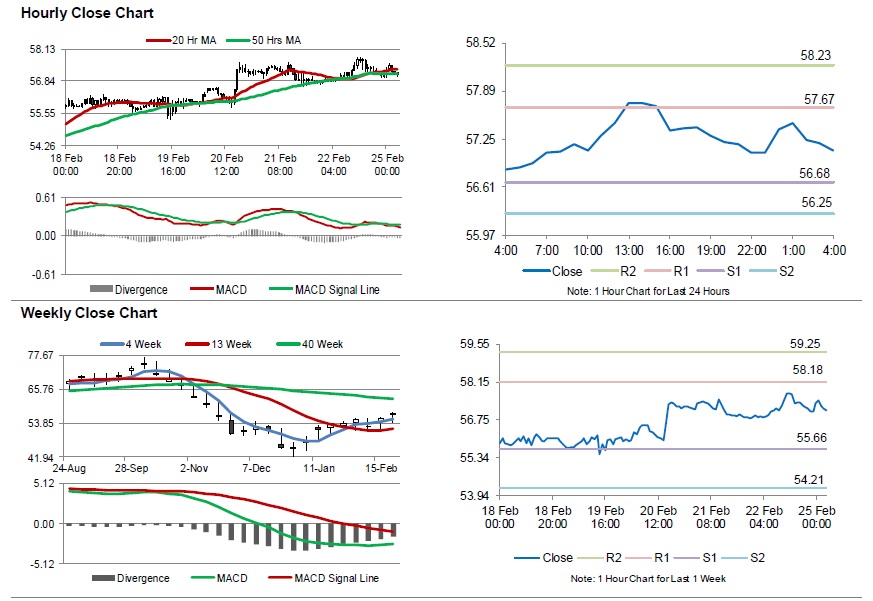
For the 24 hours to 23:00 GMT, Crude Oil rose 0.70% against the USD and closed at USD57.20 per barrel on Friday, after fresh figures from Baker Hughes disclosed that the number of active oil rigs declined by 4 to 853 in the week ended 22 February 2019.
In the Asian session, at GMT0400, the pair is trading at 57.10, with oil trading 0.17% lower against the USD from Friday’s close.
The pair is expected to find support at 56.67, and a fall through could take it to the next support level of 56.25. The pair is expected to find its first resistance at 57.67, and a rise through could take it to the next resistance level of 58.23.
Crude oil is trading below its 20 Hr moving average and showing convergence with its 50 Hr moving average.
Into European Session: China SSE up 5% on trade, AUD & NZD strongest
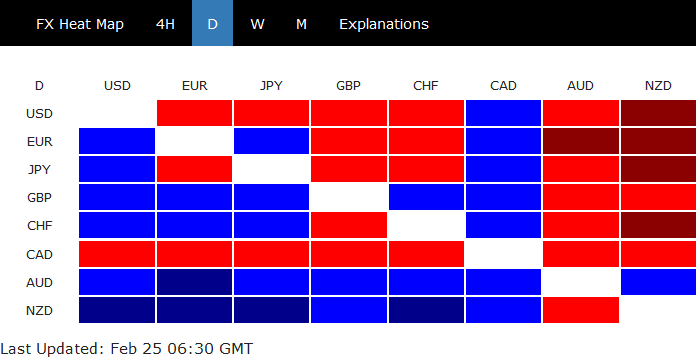
Entering into European session, Australian and New Zealand Dollar are the strongest ones for today so far. Market sentiments are generally lifted by the "substance progress" in US-China trade talks. And, Trump announced to delay the March 1 trade truce deadline. He's also planning a summit with Xi at Mar-a-Lago to seal the deal.
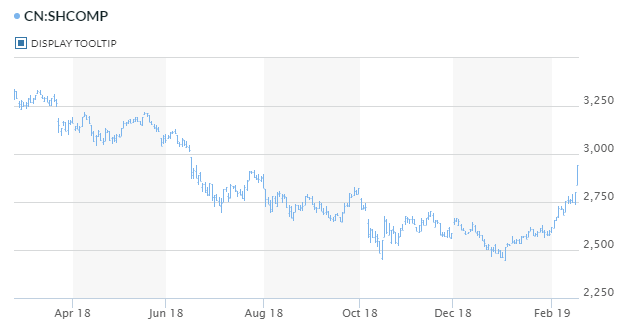
The strongest reactions are seen in Chinese stocks with Shanghai SSE hitting the highest level since June 2018. 3000 handle is now within touching distance.
Canadian Dollar is the weakest one for now but it's merely paring some of last week's strong gains. It's followed by Dollar and then Yen. Sterling is also mildly firmer after UK delays another Brexit meaningful vote from Wednesday to March 12, just 17 days ahead of the formal Brexit date.
The economic calendar is rather light today. Focus will be on BoE Governor Mark Carney's speech, as well as comments from Fed Vice Chair Richard Clarida.
In Asia:
- Nikkei closed up 0.48%.
- Hong Kong HSI is up 0.35%.
- China SSE is up 4.98%.
- Singapore Strait Times is down -0.02%.
- Japan 10-year JGB yield is up 0.006 at -0.034.
GBP/JPY Daily Outlook
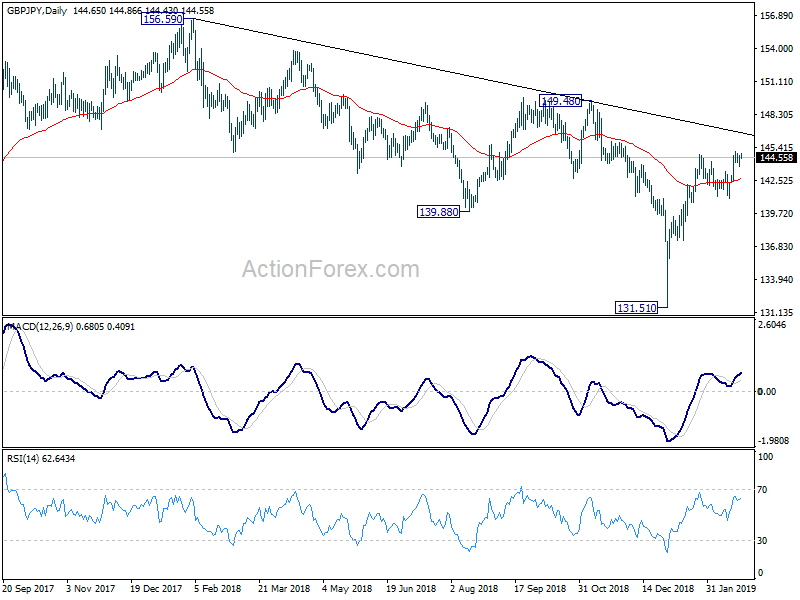
Daily Pivots: (S1) 143.92; (P) 144.33; (R1) 144.89; More...
Intraday bias in GBP/JPY remains neutral and another rise is mildly in favor. On the upside, break of 144.85 resistance suggests resumption of rebound from 131.51. Break of 145.04 will extend the rally. But we'd expect strong resistance from trend line (now at 146.75) to limit upside, at least on first attempt. On the downside, firm break of 141.00 support will suggest completion of the rebound and turn bias to the downside.
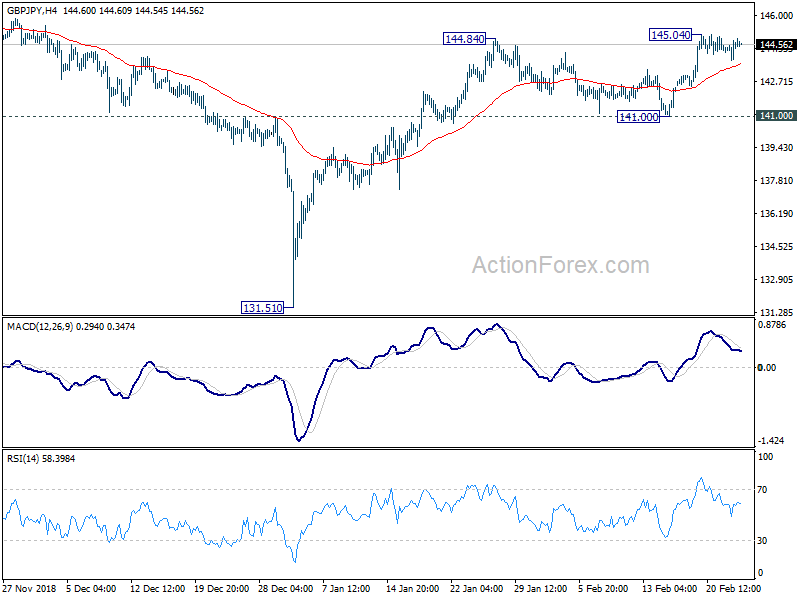
In the bigger picture, the strong rebound from 131.51 suggests that medium term fall from 156.59 (2018 high) has completed already. The corrective structure of such decline is turn argues that it's the second leg of the corrective pattern from 122.36 (2016 low). And this pattern is starting the third leg. On the upside, decisive break of 149.38 will pave the way to 156.59 resistance and above.