

Sample Category Title
GBP/USD Eyeing Upside Break While EUR/GBP Struggles
GBP/USD climbed higher recently and settled above the 1.3000 resistance area. On the other hand, EUR/GBP declined sharply and it is could continue to move down towards 0.8650.
Important Takeaways for GBP/USD and EUR/GBP
- The British Pound gained pace recently and broke the 1.2940 and 1.3000 resistance levels.
- There is a crucial breakout pattern formed with resistance at 1.3080 on the hourly chart of GBP/USD.
- EUR/GBP declined heavily and broke the key 0.8750 support area.
- There is a major bearish trend line formed with resistance at 0.8715 on the hourly chart.
GBP/USD Technical Analysis
The British Pound found a strong buying interest near the 1.2780 and 1.2800 levels against the US Dollar. The GBP/USD pair started a strong upward move and broke the 1.2850, 1.2940 and 1.3000 resistance levels.
The upward move was strong as the pair even broke the 1.3050 resistance and the 50 hourly simple moving average. A new weekly high was formed at 1.3108 on FXOpen and later the pair started a downside correction.
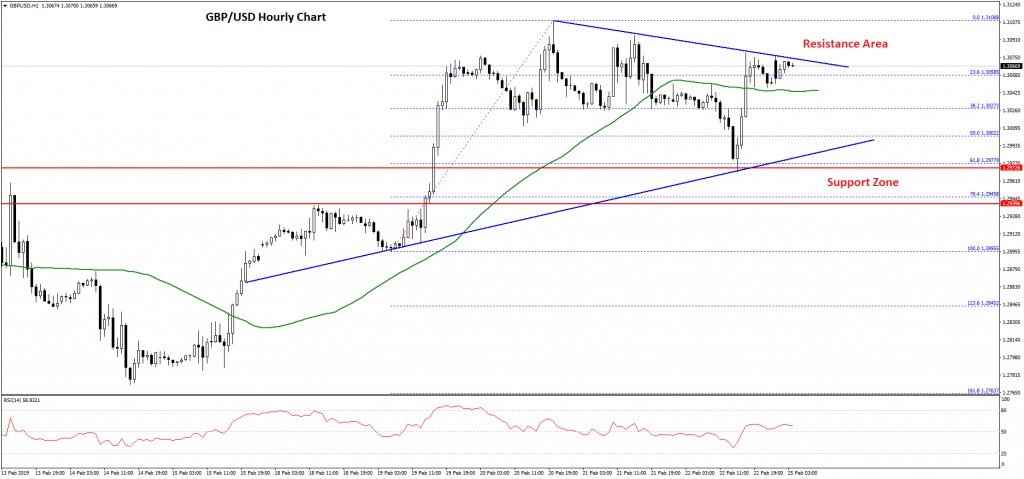
It traded below the 1.3050 and 1.3000 support levels to move into a short term bearish zone. It even broke the 50% fib retracement level of the last wave from the 1.2895 low to 1.3108 high.
However, the decline was protected by the 1.2980 support area and the 61.8% fib retracement level of the last wave from the 1.2895 low to 1.3108 high. The pair bounced back above 1.3020 and settled above the 50 hourly SMA.
At the outset, it seems like there is a crucial breakout pattern formed with resistance at 1.3080 on the hourly chart of GBP/USD. The pair could gain bullish momentum once it breaks the 1.3080 and 1.3100 resistance levels.
The next key stop for buyers could be 1.3120, above which the pair could rally towards the 1.3160 level. On the downside, an initial support is near the 1.3040 level, below which the pair could revisit the 1.3000 support area in the near term.
EUR/GBP Technical Analysis
The Euro started a major downside move from well above the 0.8800 level against the British Pound. The EUR/GBP pair traded sharply lower and broke the 0.8750 and 0.8720 support levels.
It even broke the 0.8700 support and the 50 hourly simple moving average. A low was formed at 0.8664 and later the pair started corrected higher. It is currently consolidating losses near the 23.6% Fib retracement level of the recent decline from the 0.8728 high to 0.8664 low.
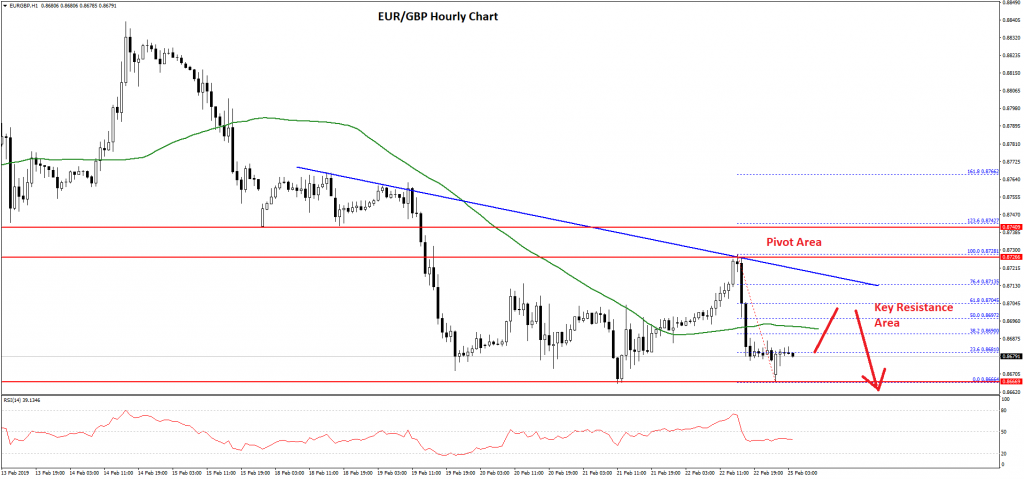
On the upside, an initial resistance is near the 0.8695 level and the 50 hourly simple moving average. The next key resistance is 0.8700 and the 50% Fib retracement level of the recent decline from the 0.8728 high to 0.8664 low.
More importantly, there is a major bearish trend line formed with resistance at 0.8715 on the hourly chart. Therefore, the pair needs to climb above the 0.8700 and 0.8715 levels to move into a positive zone.
If it continues to struggle below 0.8715, there are chances of more losses in the near term. A break below the recent low of 0.8664 could accelerate losses in EUR/GBP towards the 0.8650 or 0.8640 support level. The main support is near 0.8620, where buyers may emerge.
AUD/USD Daily Outlook
Daily Pivots: (S1) 0.7090; (P) 0.7121; (R1) 0.7158; More...
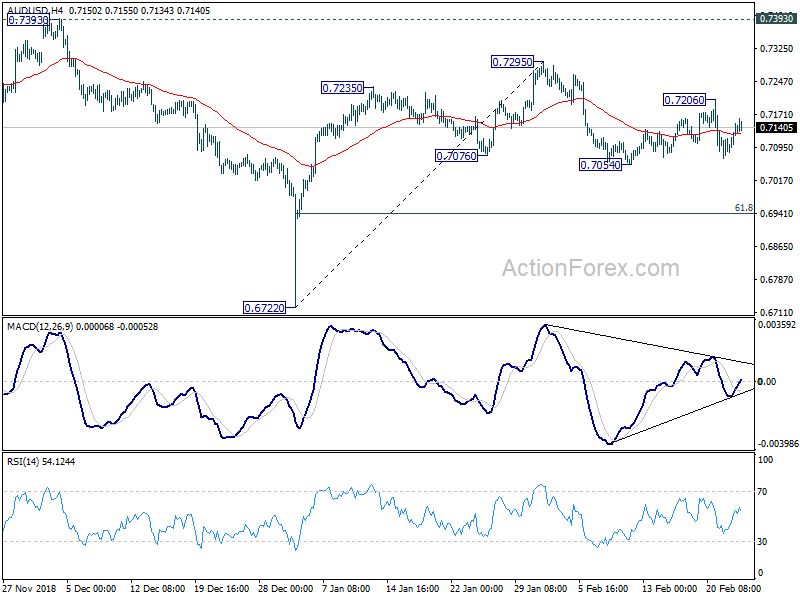
Intraday bias in AUD/USD remains neutral at this point. On the downside, decisive break of 0.7054 will complete a head and shoulder reversal pattern (ls: 0.7235, h: 0.7295, rs: 0.7206). That should confirm completion of rebound from 0.6722. Further decline should then be seen to 61.8% retracement of 0.6722 to 0.7295 at 0.6941 next. On the upside, though, break of 0.7206 will turn focus back to 0.7295 resistance instead.
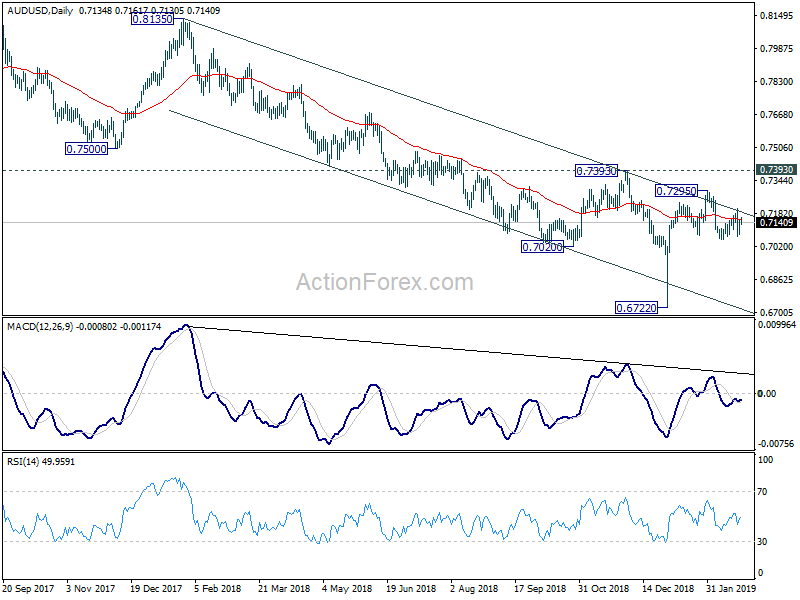
In the bigger picture, as long as 0.7393 resistance holds, we'd treat fall from 0.8135 as resuming long term down trend from 1.1079 (2011 high). Decisive break of 0.6826 (2016 low) will confirm this bearish view and resume the down trend to 0.6008 (2008 low). However, firm break of 0.7393 will argue that fall from 0.8135 has completed. And corrective pattern from 0.6826 has started the third leg, targeting 0.8135 again.
Asian Markets Lifted Mildly as US-China Trade Truce Extends
Asian markets traded higher earlier today after Trump announced to extend trade truce with China beyond March 1. But there is no sustainable buying, except in China. Australian Dollar is lifted by positive sentiments. But New Zealand Dollar is even stronger after better than expected retail sales. On the other hand, Canadian Dollar is the weakest one for now but it's just paring some of last week's oil price triggered gains. Dollar is the second weakest.
Technically, there clear sign of reversal in Dollar yet. With 1.1275 minor support intact in EUR/USD, further rise is mildly in favor. Similarly, GBP/USD is holding above 1.2938 minor support, USD/CHF is held below 1.0060 minor resistance, USD/CAD is kept well below 1.3242. On the other hand, despite initial strength today, AUD/USD kept well below 0.7026 resistance and a break of 0.7054 is still in favor later. EUR/GBP could be a pair worth watching today as break of 0.8666 will extend decline from 0.8850 to 0.8617/20 key support zone.
In other markets, Nikkei is up 0.68% at the time of writing. Hong Kong HSI is up 0.01%. China Shanghai SSE is up 2.33%. Singapore Strait Times is down -0.39%. Japan 10-year JGB yield is up 0.002 at -0.0038, staying negative.
Trump delay new tariffs on China, planning Mar-a-Lago summit
Trump tweeted on Sunday that there was "substantial progress" made in US-China trade talks on "important structural issues including intellectual property protection, technology transfer, agriculture, services, currency, and many other issues". Hence he will be delaying the scheduled March 1 tariff increase. In other words, trade truce now extends beyond the date.
Trump added that assuming there is additional progresses, he is planning a summit with Chinese President Xi Jinping at Mar-a-Lago resort in Florida to conclude the agreement.
Later, Trump also said there could be "very big news over the next week or two" if all goes in well. He added that "China has been terrific. We want to make a deal that's great for both countries and that's really what we're going to be doing."
China's Xinhua also said the US and China have made "substantial progress" on specific issues in the latest round of trade talks.
UK delays Brexit vote to Mar 12, EU mulls 21-month extensions
UK Prime Minister Theresa May announced that a Brexit "meaningful vote" would not take place this week. Instead, the vote on the withdrawal agreement is rescheduled to March 12, just 17 days before the March 29 Brexit date. Though, the Parliament will still hold a series of Brexit votes on Wednesday. Also, May insisted that "we still have it within our grasp to leave the European Union with a deal on the 29th of March and that's what I'm going to be working at".
On the other hand, Bloomberg reported that EU is mulling an Article 50 extension for as long as 21 months beyond March 29. The idea of a short three-month delay has been floating for some time. But it's seen by EU as insufficient to break the deadlock. A three-month extension is only meaningful if for completing legal processes if UK Parliament approves the agreement.
Japan Hamada: BoJ can drops the 2% inflation target
Koichi Hamada, an advisor to Japanese Prime Minister Shinzo Abe said the BoJ could abandon the 2% inflation target. He told Reuters that "prices don't need to rise much. From the perspective of people's livelihood, what's more desirable is for prices to fall, not rise."
And, the inflation target is only "a tool for achieving full employment". Hamada added "it can be abandoned. It isn't absolutely crucial", and the "appropriate target level of inflation can be decided by the central bank".
On current monetary policy, Hamada said "the world economy faces substantial turbulence, the BOJ can wait". There is no need for loosen up policy too as "Demand is exceeding supply now. As long as this trend continues, we don't need to worry too much."
Busy week with high profile events
The last week of February is guaranteed to be an interesting one with all the high-profile events scheduled. Now that the trade truce between US and China are extended focus will firstly turn to USTR Robert Lighthizer's testimony at House Ways and Means Committee on Wednesday. More details of the negotiations could be revealed.
Staying with the US, Trump will meet North Korean leader Kim Jong-un on February 27-28 in Vietnam. A one-on-one meeting is expected at some point in during the period. Fed Chair Jerome Powell will have his semi-annual Congressional testimony on Tuesday and Wednesday.
In the UK, Brexit meaningful vote is now delayed to March 12. Other Brexit votes will still take place on Wednesday. The Parliament could should vote for amendments to take over control of Brexit process. Staying with the UK, BoE Governor Mark Carney will also have his inflation report hearing in the Parliament on Tuesday.
On the data front, US will release trade balance, consumer confidence, Q4 GDP, PCE inflation and ISM manufacturing. Eurozone will release CPI flash; UK will release PMI manufacturing. Canada will release CPI and GDP. China will release manufacturing PMIs. All the data could be market moving.
Here are some highlights for the week:
- Monday: New Zealand retail sales, Japan corporate services prices
- Tuesday: German Gfk consumer sentiment; UK BBA mortgage approvals, BoE inflation report hearings; US housing starts and building permits, house price index, consumer confidence, Fed chair Powell testimony
- Wednesday: New Zealand trade balance, Eurozone M3; Canada CPI; US trade balance, wholesale inventories, factory orders, pending home sales, Fed chair Powell testimony
- Thursday: Japan industrial production, retail sales housing starts; Australia private capital expenditure; New Zealand ANZ business confidence; China PMIs; Swiss GDP, KOF; German import prices, CPI; Canada current account, IPPI, RMPI; US GDP, jobless claims; Chicago PMI
- Friday: Japan Tokyo CPI, unemployment rate, capital spending, consumer confidence; China Caixin PMI manufacturing; Swiss retail sales, PMI manufacturing; Eurozone PMI manufacturing final, CPI flash; UK PMI manufacturing, M4 money supply, mortgage approvals; Canada GDP; US personal income and spending; ISM manufacturing
AUD/USD Daily Outlook
Daily Pivots: (S1) 0.7090; (P) 0.7121; (R1) 0.7158; More...
Intraday bias in AUD/USD remains neutral at this point. On the downside, decisive break of 0.7054 will complete a head and shoulder reversal pattern (ls: 0.7235, h: 0.7295, rs: 0.7206). That should confirm completion of rebound from 0.6722. Further decline should then be seen to 61.8% retracement of 0.6722 to 0.7295 at 0.6941 next. On the upside, though, break of 0.7206 will turn focus back to 0.7295 resistance instead.
In the bigger picture, as long as 0.7393 resistance holds, we'd treat fall from 0.8135 as resuming long term down trend from 1.1079 (2011 high). Decisive break of 0.6826 (2016 low) will confirm this bearish view and resume the down trend to 0.6008 (2008 low). However, firm break of 0.7393 will argue that fall from 0.8135 has completed. And corrective pattern from 0.6826 has started the third leg, targeting 0.8135 again.
Economic Indicators Update
| GMT | Ccy | Events | Actual | Forecast | Previous | Revised |
|---|---|---|---|---|---|---|
| 21:45 | NZD | Retail Sales Ex Inflation Q/Q Q4 | 1.70% | 0.50% | 0.00% | 0.30% |
| 21:45 | NZD | Retail Sales Core Q/Q Q4 | 2.00% | 0.80% | 0.40% | 0.70% |
| 23:50 | JPY | Corporate Service Price Y/Y Jan | 1.10% | 1.10% | 1.10% | |
| 15:00 | USD | Wholesale Inventories M/M Dec P | 0.30% | 0.30% |
Can EUR/USD Gain Momentum Above 1.1380?
Key Highlights
- The Euro recovered recently and broke the 1.1350 resistance against the US Dollar.
- There was a break above a crucial bearish trend line with resistance at 1.1295 on the 4-hours chart of EUR/USD.
- The German IFO Business Climate Index declined from 99.3 to 98.5 in Feb 2019.
- The US Wholesale Inventories for Dec 2018 will be released today, which could increase 0.2%.
EURUSD Technical Analysis
The Euro formed a strong support near the 1.1250 level and bounced back against the US Dollar. The EUR/USD pair traded above the 1.1300 and 1.1350 resistance levels to move into a positive zone.
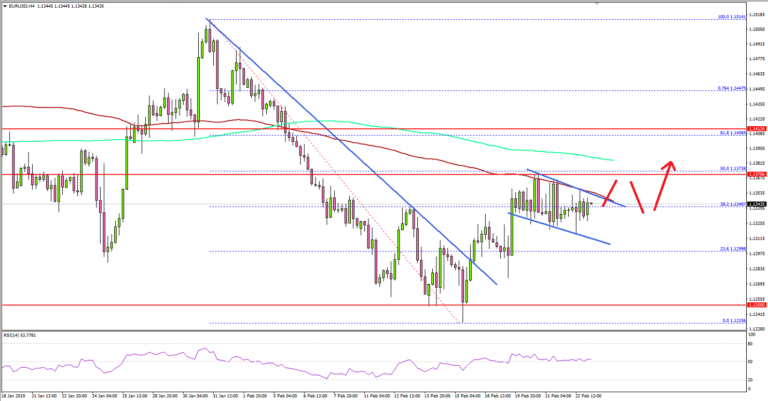
Looking at the 4-hours chart, the pair gained pace once it broke the 1.1300 resistance and the 23.6% Fib retracement level of the last decline from the 1.1514 high to 1.1236 low. The pair even climbed above the 1.1350 resistance, but it faced a strong resistance near the 1.1380 zone.
Moreover, the 50% Fib retracement level of the last decline from the 1.1514 high to 1.1236 low along with the 100 (red) simple moving average (4-hours) also prevented gains.
The current price action is neutral-to-bearish, with supports near the 1.1300 and 1.1280 levels. On the upside, a successful close above the 1.1375 and 1.1380 resistance levels could open the doors for a push towards the 1.1450 level.
Fundamentally, the German IFO Business Climate Index for Feb 2019 was released recently. The market was looking for a minor decline from the last reading of 99.1 to 99.0.
However, the result was mixed as there was a decline to 98.5, but the last reading was revised up from 99.1 to 99.3. Looking at the Expectations Index, there was a decline from 94.2 to 93.8.
Overall, the EUR/USD pair might struggle to climb above the 1.1380 resistance and it could correct a few pips before a fresh rise above 1.1400 in the coming sessions.
Economic Releases to Watch Today
- US Wholesale Inventories for Dec 2018 – Forecast +0.2%, versus +0.3% previous.
- Chicago Fed National Activity Index for Jan 2019 – Forecast 0.26, versus 0.27 previous.
Daily Markets Broadcast
Trade talks progress continues to boost equities
An extension to the March 1 deadline for China tariffs after “substantial progress in the trade talks in Washington is expected to lift Wall Street, though details remain scant, so far. The German rally is hampered by more weak data.
US30USD Daily Chart
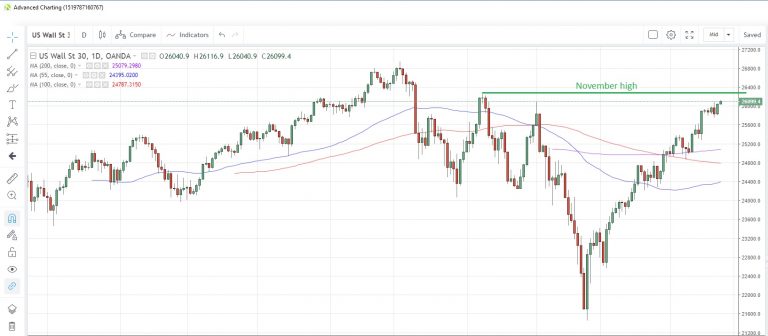
The US30 index pushed to a fresh 3-1/2 month high in early trading today, boosted by progress on the trade negotiation front
The index touched the highest since November 9 this morning after closing above the psychological 26,000 mark on Friday for the first time since November 8. The November high was 26,249
It's a slow start to the week on the data front, with January's Chicago Fed activity index and February's Dallas Fed manufacturing index on tap. Fed's Clarida is scheduled to speak.
DE30EUR Daily Chart
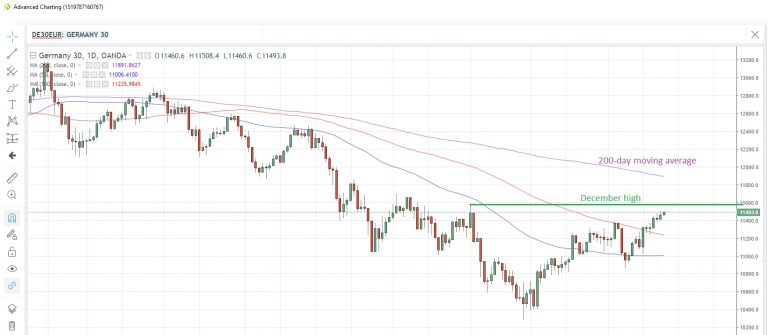
The Germany30 index edged higher on Friday, despite another weak data print confirming that the domestic economy is facing severe headwinds
The index has extended gains this morning, taking its cue form US index futures, reaching the highest since December 3
Friday's IFO surveys for February weakened across the board, with the expectations index slumping to 93.8, the lowest since July 2009. There are no data releases scheduled for today.
CN50USD Daily Chart
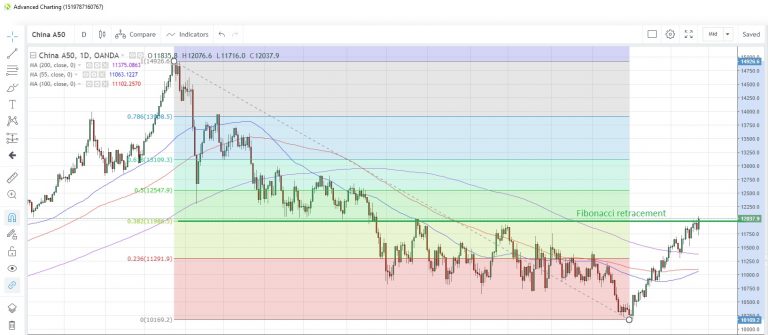
The China50 index posted its biggest one-day gain in two weeks on Friday, lifted by reported progress with the trade talks
The index is attempting to hold above the 11,987 level, which is the 38.2% Fibonacci retracement of the entire 2018 drop
Aside from developments on the trade front, the major data point for this week will be Thursday's release of PMI data for February. Investors may be hoping that a further rebound in the manufacturing PMI could extend the recent bullish run.
Trump Wins Best Trade Oscar With Early Morning Tweet
Trump wins best trade Oscar with early morning Tweet
Asia’s markets are poised for a positive open today as President Trump tweeted he is extending the US-China 1 March trade talk deadline this morning. Despite his very public spat with chief trade negotiator Robert Lighthizer over MOU agreements, the President now seems satisfied that sufficient headway has been made by both sides over the weekend to justify an extension. It would appear the US has successfully played hardball during the talks and a trade deal – should it emerge – could fundamentally reset how China does business with the world.
I can almost hear the collective sigh of relief in the region this morning because the Asia Pacific economies are so closely tied to the fortunes of China now that ripples are felt far and wide. In light of President Trump’s response, the regional FX and stock markets could have a very positive day, led by Chinese equities, which enjoyed their best run in nearly a year last week.
As Chinese negotiators head back to Beijing, President Trump will jump onto Air Force One seeking a follow on-performance in Vietnam at the two-day denuclearisation summit with North Korean leader Kim Jong-un. The impact this summit has on the markets should be negligible as the trade talk afterglow will be the only game in town. That said, with two such gregarious personalities at the helm, you can never say never when it comes to potential news headlines.
Federal Reserve Governor Jerome Powell will be up front and centre this week, undertaking a plethora of speaking engagements as well as testifying on Capitol Hill on Tuesday and Wednesday. In addition, several of his Federal Reserve colleagues will also be speaking, so the street will be looking for soothing comments about the future size of the balance sheet – the bigger the better – and insights into future rate hikes.
In terms of data, Friday’s US Personal Consumption figures look to be a highlight this week. This is being closely watched by the Fed with the market expecting 1.90%. China’s official and Caixin Manufacturing PMIs will also be released on Thursday and Friday respectively. Given the almost supernatural ability official China data has in terms of hitting forecasts, the Caixin should be more closely watched.
In other news, UK Prime Minister Theresa May has delayed Parliament’s Brexit vote by two weeks to mid-March. Noise from London and Brussels seems to point increasingly to an extension of Article 50 in order to avoid a hard Brexit on 29 March. The British are talking two months, the Europeans two years. My heart says the former, my head the latter. I am not sure the British people (or indeed the world) can face another two years of Brexit.
FX
Regional currencies could enjoy a positive day following Trump’s trade tweet. The talks have hung like a dark cloud over emerging Asia despite the fact stocks markets have bounced aggressively since January. Questions still linger about just how China will “manage” its currency or even if will agree to, but this should be lost in the post-trade-talk afterglow this week.
The Aussie dollar (AUD) has washed off the coal dust as China clarified the difference between blocking coal imports from Australia, and delaying ship unloading to assess its “environmental” impact. The AUD had already made back much of its 1% losses last week, rising 0.56% on Friday to 0.7150. With such a high beta to China, the Aussie dollar and its Kiwi cousin are poised to start the week from strong gains.
The British Pound (GBP) has held onto much of last week’s gains, buoyed by talk of an Article 50 extension. The theme should continue initially after the weekend press suggested a two-year extension could be on the table. Beware headlines and reality however as being long over 1.3100 in recent times has proved a hazardous strategy.
Equities
Given US-China trade talk progress and Wall Street’s positive finish on Friday, regional bourses should be firmly in the green as this week starts. China could lead the way, showing signs of life last week after months of being anchored to the sea floor, having been battered by Typhoon Tariff.
Gold
Gold could come under pressure today as investors move from safe havens to higher-risk assets. The technical picture, however, remains resilient and gold should still find friends on dips ahead of the Trump Kim summit mid-week. The US dollar could suffer the same fate as risk-seeking traders look to emerging markets, which could be supportive for gold as well.
Oil
Oil has enjoyed a bright start already, with Brent and WTI both jumping USD0.50. The trade-talk news will be energy nirvana for oil because the receding tariff threat will be interpreted as very positive for global consumption going forward.
GOLD Rejects Higher Prices And Looks To Weaken
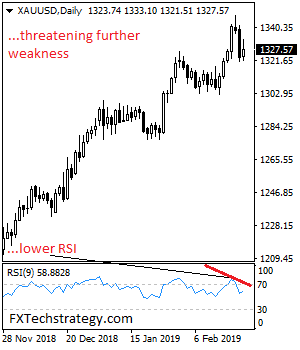
GOLD rejects higher prices and looks to weaken further lower in the new week. On the downside, support comes in at the 1,320.00 level where a break will turn attention to the 1,310.00 level. Further down, a cut through here will open the door for a move lower towards the 1,300.00 level. Below here if seen could trigger further downside pressure targeting the 1,290.00 level. Conversely, resistance resides at the 1,340.00 level where a break will aim at the 1,350.00 level. A turn above there will expose the 1,360.00 level. Further out, resistance stands at the 1,380.00 level. All in all, GOLD looks to move further higher.
EURUSD Outlook Remains Higher On More Strength
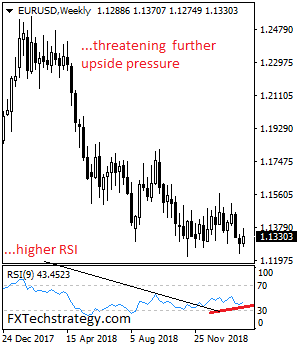
EURUSD outlook remains higher on more strength as it eyes price extension. Support comes in at the 1.1300 where a break will aim at the 1.1250 level. A break below here will target the 1.1200 level. Further down, support lies at the 1.1150. On the upside, resistance resides at 1.1400 level with a break through there opening the door for further upside towards the 1.1450 level. Further up, resistance comes in at the 1.1500 level where a violation will expose the 1.1550 level. Its weekly RSI is bullish and pointing higher suggesting further upside pressure. All in all, EURUSD continues to threaten further upside pressure.
Japan Hamada: BoJ can drops the 2% inflation target
Koichi Hamada, an advisor to Japanese Prime Minister Shinzo Abe said the BoJ could abandon the 2% inflation target. He told Reuters that "prices don't need to rise much. From the perspective of people's livelihood, what's more desirable is for prices to fall, not rise."
And, the inflation target is only "a tool for achieving full employment". Hamada added "it can be abandoned. It isn't absolutely crucial", and the "appropriate target level of inflation can be decided by the central bank".
On current monetary policy, Hamada said "the world economy faces substantial turbulence, the BOJ can wait". There is no need for loosen up policy too as "Demand is exceeding supply now. As long as this trend continues, we don't need to worry too much."
UK delays Brexit vote to Mar 12, EU mulls 21-month extensions
UK Prime Minister Theresa May announced that a Brexit "meaningful vote" would not take place this week. Instead, the vote on the withdrawal agreement is rescheduled to March 12, just 17 days before the March 29 Brexit date. Though, the Parliament will still hold a series of Brexit votes on Wednesday. Also, May insisted that "we still have it within our grasp to leave the European Union with a deal on the 29th of March and that's what I'm going to be working at".
On the other hand, Bloomberg reported that EU is mulling an Article 50 extension for as long as 21 months beyond March 29. The idea of a short three-month delay has been floating for some time. But it's seen by EU as insufficient to break the deadlock. A three-month extension is only meaningful if for completing legal processes if UK Parliament approves the agreement.