

Sample Category Title
Week Ahead – Long Overdue US Q4 GDP, Other Data Backlog to Dominate
The fourth quarter GDP estimates for the United States will finally be published next week following the disruption to the American release calendar from the government shutdown. Canadian GDP will also be in focus, along with core PCE inflation numbers out of the US. Other notable releases include Japanese and Australian capital expenditure figures for Q4, as well as Eurozone flash inflation and Chinese manufacturing PMIs. Trade talks between the US and China will also be on investors’ radar as they look set to last beyond the March 1 deadline.
Australian economy under the spotlight
After hitting a bump this week, the Australian dollar could be sailing through more choppy waters in the coming days as some important data releases will be looked at for signs the Australian economy could be entering troubled times. First on the watch list is construction work done for the fourth quarter on Wednesday. Construction constitutes a sizeable portion of Australian GDP so the data will be a guide for Q4 growth figures due in the following week. Another clue will come from Thursday’s Q4 capital expenditure figures. Also out on Thursday are private sector credit numbers for January and rounding up the week on Friday will be the AIG manufacturing index for February.
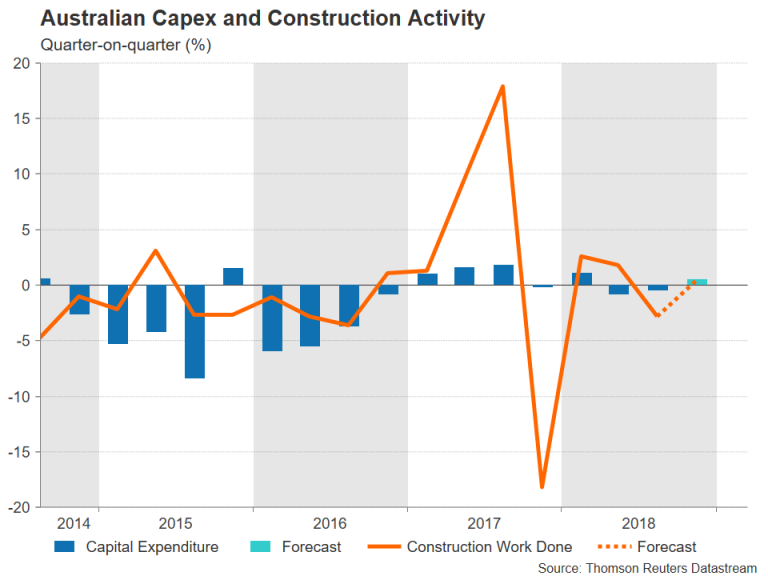
The aussie erased almost two weeks of gains on unexpectedly weak PMIs by IHS Markit as well as reports that China has banned some imports of Australian coal. Hence, any worrying aspects to next week’s data could further pressure the aussie.
In addition to the domestic data, aussie traders will also be watching the latest manufacturing PMIs out of China. The official manufacturing PMI, due on Thursday, is expected to hold steady at 49.5 in February, while a day later, the Caixin/Markit PMI could provide some relief to the markets as it’s forecast to edge up by 0.2 points to 48.5.
Could be a tough week for the kiwi too
The New Zealand dollar hasn’t fared any better than its aussie cousin over the past week despite the absence of any local data. However, New Zealand indicators will move to the forefront next week with a number of big releases. Kicking off the week are the fourth quarter retail sales numbers on Monday. This will be followed by trade figures on Wednesday and the closely-watched ANZ business outlook survey on Thursday, both for January. On Friday, kiwi traders will be hoping to get an insight to Q4 GDP performance from New Zealand’s terms of trade gauge.
A weak set of figures would likely strengthen expectations of a rate cut by the Reserve Bank of New Zealand later this year, weighing on the kiwi.
Japanese industrial output eyed
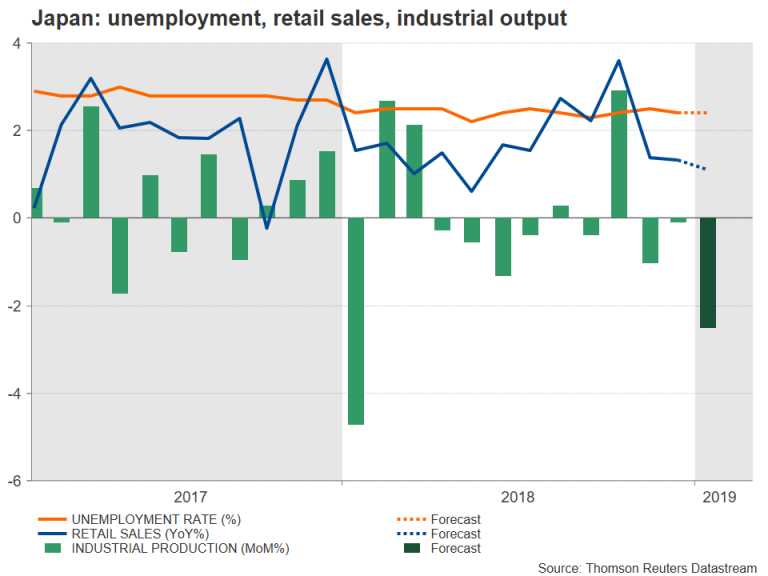
While much of the focus in the global slowdown narrative has been on China and now increasingly, on the Eurozone, Japan’s economy is also at risk of a major downturn. Fears about the world’s third biggest economy were heightened this week after data showed Japan’s exports plunged by 8.4% on an annual basis in January.
There will be more Japanese indicators for January coming up over the next seven days, with the most significant being Thursday’s preliminary reading of industrial output. Retail sales are also due on Thursday, while on Friday, unemployment numbers will be viewed along with capital expenditure for the fourth quarter. The capex data is seen as a reliable guide to the second GDP estimate, which tends to be revised sharply in Japan.
Eurozone flash CPI to be European highlight
The flash reading of the Eurozone PMIs for February provided some glimmer of hope that the severe slowdown could be coming to an end. There could be more evidence of the downtrend bottoming out in Wednesday’s economic sentiment indicator for the euro area.
The single currency could receive some support if the survey points to a steadying picture in February, but otherwise, with the only other major release being the preliminary inflation print for February, the euro could struggle for direction next week.
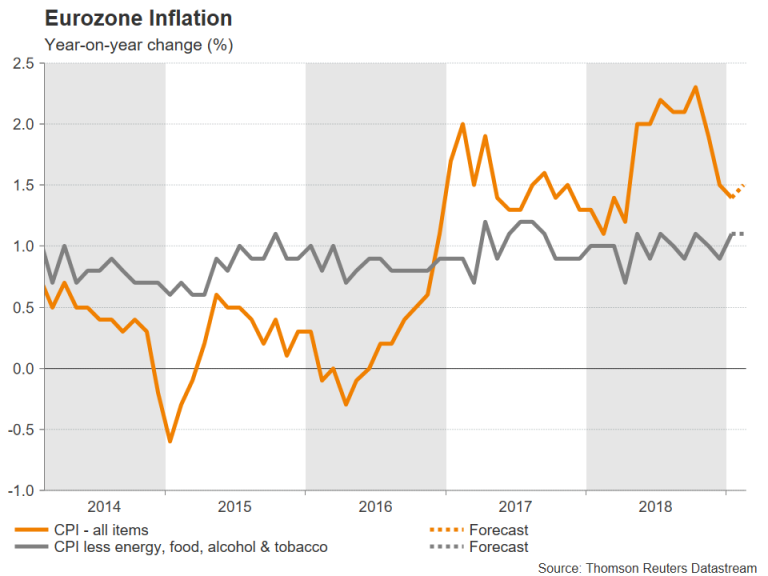
The flash headline inflation figure, out on Friday, is expected to inch higher by 0.1 percentage points to 1.5% in February. However, core CPI, which excludes food, energy, tobacco and alcohol, is forecast to stay unchanged at 1.1% year-on-year. Also out on Friday is the Eurozone unemployment rate for January and the final manufacturing PMI for February.
Yet another Brexit vote looms in UK Parliament
It’s going to be a muted week in the UK as well for economic data, with only Friday’s manufacturing PMI filling up the calendar. The Markit/CIPS manufacturing PMI is forecast to decelerate further in February, from 52.8 to 52.0.
However, Brexit will once again be keeping pound traders active as another crucial vote on the Brexit deal is scheduled next week for February 27. It’s not quite clear what MPs will be voting on at this point. If the prime minister, Theresa May, manages to secure legal assurances from the EU on the Irish backstop, there will likely be a meaningful vote on the revised deal. But if UK-EU negotiations have not been completed by then, MPs could simply vote on an amendable motion on how to proceed next with Brexit. The latter carries the risk of Parliament voting to take control of the Brexit process, possibly forcing the government to extend Article 50, if Mrs. May has nothing to show from the latest round of talks with Brussels. Either way, the pound appears to be headed for more volatility.
Canadian inflation and GDP to provide rate clues
Inflation and GDP growth numbers out of Canada next week could be significant for the loonie as any surprises in the numbers will probably impact rate hike expectations. The inflation figures are released first on Wednesday and investors will be watching for another possible strong reading in the headline number in January following December’s unexpected overshoot of 2.0% year-on-year.
Producer prices for January will be up next on Thursday but the main focus will be on Friday’s GDP estimates for Q4. Canada’s economy expanded by 0.5% quarter-on-quarter in the October quarter and a softer reading is likely for the final three months of 2018. A very disappointing figure would further dash expectations of a rate hike in 2019 following this week’s cautious remarks by Bank of Canada Governor Stephen Poloz.
US data to play catchup
There will be an overload of data out of the US in the coming week as many of the delayed releases are finally published. The housing market will fall under the limelight on Tuesday as December building permits and housing starts are released together with the S&P CoreLogic Case-Shiller 20-city home price index. Also due on Tuesday is the Conference Board’s barometer of consumer confidence. The index is forecast to increase in February from 120.2 to 125.0. If confirmed, it would end a steep three-month decline.
On Wednesday, factory orders and the trade balance for December will be monitored, as well as January pending home sales before attention moves to Thursday’s all-important GDP report. Growth in the world’s largest economy is projected to have slowed from an annualized rate of 3.4% in Q3 to 2.4% in the December quarter.
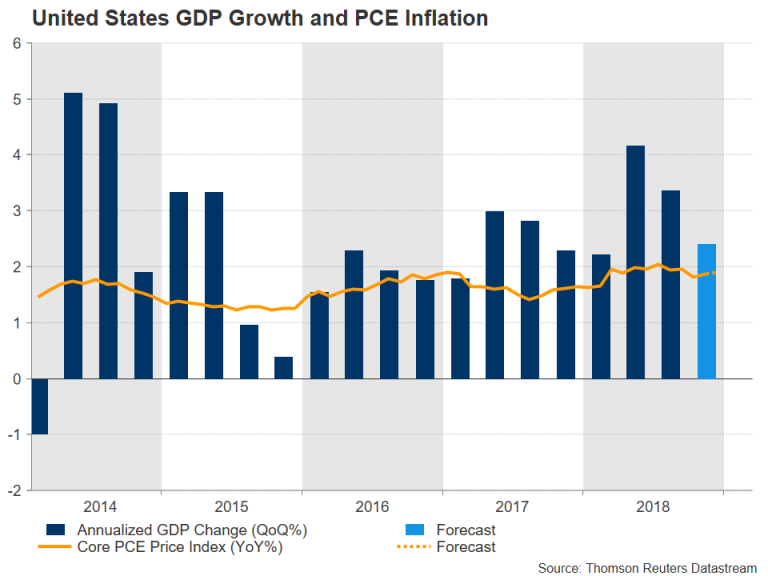
More top tier data will follow on Friday with all eyes turning to the Fed’s favourite inflation measure – the core PCE (personal consumption expenditures) price index. The price gauge is expected to have held steady at 1.9% y/y in December, just below the Fed’s 2% target. A surprise dip in the figure would probably reinforce expectations that the Fed will remain on pause until there’s a convincing build-up of inflationary pressures. In addition to the inflation data, the PCE report will contain the latest numbers on personal income and spending.
Equally important on Friday will be the ISM manufacturing PMI for February. The PMI is anticipated to record a 0.6 point drop to 56.0, in line with the other manufacturing indices released in recent days.
Tariff deadline nears; poses danger to risk rally
The US dollar could come under some selling pressure if the above data adds to the global growth worries than reassure investors that US fundamentals remain solid. The greenback is also likely to be driven by safe-haven flows as the March 1 deadline approaches when US tariffs on $200 billion worth of Chinese imports will automatically rise from 10% to 25% unless a trade agreement is struck, or President Trump decides to push back the deadline.
Given the extent of the rally in risk assets on expectations of a deal, any setback in the US-China trade negotiations could trigger a sharp correction, particularly in equities, but would lift safe havens such as the dollar and the yen.
Investors will also be watching the second summit between President Trump and North Korean leader Kim Jong-un in Vietnam on February 27-28. However, any developments in US-North Korean relations are more likely to influence gold than the currency markets.
Weekly Focus – Trade Talks Enter Critical Phase as Brexit Deadline Draws Closer
Market movers ahead
- Focus in China will continue to be on the US-China trade talks as we approach the 1 March deadline next week. High-level trade talks are likely to continue but we do not expect a final deal to be concluded by 1 March.
- In the US, a number of data releases are scheduled for next week, including PCE core inflation, ISM manufacturing and the housing market numbers. Furthermore, Powell testifies before the Senate Banking panel and House Financial Services committee.
- The UK focus remains on Brexit. Next week there will be a second so-called 'meaningful vote' on a full Brexit deal on Tuesday 26 February if PM Theresa May is able to secure a new deal with the EU27 (not the case at the time of writing).
Weekly wrap-up
- Economic data was mixed this week but we see tentative signs of a bottom. Chinese credit jumped higher in January and metal prices continue to send an early signal of a bottom in Chinese growth soon (see Market Movers). Euro PMI data also surprised on the upside, driven by a strong services PMI reading.
- On the Brexit front, things still look uncertain. Sentiment improved a little this week after UK Prime Minister Theresa May had talks with EU President Jean-Claude Juncker, which were described as 'constructive'.
- Trade talks are entering a critical phase as we near the 1 March deadline. For the third consecutive week, the US and China negotiated at the top level. This suggests to us that commitment to reach a deal soon is very high.
MARKET WRAP: Markets High on Hopes
The pivotal point in trade talks drove markets higher. The hopes are that China and US will be able to forge a deal.
Stocks
- The S&P 500 Index jumped by 0.29 percent as of 15:39 London time. There were 188 stocks up and 316 stocks trading lower. The total volume was 396 million shares.
- The Nasdaq 100 recovered some its losses from yesterday and jumped 0.35 percent and the Dow Jones Industrial Average also popped by 0.36 percent.
- The Stoxx Europe 600 Index ignored weak German IFO business data and jumped higher by 0.16 percent.
- Germany’s DAX Index had decent gains today. It gained 0.41% percent.
- The MSCI Emerging Market Index gained 0.73% on a volume of 3M shares.
Currencies
- The Dollar Spot Index finally dropped today by 0.14%. The US trade war negotiations remain the main focal point.
- The Euro reclaimed its level of 1.13 against the dollar, thanks to the improving inflation numbers.
- The British pound moved above the 1.30 mark against the dollar. However, the currency is still down today by 0.13%, the low of the day was 1.2968 and high of the day was 1.3051.
- The Japanese Yen moved lower today and dropped by 0.11 percent.
Bonds
- The yield on 10-year Treasuries sank by three basis points to 2.65 percent.
- Germany’s 10-year dropped two basis point to 0.103 percent.
- Britain’s 10-year yield also fell by five basis point to 1.151.
Commodities
- West Texas Intermediate crude gained 0.84 percent to $57.46.
- Gold maintained its momentum and moved higher by 0.13%. The support of $1,300 is under focus.
The pivotal point in trade talks drove markets higher. The hopes are that China and US will be able to forge a deal.
Fed Williams: Philips curve is alive and well
New York Fed President John Williams said in a speech that the Philips curve is the "connective tissue" between the Fed dual mandate of maximum employment and price stability. It's "alive and well" and remains an "empirical basis for forecasting and for monetary policy analysis." He said he "wholeheartedly" agree that Fed "must not be complacent about inflation expectations becoming unmoored, whether at too high or too low a level."
He noted that Fed policymakers "must remain vigilant regarding a sustained takeoff in inflation." That include the risk that "very tight labor markets could eventually lead to a resurgence of inflation and unmoor expectations, as in the 1960s." But at the same time "We must be equally vigilant that inflation expectations do not get anchored at too low a level." And the current "persistent undershoot of the Fed's target risks undermining the 2 percent inflation anchor."
Sunset Market Commentary
Markets
Global core bonds edged higher today with US Treasuries outperforming German Bunds. German Bunds opened with an upward tendency as the German Ifo Business Climate index printed slightly below expectations. Other than that, the eco calendar remained empty. ECB’s Nowotny signaled that the bank has not made any conclusions yet on a new TLTRO and expects no decision at the March meeting. ECB president Draghi speaking later today is a wildcard. The Germany yield curve edges lower with changes in the range of -0.9 bps (2-yr) to -2.4 bps (10-yr). US Treasuries moved sideways throughout the day with investors preparing for US President Trump’s meeting with China’s Vice-President Liu He and tonight’s panel discussion with several Fed heavyweights. Talk of the day will be the balance-sheet run off that is now expected to come to a halt at the end of this year. US Treasuries moved higher ahead of the US opening bell on technical buying. The US yield curve is bull flattening with changes up to -3.1 bps (30-yr). Italian BTP’s edged lower in the run-up to Fitch’s rating review later today. Financial markets are pricing in a 30% probability of a downgrade, which could dampen investor sentiment. Peripheral spreads over the German 10-yr yield are stable with only Italy (+5 bps) and Greece (+4 bps) underperforming.
In line with the price action earlier this week, trading in the EUR/USD cross rate was again confined to a very tight range. The pair gained a few tick in the run-up to the publication of the German Ifo business sentiment. The Ifo indicator slightly missed, albeit modest, market expectations. EUR/USD retuned to the 1.1330/40 area. There were no eco data in the US. Even so there was a temporary ‘up-tick’ in volatility at the start of the US session. US yields and USD/JPY declined in lockstep. USD/JPY dropped from the 110.85/90 area and trades currently again in the 110.70 area. The move also caused some temporary jitters in EUR/USD, but the pair currently trades again near 1.1335. Later today, (FX) markets will look out for comments from the Fed monetary policy forum.
At the end of last week and during most of this week, sterling traded with a positive bias. Investors tried to look through day-to-day ‘Brexit-noise’ and assumed that both parties would finally succeed avoiding a no-deal Brexit. Meetings at the highest level were seen as an indication that a compromise was building. Today however, officials from both sides tempered expectations. This change in tone caused some end of week profit taking on sterling longs before partially reversing losses at the start of US dealings. EUR/GBP is again trading close to the 0.87 handle. Cable is changing hands in the 1.30 area. Next week, political turmoil might intensify as UK PM May will again address Parliament and report on the progress in its negotiations to change the Irish backstop arrangement.
News Headlines
Germany’s IFO business confidence in February came in close to but below expectations. The headline figure fell from an upwardly revised 99.3 to 98.5, the weakest since December 2014. German businesses assessed both the current situation (103.4 vs. 104.5 in January) as the 6-month outlook (93.8 vs. 94.3) less favorably. Companies were increasingly pessimistic in the manufacturing, services and construction sector with a spark of optimism in trade.
German Economy minister Altmaier said the EU is ready to strike a deal with the US in which industrial tariffs are cut but added there is still “a long way ahead”. Meanwhile, EU’s trade chief Malmstrom said the EU stands ready to retaliate over any US auto tariffs. The retaliatory list would include the likes of Caterpillar and Xerox.
Oil prices (Brent) reached a new 2019 high on hopes the US and China are close to end their trade dispute which has been weighing on global sentiment and growth. Despite record US production, prices have also been supported by ongoing production cuts by OPEC.
Slowing Trend in Canadian Retail SalesContinues
Highlights:
- Retail sales edged 0.1% lower in December but were up 0.2% excluding price changes.
- E-commerce sales were up 4.6% from a year-ago. That was down sharply from 21% increases in each of the two prior months and could imply weaker late-holiday shopping.
- We are monitoring unchanged GDP in December and just a 1.1% increase in the quarter.
Our Take:
Canadian retail sales edged 0.1% lower in December, although were a somewhat stronger +0.2% excluding price effects. A drop in gasoline prices explained almost all of a 3.6% drop in sales at gasoline stations. Motor vehicle sales increased 1.0% but electronics sales fell 4% after rising 2.1% in November.
For all of 2018 the volume of retail sales increase by 0.7% — well-below the almost 6% increase in 2017. And more recent trends have been if anything softer. Retail volumes were unchanged in the fourth quarter. Higher interest rates and slower housing markets have had the expected dampening impact on household spending, but from the Bank of Canada’s perspective that is not entirely unwanted given concerns about household debt accumulation. With the economy still running around capacity limits, and interest rates still historically low, we continue to expect there is room for interest rates to eventually move moderately higher but not likely until further confirmation emerges that business investment and exports are picking up at least some of the slack from slower household spending growth. And that will take some time with aggregate GDP growth measures likely to be subdued in the near-term by disruptions to production in the energy sector.
USD/JPY Mid-Day Outlook
Daily Pivots: (S1) 110.55; (P) 110.73; (R1) 110.88; More...
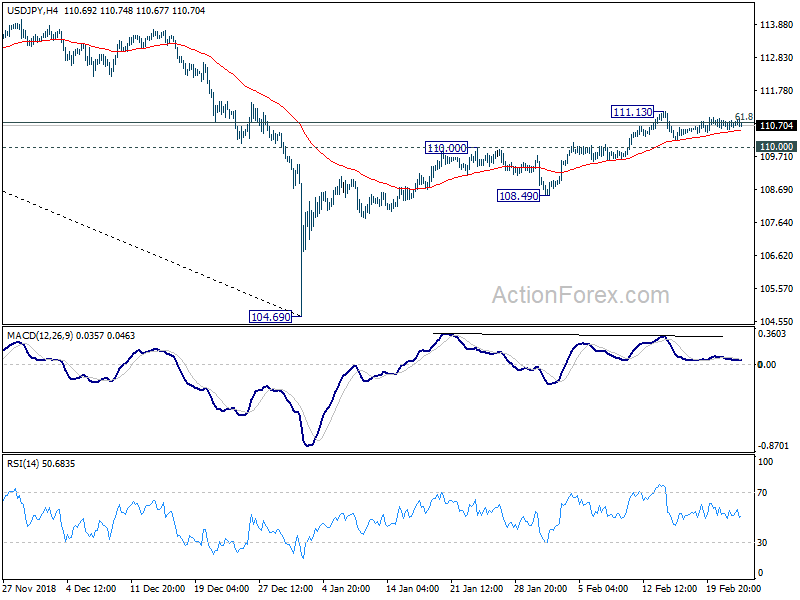
Intraday bias in USD/JPY remains neutral first. On the downside, break of 110.00 resistance turned support will suggest rejection by 61.8% retracement of 114.54 to 104.69 at 110.77 and the rebound from 104.69 has likely completed. Intraday bias will be turned back to the downside for 108.49 support for confirmation. Nevertheless, break of 111.13 should confirm resumption of rise from 104.69 for 114.54 resistance.
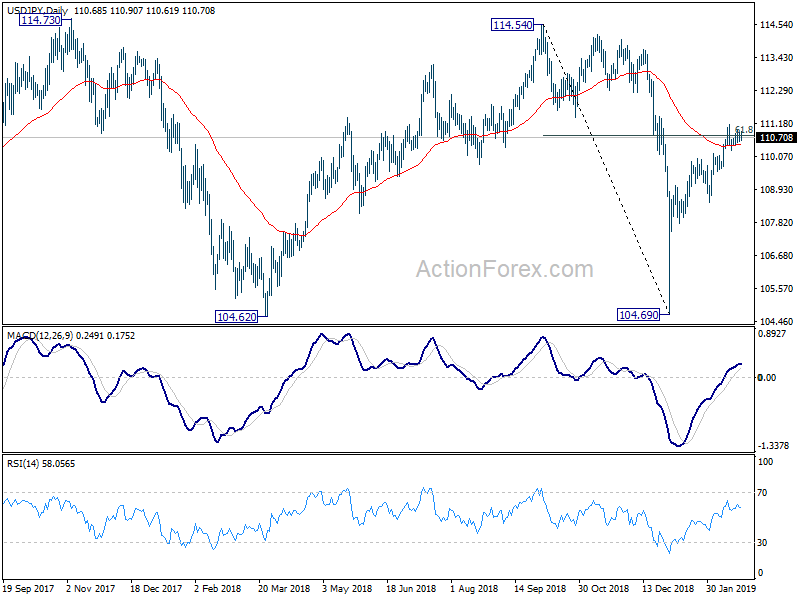
In the bigger picture, while the rebound from 104.69 was stronger than expected, it couldn't sustain above 55 day EMA yet. Outlook is turned mixed first. On the downside, break of 108.49 support will revive that case that such rebound was a correction. And, larger down trend is still in progress for another low below 104.62. But sustained trading above 55 day EMA will turn focus to 114.54. Decisive break there will confirmation completion of the decline from 118.65 (2016 high).
USD/CHF Mid-Day Outlook
Daily Pivots: (S1) 0.9995; (P) 1.0009; (R1) 1.0028; More....
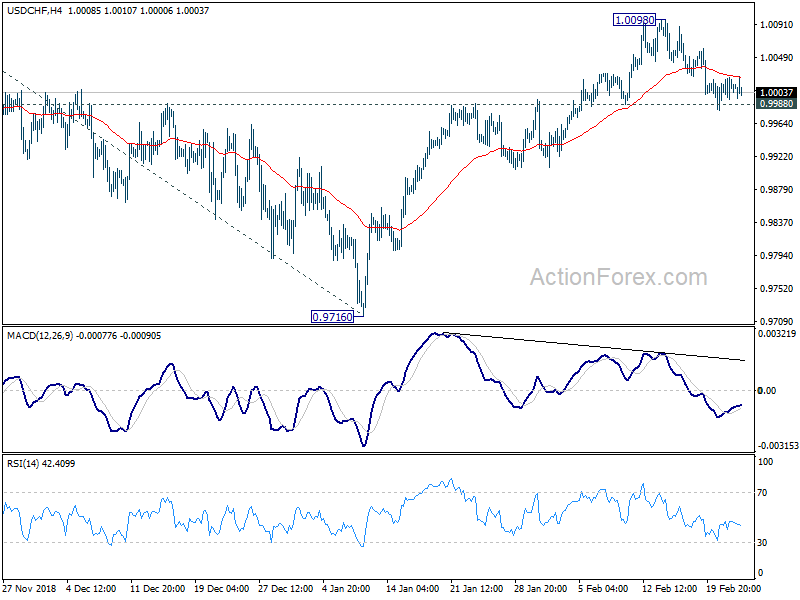
Intraday bias in USD/CHF remains neutral for the moment. On the upside, above 1.0098 will target 1.0128 first. Break will confirm resumption of up trend from 0.9186. Next target will be 100% projection of 0.9541 to 1.0128 from 0.9716 at 1.0303. However, sustained break of 0.9988 will indicate rejection by 1.0128 and turn intraday bias to the downside for 0.9716 support again.
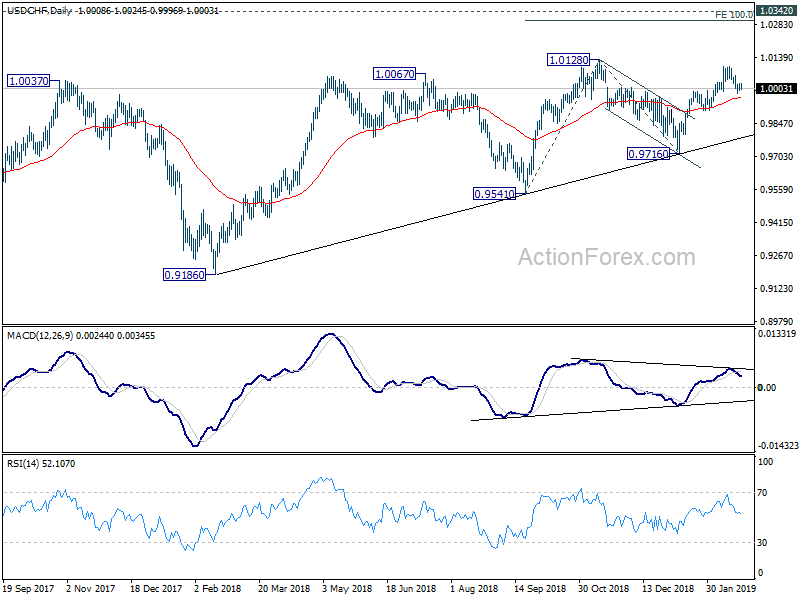
In the bigger picture, USD/CHF drew strong support from medium term trend line and rebounded. That suggests rise from 0.9186 is still in progress. Further break of 1.0128 will confirm up trend resumption and target 1.0342 key resistance. Nevertheless, break of 0.9716 will dampen this bullish view and at least bring deeper fall to 0.9541 key support.
EUR/USD Mid-Day Outlook
Daily Pivots: (S1) 1.1313; (P) 1.1341; (R1) 1.1361; More.....
Intraday bias in EUR/USD remains neutral for the moment. Further rise is mildly in favor with 1.1275 minor support intact. Rebound from 1.1234 is seen as another leg in consolidation pattern from 1.1215. On the upside, above 1.1371 will extend the rebound from 1.1234, towards 1.1514 resistance. On the downside, though, break of 1.1275 minor support will turn bias back to the downside for 1.1215 low instead. Decisive break there will confirm completion of consolidation from 1.1215, and resumption of down trend from 1.2555.
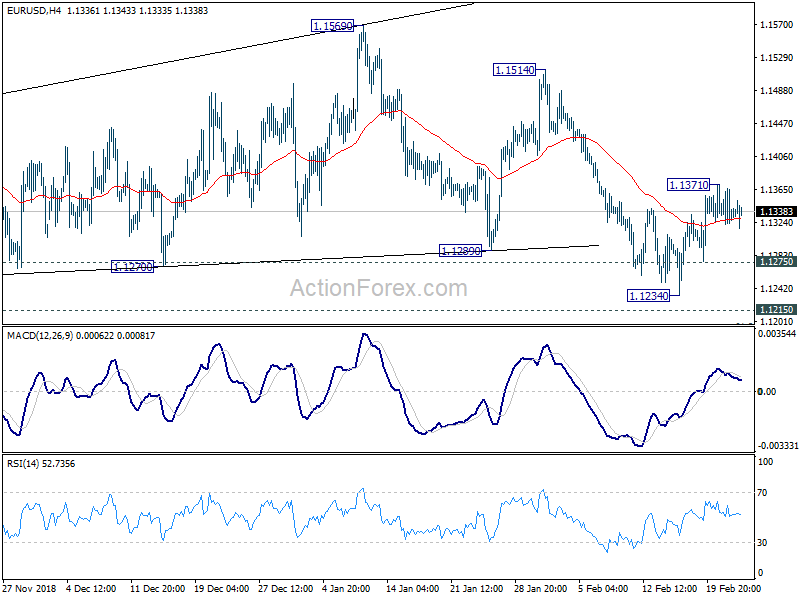
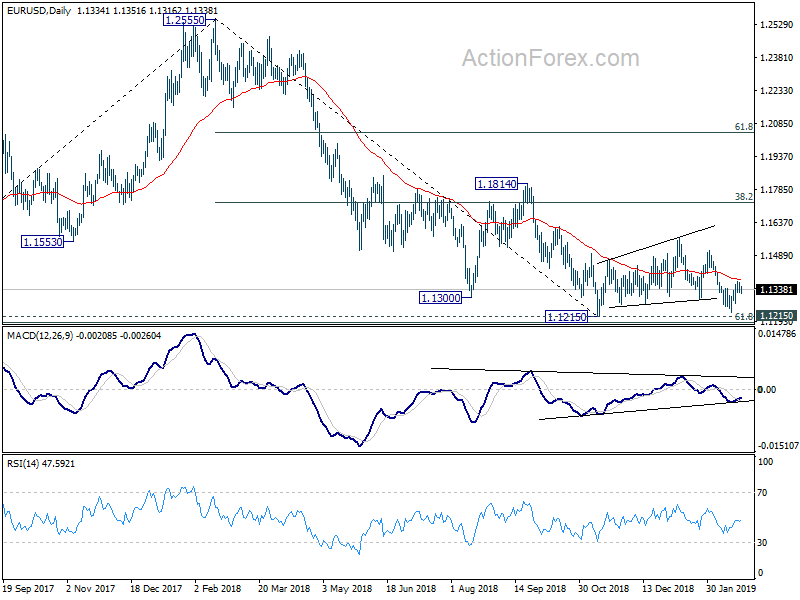
In the bigger picture, as long as 1.1814 resistance holds, down trend down trend from 1.2555 medium term top is still in progress and should target 61.8% retracement of 1.0339 (2017 low) to 1.2555 at 1.1186 next. Sustained break there will pave the way to retest 1.0339. However, break of 1.1814 will confirm completion of such down trend and turn medium term outlook bullish.
Canadian Retail Sales Down in December, But Volumes Edge Up
Canadian retail sales dropped 0.1% (m/m) in December, following the prior month's 0.9% drop. This was slightly better than consensus expectations for a 0.3% decline. The picture was somewhat better after accounting for price changes, with volumes up a modest 0.2%.
The headline decline was mostly a gasoline price story, with sales at gasoline stations falling 3.6% (0.3% in real terms). Excluding this category, retail sales were up 0.4%. Electronics and appliances stores also had a notably weak showing, down 4% on the month.
Providing some offset were sales at motor vehicles and parts dealers and food and beverage stores, which moved up 1% and 0.9% on the month, respectively. Building material and garden equipment stores provided a decent surprise, up 3.1%, the first increase in this housing-market-sensitive category since mid-year.
Regionally, retail sales were up in six provinces, leaving the decline concentrated in Ontario and Quebec. Retail sales activity fell 0.5% and 0.2% in those provinces, respectively, with B.C. sales also down -0.2% m/m and Albertan sales effectively unchanged.
Key Implications
The retail activity picture in Canada remains that of a slowdown consumer spending. For the year as a whole, retail sales increased 2.7%, with a modest 0.7% increase in volumes – a notable moderation relative to last year, and the slowest pace of volumes growth since 2009. Worse, much of the disappointment was in the fourth quarter, with a 0.5% nominal drop and an almost flat volumes print. Still, the December release came in slightly better than expected and with a modest increase in volumes.
Looking ahead, the impacts of a healthy, albeit moderating labour market will continue to be countered by elevated borrowing and debt service costs, leaving us looking for only a modest pace of consumer spending growth. We expect the Bank of Canada to remain on the sidelines in the near-term, consistent with its data-driven approach and the range of moderating economic activity indicators.
Today's print leaves our Q4 GDP tracking unchanged a 0.9%, slightly below the Bank of Canada's January MPR expectations (1.3%).