Sample Category Title
GBPUSD Back Under Pressure
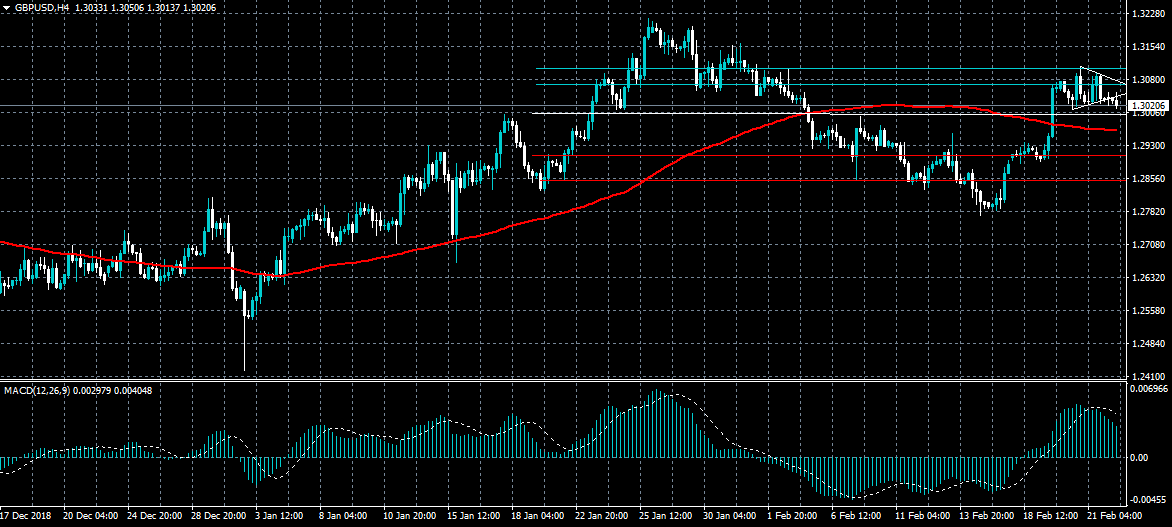
The British pound has continued to weaken against the US dollar during the European trading, as concern grows that the United Kingdom may be subject to a rating downgrade. A bearish triangle has occurred on the four-hour time frame, while technical indicators continue to trend lower. A strong downward move is likely to occur if sellers move price under the psychological 1.3000 support level.
The GBPUSD pair is bearish while trading below the 1.3000 level, key technical support is found at the 1.2960 and 1.2940 levels
If the GBPUSD pair trades above the 1.3075 level, buyers may test towards the 1.3095 and 1.3115 resistance levels.
U.S Dollar Stronger By Default, But For How Long?
Friday February 22: Five things the markets are talking about
Global equities saw some modest gains overnight as investors await results from the Sino-U.S trade talks. Will we get some concrete news or perhaps an announcement of an extension of the March 1 deadline for implementing further U.S tariffs?
On the week, most major benchmarks are on course to close out a tad higher amid continuing hopes for a deal. Sovereign bond prices have seen a modest advance.
Elsewhere, EUR has seen small advance as the markets wait for ECB President speech this morning (10:30 am ET). The ‘big’ dollar has stabilised in the wake of the Fed minutes on Wednesday, but there is a lack of decisive direction as traders require something of substance for the dollar’s next leg move. Even sterling is confined despite the E.U chief Brexit negotiator indicating that he does not rule out a delay for Britain to leave the bloc (March 29).
On tap: Canadian retail sales are at 08:30 am ET, while President Trump is expected to meet China VP Liu He at 02:30 pm ET
1. Stocks mostly up on the week
In Japan, the Nikkei snapped four straight sessions of gains overnight as yesterday’s weak U.S data dampened investor sentiment, however, the selling was contained by more signs of progress in Sino-U.S trade talks. The Nikkei share average dropped -0.2%, while it posted a +2.5% gain for the week. The broader Topix declined -0.3%.
Down-under, Aussie stocks ended higher overnight as a signal from RBA that the next move in interest rates could be a hike supported financial stocks, which was able to offset declines in commodity-backed shares. The S&P/ASX 200 index rose +0.46% at the close of trade. On the week, it gained about +1.7%. In S. Korea, the Kospi closed flat as investors remained cautious in the outcome of the U.S-China trade talks. The index has risen +9.28% so far this year.
In China, stocks closed out the week posting its best weekly gains in three-years, amid hopes of a Sino-U.S. trade deal before the March 1 deadline. The blue-chip CSI300 index rose +2.3% overnight, while the Shanghai Composite Index ended up +1.9%. For the week, the CSI300 was up +5.4%, while SSEC gained +4.5%.
In Hong Kong it was a similar story with the Hang Seng index ending up +0.7%, while the China Enterprises Index gained +1.1% in Friday’s session.
In Europe, regional bourses trade slightly higher across the board following a mixed session in Asia and higher U.S futures. Investors await trade talks signal.
Indices: Stoxx600 +0.2% at 371.0, FTSE +0.3% at 7185, DAX +0.3% at 11455, CAC-40 +0.3% at 5213, IBEX-35 +0.2% at 9212, FTSE MIB +0.2% at 20256, SMI +0.2% at 9354, S&P 500 Futures +0.3%
U.S stocks are set to open in the ‘black’ (+0.3%).
2. Oil prices firm on trade hopes, but prices capped by U.S stocks
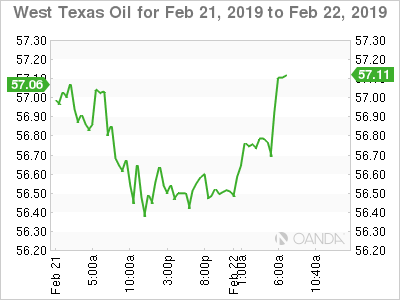
Oil prices are a tad firmer ahead of the U.S open, supported by OPEC’s ongoing supply cuts and hopes that U.S and China may soon end their trade dispute.
Brent crude futures are at +$67.18 per barrel, +11c above yesterday’s close, but below +$67.38 per barrel high print earlier this week. U.S West Texas Intermediate (WTI) crude oil futures are at +$57.15 per barrel, up +19c, but below this week’s +$57.55 per barrel 2019 high.
The supply curbs led by OPEC have helped crude prices rally more than +20% in 2019.
Note: OPEC member Nigeria signaled this week that it would limit output after its production climbed last month.
The main factor keeping oil prices from rising even further is soaring U.S output, which reached +12M bpd for the first-time last week according to the EIA yesterday. That means U.S. crude output has soared by almost +2.5M bpd since the start of 2018 – the U.S is the only country to breach these levels.
Note: OPEC last week lowered its forecast for growth in world oil demand this year to +1.24M bpd – however, there are some analysts who believe that number “could be weaker still.”
Gold prices are on course for a second straight weekly gain. Gold has inched a tad higher on U.S-China trade talks optimism, but lingering signs that the Fed could hike interest rates again this year has kept the yellow metal from penetrating its 10-month high hit earlier this week. Spot gold is +0.3% higher at +$1,326.56 per ounce, while U.S gold futures are up +0.1% at +$1,329.1 per ounce.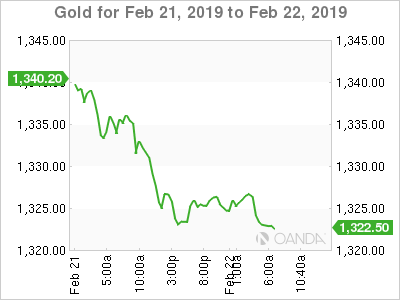
3. Italian yields rally ahead of ratings decision
Italian government BTP yields have backed up, as investors await this morning’s Fitch ratings review, while broader euro zone debt markets are little changed.
Italian bonds are underperforming other periphery debt product with yields +3 to +5 bps higher across much of the curve.
Some have suggested that it was premature to expect a Fitch downgrade of Italy’s credit rating today, but a deteriorating economic outlook had raised concerns about the ratings outlook.
Note: Data this morning showed that Eurozone headline consumer inflation slowed slightly last month because of a sharp deceleration of energy price growth, but core inflation edged slightly higher.
Italy’s 10-year bond yield was last up +3 bps at +2.86%. The gap over German Bund yields was +273 bps compared with around +269 bps yesterday. Germany’s 10-year Bund yields are around +0.12%.
Elsewhere, the yield on 10-year Treasuries has dipped -1 bps to +2.68%, while in the U.K, the 10-year Gilt yield has fallen -2 bps to +1.177%, the first retreat in more than a week.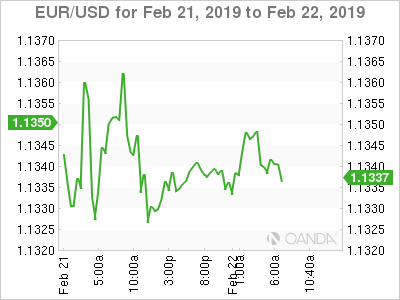
4. Dollar little changed, looks for direction
EUR/USD (€1.3337) has moved off away from its fortnight highs after this morning’s Feb German IFO survey (see below) suggested that the domestic economy was experiencing a downturn. Other data showed that Eurozone Jan CPI saw the second consecutive month where headline CPI y/y was below the ECB target of around +2.0%. ECB’s Draghi speaks at 10:30 am ET.
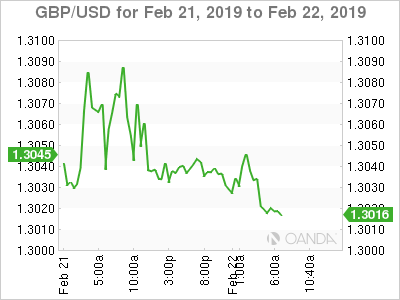
GBP/USD (£1.3014) is a tad lower, down -0.11%, but above the psychological £1.30 handle. EU officials have indicated there have been no breakthroughs in Brexit discussions in Brussels, with some expecting talks to continue next week. The EU said to be expecting U.K’s PM May to be forced to request a three-month delay if Parliament backed the Brexit deal, but it was not signed off until an EU summit on March 21-22.
5. German business sentiment hits a four-year low
Data this morning showed that German business sentiment hit a four-year low this month. This would suggest that the economic troubles which started in H2 2018, are continuing into this year.
The Ifo Institute said that its business-climate index fell to 98.5 in February from a revised 99.3 points in January. Market expectations were looking for a print of 99.0 points.
“The German economy remains weak,” Ifo President Clemens Fuest said and
“have cut their business expectations for the next six-months, a development likely to spur growth concerns.”
Note: Germany just about sidestepped a technical recession in Q4 2019, and many economists have cut their growth expectations for this year in light of weaker global demand for capital goods.
In manufacturing, the business climate fell for the sixth consecutive month, the Ifo said. Thursdays German purchasing managers index showed that the contraction in German manufacturing has deepened this month.
EUR/USD – Euro Shrugs Off Soft German Numbers
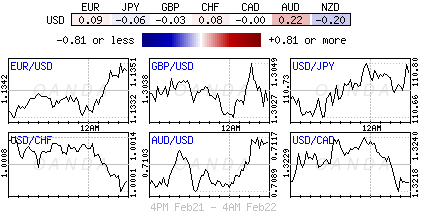
It's been a relatively quiet week for EUR/USD, and pair is unchanged on Thursday. Currently, the pair is trading at 1.1343, up 0.08% on the day. In economic news, German data continued to disappoint. Final GDP for the fourth quarter came in at 0.0%, matching the forecast. Ifo Business Climate dropped to 98.5, shy of the estimate of 99.0 points. In the eurozone, inflation dipped to 1.4%, slowing down for a third straight month. In the U.S., there are no data releases, but we'll hear from a host of FOMC members, with the markets hoping for some insights into future monetary policy.
It has been a dismal week for German numbers, but nonetheless the euro has managed to hold its own against the dollar. On Friday, fourth-quarter GDP showed no change, after a contraction of 0.2% in the third quarter. The Ifo Business Climate survey slowed for a sixth successive month, indicating concern in the business sector about the country's economic outlook. German manufacturing PMI contracted for a second straight month, while German declined in January for the first time in a year. As the largest economy in the eurozone, Germany is the bellwether for the entire eurozone, and if German data continues to miss expectations, the euro could find itself under pressure.
The Federal Reserve minutes from the January meeting indicated that policymakers remain dovish with regard to monetary policy. Investors were not surprised, and gold was unable to make any headway. Participants reiterated that the Fed will remain cautious, stating that a “patient approach to monetary policy” was appropriate. However, members added that if economic projections improved, the Fed could revise the “patient approach”. The minutes noted that the employment market had strengthened and economic activity was rising, but expected GDP in 2019 to slow down compared to 2018. We may not see a rate hike before the second half of the year, as the Fed has scaled back its forecast to two hikes this year, while the markets have priced in no rates hikes until 2020.
German IFO Continues The Streak Of Weak European Data
Notes/Observations
- More German data highlighting that the domestic economy was experiencing a downturn (weaker Feb IFO survey)
- Euro Zone Jan CPI saw the 2nd straight month where headline CPI YoY reading was below the ECB target of 'around 2.0%
- US-China trade talks remain in Focus; Trump expected to meet with China Vice-Premier
Asia:
- Japan Jan National CPI Y/Y: 0.2% v 0.2%e; CPI Ex-Fresh/Food (Core) Y/Y: 0.8% v 0.8%e; CPI Ex-Fresh Food/ Energy (Core-core) Y/Y: 0.4% v 0.4%e
- BOJ Gov Kuroda met with PM Abe to discuss the domestic and global economies; affirmed main scenario that global economy to continue to grow but protectionism was a risk
- RBA) Gov Lowe reiterated view that there was no strong case for a near-term change in cash rate, rate outlook was more evenly balanced than six months ago
Europe:
- EU officials reportedly have indicated there have been no breakthroughs in Brexit discussions in Brussels; talks expected to continue next week
- EU said to be expecting s UK PM May to be forced to request a three-month delay to Brexit if the British Parliament backed the Brexit deal but it was not signed off until an EU summit on March 21-22 (Insight: extension longer than three months would put the UK under pressure to take part in European elections on May 23-26 (something that both sides are keen to avoid)
- As many as 25 members of UK govt said to be ready to vote for Brexit delay unless UK PM May ruled out no deal. Rebel Conservatives believe there are now enough MPs across the House of Commons to pass an amendment that would require May to extend article 50 rather than allow the UK to leave without a deal.
- Germany govt to extend term Bundesbank President Weidmann for another eight years
Americas:
- President Trump expected to meet China Vice Premier Liu He on Friday (Feb 22) at 2:30 PM EST; meeting to occur at the White House . Trump administration said to counting on the Chinese leader's special envoy, Liu He, to get Beijing to accept tough new strictures that are increasingly controversial in Beijing.
- Bank of Canada (BOC) Gov Poloz reiterated stance that rates needed to head higher; path of rate rises toward the neutral range was highly uncertain Macro (UK) United Kingdom: Parliament is becoming increasingly defiant against the government, with a number of MP's trying to prevent a no-deal exit scenario. The BBC, citing Conservative party member Andrew Percy, co-chairman of a group of MPs comprising both Leavers and Remainers, said that more than 30 Conservative MPs could rebel against the prime minster to try and block a no deal. In a letter to the government, the group states that "numerous members" of the group are prepared to back an amendment that would both delay Brexit and prevent a "no-deal" scenario. The House of Commons is due to vote again on Brexit next Wednesday. It is looking increasingly likely that May will not be able to win support for the withdrawal agreement, as the EU not willing to satisfy the British government's desire for a legally-binding time-limit on the Irish backstop. (DE) Germany: Q4 GDP growth was confirmed at 0.0% q/q with the breakdown showing that investment, particularly public consumption, adding 0.3 percentage points to the headline figure. Equipment investment rose 0.7% q/q but with stock changed detracting -0.6 percentage points from the quarterly growth rate, the domestic economy stagnated, as did the external side, with a 0.7% q/q rise in imports in line with export growth during the quarter.
SPEAKERS/FIXED INCOME/FX/COMMODITIES/ERRATUM
Equities
- Indices [Stoxx600 +0.2% at 371.0, FTSE +0.3% at 7185, DAX +0.3% at 11455, CAC-40 +0.3% at 5213, IBEX-35 +0.2% at 9212, FTSE MIB +0.2% at 20256, SMI +0.2% at 9354, S&P 500 Futures +0.3%]
- Market Focal Points/Key Themes: European Indices trade slightly higher across the board following a mixed session in Asia overnight and higher US futures. On the Brexit front reports suggested the EU expects UK PM May to be forced to request a three-month delay to Brexit which gave Cable a lift. On the corporate front shares of Sopra Steria trades over 20% higher on strong earnings, leading the gainers on the Eurostoxx 600. ASM International, ISS, Person, and Edenred are among other names trading higher on earnings. Meanwhile Saint Gobain and Valeo fall on a declines in profits, with Elekta another notable decliner following a reduction in profits and downgraded margin outlook. In other news Dairy Crest trades over 10% higher after Saputo is to acquire the company for 620p/shr; Provident Financial also rises on a firm offer by NSF in all stock proposal; Eutelsat declines following BPIfinance placement of 15.5M shares; Vodafone gains on a 5G agreement with Telecom Italia. In the US Kraft Heinz drops over 20% in the pre market following a miss in earnings and dividend cut with shares of Danone and Unilever trading slightly weaker in sympathy. Looking ahead notable earners include M, Wayfair, Autonation, Barnes Group and Cinemark among others.
Equities
- Consumer discretionary: ISS [ISS.DK] +5.7% (Earnings), Sopra Steria [SOP.FR] +17.5% (Earnings), Edenred [EDEN.FR] +6.2% (earnings)
- Consumer staples: Dairy Crest [DCG.UK] +13% (to be acquired)
- Financials: Provident Financial [PFG.UK] +4% (Takeover offer)
- Healthcare: Elekta [EKTAB.SE] -9% (earnings)
- Industrials: Valeo [FR.FR] -2.9% (earnings), Saint Gobain [SGO.FR] -2.1% (earnings)
- Technology: Wirecard [WDI.DE] +3.6% (CEO comments), Sartorius [SRT.DE] -4.2% (analyst downgrade), ASM International [ASM.NL] +7.5% (earnings)
- Telecom: Eutelsat [ETL.FR] -4.2% (BPIfrance placement), Telecom Italia [TIT.IT] +2.9% (earnings, 5G agreement with Vodafone), Vodafone [VOD.UK] +1.2% (5G agreement)
Speakers
- ECB's Nowotny (Austria): German growth expectations was likely to be revised down. Did not see need for raising liquidity but could consider special measures regarding bank lending . ECB had no conclusions on TLTRO. If economic slowdown was caused by one-off factors then TLTRO might not be needed. Had time until the summer to make a decision on TLTRO
- EU Brexit Negotiator Barnier stated that could not exclude that Britain's EU withdrawal was postponed but not up to me to decide. Stressed that more discussions were needed - not time
- Sweden Central Bank (Riksbank) Feb Minutes: Economic developments have entered into a calmer phase; conditions for inflation around the 2% target has not changed
- Riksbank Gov Ingves in Feb Minutes stated that needed to be watchful about inflation pressures with risks mostly on the downside; if materialized then policy might need to be adjusted. Slowly appreciating SEK currency to dampen inflation
- Riksbank Dep Gov Skingsley in Feb Minutes: More pessimistic about global developments but more information was required before any adjustments might become relevant. Good conditions for inflation to remain close to 2% target; recent data supported this view
- Riksbank; Floden in Feb Minutes stated that a rate hike in April was possible if SEK currency remained weak and inflation rose. Developments after the Dec meeting hadnot increased the likelihood of an increase in rates being appropriate in April; everything indicated that next hike to be in H2 2019
- Sweden Central Bank (Riksbank) Gov Ingves (press comments) reiterated view that domestic economy was strong. Inflation was around the 2% target and should remain in that neighborhood
- Poland Central Bank's Lon saw interest rates staying steady at least until 2022and did not rule out additional easing if economic slowdown is pronounced
- German IFO Institute commented that the domestic economy was experiencing a downturn with the weak phase expected to continue
- China Foreign Ministry refuted press reports that it banned Australia coal imports. Stated that Chinese customs were strengthening quality and environmental checks on coal
- China Politburo reiterated stance to keep economy within a reasonable range in 2019. Reiterated to implement pro-active fiscal and prudent monetary policy
Currencies/Fixed Income
- EUR/USD moved off 2-week highs after the Feb German IFO survey suggested that the domestic economy was experiencing a downturn. Pair holding around the 1.1340 area just ahead of the US morning. Euro Zone Jan CPI saw the 2nd straight month where headline CPI YoY reading was below the ECB target of 'around 2.0%
- GBP/USD lower by 0.3% in the session. Reports circulated that EU expected UK PM May to be forced to request a three-month delay to Brexit.
Economic Data
- (DE) Germany Q4 Final GDP Q/Q: 0.0% v 0.0%e; Y/Y: 0.6% v 0.6%e; GDP NSA (unadj) Y/Y: 0.9% v 0.9%e
- (DE) Germany Q4 Private Consumption Q/Q: 0.2% v 0.1%e; Government Spending Q/Q: 1.6% v 0.6%e; Capital Investment Q/Q: 0.9% v 0.7%e
- (TR) Turkey Feb Real Sector Confidence (Seasonally Adj): 96.9 v 95.4 prior; Real Sector Confidence NSA: 97.2 v 93.0 prior
- (TR) Turkey Feb Capacity Utilization: 74.0% v 74.4% prior
- (MY) Malaysia mid-Feb Foreign Reserves: $102.3B v $102.1B prior
- (CH) Swiss Q4 Industrial Output Y/Y: 5.1% v 0.8% prior; Industry & Construction Output Y/Y: 3.8% v 0.8% prior
- (CN) Weekly Shanghai copper inventories (SHFE): 217.8K v 207.1K tons prior
- (AT) Austria Jan CPI M/M: -0.8% v +0.1% prior; Y/Y: 1.7% v 1.9% prior
- (RU) Russia Narrow Money Supply w/e Feb 15th (RUB): 10.30T v 10.20T prior
- (TW) Taiwan Jan Export Orders Y/Y: -6.0% v -8.7%e
- (TW) Taiwan Q4 Current Account Balance: $18.7B v $14.0B prior
- (HK) Hong Kong Jan CPI Composite Y/Y: 2.4% v 2.6%e
- (DE) Germany Feb IFO Business Climate: 98.5 v 98.9e; Current Assessment: 103.4 v 103.9e; Expectations Survey: 93.8 v 94.3e
- (IS) Iceland Jan Wage Index 0.3% v 0.0% prior; Y/Y: 5.8% v 6.0% prior
- (NO) Norway Q1 Consumer Confidence: 2.9 v 14.6 prior
- (EU) Euro Zone Jan Final CPI Y/Y: 1.4% v 1.4%e; CPI Core Y/Y: 1.1% v 1.1%e; CPI M/M: -1.0% v -1.1%e
Fixed Income Issuance
- (IN) India sold total INR120B vs. INR120B indicated in 2024, 2029, 2033 and 2044 bonds
- (ZA) South Africa sold ZAR650M vs. ZAR650M indicated in I/ L 2025, 2033 and 2050 bonds
- (IT) Italy Debt Agency (Tesoro) sold total €B vs. €0.75-1.25B indicated range in I/L 2023 and 2032 Bonds (BTPei)
- (IT) Italy Debt Agency (Tesoro) sold €2.25B vs. €1.75-2.25B indicated in Zero Coupon Nov 2020 CTZ; Avg Yield: 0.592% v 0.366% prior; Bid-to-cover: 1.82x v 1.47x prior
Looking Ahead
- 06:00 (UK) Feb CBI Retailing Reported Sales: 5e v 0 (nil) prior; Total Distribution: No est v 13 prior
- 06:00 (IE) Ireland Jan PPI M/M: No est v 0.5% prior; Y/Y: No est v -9.9% prior
- 06:00 (BR) Brazil Feb FGV Consumer Confidence: No est v 96.6 prior
- 06:00 (UK) DMO to sell €3.5B in 1-month, 3-month and 6-month bills (£0.5B, £1.5B and £1.5B respectively)
- 06:30 (IS) Iceland to sell 6-month bills
- 06:30 (IN) India Weekly Forex Reserves w/e Feb 15th: No est v $398.1B prior
- 06:45 (US) Daily Libor Fixing
- 07:00 (CL) Chile Jan PPI M/M: No est v -0.2% prior
- 08:00 (PL) Poland Jan M3 Money Supply M/M: -0.9%e v +2.6% prior; Y/Y: 9.4%e v 9.2% prior
- 08:00 (UK) Baltic Dry Bulk Index
- 08:00 (IN) India announces upcoming bill issuance (held on Wed)
- 08:15 (US) Fed's Bostic (dove, non-voter) in NY
- 08:30 (CA) Canada Dec Retail Sales M/M: -0.3%e v -0.9% prior; Retail Sales (ex-auto) M/M: -0.3%e v -0.6% prior
- 08:30 (US) Weekly USDA Net Export Sales
- 09:00 (BE) Belgium Feb Business Confidence: No est v -1.5 prior
- 10:00 (FR) ECB's Villeroy (France) in Lisbon
- 10:15 (US) Fed's Willams (moderate, voter) in NY
- 10:30 (EU) ECB's Draghi in Italy
- 12:00 (US) Fed's Vice Chair Clarida (moderate, voter) in NY
- 13:00 (US) Weekly Baker Hughes Rig Count data
- 13:30 (US) Fed's Bullard (dove, voter) in NY
- 13;30 (US) Fed's harker (non-voter, moderate) on panel
- 13;30 (US) Fed's Quarles (hawk, voter)
- (CO) Colombia Central Bank holds Monetary Policy Meeting
All Eyes On Washington
Sino-US talks feeding investor optimism
All eyes on the US on Friday as Trump meets with Chinese Vice Premier Liu He following another week of talks between the world's largest economies.
It would appear that there's been some real progress made in the talks, at least enough to extend the truce and avoid further tariff hikes. This is a major risk for markets and is helping to feed into the improved risk appetite we've seen this year. If Trump's team can get this over the line before next week's deadline, it could provide a major boost although European investors may get a little anxious at the prospect of the US President then turning his attention that way.
Gold pares gains but remains bullish
Gold has come under pressure in recent days but this looks nothing more than a little profit taking on a stronger dollar at this stage. The yellow metal has looked bullish for some time and the break above $1,300 just confirmed that. Since then, it's gone from strength the strength and I see no reason to believe that's over.
The environment right now may not be perfect for gold - the resurgent dollar is clearly a drag - but it is bullish. Central Banks around the world are gradually coming to terms with the fact that the global economy is slowing and is in need of a little support. The decision to put tightening on hold and maybe even loosen a little is both appropriate and supportive for gold prices for now.
Oil stalls after breakout
This fact may not be quite so bullish for oil. Slower global growth, a resurgent dollar and record US production are all weighing on prices and causing any rallies to stall relatively quickly. It has recovered from its sell-off late last year but not as much as you may have expected and there does seem to be a reluctance to hop on board.
WTI broke through a strong resistance zone this week and rather than being the catalyst for another tear higher, it's just stalled again. That doesn't fill me with confidence near-term. That may change in the coming weeks but we'll need to see evidence that OPEC still has the sway it once did. It's safe to say, Saudi Arabia has gone well above and beyond and the market shrugged. If US output starts to fall in line with oil rigs then that may change but for now, it's only going higher, 12 million and counting.
WTI Oil Outlook: Oil Consolidates Under New 2019 High, Bullish Bias Remains Intact Above 100SMA
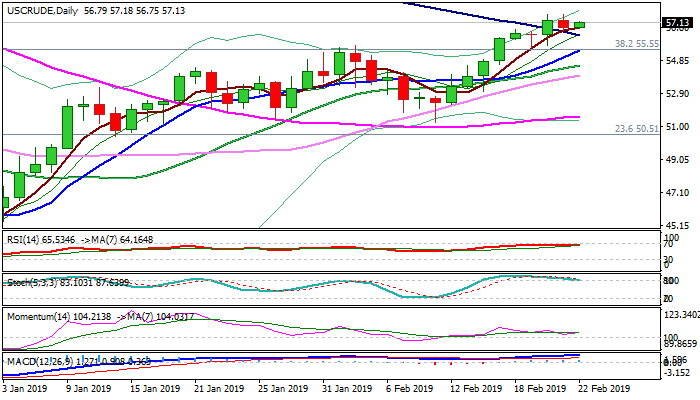
WTI oil regained traction and probes back above $57 handle on Friday, following bearish close on Thursday (the first close in red after six straight bullish days), when the price came under pressure from stronger than expected build in crude stocks (EIA report 3.67 mln bls vs 3.0 mln bls f/c).
Dip from new 2019 high at $57.58 was contained by broken 100SMA, keeping near-term bullish bias.
However, bulls may stay on hold, as negative signal is developing on daily / weekly stochastic which is reversing from overbought zone.
Break and close below 100SMA is needed to signal pullback and open way for further corrective action.
Broken Fibo barrier at $55.55, reinforced by rising 10SMA marks solid support which is expected to contain extended dips and guard pivots at $54.56/53.96 (converging rising 20/30SMA’s).
Ability to hold above 100SMA would signal extended consolidation and keep immediate focus at the upside.
The sentiment remains positive on production cut from the biggest world oil exporters, as well as prevailing optimism from US/China trade talks.
Res: 57.58, 58.14, 59.62, 60.00
Sup: 56.75, 56.37, 55.73, 55.55
USD/JPY Outlook: Bulls Struggle At 111 Zone But 200SMA Barrier Is Still In Focus
The pair holds within a narrow range on Friday, extending directionless mode into third straight day.
Bulls struggle at 111 resistance zone, which guards more significant 200SMA (111.30), break of which would generate bullish signal for continuation of recovery leg from 104.59 (2019 low).
Near-term picture remains bullish overall, but daily techs lack momentum and weekly stochastic is overbought that could further weigh on bulls.
Rising 10SMA tracks the advance in past two weeks and marks solid support at 110.63, loss of which would weaken the structure.
Extension below rising 20SMA (110.08) and psychological 110 support would sideline bulls and signal deeper pullback.
Res: 111.12, 111.30, 111.55, 112.00
Sup: 110.63, 110.31, 110.08, 109.81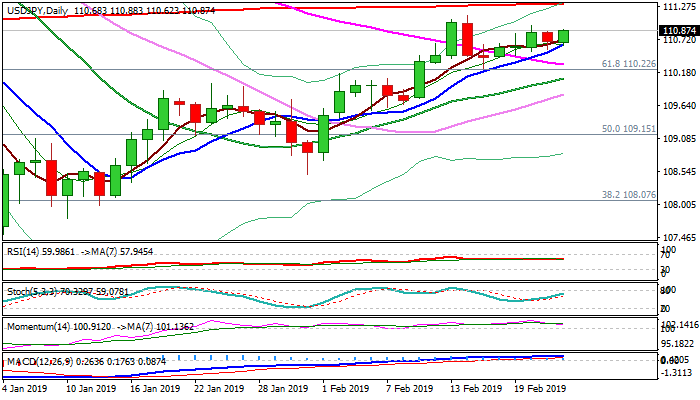
China Stocks Higher On Better Trade Outlook
US-China trade discussions are making progress. Six memoranda of understanding are in draft that cover technology transfer and cyber theft, intellectual property rights, currency, agriculture and non-tariff barriers to trade. Expectations are that a 1 March tariff-hike will be avoided. A US-China deal is unlikely to spark a double-digit rally, but it will support Chinese shares. Chinese stocks reacted sharply, climbing nearly 2.0% today. After a deep correction in 2018, they have been on a rally since November, up over 20%. The largest gainer was Shanghai Aerospace Automobile Electromechanical, up 10%.
The Chinese central bank has not cut its key interest rate. It has focused on micro tuning market-based rates, increasing credit growth and lowering borrowing costs. Still, a cut is coming, in our view, and it will profoundly affect domestic equity prices. Despite clear signs of global deceleration, China’s economy is stable. January sales of passenger vehicles in China collapsed 18% to just over 2 million. January home-price growth slipped to a 9-month low, showing the property markets are cooling as the economy softens.
Japan inflation improves slightly
After the Bank of Japan cut its 2019 outlook for core inflation, the rate has improved, with the core gauge at 0.80% (prior: 0.70%) in January. Yet private consumption in the country declined in January, while a February manufacturing PMI of 48.50 pointed to recession for the first time in 30 months. It seems that Japanese inflation is struggling to take off, although a time lag of several months might partially explain it. Headwinds are on the way, starting with a consumption tax hike from 8% to 10% planned for October 2019. The BoJ is not expected to change its current monetary easing course at its 15 March meeting. The inflation target of 2% remains distant, unreachable before 2021.
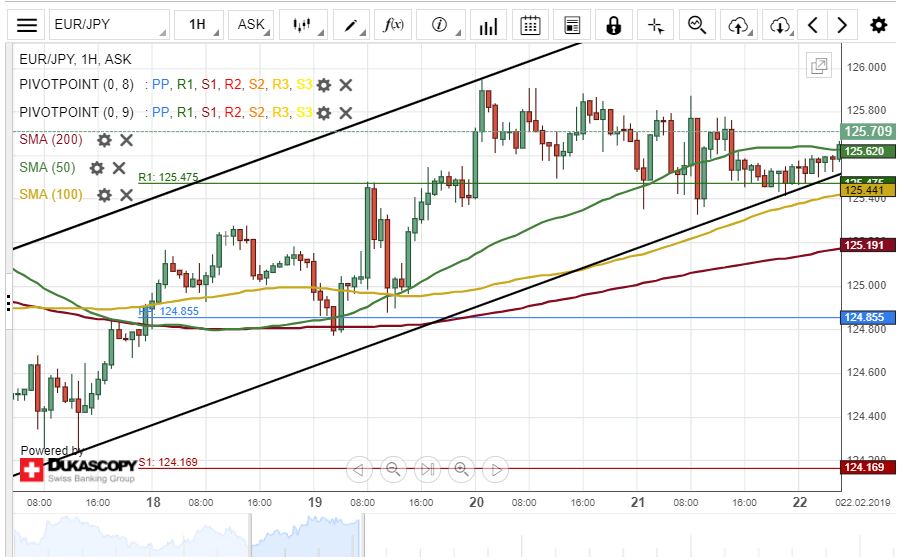
EUR/JPY Breaches 50-Hour SMA
The single European currency has continued to trade sideways against the Japanese Yen. The currency pair trading range during yesterday's session was about 45 base points.
The exchange rate breached the 50-hour simple moving average at 125.73 during the first half of today's session. Most likely, the currency exchange rate will edge higher towards a swing high of 125.95 within this session.
Although, given that the EUR/JPY pair is located near the bottom border of an ascending channel pattern, a breakout could be expected during the following trading session.
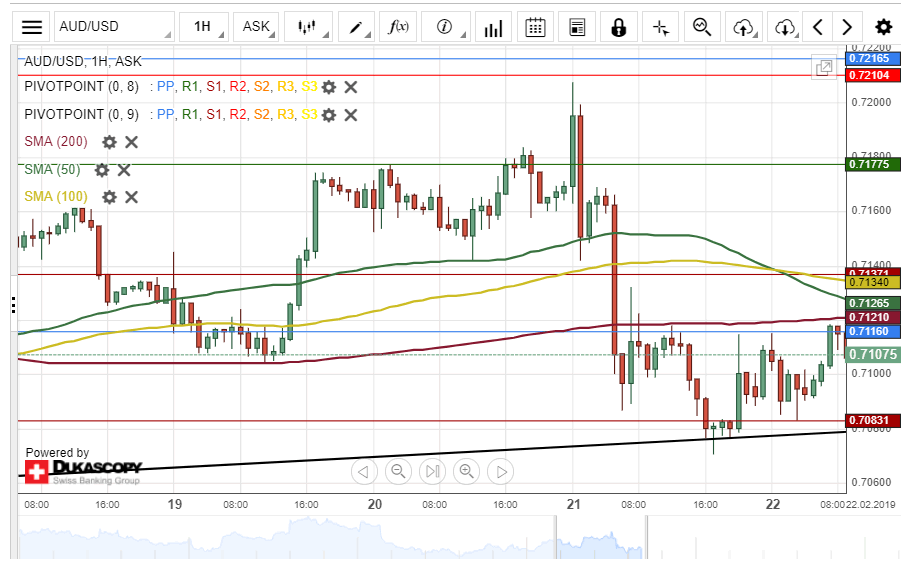
AUD/USD Remains Near 200-Hour SMA
The 200-hour simple moving average, located at the 0.7120 regions restricted the Australian Dollar from regaining some of its lost positions against the US Dollar on Thursday.
Currently, the exchange rate is trading near the resistance level formed by the 200-hour SMA and could be preparing for a breakout.
If this breakout occurs, the next target for bullish traders will be near the weekly resistance level at 0.7177.
However, if the 200-hour SMA holds, the currency exchange rate could aim at the weekly S1 at 0.7083 today