Sample Category Title
German Ifo dropped to lowest since Dec 2014, economic situation remains weak
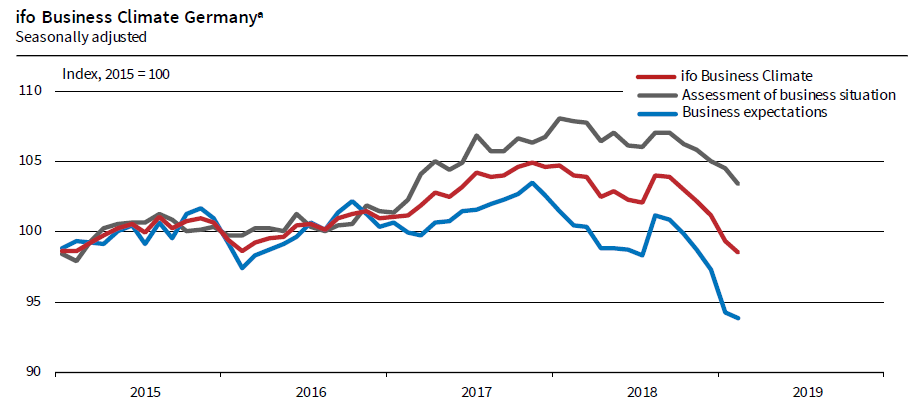
German Ifo Business Climate dropped to 98.5 in February, down from 99.3 and missed expectation of 98.9. That's also the lowest level since December 2014, and the sixth decline in a row. Expectations index dropped to 93.8, down from 94.2 and missed consensus of 94.2. Current Assessment index also dropped to 103.4, down from 104.3 and missed expectation of 103.9.
Clemens Fuest, President of ifo Institute said "these survey results as well as other indicators point to economic growth of 0.2 percent in the first quarter. The economic situation in Germany remains weak."
USD Remains Relatively Stable Despite Soft Data
The USD yesterday remained relatively stable despite the soft financial data (note the Philly Business Index drop) released. Despite the USD’s initial weakening due to the soft data mentioned, higher US bond yields provided some support balancing the greenback. The soft data indirectly strengthen the case for the Fed to keep its interest rates steady at least for the short term. Analysts point out that the market seems stuck in a tight range and rather numb to any developments of the US-Sino negotiations. It would be indicative that the market seems to be moving from one financial release to another seeking for clues about the dollar’s direction. We could see the USD in the coming days remain relatively stable, however we would not be surprised to see any sudden moves of the USD due to fundamentals. EUR/USD maintained a sideways motion yesterday, despite at some point temporarily breaking the 1.1345 (R1) resistance line. We could see the pair maintaining the range bound movement, yet some bearish tendencies could be in the cards, as financial releases could weaken EUR. Should the bears dictate the pair’s direction, we could see the pair, aiming if not breaking the 1.1300 (S1) support line. Should on the other hand the bulls have the upper hand, we could see the pair breaking the 1.1345 (R1) resistance line and aim for the 1.1385 (R2) resistance level.
Brexit continues to drive the pound.
The pound was temporarily lifted yesterday as hopes grew for UK’s PM Theresa May to get the Brexit deal changed. However expectations were later on cooled off, as a UK source reduced the chances of an imminent Brexit deal. On the other hand, reports state that the EU expects the UK to request a technical extension of 3 months for Brexit. It should be noted that UK finance minister Philip Hammond stated yesterday that the talks in Brussels have been constructive and that the UK Parliament could vote on a revised deal by next week. We see the case for the pound to strengthen should a revised Brexit deal be struck with Brussels as it would constitute another step toward an agreed Brexit. Despite cable getting a Brexit hope boost yesterday, breaking the 1.3070 (R1) resistance line it ended the session below it yesterday. We could see the pair maintaining a sideways movement, but we expect to remain highly sensitive to any further Brexit headlines. Should the pair find extensive buying orders along its path, we could see it breaking the 1.3070 (R1) resistance line and aim for the 1.3175 (R2) resistance level. On the flip side if cable comes under the selling interest of the market, we could see it aiming if not breaking the 1.2960 (S1) support line.
Today’s other economic highlights
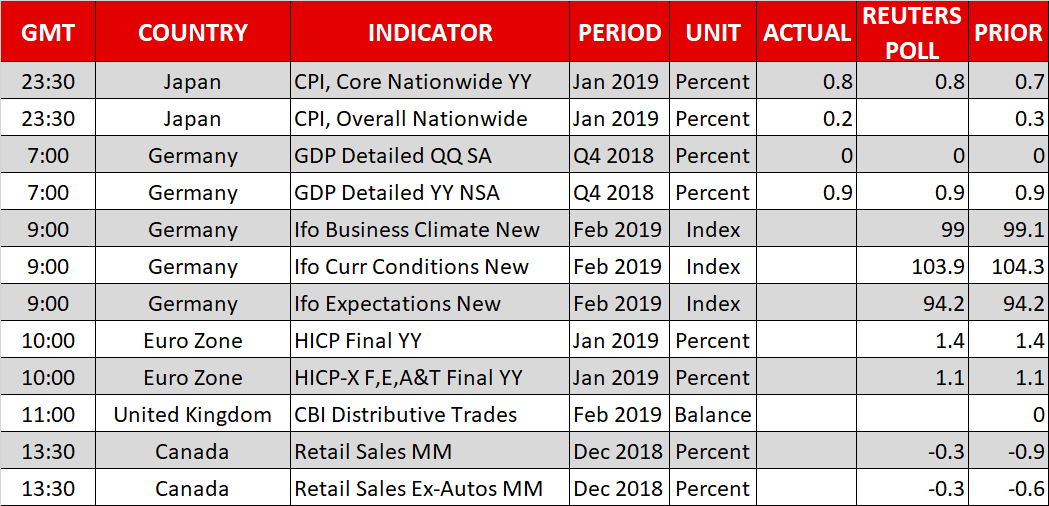
During the European session today, we get Germany’s final GDP growth rate for Q4, Ifo’s business climate indicator for February while from the Eurozone we get the final CPI rate for January. In the American session, we get Canada’s retail sales growth rates for December and from the US the baker Hughes active oil rig count figure. Please note that we will be having an extensive number of speakers today (mainly from the Fed) as Atlanta Fed President Raphael Bostic, New York Fed President John Williams and San Francisco Fed President Mary Daly, ECB President Mario Draghi, Fed’s Richard Clarida, Saint Louis Fed President James Bullard, Philadelphia Fed President Patrick Harker and Fed’s Randal Quarles speak.
GBP/USD
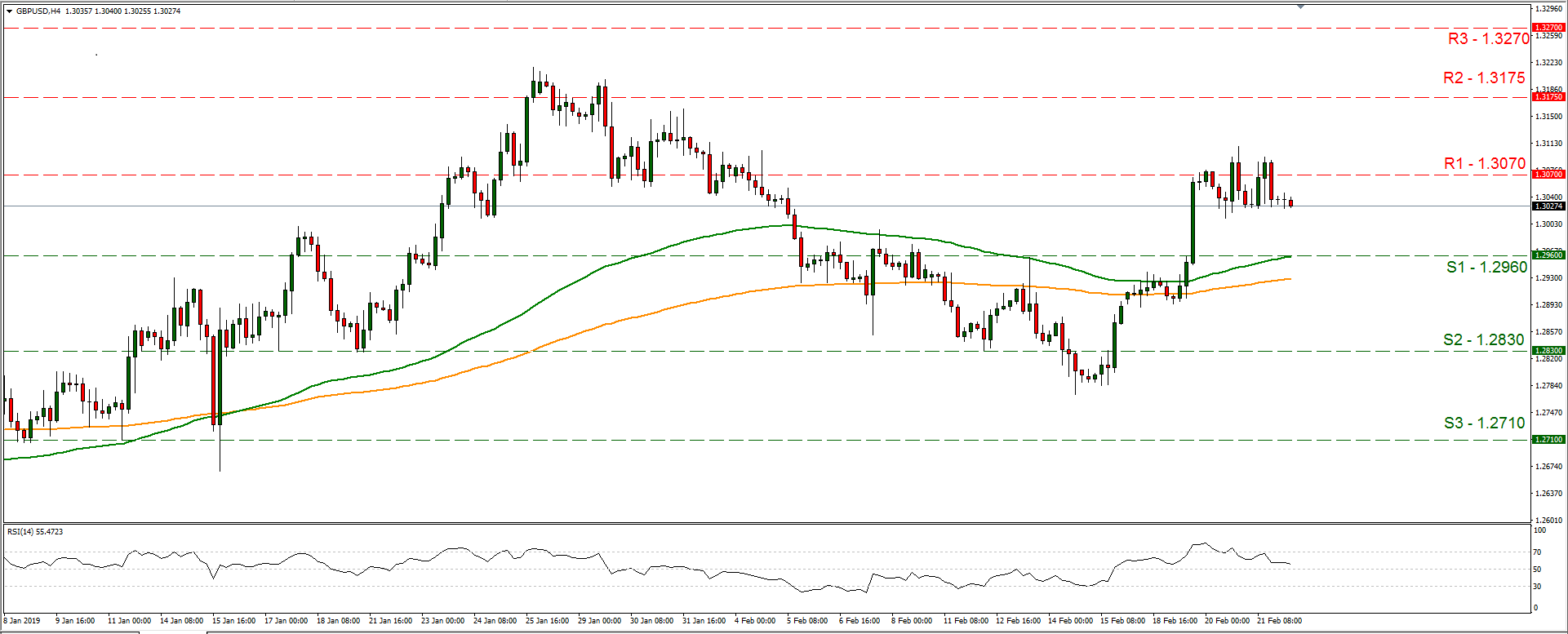
Support: 1.2960 (S1), 1.2830 (S2), 1.2710 (S3)
Resistance: 1.3070 (R1), 1.3175 (R2), 1.3270 (R3)
EUR/USD H4
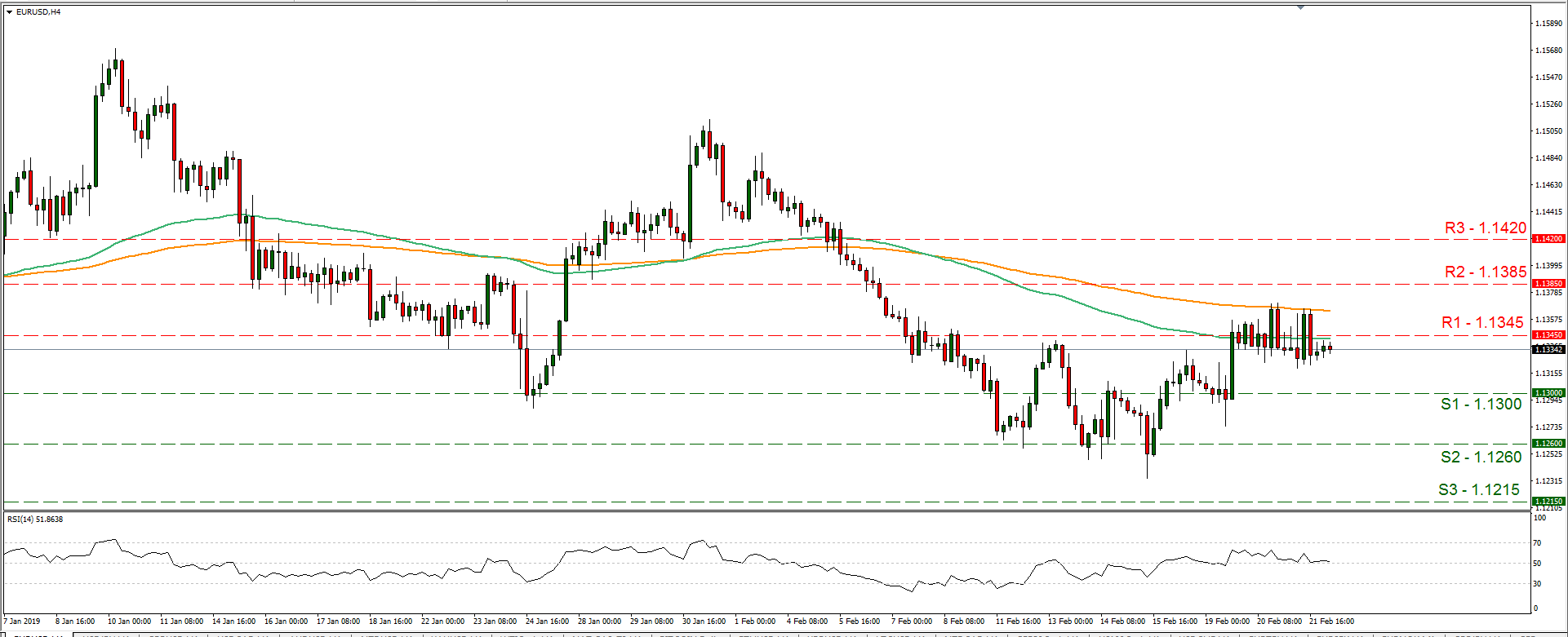
Support: 1.1300 (S1), 1.1260 (S2), 1.1215 (S3)
Resistance: 1.1345 (R1), 1.1385 (R2), 1.1420 (R3)
All Eyes On Washington As Trade Talks Wrap Up
- Markets will focus on trade today, as another round of US-China talks wraps up
- Euro looks to Germany's Ifo survey and remarks by ECB's Draghi
- Meanwhile, antipodeans are mixed amid headlines out of China and the RBNZ
All eyes on Washington as another round of trade talks concludes
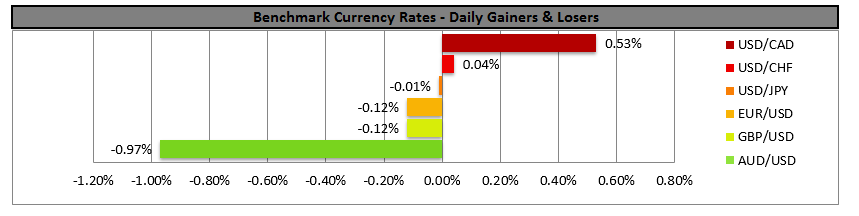
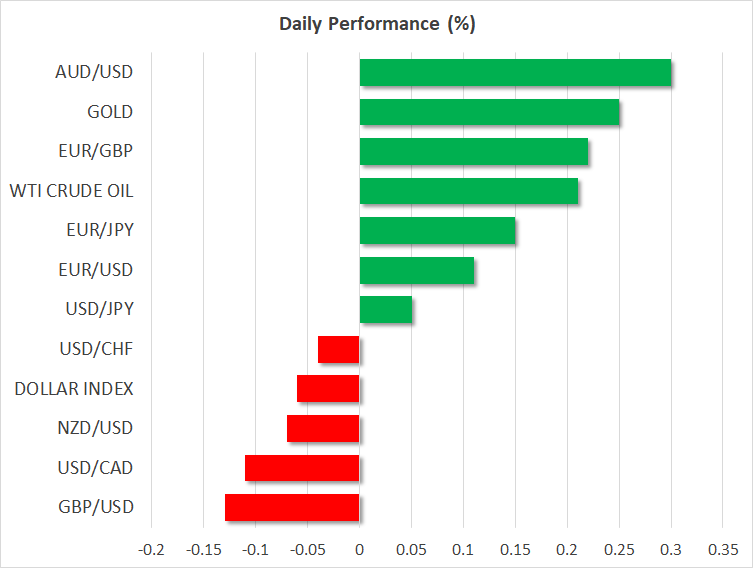
Global risk sentiment turned sour on Thursday, with European and American equity markets closing in the red, following a string of disappointing economic data out of both regions. Accordingly, the defensive Japanese yen was the best performer in the G10 FX spectrum. Zooming in on the US, core durable goods orders for December were surprisingly soft, leading to another downgrade in Q4 GDP by models like the Atlanta Fed's GDPNow, which now projects a mere +1.4% annualized growth. Manufacturing surveys for February pointed to weakness as well, suggesting this slowdown may have persisted through the new year.
As for today, markets will likely focus on the US-China trade talks, the latest round of which concludes in Washington. Expectations that a deal will be concluded soon are still riding high, following reports that the two sides are trying to sketch out the outline of an agreement. The worrisome part is that the only explicit signs of progress are on the ‘simpler' issues, such as eliminating the trade deficit, with nothing – so far – suggesting a breakthrough on structural matters like IP protection and technology transfer. Hence, much of the optimism now baked into asset prices is likely premature, and for the market to rally further, traders may need to see something concrete – beyond mere rhetoric.
Euro shrugs off soft PMIs, looks to Ifo survey and Draghi
In the euro area, PMI surveys for February were mixed but disappointing overall, with the manufacturing index surprisingly entering contractionary waters amid weakness in Germany, the bloc's traditional growth engine. A glimmer of hope was provided by the services print though, which rose by more than expected, allaying some concerns. The minutes of the ECB meeting didn't reveal much either, largely reiterating that the fading market pricing for rate hikes is reasonable given the outlook.
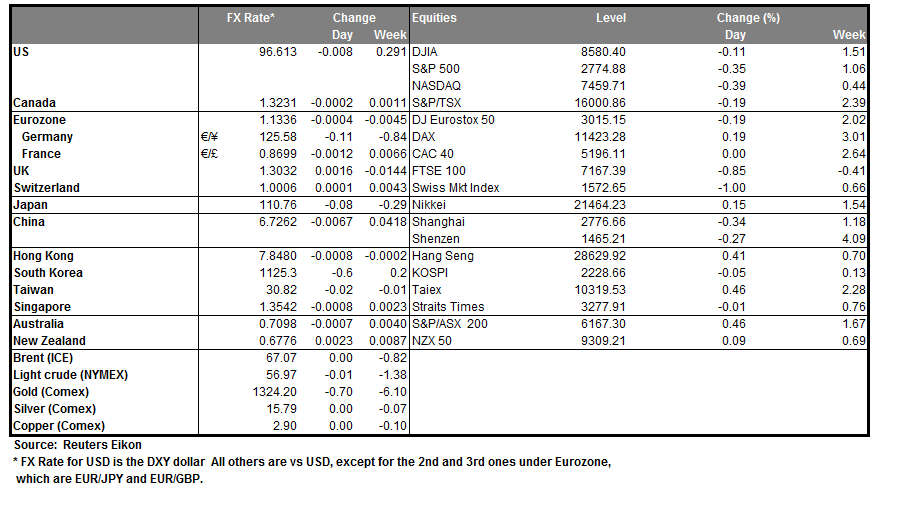
The euro took the (relatively) bad PMI news in its stride, closing the day practically unchanged against the dollar. Today, the highlight on the European calendar will be Germany's Ifo business survey for February. ECB President Draghi will also deliver remarks at 16:15 GMT. In the big picture, euro/dollar remains well supported by relative yield differentials, which are narrowing in the Eurozone's favor, implying that any massive downside in the pair – for instance below 1.1213 – looks unlikely for now.
Antipodeans mixed amid conflicting news
In the antipodean sphere, the aussie is outperforming today, after China's foreign ministry played down the ‘ban' on Australian coal imports reported yesterday, indicating it's a quota that applies to all states. Meanwhile, the kiwi is on the back foot, albeit only slightly, after the RBNZ said the increase in bank capital requirements it plans to implement could lead to an eventual interest rate cut, to offset the negative impact on financial conditions.
In the immediate term, how the US-China talks play out may be crucial for both of these trade-sensitive currencies.
Day ahead: Canadian retail sales and Fed speak
Besides Germany's Ifo survey, the economic calendar is relatively light on Friday, with Canadian retail sales being the only other tier-one release.
As for the speakers, in addition to ECB President Draghi, we will also hear from three Fed policymakers: Atlanta President Bostic (13:40 GMT), New York President Williams (15:15 GMT) and Vice Chairman Clarida (17:00 GMT). Focus may fall mainly on the latter two, who are permanent voting members of the FOMC.
EUR/USD Outlook: Extended Sideways Mode Looks For Fresh Signals
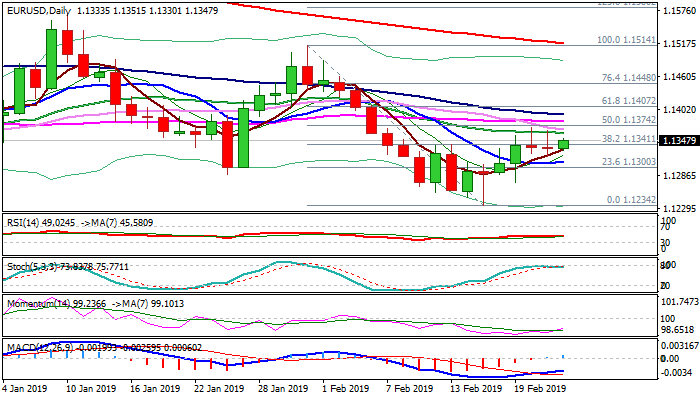
The Euro holds at familiar levels and trading around the mid-point of past two days range (1.1320/71) in early European trading on Friday. Double-Doji on Wed/Thu signals strong indecision as recovery attempts repeatedly failed to close above pivotal Fibo barrier at 1.1341 (38.2% of 1.1514/1.1234) following short-lived spikes to 1.1370 zone. Daily momentum heads north and created bulls-cross with its 7d MA and 10SMA is reversing higher that marks supportive factors. On the other side, falling 20SMA (1.1360) resisted attacks for now and marks initial barrier, followed by plethora of daily MA's (30/55/100 SMA) at 1.1368/94 zone that maintain pressure. German Ifo and EU CPI data are in focus for fresh signals on surprise (Ifo 99.0 f/c vs 99.1 prev/CPI Jan 1.4% f/c vs 1.4% prev). Initial bullish signal could be expected on sustained break above 20SMA, but scenario needs confirmation on lift above 1.1394/1.1407 (100SMA / Fibo 61.8% of 1.1514/1.1234). Rising 5SMA offers immediate support at 1.1333, but stronger bearish signal could be expected on firm break below 10SMA (1.1311).
Res: 1.1360,1.1374,1.1382,1.1394
Sup: 1.1341,1.1333,1.1311,1.1275
GBP/JPY Daily Outlook
Daily Pivots: (S1) 143.96; (P) 144.44; (R1) 144.79; More...
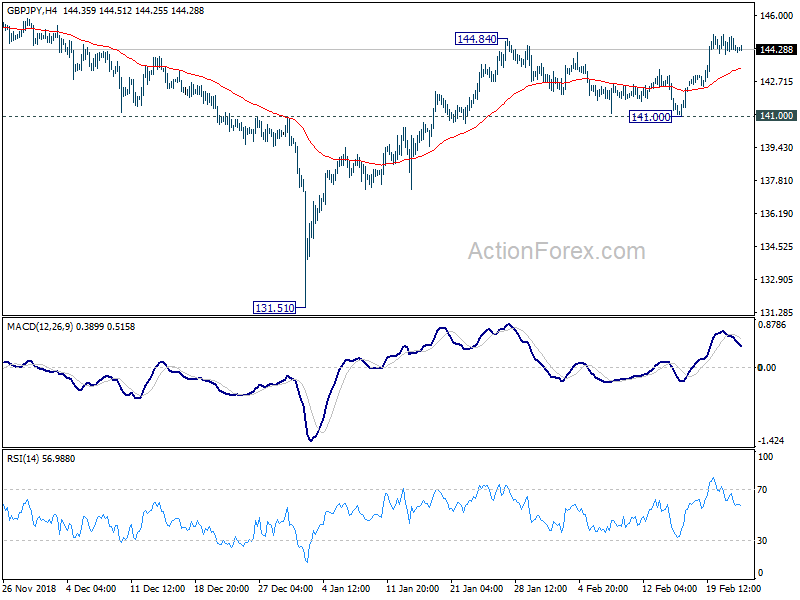
GBP/JPY continues to lose upside momentum as seen in 4 hour MACD. But further rise cannot be rule out yet. Though, we'd expect strong resistance from trend line (now at 146.81) to limit upside, at least on first attempt. On the downside, firm break of 141.00 support will suggest completion of the rebound and turn bias to the downside.
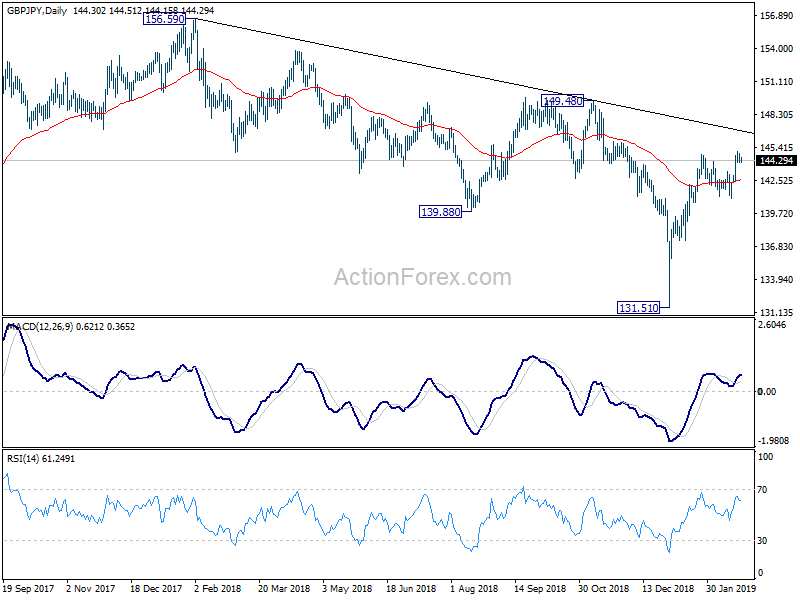
In the bigger picture, the strong rebound from 131.51 suggests that medium term fall from 156.59 (2018 high) has completed already. The corrective structure of such decline is turn argues that it's the second leg of the corrective pattern from 122.36 (2016 low). And this pattern is starting the third leg. On the upside, decisive break of 149.38 will pave the way to 156.59 resistance and above.
The U.S. Economy Cooling As An Incentive For Trade Negotiations
Weak U.S. data cooling markets
Trump chose not a good time for trade disputes, as the economy cyclical slowdown after 10 years of growth and tax incentives worsen trading conditions.
The United States economic statistics published on Thursday disappointed market participants, causing a decline in major stock US indices by 0.4%.
Household cautions
Existing homes market sales declined in January by 1.2% to a 3-year low after falling by 4% a month earlier. Such a decline could be attributed to the American government's shutdown, but the downtrend has remained unchanged since March last year.
Business cautions
Weak home sales statistics complemented the general picture of the business sector alertness. Durable goods orders were worse than expected.
The construction slowdown in the United States is difficult to associate with trade disputes. Rather, it is a very unpleasant coincidence. But the apparent durable goods orders weakening since May last year perfectly reflects the business alertness.
World trade cautions
At the global level, trade disputes led to a decrease of the WTO’s world trade index at the beginning of the year to a minimum of 9 years due to a decline of the manufacturing and sales for cars, electronics, and agricultural raw materials.
More flexible policymakers?
Many warning signals from the economy do not yet allow us to talk about the inevitable and imminent stock markets collapse, but they warn of future difficulties. Similar market cooling signals are also noted in China, where production is stagnating, and auto sales are declining. If the politicians of the two largest economies in the world pay attention to these signals, this can speed up negotiations, showing the economic price of a lack of political flexibility.
Or more creative Central bankers?
If the negotiations continue to be delayed, we'll get even more alarming signals. High government debt burden limits fiscal stimulus. That is, central banks will have to invent new ways to stimulate the economy, since interest rates are still around zero, leaving no room for manoeuvre.
EUR/JPY Daily Outlook
Daily Pivots: (S1) 125.24; (P) 125.55; (R1) 125.78; More....
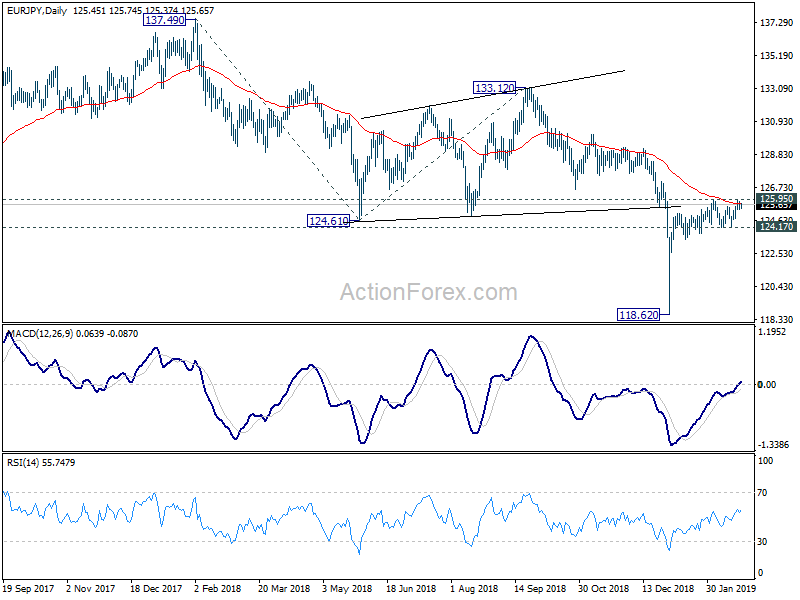
EUR/JPY is staying in range below 125.95 and intraday bias remains neutral. On the downside, break of 123.78 support will suggests completion of rebound from 118.62 after rejection by 55 day EMA. Deeper fall would then be seen back to retest 118.62 low. However, decisive break of 125.95 will dampen our bearish view and target 129.25 resistance next.
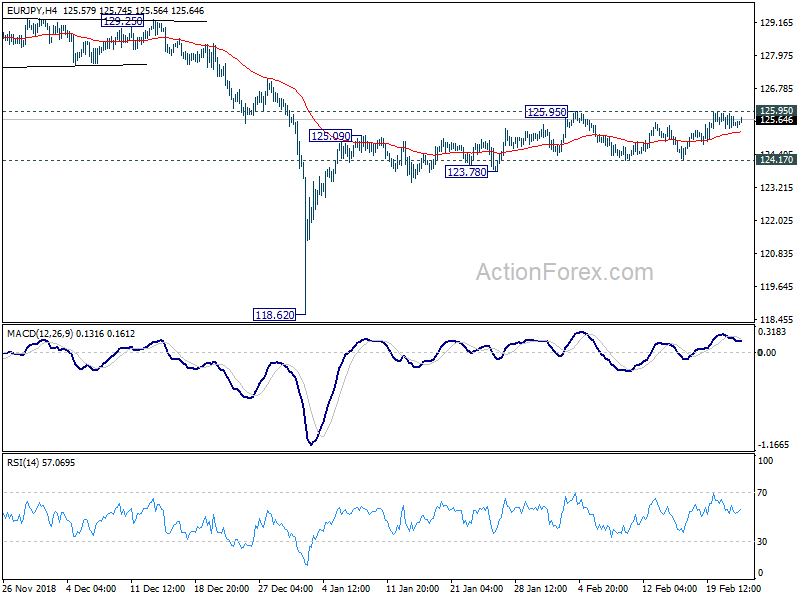
In the bigger picture, medium term rebound from 109.03 (2016 low) has completed at 137.49 already, with corrective structure. Fall from 137.49 is likely still in progress. Decisive break of 118.62 will target 161.8% projection of 137.49 to 124.61 from 133.12 at 112.28, which is inside 109.03/114.84 support zone.
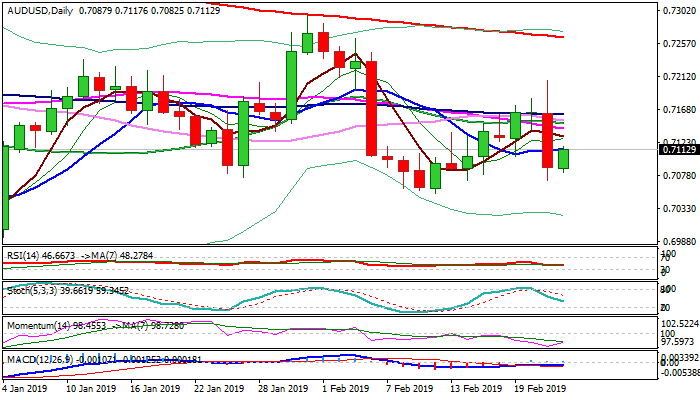
AUD/USD Outlook: Bounce After 1% Fall Struggle At 10SMA Barrier, News From China In Focus
The Australian dollar bounces from one-week low at 0.7070 in early Friday's trading, after 1% fall on Thursday.
The Aussie was hit by China's Dalian port to ban coal imports from Australia, with focus turning towards further steps of China.
If the case was isolated the pressure on Aussie dollar would likely ease, while stronger losses could be anticipated if China extends bans on Australian imports.
Today's recovery comes after markets digested the news and profit taking on Thursday's strong fall, with optimistic comments from RBA Governor Lowe, also being supportive for the Aussie dollar.
Thursday's fall was contained by important Fibo support at 0.7070 (38.2% of 0.6706/0.7295), with thickening daily cloud after Thursday's twist (0.7050) also underpins recovery, which probes through initial pivot at 0.0.7114 (10SMA).
Sustained break here would ease downside risk and expose a cluster of daily MA's within 0.7141/60 that repeatedly capped recent rallies.
Daily techs are mixed and lack clearer signal, as MA's remain in bearish setup while momentum turned up and supports recovery.
Stronger direction signals could be expected on violation of pivotal points at: 0.7070/50 (Fibo support / daily cloud base) or 0.7160/0.7203 (100SMA/Fibo 61.8% of 0.7295/0.7054).
Res: 0.7117, 0.7141, 0.7160, 0.7203
Sup: 0.7082, 0.7070, 0.7050, 0.7000
EUR/GBP Daily Outlook
Daily Pivots: (S1) 0.8668; (P) 0.8687; (R1) 0.8709; More...
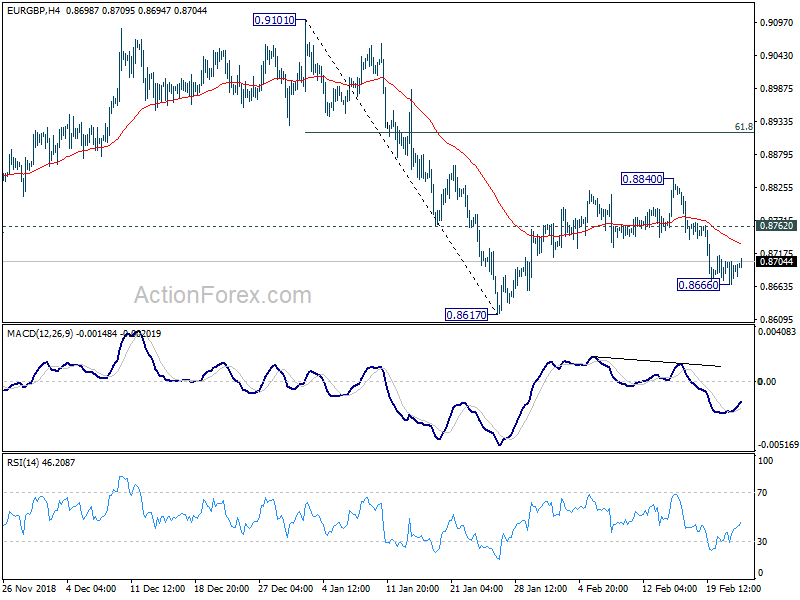
Intraday bias in EUR/GBP is turned neutral with 4 hour MACD crossed above signal line. On the downside, below 0.8666 will target 0.8617/20 key support zone. We'd look for strong support from there to bring rebound. On the upside, above 0.8762 minor resistance will turn bias back to the upside. Further break of 0.8440 will extend the rebound to 61.8% retracement of 0.9101 to 0.8617 at 0.8916 instead.
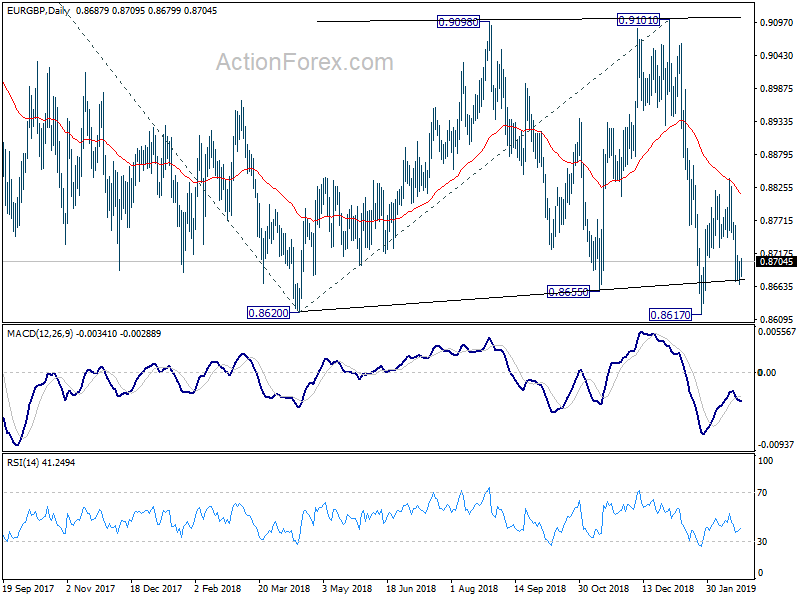
In the bigger picture, EUR/GBP is seen as staying in long term range pattern started at 0.9304 (2016 high). The medium term range is set between 0.8620 and 0.9101. Downside breakout of 0.8620 will pave the way back to 0.8312 support . Break of 0.9101 will bring retest of 0.9304/5 resistance.
EUR/AUD Daily Outlook
Daily Pivots: (S1) 1.5811; (P) 1.5916; (R1) 1.6089; More....
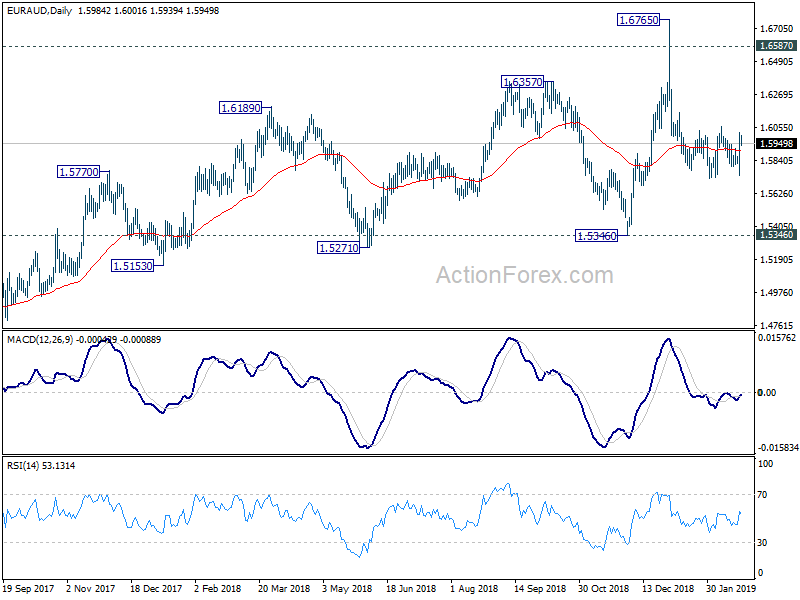
EUR/AUD is staying in range of 1.5721/6060 and intraday bias remains neutral for the moment. On the upside, break of 1.6060 resistance should confirm that decline from 1.6765 has completed. Further rally should then be seen to retest 1.6765 high. On the downside, however, break of 1.5721 will extend the decline to 1.5346 support instead.
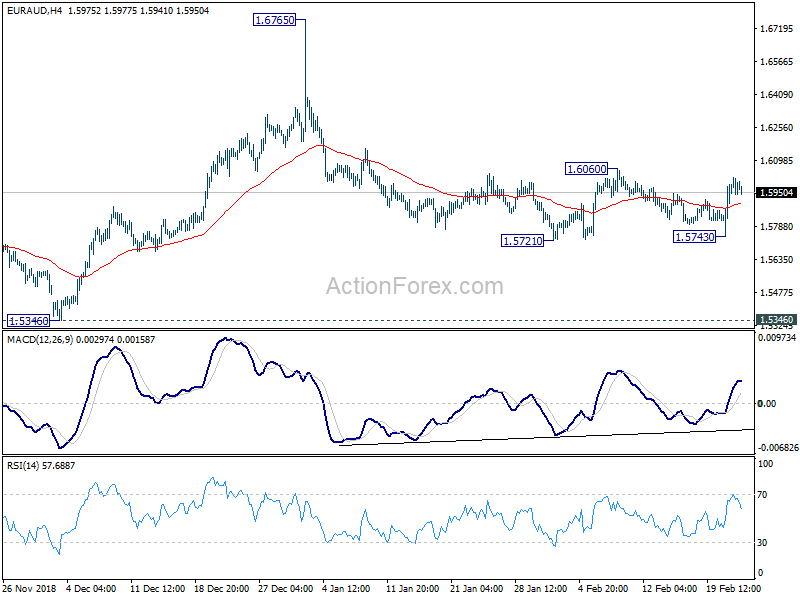
In the bigger picture, as long as 1.5346 support holds, outlook will remain bullish. Uptrend from 1.1602 (2012 low) is expected to resume sooner or later. Break of 1.6765 will target 61.8% retracement of 2.1127 (2008 high) to 1.1602 at 1.7488 next. However, firm break of 1.5346 key support will indicate trend reversal, with bearish divergence condition in weekly MACD, and turn outlook bearish.