Sample Category Title
EUR/USD Trend Overwhelmingly Bearish Below 1.1350
Key Highlights
- The Euro declined heavily and broke the 1.1400 and 1.1350 supports against the US Dollar.
- There is a major bearish trend line formed with resistance at 1.1320 on the 4-hours chart of EUR/USD.
- The US Industrial Production in Jan 2019 declined 0.6% (MoM), whereas the forecast was +0.1%.
- The UK Rightmove House Price Index for Feb 2019 will be released today, which could increase 0.2% (MoM).
EURUSD Technical Analysis
The Euro started a major decline from the 1.1520 swing high against the US Dollar. The EUR/USD pair broke the 1.1400 and 1.1350 supports to move into a bearish zone.
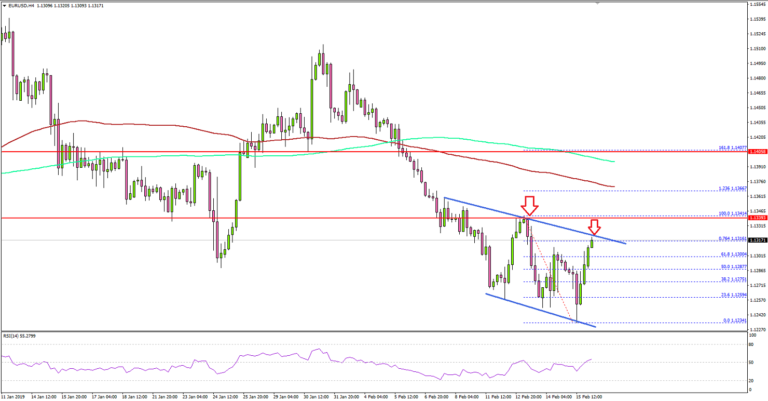
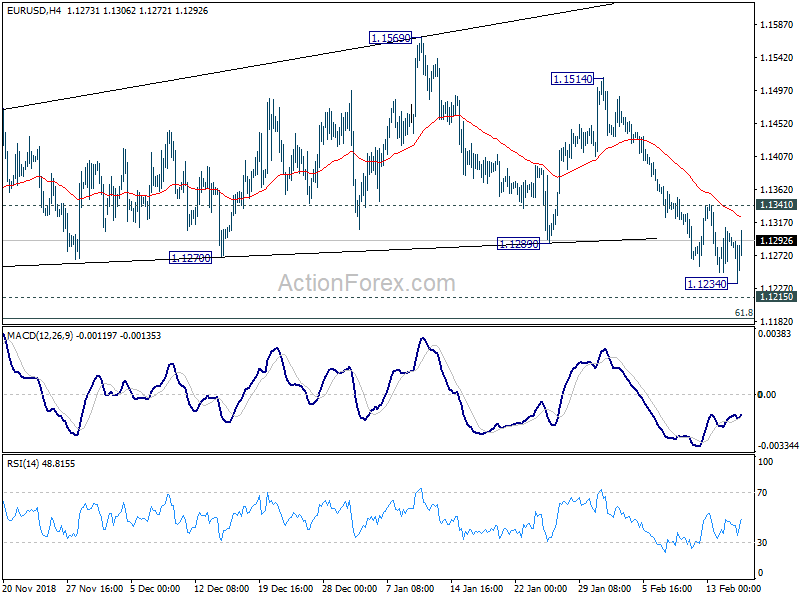
Looking at the 4-hours chart, the pair even broke the 1.1300 support area and settled below the 100 (red) simple moving average (4-hours). Sellers pushed the pair towards the 1.1220 support area and a low was formed at 1.1234.
Later, the pair corrected higher and moved above the 1.1250 level and the 50% Fib retracement level of the last decline from the 1.1341 high to 1.1234 high.
However, there is a strong resistance formed near the 1.1315-1.1320 area. Moreover, there is also a major bearish trend line formed with resistance at 1.1320. Therefore, buyers need to push the pair above the 1.1320 resistance to start a decent rebound towards 1.1350 and 1.1400.
If buyers fail, there is a risk of a fresh decline below the 1.1250 and 1.1235 levels in the coming sessions. The main support is near the 1.1220 level, below which there could a sharp drop below 1.1200.
Recently in the US, the Industrial Production report for Jan 2019 was released. The market was looking for a 0.1% rise in production in Jan 2019, compared with the previous month.
However, the result was very disappointing as there was a 0.6% decline in the Industrial Production. Moreover, the last reading was revised down from +0.3% to +0.1%.
The report added that:
In January, manufacturing production fell 0.9 percent, primarily as a result of a large drop in motor vehicle assemblies; factory output excluding motor vehicles and parts decreased 0.2 percent.
Overall, there could be an upside correction in EUR/USD, but the pair is likely to face a lot of hurdles near 1.1320 and 1.1350.
Economic Releases to Watch Today
- UK Rightmove House Price Index for Feb 2019 (MoM) – Forecast 0.2%, versus 0.4% previous.
- UK Rightmove House Price Index for Feb 2019 (YoY) – Forecast +0.4%, versus +0.4% previous.
Regional Markets To Have Their Say On President’s Day
Regional markets to have their say on President's Day
The US-China trade talks in Beijing wrapped up without a deal on Friday and now move to Washington this week as the 1 March deadline looms. Taking the view that no news is good news, the stock markets remain optimistic, with the Dow Jones and S&P up 1.70% and 1.0% respectively, as the sparkling post-Fed rally continues. The FX and bond markets were more sanguine as the dollar gave back a small proportion of its recent gains and bond yields rose slightly across the curve.
What is becoming clear however, is the US is not prepared to settle for easy wins on the trade deficit by simply agreeing to China buying more planes, beans and automobiles etc. If the US government had taken this approach, we would likely have already seen a completed deal. Instead, they are seeking structural changes in the way China does business with regards to subsidies, trade barriers, industrial espionage and forced technology transfers. The US is in its strongest negotiating position with China for years, with its economy pumping along as China's slows down. As such, the US seems determined not to squander that advantage with an easy win.
The US markets will be closed for President's Day today, but that shouldn't stop the regional markets from following their lead from Friday. In Asia, today's focus will be the release of Thailand's GDP this morning followed by Singapore's Budget 2019 this afternoon. The markets are forecasting the Thai Q4 GDP data will be up by a glowing 3.80% year-on-year and an equally impressive 4.20% full-year. This should knock pre-election shenanigans off the front pages – for now – and possibly see the baht's recent rally continue.
Singapore's budget may see a lower deficit due to more efficient tax collection, and we could see a few goodies handed out ahead of a possible election later this year. We expect no new tax increases and the emphasis will likely continue to focus on health care for Singapore's rapidly ageing population along with extensive infrastructure and smart nation spending.
Internationally, attention will focus on the trade talks with this week's data highlight being the FOMC Minutes mid-week.
The energy markets may outperform as Reuters reported Gazprombank has frozen the accounts for Venezuelan state oil company PDVSA.
FX
The US dollar gave back some of its recent gains on Friday as the Beijing trade talks closed without a deal and end-of-week profit taking set in. The focus will be on regional currencies today with petro-aligned currencies such as MYR and IDR likely to benefit, possibly also the Thai baht. A strong Thai GDP could see the baht rally towards the 31.10 area against the dollar.
Trading will likely be muted with the US on holiday, and the dollar could likely continue its short-term weakness against the major currencies. This weakness may be temporary as the economy continues to fire on all cylinders.
Stock markets
Regional bourses will likely follow Wall Street's lead and trade higher today with Friday's oil rally perhaps giving an extra boost to Malaysia and Indonesia's markets.
The trade talks are a distant cloud today, but that cloud may grow closer and much darker if there is no progress this week. Today's anticipated rallies could then run out of steam in the days ahead.
Gold
Gold rose ten dollars to 1,321.00 an ounce on Friday due to risk-aversion buying and a falling dollar after the trade talks broke without a result. Gold has now traced out multiple daily lows at 1,301.00, which represents strong support at present. Gold bullish technical consolidation continues therefore with the charts suggesting the yellow metal is gathering its strength for an attack on the 1,330.00 resistance region.
Oil
Oil rocketed higher on Friday ending a spectacular week for both Brent and WTI. Brent rose 2.60% to USD66.20 a barrel, finishing the week 6.00% higher. Meanwhile, WTI rose 2.20% to USD55.80 a barrel, concluding a 5% rally over the week. Tighter OPEC+ supplies, mainly from Saudi Arabia, and Venezuela sanctions drove the black gold higher.
This weekend, Reuters reported that Russia's Gazprombank has frozen PDVSA's accounts, following news that Lukoil has also suspended oil swaps with PDVSA. This tightening noose should see bullish sentiment continue in oil with both contracts jumping 0.50% in early Asian trading.
Daily Markets Broadcast
Wall Street climbs as trade talks progress
US-China trade talks supposedly made significant progress last week, so much so that they will continue in Washington this week. China’s new loans data suggest stimulus measures may be taking hold.
US30USD Daily Chart
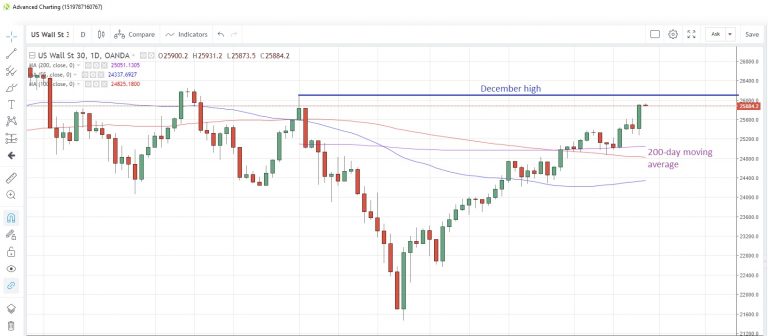
The US30 index posted the biggest one-day gain since January 4 on Friday, rising to the highest level in 10 weeks on trade talk optimism
The next resistance point could be the December high of 26,085. The 200-day moving average at 25,051 may act as near-term support
It’s the US Presidents’ Day holiday today, with no data releases scheduled. Liquidity/activity may be thin.
DE30EUR Daily Chart
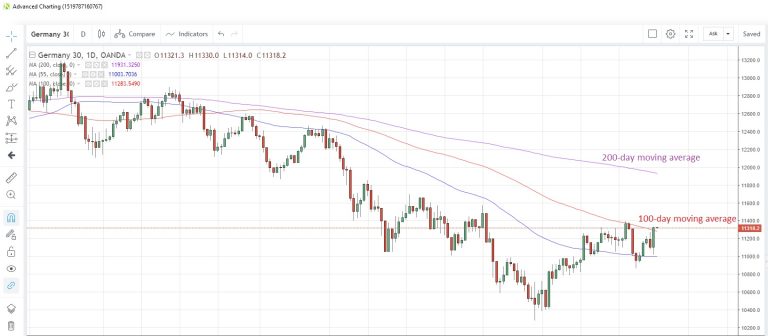
The Germany30 index surged on Friday, shrugging off early losses, amid positive vibes from the trade talks, while shrugging off any possible fallout from the snap general election called in Spain
The index closed above the 100-day moving average at 11,295 for the first time since August 9 on Friday. The next resistance level could be the high from earlier this month at 11,392
There are no data releases scheduled for today. The US is due to release a Commerce Dept report supporting a 25% tariff on cars and other options. This could affect German shares.
CN50USD Daily Chart
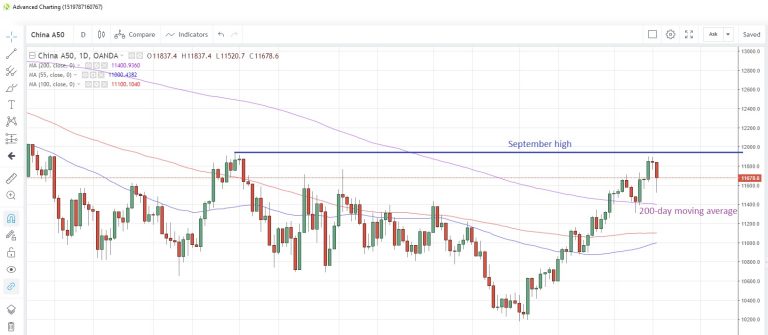
China shares extended the retreat from 4-1/2 month highs on Friday, posting the biggest one-day loss since January 22 as investors feared China may have to make heavy concessions in order to secure a trade deal
The index is dropping toward to 200-day moving average at 11,400
Data released Friday showed China’s new loans surging to a record 3.23b yuan in January, well above forecasts of an increase to 2.8b and December’s 1.08b. This suggests the government’s stimulus measures may be filtering through to the broader economy.
EURUSD Faces Risk Of More Recovery Threats
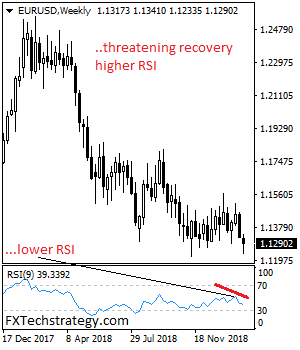
EURUSD faces risk of more recovery threats in the week following a reversal ahead of its key support the past week. Support comes in at the 1.1250 where a break will aim at the 1.1200 level. A break below here will target the 1.1150 level. Further down, support lies at the 1.1100. On the upside, resistance resides at 1.1350 level with a break through there opening the door for further upside towards the 1.1400 level. Further up, resistance comes in at the 1.1450 level where a violation will expose the 1.1500 level. All in all, EURUSD continues to threaten further downside pressure.
ECB Rehn: Have to wait and see how long slowdown lasts
ECB Governing Council member Olli Rehn told German newspaper Handelsblatt that "the most recent data point to a weakening of the economy." And, the reasons for the slowdown mainly lie abroad, including US-China trade conflicts. Though, there were also uncertainties over Brexit, yellow vest protest in France, fiscal issues in Italy and slower industrial production in Germany.
But Rehn also noted that ECB's monetary policy orientation is clear and unchanged. He added, "we have said that rates will be at their current level until we have sustainably reached our monetary policy goal." For now, wage growth had not had much impact on core inflation yet even though "at the end of last year it looked as if there would be stronger momentum in inflation.". And, "we have to wait and see how long the period of weaker growth will last."
ECB de Galhau: The key question is if slowdown is temporary or more durable
ECB Governing Council member Francois Villeroy de Galhau said in a El Pais newspaper interview over the weekend that the central bank will scrutinize incoming data to decide whether to hike after this summer.
He said "the key question will be if the slowdown is temporary — with a bounce-back during this year — or more durable." For now, there is resilient domestic demand in Germany, France and Spain. And that kept recession risk low even though outlook was clouded by protectionism and Brexit.
And de Galhau also noted that there was strong convergence of views within ECB about the sequencing of the next policy steps, as well as the flexibility about timing.
Canada Freeland: Time to remove Section 232 tariffs with USMCA concluded
Canadian Foreign Minister Chrystia Freeland attended the Munich Security Conference over the weekend. There she also met US House Speaker Navy Pelosi and urged to remove the steel and aluminum tariffs. Freeland noted that Canada is now in the process of domestic ratification of the so called USMAC, US-Mexico-Canada agreement on trade. And Canada's position remains strongly opposed to the section 232 steel tariffs. She also told reporters that "the Canada position is now that we have concluded (USMCA) that is all the more reason why the tariffs must be lifted."
Separately at the conference, Freeland also urged to reinforce "rules-based international order". And she proposed to bring together specific coalitions around specific issues."
Forex Forecast and Cryptocurrencies Forecast
First, a review of last week’s events:
EUR/USD. Recall that the expert community was not able to form a more or less definite opinion on the movement of this pair last week. This was due to the lack of clarity on both Brexit and the US-China negotiations. In addition, analysts were waiting for the release of data on GDP in Germany and the EU, as well as inflation and retail sales in the US. And if Europe showed an expected growth of 1.2%, and Germany rose by 0.2% (from -0.2% to 0.0%), the data from the USA caused a strong alarm in the market. Retail sales fell by 1.2%, the maximum value in 10 years. As a result, the dollar index suspended growth and moved away from two-month highs.
The dollar has also stopped growing to the European currency. However, if we sum up the results of the whole five-day week, the victory nevertheless remained with the “American”: having started from the level of 1.1320, the pair finished the week at the level of 1.1295;
GBP/USD. Pound is falling for the third week in a row. The problems associated with Brexit have been supplemented by poor macroeconomic indicators indicating a slowdown in the country's economy: the GDP growth has declined compared to the previous quarter from 0.6% to 0.2%, and the consumer price index fell by 0.3%. As a result, the pair recorded a weekly minimum at 1.2770 on Thursday.
Then the statistics on the US economy came out and turned the trend from south to north. As a result, the British pound was able to win back 115 points from the dollar and complete the week at 1.2885;
USD/JPY. The Japanese currency was losing ground throughout the first half of the week, reaching the value of 111.12 yen per dollar. But then, against the background of the fall in the stock market due to the weak economic data from the United States and the US-China talks that once again reached a deadlock, the pair made a sharp reversal. Increased appetites for risk-free investments allowed the quotes to lower to the level of 110.25, after which a correction followed, and the pair froze at 110.45;
Cryptocurrencies. Last week, answering the question of whether the Bitcoin jerk to the height of $3,800 could be considered a harbinger of a storm, we noticed that the pair had just returned to the consolidation line (or Pivot Point), along which it has been moving for 11 weeks, beginning in late November 2018. And we were right: the consolidation continued, and the pair kept in a very narrow side corridor of $3,630-3,750 for the whole, already the 12th, week.
The total capitalization of the crypto market has also remained almost unchanged. If it was at the level of $121.78 billion on Friday, February 9, after seven days it was equal to $120.16 billion. As for the top altcoins, in contrast to the reference cryptocurrency, they showed a somewhat greater volatility. So, for example, the fluctuations range of Litecoin (LTC/USD) was about 15%, and of Ripple (XRP/USD) - about 7%.
As for the forecast for the coming week, summarizing the opinions of a number of analysts, as well as forecasts made on the basis of a variety of methods of technical and graphical analysis, we can say the following:
EUR/USD. Not the rosiest economic situation in Europe is on one side of the scale, on the other is the collapse of stock indices and trade wars in the United States. JP Morgan and Macroeconomic Advisers lower their forecasts for the US GDP growth. And BofA Merrill Lynch and Bloomberg raise their forecasts for the Eurozone. In their opinion, the zero growth of Germany’s GDP is a temporary factor, and in the case of the soft Brexit and improvements in the Chinese economy, Germany, together with the rest of Europe, will turn to sustainable economic growth. All this, together with the desire of the Fed to take a pause in monetary tightening, gives the market a reason to believe that the measures of the regulator are late, the recession in the US is not far off, and the balance will swing to Europe. In this case, the pressure on the dollar will increase. But this is for the future.
In the meantime, 70% of experts, supported by indicators on D1, expect the dollar to strengthen and the EUR/USD downtrend line to continue. The immediate goal is 1.1200. The following support is located in the zone 1.1085-1.1115.
The opposite opinion is held by 30% of analysts and graphical analysis on D1, who believe that problems in the US economy will force the dollar to lose ground in the near future. In this case, the pair will return to the limits of the medium-term corridor 1.1300-1.1500 and rush first to its central and then to the upper border;
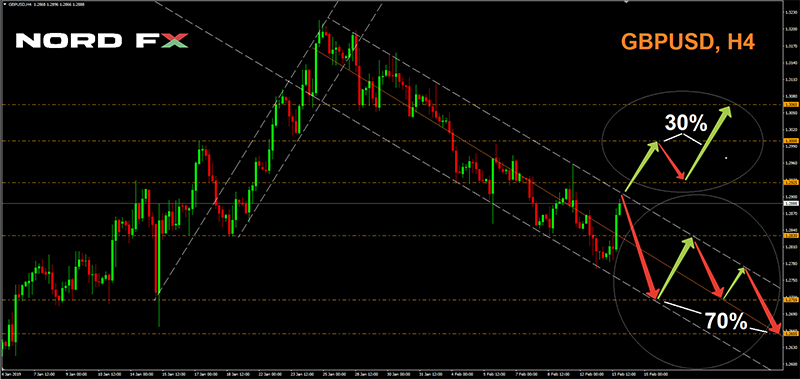
GBP/USD. The forecast for this pair for the coming week is similar to the forecast for the pair EUR/USD. Here, also, 70% of experts, along with 90% of oscillators and trend indicators on D1, expect the pair to fall, and 30%, along with graphical analysis, show its growth. The inevitably approaching hour of divorce from the EU under still incomprehensible conditions, sides with the former. The latter have those problems of the United States, about which much has already been said above, on their side. Support levels are 1.2830, 1.2715, 1.2655, resistances are 1.2925, 1.3000 and 1.3065;
USD/JPY. If the US dollar feels good enough against the euro and the pound, this cannot be said about the confrontation with the yen. The positive dynamics of the Japanese currency as a safe haven may continue with a further deterioration in the global economic outlook and a decrease in risk appetites.
Experts' opinions have divided in half regarding the nearest future of the pair, but in the transition to the monthly forecast, 65% of analysts vote for the strengthening of the yen. The support levels for the pair are 110.00, 109.60, 109.10, 108.50. The resistance levels are 110.65, 111. 25, 112.30, 113.70;
Cryptocurrencies. As analysts say, there are no fundamental factors explaining the Bitcoin jump to the height of $3,800. So, most likely, this upward impulse will not develop further. 65% of experts believe the most likely movement of the BTC/USD pair is in the range of 3,500-3,300 with a gradual decrease to the level of $3,000. The remaining 35% of analysts have an opposite point of view, expecting the pair to be able, at least for a while, to rise to the level of $4,000.
Eco Data 2/18/19
[php_everywhere instance="1"]
EUR/USD Weekly Outlook
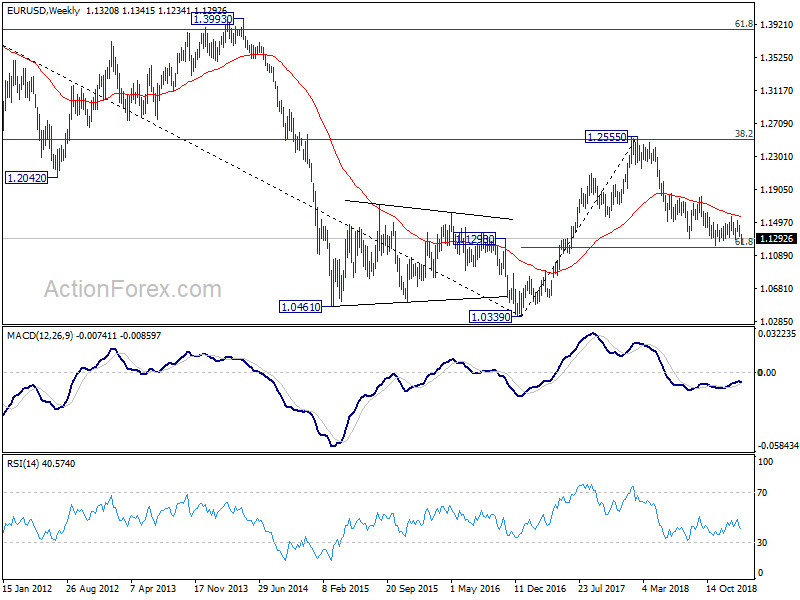
EUR/USD dropped to 1.1234 last week but recovered again ahead of 1.1215 low. Initial bias is turned neutral this week first. Further decline is expected as long as 1.1341 resistance holds. Decisive break of 1.1215 will resume the larger down trend from 1.2555 to 1.1186 fibonacci level next. Nevertheless, break of 1.1341 will suggests that consolidation from 1.1215 is extending with another rising leg back towards 1.1514 resistance.
In the bigger picture, as long as 1.1814 resistance holds, down trend down trend from 1.2555 medium term top is still in progress and should target 61.8% retracement of 1.0339 (2017 low) to 1.2555 at 1.1186 next. Sustained break there will pave the way to retest 1.0339. However, break of 1.1814 will confirm completion of such down trend and turn medium term outlook bullish.
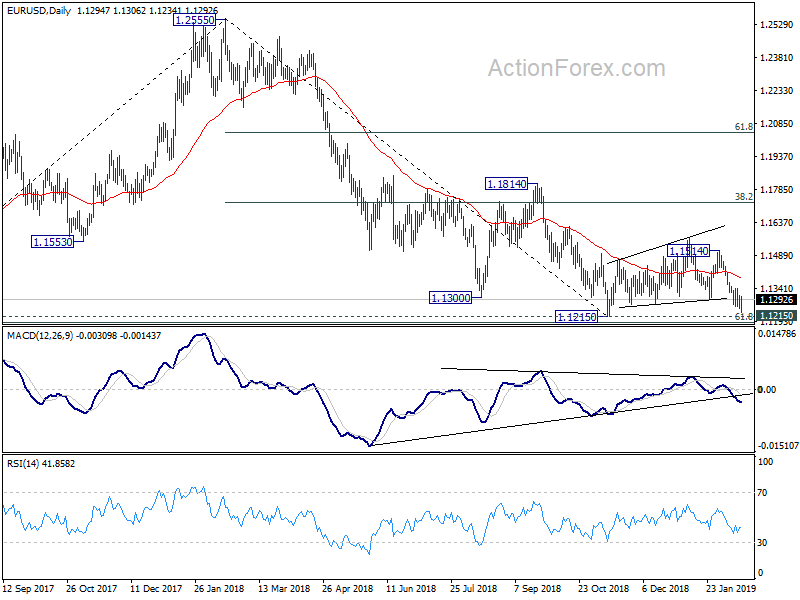
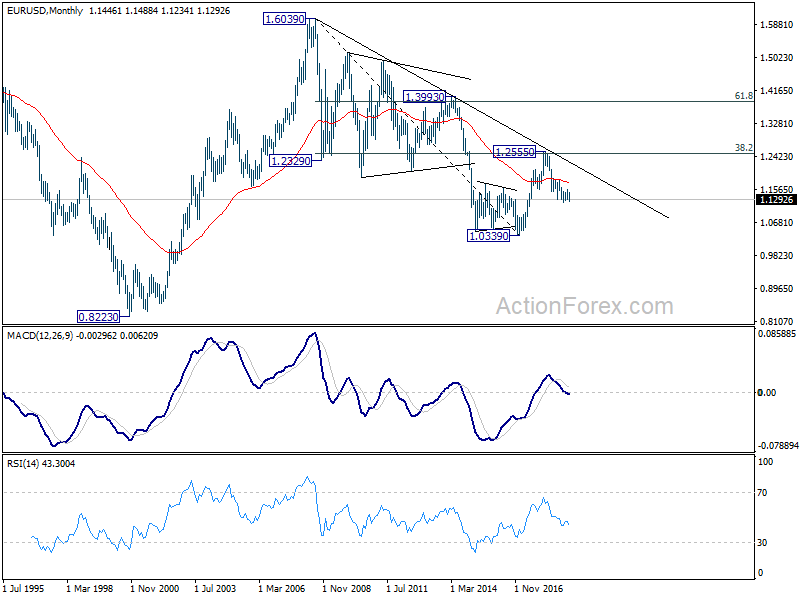
In the long term picture, the rejection from 38.2% retracement of 1.6039 to 1.0339 at 1.2516 argues that long term down trend from 1.6039 (2008 high) might not be over yet. EUR/USD is also held below decade long trend line resistance. Firm break of 61.8% retracement of 1.0339 to 1.2555 at 1.1186 should at least bring a retest on 1.0339 low. This will remain the favored case as long as 1.1814 resistance holds.