

Sample Category Title
Stocks and Dollar Rally on Trade Optimism
The greenback and US stocks are poised for another weekly gain as trade talk progress appears to be gaining momentum, with negotiations continuing next week in Washington. Financial markets in the short-term are relieved the government will be funded, despite a legal dispute on emergency powers, and expectations are high we will not see an escalation in trade tariffs as China and the US appear close to reaching a memorandum of understanding.
- USD – Dollar may have overreacted to retail sales miss
- EUR – Spain elections, 3rd time in 4 years
- Amazon – Recession fears spark on terrible sales data
- GOLD – Remains stuck in key range
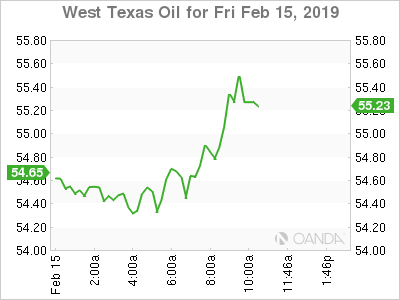
- OIL – Stronger economic data needed to push oil higher
USD
Dollar traders may have overreacted after yesterday’s shocking headline of December retail sales falling the most since 2009. The greenback sunk heavily as concerns rose that the US is not on sound footing. Today’s economic data painted a mix picture as the Empire manufacturing reading rebounded better than expected but both industrial production and factory output decreased more than expected. Economic data for the US is likely to remain volatile and mixed in the first quarter, but so far does not derail the base case for the US post near 2% economic growth in 2019.
EUR
The political situation in Spain remains dicey as we will see another election, the third in four years, with the potential outcome of seeing another minority government formed, leading one to believe Spain may not be able to implement strong initiatives going forward. Prime Minister Sanchez called for snap elections on April 28th, just ahead of the European Parliament elections that will be held in late May. In early polls, Sanchez’s Socialists appear to have a slight lead over the conservative People’s Party. The market reaction is somewhat limited to the Spanish elections as stronger economic success from Madrid has kept yields stable on Spanish bonds, the 10-year yield remains near 2-year lows.

Stocks
Amazon remained the key story on Wall Street as the decision to cancel plans to build a second headquarter in Long Island City, NY sparked a political debate that will likely become a key campaign issue for 2020. Amazon decided that the $3 billion in subsidies might not be enough to outweigh the rising concerns from state and local politicians. Local leaders felt Amazon got too much in subsidies, feared the rising cost of living and strains to the infrastructure system was to do more damage to the existing community. The loss of 25,000 Amazon jobs, 1,300 construction jobs and several thousand in direct and indirect jobs will be missed, but not nearly as much as the $27 billion in tax revenue NY would have seen in over the next couple of decades.
Amazon stock did not have a major reaction, but the decision could eventually be positive for the stock. Amazon was set on reinvesting this year and while they will miss out on a key objective of establishing a major east coast office, they will likely be able redirect the funds set aside for the NY headquarters on acquisitions, build their existing offices and continue recruiting top talent.

GOLD
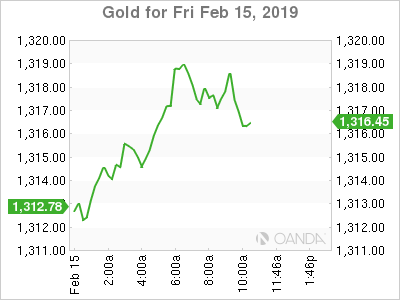
Gold’s refusal to break below $1,300 despite significant progress and optimism signals that the market may be focused on the slowdown that is developing in the US. A softer US economy could further cement a dovish Fed, which could help the yellow metal resume its’ recent rebound. Economic data from the US continues to remain soft, Empire Manufacturing beat expectations, but is well off the levels it enjoyed in 2018 and Industrial Production and Factory output continued to show weakness. Momentum traders may be on the sidelines and waiting to see if gold is eventually able to take out the 2019 high of $1,331.
OIL
Crude prices benefited from positive developments on the trade front. For most of the week oil’s gains were capped as OPEC’s reduction efforts appear to be running out of steam. The supply side argument has dominated headlines, with US production likely to be the dominant theme for years, but if we see a significant memorandum of understanding in the China-US trade war that includes progress on technology transfer, IP protection, non-tariff barriers, and better trade terms, we could see oil remain bid on improving demand as global growth concerns would ease rapidly.
Sunset Market Commentary
Markets
Global core bonds are losing ground today with US Treasuries underperforming German Bunds. Risk sentiment turned positive after constructive signals from the US-Sino trade talks. EU equities moved higher, weighing core bonds down. Still the move in German Bunds remains limited. ECB heavyweight Benoit Coeuré acknowledged that the economic slowdown in the euro area is “clearly stronger and broader” than expected, which means the inflation “path also will be shallower”. So the ECB “has to adapt to that”. He suggested policy rates should remain low for longer. He also indicated that the ECB is discussing a new TLTRO. That’s the strongest signal so far that the central bank is working on this tool. The German yield curve slightly steepens with changes varying between -0.3 bps (2-yr) to +0.8 bps (30-yr). However, a new TLTRO has more impact for peripheral countries. Italian spread over the German 10-yr yield completely reversed an intraday widening (+10 bps). US Treasuries moved sideways throughout the day but fell on a strong February Empire Manufacturing, pairing some of the gain after yesterday’s disappointing retail sales. The move down halted after weak January US industrial production numbers (-0.6% M/M vs. +0.1% exp.). The US yield curve moved higher with changes up to +2.0 bps (10-yr).
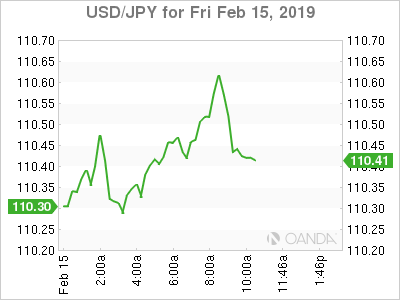
FX traders looked for direction today after yesterday’s USD sell-off in the wake of very poor US retail sales. In Asia, headlines on the US-China trade talks were cautious, even negative. The tone improved later as officials confirmed talks will continue in the Washington next week. Positive news on global trade can be considered positive for both the US and for Europe. However, the US/German (EMU) yield spread re-widened and supported the dollar at that time. Euro-sceptic headlines from Italian MP Borghi weighed on Italian bonds and were a secondary negative for the euro. During afternoon session, headlines initially still favoured the dollar rather than the euro. ECB’s Coeure did speak soft on inflation/monetary policy and mentioned the ECB discussing new TLTRO’s. More or less at the same time, the NY Empire manufacturing survey printed stronger than expected (8.8). EUR/USD touched a new correction low in the 1.1235 area. However, US production data were again very weak blocking an intraday rise of US yields and of the USD dollar. EUR/USD is trading in the 1.1275 area. A new set of TLTRO’s also might be considered a supportive factor for EMU assets and maybe even for the euro. USD/JPY shows no clear trend and is trading in the 100.40 area.
Sterling rebounded slightly even as yesterday’s vote in the UK Parliament confirmed the profound division among UK politicians on how to solve the Brexit stalemate. UK January retail sales rebounded sharply after dismal December sales. The impact on sterling was limited. It is too early to draw any conclusions for BoE policy as long as Brexit uncertainty remains as big as it is currently. EUR/GBP is trading in the 0.8790 area. Cable hovers near the 1.28 pivot.
News Headlines
The Spanish Prime Minister Sanchez pulled the plug on his minority government. He called for snap elections on Friday morning after Catalan parties refused to support his 2019 budget bill in parliament last Tuesday. Spain is scheduled to vote on April 28, just weeks ahead of the European elections.
Chinese President Xi Jinping said “important progress” has been made during this week’s trade talks. The White House sounded similarly optimistic but added that work remained. Parties agreed to continue talks next week in Washington ahead of the March 1 deadline. Equities staged a strong intraday turnaround after the news got public.
US Empire Manufacturing recovered in February from last month’s blow. The headline index climbed to 8.8, up from 3.9 in January and beating expectations (7.0). Current situation subcomponents were mixed (new orders up, employment down) but the survey revealed striking optimism about the economic environment going forward.
EUR/USD Mid-Day Outlook
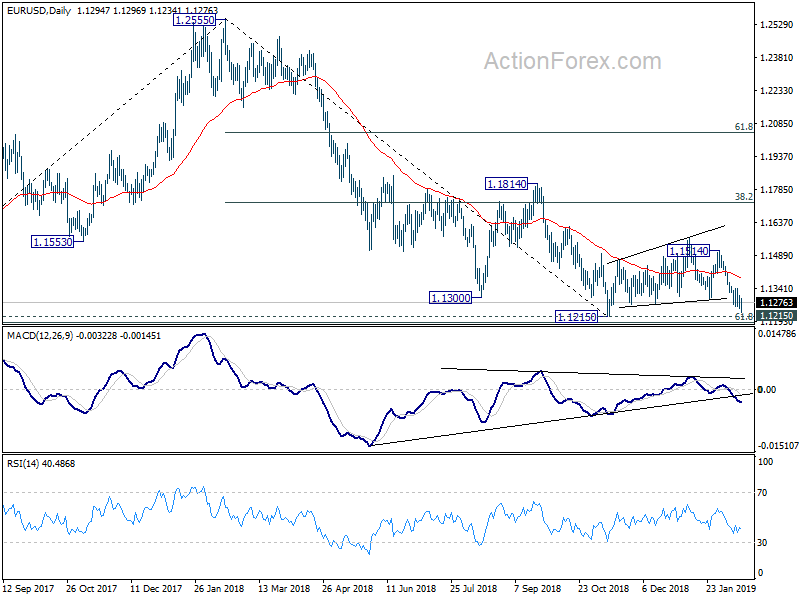
Daily Pivots: (S1) 1.1260; (P) 1.1285; (R1) 1.1321; More.....
EUR/USD's decline resumed by breaking 1.1249 temporary low and intraday bias is back on the downside for 1.1215 low. Break will resume larger down trend from 1.2555 to 1.1186 fibonacci level. However, break of 1.1341 resistance will suggest short term bottoming. Intraday bias will be turned back to the upside to extend the consolidation from 1.1215 with another rising leg.
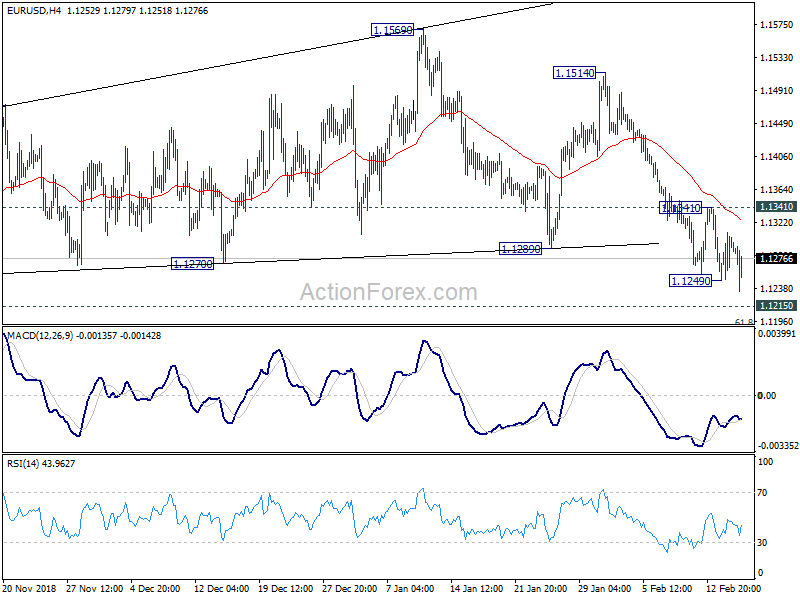
In the bigger picture, as long as 1.1814 resistance holds, down trend down trend from 1.2555 medium term top is still in progress and should target 61.8% retracement of 1.0339 (2017 low) to 1.2555 at 1.1186 next. Sustained break there will pave the way to retest 1.0339. However, break of 1.1814 will confirm completion of such down trend and turn medium term outlook bullish.
GBP/USD Mid-Day Outlook
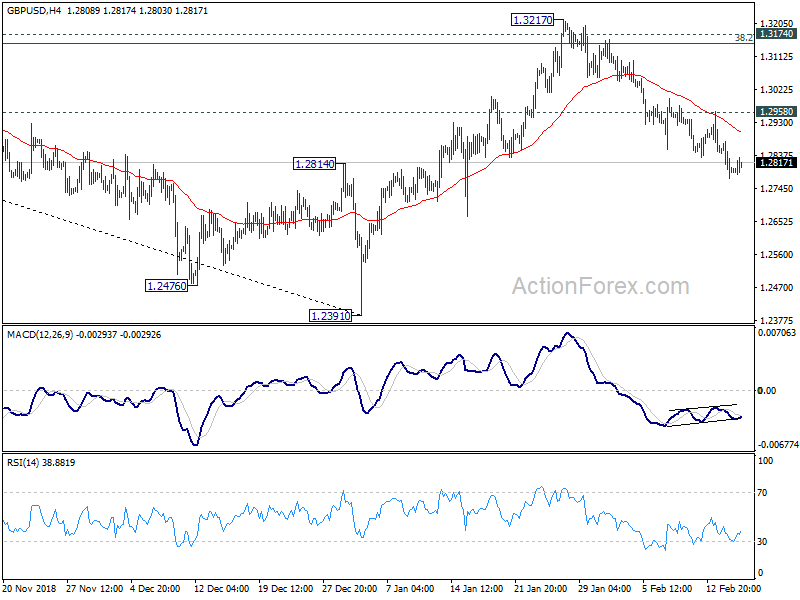
Daily Pivots: (S1) 1.2755; (P) 1.2816; (R1) 1.2860; More....
Intraday bias in GBP/USD remains on the downside as fall from 1.3217 is in progress. As noted before, we're holding on to the view that rebound from 1.2391 has completed at 1.3217 already, after rejection by 1.3174 key resistance. Further decline should be seen to retest 1.2391 low. On the upside, break of 1.2958 resistance is needed to be the first sign of short term bottoming. Otherwise, further decline is expected even in case of recovery.
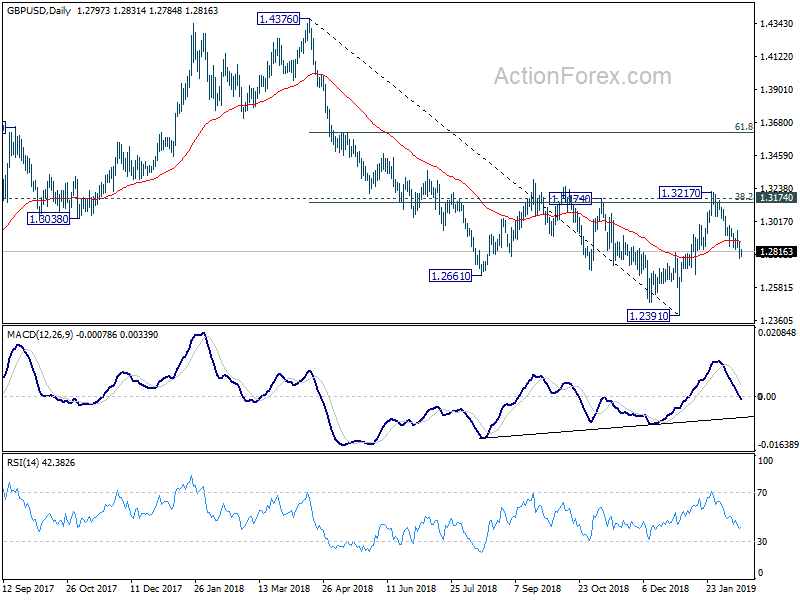
In the bigger picture, the rejection by 1.3174 key resistance revived the original view on GBP/USD. That is, decline from 1.4376 is possibly resuming long term down trend from 2.1161 (2007 high). Firm break of 1.2391 will solidify this bearish case and target 1.1946 (2016 low). However, decisive break of 1.3174 will invalidate this bearish case again and turn outlook bullish.
USD/JPY Mid-Day Outlook
Daily Pivots: (S1) 110.26; (P) 110.69; (R1) 110.92; More...
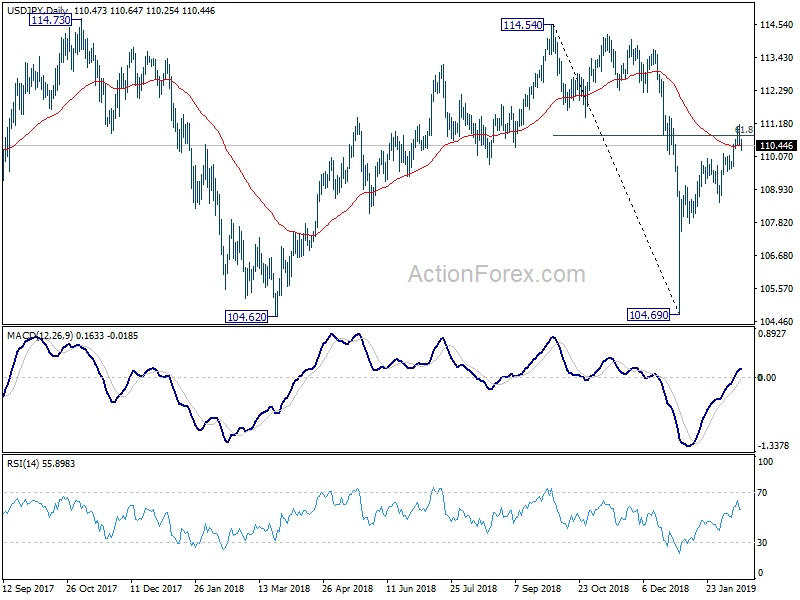
Intraday bias in USD/JPY remains neutral at this point. Focus remains on whether USD/JPY could sustain above 61.8% retracement of 114.54 to 104.69 at 110.77. If yes, further rise could be seen back to 114.54 resistance. However, break of 110.00 will suggest that it's actually rejected after the rebound from 104.69 was skewed slightly upwards. In that case, the original bearish view will be revived and further fall should be seen through 108.49 support.
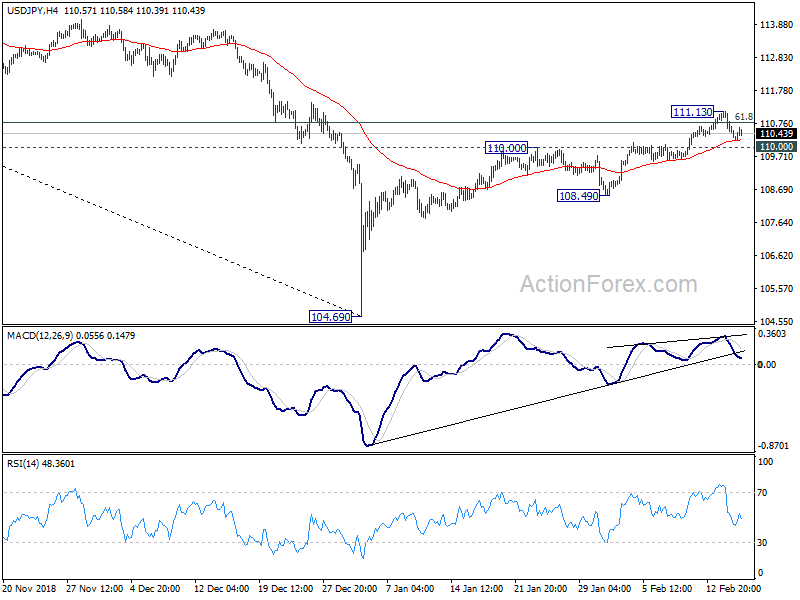
In the bigger picture, the stronger than expected rebound from 104.69 mixed up outlook. We'd turn neutral for now first. On the upside, firm break of 110.77 resistance will suggest that fall from 114.54 has completed at 104.69 already. Such decline is seen as a leg in the corrective pattern from 118.65, which might be finished too. Decisive break of 114.54 will confirm this case and target 118.65 and above. On the downside, break of 108.49 support will turn focus back to 104.62/9 support zone instead.
Canadian Dollar Steady, Investors Eye U.S. Consumer Confidence
USD/CAD is showing little movement in the Friday session. Currently, the pair is trading at 1.3282, down 0.08% on the day. On the release front, Canadian foreign securities purchases are expected to drop to C$7.6 billion. In the U.S., the Empire State Manufacturing Index is expected to rise to 7.1 and UoM consumer sentiment is projected to climb to 93.3 points.
Recent Canadian numbers have been mixed. The economy created 66.8 thousand jobs in January, crushing the forecast of 6.5 thousand. However, manufacturing sales has recorded declines of 1.3% in December and 1.4% in November. The manufacturing sector has sputtered, as the global trade war has lessened the demand for Canadian exports. As well, low oil prices are weighing on the economy and on the Canadian dollar. The currency has slipped 1.2% in February. The Bank of Canada is unlikely to raise rates at the March 6 meeting, but there is room for rate hikes later in the year if economic growth improves.
In the U.S., consumer data has been dismal in January. Retail sales and core retail sales showed sharp contraction, and these numbers came on the heels of soft inflation indicators. Inflation remains low, despite a solid U.S. economy and strong labor market. CPI showed no change in January, and has failed to post a gain since November. Core CPI has recorded weak gains of 0.2% for four successive months. On an annualized basis, CPI gained 1.6% in January, the weakest year-over-year gain since mid-2017. The soft inflation numbers were a result of low energy prices, which fell 3.1% in January as oil prices remain under pressure.
USD/CHF Mid-Day Outlook
Daily Pivots: (S1) 1.0030; (P) 1.0064; (R1) 1.0085; More....
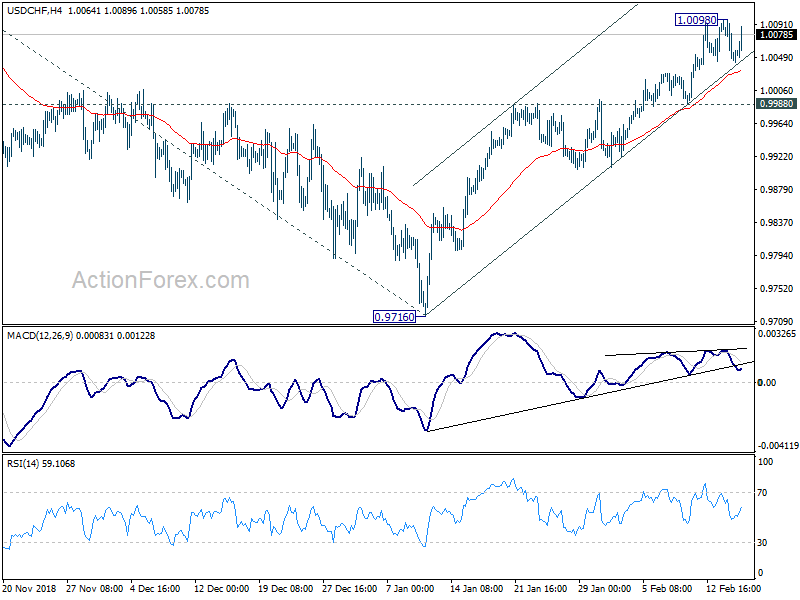
USD/CHF rebounds strongly in early US session but stays below 1.0098 temporary top. Intraday bias remains neutral first. In any case, further rally is expected as long as 0.9988 support holds. On the upside, above 1.0098 will target 1.0128 first. Break will confirm resumption of up trend from 0.9186. Next target will be 100% projection of 0.9541 to 1.0128 from 0.9716 at 1.0303. However, break of 0.9988 will indicate rejection by 1.0128 and turn intraday bias to the downside for 0.9716 support again.
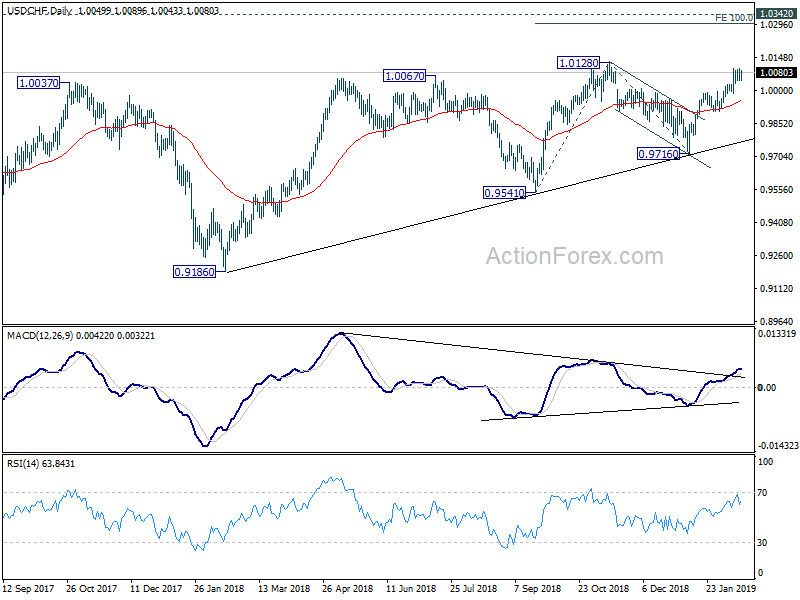
In the bigger picture, USD/CHF drew strong support from medium term trend line and rebounded. That suggests rise from 0.9186 is still in progress. Further break of 1.0128 will confirm up trend resumption and target 1.0342 key resistance. Nevertheless, break of 0.9716 will dampen this bullish view and at least bring deeper fall to 0.9541 key support.
US-China Trade Talks to Continue Next Week, Sentiments Lifted
Risk appetite seems to be given a lift again by words regarding US-China trade negotiations. There seems to be some consensuses and progress made even thought it's unsure what they exactly are. Nevertheless, at least, trade talks will resume next week in Washington, which is a positive sign. Yen and Swiss Franc are back under some pressure but Euro is the weakest one for today. Commodity currencies are having a come back too while Dollar is mixed.
Technically, EUR/USD resumed recent fall again by breaking 1.1249 temporary low and is set to challenge 1.1215 low finally. USD/CHF and USD/JPY also rebounds strongly and both could take on 1.0098 and 111.13 resistance. Sterling is showing sign of recovery against Euro and Yen. But GBP/USD remains well below 1.2958 resistance and further decline is expected.
In other markets, FTSE is currently up 0.76%. DAX is up 1.89%. CAC is up 1.80%. German 10-year yield is up 0.0006 at 0.108. Earlier in Asia, Nikkei dropped -1.13%. Hong Kong HSI dropped -1.87%. China Shanghai SSE dropped -1.37%. Singapore Strait Times dropped -0.41%. Japan 10-year JGB yield dropped -0.0114 to -0.022, staying negative.
Release in US session, Empire State Manufacturing index rose to 8.8 in February, up from 3.9 and beat expectation of 7.6. Import price index dropped -0.5% mom in January, below expectation of -0.1% mom. Canada international securities transactions dropped CAD -18.96B in December.
US-China trade talks to continue in Washington next week
The session in Beijing concluded with positive words from both sides, but without much substance. China's Xinhua news agency said the delegations discussed topics including technology transfers, intellectual property protection, non-tariff barriers, services, agriculture and the trade balance. And it claimed that both countries reached consensus is principle on a number of issues. They're working towards a memorandum of understanding on trade and economic issues.
US Trade Representative Robert Lighthizer said "we feel we have made headway on very, very important and difficult issues. We have additional work to do but we are hopeful," Treasury Secretary Steven Mnuchin tweeted "Productive meetings with China's Vice Premier Liu He and @USTradeRep Amb. Lighthizer", without any elaboration.
Trade negotiations will resume in Washington next week, as confirmed by White House spokesperson Sarah Sanders. She added that "The United States looks forward to these further talks and hopes to see additional progress." And, "Both sides will continue working on all outstanding issues in advance of the March 1, 2019, deadline for an increase in the 10 percent tariff on certain imported Chinese goods."
Ifo: German car exports to US could be halved on new tariffs, but EU could have clever counterstrategy
The US Commerce Department is set to deliver its recommendation to the White House regarding auto tariffs, meeting a deadline on Sunday. Ahead of that German Ifo institute warned that if US imposes 25% additional, permanent tariffs on cars, that could reduce German car experts to the US by 50% in the long run.
For Germany, according to Gabriel Felbermayr, director of the ifo Center for International Economics, total car exports could drop by -7.7%, or EUR 18.4B. But, exports from other sectors and to other countries could "slightly cushion" the overall loss. But the net result could still be EUR 11.6B loss of exports.
Felbermayr adds: "The EU can, however, develop a clever counterstrategy that would bring the effects of US tariffs on the economic performance of both sides to roughly zero. That would be tariffs on US products whose manufacturers would have to react with price reductions. This, in turn, would harm third countries whose economic output could fall by about five billion euros." All calculations assume adjustment reactions, 90 percent of which take place within five years.
UK Leadsom: No-deal Brexit is on the table, it's the legal default position
UK government's leader in the House of Commons Andrea Leadsom said the government does not want no-deal Brexit. But it's there because that is the "legal default position". And "essentially that is what will happen if we don't vote for a deal." She also noted that "What the government is seeking to do is to sort out the arrangements on the backstop so that parliament can vote for the deal. That is the government's sole focus."
Meanwhile, Leadsom also urged EU to compromise on the Irish border backstop. She said "If the EU were to bring on the one thing that they have said they are determined to avoid, that is the risk of the UK leaving the EU without a deal at the end of March and thereby having to have some kind of hard border between Northern Ireland and Ireland. So it simply would not make sense to precipitate such a conundrum when the option of a negotiated arrangement, where the UK could put in place alternative arrangements for the backstop, would be far preferable from everybody's point of view including from the perspective of the issue of the border between Northern Ireland and Ireland."
UK Jan retail sales blew expectations, but store price slowed to lowest since 2016
UK January retail sales came in much stronger than expected. Including auto and fuel, sales rose 1.0% mom, 4.2% yoy versus expectation of 0.2% mom, 3.4% yoy. Excluding auto and fuel, sales rose 1.2% mom, 4.1% yoy versus expectation of 0.2% mom, 3.1% yoy. However, year-on-year average store prices growth slowed to 0.4%, lowest price increase since November 2016.
Also released in European session, Eurozone trade surplus narrowed to EUR 15.6B in December, below expectation of EUR 16.4B.
RBA Kent: Markets expect next RBA move to be down than up
RBA Assistance Governor Christopher Kent delivered a speech on "Financial Conditions and the Australian Dollar – Recent Developments" today. There he acknowledged that developments in Australian financial markets have been similar to those offshore, with falling equity prices, rising credit spreads and increased volatility. Such development is "a story of risk premia increasing from low levels and were associated with rising concerns about downside risks, both internationally and domestically."
The outlook for domestic economy has "also shifted" with downward revision in both growth and inflation forecasts. And market expectations for the next move in cash rate have "switched signs too". Kent noted that "markets have assessed that the next move is more likely to be down than up.". And that's reflected in lower bond yields.
Fall in Australian bond yields is "likely to have contributed somewhat to the modest depreciation of the Australian Dollar of late". On the other hand, "higher commodity prices appear to have worked to limit the extent of Australian dollar depreciation".
USD/CHF Mid-Day Outlook
Daily Pivots: (S1) 1.0030; (P) 1.0064; (R1) 1.0085; More....
USD/CHF rebounds strongly in early US session but stays below 1.0098 temporary top. Intraday bias remains neutral first. In any case, further rally is expected as long as 0.9988 support holds. On the upside, above 1.0098 will target 1.0128 first. Break will confirm resumption of up trend from 0.9186. Next target will be 100% projection of 0.9541 to 1.0128 from 0.9716 at 1.0303. However, break of 0.9988 will indicate rejection by 1.0128 and turn intraday bias to the downside for 0.9716 support again.
In the bigger picture, USD/CHF drew strong support from medium term trend line and rebounded. That suggests rise from 0.9186 is still in progress. Further break of 1.0128 will confirm up trend resumption and target 1.0342 key resistance. Nevertheless, break of 0.9716 will dampen this bullish view and at least bring deeper fall to 0.9541 key support.
Economic Indicators Update
| GMT | Ccy | Events | Actual | Forecast | Previous | Revised |
|---|---|---|---|---|---|---|
| 21:30 | NZD | BusinessNZ Manufacturing PMI Jan | 53.1 | 55.1 | 54.8 | |
| 01:30 | CNY | CPI Y/Y Jan | 1.70% | 1.90% | ||
| 01:30 | CNY | PPI Y/Y Jan | 0.10% | 0.90% | ||
| 04:30 | JPY | Industrial Production M/M Dec F | -0.10% | -0.10% | -0.10% | |
| 09:30 | GBP | Retail Sales Ex Auto Fuel M/M Jan | 1.20% | 0.20% | -1.30% | -1.00% |
| 09:30 | GBP | Retail Sales Ex Auto Fuel Y/Y Jan | 4.10% | 3.10% | 2.60% | 2.90% |
| 09:30 | GBP | Retail Sales Inc Auto Fuel M/M Jan | 1.00% | 0.20% | -0.90% | -0.70% |
| 09:30 | GBP | Retail Sales Inc Auto Fuel Y/Y Jan | 4.20% | 3.40% | 3.00% | 3.10% |
| 10:00 | EUR | Eurozone Trade Balance (EUR) Dec | 15.6B | 16.4B | 15.1B | 15.8B |
| 13:30 | CAD | International Securities Transactions (CAD) Dec | -18.96B | 9.45B | 10.24B | |
| 13:30 | USD | Empire State Manufacturing Feb | 8.8 | 7.6 | 3.9 | |
| 13:30 | USD | Import Price Index M/M Jan | -0.50% | -0.10% | -1.00% | |
| 14:15 | USD | Industrial Production M/M Jan | 0.10% | 0.30% | ||
| 14:15 | USD | Capacity Utilization Jan | 78.70% | 78.70% | ||
| 15:00 | USD | U. of Mich. Sentiment Feb P | 93.9 | 91.2 | ||
| 21:00 | USD | Net Long-term TIC Flows Dec | 37.6B |
Investors Sigh as Trade Talks Drag On; Gold Glitters
A sense of disappointment was felt across financial markets today after high-level trade talks between the US and China ended with no immediate announcement from either side.
Although US Treasury Secretary Steven Mnuchin said the negotiations were ‘productive’, the amount of progress made remained unclear and this uncertainty was reflected across global equity markets. Asian shares closed lower today thanks to pessimism about the US-China trade talks, weak Chinese economic data and renewed concerns over slowing US growth. While European markets are edging higher as bulls find inspiration from Mnuchin’s optimism on trade, upside gains are likely to be limited by Eurozone growth concerns. Wall Street is seen opening in a depressed fashion this afternoon as concerns about US growth prompts investors to think twice about purchasing riskier assets.
With trade talks set to continue in Washington next week as the March 1 deadline looms, market sensitivity to trade developments is set to intensify in the upcoming week.
Weak US retail sales flashes warning signs
Confidence over the strength of the US economy took a hit after US retail sales heavily disappointed in December.
US retail sales tumbled 1.2% during the last month of 2018, marking their biggest drop in more than nine years. This dismal report has certainly erased any odds of the Federal Reserve raising US interest rates anytime soon. With the Dollar safe-haven status also threatened by renewed concerns over the health of the US economy, bears are likely to return with a vengeance. Appetite for the Dollar is seen diminishing as political risk in Washington, growth fears and expectations of the Fed taking a pause on rate hikes reduce the Greenback’s competitive advantage against its peers.
Commodity spotlight – Gold
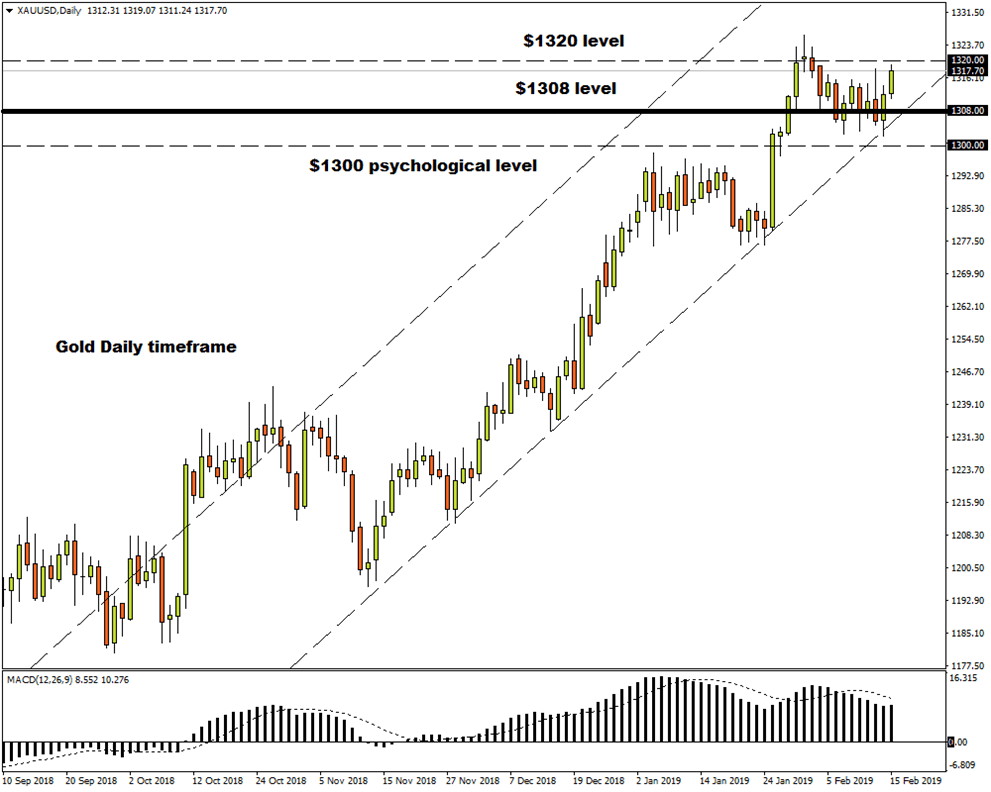
It has been an erratic week for Gold as the metal bounced within a $1,303 - $1,317 trading range.
There has been plenty of noise surrounding US-China trade talks this week with more noise from Washington over Trump’s push to declare a national emergency to get the funding for his border wall. Across the Atlantic, the House of Commons brought the UK closer to a no-deal Brexit by March 29, after rejecting Theresa May’s plans to renegotiate her deal. These concerns are clearly impacting global risk sentiment, with disappointing economic data from China, Germany, and the United States fuelling fears over plateauing global growth.
It is worth noting how US growth momentum may also be waning, after December’s retail sales thoroughly disappointed market expectations. It appears that the strong jobs data isn’t translating into stronger spending by US consumers, which may be seen as justification for the Fed’s dovish stance.
All of the above-mentioned factors are expected to support Gold’s bullish trend in the short to medium term. Focusing on the technical picture, Gold maintains a healthy bullish trend on the daily charts with prices trading around $1,318 as of writing. The upside momentum is seen pushing Gold prices towards $1,320 in the near term. A weekly close above this level should open the gates towards $1,340 in the medium term.
Into US session: Euro weakest, talks on trade talks lift sentiments again
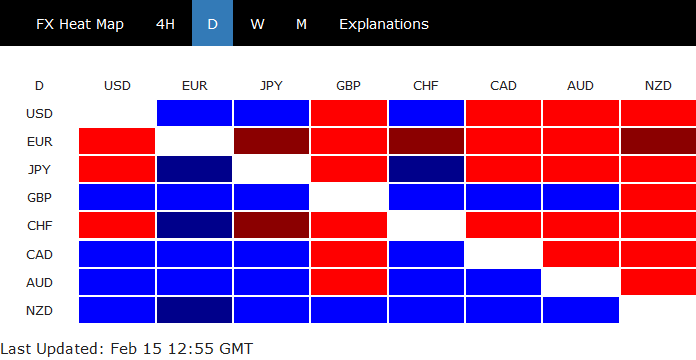
Entering into US session, Euro is trading as the lowest one for today, followed by Swiss Franc, in relatively mixed markets. New Zealand Dollar is the strongest one while Australian Dollar recovers much of yesterday's losses. But for now, pre-weekend recovery in Sterling put it into second place. But movements in the currency markets are relatively limited. Thus, the picture could have a drastic change at close.
US-China trade negotiations were the main focus of the day. Words from both sides were positive, but without much substance. China's Xinhua news agency said the delegations discussed topics including technology transfers, intellectual property protection, non-tariff barriers, services, agriculture and the trade balance. And both countries reached consensus is principle on a number of issues. They're working towards a memorandum of understanding on trade and economic issues.
White House spokesperson Sarah Sanders confirmed that trade talks with China will continue in Washington next week. She said "The United States looks forward to these further talks and hopes to see additional progress." And, "Both sides will continue working on all outstanding issues in advance of the March 1, 2019, deadline for an increase in the 10 percent tariff on certain imported Chinese goods."
US Trade Representative Robert Lighthizer said "we feel we have made headway on very, very important and difficult issues. We have additional work to do but we are hopeful," Treasury Secretary Steven Mnuchin tweeted "Productive meetings with China's Vice Premier Liu He and @USTradeRep Amb. Lighthizer", without any elaboration.
But the development so far seems to be enough to lift sentiments slightly. DOW futures in currently up 76 pts.
In Europe:
- FTSE is up 0.55%.
- DAX is up 1.39%.
- CAC Is up 1.44%.
- German 10-year yield is down -0.0032 at 0.104, holding on to 0.1 handle.
Earlier in Asia:
- Nikkei dropped -1.13%.
- Hong Kong HSI dropped -1.87%.
- China Shanghai SSE dropped -1.37%.
- Singapore Strait Times dropped -0.41%.
- Japan 10-year JGB yield dropped -0.0114 to -0.022, staying negative.