

Sample Category Title
Risk Appetite Boosted by Unknown Progress in US-China Trade Negotiation, More Talks Ahead
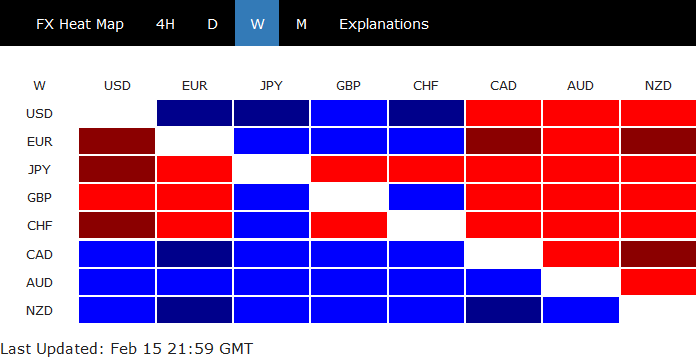
Trade talk optimism, trade pessimism, drove markets up and down last week. In the end, Presidents of US and China decided to give markets some lip service and boosted stocks towards weekly close. Words, rather than substance, are enough to make investors happy. Yen and Swiss Franc ended as the weakest ones on late rally in stocks. Sterling followed as the third weakest for the week, as Brexit impasse continued. But strong retail sales from UK did give the Pound a mild lift.
On the other hand, commodity currencies made a strong come back. New Zealand Dollar ended as strongest as RBNZ did nothing to endorse market views that next move is a cut. Australian Dollar followed as second with help from the impression that US and China will finally make a trade deal. But the Aussie is set to face a string of tests in RBA minutes, wage price and employment data this week. Canadian Dollar was pulled up to third place by rallying oil prices, with WTI crude oil ended above 56 handle.
US-China trade talks made unknown progress, to be continued in Washington
Specifics were virtually non-existent regarding the week-long US-China trade negotiations in Beijing. But markets nevertheless cheered positive words from both sides. Trump hailed that the talks was "going extremely well" and "we're a lot closer than we ever were in this country with having a real trade deal". He even offered that "it would be my honor to remove" the tariffs if they cane make the deal.
On the rumor of 60-day extension to the March 1 trade truce deadline, Trump said "there is a possibility that I will extend the date. But if I do that - if I see that we're close to a deal or the deal is going in the right direction - I would do that at the same tariffs that we're charging now, I would not increase the tariffs."
White House also issued a statement regrading the meetings in Beijing. It's noted that "These detailed and intensive discussions led to progress between the two parties... Both sides will continue working on all outstanding issues in advance of the March 1, 2019, deadline... United States and Chinese officials have agreed that any commitments will be stated in a Memoranda of Understanding between the two countries.".
According to a statement published by China Daily, "Both sides reached consensus in principle on major issues and had specific discussions about a memorandum of understanding on bilateral economic and trade issues... The two sides said they will step up their work within the time limit for consultations set by both heads of state, and strive for consensus."
Now, both team will meet again in Washington this week (starting Feb 18), at both ministerial and vice-ministerial levels. Focus will be on whether they could really deliver a certain MOU.
Fed might stand pat through 2019, or maybe just one hike
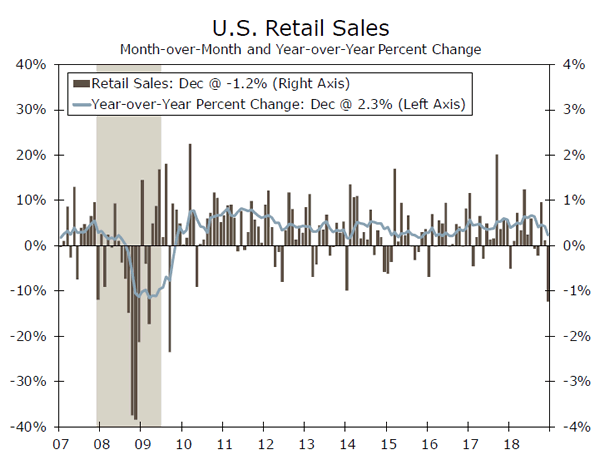
The shockingly poor US December retail sales, which released was delayed due to government shutdown, was more than enough to offset the positive impact from higher than expected January inflation reading. Headline sales dropped -1.2% mom while ex-auto sales decreased -1.8%. That was the worse contraction in nine years since 2009. The data prompted Atlanta Fed to slash its Q4 GDP estimate by -1.2% to just 1.5%, less than half of Q3's 3.4%. Later in the week, New York Fed also halved Q1's GDP forecast to 1.08%, from 2.17% just a week ago.
Fed officials generally played down the importance of just one month of data. But they're firmer than ever of their "patient" stance regarding monetary policy. San Francisco Fed President Mary Daly said "the case for a rate increase isn't there for 2019, if the economy evolves as I just said I expect it to, 2 percent growth, 1.9 percent inflation, no sense that (price pressures are) going up, no sense that we have any acceleration."
Fed Governor Lael Brainard warned that "downside risks have definitely increased relative to that modal outlook for continued solid growth." And, on monetary policy, she's "comfortable waiting and learning" and the current policy is "in a good place". And, she would weigh "what move, if any, later in the year". Atlanta Fed President Raphael Bostic though, said his' outlook for 2019 is "still above trend" at around 2.3 to 2.5% growth. Fed will still likely need to raise interest rates once this year.
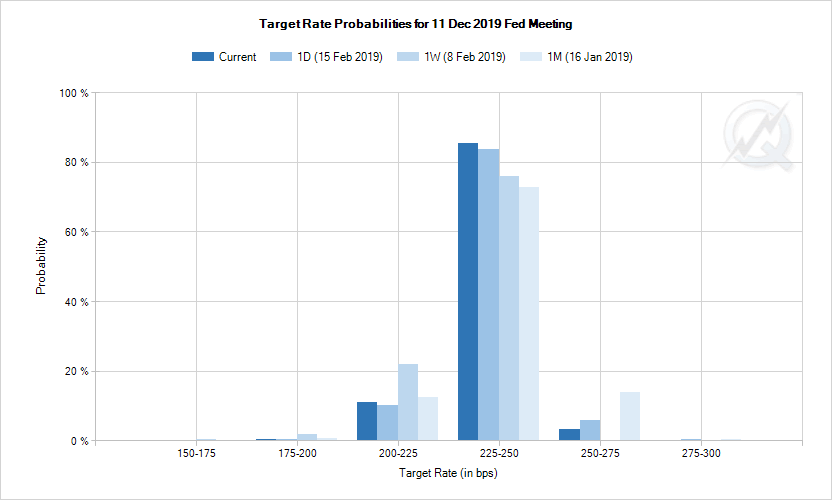
Fed fund futures are pricing in 85.3% chance of federal funds rate staying at current 2.25-2.5% after December FOMC meeting, up from 76.0% a week ago, and 72.7% a month ago.
DOW surged on trade optimism, now in key resistance zone
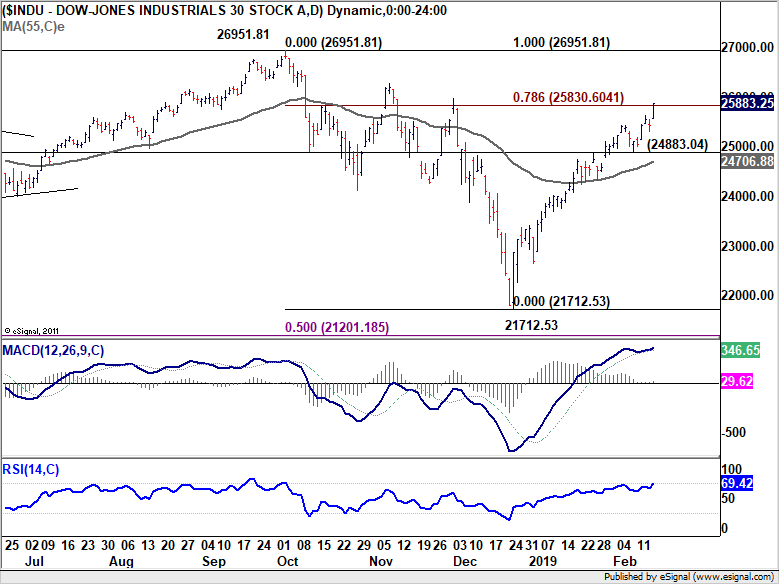
DOW reaccelerated on Friday to close strongly at 25883.25 last week, above 78.6% retracement of 26951.81 to 21712.53. at 25830.60. There is no clear loss of momentum as we expected yet. But our overall view is unchanged that rebound from 21712.53 is a leg in the medium- to long-term corrective pattern from 26951.81. That is, the long term up trend shouldn't be ready to resume yet.
Thus, we'd still expected overbought condition to limit upside inside 25830.60/26951.81 resistance zone to limit upside. Break of 24883.04 support should indicate completion of the rebound and near term reversal. However, S&P 500 and NASDAQ are kept rather well below equivalent 78.6% fibonacci level at 2813.72 and 7717.47 respectively. Thus as two catch up, there is a chance for DOW to be squeezed through 26951.81 high briefly.
Yield curve flattened further, 10- and 30-year yield at critical support
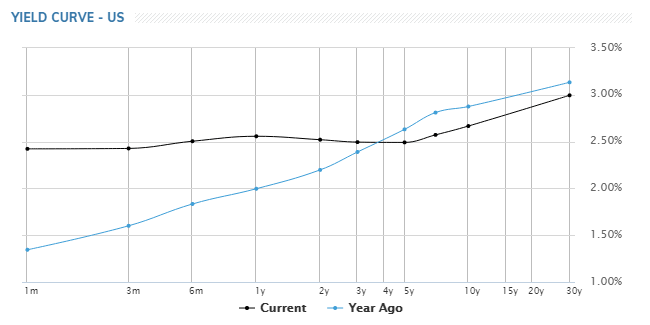
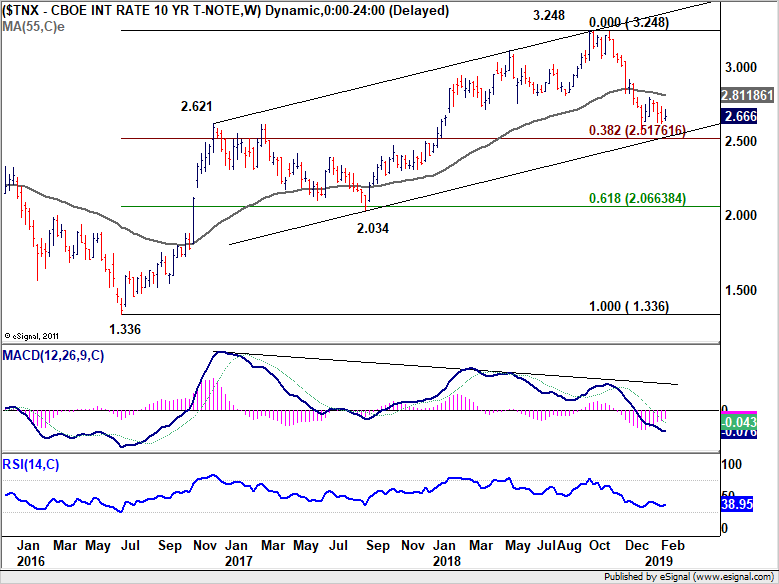
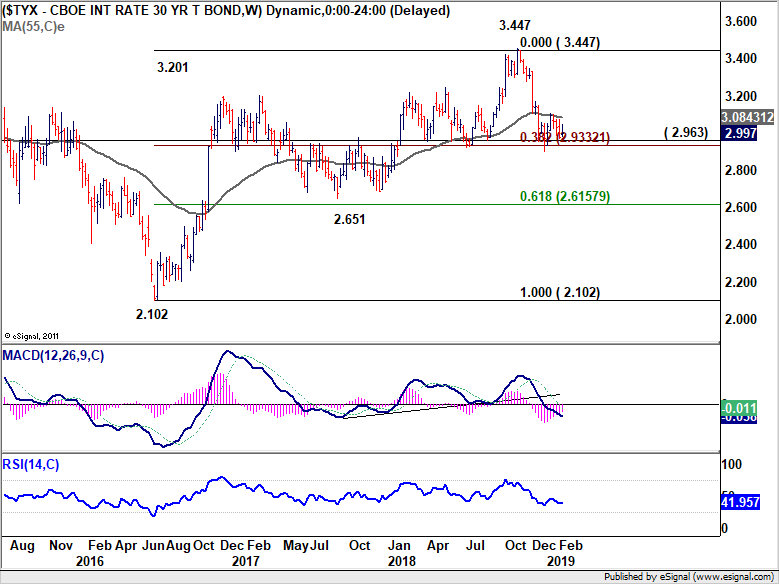
Meanwhile, market optimism was not quite reflected in treasury yields. 10-year yield lost 2.7 handle again to close at 2.666. 30-year yield also close below 3.0 handle at 2.997. Also, 5-year yield closed at 2.495, below 6-month yield at 2.504. Yield curve continued to flatten between 1-month (2.423) and 5-year, even though it's not seriously inverted.
Technically, we're still expect strong support at 38.2% retracement of 1.366 to 3.248 at 2.517 in 10-year yield to bring reversal.
30-year yield should also see strong support from 2.963, which is close to 38.2% retracement of 2.102 to 3.447 at 2.933, to bring sustainable rebound. But let's see.
Position trading
We entered AUD/JPY short at 78.40 last week as last updated here. The rebound to 79.24 was firstly stronger than expected. And sequent fall, which was contained at 78.09 as supported by risk appetite, was also quite disappointing.
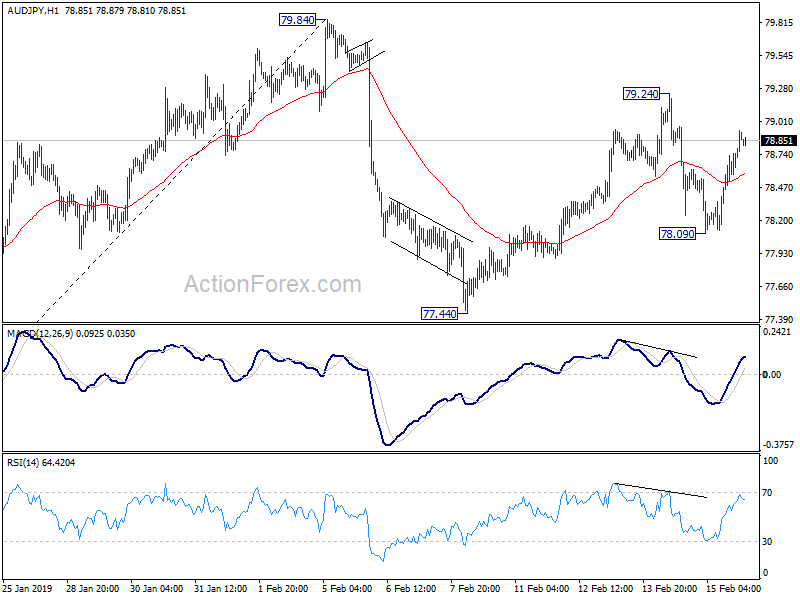
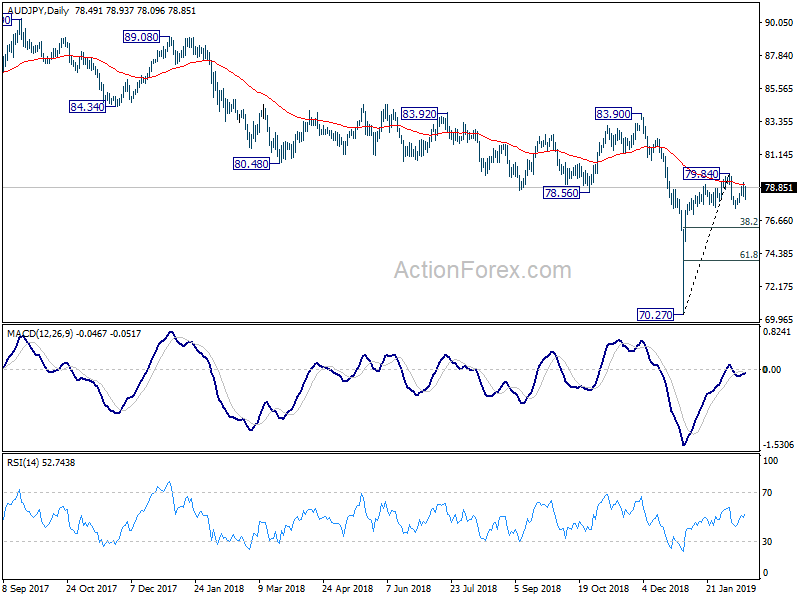
Nevertheless, AUD/JPY is, for now, kept by falling 55 day EMA, with daily MACD staying negative. We're not seeing clear strength in Aussie or weakness in Yen elsewhere. For example, AUD/USD is held below 55 day EMA at 0.7158. EUR/AUD is kept well above 1.5721 short term bottom. GBP/AUD is kept well above 1.7868 support. AUD/CAD is also kept below 55 day EMA at 0.9499. On the other hand, USD/JPY failed to sustain above key fibonacci level at 110.77. EUR/JPY and GBP/JPY are held well below 125.95 and 144.85 highs. CAD/JPY was also rejected by 83.98 resistance last week.
So, we'll hold short in AUD/JPY, with stop placed at 79.84, with target at 61.8% retracement of 70.27 to 79.84 at 73.92.
USD/CAD Weekly Outlook
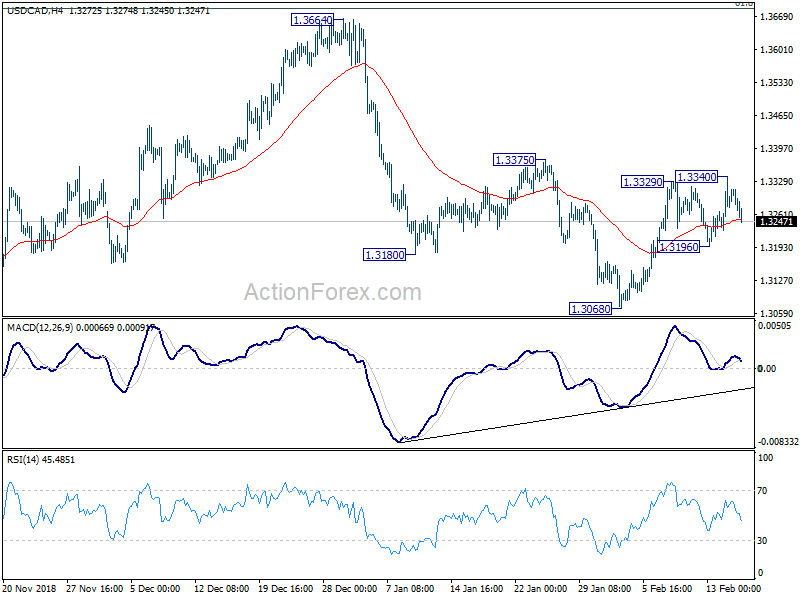
USD/CAD edged higher to 1.3340 last week but failed to break through 1.3375 resistance and retreated. Initial bias remains neutral this week first and some more consolidation could be seen. For now, further rise is in favor as long as 1.3196 minor support holds. We're favoring the case that decline from 1.3664 has completed with three waves down to 1.3068 already, on bullish convergence condition in 4 hour MACD, just ahead of medium term channel support. Decisive break of 1.3375 resistance will confirm this bullish case and target a test on 1.3664 high. However, break of 1.3196 will now dampen our view and turn bias back to the downside for 1.3068 support instead.
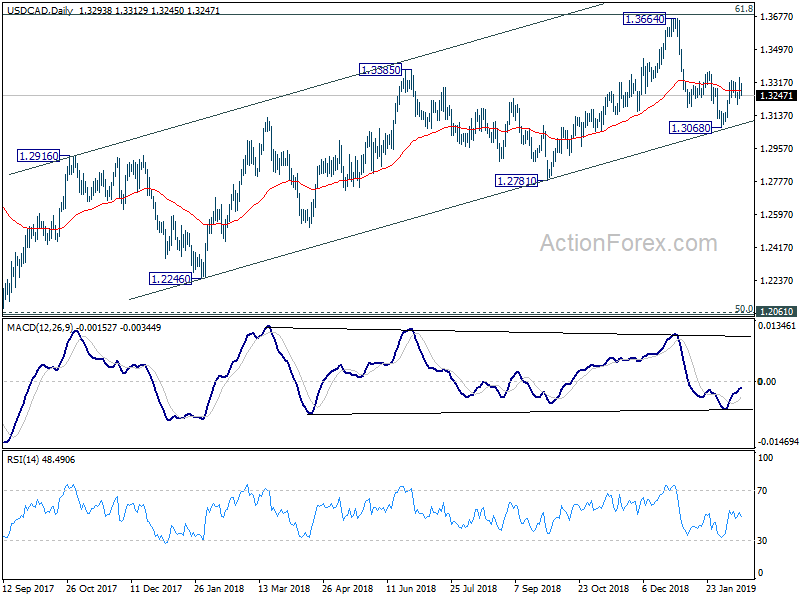
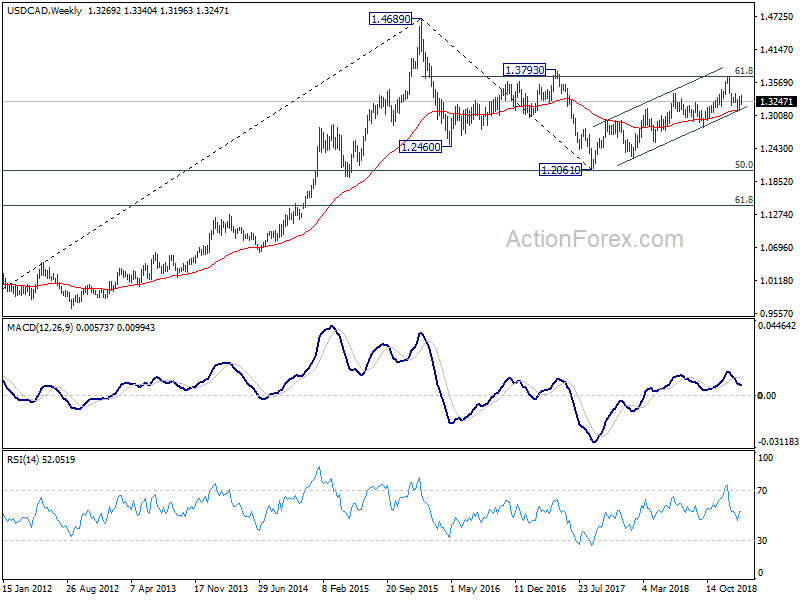
In the bigger picture, structure of the medium term rise from 1.2061 (2017 low) to 1.3664 is not clearly impulsive. Hence, we'd stay cautious on strong resistance from 61.8% retracement of 1.4689 (2016 high) to 1.2061 at 1.3685 and 1.3793 resistance to limit upside, and bring medium term topping. But in any case, medium term outlook will stay bullish as long as channel support (now at 1.3095) holds. Sustained break of 1.3793 will pave the way to retest 1.4689 (2015 high). Firm break of the channel support should confirm reversal target 1.2061 low again.
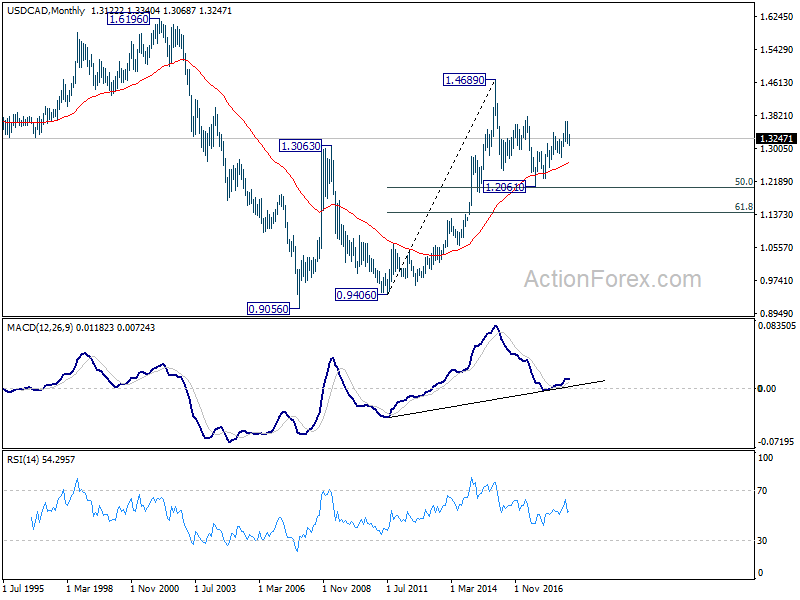
In the longer term picture, corrective fall from 1.4689 (2015 high) should have completed with three waves down to 1.2061, just ahead of 50% retracement of 0.9406 (2011 low) to 1.4689 (2015 high) at 1.2048. The development keeps long term up trend from 0.9406 and that from 0.9056 (2007 low) intact. For now, there is still prospect of extending the long term up trend through 1.4689.
Statement from US and China regarding trade negotiations
Here is the statement of the US.
Statement by the Press Secretary Regarding China Talks
This week, at the direction of President Donald J. Trump, officials from the United States traveled to Beijing to continue negotiations on the trade relationship between the United States and China. On the United States side, the talks were led by Ambassador Robert E. Lighthizer, the United States Trade Representative, and the Honorable Steven T. Mnuchin, the Secretary of the Treasury. On the Chinese side, the talks were led by Vice Premier Liu He. On Friday, both delegations had the opportunity to meet with President Xi Jinping regarding their discussions. The talks also featured extensive technical exchanges between the professional staffs of both countries.
These detailed and intensive discussions led to progress between the two parties. Much work remains, however. Both sides will continue working on all outstanding issues in advance of the March 1, 2019, deadline for an increase in the 10 percent tariff on certain imported Chinese goods. United States and Chinese officials have agreed that any commitments will be stated in a Memoranda of Understanding between the two countries.
During the talks, the United States delegation focused on structural issues, including forced technology transfer, intellectual property rights, cyber theft, agriculture, services, non-tariff barriers, and currency. The two sides also discussed China's purchases of United States goods and services intended to reduce the United States' large and persistent bilateral trade deficit with China.
Next week, discussions will continue in Washington at the ministerial and vice-ministerial levels. The United States looks forward to these further talks and hopes to see additional progress.
Here is the statement from China.
China, US conclude new round of high-level economic, trade consultations
China and the United States held the sixth round of high-level economic and trade consultations in Beijing from Thursday to Friday.
Present at the talks were Chinese Vice Premier Liu He, also a member of the Political Bureau of the Communist Party of China Central Committee and chief of the Chinese side of the China-US comprehensive economic dialogue, US Trade Representative Robert Lighthizer, and Treasury Secretary Steven Mnuchin.
The two sides earnestly implemented the consensus reached by the two heads of state during their Argentina meeting late last year, and had in-depth communication on topics of mutual concern including technological transfer, intellectual property rights protection, non-tariff barriers, the service industry, agriculture, trade balance and implementation mechanism; as well as on issues of China's concern.
Both sides reached consensus in principle on major issues and had specific discussions about a memorandum of understanding on bilateral economic and trade issues.
The two sides said they will step up their work within the time limit for consultations set by both heads of state, and strive for consensus.
They agreed that consultations will be continued in Washington next week.
Summary 2/18 – 2/22
Monday, Feb 18, 2019
[php_everywhere instance="1"]
Tuesday, Feb 19, 2019
[php_everywhere instance="2"]
Wednesday, Feb 20, 2019
[php_everywhere instance="3"]
Thursday, Feb 21, 2019
[php_everywhere instance="4"]
Friday, Feb 22, 2019
[php_everywhere instance="5"]
Weekly Economic and Financial Commentary: More Subdued Data from the Global Economy
U.S. Review
Retail Sales Go Rogue
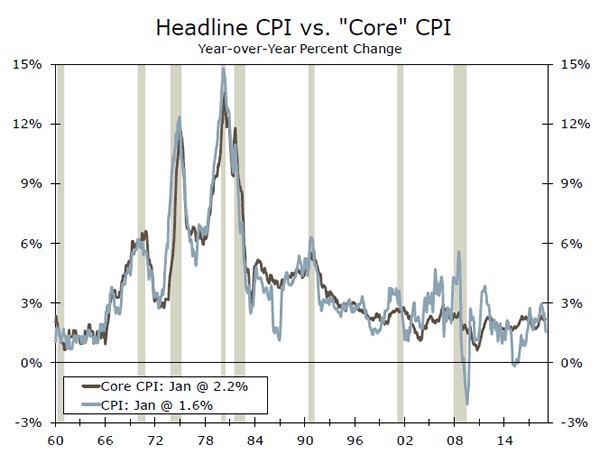
- Energy prices weighed on both headline CPI and PPI. The January CPI was unchanged, while PPI fell 0.1%. Core measures were more firm, rising 0.3% and 0.2%, respectively.
- Retail sales unexpectedly plunged 1.2% during December. Control group sales, which factor into GDP, also sharply declined 1.7%.
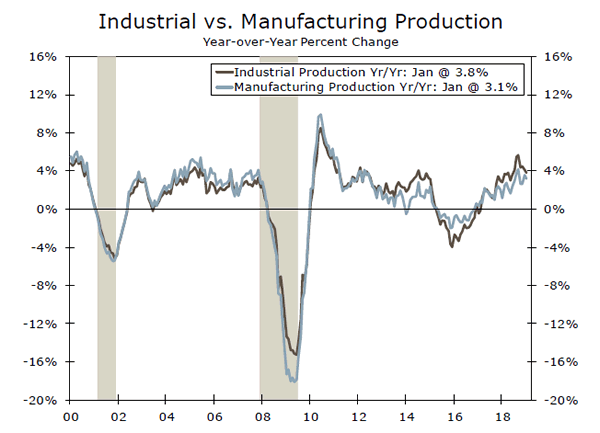
- Industrial production fell 0.6% in January, with the weakness being traced to the manufacturing sector.
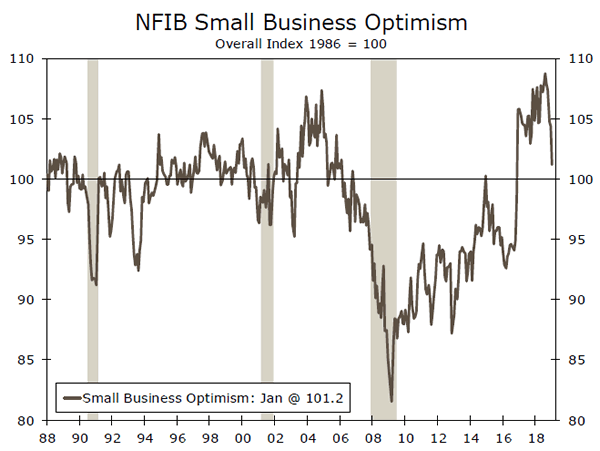
- The NFIB Small Business Optimism Index dropped 3.2 points in January amid uncertainty from the government shutdown.
Retail Sales Go Rogue
Another government shutdown appears to have been averted this week, which is good news as we are still catching up on the economic data postponed as a result of the December-January shutdown. Front-and-center was December's retail sales report, which unexpectedly dropped 1.2%. Control group retail sales, which factor into GDP, also fell 1.7%, the sharpest decline since 2000. We view this report with a degree of skepticism, however consumer spending appears to have lost some momentum headed into 2019. Please see our Topic of the Week on Page 7 for additional detail on holiday sales.
Meanwhile, price pressures continue to be modest and in-line with the inflation goals laid out by the Fed. The headline consumer price index (CPI) was left unchanged in January, as lower overall energy prices weighed on the topline index. However, the less-volatile core measure rose 0.2% for the fifth consecutive month. Overall, core inflation continues to trend higher, yet remains contained with few signs of any sizable moves in either direction. Core inflation is up 2.7% annualized over the past three months, and has risen 2.2% over the past year.
A similar story played out for input prices. Lower energy prices led to a 0.1% dip in the producer price index (PPI). Core producer prices, which exclude energy and food, increased 0.3%. With inflation largely contained, the FOMC will likely feel less pressure to lift rates at its upcoming March meeting.
Industrial production (IP) also disappointed, falling 0.6% in January which was weaker than expected. The weakness can be tied to the 0.9% drop in manufacturing production, as both mining and utilities production experienced gains. In a separately released report, we learned that the NY Fed's Empire Manufacturing Index rose to 8.8%, offering some hope for a near-term rebound in IP.
Small business optimism appears to have been adversely impacted by the shutdown. The NFIB index slipped 3.2 points to 101.2 in January, the lowest level since 2016. Financial market weakness towards the end of 2018 likely played a role, but uncertainty arising from the 35 day-long government closure clearly weighed on sentiment. The monthly decline also mirrors the steep drop in the Wells Fargo Small Business Survey to start the year. While optimism has faded somewhat, the index remains high relative to historical averages. More firms are reporting difficulty finding labor, which continues to signal a tight labor market. By contrast, firms have become somewhat less upbeat about the future and have expressed more guarded optimism surrounding the prospects for 2019.
Further evidence of a resilient labor market was also evident in the job openings data released this week. According to the JOLTS survey, there were over 7.3 million job openings in December, a record high. Furthermore, the number of job openings exceeded the number of jobless for the third straight month. Initial jobless claims have also mostly recovered from the uptick seen postshutdown. Claims for the week ending February 9 rose slightly to 239,000, but remain at an exceptionally low level.
U.S. Outlook
Durable Goods • Thursday
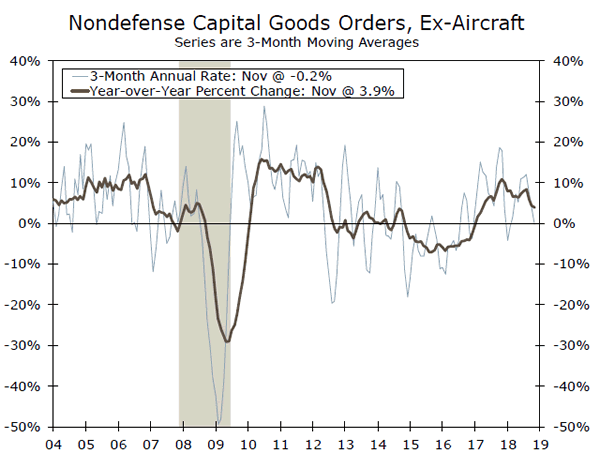
With funding for the Census Bureau restored, on Thursday we will get an overdue look at December durable goods data, originally scheduled for release on January 16. Nondefense capital goods orders, ex-aircraft, have been trending lower recently, and have fallen on a sequential basis three of the last four months.
The slowdown in business fixed investment spending suggested by the hard data is corroborated by forward-looking surveys of business capital spending intentions. The ISM new orders component plunged 10.5 points in December, the largest decline since January 2014, before rebounding in January. Similarly, the proportion of small businesses indicating plans to increase capital spending in December fell almost five points. The durables data for December will likely provide some perspective on the factory sector amid a moderation in business investment growth.
Previous: 0.7% Wells Fargo: 3.5% Consensus: 1.7% (Month-over-Month)
Leading Index (LEI) • Thursday
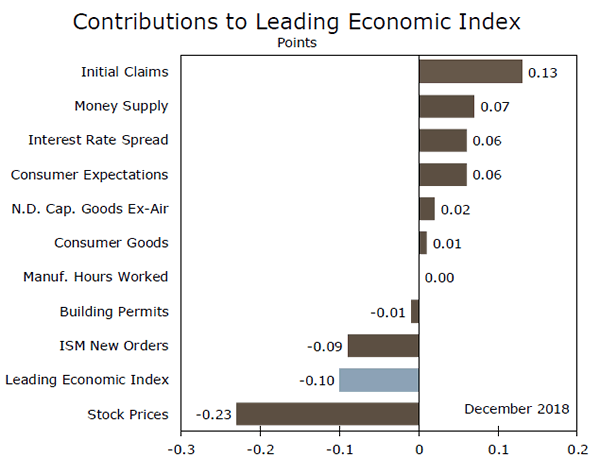
The Leading Economic Index reading for December was noteworthy for two reasons. For one, the government shutdown forced the Conference Board to estimate data on durable goods orders and building permits. Even with the Census Bureau back up and running, we are still flying blind with respect to new residential construction. Moreover, durable goods data for December will be published merely 90 minutes before the LEI on Thursday, suggesting that the index may again incorporate estimated values for these subcomponents.
Secondly, the 9% decline in the S&P 500 shaved 0.23 points off the headline, the largest drag from equity markets since January 2016. A decidedly more dovish Fed and recovery in investor sentiment have catalyzed a near complete retracement, with the S&P bouncing back 8% in January. Although the economic data haze from the shutdown has yet to fully clear, the easing of financial conditions should push the LEI back into positive territory in January.
Previous: -0.1% Wells Fargo: 0.1% Consensus: 0.2% (Month-over-Month)
Existing Home Sales • Thursday
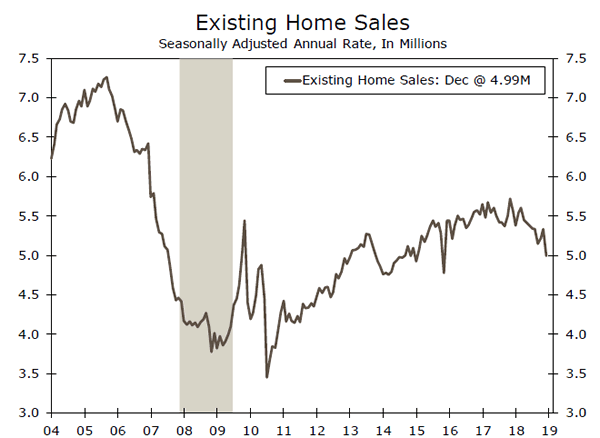
Lower mortgage rates at the end of last year have yet to offer much of a reprieve for the housing market. Existing home sales dropped 6.4% in December, marking the fourth drop in the past six months and leaving sales down more than 10% on a year-ago basis. Adding to this picture of the slowdown, national price appreciation has cooled markedly to around a 5% pace and homes are now staying on the market for much longer.
Mortgage applications popped to start the year, with double digit increases the first two weeks of January raising hopes of a breakthrough in pent-up demand as a result of a rapid 50 bps decline in mortgage rates. This jump was followed, however, by four consecutive declines. Pending home sales, which tend to lead closings by two-to-three months, have similarly been down for five of the last six months. We expect a modest stabilization in sales in January.
Previous: 4.99M Wells Fargo: 5.05M Consensus: 5.00M
Global Review
More Subdued Data from the Global Economy
- U.K. GDP growth slowed more than expected toward the end of last year as business investment declined for the fourth-straight quarter, likely at least partly a symptom of Brexit uncertainty. Still, consumer activity has held up against a backdrop of stronger real wage growth.
- Eurozone industrial output figures pointed to a further slowing in activity in the currency bloc, while we also learned that Germany's economy stagnated in Q4. Japanese GDP data showed a rebound in Q4 after a string of natural disasters in the prior quarter, although that rebound was not quite as strong as expected.
U.K. Economy Weakens Amid Brexit Concerns
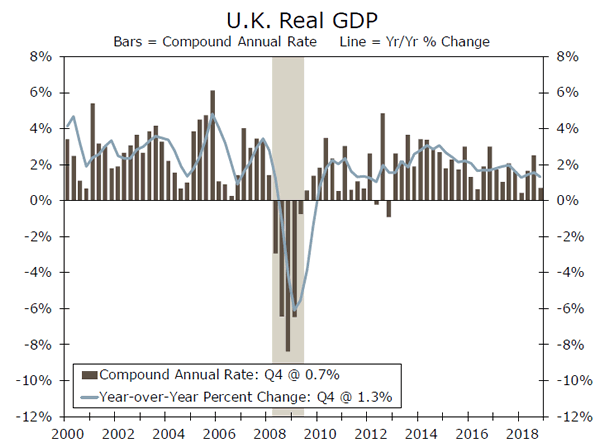
The past week kicked off with the release of U.K. GDP figures, which showed the economy grew just 0.2% (not annualized) on a sequential basis in Q4-2018, while the year-over-year growth pace slowed to just 1.3%. The result was weaker than expected, and a closer look at the data suggests Brexit uncertainty may have contributed at least partly to the weakness during the quarter. Indeed, much of the weakness showed up in business investment, which fell 1.4% (not annualized) during the quarter, marking the fourth-straight quarterly decline. March 29, the deadline for a Brexit deal to be reached, is fast approaching and with no signs of a clear path forward from the U.K. government, businesses have had to operate in an increasingly uncertain environment. A series of votes in U.K. Parliament this week did little to reduce that uncertainty, with the next round of votes scheduled for February 27.
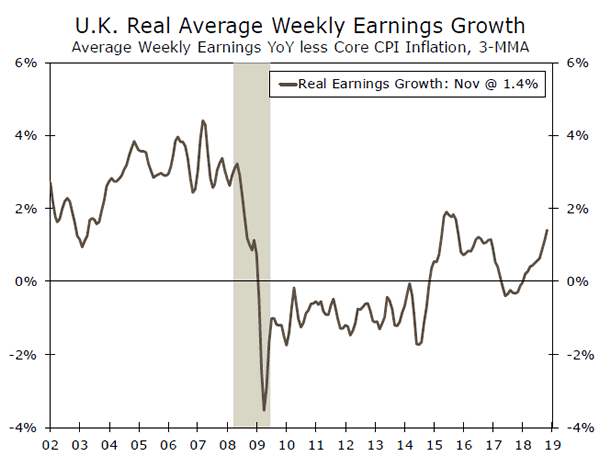
Meanwhile, consumer activity has generally held up better, as reflected in the healthy 0.4% (not annualized) increase in private consumption in Q4. Despite Brexit concerns, U.K. consumers have been helped by a steady climb in nominal wage growth while inflation has continued to slow, implying stronger real earnings growth (top chart). The latest figures released this week showed U.K. CPI inflation eased to 1.8%, the slowest since early 2017 and well below the 3%+ rates of wage growth seen in recent months. Still, while consumer fundamentals are strong, business investment—as well as overall growth—should remain subdued until there is a clearer resolution of Brexit uncertainty.
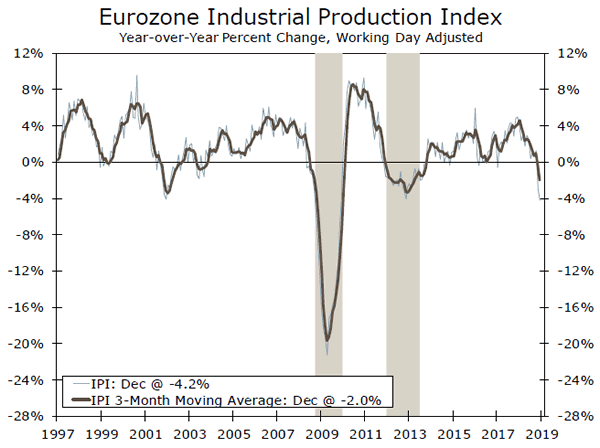
Elsewhere in Europe, more disappointing data were released in the Eurozone. Germany's economy stagnated in Q4 after GDP declined in the prior quarter, while industrial output in the broader Eurozone fell 0.9% in December. On a year-over-year basis, industrial output declined 4.2%, the sharpest decline since the European debt crisis (middle chart). A closer look at activity in the industrial sector suggests that the weakness is more internally driven rather than a result of softer external demand. Indeed, industrial orders from non-Eurozone economies have remained fairly resilient, while orders from within the Eurozone have fallen sharply over the past year or so. It is still hard to square internal weakness in the Eurozone economy with highly accommodative monetary policy, generally neutral fiscal policy and strong real consumer income growth. Accordingly, we remain of the view that the currency bloc will see a near-term rebound in activity.
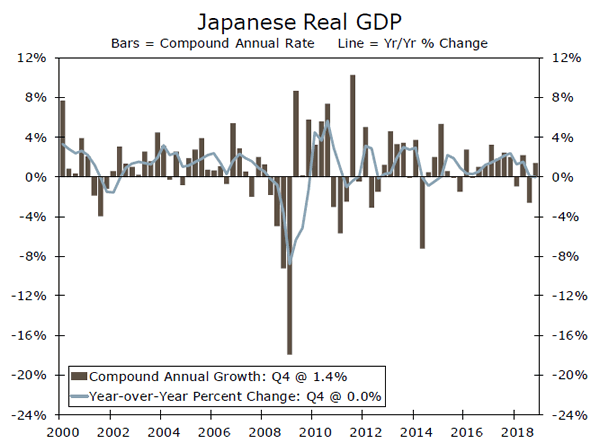
Japanese GDP figures were also fairly subdued (bottom chart). Real GDP in Japan rose 0.3% quarter-over-quarter (not annualized) in Q4, less than expected, after a sharp drop in activity in the prior quarter amid a string of natural disasters. The rebound was more pronounced in investment, as business spending climbed 2.4% over the quarter, although private consumption rebounded 0.6% during the quarter (both not annualized). Looking ahead, the pace of Japanese growth will be especially important to monitor ahead of a planned consumption tax hike in October. Growth will likely have to remain fairly robust ahead of any actual tax hike given the likelihood that a temporary drop in activity will follow.
Global Outlook
U.K. Employment & Wages • Tuesday
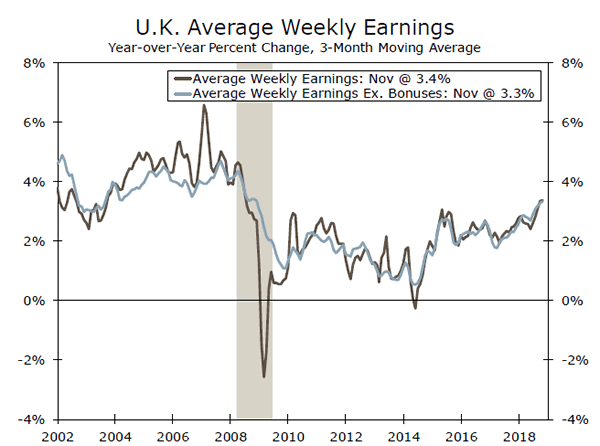
Amidst all the focus on Brexit, it has been easy to lose sight of actual data and macro developments in the U.K. economy. One trend of note has been the consistent acceleration in wages, which are now growing at their fastest pace of the current cycle. With productivity growth in the United Kingdom still subdued, the pickup in wages may become inflationary if businesses feel comfortable raising prices, while it could instead eat into corporate profits if consumer prices remain steadier.
The Bank of England (BoE) has taken note of this, and were Brexit uncertainty not hanging over the U.K. economy, it would probably have raised rates one or two more times in recent months. If Brexit is resolved by the end of March and if wage growth remains firm, we think the BoE could raise rates one or two times this year to head off inflation pressures.
Previous: 3.4% Consensus: 3.5% (Year-over-Year, 3-Month Moving Avg.)
Eurozone PMIs • Thursday
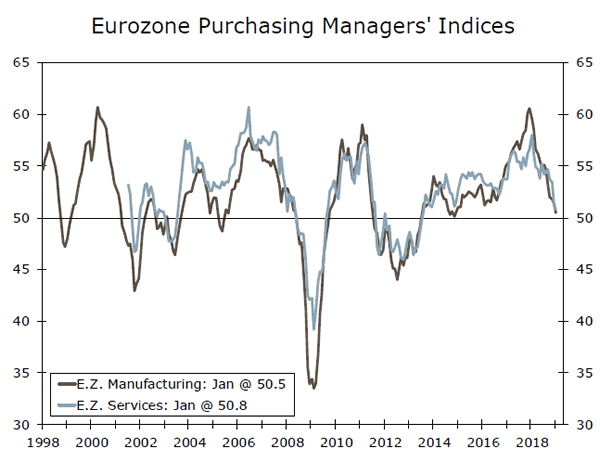
There is more attention than usual on developments in the Eurozone economy, with persistent weakness in activity and sentiment figures leading to concerns the currency bloc is heading toward recession. The purchasing managers' indices (PMIs) for the manufacturing and services sectors have been steadily falling since last year, and are currently hovering just slightly above the 50-line demarcating expansion and contraction.
The mild upward revisions to last month's PMI figures were a rare bright spot, but if these indices remain close to or below 50 on a consistent basis and activity data fail to show signs of a solid rebound, we would become more concerned about a potential Eurozone recession. Until then, however, we remain of the view that the economy will bounce back and grow close to potential in 2019.
Previous: Manufacturing 50.5; Services 51.2 Consensus: Manufacturing 50.3; Services 51.5
Canada Retail Sales • Friday
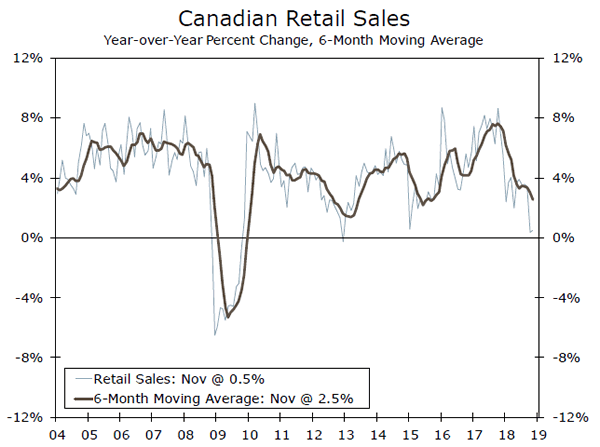
A wide range of indicators have pointed to softening economic growth in Canada in recent months, and retail sales has been no exception. On a year-over-year basis, retail sales rose just 0.5%, the slowest growth pace since 2012, while even through the monthly volatility the trend is clearly slower. Weakness in the country's housing market could be one culprit for the slowdown in consumer activity—new home prices in Canada were stagnant on a year-overyear basis in November for the first time since the global recession.
However, the Bank of Canada (BoC) has also noted slow growth in oil-producing provinces amid lower oil prices as another possible source of the weakness in consumer activity. In all, the BoC will likely remain cautious in the weeks and months ahead until there are clearer signs of stabilization in economic activity. However, we still expect the central bank to hike rates two times this year as uncertainty dissipates and growth and activity turn around.
Previous: -0.9% Consensus: -0.0% (Month-over-Month)
Point of View
Interest Rate Watch
Rogue Wave?
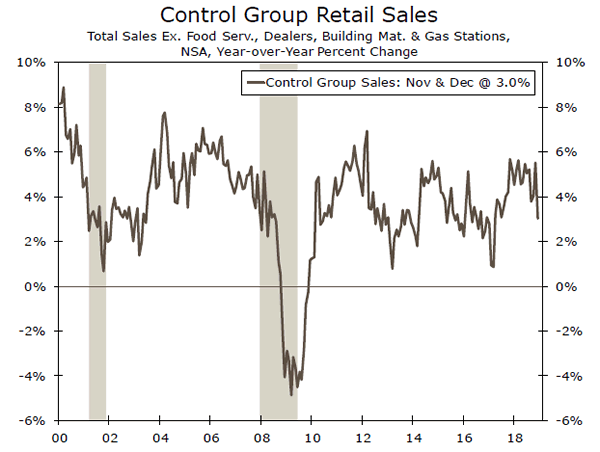
December's freakishly weak retail sales report raises questions about how much economic growth slowed late last year. The advance estimate shows sales plunging 1.2% in December and control group sales, which exclude sales at auto dealers, gasoline stations and building materials stores, fell 1.7%. Declines were remarkably broad based, with only two of the 13 major categories posting increases. Sales for November were also revised slightly lower.
The drop in control group sales was the largest since September 2001, when shellshocked consumers stayed away from the malls. The stock market sell-off, which hit a crescendo on Christmas Eve, may have dampened consumers' spirit somewhat. But the drop in December retail sales seems way out of proportion to what we have seen in various measures of consumer confidence or reports from individual retailers.
We suspect the retail sales data are suffering from Seasonal Adjustment Disorder (SAD). Thanksgiving came exceptionally early this year so all Black Friday and Cyber Monday sales were captured in November. This may explain why sales at non-store retailers, which capture most online purchases, fell more in December (-3.9%) than department stores (-3.3%). Did Amazon really have a worse Christmas than Sears?
While seasonal adjustment may have exaggerated December's slide in retail sales, we have found that even seemingly rogue economic numbers often contain important signals. Anecdotal reports confirm retail sales slowed in early December. Part of that slowing reflects sales being pulled forward into November but part was genuine. On a non-seasonally adjusted basis, control group sales for the past two months are up just 3.0% from their year-ago level.
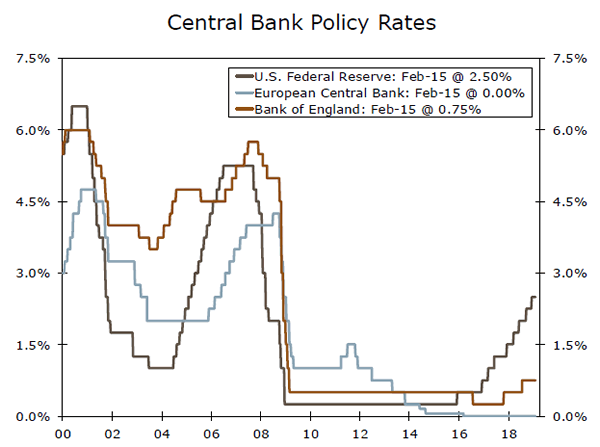
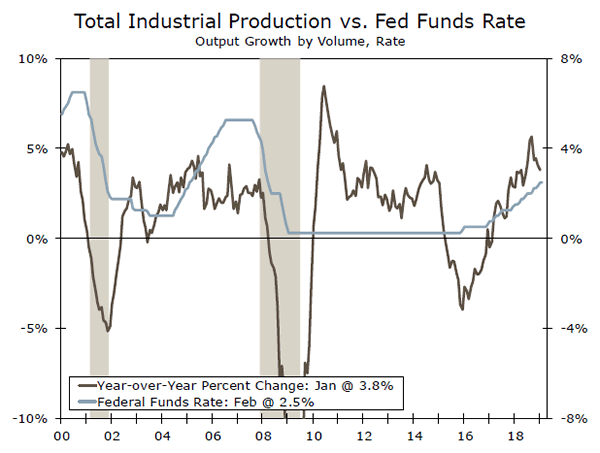
The genuine slowing hinted by December's weak retail sales was evident in January industrial production, which fell 0.6%. The first quarter is off to a sluggish start. Jay Powell's shift toward a more patient and data driven policy now appears prescient. While we still see the Fed hiking rates in September, the debate appears to be shifting from when the Fed makes its next move to what that move will actually be.
Credit Market Insights
Foreign Investors Dropping U.S. Debt
Since the financial crisis in 2008, the share of U.S. Treasuries held by foreign investors has fallen 16 percentage points. The largest foreign holder of treasury securities, China, has reduced its holdings to $1.1 trillion in November 2018 from $1.2 trillion a yearearlier. Total outstanding U.S. Treasuries recently surpassed $22 trillion, with only $6.2 trillion held by foreign investors. China's demand for U.S. Treasuries has decreased due to declining dollar reserves and increased costs of holding dollar assets. The second largest holder, Japan, owns $1.04 trillion, down from its $1.08 trillion holdings in November 2017. Like China, Japan has been reducing its holdings because of the rise in U.S. dollar hedging costs.
Meanwhile, the Federal Reserve has been gradually reducing its holdings of U.S. Treasuries on its balance sheet. Therefore, private investors now have to absorb more of the supply. This has led to concerns about the mounting debt and the ability to finance it. The most recent projections of the Congressional Budget Office suggest that deficits will exceed $1 trillion each year starting in 2022. Because of this, federal debt, as a percent of GDP held by the public is expected to reach the highest level since just after World War II. These projections could be more problematic if interest rates rise. However, domestic investors are expected to continue purchasing the government's debt.
Topic of the Week
2018 Holiday Sales
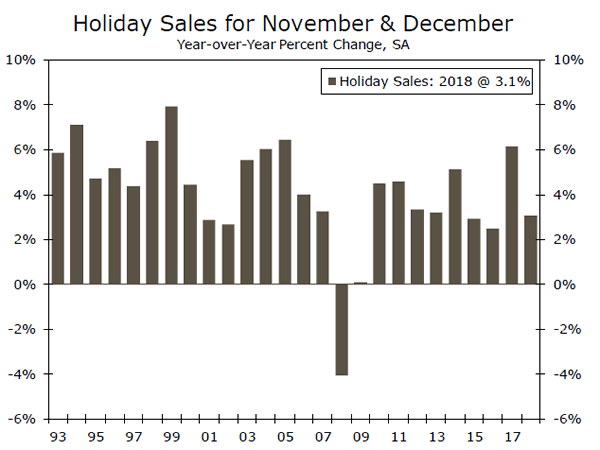
The plunge in December retail sales meant that 2018 holiday spending was up only 3.1%. We say "only", because we were expecting a 4.5% gain over 2017, which at 6.2% was the strongest holiday sales season in more than ten years. Difficult year-over-year comparisons, shaken confidence and the timing of the holiday season contributed to the softer-than-expected print last year.
Holiday sales are defined as sales at retailers (excluding gas stations, car dealers and bars & restaurants) which take place in the months of November and December. We had released our expectation for a 4.5% gain back in mid-October, when consumer confidence was at-or-near a cycle high (depending on the measure utilized) and the stock market was soaring to all-time record highs.
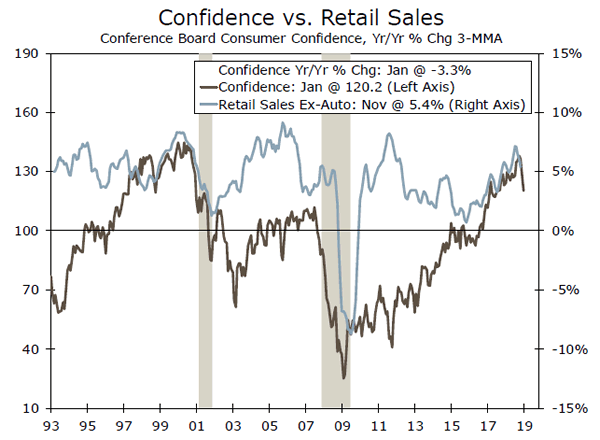
In the months since, confidence has pulled-back, as the year came to a close with wobbly equity markets, a partial government shutdown that stretched into the longest on record and unresolved trade tensions. The shaken confidence appears to have weighed on consumer spending in December more than we anticipated, but also more than leading indicators had suggested. The Redbook index, a high-frequency proxy for retail sales, was up close to 8% in December, the largest year-overyear gain on records that date back to the mid-1990's.
There is also a case to be made that the early timing of Thanksgiving dragged holiday shopping into November. Holiday sales were up 0.8% in November, before declining 1.6% in December. An earlier-Thanksgiving, however, also meant there were four full weekends for shopping in December before the Christmas holiday.
We do not include October in our holiday sales calculation, but sales for holiday outlays in the month were up 0.4%. Being the strongest monthly gain in October since 2014, this could suggest consumers had shifted some of their holiday shopping forward.
With the weaker-than-expected sales print in December, we have cut back our expectations for real personal consumption expenditures in Q4 to 2.4% from 3.6% previously. Weakness likely also found its way into the first quarter, but we do not expect it to be sustained.
USDCHF Backs Off Higher Prices On Loss Of Momentum
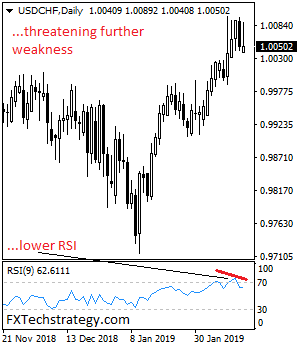
USDCHF backs off higher prices on loss of upside momentum on Friday. This development leaves risk of more weakness on the cards. Resistance comes in at the 1.0100 level. A break of here will clear the way for more gain towards the 1.0150 level. Above here, resistance lies at the 1.0200 level and then the 1.0250 level. On the downside, support is seen at the 1.0000 level. A turn below there will set the stage for more decline towards the 0.9950 level. And then the 0.9900 level. Its daily RSI is bearish and pointing lower suggesting further weakness. All in all, USDCHF faces further downside pressure on price pullback.
The Weekly Bottom Line: Wall of Uncertainty
U.S. Highlights
- December retail sales came in significantly weaker than expected, falling 1.2% m/m, with the decline being broad-based. Consumption in Q4 is now tracking around 2.6% annualized - softer than expected, but still a pretty good showing.
- The retail sales report provides a weak handoff to 2019. The fact that the government shutdown extended into January and consumer confidence retreated on the month, further reinforces the notion for a soft print in first-quarter spending and GDP.
- Core inflation remained at 2.2% (y/y) in January, where it has sat for five of the past six months. And there is little indication that it will move in either direction soon. This should provide comfort for the Fed to remain patient.
Canadian Highlights
- This was a quiet week in financial markets, with the S&P/TSX moving up 1% and the CAD almost unchanged. Oil benchmarks advanced on reassuring signs of OPEC+'s curtailment discipline.
- The week was also light on data, but a poor manufacturing sales showing served to further reinforce the moderating growth narrative and slightly impacted our Q4 GDP tracking.
- Housing data delivered a pleasant surprise, advancing 3.6% on the month. Average homes prices, however, continued to decelerate.
U.S. - Wall of Uncertainty
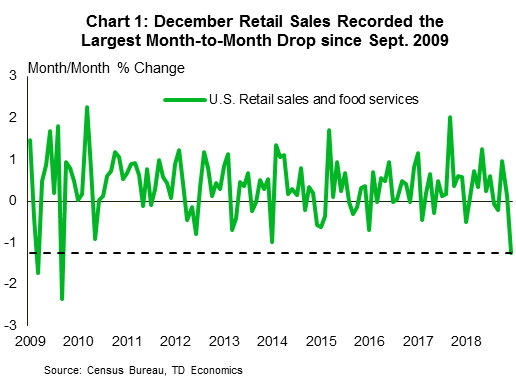
They say good things come to those who wait. But judging from developments this week, we'll have to wait a bit longer. The delayed December retail sales report finally came out this week, but the results were deeply disappointing. While consensus had set a low bar for a nearly-flat print, sales fell a whopping 1.2% m/m - the worst decline since September 2009 (Chart 1). Moreover, the pullback was broad-based. Apart from gains at autos and building materials stores, everything else was in the red. Sales in the 'control group', which strips out volatile categories and is then used in the calculation of GDP, fared even worse (-1.7%).
The weak report raised a few eyebrows, with its reliability in question among economics circles. December's result is hard to square with other industry reports, such the Redbook index, which shows same-store sales accelerating in year-over-year terms in December. The fact that non-store sales (-3.9%) weren't spared from the pullback also raises some suspicion. This category is largely made up of online sales, where there were no other major signs of stress during holiday season. Still, giving the Commerce Department the benefit of the doubt here, it would appear that the threat and subsequent materialization of the late-year government shutdown, together with a sharp selloff in equity markets amidst elevated trade tensions with China, prompted Americans to keep a tight grip on their wallets.
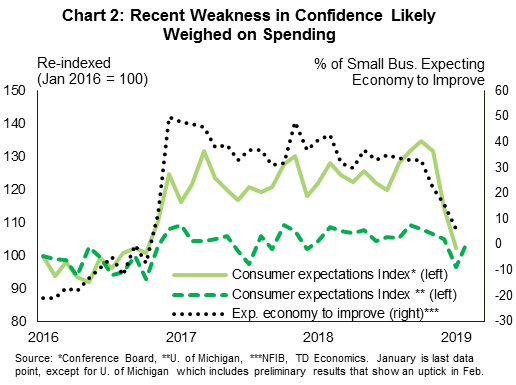
Consumer spending in the fourth quarter is now tracking around 2.6% ann. - softer than we previously expected, but still a pretty good showing. The December weakness also provides a weak handoff to the start of 2019. The fact that the government shutdown dragged on until late-January and consumer confidence deteriorated on the month (Chart 2), further reinforces the notion of softer spending, with consumption expected to advance at just below 1.5% (ann.). A pullback in small business confidence and industrial production in January provide further credence to the view for a soft quarter overall.
Similar to last year, however, we don't expect the first-quarter performance to set the pace for the rest of the year, so long as a resilient labor market shores up spending. Consumption is expected to rebound in the second quarter, provided that there is no major disruption on the trade front or another government shutdown. Progress appeared to have been made on both of these areas this week. Reports indicate that Chinese and U.S. negotiators made headway in agreeing on broad principles, with negotiations to continue next week in Washington. It appears that President Trump will get his border wall funding by declaring a national emergency, and is also expected to sign a bipartisan spending bill that will avoid a second shutdown.
This week's developments reinforce the notion that the Fed will stay put until muddy waters begin to clear. The other part of the Fed's calculus, inflation trends, provide added comfort for patience. Core CPI has been holding at just above the Fed's target recently (2.2% y/y), with little indication that it will shift in either direction. For now, it's all about keeping the faith and playing the waiting game.
Canada - A Snooze Button Week
This week was nothing to write home about on the Canadian data and financial markets fronts. The S&P/TSX composite edged up around 1.4% on the week. Oil markets fared better, with the WTI benchmark moving more than 5% and Brent an even more impressive 6%. The absence of a U.S-China deal was countered by reassurances of Russian cuts and intentions by Saudi Arabia to curtail output further in the upcoming months. OPEC has already demonstrated commitment to its output curtailment plan; January output for the group fell more than 1 million barrels per day below its November peak. The Canadian dollar, however, didn't follow suit, remaining almost flat against its U.S. counterpart.
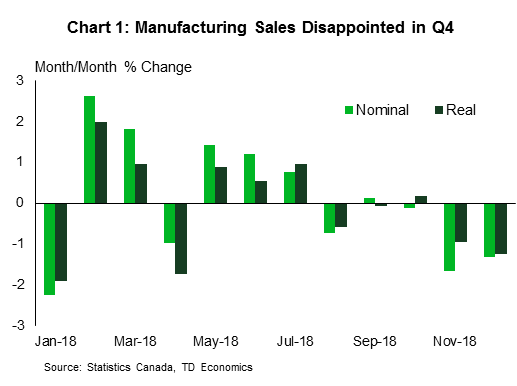
It was also quiet on the economic data front. Still, and at the risk of sounding like a broken record, one Statistics Canada release served to further reinforce the moderating growth narrative. Manufacturing sales fell for the third consecutive month, coming in at a disappointing -1.3% with an almost equal decline in volumes (Chart 1). While a 10.4% drop in petroleum and coal services was the culprit, the overall decline was still broad-based, with 12 of the 21 industries in decline.
Energy sector woes during the fall of 2018 may have been partly contributing to recent Canadian data disappointments (both in real and nominal terms), although some of the declines are also due to maintenance work at some refineries. Combined with a range of other slowing indicators, the print pushed our Q4 real GDP tracking down to 0.9%, slightly below the Bank of Canada's 1.3% estimate in its latest MPR. Looking forward, more near-term sluggishness is expected as the Alberta oil cuts are set to impact volumes during the first quarter of 2019. The manufacturing sector should receive support in the medium term on the back of a weak loonie, still-strong growth south of the border, and evidence of capacity constraints. At least this is the hope, as Canada's growth outlook is dependent on a much-needed rotation from consumer spending to investment and export-driven growth.
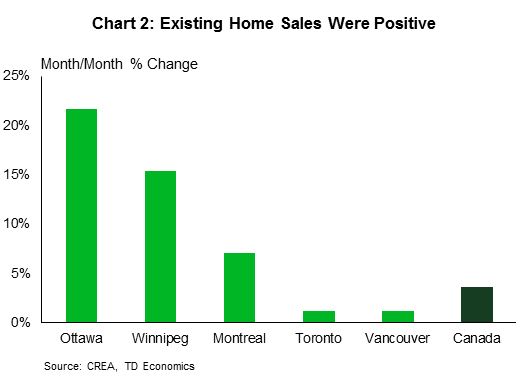
Meanwhile, Canada's housing market delivered a relatively pleasant surprise this morning, with existing home sales advancing 3.6% - the strongest monthly change since June (Chart 2). Montreal's surge, at 7.1% was particularly notable, but the closely watched Vancouver and Toronto markets also put in a positive showing. Still, average home prices continued to decelerate, falling 2.9% on the month as the regulation-prone B.C. and oversupplied Alberta markets continued to weigh on price growth. Moreover, the overall British Columbia market still turned in a monthly sales decline.
That said, while one month of data is not sufficient, the headline print, together with positive housing starts data should support a return to positive growth in residential investment in the first quarter of 2019.
Canada: Upcoming Key Economic Releases
Canadian Retail Sales - December
Release Date: February 22, 2019
Previous: -0.9%, ex-auto: -0.6%
TD Forecast: -0.4%, ex-auto: -0.4%
Consensus: 0.0%, ex-auto: -0.5%
TD looks for a 0.4% contraction in December retail sales due to weaker sales at gasoline stations, with little offset from core retail sales. Seasonally adjusted gasoline prices fell by over 4% during the month which presents a headwind to sales after a 5% decline last month, although favourable weather and holiday driving may contribute to an offsetting increase in volumes. Elsewhere we expect the continued weakness in the housing market to weigh on retail sales of building materials and home furnishings, while auto sales should see a modest decline to leave the ex-autos measure in line with the headline print. Real retail sales are likely to post a slightly larger decline than the nominal series owing to higher consumer prices, which will weigh on service-sector growth in December.
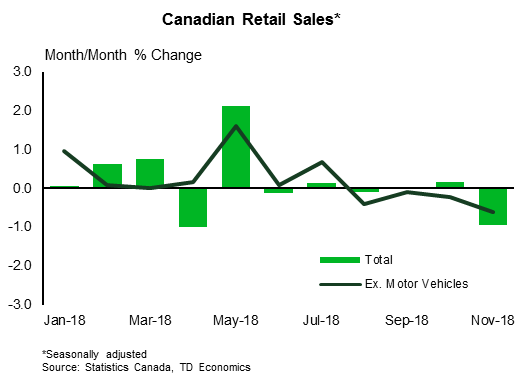
Stocks Surge on Optimism US-China Trade War Nearing An End
The global equity rally continues to be bolstered by optimism that the trade war could finally see a framework agreement. The US also avoided a second government shutdown as President Trump accepted the deal lawmakers worked on, only to declare a national emergency to secure additional funds for his border wall funding.
The S&P 500 rose to a 10-week high as trade talks continued to make constructive progress this week and US consumer sentiment showed signs of stabilizing. The main driver for equities remains the trade story and while global growth concerns are the other key risk, the current backdrop of accommodative stances with the Fed, PBOC, and ECB, may make it difficult to derail the bullish argument.
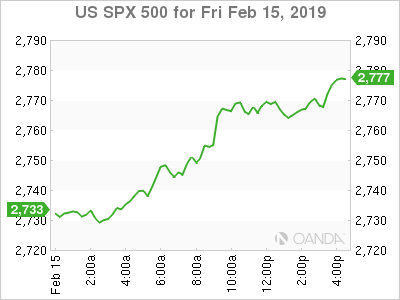
The US dollar continues to whipsaw on risk-off flows from softer US economic data and risk-on moves from continued progress on the trade front. The Fed has clearly signaled interest rates are not going up anytime soon and we could finally learn more in the coming weeks on when the Fed will end quantitative tightening. On Thursday, Fed’s Brainard noted that balance sheet normalization could come to an end this year. Next week, the markets will dissect the Fed’s Minutes on Wednesday and the Fed’s Monetary Policy Report on Friday, along from hearing from Fed members (Williams, Clarida, Bullard and Quarles).
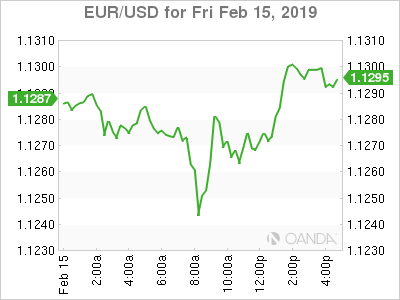
Week Ahead – Flash February PMIs Eyed for Growth Clues; Fed and ECB Minutes to Be Watched Too
The focus will firmly be on economic indicators next week as political and central bank events temporarily take a back seat. The latest PMI releases for the Eurozone will be one of the highlights as growth in the region grinds to a halt, while employment numbers out of Australia and the United Kingdom will attract attention too. Japanese trade and inflation figures will also be on investors’ watch list. Central banks will not be totally absent, however, as the latest meeting minutes from the RBA, ECB and the Fed should provide a fuller insight on the extent of the dovish tilt by policymakers in recent weeks.
Further risks ahead for the aussie
The Australian dollar managed to recover slightly in the past week from the Reserve Bank of Australia’s unexpected dovish turn in the prior week. There could be further gains ahead for the aussie if wage growth and employment numbers due out of Australia in the coming days show further tightening in the labour market.
The wage price index, due on Wednesday, is expected to show steady yearly growth of 2.3% during the fourth quarter, unchanged from the previous period. On a quarterly basis, wage growth is forecast at 0.6%. On Thursday, the labour market theme will continue with the release of the January employment report. The Australian economy is expected to have added 15k jobs in January, slowing slightly from the prior 21.6k. The unemployment rate is forecast to have held steady at 5.0%.
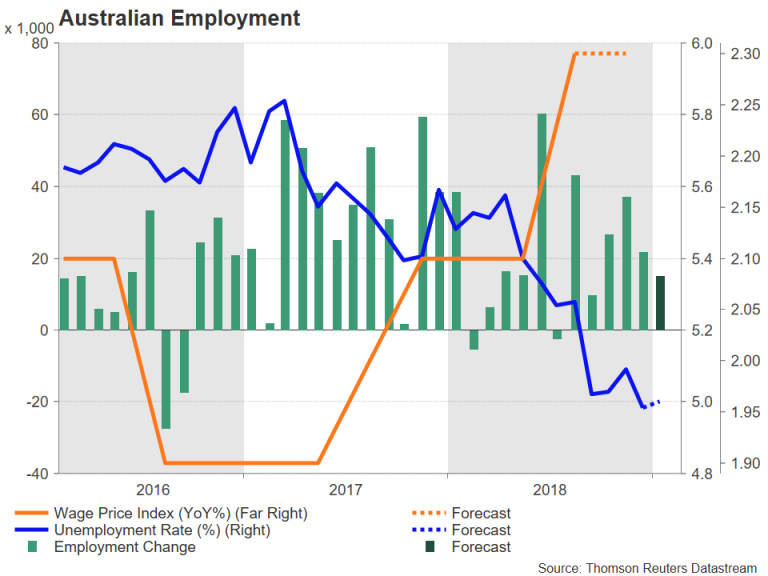
An overall solid set of figures should provide some support for the struggling aussie, but the currency is likely to be vulnerable to not only downside surprises in the data, but also from more dovish language from the RBA. The central bank will publish the minutes of its February meeting on Tuesday and Governor Philip Lowe will be speaking before a parliamentary committee on Friday.
Japanese inflation to tick higher
After this week’s somewhat disappointing GDP growth numbers, Japan’s economy will remain under the spotlight over the next seven days. First up on the Japanese calendar are December machinery orders on Monday. Core machinery orders – a forward-looking gauge for capital expenditure – will be looked at for possible signs that business spending could be slowing or even falling in the early parts of 2019.
Trade figures will follow on Wednesday with exports expected to have declined for a second straight month in January, while the flash Nikkei/Markit manufacturing PMI on Thursday will be the first data point for manufacturing activity in February. On Friday, the latest inflation report might provide some good news for the Bank of Japan if core CPI, which excludes fresh foods and is the Bank’s targeted price measure, edges up by 0.1 percentage points to 0.8% year-on-year in January as forecast.
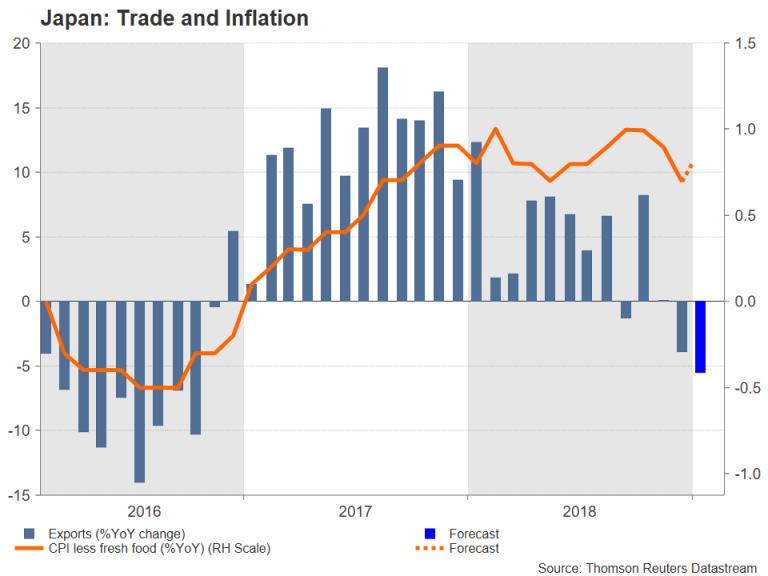
Should the data signal more weakness for the Japanese economy in Q1, the yen could come under downside pressure, which is likely to be exacerbated if the broader market mood turns risk-on.
More misery ahead for the Eurozone?
Good news is in short supply when it comes to the euro area economy and this is reflected in the single currency, which continues to plough fresh lows versus the US dollar. The negative picture isn’t likely to change next week but there could be some signs that growth is steadying after months of deceleration. Germany’s ZEW sentiment survey will be the first key indicator out of Europe on Tuesday. The ZEW economic sentiment index is expected to improve marginally from -15 to -14.0 in February.
On Thursday, all eyes will be on the closely-watched flash PMI prints from IHS Markit. The manufacturing PMI is forecast to ease further to 50.3 in February, but the services PMI is anticipated to improve from 51.2 to 51.4. The German Ifo business climate index will round up the business confidence surveys on Friday and final January CPI readings for the Eurozone are also due the same day.
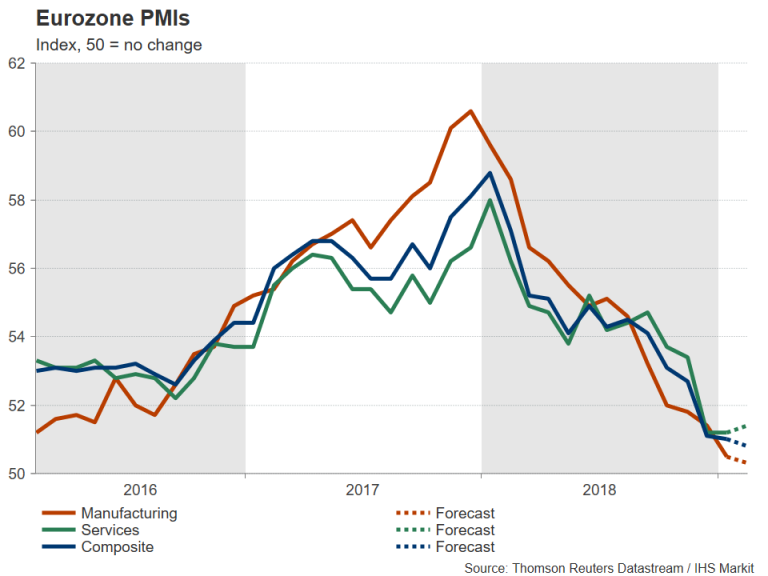
Meanwhile, the European Central Bank will be publishing the account of its January policy meeting on Thursday. ECB Governing Council members have been increasingly acknowledging the weakening economic backdrop in their remarks in recent weeks, adding to the growing expectations that there will be no rate hikes in 2019. However, at the last meeting, ECB head, Mario Draghi, failed to give clear signals that a change in the forward guidance on interest rates as well as a new round of TLTRO programme were forthcoming. Hence, any evidence in the minutes that Council members discussed the aforementioned in more detail than what Draghi let on in his press conference could be interpreted as a dovish sign.
Jobs data only major release from UK
Sterling could be headed for relatively calmer trading sessions over the coming week as there may not be any significant update on the Brexit process until the following week and it’s also looking quieter on the data front. The UK labour market report on Tuesday will be the main highlight for traders.
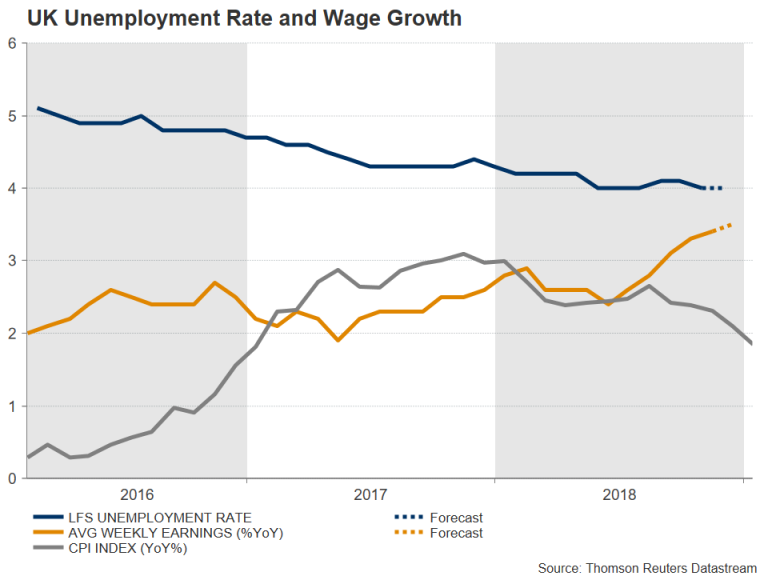
After the worrying GDP numbers for December, a weak set of jobs figures could spark more concerns that the never-ending Brexit saga is starting to have a more profound impact on the UK economy. The jobless rate is predicted to have held at 4.0% in the three months to December, while average weekly earnings are forecast to have increased by 3.5 y/y during the same period, accelerating slightly from the prior 3.4%. Faster wage growth could be seen as offsetting some of the negative effects of lower oil prices on the consumer price index, which fell to 1.8% y/y in January.
Few headlines expected from US
US data over the coming period will probably struggle to change the mood set by the past week’s unexpectedly weak retail sales numbers for December and reports that US and Chinese negotiators remain far apart on the structural reforms that the US is demanding from China even if progress is being made in other areas of the trade talks.
The week will get off to a quiet start as US markets will be closed for Presidents’ Day on Monday and the agenda will be empty until Thursday when durable goods orders are due. Durable goods orders are forecast to have risen by 1.7% month-on-month in December, adding to the 0.7% gain made in November. The Philly Fed manufacturing index for February is also out on Thursday, as well as IHS Markit’s flash manufacturing PMI reading for the same month. A softening in manufacturing activity in February could weigh on sentiment and the dollar.
The greenback lost some steam after the poor retail sales figures but disappointment over the lack of substantial progress in the Sino-US trade talks is keeping the currency supported. But even if next week’s data does not disappoint, another risk for the dollar are the FOMC minutes of the January meeting. The Federal Reserve surprised many when it seemingly ruled out a rate hike in the near term and flagged potential changes to its balance sheet unwinding plans. Should the minutes corroborate the dovish shift, the dollar could face some increased downside pressure.
North of the border, Canadian retail sales for December will be monitored on Friday. However, a public address by Bank of Canada Governor, Stephen Poloz, on Thursday could be another focal point for traders as the speech will be on monetary policy. The Canadian dollar, which in recent weeks has been pulled in different directions from trade and growth uncertainty on the one hand and higher oil prices on the other, will likely be sensitive to any hints on future rate moves.
Cliff Notes: Sentiment’s Many Facets
Key insights from the week that was.
Sentiment has been at the heart of the action this week, both in Australia and abroad.
With confidence and conditions having fallen sharply in the December reading, the January edition of the NAB business survey was eagerly anticipated. While the survey did show a bounce in conditions and confidence in the month, conditions only came back in line with its long-run average and confidence remained below. Key to the outlook for the economy: the employment index was broadly unchanged in January (+1pt) having fallen over 5pts in December – indicating a moderation in employment growth in 2019; while CAPEX (investment) expectations fell to a three-year low. If we continue to see broad-based weakness in conditions across the consumer sector and business services, then both employment and investment are at risk of coming under further pressure.
From the consumer’s perspective, February brought a reversal of fortunes, with the Westpac-MI Index of Consumer Sentiment back into ‘cautiously optimistic’ territory having printed a pessimistic read in January for the first time since late-2017. The survey was in the field last week, at the same time the RBA shifted to a balanced view on interest rates. Consumers look to have responded to that change, with the number of respondents expecting rates to rise over the next 12 months falling to its lowest reading since August 2016 – the last time the RBA cut the cash rate. Lower petrol prices and the continued rise in global equity markets from their December lows were additional positives, and arguably are key reasons why households’ views on the economy remain well above average – in addition to the low unemployment rate.
In contrast, views on family finances continue to hold headline sentiment down, being only in line with their long-run average rather than materially above. Finance and wealth expectations face stiff headwinds, not only from still-weak wages growth but also broadening house price declines. In February, our index of House Price Expectations fell another 8% to a new record low back to the start of the survey sample in 2009. Over half of respondents in NSW and Victoria expect further price declines over the coming year. This entrenched weakness now looks to be spilling over to the other states, particularly Queensland and WA. It is unsurprising then that new lending data is so weak, across both investors and increasingly owner occupiers, as households bide their time.
Moving offshore, in New Zealand the RBNZ met for the first time in 2019. Like the RBA the week before, they also took a more cautious view of the outlook, with the cash rate unchanged “through 2020” and the next move potentially “up or down”. This dovish shift came more as a result of international risks than concerns over the domestic economy. On the latter though, our NZ team and the market believe there is justification for a further dovish tilt. This is because of last week’s weak labour market data as well as downward revisions to immigration, both of which have not been incorporated into the RBNZ’s current view. Westpac sees the RBNZ on hold through 2021.
Turning then to the US, it has generally been a positive week. As we go to print, a deal preventing another near-term shutdown is about to be finalised. And, although a compromise is still a long way off, trade negotiations between the US and China are continuing, and there seems a willingness on both sides to allow further time past the current March 1 deadline – if needed. As a result, the market remains sanguine on US' risks, with both US equities and the US dollar higher over the week.
The one counterpoint to this optimism came from core retail sales reportedly falling 1.7% in December – the weakest read since 2001. Albeit coincident to December’s sharp equity decline, this result is contrary to the strength of the labour market and hence is probably, at least in part noise. It will hit Q4 GDP and keep market expectations over growth and policy subdued near-term, but the weakness in sales is unlikely to persist.
Finally, the second estimate of Euro Area Q4 GDP of 0.2% growth indicates a subdued end to 2018. Consensus expectations are still for the Euro Area to grow around trend at 1.5%yr in 2019, but, given high geopolitical uncertainty, the confidence band around this point estimate is naturally wide. While Westpac’s forecast for 2019 was only slightly lowered to 1.4% at the start of this year, from 1.6% at March 2018, we have still been surprised by the recent data.
Of particular concern was Wednesday’s industrial production data showing a 2.5% fall in Q4 equating to a 3.9% decline through 2018. Against this, over 2018, the unemployment rate declined to 7.9% from 8.6% as growth in employment outpaced that of the labour force four to one (1.0%yr versus 0.25%yr). Here there are two take-outs: a) the rate of employment growth needed to see a lower unemployment rate isn’t that high and b) lower GDP growth than in the past is largely structural.
Weekly Focus – Still Waiting for the Rebound
Market Movers ahead
We expect euro area manufacturing PMI to decline marginally on the back of weak new orders and political risk. We will be looking to German Ifo figures for signs of a rebound, having seen some encouraging signs from the Chinese economy.
Brexit is moving closer, but as expected, negotiations continue to drag out. PM Theresa May will continue talks with the EU27 in late February, when she has also promised a new Brexit vote.
US-China trade talks are set to continue. President Trump has indicated more flexibility in moving the 1 March ceasefire deadline and that he expects to meet Xi Jinping in the near future to close the deal.
In Sweden, we estimate January inflation will come out slightly below the Riksbank's estimates, but the factors that drove the surprisingly high Danish January inflation pose an upside risk.
Weekly wrap-up
Amid continued gloomy data out on the macro front in the eurozone, politics remain the key focus for markets. With regard to Brexit, Thursday's vote in the House of Commons brought little progress, as the next 'meaningful vote' on a full Brexit deal has been postponed.
Trade talks between the US and China continued this week. Though signals continue to be positive, the parties are still far apart on key questions.
Receding risk of a renewed US government shutdown, after the Republicans and Democrats reached an agreement in principle on border security, also ensured that risk appetite remained relatively upbeat this week.