

Sample Category Title
GBP/USD Daily Outlook
Daily Pivots: (S1) 1.2817; (P) 1.2857; (R1) 1.2930; More....
Intraday bias in GBP/USD remains neutral for consolidation above 1.2773 temporary low. With 1.2958 minor resistance intact, further decline is expected. Break of 1.2773 will resume the fall from 1.3217 to retest 1.2391 low. On the upside, however, break of 1.2958 resistance will turn bias to the upside for retesting 1.3217 instead.
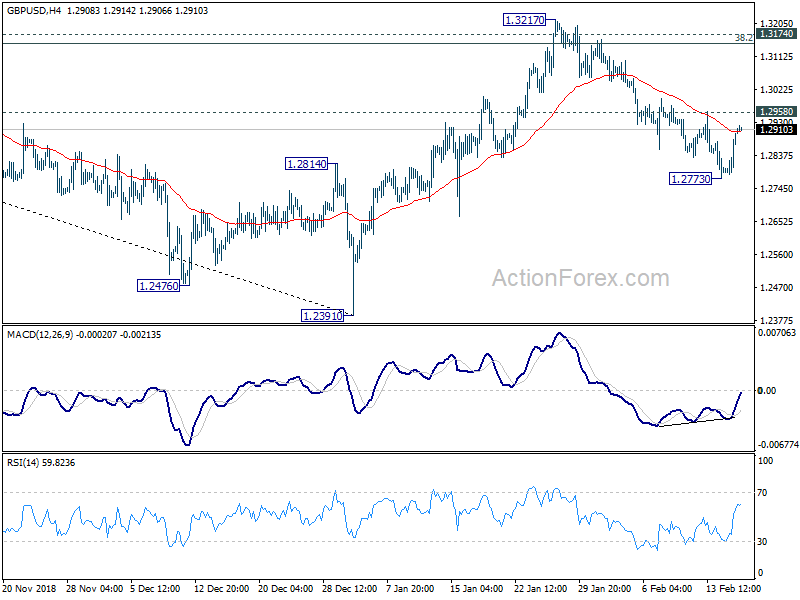
In the bigger picture, the rejection by 1.3174 key resistance revived the original view on GBP/USD. That is, decline from 1.4376 is possibly resuming long term down trend from 2.1161 (2007 high). Firm break of 1.2391 will solidify this bearish case and target 1.1946 (2016 low). However, decisive break of 1.3174 will invalidate this bearish case again and turn outlook bullish.
Crude Oil: Oil Extends Its Gains In The Asian Session
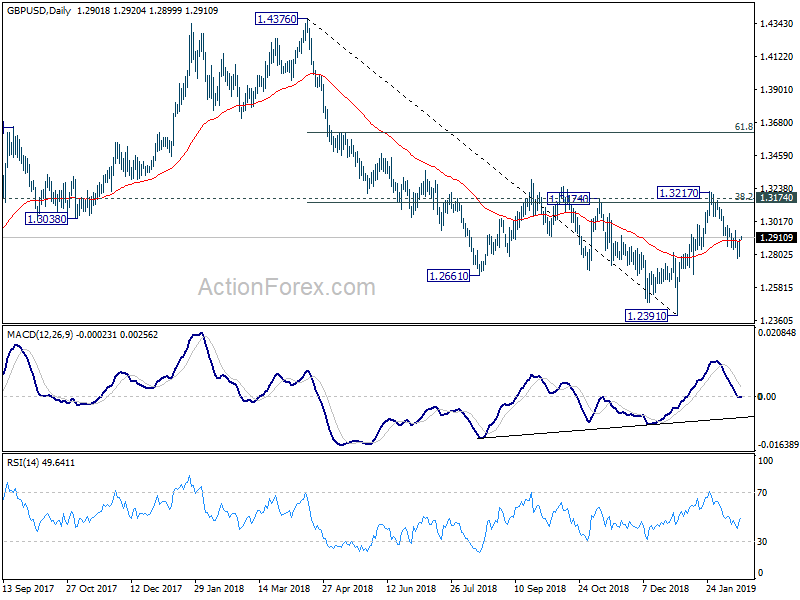
For the 24 hours to 23:00 GMT, Crude Oil rose 2.26% against the USD and closed at USD55.69 per barrel on Friday, amid tightening global supplies and progress in US-China trade negotiations.
Meanwhile, fresh figures from Baker Hughes disclosed that the number of active oil rigs rose by 3 to 857, in the week ended 15 February.
In the Asian session, at GMT0400, the pair is trading at 55.81, with oil trading 0.22% higher against the USD from Friday’s close.
The pair is expected to find support at 54.66, and a fall through could take it to the next support level of 53.50. The pair is expected to find its first resistance at 56.55, and a rise through could take it to the next resistance level of 57.28.
Crude oil is trading above its 20 Hr and 50 Hr moving averages.
USD/CHF Daily Outlook
Daily Pivots: (S1) 1.0033; (P) 1.0061; (R1) 1.0079; More....
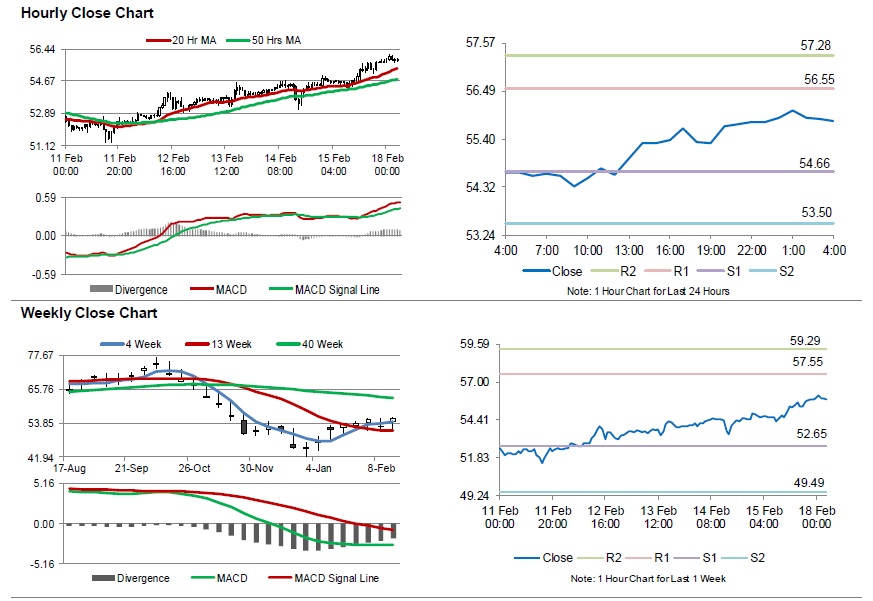
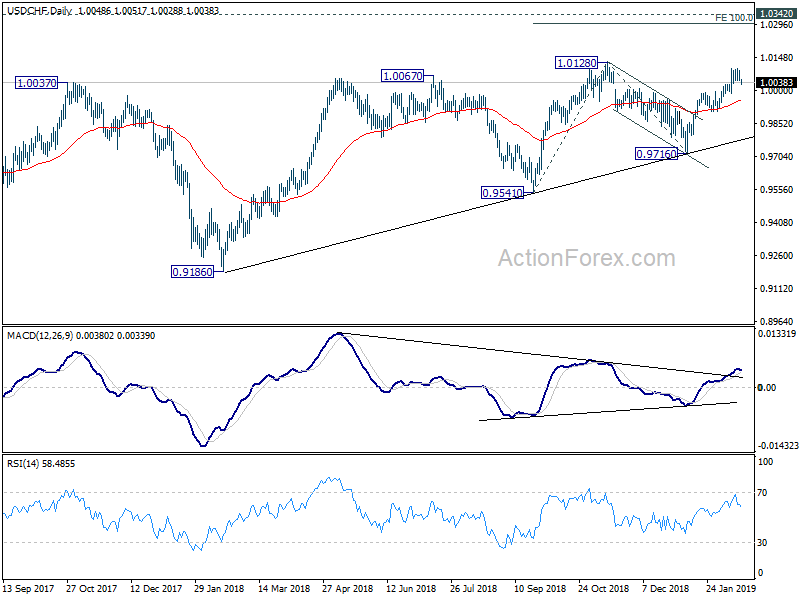
Intraday bias in USD/CHF remains neutral for consolidation below 1.0098 temporary top. Further rally is expected as long as 0.9988 support holds. On the upside, above 1.0098 will target 1.0128 first. Break will confirm resumption of up trend from 0.9186. Next target will be 100% projection of 0.9541 to 1.0128 from 0.9716 at 1.0303. However, break of 0.9988 will indicate rejection by 1.0128 and turn intraday bias to the downside for 0.9716 support again.
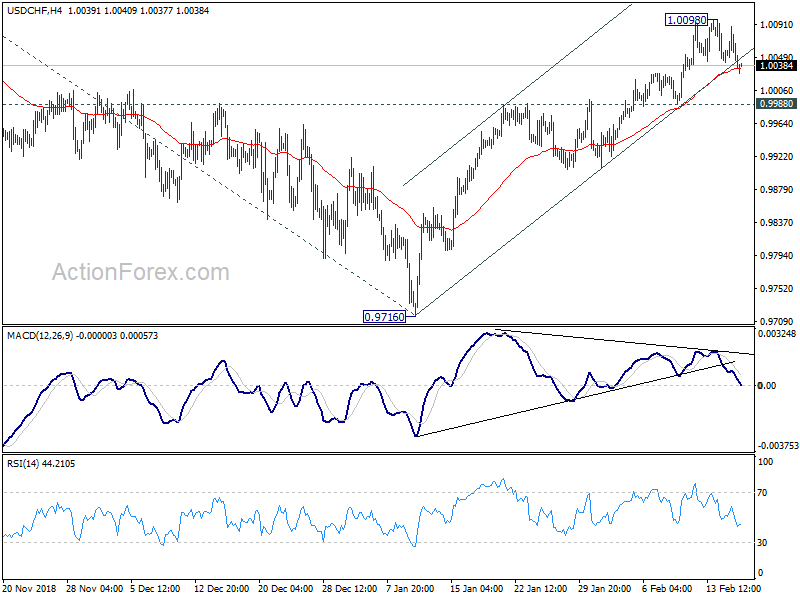
In the bigger picture, USD/CHF drew strong support from medium term trend line and rebounded. That suggests rise from 0.9186 is still in progress. Further break of 1.0128 will confirm up trend resumption and target 1.0342 key resistance. Nevertheless, break of 0.9716 will dampen this bullish view and at least bring deeper fall to 0.9541 key support.
USD/JPY Daily Outlook
Daily Pivots: (S1) 110.26; (P) 110.46; (R1) 110.66; More...
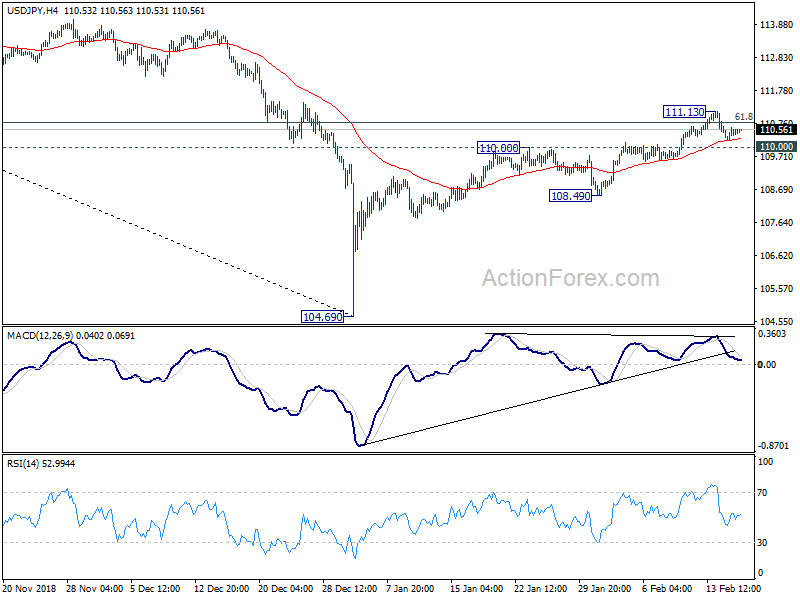
Intraday bias in USD/JPY remains neutral at this point. On the downside, break of 110.00 resistance turned support will suggest rejection by 110.77 and the rebound from 104.69 has likely completed. Intraday bias will be turned back to the downside for 108.49 support for confirmation. Nevertheless, break of 111.13 should confirm resumption of rise from 104.69 for 114.54 resistance.
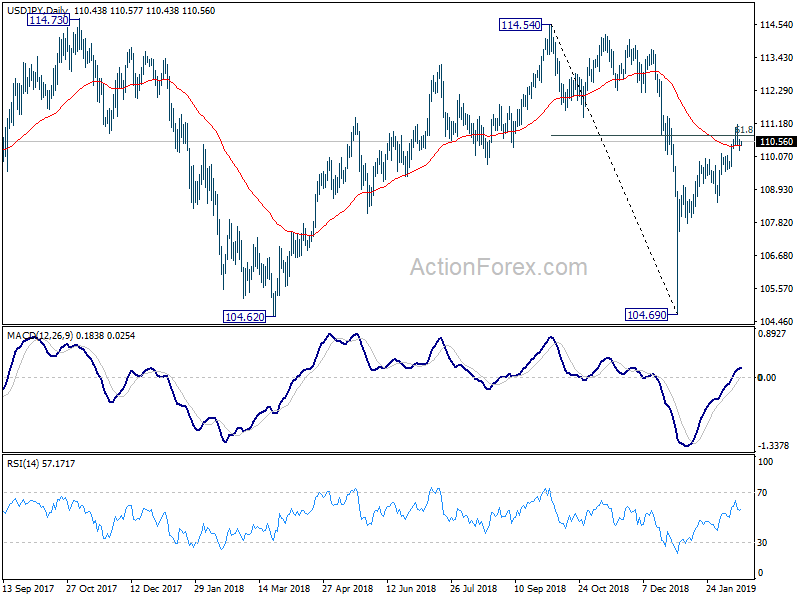
In the bigger picture, while the rebound from 104.69 was stronger than expected, it couldn't sustain above 55 day EMA yet. Outlook is turned mixed first. On the downside, break of 108.49 support will revive that case that such rebound was a correction. And, larger down trend is still in progress for another low below 104.62. But sustained trading above 55 day EMA will turn focus to 114.54. Decisive break there will confirmation completion of the decline from 118.65 (2016 high).
Asian Markets Boosted by Trade Optimism Again, Yen Broadly Lower
Yen remains the weakest one as another week starts with solid risk appetite. Sentiments towards US-China trade negotiation turned optimistic again after positive statements from both sides. Trump also hailed there were "big progress" during last week's meetings in Beijing. More talks are scheduled this week in Washington to work out a memorandum of understand. It remains to be seen whether there will finally be something with substance, or it would turn out to be another cosmetic agreement. Risk appetite is lifted anyway.
In the currency market, Dollar follows Yen as the second weakest. However, Canadian Dollar and Australian Dollar receive no boost and are trading just next to Dollar. New Zealand Dollar, on the other hand, decouples from other commodity currencies as the strongest one for today so far. Euro follows as the second strongest and then Sterling.
Technically, Dollar is staying above near term support levels against other major currencies. Current retreat is seen as a corrective pull back only and more upside is in favor. The levels include 1.341 resistance in EUR/USD, 1.2958 resistance in GBP/USD, 0.9988 support in USD/CHF, 110.00 support in USD/JPY and 1.3196 support in USD/CAD.
In other markets, Nikkei close up 1.8%. Hong Kong HSI is up 1.73%. China Shanghai SSE is up 2.34%. Singapore Strait Times is up 0.81%. Japan 10-year JGB yield is up 0.003 at -0.018, staying negative.
WH adviser Pillsbury: Trump is giving China one last chance
Michael Pillsbury, a leading adviser to Trump on China issues, told Fox that Trump is "essentially giving the Chinese one last chance next week, and then perhaps ... a short extension", referring to the next round of trade negotiation in Washington this week. He pointed out, "notice how the president always refers to the tariffs as bringing in revenue, billions of dollars of revenue to us," and "so he is not somebody who's anti-tariff."
Pillsbury also said "this coming week's going to be awfully important, when the Chinese come here at the working level." And, "We're going to try to find out, I think, what will be in this memorandum of understanding," he said, "whether it will "have enforcement and time limits and ... be tough" or just "be a cosmetic agreement."
Trump on the weekend tweeted "Important meetings and calls on China Trade Deal, and more, today with my staff. Big progress being made on soooo many different fronts! Our Country has such fantastic potential for future growth and greatness on an even higher level!"
Chinese delegation with travel to the US this week to work towards a memorandum of understanding, which should form the framework of a trade agreement, to be finalized through a Trump-Xi summit.
Auto tariff report submitted, 90 days for Trump to act
The US Commerce Department met the Sunday deadline and submitted its investigation report on imported cars and auto parts to the White House. The Section 232 is about national security threats from those auto imports. A Commerce Department spokesperson said it would not disclose any details of the report. Trump has 90 days to make a decision on whether to act up the recommendations, which could include some tariffs on fully assembled vehicles or on technologies and components related to electric, automated, connected and shared vehicles.
German Chancellor Angela Merkel said in the Munich Security Conference that "we are proud of our cars and so we should be." She added that "if that is viewed as a security threat to the United States, then we are shocked". German car lobby VDA said the countries car industry has created more than 113k jobs in the US in recent years, with around 300 factories. German car companies were the largest car exporters from the US. And VDA said "all this strengthens the USA and is not a security problem."
Canada Freeland: Time to remove Section 232 tariffs with USMCA concluded
Canadian Foreign Minister Chrystia Freeland attended the Munich Security Conference over the weekend. There she also met US House Speaker Navy Pelosi and urged to remove the steel and aluminum tariffs. Freeland noted that Canada is now in the process of domestic ratification of the so called USMAC, US-Mexico-Canada agreement on trade. And Canada's position remains strongly opposed to the section 232 steel tariffs. She also told reporters that "the Canada position is now that we have concluded (USMCA) that is all the more reason why the tariffs must be lifted."
Separately at the conference, Freeland also urged to reinforce "rules-based international order". And she proposed to bring together specific coalitions around specific issues."
ECB de Galhau: The key question is if slowdown is temporary or more durable
ECB Governing Council member Francois Villeroy de Galhau said in a El Pais newspaper interview over the weekend that the central bank will scrutinize incoming data to decide whether to hike after this summer.
He said "the key question will be if the slowdown is temporary — with a bounce-back during this year — or more durable." For now, there is resilient domestic demand in Germany, France and Spain. And that kept recession risk low even though outlook was clouded by protectionism and Brexit.
And de Galhau also noted that there was strong convergence of views within ECB about the sequencing of the next policy steps, as well as the flexibility about timing.
ECB Rehn: Have to wait and see how long slowdown lasts
Another ECB Governing Council member Olli Rehn told German newspaper Handelsblatt that "the most recent data point to a weakening of the economy." And, the reasons for the slowdown mainly lie abroad, including US-China trade conflicts. Though, there were also uncertainties over Brexit, yellow vest protest in France, fiscal issues in Italy and slower industrial production in Germany.
But Rehn also noted that ECB's monetary policy orientation is clear and unchanged. He added, "we have said that rates will be at their current level until we have sustainably reached our monetary policy goal." For now, wage growth had not had much impact on core inflation yet even though "at the end of last year it looked as if there would be stronger momentum in inflation.". And, "we have to wait and see how long the period of weaker growth will last."
Central bankers and growth outlook to dominate
In addition to US-China trade talks and Brexit, growth outlook and central bankers views will be the major focuses this week. Fed's "patience" turn in January meeting was much of a surprise to the markets. However, despite of a downgrade, the median projection of federal funds rates by the end of 2019 was still at 2.9%, as seen in the projections. That is, there could be two more rate hikes. That's apparently very different from recent comments from Fed officials, which indicate one hike at most, probably none at all. So, the minutes will be scrutinized for more hints on what the officials are actually thinking. A number of Fed officials will also speech this week, including John Williams, Richard Clarida and Randal Quarles. Durable goods orders and PMIs from US will also be watched for hints on growth outlook.
ECB will also release January monetary policy accounts. At the meeting, ECB turned more dovish and noted that "the risks surrounding the Euro area growth outlook have moved to the downside". That's the first time since April 2017 that the central bank admitted that risks are to the downside. And investors will be keen to know more about how much do the downside that is. ECB President Mario Draghi and Chief Economist Peter Praet will speak this week too. Eurozone will also release German ZEW and Ifo as well as PMIs, which will provide more hints on growth outlook ahead, and probably recession risks too.
RBA will also release February meeting minutes. The most important change in the monetary policy statement is that RBA noted that the chance for a hike or cut as next move is now roughly balanced. The minutes might provide more information on the chances. RBA Governor Philip Lowe would also face a lot of questions regarding the economy at the parliamentary testimony. Australian Dollar will also face important data including wage price, and employment.
Here are some highlights for the week:
- Monday: Japan machine orders, UK Rightmove house price
- Tuesday: RBA minutes; Swiss trade balance; Eurozone current account, German ZEW; UK employment; US NAHB housing index
- Wednesday: New Zealand PPI; Japan trade balance; Australia wage price; German PPI; FOMC minutes
- Thursday: Australia PMIs, employment; Japan PMI manufacturing, all industry index; German CPI final; Eurozone PMIs; UK public sector net borrowing; ECB accounts; Canada wholesale sales; US durable goods, Philly Fed survey, jobless claims, PMIs, leading index, existing home sales
- Friday: German GDP final, Ifo; Eurozone CPI final; Canada retail sales;
USD/JPY Daily Outlook
Daily Pivots: (S1) 110.26; (P) 110.46; (R1) 110.66; More...
Intraday bias in USD/JPY remains neutral at this point. On the downside, break of 110.00 resistance turned support will suggest rejection by 110.77 and the rebound from 104.69 has likely completed. Intraday bias will be turned back to the downside for 108.49 support for confirmation. Nevertheless, break of 111.13 should confirm resumption of rise from 104.69 for 114.54 resistance.
In the bigger picture, while the rebound from 104.69 was stronger than expected, it couldn't sustain above 55 day EMA yet. Outlook is turned mixed first. On the downside, break of 108.49 support will revive that case that such rebound was a correction. And, larger down trend is still in progress for another low below 104.62. But sustained trading above 55 day EMA will turn focus to 114.54. Decisive break there will confirmation completion of the decline from 118.65 (2016 high).
Economic Indicators Update
| GMT | Ccy | Events | Actual | Forecast | Previous | Revised |
|---|---|---|---|---|---|---|
| 23:50 | JPY | Machine Orders M/M Dec | -0.10% | -1.10% | 0.00% | |
| 00:01 | GBP | Rightmove House Prices M/M Feb | 0.70% | 0.40% |
US-China Trade Talks – Likely Extension of Trade Truce also Means Extension of Uncertainty and Market Volatility
We refrain from overtly optimistic over US-China trade negotiations. Following US officials’ Beijing trip which included a meeting with China’s Xi Jinping on Friday, both countries released their own statements. Yet, the tones of which suggested that discrepancies remain. While the market appears thrilled by the likely extension of the trade truce, possibly by 180 days, it also means extension of uncertainty and volatility in the financial markets.
In China’s statement, “consensus” was the keyword. It emphasized that both sides “earnestly implemented the consensus” reached at the G20 summit last December and reached “consensus in principle on major issues” with a view toward a “memorandum of understanding on bilateral economic and trade issues”. However, the US made no mention in “consensus”. While acknowledging “detailed and intensive discussions”, it stressed that “much work remains” and any commitments agreed upon will be “stated in a Memorandum of Understanding between the two countries”.
China emphasized the issues discussed were of “common concern”. These include “technology transfer, protection of intellectual property rights, non-tariff barriers and balanced trade”. The US, however, noted that the “structural issues” discussed include “forced-technology transfer, intellectual-property rights, cyber theft, agriculture, services, non-tariff barriers and currency”. The US also noted the discussion of “China’s purchases of United States goods and services intended to reduce the United States’ large and persistent bilateral trade deficit with China”. Interestingly, this was not mentioned in China’s statement.
Foreign policy is an extension of domestic policy. Apparently, the statements released by the two governments target their own people. Toughness on trade issues and insistence on construction on Mexico border wall are Trump’s major strategy for reelection. As such the US statement inevitably sounds aggressive and keen on putting pressure on China. Nationalism is a key tactic not only employed by Trump. Xi, struggling to maintain his support as the leader of the authoritarian government, has nothing but nationalism to grip on given the country’s economy is facing severe slowdown. China’s statement, thus, has to refrain from sounding compromising and focus on “mutual” benefit.
Of the various demands requested by the US, some can be satisfied by China while others are non-negotiable. In our opinion, the former covers merchandise trade, which could help the US narrow the trade deficit with China. China could agree to increase purchase of US goods, in particular from states that would help Trump in the reelection. As mentioned above, the US is also concerned about “forced-technology transfer, intellectual-property rights, cyber theft”. We do not expect a short-term solution on these issues. Indeed, we do not expect a solution in the longer-term, either. While China might want to buy and show willingness to negotiate on these issues, it would likely compromise.
US tariffs on U$200B worth of Chinese imports are scheduled to rise to 25% from the current 10% if no deal is reached by March 1. It is highly likely that Trump would agree to extend the deadline. The extension means both sides have more time to negotiate. While China could eventually agree to import more US products, little would be achieved on the "new economy" issues. It remained uncertain whether Trump would agree on such outlook. As such, the extension also means more uncertainty and volatility on the financial markets.
WH adviser Pillsbury: Trump is giving China one last chance
Michael Pillsbury, a leading adviser to Trump on China issues, told Fox that Trump is "essentially giving the Chinese one last chance next week, and then perhaps ... a short extension", referring to the next round of trade negotiation in Washington this week. He pointed out, "notice how the president always refers to the tariffs as bringing in revenue, billions of dollars of revenue to us," and "so he is not somebody who's anti-tariff."
Pillsbury also said "this coming week's going to be awfully important, when the Chinese come here at the working level." And, "We're going to try to find out, I think, what will be in this memorandum of understanding," he said, "whether it will "have enforcement and time limits and ... be tough" or just "be a cosmetic agreement."
Trump on the weekend tweeted "Important meetings and calls on China Trade Deal, and more, today with my staff. Big progress being made on soooo many different fronts! Our Country has such fantastic potential for future growth and greatness on an even higher level!"
https://twitter.com/realDonaldTrump/status/1097103477329649664
Chinese delegation with travel to the US this week to work towards a memorandum of understanding, which should form the framework of a trade agreement, to be finalized through a Trump-Xi summit.
Auto tariff report submitted, 90 days for Trump to act
The US Commerce Department met the Sunday deadline and submitted its investigation report on imported cars and auto parts to the White House. The Section 232 is about national security threats from those auto imports. A Commerce Department spokesperson said it would not disclose any details of the report. Trump has 90 days to make a decision on whether to act up the recommendations, which could include some tariffs on fully assembled vehicles or on technologies and components related to electric, automated, connected and shared vehicles.
German Chancellor Angela Merkel said in the Munich Security Conference that "we are proud of our cars and so we should be." She added that "if that is viewed as a security threat to the United States, then we are shocked". German car lobby VDA said the countries car industry has created more than 113k jobs in the US in recent years, with around 300 factories. German car companies were the largest car exporters from the US. And VDA said "all this strengthens the USA and is not a security problem."
GBP/USD Climbing Higher While USD/CAD Slides Further
GBP/USD recovered nicely and broke the 1.2840 and 1.2880 resistance levels. USD/CAD is under bearish pressure and it could revisit the 1.3200 support area.
Important Takeaways for GBP/USD and USD/CAD
- The British Pound found support near 1.2770 and later recovered above the 1.2840 resistance.
- There is a key connecting bearish trend line formed with resistance at 1.2935 on the hourly chart of GBP/USD.
- USD/CAD declined sharply and broke the 1.3300 and 1.3260 support levels.
- There was a break below a major bullish trend line at 1.3265 on the hourly chart.
GBP/USD Technical Analysis
The British Pound declined steadily this past week from the 1.2980 swing high against the US Dollar. The GBP/USD pair broke the 1.2850 and 1.2800 support levels before buyers appeared near the 1.2770 level.
A low was formed at 1.2773 on FXOpen and later the pair started an upside correction. It moved nicely above the 1.2840 resistance and the 50% Fib retracement level of the last decline from the 1.2958 high to 1.2773 low.
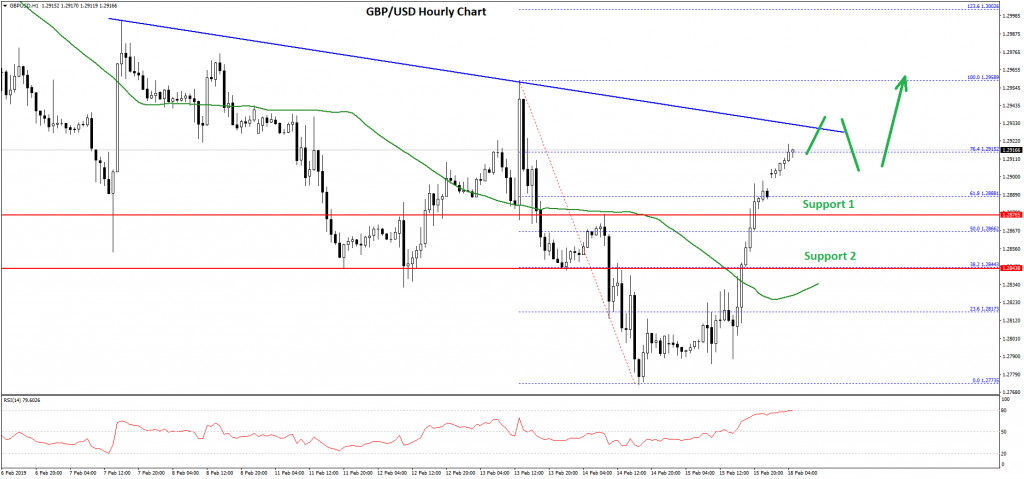
Moreover, there was a break above the 1.2880 resistance and the 50 hourly simple moving average. It opened the doors for more gains and the pair traded above the 1.2900 resistance level.
At the moment, the pair is testing the 1.2915 resistance and the 76.4% Fib retracement level of the last decline from the 1.2958 high to 1.2773 low. More importantly, there is a key connecting bearish trend line formed with resistance at 1.2935 on the hourly chart of GBP/USD.
Therefore, there could be a short term downside correction towards the 1.2880 level in the near term. The current price action is positive and if there is a downside correction, buyers are likely to protect dips near the 1.2880 level.
The next key support is near the 1.2840 level and the 50 hourly simple moving average. On the upside, a break above the bearish trend line and 1.2940 could push the price towards the 1.2980 and 1.3000 levels.
USD/CAD Technical Analysis
The US Dollar was rejected near the 1.3340 level against the Canadian Dollar. The USD/CAD pair started a major downside move and broke the key supports near 1.3300 and 1.3280 levels.
The decline was such that the pair broke the 1.3260 support and the 50 hourly simple moving average. Moreover, there was a break below the 61.8% Fib retracement level of the last wave from the 1.3196 low to 1.3339 high.
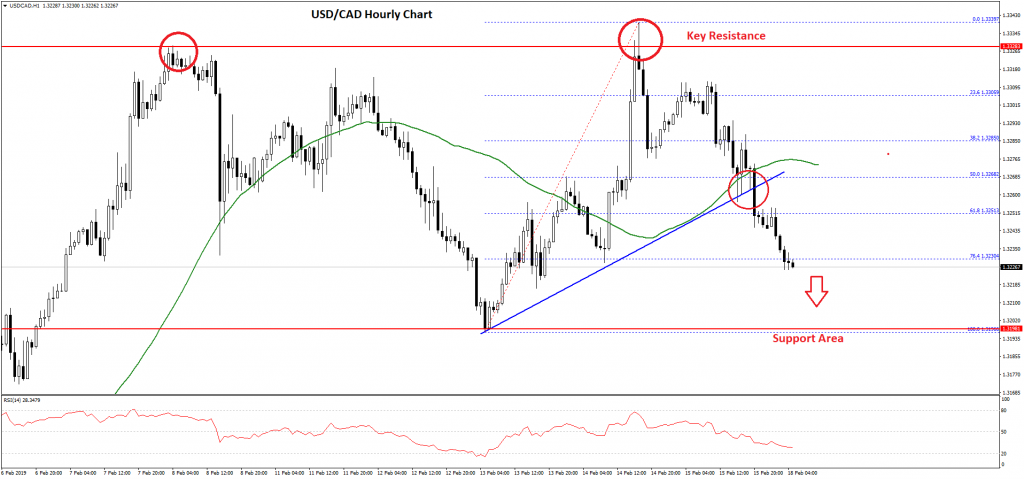
Additionally, there the pair surpassed a major bullish trend line at 1.3265 on the hourly chart, opening the doors for more losses. The pair is now trading well below 1.3250 level and the 76.4% Fib retracement level of the last wave from the 1.3196 low to 1.3339 high.
Therefore, there are high chances that the pair could continue to move down towards the 1.3196 swing low or the 1.3200 support area.
On the upside, an initial resistance is near the 1.3250 level. However, the main resistance is near the 1.3270 level and the 50 hourly simple moving average.
In the short term, if there is an upside correction, sellers are likely to protect the 1.3260-1.3270 area. On the downside, the main target for sellers could be 1.3200, below which it might slide towards the 1.3175 level.
Market Morning Briefing: Euro Rose Back Sharply From 1.1234
STOCKS
Asian markets have opened the week on strong note following a sharp surge in the US equities on Friday. Increased optimism on the US and China to strike a trade deal is also supporting the equity markets. Will the Indian equities which was beaten down all-through last week join the party this week, at least? We will have to wait and see.
The uptrend in the Dow Jones (25,883.25,+443.86, +1.74%) remains intact. The index can test 26,200 and 26,300 in the near term. The US markets are closed today on account of a public holiday.
DAX (11,299.80, +210.01, +1.89%) looks mixed and can trade in a broad range between 11,000 and 11,400 for some time.
Nikkei (21,273.16, +372.53, +1.78%) and Shanghai (2,730.98, +48.60, +1.81%) have risen-back sharply above the key levels of 21,000 and 2,700 respectively. A strong close above 21,170 today on the Nikkei will keep the doors open for it to test 21,700 over the short term. Shanghai is bullish for a test of 2,750.
Sensex (35,808.95, -67.27, -0.19%) and the Nifty 50 (10,724.40, -21.65, -0.20%) have crucial supports at 35,520 and 10,600 respectively. If the indices manage to sustain above these supports, a corrective rally to 36,250-36,450 on the Sensex and 10,850-10,900 on the Nifty 50 is possible this week.
COMMODITIES
Commodities are bullish. Gold, Silver and Copper seems to be gearing-up for a fresh rally after consolidating/correcting last week. Oil remains bullish and can inch higher in the short term.
Gold (1,323) is on the verge of breaching 1,325 which will then pave way for a fresh rally towards 1,350-1,360.
Silver (15.80) has risen well after testing its 15.60-15.55 support region last week. The outlook is bullish for it to test 16 and 16.20 in the short term.
The corrective fall in Copper (2.80) has found strong support at 2.75 last week. A break above 2.81 can take it further higher to 2.83 and 2.85. It will also keep the chances high of copper testing 2.87 and 2.88 going forward.
WTI (55.75) has support in between 55 and 54.5. While above this support region, a rise to 57 is likely in the near term.
Brent (66.15) has an immediate support at 65.60 a break below which can trigger a corrective fall to 64.5 and 64 before we see a fresh rally towards 68 and higher levels.
FOREX
US is closed today for President’s day. There could be some stable movement in the currency segment today unless domestic factors trigger any volatility. Euro, Euro-Yen, Pound, Aussie all look strong against the US Dollar just now and could head towards near term resistances in the coming sessions.
Dollar-Index (96.74) came off from levels below 97.50 instead of rising higher. While the US market is closed for the day, we could possibly see some follow through Dollar selling tomorrow, taking the index lower towards 96.50/00. Note on the upside 97.50-98.00 is an important resistance zone and while that holds, Dollar Index looks bearish for the medium term.
Euro (1.1318) rose back sharply from 1.1234 and while above 1.13, there is scope for rising towards 1.1375 on the upside which is also the 21-day MA. While we do not negate a fall towards 1.1250-1.1200 again, we wait to see if Euro faces rejection from 1.1375.
Euro-Yen (125.11) has bounced back as expected and while above 124.40, Euro-Yen looks bullish towards 126. Overall the next couple of weeks could continue to see ranged movement within 126-124 region before a sharp break on either side comes in.
Dollar Yen (110.53) is taking some support from 110.00-110.19 which could keep the pair above 110.20 for a couple of sessions. Near term charts look bearish indicating a possible fall towards 109.50 over the coming sessions while there is scope for rising towards 112 on the medium term charts. Note 21-Ma on the 3-day line charts could act as immediate resistance near 111.
Pound (1.2917) and Aussie (0.7157) have risen sharply on Friday, bouncing from levels near 1.2773 and 0.7057 respectively. Note immediate resistance on Pound near 1.2900-1.2950. A dip back to 1.2750 could be expected again in the coming sessions. Aussie is holding well above 0.7050 and while that holds, a rise towards 0.72 looks likely. Note that 0.72 is a medium term resistance which could push down Aussie back towards 0.70/69 in the longer run.
USDCNY (6.7550) is holding below immediate resistance near 6.78/80 and could come off to test 6.70 in the near term.
Dollar Rupee (71.32) should ideally come off looking at the weaker US Dollar but the strong correlation with Brent and the 10Yr GOI could be factors which if rise today could pull up Dollar-Rupee higher with itself. Note 71.50 is an immediate resistance on the near term charts. Indian markets are closed tomorrow for Shivaji Jayanti.
INTEREST RATES
The US yields could fall some more towards immediate near term support levels. The 2Yr (2.52%), 5Yr (2.49%), 10Yr (2.67%) and 30Yr (2.99%) could fall towards 2.45%, 2.43%, 2.60% and 2.95% respectively. Near term looks weak for the US yields. Note that the US market is closed today for President’s Day.
The German-JGB 10Yr (0.13%) is stable and could rise towards 0.15/16% in the near term.
The German-US 2Yr differential (-3.08%) is rising towards -3.10% from where a rejection is possible. The rise towards -3.10% could take Euro higher for the next 1-2 sessions at least before the currency comes off to lower levels.
The 10Yr GOI (7.5771%) has moved up towards 7.60% exactly as expected. While 7.60% holds, a short corrective dip towards 7.50/48% is possible before the yield resumes its rise towards 7.70%.