

Sample Category Title
Silver: White Metal Trading On A Weaker Footing This Morning
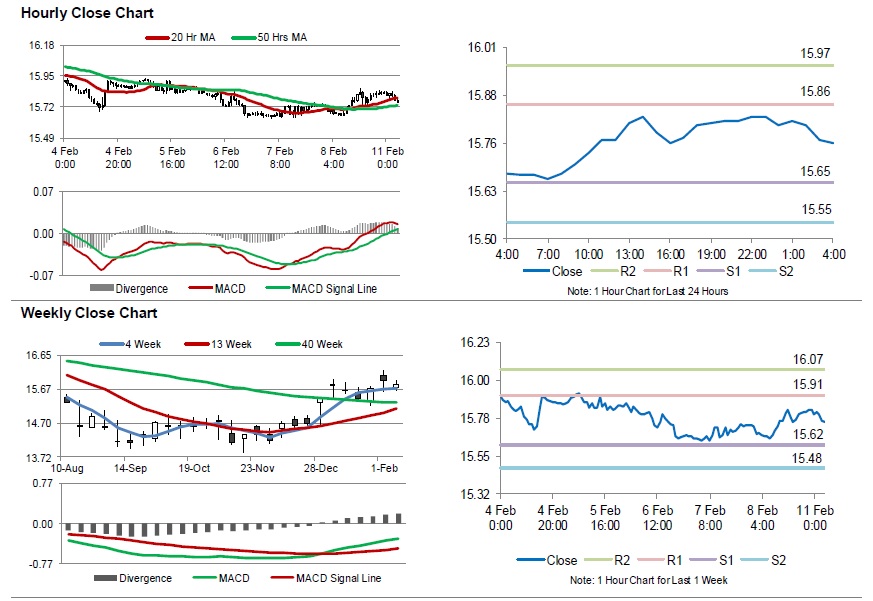
For the 24 hours to 23:00 GMT, Silver rose 0.51% against the USD and closed at USD15.82 per ounce on Friday, tracking rise in gold prices.
In the Asian session, at GMT0400, the pair is trading at 15.76, with silver trading 0.38% lower against the USD from Friday’s close.
The pair is expected to find support at 15.65, and a fall through could take it to the next support level of 15.55. The pair is expected to find its first resistance at 15.86, and a rise through could take it to the next resistance level of 15.97.
The white metal is trading in between its 20 Hr and 50 Hr moving averages.
Crude Oil: Oil Reverses Its Gains In The Asian Session
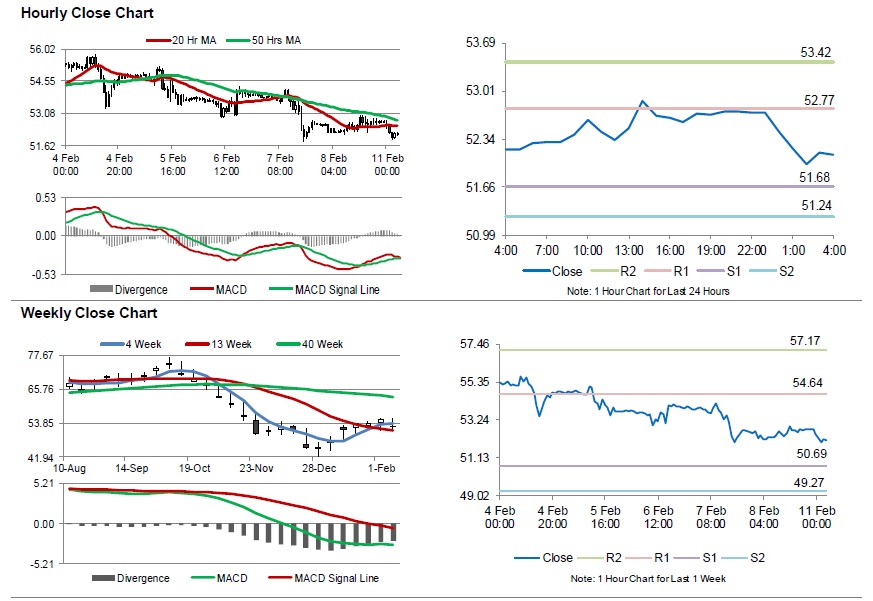
For the 24 hours to 23:00 GMT, Crude Oil rose 0.34% against the USD and closed at USD52.72 per barrel on Friday.
Meanwhile, fresh figures from Baker Hughes disclosed that the number of active oil rigs advanced by 7 to 854 in the week ended 08 February 2019.
In the Asian session, at GMT0400, the pair is trading at 52.11, with oil trading 1.16% lower against the USD from Friday’s close.
The pair is expected to find support at 51.68, and a fall through could take it to the next support level of 51.24. The pair is expected to find its first resistance at 52.77, and a rise through could take it to the next resistance level of 53.42.
Crude oil is trading below its 20 Hr and 50 Hr moving averages.
GBP/USD And EUR/GBP: Risk Of Fruther Declines
GBP/USD declined heavily recently before buyers appeared near the 1.2850 support. EUR/GBP is struggling to break the 0.8760-0.8770 resistance and it could decline further.
Important Takeaways for GBP/USD and EUR/GBP
- The British Pound traded as low as 1.2853 and later started an upside correction.
- There is a major bearish trend line in place with resistance at 1.2945 on the hourly chart of GBP/USD.
- EUR/GBP is under a lot of pressure below the 0.8760 and 0.8770 resistance levels.
- There is a connecting bearish trend line formed with resistance at 0.8770 on the hourly chart.
GBP/USD Technical Analysis
The British Pound started a significant downward move from the 1.3150 resistance area against the US Dollar. The GBP/USD pair declined heavily and broke the 1.3080 and 1.3000 support levels.
The decline was such that the pair even broke the 1.2900 support level. It traded as low as 1.2853 on FXOpen and later started an upside correction. Buyers were successful in pushing the pair above the 1.2900 and 1.2920 resistance levels.
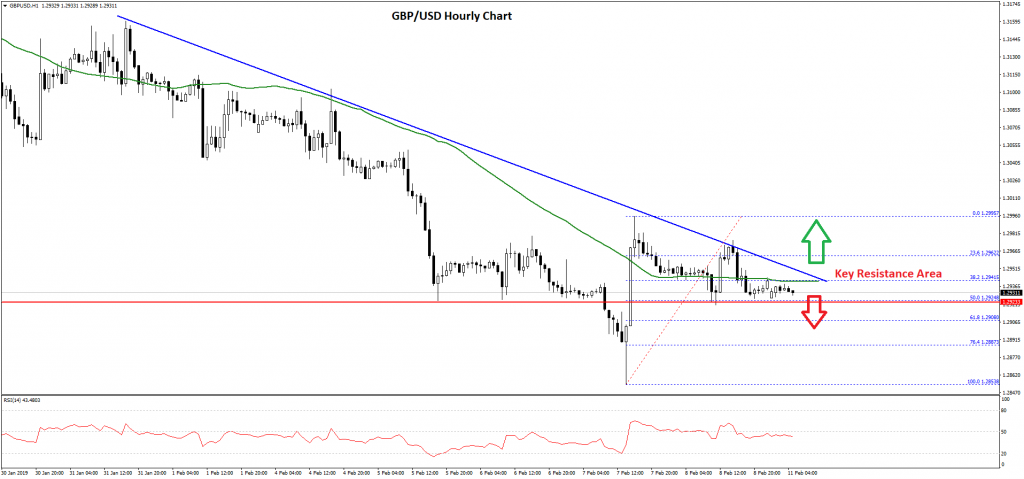
The pair traded close to the 1.3000 resistance, but it failed to hold gains. There was a fresh drop below the 1.2950 level and the 50 hourly simple moving average. On the downside, the 1.2920 and 1.2925 levels are acting as decent supports.
If there is a break below the 1.2920 support, there could be a nasty drop in GBP/USD below the 1.2900 level in the near term. The next key support is near the 1.2850 level, followed by 1.2820.
On the upside, there is a strong resistance formed near the 1.2940 level and the 50 hourly simple moving average. There is also a major bearish trend line in place with resistance at 1.2945 on the hourly chart of GBP/USD.
Therefore, a proper close above the 1.2940 and 1.2950 resistances is must for a fresh recovery towards the 1.3000 or 1.3050 level. If not, there is a risk of more declines below 1.2920 and 1.2900.
EUR/GBP Technical Analysis
The Euro followed a positive structure from the 0.8720 support level against the British Pound. However, the EUR/GBP pair faced a strong resistance near 0.8820 and later declined sharply below 0.8780.
The pair gained bearish momentum and declined below the 0.8760 and 0.8740 supports. It settled below the 0.8760 level and the 50 hourly simple moving average. A low was formed at 0.8728 and later the pair corrected higher.
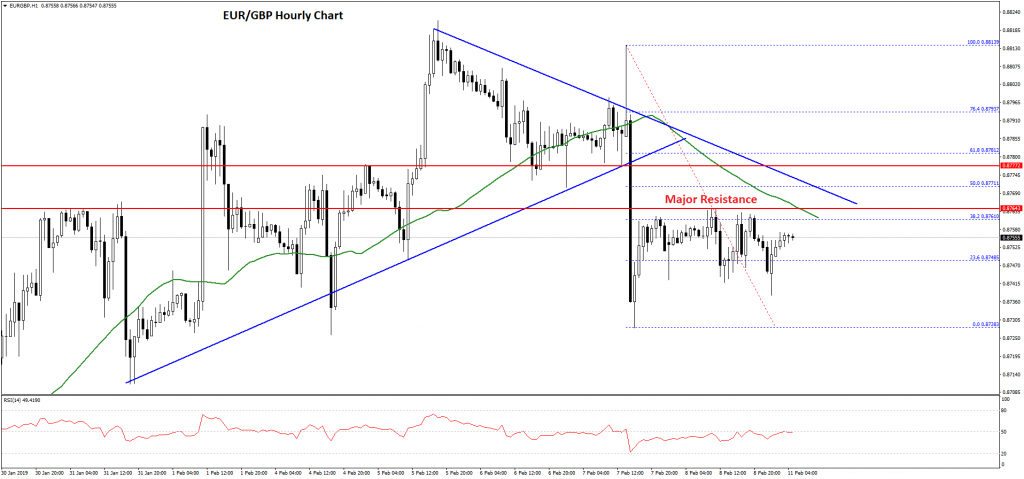
It climbed above the 23.6% Fib retracement level of the recent decline from the 0.8813 high to 0.8728 low. However, the upside move was protected by the 0.8760 and 0.8770 resistance levels.
Moreover, there is a connecting bearish trend line formed with resistance at 0.8770 on the hourly chart. The 50 hourly simple moving average and the 50% Fib retracement level of the recent decline from the 0.8813 high to 0.8728 low are also near the trend line.
Therefore, a proper break above the 0.8770 resistance and bearish trend line is must for a decent upward move in the near term. The next key resistance is at 0.8800, followed by 0.8820.
If EUR/GBP fails to move above the 0.8770 resistance, there is a risk of a downside reaction below the 0.8750 and 0.8740 support levels. The next key supports are at 0.8725 and 0.8710.
GBP/USD Daily Outlook
Daily Pivots: (S1) 1.2917; (P) 1.2947; (R1) 1.2972; More....
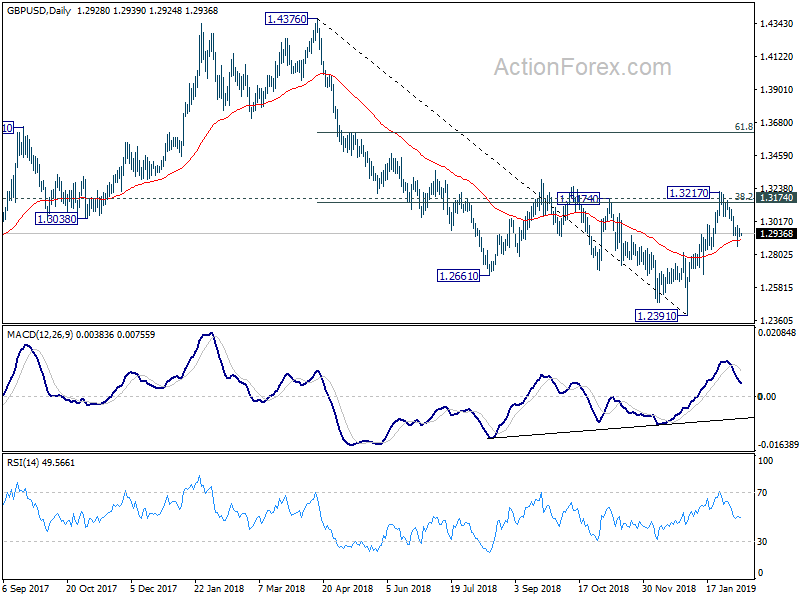
Intraday bias in GBP/USD remains neutral for consolidation above 1.2854 temporary low. Further recovery cannot be ruled out but risk will stay on the downside as long as 1.3217 resistance holds. As noted before, current development suggests that rebound from 1.2391 has completed at 1.3217 already, after rejection by 1.3174 key resistance. On the downside, break of 1.2854 will turn bias to the downside for retesting 1.2391 low.
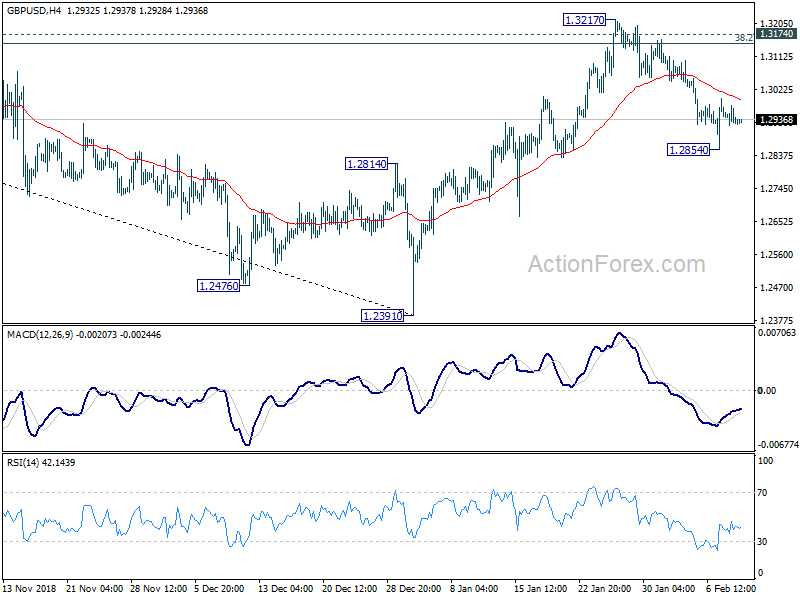
In the bigger picture, the rejection by 1.3174 key resistance revived the original view on GBP/USD. That is, decline from 1.4376 is possibly resuming long term down trend from 2.1161 (2007 high). Firm break of 1.2391 will solidify this bearish case and target 1.1946 (2016 low). However, decisive break of 1.3174 will invalidate this bearish case again and turn outlook bullish.
Sterling Soft as GDP, Productions and Trade Balance Awaited
Sterling is trading generally soft today, except versus Yen, as market focus turns to UK data. GDP, productions and trade balance will be featured. BoE just downgraded both growth and inflation forecasts last week, based on assumption on smooth Brexit. The Pound would be vulnerable to another round of selloff should data disappoint today.
Meanwhile, Yen is trading broadly lower so far as Chinese markets come back from holiday with a rise. Canadian Dollar is also weak with WTI crude oil struggling below 52.5. On the other hand, Australian and New Zealand Dollar are broadly higher, digesting some of last week's losses.
Technically, 1.2854 temporary low in GBP/USD will be a focus today, 0.8821 temporary top in EUR/GBP too. Break of these levels will resume the decline in Pound which started in late January. 140.56 in GBP/JPY will also be watched too and break will indicate near term bearish reversal.
In Asia, Hong Kong HSI is up 0.29%. China Shanghai SSE is up 0.98%. Singapore Strait Times is down -0.44%. Japan is on holiday.
White House Mulvaney: Absolutely cannot rule out another government shutdown after border talks collapsed
In the US, the talks between Republican and Democratic lawmakers appeared to have collapsed over the week end. Nine federal departments and related agencies could be facing another shutdown if there is no breakthrough this week. The special congressional negotiating panel over border security is still aiming to reach a deal on Monday.
The government just had a historic partial shutdown earlier this year after Trump failed to get support from the Democrats on funding for the border wall. Now, it's believed that in return for some funding for physical barriers at the border, Democrats requested to lower the cap of detention beds for undocumented migrants. Democrats believed that would force ICE agents to focus on arresting and deporting serious criminals.
White House Acting Chief of Staff Mick Mulvaney warned that he "absolutely cannot" rule out another shutdown. And he added Trump "cannot sign everything they put in front of him. There'll be some things that simply we couldn't agree to."
UK and Swiss signed agreement to protect GBP 32B trade relationship after Brexit
UK and Switzerland signed an agreement on Sunday that will protect GBP 32B trade relationship between the two countries. With the agreement, both countries will continue to trade on preferential terms after Brexit. That is, the two countries could continue to trade freely without new tariffs. But financial services are not included in the deal.
UK Trade Minister Liam Fox hailed that "Switzerland is one of the most valuable trading partners that we are seeking continuity for." And, "this is of huge economic importance to UK businesses so I'm delighted to be here in Bern ensuring continuity for 15,000 British exporters. "
Fox added that "not only will this help to support jobs throughout the UK but it will also be a solid foundation for us to build an even stronger trading relationship with Switzerland as we leave the EU."
RBNZ to stand pat this week, might deliver more dovish tone
RBNZ is widely expected to keep OCR unchanged at 1.75% this week. The central bank would likely reiterate the stance that "the next move in the OCR could be up or down". And, the tone of the overall announcement could be tiled to the dovish side as both global and domestic environment deteriorated since November meeting. RBNZ might also downgrade growth forecasts. While the majority of market participants judge that the policy rate has bottomed at the current 1.75%, some believe that further rate cut is possible. We expect there would be no rate change at least until second half of 2020. More in RBNZ Preview – Turning More Dovish while Affirming Next Move Can be Up or Down.
Global slowdown, Brexit and trade war the three main themes
Global slowdown, Brexit and US-China trade talks will be the three main themes this week. GDP data from UK, Japan, Germany and Eurozone reveal how poorly respective economy performed in at the end of Q4. Japan and German GDP already contracted in Q3. Any downside surprises there with contraction numbers would confirm technical recession. In particular, markets are expecting German data to show 0.1% qoq. It's really quite marginal. In terms of data, it will also be a big week for the UK with productions, trade balance, CPI and retail sales featured. Attention will also be on US CPI, PPI and retail sales, and China trade balance.
UK Prime Minister Theresa May came back from Brussels last week empty and there is little chance for to bring back a deal for vote by February 13. May is expected to give a statement that date, and as she promised, Brexit debate will resume in the Commons on February 14. The main focus would be on any motions that could shift the control of Brexit from the government to the parliament. And if so, that would open up the route for lawmakers to renegotiate, delay, or even block Brexit.
US-China trade negotiations will resume this week. Lower-level officials will kick off meetings in Beijing on Monday, on the US side led by Deputy Trade Representative Jeffrey Gerrish. Later on Thursday and Friday, high level talks will be carried out involving USTR Robert Lighthizer, Treasury Secretary Steven Mnuchin, and Chines Vice Premier Liu He. The main focuses will remain on intellectual property theft, forced technology transfer, State owned enterprises, and enforcement of agreement. Without, breakthrough in these area, it's quite justifiable for Trump to refuse to meet Chinese President Xi Jinping again this month.
Here are some highlights for the week:
- Monday: Swiss CPI; UK GDP, trade balance, industrial and manufacturing productions.
- Tuesday: Australia home loans, NAB business confidence; Japan tertiary industry index, machine tool orders.
- Wednesday: RBNZ rate decision; Japan PPI; UK CPI, PPI; Eurozone industrial production; US CPI.
- Thursday: Japan GDP; China trade balance; Germany GDP; Swiss PPI; Eurozone GDP, employment; Canada manufacturing sales, new housing price index; US retail sales, PPI, jobless claims, business inventories;
- Friday: New Zealand BusinessNZ manufacturing index; China CPI, PPI; UK retail sales; Eurozone trade balance; Canada foreign securities purchases; US Empire State manufacturing index, import price, industrial production, U of Michigan sentiments.
GBP/USD Daily Outlook
Daily Pivots: (S1) 1.2917; (P) 1.2947; (R1) 1.2972; More....
Intraday bias in GBP/USD remains neutral for consolidation above 1.2854 temporary low. Further recovery cannot be ruled out but risk will stay on the downside as long as 1.3217 resistance holds. As noted before, current development suggests that rebound from 1.2391 has completed at 1.3217 already, after rejection by 1.3174 key resistance. On the downside, break of 1.2854 will turn bias to the downside for retesting 1.2391 low.
In the bigger picture, the rejection by 1.3174 key resistance revived the original view on GBP/USD. That is, decline from 1.4376 is possibly resuming long term down trend from 2.1161 (2007 high). Firm break of 1.2391 will solidify this bearish case and target 1.1946 (2016 low). However, decisive break of 1.3174 will invalidate this bearish case again and turn outlook bullish.
Economic Indicators Update
| GMT | Ccy | Events | Actual | Forecast | Previous | Revised |
|---|---|---|---|---|---|---|
| 07:30 | CHF | CPI M/M Jan | -0.30% | -0.30% | ||
| 07:30 | CHF | CPI Y/Y Jan | 0.60% | 0.70% | ||
| 09:30 | GBP | GDP M/M Dec | 0.00% | 0.20% | ||
| 09:30 | GBP | GDP Q/Q Q4 P | 0.30% | 0.60% | ||
| 09:30 | GBP | GDP Y/Y Q4 P | 1.40% | 1.50% | ||
| 09:30 | GBP | Total Business Investment Q/Q Q4 P | -1.00% | -1.10% | ||
| 09:30 | GBP | Index of Services 3M/3M Dec | 0.40% | 0.30% | ||
| 09:30 | GBP | Visible Trade Balance (GBP) Dec | -12.0B | -12.0B | ||
| 09:30 | GBP | Industrial Production M/M Dec | 0.10% | -0.40% | ||
| 09:30 | GBP | Industrial Production Y/Y Dec | -0.50% | -1.50% | ||
| 09:30 | GBP | Manufacturing Production M/M Dec | 0.20% | -0.30% | ||
| 09:30 | GBP | Manufacturing Production Y/Y Dec | -1.10% | -1.10% | ||
| 09:30 | GBP | Construction Output M/M Dec | 0.10% | 0.60% |
Sanction on Venezuelan Exports Poses Little Impact on Oil Prices
Oil prices have got limited boost after the US imposed sanctions on Venezuela’s oil exports. The direction of oil price movement is ultimately driven by the expectations of demand and supply balance. Oil demand is anticipated to reduce for the years ago amidst global economic slowdown, which is intensified by the trade war between US and China, the world’s two biggest consumers. On the supply side of the equation, oil production is relatively easy to adjust in the US, thanks to the shale gas boom began more than a decade ago. While OPEC and its non-OPEC allies (OPEC+) have endeavored to support price via output cut, the commitment is in question as the participants have their own agendas. Despite agreeing to extend the output for a total of 1.2M bpd from January to June 2018, it is reported that Igor Sechin, Russian oil giant Rosneft’s CEO, has pressured president Putin to withdraw from the deal. It appears that risk is skewed to the downside on demand, but to the upside on supply.
As an OPEC member, Venezuela is exempted from output cut due to the dramatic decline in oil production due to US sanction. It is believed that sanction on a country’s oil exports would trim world oil supply in an aggregate basis, thus boost oil price. The case is not strong enough for Venezuela.
Despite possessing the world’s biggest oil reserve, Venezuela’s crude oil production has been low, below 2.5M bpd, since 2000s, largely driven by geopolitical issues and mismanagement of oil companies. The downtrend accelerated in recent years. It is estimated that the country’s output declined to 2.1M bpd and 1.3M bpd, respectively, in the first 11 months of 2017 and 2018. While exporting over 90% of its output, the slump in production suggests that exports were constrained. Last year, Venezuela exported only 1.2M bpd of its oil, compared with about 7M bpd shipped by Saudi Arabia.
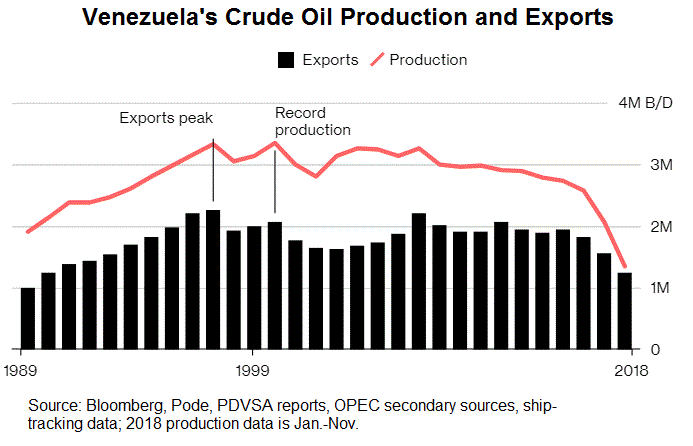
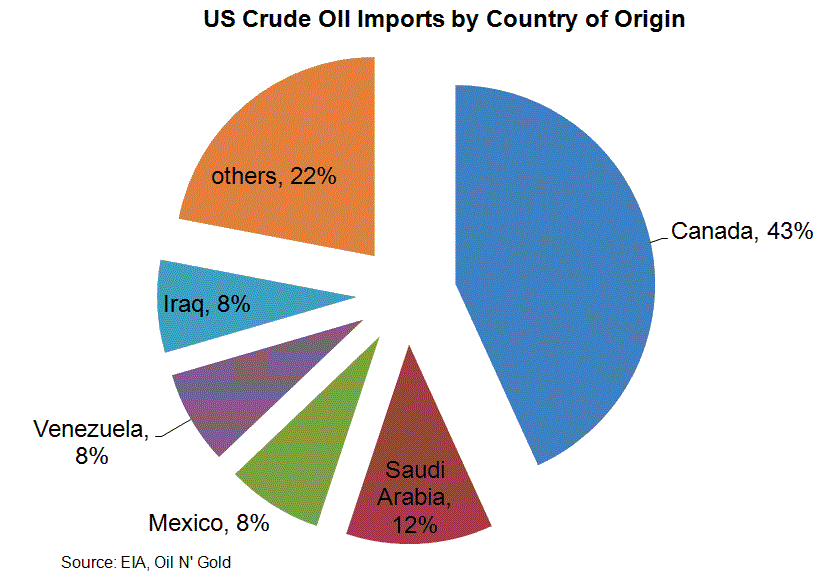
The scarce amount of exports indicates that sanctions should have little, if any, impact on oil prices. Notwithstanding diminished reliance on overseas oil, the US remains the world’s second largest oil importers. EIA’s data show that Venezuela is the fourth largest supplier of US crude imports. Yet, it took up about 8% of the total imports, compared with 43% from Canada. Region-wise, refiners from Gulf Coast used to import most of Venezuela’s crude oil. However, since early 2018, the region has imported more crude oil from Canada than from Venezuela. According to the EIA, Gulf Coast imports of Venezuelan crude oil declined to 0.498M bpd in the first 11 months of 2018, compared with 0.618M bpd in the same period in 2017. Meanwhile, imports by these refiners from Canada soared +0.113M bpd from the same period in 2017. A key reason for such change is that Gulf Coast refiners are increasing their demand for lighter grade crude, as a result of “increased refinery capacity and availability of lighter crude oils”, as well as “transportation constraints” that “limit the availability of heavy crude oils”.
A more self-sufficient US oil market has change the country's foreign policy. From the Iraq war in the era of George Bush to Barack Obama's withdrawal from Afghanistan, much was to deal with US' lust for oil, a major national interest of the country. It is not surprising for Trump, who has been pressuring Saudi Arabia to lower oil prices, to toughen his stance on Venezuela, as the influence of the Latin American state diminishes on US' oil security policy.
Asian update: Yen mildly lower as Chinese stocks rise after holiday
Yen trades generally lower today as Chines stocks are back from holiday opening mildly higher. Canadian Dollar follows as the second weakest and dragged down by oil prices. Sterling is also heavy on Brexit uncertainty. Australian and New Zealand Dollar are paring some of last week's losses. But upside momentum is rather weak so far. Overall, trading is subdued with Japan on holiday.
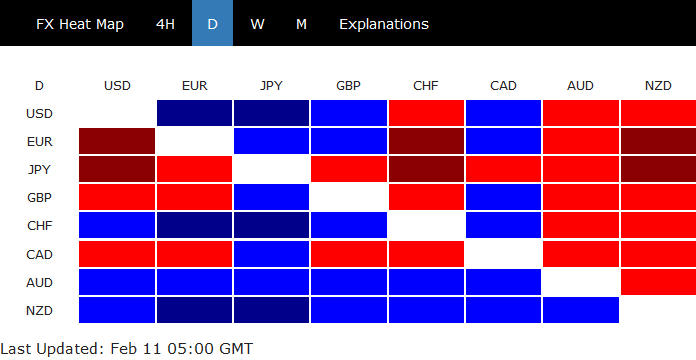
Though, activity will likely surge again in European session. A batch of important economic data will be released from the UK, including GDP, trade balance and productions.
In Asia:
- Hong Kong HSI is up 0.23%.
- China Shanghai SSE is up 0.83%.
- Singapore Strait Times is down -0.48%.
- Japan is on holiday.
White House Mulvaney: Absolutely cannot rule out another government shutdown after border talks collapsed
In the US, the talks between Republican and Democratic lawmakers appeared to have collapsed over the week end. Nine federal departments and related agencies could be facing another shutdown if there is no breakthrough this week. The special congressional negotiating panel over border security is still aiming to reach a deal on Monday.
The government just had a historic partial shutdown earlier this year after Trump failed to get support from the Democrats on funding for the border wall. Now, it's believed that in return for some funding for physical barriers at the border, Democrats requested to lower the cap of detention beds for undocumented migrants. Democrats believed that would force ICE agents to focus on arresting and deporting serious criminals.
White House Acting Chief of Staff Mick Mulvaney warned that he "absolutely cannot" rule out another shutdown. And he added Trump "cannot sign everything they put in front of him. There'll be some things that simply we couldn't agree to."
UK and Swiss signed agreement to protect GBP 32B trade relationship after Brexit
UK and Switzerland signed an agreement on Sunday that will protect GBP 32B trade relationship between the two countries. With the agreement, both countries will continue to trade on preferential terms after Brexit. That is, the two countries could continue to trade freely without new tariffs. But financial services are not included in the deal.
UK Trade Minister Liam Fox hailed that ""Switzerland is one of the most valuable trading partners that we are seeking continuity for." And, "this is of huge economic importance to UK businesses so I'm delighted to be here in Bern ensuring continuity for 15,000 British exporters. "
Fox added that "not only will this help to support jobs throughout the UK but it will also be a solid foundation for us to build an even stronger trading relationship with Switzerland as we leave the EU."
Market Morning Briefing: Aussie Could Take Some Support At 0.7050
STOCKS
Equities looks vulnerable for a fresh sell-off this week as the indices like Nikkei and DAX have already come-off from their key resistances while the Sensex and Nifty 50 has failed to sustain the breakout.
Dow Jones (25,106.33, -63.2, -0.25%), though seems to get fresh buyers below 25,000 at the moment, it has a key resistance around 25,300. A strong break above this resistance is needed for it to move further higher. While below 25,300 Dow is vulnerable to break below its support level of 24,880 and fall towards 24,700 and 24,680.
DAX (10,906.78, -115.24, -1.05%) has significant resistances at 11,000 and 11,100. A fall to 10,800 and 10,700 looks likely in the near term.
Nikkei (20,333.17, -418.11, -2.01%) has come-off sharply after testing its resistance level of 21,000 last week. A fall to 20,000 and 19,750 looks likely. Resistances are at 20,550 and 20,620. Japanese markets are closed today on account of a public holiday.
Shanghai (2,616.56, -1.67, -0.06%) reopened on a flat note after being closed the whole of last week for public holidays. It has resistance at 2,635. A pull-back from this resistance can drag the index lower to 2,600 and 2,570 in the coming sessions.
Sensex (36,546.48, -424.61, -1.15%) and the Nifty 50 (10,943.60, -125.80, -1.14%) have tumbled on Friday. They have failed to get fresh follow through buyers after breaching their key resistances on Wednesday last week. Sensex has resistance in between 36,850 and 36,900. While below this resistance, it can fall to 36,280. Nifty 50 can fall to 10,850 while it remains below its resistance level of 10,985.
COMMODITIES
Gold and Silver have bounced from their key supports. They can remain range bound in the near-term with the overall bias continuing to be positive. Copper has seen an interim pause in its upmove and can correct slightly before resuming its uptrend. Oil remains negative in the near term.
Gold (1314) has supports in between 1312 and 1310. While above these supports, an upmove to 1320 and 1325 is possible in the coming days.
Silver (15.82) is holding well above its support level of 15.60. It can remain range bound between 15.6 and 16.2 for some time before we see a fresh rally to 16.8 and 17.
Copper (2.79) has come-off after facing resistance around 2.85. A corrective dip to 2.78 and 2.76 is possible before the uptrend resumes targeting 2.87.
WTI (51.95) has tumbled over 5 per cent last week. A further fall to 51 and 50 looks possible in the near term.
Brent (61.45) seems to be not gaining strength to breach 63. It looks vulnerable for a fall to 60 on a break below the immediate support level of 61.
FOREX
Dollar Index (96.64) is stable just now but has scope of testing 97 on the upside which is an immediate resistance on the daily candles. While 97 holds, a rejection to 96.50-96.25 could be possible in the medium term.
As Dollar-Index heads towards 97, Euro (1.1326) could test 1.1300 on the downside before bouncing back sharply from there back to 1.14-1.15 levels.
Euro-Yen (124.45) is trading near immediate support on the daily candles and we could see a bounce to 126 in the near term. Immediate view is bullish while support near 124.40 holds. At the same time watch fall in German-JGB 10Yr as it looks bearish for the near term. Continued fall in the yield differential could pull down Euro-Yen to levels below 124.40-124.00 in the near term. (Refer Interest Rates section below)
Dollar Yen (109.88) might test 109 on the downside before bouncing back towards 110.50. On the weekly charts, 108-109 is a crucial support zone and while that holds could indicate long term bullishness for Dollar-Yen.
Pound (1.2932) has been coming off from 3-day candle resistance near 1.32. Immediate support is seen near 1.28-1.29 levels which if holds could lead to a small bounce back towards 1.31-1.32 levels in the near term.
Aussie (0.7099) could take some support at 0.7050 and bounce back a bit towards 0.7150. Failure to sustain above 0.7050 could take it higher towards 0.7250-0.7300 in the near to medium term.
USDCNY (6.7739) opened with a sharp rise after a week-long holiday. A test of 6.8 on the upside is possible before a pause is seen.
Dollar Rupee (71.31) could come off towards 71.10-71.00 again while below 71.40. Immediate view is bearish for Dollar-Rupee.
INTEREST RATES
The US yields have been falling breaking below immediate supports and look bearish for the near term. The 5YR (2.44%), 10YR (2.63%) and 30Yr (2.98%) are down from 2.46%, 2.65% and 2.99% respectively. Near term looks bearish as the 5Yr, 10YR and the 30Yr yields could come off towards 2.40%, 2.58% and 2.95% respectively.
The German-JGB 10Yr differential (0.12%) has fallen sharply breaking below the immediate support level and while the differential moves lower, it could possibly pull down Euro-Yen to levels below 124.40-124.00 in the near term.
The Indian 10YR GOI (7.5243%) rose slightly on Friday. We could possibly see a fall back towards 7.48% while the upside could be limited to 7.55/56% just now.