

Sample Category Title
AUD/USD Daily Outlook
Daily Pivots: (S1) 0.7205; (P) 0.7230; (R1) 0.7249; More...
AUD/USD rebounds strongly today but stays below 0.7295 temporary top. Intraday bias remains neutral first and outlook is unchanged. Another rise could be seen with 0.7180 minor support intact. On the upside, above 0.7295 will target 0.7393 cluster resistance (61.8% projection of 0.6722 to 0.7235 from 0.7076 at 0.7393). We'd expect strong resistance from there to limit upside to complete the rebound from 0.6722. On the downside, break of 0.7180 minor support will turn bias back to the downside for 0.7076 support. However, sustained break of 0.7393 will indicate bullish reversal and target 100% projection at 0.7589 next.
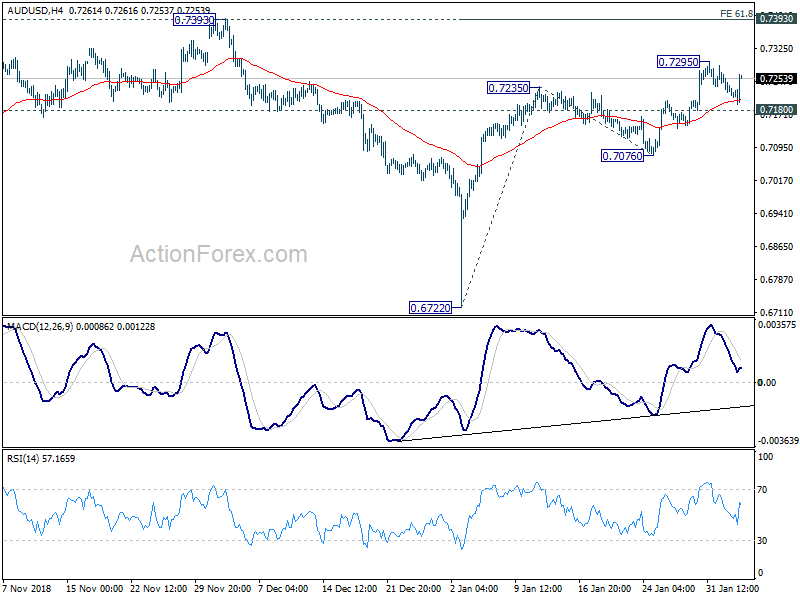
In the bigger picture, as long as 0.7393 resistance holds, we'd treat fall from 0.8135 as resuming long term down trend from 1.1079 (2011 high). Decisive break of 0.6826 (2016 low) will confirm this bearish view and resume the down trend to 0.6008 (2008 low). However, firm break of 0.7393 will argue that fall from 0.8135 has completed. And corrective pattern from 0.6826 has started the third leg, targeting 0.8135 again.
Australian Dollar Surges as RBA Maintains Tightening Bias Despite Growth and Inflation Downgrade
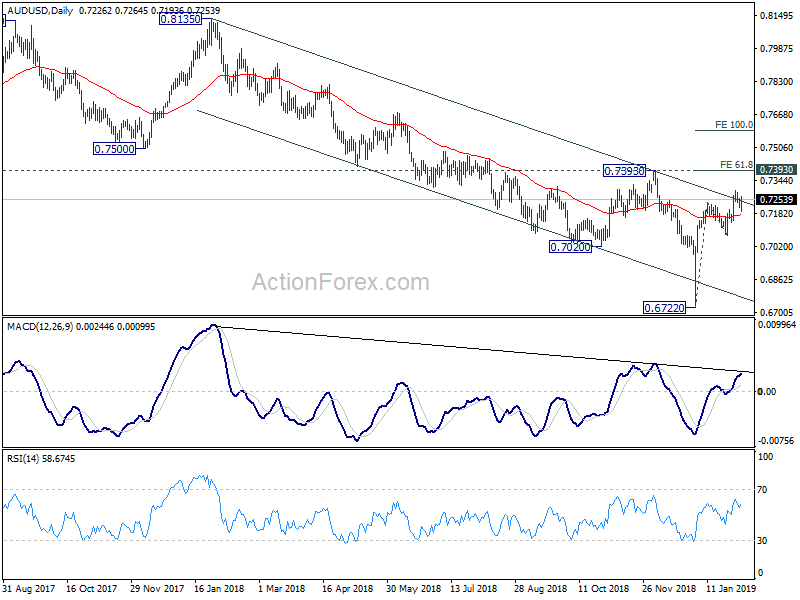
Australian Dollar jumps broadly today after RBA rate decision. While growth and inflation forecasts are downgraded, the overall announcement suggests that RBA is maintaining tightening bias. The next move on interest rate is still a hike even though it may take longer to happen. The positive impact of RBA is more than enough to offset rather poor economic data from Australia. Strength in the Aussie takes New Zealand Dollar up too.
The currency markets are rather mixed elsewhere though, as part of Asia is on lunar new year holiday. Mild risk appetite keeps Yen and Swiss Franc weak but there is no follow through selling yet. Dollar's rebound attempt fades ahead of near term resistance against Euro, Sterling, Australian and Canadian. But at the same, no particular strength is seen in others. The markets are generally waiting for fresh inspirations.
Technically, with today's rebound in Aussie, AUD/USD is now looking at 0.7295 resistance and break will resume recent rebound from 0.6722 flash crash low. EUR/AUD is also looking at 1.5721 and break will resume fall from 1.6765 high. EUR/USD is approaching 1.1407 minor support while GBP/USD is close to 1.3012. Break of these levels will solidify the case for Dollar rebound. But as long as these supports hold, more downside remains in favor in Dollar.
In other markets, Nikkei closed down -0.19% at 20844.45. Japan 10-year JGB yield is down -0.0032 at -0.015, staying negative. China, Hong Kong and Singapore are on lunar new year holiday. Overnight, DOW rose 0.7%. S&P 500 rose 0.68%. NASDAQ rose 1.15%. 10 year yield rose 0.033 to 2.724, back above 2.7 handle.
RBA downgrades growth and inflation forecast, cites increased risks
Australian Dollar jumps after RBA left cash rate unchanged at 1.50% as widely expected. The conclusion of the statement was kept totally unchanged. And most importantly, RBA maintained "further progress in reducing unemployment and having inflation return to target is expected, although this progress is likely to be gradual."
There are some dovish tweaks in the statement, including mentioning of increased risks, downgrade of growth and inflation forecasts. But for now, the statement still suggests the next move is a hike rather than a cut. Just that it may take longer to happen.
Globally, RBA said growth "remains reasonable" but "downside risks have increased". In particular "trade tensions are affecting global trade and some investment decisions". Headline inflation also "moved lower" due to fall in oil prices. Regarding financial markets, RBA also noted government bond yields have declined in most countries including Australia. Australia's terms of trade are "expected to decline over time"
Domestically, RBA expects Australian economy to growth by around 3% in 2019 and a little less in 2020. That's a downward revision from prior expectation of growth at 3.5% in 2019. Further than that, RBA acknowledged weaker than expected growth in Q3 and said "some downside risks have increased". And, "the main domestic uncertainty remains around the outlook for household spending and the effect of falling housing prices in some cities."
On inflation, RBA now expects underlying inflation to hit 2% in 2019 and 2.25% in 2020. Headline inflation is also expected to decline in the near term due to petrol prices. That's also a downgrade as in previously, RBA expected inflation to hit 2.25% in 2019 and a bit higher in 2020.
Fed Powell told Trump directly: We set policy based on non-political analysis
Fed Chair Jerome Powell met Trump at an informal dinner meeting at the White House yesterday to discuss the economy. Treasury Secretary Steven Mnuchin and Fed Vice Chair Richard Clarida was also present. Fed said in a statement that the meeting was as Trump's invitation. The purpose was to "discuss recent economic developments and the outlook for growth, employment and inflation."
Powell's comments were "consistent with his remarks at his press conference of last week." And he "did not discuss his expectations for monetary policy". Powell also emphasized that "the path of policy will depend entirely on incoming economic information and what that means for the outlook."
Powell also told Trump that Fed will set monetary policy "based solely on careful, objective and non-political analysis."
Fed Mester: Interest rate at lower end of neutral range
Cleveland Fed President Loretta Mester said more rate hikes are still needed if the economy develops as she expected. She tweeted that "If economy performs as I expect, fed funds rate may need to move a bit higher. But if downside risks come to pass and economy is weaker than expected, I will adjust my outlook and policy views."
However, in a speech "Perspectives on the Economic Outlook and Monetary Policy in the Coming Year", Mester said interest rate is already "at the lower end" of the longer-run neutral rate. It's at a level that neither stimulates nor restricts the economy, and recent rate hikes are still working themselves through the economy. In the coming meetings, Fed will also finalize the plan for ending the balance-sheet runoff and completing balance-sheet normalization.
Mester also noted that the economy is a "very good spot". While growth is slowing from an above-trend pace, labor markets are strong. Inflation is near 2% with no signs of appreciably rising. So, in her view "monetary policy does not appear to be far behind or far ahead of the curve". And that gives Fed the opportunity to " gather information on the economy and assess our forecast and the risks, before making any further adjustments in the policy rate."
On the data front
Australian AiG performance of services dropped sharply from 52.1 to 44.3 in January. Retail sales dropped -0.4% mom in December versus expectation of 0.0%. Trade surplus widened to AUD 3.68B in December versus expectation of AUD 2.25B. UK BRC retail sales monitor rose 2.1% yoy in January.
Looking ahead, Eurozone PMI services final and retail sales will be released in European session. UK will also release PMI services. Later in the day, US will release ISM non-manufacturing.
AUD/USD Daily Outlook
Daily Pivots: (S1) 0.7205; (P) 0.7230; (R1) 0.7249; More...
AUD/USD rebounds strongly today but stays below 0.7295 temporary top. Intraday bias remains neutral first and outlook is unchanged. Another rise could be seen with 0.7180 minor support intact. On the upside, above 0.7295 will target 0.7393 cluster resistance (61.8% projection of 0.6722 to 0.7235 from 0.7076 at 0.7393). We'd expect strong resistance from there to limit upside to complete the rebound from 0.6722. On the downside, break of 0.7180 minor support will turn bias back to the downside for 0.7076 support. However, sustained break of 0.7393 will indicate bullish reversal and target 100% projection at 0.7589 next.
In the bigger picture, as long as 0.7393 resistance holds, we'd treat fall from 0.8135 as resuming long term down trend from 1.1079 (2011 high). Decisive break of 0.6826 (2016 low) will confirm this bearish view and resume the down trend to 0.6008 (2008 low). However, firm break of 0.7393 will argue that fall from 0.8135 has completed. And corrective pattern from 0.6826 has started the third leg, targeting 0.8135 again.
Economic Indicators Update
| GMT | Ccy | Events | Actual | Forecast | Previous | Revised |
|---|---|---|---|---|---|---|
| 21:30 | AUD | AiG Performance of Service Index Jan | 44.3 | 52.1 | ||
| 0:01 | GBP | BRC Retail Sales Monitor Y/Y Jan | 2.10% | -0.20% | -0.70% | |
| 0:30 | AUD | Trade Balance (AUD) Dec | 3.68B | 2.25B | 1.93B | 2.26B |
| 0:30 | AUD | Retail Sales M/M Dec | -0.40% | 0.00% | 0.40% | 0.50% |
| 3:30 | AUD | RBA Rate Decision | 1.50% | 1.50% | 1.50% | |
| 8:45 | EUR | Italy Services PMI Jan | 50 | 50.5 | ||
| 8:50 | EUR | France Services PMI Jan F | 47.5 | 47.5 | ||
| 8:55 | EUR | Germany Services PMI Jan F | 53.1 | 53.1 | ||
| 9:00 | EUR | Eurozone Services PMI Jan F | 50.8 | 50.8 | ||
| 9:30 | GBP | Services PMI Jan | 51.1 | 51.2 | ||
| 10:00 | EUR | Eurozone Retail Sales M/M Dec | -1.60% | 0.60% | ||
| 14:45 | USD | US Services PMI Jan F | 54.2 | 54.2 | ||
| 15:00 | USD | ISM Non-Manufacturing/Services Composite Jan | 57 | 57.6 |
Equities Trade Mixed Amid China Holiday
General Trend:
- Australia Financials index rises over 5%, AMP up over 10% ; Banking recommendations seen as not as bad as feared
- Australian Finance Group and Mortgage Choice decline after release of banking report
- Australian building materials firm James Hardie rises over 5% post earnings
- Nasdaq futures decline, Google drops post earnings
- Nikkei-weighted Fast Retailing drops over 3% after Jan sales figures
- Panasonic declines over 3%, cut operating earnings forecast
- Apple supplier Largan Precision Jan sales -4.8% y/y
- Aussie drops after weaker than expected retail sales, Dec exports decline
- Aussie rebounds after RBA statement
- RBA remains in focus this week: Gov Lowe expected to speak on Feb 6th (Wed), RBA quarterly statement on monetary policy seen on Feb 8th (Friday)
- Philippines inflation slows again in Jan, central bank sees more policy space
- US companies expected to report earnings on Tuesday include Electronic Arts, Ralph Lauren, SNAP, Disney (includes after hours)
Headlines/Economic Data
Japan
- Nikkei 225 opened +0.4%
- (JP) Japan PM Abe has asked China President Xi to visit Japan two times in 2019 - Japan press
- (JP) Togo Securities offices raided by investigators for allegedly offsetting Forex losses - Nikkei
- (JP) Japan Jan PMI Services: 51.6 v 51.0 prior; PMI Composite 50.9 v 52.0 prior
- (JP) Japan MoF sells ¥2.2T v ¥2.2T indicated in 0.10% (prior 0.10%) 10-yr JGBs, avg yield -0.013% v 0.015% prior, bid to cover 4.80x v 4.04x prior
- (JP) BoJ Gov Kuroda: Wage data issue does not affect BOJ's view on economy, has limited impact on BOJ's output gap
Korea
- Kospi closed, re-opens Feb 7th
- (KR) US envoy to North Korea to visit Pyongyang Feb 6th - US State Dept
- 042670.KR May report 2018 net profit at record high due to increased sales of excavators in China and emerging markets - Yonhap
- (KR) US and South Korea reach agreement in principal on cost of troops; US thought to have accepted S. Korea's request to contribute less than $1.0B – CNN
- (KR) UN Sanctions Monitor Report: North Korea nuclear, ballistic missile program is intact; they are working to protect those capabilities from military strikes; N. Korea is violating arms embargo, continues to defy sanctions though use of massive increase in illegal ship to ship transfers or oil and coal
China/Hong Kong
- Hang Seng and Shanghai Composite closed remainder of the week
- (CN) China's NDRC has invested $219.4B in 27 infrastructure projects since start of 2018 to stimulate economy -Chinese press
- HUAWEI.CN CFO Meng's lawyers said to consider defense strategy that arrest was due to US political motives - Canadian press
Australia/New Zealand
- ASX 200 opened +0.3%
- (AU) RBA LEAVES CASH RATE TARGET UNCHANGED AT 1.50%; AS EXPECTED; Central scenario is for 2019 GDP ~3%; Central scenario is for 2020 GDP is a little less than 2019
- (AU) AUSTRALIA DEC RETAIL SALES M/M: -0.4% V 0.0%E
- (AU) AUSTRALIA DEC TRADE BALANCE (A$): 3.7B V +2.2BE; Exports m/m: -2% v +1% prior; Imports m/m: -6% v +2% prior
- (AU) AUSTRALIA Q4 RETAIL SALES EX INFLATION Q/Q: 0.1% V 0.5%E
- CIM.AU Reports FY18 (A$) Net 780.6M v 778Me, Rev 17.3B v 16.1B y/y; Guides initial FY19 (A$) net 790-840M
- (NZ) New Zealand Jan ANZ Commodity Price: +2.1% v -0.2% prior
- (AU) Australia Jan AiG Performance of Services Index: 44.3 v 52.1 prior
- JHX.AU Reports 9M Net $228M v $204M y/y; Rev $1.88B v 1.53B y/y
- RVA.AU To reduce employees at San Diego location by 44% to 22 employees, to realigning the organization to align with current business conditions
Other Asia
- (PH) PHILIPPINES JAN CPI M/M: -0.6% V -0.4% PRIOR; Y/Y: 4.4% V 4.5%E (lowest since March 2018)
- (PH) Philippines Central Bank (BSP) Official Guinigundo: Recent CPI data gives more space to review policy, with modest demand pressures monetary policy could be 'slight on the brake'
North America
- (US) Trump Inaugural committee lawyers receives subpoena from Manhattan US attorney's office for documents relating to committee's donors and spending - US press
- (US) Fed Mester (hawk, non-voter in 2019): Current Fed policy is well calibrated to economy
- (US) Fed Chairman Powell met with Trump at White House tonight, discussed economic outlook; told Trump policy will be data dependent, Policy set on dual goals non-political
Europe
- (UK) UK govt indicates that UK would waive through most EU goods at ports in the event of a 'no deal ' Brexit to avoid massive jams - The Sun
- (UK) JAN BRC LFL SALES Y/Y: +1.8% V -0.2%E
Levels as of 12:50ET
- Hang Seng closed; Shanghai Composite closed; Kospi closed; Nikkei225 -0.2%; ASX 200 +2.0%
- Equity Futures: S&P500 -0.1%; Nasdaq100 -0.1%, Dax -0.0%; FTSE100 +0.1%
- EUR 1.1426-1.1455; JPY 109.84-109.05; AUD 0.7195-0.7265; NZD 0.6872-0.6902
- Commodity Futures: Gold -0.0% at $1,319/oz; Crude Oil +0.4% at $54.80/brl; Copper +0.4% at $2.81/lb
Into European session: Dollar rebound lost steam, Aussie higher after RBA
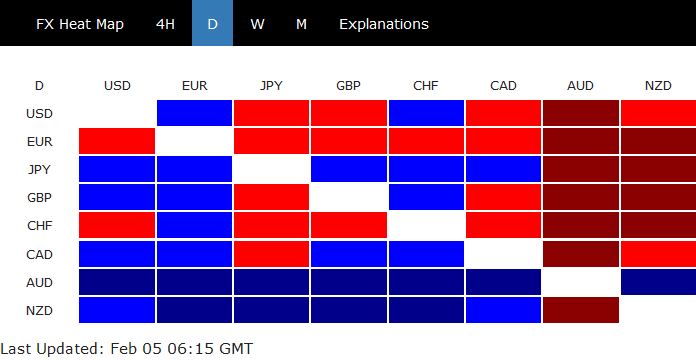
Entering into European session, Australian Dollar is the strongest one for today so far, followed by New Zealand Dollar. RBA kept interest rate unchanged and downgraded growth and inflation projections. But after all, the central bank remained confident that inflation will gradually pick up. Thus, the next move will still more likely be a hike than a cut. That's the factor that keeps Aussie buoyed.
Euro is currently trading as the weakest one for today, followed by Swiss Franc and the Dollar. The greenback attempted for a rebound yesterday. But apparently, the rebound was rather weak. Dollar remains near term bearish against Euro, Sterling, Aussie and Canadian. And Dollar is only performing marginally better against Swiss Franc and Yen.
In Asia:
- Nikkei closed down -0.19% at 20844.45.
- Japan 10-year JGB yield is down -0.0032 at -0.015, staying negative.
- China, Hong Kong and Singapore are on lunar new year holiday.
Overnight:
- DOW rose 0.7%.
- S&P 500 rose 0.68%.
- NASDAQ rose 1.15%.
- 10 year yield rose 0.033 to 2.724, back above 2.7 handle.
Fed Mester: Interest rate at lower end of neutral range
Cleveland Fed President Loretta Mester said more rate hikes are still needed if the economy develops as she expected. She tweeted that "If economy performs as I expect, fed funds rate may need to move a bit higher. But if downside risks come to pass and economy is weaker than expected, I will adjust my outlook and policy views."
https://twitter.com/ClevelandFed/status/1092584863172042753
However, in a speech "Perspectives on the Economic Outlook and Monetary Policy in the Coming Year", Mester said interest rate is already "at the lower end" of the longer-run neutral rate. It's at a level that neither stimulates nor restricts the economy, and recent rate hikes are still working themselves through the economy. In the coming meetings, Fed will also finalize the plan for ending the balance-sheet runoff and completing balance-sheet normalization.
Mester also noted that the economy is a "very good spot". While growth is slowing from an above-trend pace, labor markets are strong. Inflation is near 2% with no signs of appreciably rising. So, in her view "monetary policy does not appear to be far behind or far ahead of the curve". And that gives Fed the opportunity to " gather information on the economy and assess our forecast and the risks, before making any further adjustments in the policy rate."
RBA Review – Policy Rate to Stay Low for Some Time as Risks to Growth and Inflation Skewed to...
As widely anticipated, RBA left the cash rate unchanged at 1.5% for the 27th consecutive meeting. Yet, it has turned less optimistic about Australia’s economic outlook while noting downside risks to global growth.
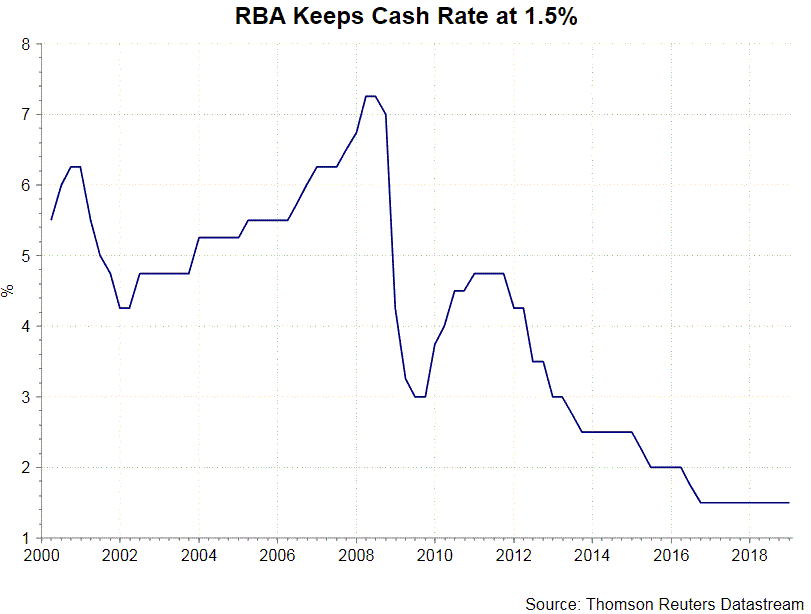
As suggested in the accompanying statement, the members indicated that “the central scenario is for the Australian economy to grow by around 3% this year and by a little less in 2020 due to slower growth in exports of resources”. This is compared with the December meeting when the central bank forecast growth to reach 3.5% “over this year and next, before slowing in 2020 due to slower growth in exports of resource”. Meanwhile, RBA did not describe the country’s economy as “performing well” this month.
One of the major concerns is weak household spending, which is believed to be the key drag on the third quarter GDP growth. While the members admitted that the sluggish household income growth has been dampening spending, they believed that income would “pick up and support household spending”. The stressed that “the main domestic uncertainty remains around the outlook for household spending and the effect of falling housing prices in some cities”.
It is likely that the RBA would downgrade the growth and inflation forecasts as it releases the Statement on Monetary Policy on Friday. In 4Q18, headline CPI eased to +1.8% y/y while core CPI improved to +1.6%. Both readings have been staying below the central bank’s +2% target. The phenomenon is the same in other countries, with the headline reading dragged by declining oil prices. Indeed, the members noted in the statement that global inflation has “moved lower due to the decline in oil prices, although core inflation has picked up in a number of economies”.
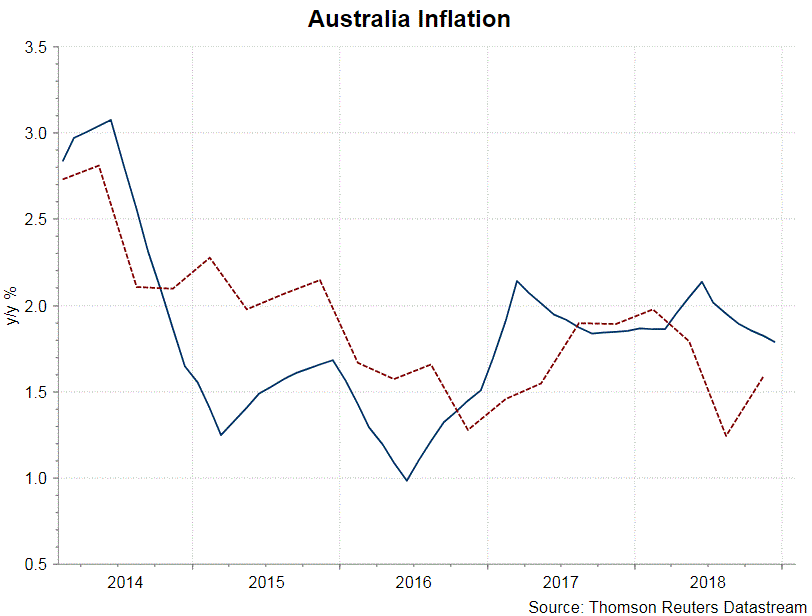
On the housing market, the RBA acknowledged that the property prices in Sydney and Melbourne are “going through a period of adjustment”, compared with December’s language that the prices “have continued to ease”.
Against the domestic and global economic backdrop, we expect the central bank would leave the policy rate unchanged for an extended period time.
Powell told Trump directly: We set policy based on non-political analysis
Fed Chair Jerome Powell met Trump at an informal dinner meeting at the White House yesterday to discuss the economy. Treasury Secretary Steven Mnuchin and Fed Vice Chair Richard Clarida was also present. Fed said in a statement that the meeting was as Trump's invitation. The purpose was to "discuss recent economic developments and the outlook for growth, employment and inflation."
Powell's comments were "consistent with his remarks at his press conference of last week." And he "did not discuss his expectations for monetary policy". Powell also emphasized that "the path of policy will depend entirely on incoming economic information and what that means for the outlook."
Powell also told Trump that Fed will set monetary policy "based solely on careful, objective and non-political analysis."
RBA: Reserve Bank Lowers Growth and Inflation Forecasts But Remains Confident
The RBA has lowered their growth forecasts but they remain above that of Westpac. The Governor chose to repeat the statement’s concluding paragraph which explains the policy decision with the same words that he used in December despite lower forecasts and recognition of downside risks.
As expected, the Board of the Reserve Bank decided to leave the cash rate unchanged at 1.5%. At the February meeting, the Board discusses the executive’s revised forecasts which will be released in the February Statement of Monetary Policy on February 8. However, in recent statements, the Governor has provided readers with growth and inflation forecasts and this was repeated in today’s statement. For 2019, forecast growth has been revised down from 3 ¼ per cent to 3 per cent, and 2020, from 3 per cent to “a little less” due to slower growth in exports of resources. It is important that this 3 per cent growth forecast is above the assessed trend rate of 2 ¾ per cent, and the implied 2020 forecast is likely to be around trend. If a central bank is forecasting above trend growth, then it is highly unlikely to adopt an easing bias, and indeed the chances are still likely that the Governor will persist with his assessment that even though rates are likely to remain steady for some time, the next move is likely to be up.
The inflation forecasts were also revised with the underlying inflation forecast for 2019 reduced from 2 ¼ per cent to 2 per cent, while the 2020 forecast remains at 2 ¼ per cent. Hence the Bank is maintaining the view that inflation will gradually move into the 2 to 3 per cent band, although it will take somewhat longer than previously expected.
There are good reasons why the Bank lowered its growth forecasts. Firstly, while it still assesses the outlook for global growth as “reasonable”, it recognises that “downside risks have increased”. Secondly, it has made some significant changes around the household sector and housing. For some time, Westpac has argued that the fall in house prices in Sydney and Melbourne will be associated with a negative wealth effect. In the RBA’s previous writings, they tended to dismiss any wealth effect, but in today’s statement the Governor notes “the main domestic uncertainty remains around the outlook for household spending and the effect of falling housing prices in some cities”. In linking house prices with household spending, he appears to be recognising the risk of a negative wealth effect.
Westpac has also argued that residential housing construction will be a drag on growth in both 2019 and 2020. The RBA has not supported that view, referring to a strong pipeline. But, recent falls in dwelling approvals, including for detached housing, clearly point to a significant drag on growth from the housing construction downturn.
The statement continues to point to “rising business investment” which in the December statement was linked to “business conditions are positive”. The Governor has obviously decided that the strong negative signal from the recent NAB business survey was insufficient at this stage to review the business investment outlook. Given that the survey was taken in early January, Westpac thinks that approach is reasonable but there will be considerable interest to see whether future surveys send a more positive signal.
The Governor maintains his positive rhetoric around the labour market and confirms its forecast that the unemployment rate will fall to 4 ¾ per cent by the end of 2020. He also expects a further lift in wages over time, supporting household incomes.
Financial conditions in the US attract some attention, although the recent sharp decline in equity prices is noted to have been partly reversed. He also observes that market participants no longer expect the FOMC to be tightening monetary policy. The Sydney and Melbourne housing markets are assessed as “going through a period of adjustment”, and credit conditions have tightened. This is the approach which he has taken in previous statements but it is very significant that he has begun to recognise a potential wealth effect, meaning that the price adjustment may have implications for the real economy.
With a more cautious view on the wealth effect and recognition that dwelling construction will contract, Westpac’s GDP forecast for 2019 and 2020 is 2.6%, with recent data releases pointing to downside risks even for those modest numbers.
Finally, the Governor chose to repeat the concluding paragraph which explains the policy decision with the same words that he used in December despite lower forecasts and recognition of downside risks. Notably, it includes the sentence “Further progress in reducing unemployment and having inflation return to target is expected, although this progress is likely to be gradual.”
Conclusion
With these revised forecasts, the RBA is clearly less comfortable with its previous positive outlook. Its growth forecasts remain significantly above Westpac’s own view. With our forecasts of 2.6% growth in 2019 and 2020, it still seems that the more likely outcome will be for steady rates, even if as we expect, the RBA will eventually have to adopt growth forecasts much closer to Westpac’s current view. Westpac confirms its long-held forecast that the RBA cash rate will remain on hold in 2019 and 2020.
RBA downgrades growth and inflation forecast, cites increased risks
Australian Dollar jumps after RBA left cash rate unchanged at 1.50% as widely expected. The conclusion of the statement was kept totally unchanged. And most importantly, RBA maintained "further progress in reducing unemployment and having inflation return to target is expected, although this progress is likely to be gradual."
There are some dovish tweaks in the statement, including mentioning of increased risks, downgrade of growth and inflation forecasts. But for now, the statement still suggests the next move is a hike rather than a cut. Just that it may take longer to happen.
Globally, RBA said growth "remains reasonable" but "downside risks have increased". In particular "trade tensions are affecting global trade and some investment decisions". Headline inflation also "moved lower" due to fall in oil prices. Regarding financial markets, RBA also noted government bond yields have declined in most countries including Australia. Australia's terms of trade are "expected to decline over time"
Domestically, RBA expects Australian economy to growth by around 3% in 2019 and a little less in 2020. That's a downward revision from prior expectation of growth at 3.5% in 2019. Further than that, RBA acknowledged weaker than expected growth in Q3 and said "some downside risks have increased". And, "the main domestic uncertainty remains around the outlook for household spending and the effect of falling housing prices in some cities."
On inflation, RBA now expects underlying inflation to hit 2% in 2019 and 2.25% in 2020. Headline inflation is also expected to decline in the near term due to petrol prices. That's also a downgrade as in previously, RBA expected inflation to hit 2.25% in 2019 and a bit higher in 2020.
Full statement below.
Statement by Philip Lowe, Governor: Monetary Policy Decision
At its meeting today, the Board decided to leave the cash rate unchanged at 1.50 per cent.
The global economy grew above trend in 2018, although it slowed in the second half of the year. Unemployment rates in most advanced economies are low. The outlook for global growth remains reasonable, although downside risks have increased. The trade tensions are affecting global trade and some investment decisions. Growth in the Chinese economy has continued to slow, with the authorities easing policy while continuing to pay close attention to the risks in the financial sector. Globally, headline inflation rates have moved lower due to the decline in oil prices, although core inflation has picked up in a number of economies.
Financial conditions in the advanced economies tightened in late 2018, but remain accommodative. Equity prices declined and credit spreads increased, but these moves have since been partly reversed. Market participants no longer expect a further tightening of monetary policy in the United States. Government bond yields have declined in most countries, including Australia. The Australian dollar has remained within the narrow range of recent times. The terms of trade have increased over the past couple of years, but are expected to decline over time.
The central scenario is for the Australian economy to grow by around 3 per cent this year and by a little less in 2020 due to slower growth in exports of resources. The growth outlook is being supported by rising business investment and higher levels of spending on public infrastructure. As is the case globally, some downside risks have increased. GDP growth in the September quarter was weaker than expected. This was largely due to slow growth in household consumption and income, although the consumption data have been volatile and subject to revision over recent quarters. Growth in household income has been low over recent years, but is expected to pick up and support household spending. The main domestic uncertainty remains around the outlook for household spending and the effect of falling housing prices in some cities.
The housing markets in Sydney and Melbourne are going through a period of adjustment, after an earlier large run-up in prices. Conditions have weakened further in both markets and rent inflation remains low. Credit conditions for some borrowers are tighter than they have been. At the same time, the demand for credit by investors in the housing market has slowed noticeably as the dynamics of the housing market have changed. Growth in credit extended to owner-occupiers has eased to an annualised pace of 5½ per cent. Mortgage rates remain low and there is strong competition for borrowers of high credit quality.
The labour market remains strong, with the unemployment rate at 5 per cent. A further decline in the unemployment rate to 4¾ per cent is expected over the next couple of years. The vacancy rate is high and there are reports of skills shortages in some areas. The stronger labour market has led to some pick-up in wages growth, which is a welcome development. The improvement in the labour market should see some further lift in wages growth over time, although this is still expected to be a gradual process.
Inflation remains low and stable. Over 2018, CPI inflation was 1.8 per cent and in underlying terms inflation was 1¾ per cent. Underlying inflation is expected to pick up over the next couple of years, with the pick-up likely to be gradual and to take a little longer than earlier expected. The central scenario is for underlying inflation to be 2 per cent this year and 2¼ per cent in 2020. Headline inflation is expected to decline in the near term because of lower petrol prices.
The low level of interest rates is continuing to support the Australian economy. Further progress in reducing unemployment and having inflation return to target is expected, although this progress is likely to be gradual. Taking account of the available information, the Board judged that holding the stance of monetary policy unchanged at this meeting would be consistent with sustainable growth in the economy and achieving the inflation target over time.
(RBA) Statement by Philip Lowe, Governor: Monetary Policy Decision
At its meeting today, the Board decided to leave the cash rate unchanged at 1.50 per cent.
The global economy grew above trend in 2018, although it slowed in the second half of the year. Unemployment rates in most advanced economies are low. The outlook for global growth remains reasonable, although downside risks have increased. The trade tensions are affecting global trade and some investment decisions. Growth in the Chinese economy has continued to slow, with the authorities easing policy while continuing to pay close attention to the risks in the financial sector. Globally, headline inflation rates have moved lower due to the decline in oil prices, although core inflation has picked up in a number of economies.
Financial conditions in the advanced economies tightened in late 2018, but remain accommodative. Equity prices declined and credit spreads increased, but these moves have since been partly reversed. Market participants no longer expect a further tightening of monetary policy in the United States. Government bond yields have declined in most countries, including Australia. The Australian dollar has remained within the narrow range of recent times. The terms of trade have increased over the past couple of years, but are expected to decline over time.
The central scenario is for the Australian economy to grow by around 3 per cent this year and by a little less in 2020 due to slower growth in exports of resources. The growth outlook is being supported by rising business investment and higher levels of spending on public infrastructure. As is the case globally, some downside risks have increased. GDP growth in the September quarter was weaker than expected. This was largely due to slow growth in household consumption and income, although the consumption data have been volatile and subject to revision over recent quarters. Growth in household income has been low over recent years, but is expected to pick up and support household spending. The main domestic uncertainty remains around the outlook for household spending and the effect of falling housing prices in some cities.
The housing markets in Sydney and Melbourne are going through a period of adjustment, after an earlier large run-up in prices. Conditions have weakened further in both markets and rent inflation remains low. Credit conditions for some borrowers are tighter than they have been. At the same time, the demand for credit by investors in the housing market has slowed noticeably as the dynamics of the housing market have changed. Growth in credit extended to owner-occupiers has eased to an annualised pace of 5½ per cent. Mortgage rates remain low and there is strong competition for borrowers of high credit quality.
The labour market remains strong, with the unemployment rate at 5 per cent. A further decline in the unemployment rate to 4¾ per cent is expected over the next couple of years. The vacancy rate is high and there are reports of skills shortages in some areas. The stronger labour market has led to some pick-up in wages growth, which is a welcome development. The improvement in the labour market should see some further lift in wages growth over time, although this is still expected to be a gradual process.
Inflation remains low and stable. Over 2018, CPI inflation was 1.8 per cent and in underlying terms inflation was 1¾ per cent. Underlying inflation is expected to pick up over the next couple of years, with the pick-up likely to be gradual and to take a little longer than earlier expected. The central scenario is for underlying inflation to be 2 per cent this year and 2¼ per cent in 2020. Headline inflation is expected to decline in the near term because of lower petrol prices.
The low level of interest rates is continuing to support the Australian economy. Further progress in reducing unemployment and having inflation return to target is expected, although this progress is likely to be gradual. Taking account of the available information, the Board judged that holding the stance of monetary policy unchanged at this meeting would be consistent with sustainable growth in the economy and achieving the inflation target over time.