Sample Category Title
Market Morning Briefing: Dollar Yen Has Risen To Test 110 On The Upside As Expected
STOCKS
Indices like the Dow and India's Sensex and Nifty 50 are bullish in the near term while the Nikkei and DAX are looks mixed.
Dow Jones (25,239.37, +175.48, +0.70%) has risen decisively above 25,000. While above 25.000, the outlook is bullish for a test of 25,400 and 25,500.
DAX (11,176.58, -4.08, -0.04%) continues to trade mixed and was stuck in a narrow range on Monday. As being mentioned in this column over the last few days, the index can either dip to 11,000 or move higher towards 11,400.
Nikkei (20,869.48, -14.29, -0.07%), though inching closer to the key resistance level of 21,000 seems to be lacking strength. A pull-back from 21,000 can drag it lower to 20,500 and 20,400
The Indian benchmark indices made a sharp recover in late trades on Monday. The Sensex (36,582.74, +113.31, +0.31%) and the Nifty 50 (10,912.25, 18.60, 0.17%) can test their crucial resistance levels of 36,850 and 10,985 in the near term. A strong break above these resistances is needed for the indices to extend their upmove. While these resistances hold, a pull-back move to 10,800-10,700 on Nifty and 36,000-35,500 on the Sensex cannot be ruled out going forward.
COMMODITIES
Gold and Silver prices have declined in line with expectation and are heading closer to key supports. A bounce back is more likely in the coming days. Oil remains mixed in the near term and can trade in a sideways range. Copper has gained strength and looks more bullish among all.
Gold ($1,313) has key support in between $1,308 and $1,306. A bounce from this support region can take gold higher towards $1,320 again. The broader bullish outlook remains intact for a test of $1,350-$1,360 in the coming weeks.
Silver ($15.85) has bounced from the low of $15.70. Support around $15.60 can limit the downside. While this support holds, an eventual rally to $16.50-$16.55 is on the cards.
Copper ($2.80) dipped to test $2.75 as expected and has reversed sharply higher from there. The outlook is bullish for a the current rally to extend towards $2.83 and $2.85.
WTI ($54.6), Brent ($62.6) has come-off after making a high of $55.75 and $63.6 respectively. The near-term view is mixed. As being reiterated in this column over the last few days, a sideways range movement between $59 and $64 on the Brent and between $50 and $54 on WTI can be seen for some time. A breakout of this range will give a clear indication on the next trend.
FOREX
Stronger US Dollar could keep the major currencies weak. Aussie and Pound are coming off from crucial resistances and look weak; Dollar-Rupee and Dollar-Yen could be seen rising while the Chinese markets are closed for the week and could see fresh volatility next week.
Dollar Index (95.83) has risen slightly but looks bullish towards 96.10. Euro (1.1438) is down a bit and while below 1.15, it could come off to test 1.1350 in the near term.
Euro-Yen (125.80) has risen well. 126.0-126.8 (revised to 126.8 from 126.6 mentioned yesterday) region is an important resistance zone and could hold in the near term pushing the currency pair back towards 124.
Dollar Yen (109.98) has risen to test 110 on the upside as expected. 110.50 is an immediate resistance on the daily candles and while that holds, a dip back towards 108 could be seen. Failure to come off from 110.50 could open up chances of testing 111.50-112.00 in the near term. A break above 110.50 looks more likely just now..
Pound (1.3041) has been coming off from important trend resistance on the 3-day candles and while that holds, near term is bearish towards 1.29 or even lower. Near term trend is down below 1.32.
Like Pound, Aussie (0.7207) is also coming off from important resistance near 0.73 and while that holds, Aussie looks bearish towards 0.7150-0.7000 levels.
USD-CNY (6.7425) is stable. No movement expected this week as the Chinese Markets are closed. Volatility could trigger in, next week when the market opens after the week-long holiday.
Dollar-Rupee (71.80) closed sharply higher yesterday compared to the close at 71.25 seen on Friday. While the pair sustains above 71.80, the pair could move up towards 72 in the near term before facing a rejection from there. Note 72 is a crucial resistance, break on the upside could trigger further bullishness else a rejection could keep the pair intact and help to re-attempt lower levels of 71.40-71.20 in the medium term. For now, 72 is a possibility on the upside.
INTEREST RATES
The US yields have risen slightly. The 2Yr and 5YR yield are both up from 2.52% to 2.53%,while the 10yr and the 30Yr are up from 2.70% and 3.04% to 2.72% and 3.05 respectively. Some more rise in the yields look likely for the coming sessions.
The US-Japan 10YR yield (2.73%) has risen from support levels and look bullish for the near to medium term. While there is enough scope on the upside, we may see a rise towards 2.80%.
The UK yields are testing support levels and could soon see a bounce from here in the coming sessions. The 5Yr, 10Yr and 20Yr trades at 0.92%, 1.17% and 1.71% respectively and could rise towards 0.95%, 1.23% and 1.75%.
The Indian 10YR GOI (7.6720%) rose as expected and could target 7.70/71% in the near term from where a small dip is possible. Failure to fall from 7.71% could open up chances of further rise towards 7.80% or higher in the longer run.
GBP/USD Correcting Lower Towards Key Support
Key Highlights
- The British Pound started a major downside correction from the 1.3217 high against the US Dollar.
- There is a key declining channel formed with resistance at 1.3120 on the 4-hours chart of GBP/USD.
- The UK Construction PMI in Jan 2019 declined from 52.8 to 50.6.
- The UK Services PMI for Jan 2019 will be released today, which could decline from 51.2 to 51.0.
GBPUSD Technical Analysis
After a massive rally, the British Pound found sellers above the 1.3200 level against the US Dollar. The GBP/USD pair topped near 1.3217 and later started a substantial downside correction.
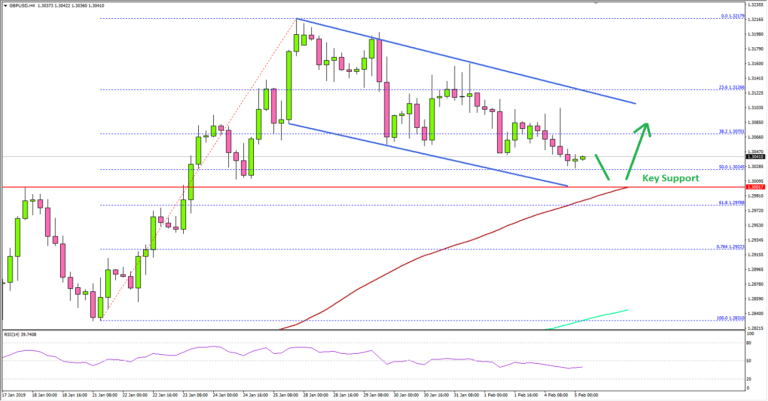
Looking at the 4-hours chart, the pair declined below the 1.3180 and 1.3150 support levels to start a downside correction. Sellers even pushed the price below the 38.2% Fib retracement level of the last wave from the 1.2830 swing low to 1.3217 high.
However, there are many key supports on the downside, starting with the 1.3020 level and the 50% Fib retracement level of the last wave from the 1.2830 swing low to 1.3217 high.
The main support is near the 1.3000 handle and the 100 (red) simple moving average (4-hours). If there is a daily close below 1.3000, the pair could accelerate losses towards the 1.2920 support level.
On the upside, there is a strong resistance formed near 1.3120 and a declining channel on the same chart. A successful break above the channel resistance will most likely open the doors for a fresh rise towards the 1.3200 and 1.3220 levels.
Fundamentally, the UK Construction PMI for Jan 2019 was released recently by the Chartered Institute of Purchasing & Supply and Markit Economics. The market was looking for a minor drop in the PMI from 52.8 to 52.4.
However, the result was disappointing as the UK Construction PMI dropped to 50.6 and just managed to stay in the expansion zone. The report stated:
January data pointed to a loss of momentum for the UK construction sector, with business activity growth easing to its weakest for ten months. New orders increased only marginally at the start of 2019, which contributed to the slowest expansion of employment numbers for two-and-a-half years.
Overall, the GBP/USD pair might correct further in the short term, but the 1.3000 support area could play an important role in the next move.
Economic Releases to Watch Today
- Germany’s Services PMI for Jan 2019 – Forecast 53.1, versus 53.1 previous.
- Euro Zone Services PMI for Jan 2019 – Forecast 50.8, versus 50.8 previous.
- UK Services PMI for Jan 2019 – Forecast 51.0, versus 51.6 previous.
- US Services PMI for Jan 2019 – Forecast 54.2, versus 54.2 previous.
- US ISM Non-Manufacturing Index for Jan 2019 – Forecast 57.1, versus 58.0 previous.
Eco Data 2/5/19
[php_everywhere instance="1"]
RBA to Tell the Same Story But With Different Language
Following the Fed, the RBA comes next in line to decide on monetary policy. The first meeting of 2019 at 0330 GMT on Tuesday is expected to extend the historic period of inaction to 29 months, though with the Fed, the world’s most influential central bank, shifting outlook to neutral, speculation is swirling that Australia’s central may appear more dovish this time. The event will be followed by a speech from the RBA governor, Philip Lowe, on Wednesday (0130 GMT) and updated economic forecasts mentioned in the Bank’s quarterly policy statement on Friday (0030 GMT).
After making markets believe that interest rates will rise at least two times in 2019, the Fed chief Jerome Powell made a U-turn at last Wednesday’s FOMC policy meeting, saying instead that the central bank will not raise borrowing costs until the data clarify that the economy is heading in the right direction. It is not that Fed policymakers doubt the healthy shape of the US economy but that headwinds such as the boiling US-Sino trade war, Brexit, and signs of economic weakness in China and the Eurozone, could potentially squeeze the global economy, dragging US economic activities downward as well.
With rate cut speculation now increasing in the US and elsewhere, and fears over a global economic slowdown heating, it would not be wise for the Reserve Bank of Australia to abandon its easy-policy approach at this point. Recall that the Bank refrained from easing its record stimulus during 2018 in the face of highly indebted households, subdued wages, and rising uncertainties surrounding the Chinese economy at a time when its overseas peers were moving ahead with their tightening plans. Even if the labour market showed improvement last year, with the unemployment rate dropping to seven-year lows, the advance in wages was insufficient to boost household spending and hence inflation towards the midpoint of the RBA’s 2-3% target band. Since this is still the case, and in consideration of a slowing housing market and a discouraged business sector, policymakers are anticipated to keep interest rates at the all-time low of 1.5% once again.
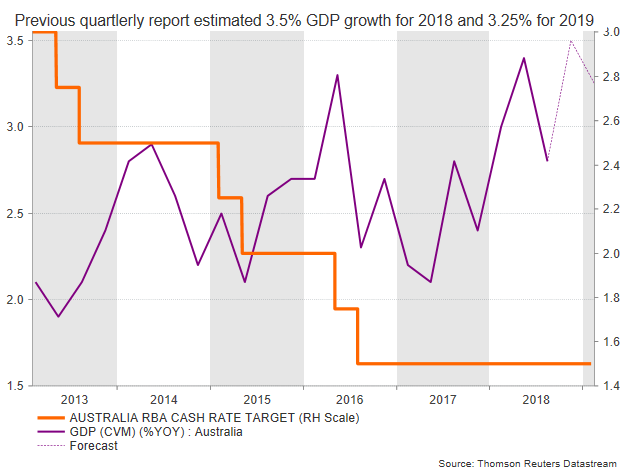
Powell’s dovish turn however, will likely affect sentiment within the RBA and it would be interesting to see whether the RBA has become worried enough to adjust the content of the rate statement. Specifically, a removal of the well-contained “next move up” phrase would confirm that policymakers have put rate hike plans to rest in the current time and are relying on data to shape the direction of interest rates. Such an action could also foresee Philip Lowe delivering a cautious speech on Wednesday and growth forecasts easing on Friday in fears the economy may appear relatively more sensitive to a contraction in global growth because of the importance of capital inflows and commodity exports. Consequently, the rate cut scenario may come back to the surface as well. Yet, some board members attempted to discard such expectations last week, with Ian Harper, one of the nine policy setters, putting faith that the next move in interest rates is likely to be higher.
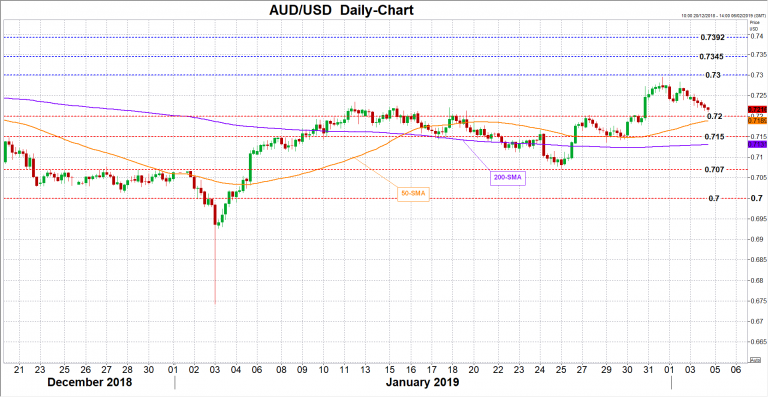
In FX markets, even if some degree of dovishness has been already priced in, AUDUSD would still bear the negative consequences if the RBA softens its language. The pair could find immediate support within the 0.72-0.7150 area where the 50-period moving average is currently trending. Breaking that range, the next stop could be near the 0.7070 resistance-turned support level., while lower the way could open towards the 0.70 round level.
Alternatively, should the RBA envision higher interest rates in the future, painting a more rosy outlook for the Australian economy than analysts expect, the price could crawl up to 0.73. Another leg higher could hit resistance at 0.7345, while steeper increases may also retest the December high of 0.7392.
It is also worth noting that beyond the RBA rate decision, data on retail sales and trade balance will be separately handed at 0030 GMT on Tuesday.
Elliott Wave Analysis: GBP/JPY Update
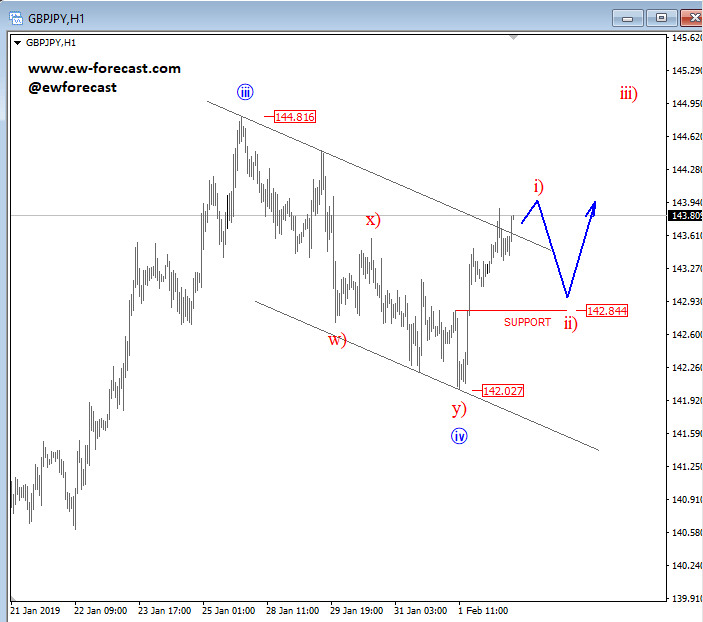
GBPJPY is nicely recovering from the 142.02 level, giving us an idea that corrective wave iv as part of a bigger, bullish cycle is completed, and that final wave v is in play. In such case we labelled current leg up as sub-wave i) of v, which can once completed push price into a temporary pullback, labelled as wave ii), that can look for support and a bounce near the 142.84 level.
A decisive break above the Elliott wave corrective channel line would favor a bullish continuation. GBPJPY, 1h
Sunset Market Commentary
Markets
Global core bonds lost ground today even as risk sentiment slightly deteriorated. Asian markets performed mixed this morning with Chinese markets closed for the week. The economic calendar was feathery light today, with in the Eurozone only the February Sentix Investor Confidence and producer inflation for December. The former disappointed (-3.7 vs. -1.3 exp.), as did the latter (-0.8% (M/M) vs. -0.5% exp.). ECB Governing Council member Nowotny said he doesn’t expect a recession in Europe and sees higher core inflation this year as wage developments impact the underlying price pressures. The German yield curve edged higher with changes in the range of 0.1 bp (30-yr) to +1 bp (2-yr). US Treasuries moved steady throughout the day but turned south once US investors joined the debates. With nothing on the US eco calendar, risk sentiment will dominate US trading. US equities opened flat .The US yield curve moves higher with changes up to 3.4 bps (10-yr). Italian BTP’s initially fell as Bank of Italy Governor Ignazio Visco warned over the weekend for less favorable prospects for the Italian economy. However, BTP’s reversed the opening move as the Italian 10-yr yield bounced off 2.8% resistance. The Italian spread over the German 10-yr yield widens 2 bps. Other peripheral spreads are steady.
There was no compelling story to inspire any directional price action in the EUR/USD cross rate today. The pair was paralyzed in a tight range in the mid-1.14 area. Last week’s U-turn in the Fed’s communication is discounted and this apparently also applies for recent poor EMU eco news. Euro weakness and USD softness are basically keeping each other in balance. Some external event risk (US-Sino trade talks, Brexit,….) is probably needed to break this stalemate. The intraday balance tilted slightly in favour for the dollar this afternoon a s US traders came in. However, for now, EUR/USD is firmly holding in the 1.12/15 consolidation pattern. This morning, USD/JPY cautiously extended Friday’s gain. The yen-decline took a breather as European equities traded with are cautious negative bias. Yen selling resumed as core (EMU and US) yields ticked slightly higher this afternoon. USD/JPY is extensively testing the 110 barrier.
EUR/GBP hovered in the mid-0.87 area in Asia and early in Europe this morning. In line with last week’s price action, investor caution on sterling prevailed. EU policy markets are holding the line that no new withdrawal deal is possible. The January construction PMI printed softer than expected this morning (50.6 from 52.8 vs 52.6 forecast), as was the case for the manufacturing PMI last week. Sterling was already under modest pressure in the run-up to the release and settled in the 0.8760/75 area afterward. Cable is also on a downward ST trajectory and dropped back to the 1.3050 area.
News Headlines
The ECB published an article of driving factors of risks to domestic demand in the EMU. They conclude that domestic demand growth, in particular private consumption, will remain a key driver of activity over the next few years, albeit with a diminishing contribution, reflecting the expected maturing of the business cycle. Meanwhile, increasing uncertainties at the global level constitute a downside risk to the outlook, particularly for business investment.
The Slovak Finance Ministry has cut its growth outlook for 2019 (4% from 4.5%) and 2020 (3.7% from 3.9%). The downgrade reflects the slowdown in one of the biggest Slovak trading partners, Germany. The setback in foreign demand should be offset by rising output at the Jaguar Land Rover plant which opened last year. FM Kazimir still expects a balanced budget next year despite the growth forecast downgrades.
EU Selmayr: Nobody is considering tweak on Irish backstop
European Commission Secretary-General Martin Selmayr denied reports that the EU is considering tweaks on the Irish Backstop in Brexit Withdrawal Agreement. He tweeted that "On the EU side, nobody is considering this. Asked whether any assurance would help to get the Withdrawal Agreement through the Commons, the answers of MPs were inconclusive." And he added that "the meeting confirmed that the EU did well to start its no deal preparations in December 2017."
Ireland's Foreign Minister Simon Coveney also said he had heard of no "alternative arrangements" on Irish backstop that would work. He said "the problem has been that none of those ideas around alternative arrangements have actually stood up to scrutiny. We certainly haven't seen any that have". He added that "We spent well over a year looking at different ways of providing the guarantee of no physical border infrastructure on the island of Ireland to protect an all Ireland economy which reinforces a peace process. Many hours were involved with coming up with a legally credible and pragmatic solution,"
And Coveny said, "I have yet to hear any new thinking that goes beyond what's already been tested. What Ireland is being asked to do by some in Westminster is to essentially do away with an agreed solution between the UK government and EU negotiators and to replace it with wishful thinking. That is a very unreasonable request to ask the Irish government to be flexible on."
USD/JPY – Dollar Punches Past 110 as Yen Slips
USD/JPY has posted considerable gains in the Monday session, continuing the upward trend seen on Friday. In North American trade, the pair is trading at 109.95, up 0.41% on the day. It’s a quiet day on the release front, with no major indicators. On Tuesday, the key event is ISM Non-manufacturing PMI.
Japanese manufacturing PMI slipped to 50.3 in January, down from 52.6 points a month earlier. This was the weakest score since August 2016 and points to stagnation in the manufacturing sector. The ongoing global trade war has taken a toll on Japanese exports, which is turn has dampened the manufacturing industry. The U.S-China trade spat has been the catalyst behind the global trade war, and investors are cautiously optimistic that negotiations between the sides will continue and that a threat by the U.S. to impose further sanctions on March 1 will be avoided.
In the U.S., the week ended with mixed employment numbers. The economy created 304 thousand jobs, crushing the estimate of 165 thousand. This was the second score above the 300-thousand mark for a second successive month. However, wage growth was a disappointment, dropping from 0.4% to 0.1%. This fell shy of the estimate of 0.3% and marked the weakest reading since April 2018.
EUR/USD Mid-Day Outlook
Daily Pivots: (S1) 1.1431; (P) 1.1460; (R1) 1.1485; More.....
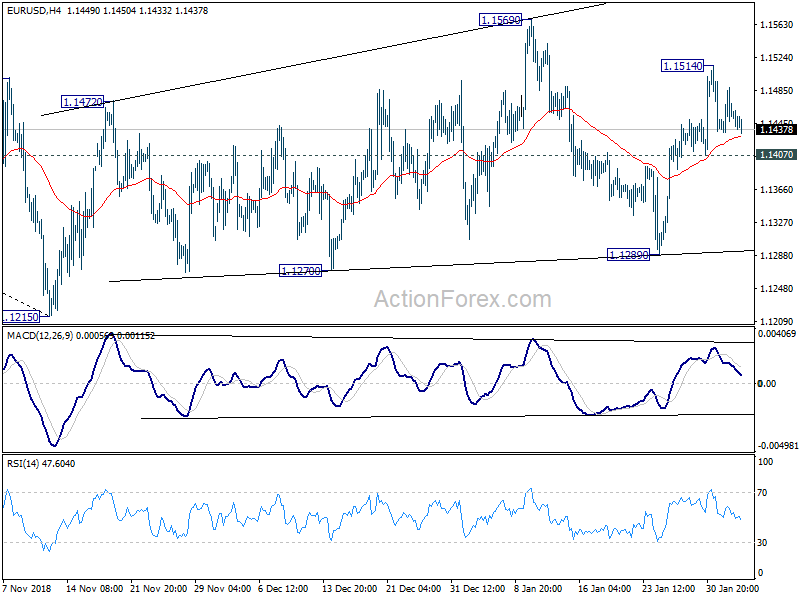
EUR/USD is staying in range of 1.1407/1514 and intraday bias remains neutral. Another rise is mildly in favor with 1.1407 minor support intact. Rise from 1.1289 is seen as another rising leg in the correction pattern from 1.1215. Above 1.1514 will target 1.1569 resistance and above. On the downside, break of 1.1407 minor support will turn bias back to the downside for 1.1289 support instead.
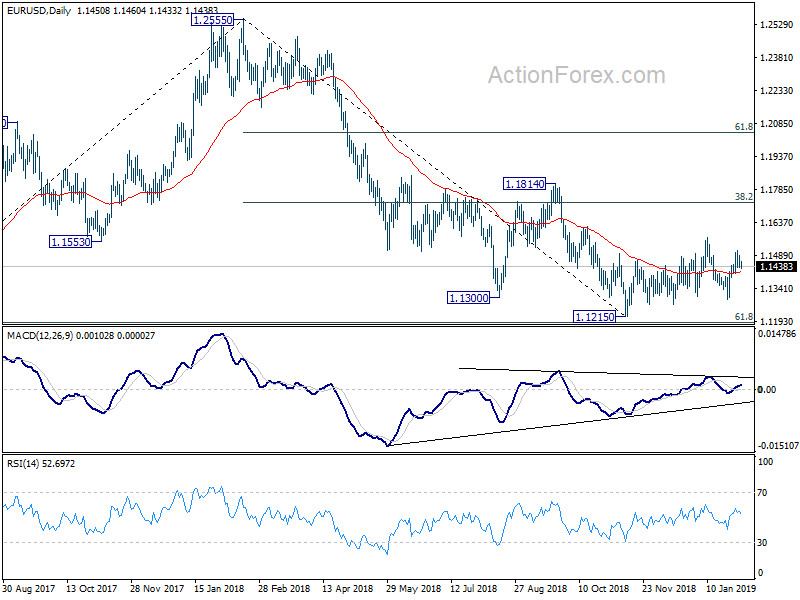
In the bigger picture, as long as 1.1814 resistance holds, down trend down trend from 1.2555 medium term top is still in progress and should target 61.8% retracement of 1.0339 (2017 low) to 1.2555 at 1.1186 next. Sustained break there will pave the way to retest 1.0339. However, break of 1.1814 will confirm completion of such down trend and turn medium term outlook bullish.
GBP/USD Mid-Day Outlook
Daily Pivots: (S1) 1.3046; (P) 1.3081; (R1) 1.3118; More....
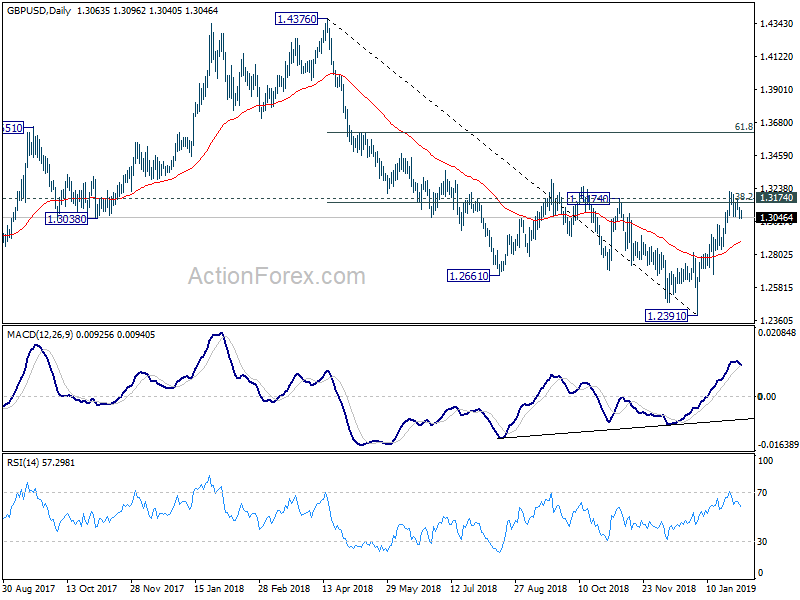
GBP/USD is still bounded in range of 1.3012/3217 and intraday bias remains neutral first. On the downside, break of 1.3012 minor support will suggest rejection by 1.3174 key resistance, and turn bias to the downside for 1.2814 support. On the upside, sustained break of 1.3174 key resistance will argue that whole decline from 1.4376 has completed at 1.2391. In such case, further rise should then be seen to 61.8% retracement of 1.4376 to 1.2391 at 1.3618.
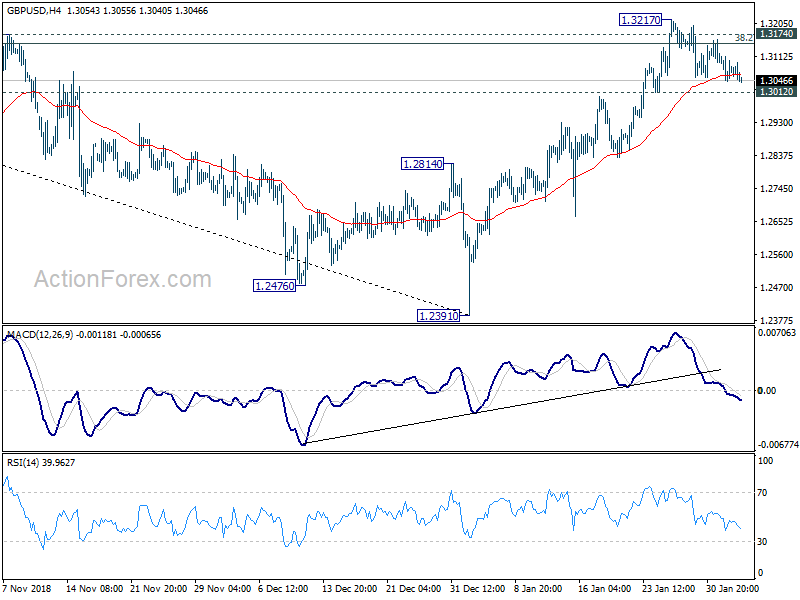
In the bigger picture, rise from 1.1946 (2016 low) to 1.4376 (2018 high) is seen as a corrective move. Similarly, fall from 1.4376 to 1.2391 also displace a corrective structure. Current development suggests that rise from 1.2391 is the third leg of the corrective pattern from 1.1946 and could extend beyond 1.4376 high. Firm break of 61.8% retracement of 1.4376 to 1.2391 at 1.3618 will affirm this case. On the downside, break of 55 day EMA (now at 1.2865) will turn focus back to 1.2391 low instead.