Sample Category Title
U.S. Dollar Falls Expect To Be Limited
Monday February 4: Five things the markets are talking about
Global equities hover atop of their four-month highs while the ‘big' dollar holds firm after last Friday's solid non-farm payroll (NFP) report and this despite inconclusive Sino-U.S trade talks stateside last week.
Trading overnight was subdued with many of the Asian markets closed for the Lunar New Year.
On the Brexit front, European Commissioner Juncker said that PM Theresa May's bid to reopen the U.K's divorce deal with the EU has increased the chances of a “disorderly Brexit” and that EU leaders should prepare for the worst.
The EU has offered no signs of giving any concessions to the U.K over the next few weeks. Nevertheless, PM May is still planning on going to Brussels to make her case. The EU seems set “not” to offer her anything until after the U.K has another vote on February 14th.
The next move for investors' risk appetite will likely be dictated by ongoing U.S corporate earnings for this week.
On tap, tomorrow, the Reserve Bank of Australia (RBA), and on Thursday, the Bank of England (BoE) will deliver their respective monetary policy announcements. Also, on Thursday, investors will also see industrial production from Germany, which has been weak, and from France and Italy both out on Friday. Elsewhere, CAD trade balance & U.S ISM non-manufacturing PMI (Feb 5), U.S advanced GDP, retail sales & NZD unemployment (Feb 6) and CAD employment (Feb 8).
Note: Beginning today, the market can expect to start getting some of the U.S data we missed from the U.S government shutdown – GDP, personal income and spending.
Finally, tomorrow evening, U.S President Donald Trump will deliver his delayed State of the Union (9pm EDT).
1. Stocks see green in thin trading
Global equity markets performed strongly last week after the Fed pledged to be patient with further interest rate hikes, signaling a potential end to its tightening cycle.
In Japan overnight, the Nikkei booked moderate gains (+0.5%) amid strength in commodity and brokerage stocks and overcame a slump in electronics (Sony was down -8%). Elsewhere, all but one of the 33 Topix sectors rallied overnight following Friday's strong U.S jobs report. The broader Topix gained +1.1%.
Down-under, Aussie stocks climbed to new session highs before the close, as investors took some late positions ahead of a long-awaited report on alleged financial-sector wrongdoing. The review has pressured both financial and insurance stocks for the past 12-months, the ASX 200 rallied +0.5%.
Note: China's financial markets are closed all week, while those in S. Korea are shut until Thursday.
In Hong Kong, equities edged a tad higher in half-day trading overnight, on the back of mildly positive data on the Chinese economy. The Hang Seng index closed up +0.2%, while the Hang Seng China Enterprises index fell -0.3%.
In Europe, regional bourses trade flat to slightly higher ahead of a busy week for corporate earnings as China is closed for the lunar New Year.
U.S stocks are set to open in the ‘black' (+0.11%).
Indices: Stoxx600 +0.02% at 359.76, FTSE +0.27% at 7,039.05, DAX +0.03% at 11,184.08, CAC-40 -0.23% at 5,007.57, IBEX-35 -0.23% at 8,998.80, FTSE MIB +0.29% at 19,633.50, SMI +0.08% at 9,005.50, S&P 500 Futures +0.11%
2. Oil hits 2019 high on Venezuela sanction and OPEC, gold lower
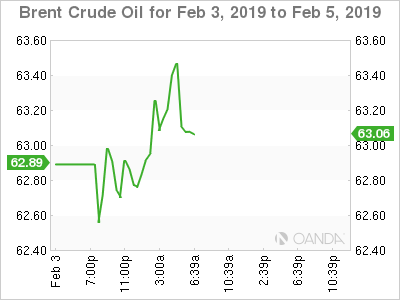
Oil hit a new 2019 high in Europe this morning as OPEC-led supply cuts and U.S sanctions against Venezuela's petroleum industry offset forecasts of weaker demand and an economic slowdown.
Brent crude hit +$63.40 a barrel, the highest since Dec. 7, and is up +49c at +$63.24. Elsewhere, U.S crude (WTI) hit a 2019 high of +$55.68 and was later up +9c at +$55.35.
Analysts note that there are currently little signs of any overhang in the market now that the U.S has imposed sanctions on Venezuela, on top of the reduced supply from Saudi Arabia.
Note: Last week, the U.S administration announced export sanctions against state-owned oil firm Petroleos de Venezuela SA (approx. +500k bpd) – this has led to some disruption for oil refineries on the Gulf coast. They have had to seek alternative heavy crude supplies from Canada.
OPEC supply fell this month by the largest amount in two-years, which has helped to offset limited compliance so far by non-OPEC Russia.
While OPEC cuts, the U.S continues willing to expand its supply. However, data on Friday showed a drop in the number of U.S oil rigs on line to their lowest in eight-months, lending temporary prices some support.
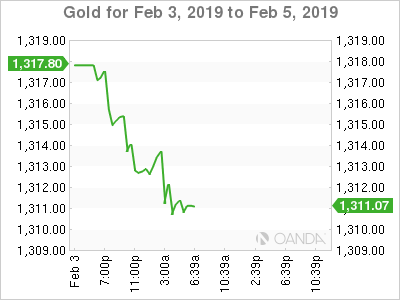
Ahead of the U.S open, gold prices have fallen in thin trade as risk-aversion recedes amid some signs of progress in Sino-U.S trade talks and as the dollar firmed. Spot gold has fallen about -0.4% to +$1,313.38 per ounce, after having hit +$1,326.30 last week – its highest level since April 26.
3. Italian sovereign yields back up aggressively
Italy's government borrowing costs have rallied to their highest level in three-weeks in the Euro session, pushed up by heightened concern that the Italian economic outlook will worsen the country's fiscal position.
Across the Italian curve, BTP yields have backed up an aggressive +8 bps as data last week confirmed that Italy's economy had slipped into a recession in Q4, 2018. With Italian manufacturing activity contracting for a fourth consecutive month in January suggests that things could get worse for the economy. The spread of Italy's 10-year BTP's over Germany's advanced +3 bps to +2.61% to the widest in almost three-weeks.
Weaker data in general has been supporting eurozone bond markets as investors bet the ECB will keep record-low rates in place for longer. Germany's 10-year Bund yield has climbed less than +1 bps to +0.17%.
Elsewhere, the yield on 10-year Treasuries has increased by +1bps to +2.70%, while in the U.K, the 10-year Gilt yield has climbed +2 bps to +1.268%, the biggest increase in more than a week.
Note: While no monetary policy changes are expected by the BoE on Thursday, Governor Carney could revise down its above-trend U.K. economic growth expectations. Continued Brexit uncertainty coupled with weaker economic news would be reason enough to lower projections.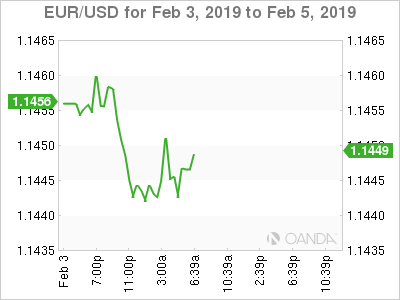
4. Dollar in demand for the moment
The USD is holding onto its recent ranges despite the recent ‘dovish' FOMC statement last week. Last Friday's strong payroll number is helping to support the dollar ‘bulls' course of action as U.S growth remains quite strong.
The pound (£1.3053) has slumped to below the psychological £1.3100 handle outright as the U.K parliamentary vote last week still does not entirely rule out a ‘no-deal' Brexit – PM May is again tasked with attempting to re-open negotiations (including a possible delay) with the E.U. It looks like the Brexit process will ‘go down to the wire' – the current deadline for the U.K to leave the E.U is March 29. The E.U has been very forthright in their views and what they are willing to accept and not accept. PM May can expect a hostile greeting from its E.U partners as she attempts reopen closed doors.
EUR/USD little changed in session at €1.1450 area.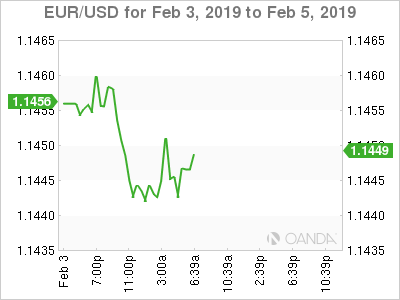
5. Eurozone producer prices slip more than expected
Data this morning from Eurostat showed Eurozone producer prices fell more than expected month-on-month in December, pressured mostly by cheaper energy – prices fell -2.6% in December and rose +7.7% y/y.
Analysts had expected a -0.6% monthly fall and a +3.2% annual rise.
Note: Ex-energy costs, producer prices fell only -0.1% on the month, and were +1.3% higher year-on-year.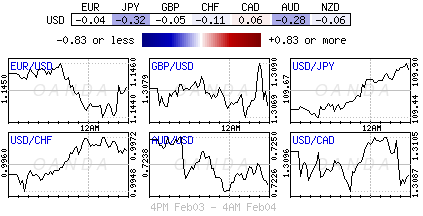
EUR/USD Starts Week With A Whimper
EUR/USD is showing little movement in the Monday session. Currently, the pair is trading at 1.1450, up 0.05% on the day. There are no major events on the schedule. Eurozone Sentix Investor Confidence posted a third successive decline, with a score of -3.7 points. On the inflation front, PPI disappointed with a decline of 0.8%, its weakest reading since January 2016. On Tuesday, Germany and the eurozone release services PMIs. The eurozone will also publish retail sales. In the U.S, the key event is ISM Non-manufacturing PMI.
German numbers continue to sag, raising concerns about the health of the eurozone economy. On Friday, German manufacturing PMI for January dipped to 49.7, below the 50-point level which separates contraction and expansion. This was the weakest score since October 2014. Trade tensions and weakness in the German auto sector continue to weigh on the manufacturing sector. This reading followed a very soft reading from German retail sales, which plunged 4.3% in December. This marked its sharpest decline in more than 12 years.
In the U.S., the week ended with mixed employment numbers. The economy created 304 thousand jobs, crushing the estimate of 165 thousand. This was the second score above the 300-thousand mark for a second successive month. However, wage growth was a disappointment, dropping from 0.4% to 0.1%. This fell shy of the estimate of 0.3% and marked the weakest reading since April 2018. Despite the sparkling non-farm payrolls, the dollar was unable to make any gains against the euro, as dollar bulls focused on the weak wage growth numbers. As well, enthusiasm for the greenback was dampened by the dovish message from the Fed in its first monetary policy update of 2019. Fed chair Powell reinforced the sentiment that the Fed will ease up on rate policy, saying the central bank would be “patient” regarding future rate hikes.
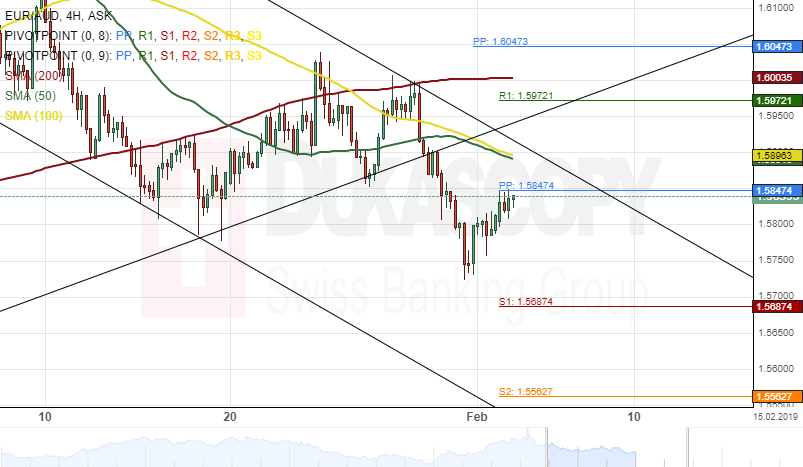
EUR/AUD 4H Chart: Weekly Buy Signals
The Eurozone single currency has depreciated about 1.76% against the Australian Dollar during the last one week. The decline started when the currency pair tested the 200-hour simple moving average at 1.5972.
As for the near future, it is likely that the exchange rate will continue its journey south. The potential downside target during the following trading session will be near the lower boundary of an ascending channel pattern at 1.5419.
However, technical indicators flash strong buy signals on the weekly time-frame chart. If this signal is accurate, a possible upside reversal from a support level formed by the weekly S1 at 1.5687 could be expected.
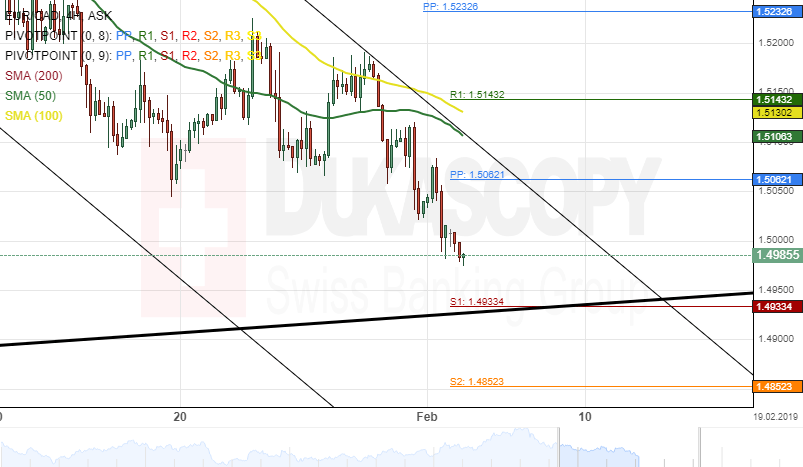
EUR/CAD 4H Chart: Moving Towards 1.4933
The single European currency has continued to edge lower against the Canadian Dollar. The exchange rate has depreciated about 215 base points during the last week.
The currency pair tested the upper boundary of a descending channel pattern at 1.5194 on January 30 and followed by a downside movement.
The short-term target for bearish traders will be near a support level formed by the lower boundary of a dominant ascending channel at 1.4933.
A possible upside reversal could follow from the support level as mentioned above.
Euro Regional Data Remains Soft
Notes/Observations
- Subdued session in Europe; China markets closed for Lunar New Year holiday
- European data remains on soft footing; Euro Zone Feb Sentix Investor Confidence at a fresh 4-year low; UK Jan Construction PMI at a 10-month low
Asia:
- Lunar New Year holiday has China markets closed all week
- China Jan Caixin Services PMI: 53.6 v 53.4e
Europe:
- UK PM May office denies report related to June 6th election plan (Note: w/e press article suggested advisers to PM May were considering holding elections on June 6th under a plan where the Brexit was delayed past March 29th).
- Alternative Arrangements Working Group will begin a 3-day meeting on Monday, Feb 4th for talks to find another way of avoiding an Irish border
- Bank of Italy Gov Visco: There were internal and external downside risks for Italy's growth. Saw significant downside risks to Italy's 2019 GDP growth forecast of +0.6%; interest rates on govt bonds also a significant risk
- Renewed speculation that Germany was looking at €24.7B budget shortfall by 2023. A previous article cited that if spending was not tightened because tax revenues were expected to decline amid higher public sector wage costs.
Americas:
- Fed's Kashkari (dove, non-voter): Chairman Powell is coming around to the view that more rate hikes are not needed
Macro
- (UK) United Kingdom: The government and members of parliament who collectively form the new created Alternative Arrangements Working Group will convene today through to Wednesday to try and come up with an alternative solution to the Irish backstop, the ideas from which PM May will return to Brussels with. The EU has continued to pre-emptively reject it with the Irish PM stating over the weekend that it was "very frustrating" that the UK government was "going back to the idea of technology." If the EU rejects whatever proposals are put forward then the Withdrawal Agreement will remain unmodified and likely to be voted down next week, although May could under this scenario simply just cancel the vote altogether.
- (EU) Eurozone: ECB's Nowotny said he doesn't expect a recession in the Eurozone, despite a lot of economic uncertainty, especially around the situation in Germany. "The ECB is a fact based institution - when we have reliable developments we have to discuss". Nowotny has been pushing for further policy normalization sooner rather than later but his comments suggests slight shift in rhetoric and even the most hawkish of board members are starting to worry about the poor run of economic data.
SPEAKERS/FIXED INCOME/FX/COMMODITIES/ERRATUM
Equities
- Indices [Stoxx600 +0.02% at 359.76, FTSE +0.27% at 7,039.05, DAX +0.03% at 11,184.08, CAC-40 -0.23% at 5,007.57, IBEX-35 -0.23% at 8,998.80, FTSE MIB +0.29% at 19,633.50, SMI +0.08% at 9,005.50, S&P 500 Futures +0.11%]
- Market Focal Points/Key Themes: Equities European Indices trade flat to slightly higher tracking slightly higher US futures overnight ahead of a busy week for corporate earnings as China is closed for the week for lunar New Year. On the corporate front Wirecard trades sharply higher following weakness last week after an investigation found no evidence to support allegations wrong doing by senior executives. On the earnings front CompuGroup rises on strong earnings and Revenue growth; with Kainos Group and Tissue Regenix among other trading higher on trading updates. Meanwhile Ryanair falls sharply after reporting a Q3 loss while affirming their recently lowered guidance; Julius Baer is another notable faller after earnings missed consensus. In other notable news, Gensight Biologics plummets after its Rescue Phase III trial failed to meet primary endpoint; Panlpina also declines as major shareholders does not support proposed acquisition by DSV. Looking ahead notable earners include Sysco Corp, Johnson Outdoor, and Alexion Pharmaceutical among others.
- Consumer discretionary: Ryanair [RYA.UK] -4.5% (earnings), Wizz Air Holdings [WIZZ.UK] +0.5% (load factor)
- Materials: Ferrexpo [FXPO.UK] -7.5% (to conduct review amid discrepancies in bank statements)
- Financials: Julius Baer [BAER.CH] -4.5% (earnings; cost reduction program)
- Healthcare: argenx [ARGX.BE] +2.5% (collaboration), Tissue Regenix Group [TRX.UK] 0.5% (trading update), GenSight Biologics [SIGHT.FR] -17.5% (study results), Curetis [CURE.NL] +6% (regulatory approval)
- Industrials: Stabilus [STM.DE] -2.5% (earnings; outlook cut), Panalpina [PWTN.CH] -8.5%, DSV [DSV.DK] -3.5% (Panalpina's largest shareholder does not support DSV's takeover offer), RPS Group [RPS.UK] +8.5% (trading update; acquisition)
- Technology: Wirecard [WDI.DE] +15.5% (issues statement on internal investigation), Kainos Group [KNOS.UK] +5.5% (trading update), Compugroup [COP.DE] +10% (earnings)
Speakers
- ECB's Nowotny (Austria): Would see an increase in core CPI; reiterated ECB stance that policy was data driven. Reiterated ECB Council stance that the region will not experience a recession
- ECB's Mersch (Luxembourg): Best solution is to integrate financial stability concerns into monetary policy at the European level
- UK MP Jacob Rees Mogg (Brexiteer): Would accept a Brexit deal that did not include the Irish backstop. Leaving the EU without a deal a rational decision; key would be having a functional govt after Brexit
- Ireland Fin Min Donohoe reiterated view that EU stands firmly behind Ireland on Brexit; will not take part in hard border. If no deal then would engage with UK and EU on border
Currencies/Fixed Income
- USD holding onto recent ranges despite the recent dovish FOMC. Greenback aided by a recent strong payroll report. Analysts note that headline message was that US growth still looked quite strong currently and in?ation pressures were not announcing themselves at the moment.
- EUR/USD little changed in session at 1.1450 area.
- GBP/USD lower by 0.3% at 1.3055 as the UK continued to find common ground among its Parliamentary members to secure a Brexit deal.
Economic Data
- (TR) Turkey Jan CPI M/M: 1.0% v 1.0%e; Y/Y: 20.4% v 20.3%e; CPI Core Index Y/Y: 19.0% v 19.0%e
- (TR) Turkey Jan PPI M/M: +0.5% v -2.2% prior; Y/Y: 32.9% v 32.2%e
- (BR) Brazil Jan FIPE CPI (Sao Paulo) M/M: 0.6% v 0.6%e
- (ES) Spain Jan Net Unemployment M/M: +83.5K v +62.5Ke
- (CH) Swiss Total Sight Deposits w/e Feb 1st (CHF): 576.2B v 576.7B prior; Domestic Sight Deposits: 482.7B v 481.7B prior
- (EU) Euro Zone Feb Sentix Investor Confidence: -3.7 v -1.3e (lowest since Nov 2014)
- (UK) Jan Construction PMI: 50.6 v 52.5e (10th month of expansion but lowest since March)
- (EU) Euro Zone Dec PPI M/M: -0.8% v -0.5%e; Y/Y: 3.0% v 3.1%e
- (IT) Italy Jan Preliminary CPI M/M: 0.1% v 0.1%e; Y/Y: 0.9% v 0.9%e
- (IT) Italy Jan Preliminary CPI EU Harmonized M/M: -1.7% v -1.9%e; Y/Y: 0.9% v 0.8%e
Fixed Income Issuance
- (NO) Norway sold NOK2.0B vs. NOK2.0B indicated in 6-month bills; Avg Yield: 0.99% v 0.82% prior; Bid-to-cover: 2.22x v 2.93x prior
Looking Ahead
- (RU) Russia Dec Sovereign Wealth Funds: Wellbeing Fund: $58.1B prior
- 05:25 (BR) Brazil Central Bank Weekly Economists Survey
- 05:30 (NL) Netherlands Debt Agency (DSTA) to sell €1.0-2.0B in 6-month bills
- 06:00 (IL) Israel to sell 2023, 2026, 2027 and 2028 bonds - 06:45 (US) Daily Libor Fixing
- 07:00 (CL) Chile Dec Retail Sales Y/Y: 3.0%e v -0.8% prior; Commercial Activity Y/Y: No est v 0.6% prior
- 08:00 (SG) Singapore Jan Purchasing Managers Index: No est v 51.1 prior; Electronics Sector Index: No est v 49.8 prior
- 08:00 (RU) Russia Annual 2018 GDP Y/Y: 1.9%e v 1.5% prior
- 08:00 (UK) Baltic Dry Bulk Index
- 08:00 (ES) Spain Debt Agency (Tesoro) announces size of upcoming issuance
- 09:00 (FR) France Debt Agency (AFT) to sell combined €3.6-4.8B in 3-month. 6-month and 12-month Bills
- 09:00 (PT) ECB's Costa (Portugal at Conference on Companies
- 09:00 (IT) Italy PM Conte on plan for Income Support Scheme
- 09:45 (US) Jan ISM New York
- 10:00 (US) Nov Factory Orders: +0.3%e v -2.1% prior; Factory Orders (Ex-transportation): No est v 0.3% prior
- 10:00 (US) Nov Final Durable Goods Orders: 1.5%e v 0.8% prelim; Durables Ex-Transportation: 0.1%e v 0.3% prelim; Capital Goods Orders (Non-defense/ex-aircraft): +0.1%e v -0.6% prelim; Capital Goods Shipments (Non-defense/ex-aircraft): +0.1%e v -0.1% prelim
- 11:00 (DK) Denmark Jan Foreign Reserves (DKK): No est v 457.4 prior
- 11:30 (US) Treasury to sell 3-Month and 6-Month Bills
- 19:30 (US) Fed's Mester on Economic Outlook and Monetary Policy
During A Losing Trade
Here's an example of how proper inter-metal technical analysis can improve confidence during a losing trade. On Oct 16, we issued a LONG trade in silver for the Premium subscribers at 14.80 with the rationale that the impending inverted H&S formation was about to break above the neckline resistance. Well, it did not break it right away. Instead, silver continued to drop, extending towards the head (lows) of 13.96 over the ensuing 4 weeks. The stop remained at 13.80. So how did we manage the positon and thinking? (here's the snapshot of the trade below)
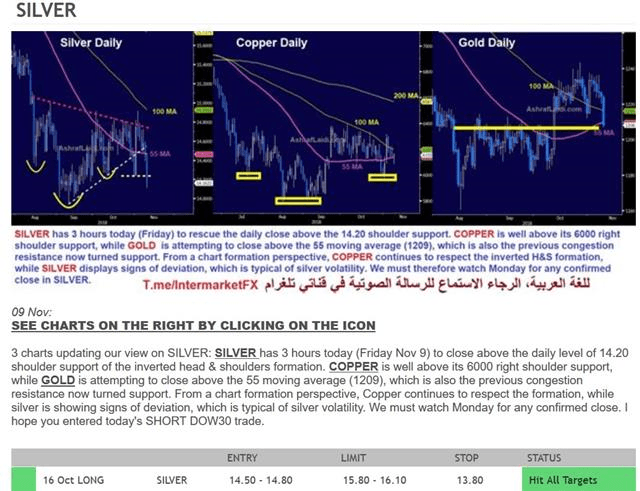
On Nov 9th (as the trade was deteriorating), I issued a trade update with 3 charts, highlighting my confidence in the silver long based on positive technical dynamics occurring in copper and gold, with each respecting key support levels. (Please see the text under the charts and feel free to look at your own charts for a better view). Gold remained above the trendline support from the Nov 14 lows and continued to chart a series of higher lows since the August lows, while copper continued to respect its right shoulder support. Some may say copper went on to break below the right shoulder later in early Jan and test the head (low). Yes, but by the time that occurred, silver was well off its low and gold remained above the Aug trendline support.
The message was crucial. Silver, being the smaller and relatively less liquid market was vulnerable to accelerating downside momentum, before gaining important support. A similar approach was applied to USDX vs EURUSD vs USDCNY. I long said in summer and autumn during the days of USD strength that only a break above 7.0 in USD/CNH would indicate the next leg-up in USD momentum and not EURUSD 1.11, USDJPY 115 or GBPUSD 1.26. Sometimes, it is invaluable to know where to look without moving the goal-posts too much.
ECB Nowotny: No perspective of a Eurozone recession
ECB Governing Council member Ewald Nowotny said on the sidelines of a conference today that growth uncertainty in the Eurozone has increased. However, the economy is only going through a slow down. He's optimistic that "we'll be able to overcome these negative influences". And more importantly, "there is no perspective of a recession." He also noted positives signs in underlying inflation due to rising wages.
Separately, Executive Board member Yves Mersch said "the best solution is to integrate financial stability concerns into monetary policy at the European level – including possible corrections with instruments at national levels." However, he's doubtful on a Eurozone wide authority to deal with stability. He said "I doubt that adding an additional European layer without a clear view of who is in charge with what instruments and for what objective will advance the issue". And, "the time is not ripe for an operationalized standalone macroprudential approach."
EUR/USD Stays At 1.1450
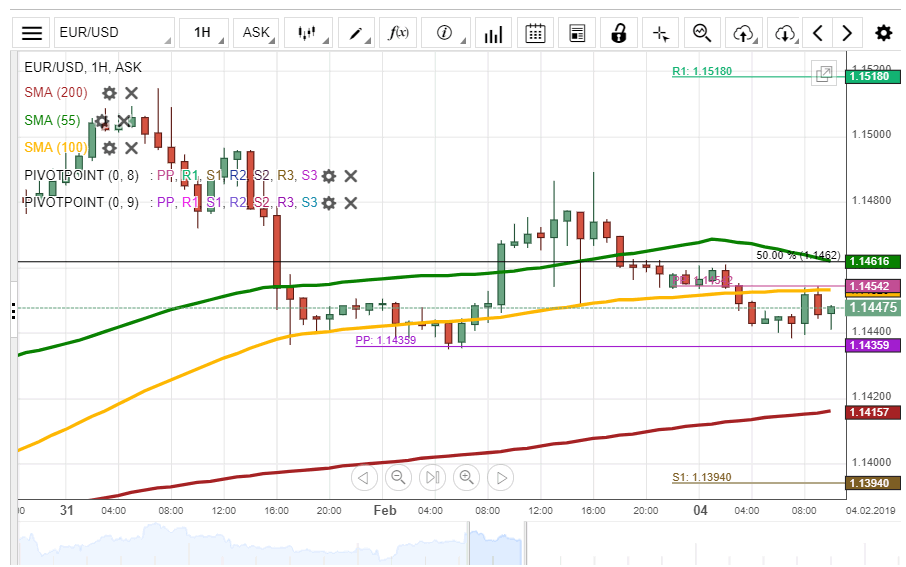
During Friday's trading session, the currency exchange rate passed through the support level of the 55-hour simple moving average to end the trading session at 1.1453. On Monday morning, the rate was located between the 55-hour and the 100-hour SMAs at the 1.1445 mark.
In regards to the near-term future, most likely, the European Single Currency will trade sideways to stay at 1.1450 during the day.
However, the weekly pivot point at the 1.1454 mark and the 55-hour simple moving average could retrace the rate to push it to pass through the support level of the monthly pivot point at 1.1435.
GBP/USD Depreciates To 1.3040 Level
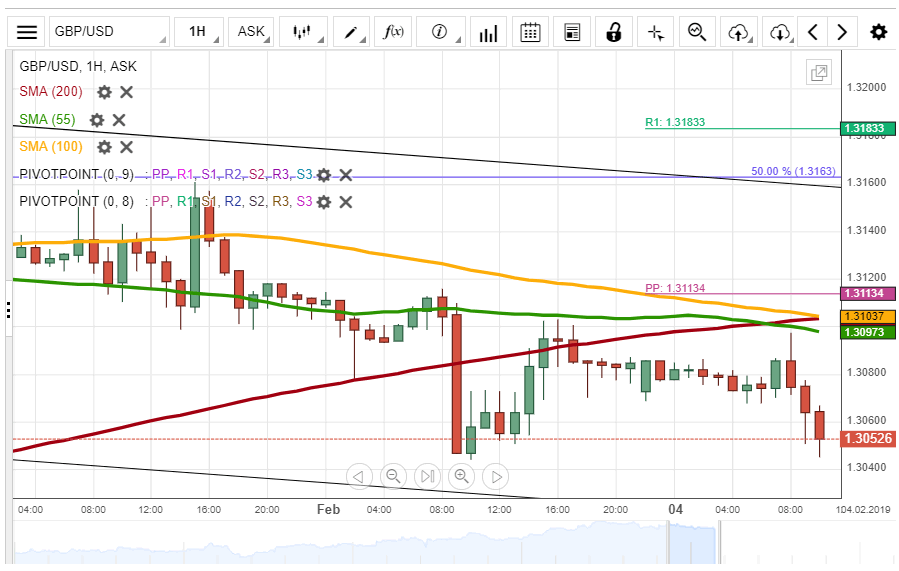
During Friday's trading session, the currency exchange rate was retraced by the 55-hour simple moving average to the 1.3060 level. On Monday morning, the British Pound kept depreciating against the US Dollar to the 1.3053 mark.
Most likely, the currency exchange rate will be trading downwards to the bottom boundary of the medium pattern line at the 1.3030 mark.
Besides, the simple moving averages at the 1.3100 mark retrace the rate to give an additional push for the British Pound to depreciate against the US Dollar to the 1.3020 level.
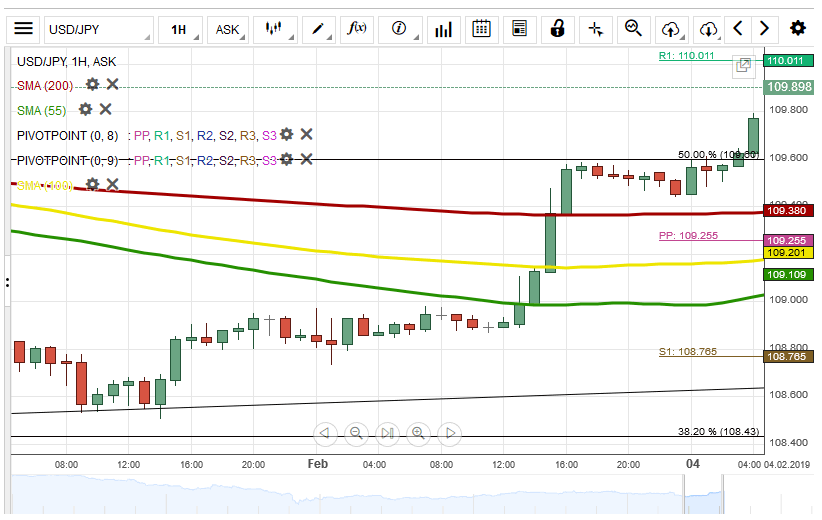
USD/JPY Will Break R1 At 110.01
During Friday's trading session, the currency exchange rate broke through the resistance levels of the simple moving averages to end the trading day at 109.40. On Monday morning, the rate broke the 50.00% Fibonacci retracement level to trade at the 109.88 mark.
In regards to the near-term future, most likely, the rate will break the descending dominant pattern line at the 110.35 mark to surge towards the 111.00 level.
On the other hand, the descending dominant pattern line could retrace the rate at the 110.35 mark to push the US Dollar to trade near the weekly R1 at 110.01.