Sample Category Title
USD/CHF Mid-Day Outlook
Daily Pivots: (S1) 0.9930; (P) 0.9947; (R1) 0.9972; More....
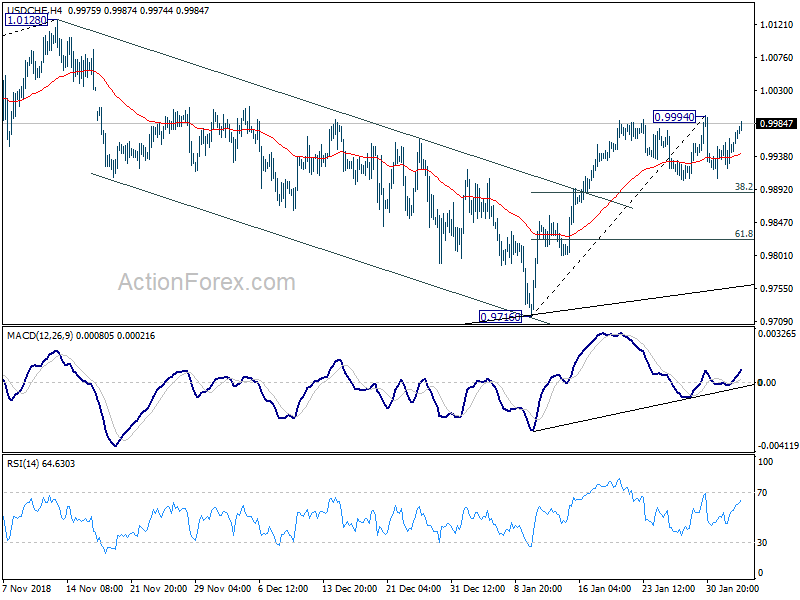
USD/CHF is staying below 0.9994 and intraday bias remains neutral first. Some more consolidation could be seen. But downside should be contained by 38.2% retracement of 0.9716 to 0.9994 at 0.9888 to bring another rally. As noted before, the corrective decline from 1.0128 should have completed at 0.9716 already. On the upside, break of 0.9994 will extend the rise from 0.9716 to retest 1.0128 next. On the downside, though, firm break of 0.9888 will target 61.8% retracement at 0.9822 before completing the retreat.
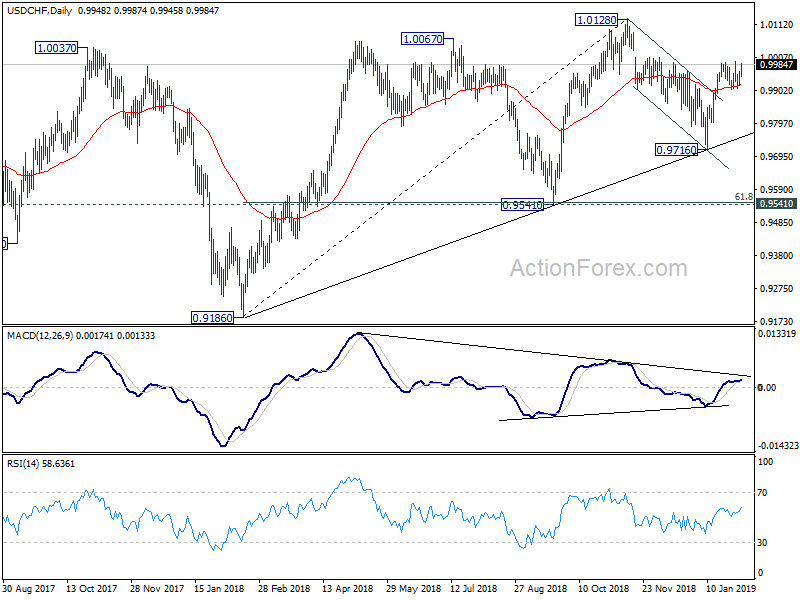
In the bigger picture, USD/CHF drew strong support from medium term trend line and rebounded. That suggests rise from 0.9186 is still in progress. Further break of 1.0128 will confirm up trend resumption and target 1.0342 key resistance. Nevertheless, break of 0.9716 will dampen this bullish view and at least bring deeper fall to 0.9541 key support.
USD/JPY: Looks To Extend Gain Above Key Resistance
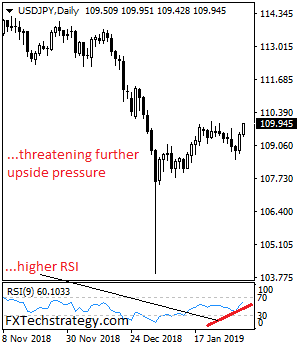
USDJPY looks to extend gain above key resistance located at 109.99 zone and beyond. On the upside, resistance comes in at 110.50 level. Above here will turn attention to the 111.00 level. Further out, we expect a possible move towards the 111.50 level if the earlier resistance is taken out. A break of here will open the door for more gain towards the 112.00. On the downside, support comes in at the 109.50 level where a break will target the 109.00 level. Below that level will turn focus to the 108.50 level and then lower towards the 108.00 level. On the whole, USDJPY faces further upside pressure.
USD/JPY Mid-Day Outlook
Daily Pivots: (S1) 108.95; (P) 109.27; (R1) 109.81; More...
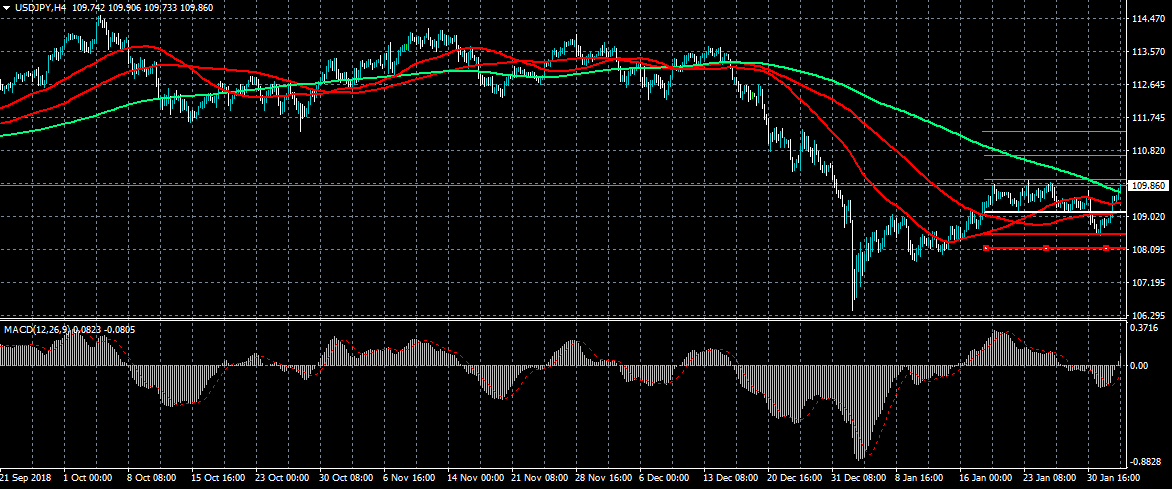
USD/JPY's break of 110.00 resistance suggests resumption of rebound from 104.69. Intraday bias is turned back to the upside for 61.8% retracement of 114.54 to 104.69 at 110.77. For now, we'd still expect strong resistance from there to limit upside. On the downside, break of 108.49 support will now confirm completion of the rebound and bring retest of 104.69 low. However, sustained trading above 110.77 will dampen our bearish view and target a test on 114.54 resistance instead.
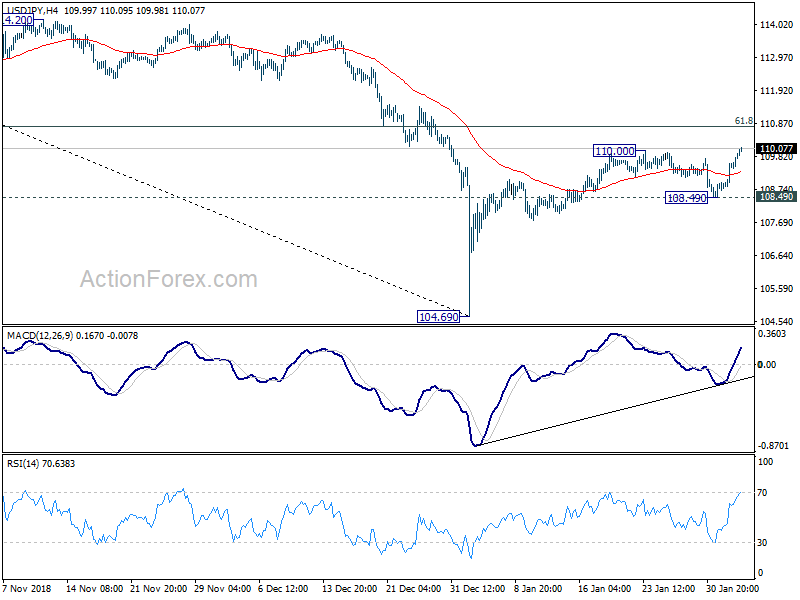
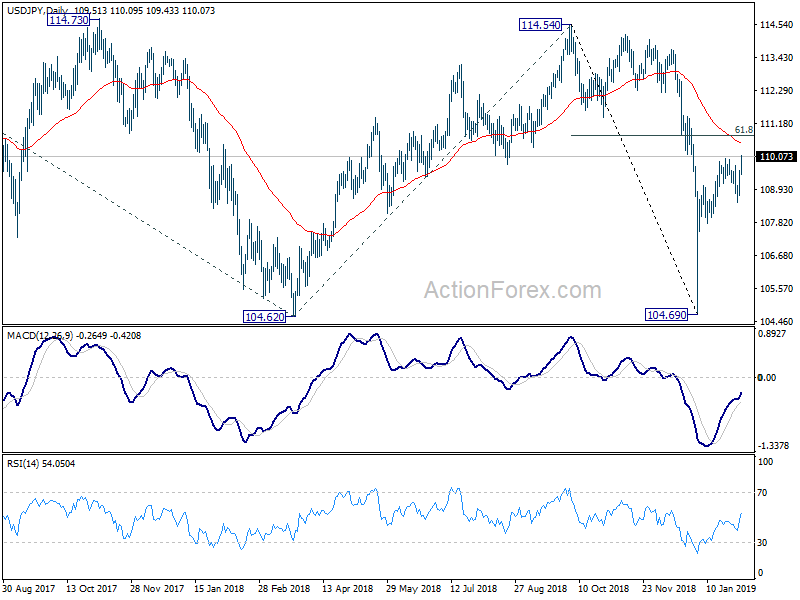
In the bigger picture, while the rebound from 104.69 is strong, there is no change in the view that it's a corrective move. That is, fall from 114.54, as part of the decline from 118.65 (2016 high), is not completed yet. Break of 104.62 will target 100% projection of 118.65 to 104.62 from 114.54 at 100.51, which is close to 100 psychological level. Nevertheless, sustained trading above 55 day EMA (now at 110.55) will dampen this bearish view and turn focus back to 114.54 resistance instead.
Yen Sold Off Broadly, Dollar Extends Recovery But Still Held Below Resistance Elsewhere
While Dollar is extending it's broad based recovery today, it's Yen's weakness that's worth more of a mention. There is no clear follow through in global stock rally today. Yet Yen is under broad based pressure and it's overtaking Aussie as the weakest one in early US session. Aussie, though, remains pressured as markets brace for tomorrow's RBA meeting and statement. There is no chance for RBA to move interest rate. But the accompanying statement could provide a dovish twist via information on the revised economic projections.
Technically, USD/JPY breaks 110.00 resistance and it's resuming the rebound from 104.69. EUR/JPY is also heading to 126 handle as equivalent rebound extends. For now, Dollar is held below near term resistance against Euro, Sterling, Swiss Franc, Aussie and Canadian. Thus, there is no confirmation on bottoming of the greenback yet. Rally in USD/JPY is more due to Yen's own weakness.
In European markets, currently, FTSE is up 0.18%. DAX is down -0.27%. CAC is down -0.59%. German 10-year yield is up 0.0055 at 0.173. Earlier in Asia, Nikkei rose 0.46%. Hong Kong HSI rose 0.21%. China started lunar new year holiday already. Singapore Strait Times dropped -0.13%. Japan 10-year JGB yield rose 0.008 to -0.012, staying negative.
Eurozone Sentix investor confidence: Growth forces weakening dangerously quickly and strongly
Eurozone Sentix Investor Confidence dropped to -3.7 in February, down from -1.5 and missed expectation of -1.1. That's the sixth decline in a row and the lowest level since November 2014. Current situation index dropped to 10.8, down from 18.0. That's also the sixth decline in a row and lowest since December 2016. Expectations index, however, improved from -19.3 to -17.3.
Sentix noted that "the bad news for the economy in Euroland is not abating." And, "at the current edge the growth forces seem to be weakening dangerously quickly and strongly." The main reason for the development was likely the approaching Brexit. And, "The economy now has to deal with the contingency plans in view of the unresolved political situation. Many companies exposed to UK-EU trade are currently not aiming for growth; they would probably be satisfied with stable business in the coming months."
Also from Eurozone, PPI dropped -0.8% mom, rose 3.0% yoy in December, below expectation of -0.6% mom, 3.3% yoy.
ECB Nowotny: No perspective of a Eurozone recession
ECB Governing Council member Ewald Nowotny said on the sidelines of a conference today that growth uncertainty in the Eurozone has increased. However, the economy is only going through a slow down. He's optimistic that "we'll be able to overcome these negative influences". And more importantly, "there is no perspective of a recession." He also noted positives signs in underlying inflation due to rising wages.
Separately, Executive Board member Yves Mersch said "the best solution is to integrate financial stability concerns into monetary policy at the European level – including possible corrections with instruments at national levels." However, he's doubtful on a Eurozone wide authority to deal with stability. He said "I doubt that adding an additional European layer without a clear view of who is in charge with what instruments and for what objective will advance the issue". And, "the time is not ripe for an operationalized standalone macroprudential approach."
UK PMI construction dropped to 50.6, growth shifted down a gear
UK PMI construction dropped to 50.6 in January, down from 52.8 and missed expectation of 52.6. That's the slowest rise in business activity for ten months. Also, commercial work remains weakest performing area and employment growth hits two-and-a-half year low.
Tim Moore, Economics Associate Director at IHS Markit, said ""UK construction growth shifted down a gear at the start of 2019, with weaker conditions signalled across all three main categories of activity." Also, "the latest survey also revealed a loss of momentum for house building and civil engineering, although these areas of the construction sector at least remained on a modest growth path.
China Caixin PMI dropped to 50.9, hard to turn around without strong stimulus
China Caixin PMI services dropped to 53.6 in January, down from 53.9 but beat expectation of 53.3. PMI composite dropped to 50.9, down from 52.2. Caixin noted that "services activity continues to rise solidly, but manufacturing sector remains subdued", "new orders rise only slightly, despite rebound in export sales", "overall employment stabilises".
Zhengsheng Zhong, Director of Macroeconomic Analysis at CEBM Group said in the release that "Overall, China's economic growth was weighed on by weakening domestic demand in January, although exports improved marginally as the Sino-U.S. trade negotiations flagged signs of progress. The effects of China's policies to support domestic demand and the development of the trade war between the country and the U.S. will remain key to the prospects of the Chinese economy. Given that the government has refrained from taking policies of strong stimulus, the downward trend of the economy may be hard to turn around for the time being."
Released earlier today, Australia building approvals dropped -8.4% mom in December versus expectation of 2.1% mom. TD securities inflation dropped -0.1% mom in January. New Zealand building permits rose 5.1% mom in December. Japan monetary base rose 4.7% yoy in January.
USD/JPY Mid-Day Outlook
Daily Pivots: (S1) 108.95; (P) 109.27; (R1) 109.81; More...
USD/JPY's break of 110.00 resistance suggests resumption of rebound from 104.69. Intraday bias is turned back to the upside for 61.8% retracement of 114.54 to 104.69 at 110.77. For now, we'd still expect strong resistance from there to limit upside. On the downside, break of 108.49 support will now confirm completion of the rebound and bring retest of 104.69 low. However, sustained trading above 110.77 will dampen our bearish view and target a test on 114.54 resistance instead.
In the bigger picture, while the rebound from 104.69 is strong, there is no change in the view that it's a corrective move. That is, fall from 114.54, as part of the decline from 118.65 (2016 high), is not completed yet. Break of 104.62 will target 100% projection of 118.65 to 104.62 from 114.54 at 100.51, which is close to 100 psychological level. Nevertheless, sustained trading above 55 day EMA (now at 110.55) will dampen this bearish view and turn focus back to 114.54 resistance instead.
Economic Indicators Update
| GMT | Ccy | Events | Actual | Forecast | Previous | Revised |
|---|---|---|---|---|---|---|
| 1:45 | CNY | Caixin China PMI Services Jan | 53.6 | 53.3 | 53.9 | |
| 21:45 | NZD | Building Permits M/M Dec | 5.10% | -2.00% | -1.90% | |
| 23:50 | JPY | Monetary Base Y/Y Jan | 4.70% | 4.60% | 4.80% | |
| 0:00 | AUD | TD Securities Inflation M/M Jan | -0.10% | 0.40% | ||
| 0:30 | AUD | Building Approvals M/M Dec | -8.40% | 2.10% | -9.10% | -9.80% |
| 9:30 | EUR | Eurozone Sentix Investor Confidence Feb | -3.7 | -1.1 | -1.5 | |
| 9:30 | GBP | Construction PMI Jan | 50.6 | 52.6 | 52.8 | |
| 10:00 | EUR | Eurozone PPI M/M Dec | -0.80% | -0.60% | -0.30% | |
| 10:00 | EUR | Eurozone PPI Y/Y Dec | 3.00% | 3.30% | 4.00% | |
| 15:00 | USD | Factory Orders Dec | 0.30% | -2.10% |
CADJPY Surpasses Downtrend Line; Unlocks 7-Week High
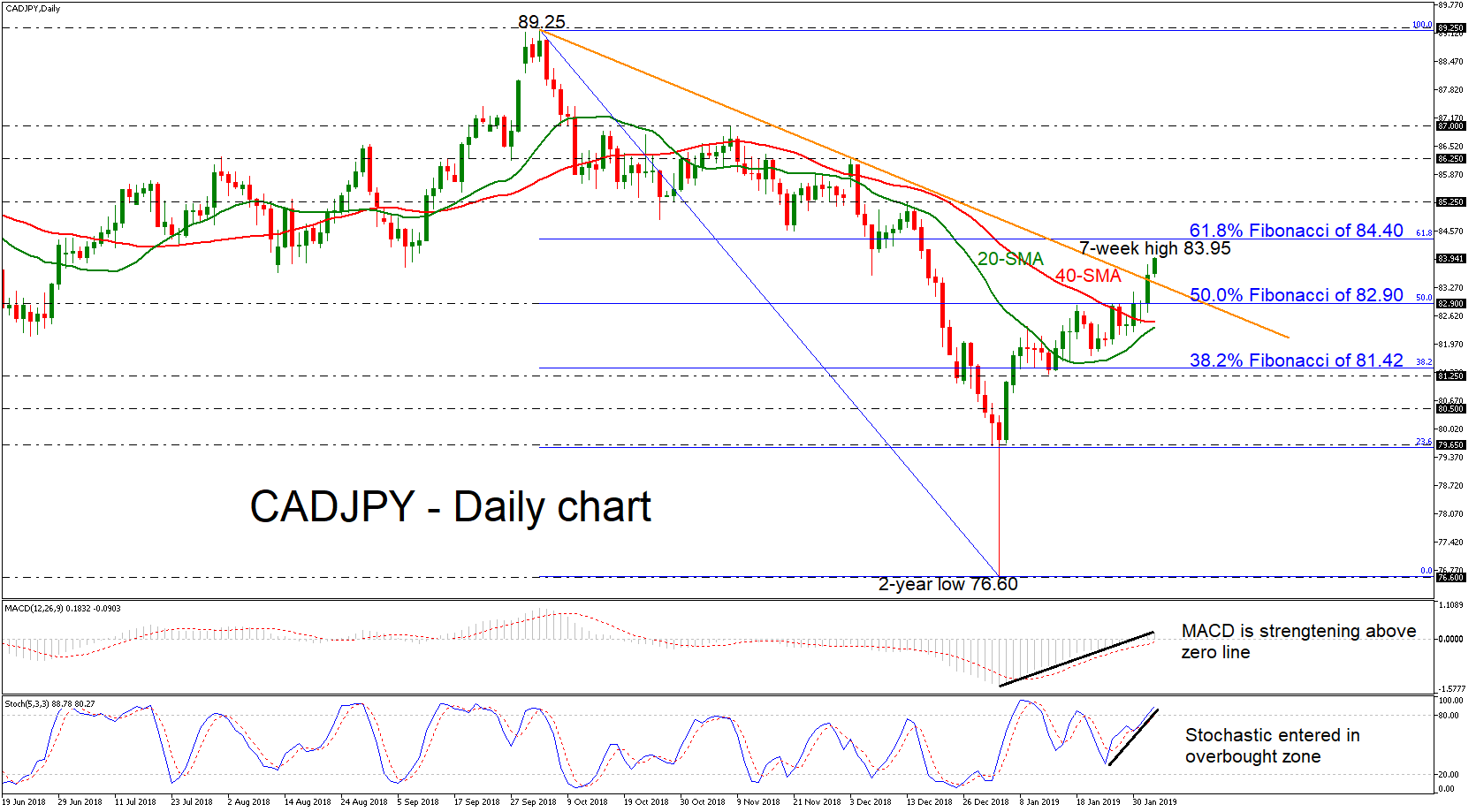
CADJPY is extending its gains, recording a seven-week high of 83.95 earlier today and is set to complete the fourth straight green day. Also, the price surpassed the 20- and 40-simple moving averages (SMAs) which are on course to post a bullish crossover in the next daily sessions. The MACD is strengthening its bullish momentum, entering the positive area, while the stochastic continue its rise in overbought territory in the near term.
Should the price extend advances, the 61.8% Fibonacci retracement level of the downleg from 89.25 to 76.60 around 84.40 could be the immediate resistance for investors to look for. A climb above this significant level could turn the bias to a more bullish one and the market could head towards the 85.25 resistance, taken from the peak on December 13. If the latter permits for further upside rally the next stop could be around 86.25, registered on December 3.
On the other hand, a downside retracement could retest the 50.0% Fibonacci of 82.90, before challenging the SMAs, currently around 82.40. Moving lower, the 38.2% Fibonacci of 81.42 and the 81.25 support could attract attention.
Overall, CADJPY holds a slightly bullish profile in the short-term as it also surged above the medium-term descending trend line, which has been holding since October 2018.
Canadian Dollar at 3-Month High after Strong Week Gains
USD/CAD has posted small gains in the Monday session. Currently, the pair is trading at 1.3116, up 0.11% on the day. In economic news, it’s a quiet start to the week, with no Canadian releases until Wednesday. The U.S. releases factory orders, which is expected to rebound with a gain of 0.3%, after a decline of 2.1% in the previous release. On Tuesday, the key event is ISM Non-manufacturing PMI.
The Canadian dollar enjoyed a strong week, posting gains of close to 1.0%. USD/CAD slipped on Wednesday as the Federal Reserve reinforced its dovish stance. At its first monetary policy update of 2019, Federal chair Powell said that the central bank would be “patient” regarding future rate hikes. It was an aggressive 2018 for the Fed, which raised rates four times last year, in response to a hot U.S. economy. However, with a global trade war in full force and U.S. growth slightly lower, the Fed has trimmed its forecast to two interest rates in 2019. Many analysts have gone further, predicting no rate hikes this year.
In the U.S., the week ended with mixed employment numbers. The economy created 304 thousand jobs, crushing the estimate of 165 thousand. This was the second score above the 300-thousand mark for a second successive month. However, wage growth was a disappointment, dropping from 0.4% to 0.1%. This fell shy of the estimate of 0.3% and marked the weakest reading since April 2018. Despite the sparkling non-farm payrolls, USD/CAD edged lower on Friday, as greenback bulls focused on the weak wage growth numbers.
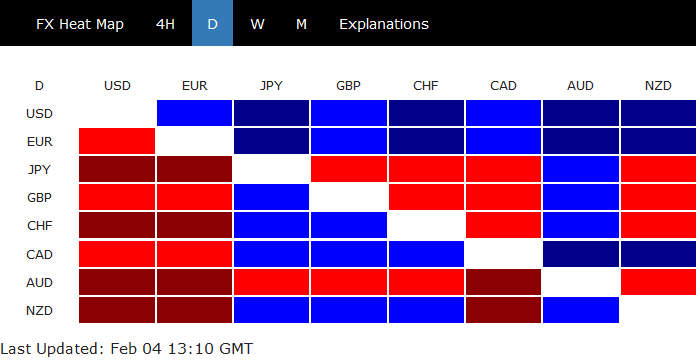
Into US session: Dollar strongest as recovery continues, Euro shrugs weak data
Entering into US session, Dollar remains the strongest one for today as recovery continues. The second place is taken up by Euro, despite weak Sentix Investor Confidence and PPI. Canadian Dollar also remains firm as WTI crude oil edges higher to 55.85. Nevertheless, oil price is suffering some profit taking currently, which oil drags down the Loonie.
Meanwhile, Australian Dollar is the weakest one for today, weighed down by poor housing data. Focus will turn to tomorrow's RBA rate decision. No change in interest rate is expected. But RBA could give some hints on revisions on economic projections. Details will be published with the Statement on Monetary Policy on Friday. Yen is following as the second weakest, then Sterling.
In European markets:
- FTSE is up 0.28%.
- DAX is down -0.16%.
- CAC is down -0.53%.
- German 10-year yield is down -0.001 at 0.166, staying far below 0.2 handle.
Earlier in Asia:
- Nikkei rose 0.46%.
- Hong Kong HSI rose 0.21%.
- China started lunar new year holiday already.
- Singapore Strati Times dropped -0.13%.
- Japan 10-year JGB yield rose 0.008 to -0.012, staying negative.
DAX Under Pressure as Bank, Auto Shares Slide
The DAX index has edged lower in the Monday session. Currently, the index is at 11,151, down 0.27% on the day. It’s a slow start to the week, with no major events. Eurozone Sentix Investor Confidence posted a third successive decline, with a score of -3.7 points. On the inflation front, PPI disappointed with a decline of 0.8%, its weakest reading since January 2016. On Tuesday, Germany and the eurozone release services PMIs. The eurozone will also publish retail sales.
German numbers continue to sag, raising concerns about the health of the eurozone economy. On Friday, German manufacturing PMI for January dipped to 49.7, below the 50-point level which separates contraction and expansion. This was the weakest score since October 2014. Trade tensions and weakness in the German auto sector continue to weigh on the manufacturing sector. This reading followed a very soft reading from German retail sales, which plunged 4.3% in December. This marked its sharpest decline in more than 12 years.
Weak German numbers are weighing on the DAX in the Monday session as bank and automaker shares are down sharply. BMW, Daimler and Volkswagen have all declined by over 1.0%, and Deutsche Bank has fallen by 1.4%. Lufthansa has dropped by 0.81%, after low-cost carrier Ryanair posted losses in the fourth quarter.
In the U.S., key employment numbers were a mix on Friday. The economy created 304 thousand jobs, crushing the estimate of 165 thousand. This was the second score above the 300-thousand mark for a second successive month. However, wage growth was a disappointment, dropping from 0.4% to 0.1%. This fell shy of the estimate of 0.3% and marked the weakest reading since April 2018. Earlier in the week, the Fed continued its dovish message in its first monetary policy update of 2019. Fed chair Powell reinforced the sentiment that the Fed will ease up on rate policy, saying the central bank would be “patient” regarding future rate hikes.
GBPUSD Testing Trendline Support
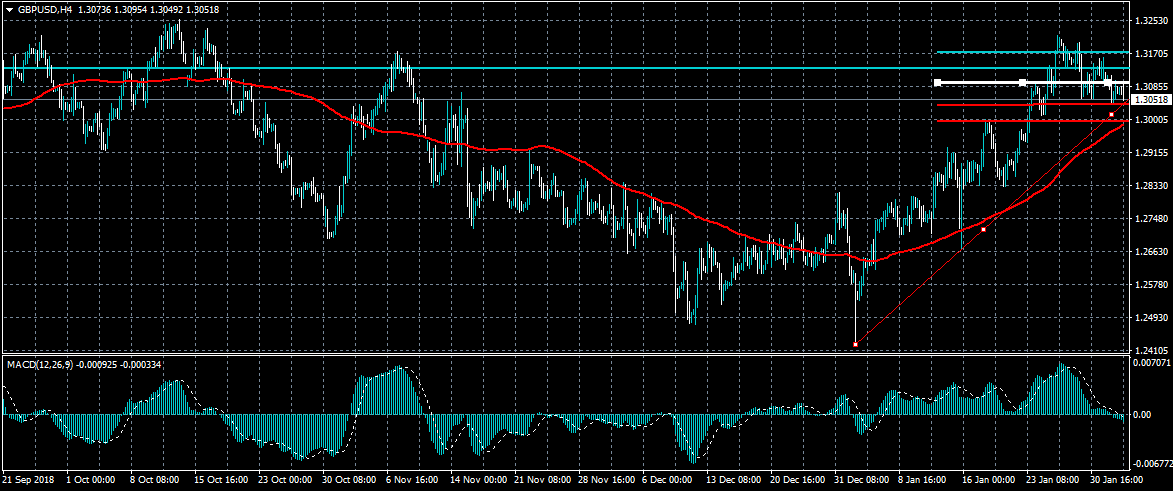
The British pound has moved sharply lower against the US dollar after the United Kingdom Construction PMI came in much weaker than expected for the month of January. The GBPUSD pair is now testing key trendline support, while technical indicators are also starting to turn down across the lower time frames. A sustained break below the key trendline exposes further losses towards the 1.3000 support level.
The GBPUSD pair is bearish while trading below the 1.3050 level, key technical support is found at the 1.3000 and 1.2970 levels
If the GBPUSD pair trades above the 1.3090 level, key resistance remains at the 1.3130 and 1.3170 levels.
USDJPY 110.00 Level Now Key Resistance
The US dollar has recovered sharply higher against the Japanese yen currency after the better than expected US Nonfarm payrolls jobs report boosted the greenback. The USDJPY pair is now approaching the 110.00 level, with a bullish break above this key area exposing further upside towards the 110.70 level. The recent move higher has now invalidated the bearish head and shoulders pattern that was previously seen on the lower time frames.
The USDJPY pair is bullish while trading above the 109.14 level, key technical resistance is found at the 110.00 and 110.70 levels.
If the USDJPY pair moves below the 109.14 level, sellers may test towards the 108.80 and 108.50 levels.